tire pressure VOLKSWAGEN GOLF 2004 User Guide
[x] Cancel search | Manufacturer: VOLKSWAGEN, Model Year: 2004, Model line: GOLF, Model: VOLKSWAGEN GOLF 2004Pages: 444, PDF Size: 92.7 MB
Page 41 of 444
Engine: oil and oil filter
Engine: for leaks
Exhaust system: fo r damage and leaks
Water separator: Drain water (TDI e ngi ne only)
Fuel
electrolyte level
Battery: (Golf, )etta, New
Door check straps: Lubricate
s ystem:
Windshield washer:
Automatic sh ift lock:
Automatic transmiss ion:
Manual transmiss ion:
Wheels:
Tires/spare wheel :
Date: .................. ... ...
Miles/km: .................. .
which ev
er occurs first
Brake system: for damage/leaks, brak e pad thickness and brake fluid
Drive shafts: boots
On-Board diagnos tic system: fault
memory; purge if nece ssary
Roof frame: and lubricate
Front axle: jo int s and tie rod ends; ch eck tie rods
Hea dligh ts : Adjust
Rear sp oile r: Lub ricate (New Beetle only)
Airbag system: Visual check every 12 months regardless of mileage (kilom eters)
Road test: kickdown , braking, steering, heating and ventilation , air conditioning, powe r accessories and electrical systems
Timing belt: Replace (TDI engine only)
starter and auxiliary banery: check
( w here applicable)
T ires: tread dept h, adjust tire pressure
if nec essary _
Tire pressure monitoring system sen sors: battery charge, replace wheel electronics and aluminum valve if necessary (whe re appli
cable) .
date and Volkswagen Dealer stamp
Page 91 of 444
driver.
For your safety and the safety of your pas
sengers, before driving always:
- Make sure
that all lights and signals are
operating corr ect ly.
- Make su re
that the tire pres sure is cor
r
ect.
- Make sure that all windows are clean
and afford good visibility to the outside .
- Secure all luggage and
other items care
page
re
stra int correctly to protect children
53.
- S it properly in your seat and make sure
that your passengers do the same
4.
- Fasten your safety belt and wear it prop
erly. Also instruct your passenge rs to
fasten their safety belts properly
Safe driving is directly related to the condition of the vehicle, the driver as well as
the driver' s ability to concentra te on the road without being distracted.
The driver is responsible for the safety of
the vehi cle and all of its occupants. If your
ability to drive is impa ir ed, safety risks for
everybody in
the vehicle in crease and you
a lso becom e a hazard to everyo ne else
on
the There fo re:
- Never let yourse lf be di stracted by pas
sengers
or by using the Infotainm ent
syste m or a cellular tel ephone.
- Never drive w
hen your driving ability is
impa ired (by medication s, alco hol,
drugs,
etc.) .
- Observe a
ll traffic laws, rules of th e road
and speed limit s and plain common sense. -
Alway s
adjust you r speed to road, traffic
a
nd weathe r conditions.
- Take frequen t breaks on long trip
s.
Don't drive for more than two hours at a
s tretch.
-
Do n ot drive when you are tir ed, unde r
pressure
or when you are stresse d.
WARNING
Impaired driving safety increases the risk of serious personal injury and death whenever a
vehicle is being used
Page 279 of 444
on. the bra ke sys tem warning symbol or
If a malfunction occurs in the ABS. the warning light light up togethe r the brake o r
39. T he e ngin e com partment of any motor ve hicle is po te ntiall y dangerou s area and can cause serious personal injury.
Dri vin g w ith ba d brakes can cause a c olli sion and serio us person al injury.
does n ot go out, or if it lights up w hen driving the brake fluid level in the reservoir is too lo w or there is a f ault in the brake syste m .lmmedi-
Brake Assist System (BAS)
In an emergency, most drive rs brake in time, but not p in g dista nces that are longer than they have to be!
T he
brake assis t sys te m helps: if yo u p ress the b rake pedal very quick ly , th e brake assist sys te m
regi sters an emergency situation.
can be activated more quickly and ciently, reducing th e brakin g distance while ting you steer at the sam e tim e.
Do no t reduce th e pressure on the brake pedal.
T he bra ke switches off cally as soon as you re lease th e bra ke. The brake assist system work s onl y w hen the engi ne is
nin g.
A lways adjust yo ur speed and driving sty le to road , weather condit io ns.
{continued)
a te ly s to p dri ving a nd ta nce=> page 53.
symbol BRA KE or lights up a t the same ti m e as th eABS warning light the may not be working pro perl y and th e rear w heels could lock up first under
hard braki ng. Rear wheel brake lock-up can cause loss o f vehicl e control. If yo u believe tha t it is safe to do so, go imm ediately a t low speed to the nearest autho rized V olkswagen
dealer o r
w arning light does no t go o ut, or if it comes on w hil e driving, the
your autho rized
V o lkswagen deale r o r qualifi ed wo rkshop as soon as possible.
(continuod)
Neve r let the ex tra safety offered b y the
B rake Ass is t
The Brake Assis t Syst em canno t reduce the
risk o f a n acci dent, fo r example i f yo u drive too fast fo r conditions or if yo u d o not keep your distance from the vehicl e in front of yo u.
S li ppery and we t roads a re dangerous even with the Brake Ass ist Sys te m!
Always re m ember tha t vehi cle alterations
o r m odificati ons can affect the functio n oft h e syste m s. Exa mples of
these alteration s or modifica tions include a different w heel/tire com bination and brake or chassis m odificati on s=> page 32, "Repairs a nd
t echnical m odifica tion s".
the vehicle su sp en sion or u sing unapproved tire I rim combinati on can ch an ge the way the
Smart
Page 280 of 444
The Anti-Lock Brake System prevents the wheels from locking up when the brakes
are applied.
The is an
works only when the engin e is running.
How the ABS works
I f
one w hee l beg ins to turn too slow ly in relat ion to vehicle spee d and tends to lock up, the automati cally redu ces brak e pressure to pre vent
that w heel from lock ing up. When is doing its job you will notic e a slight vib ration through the brake ped a l a nd hear a noise to le t you know
that your speed must be adjusted to road, traffic and weather co ndition s. Thi s is a warni ng that one or more of th e whee ls is about to lock up and
that th e control function has intervened. In
thi s situati on it is important to keep th e br ake
peda l full y depressed so th e the
b rake ped al-cannot do its job if yo u do .
helps you to keep the vehicle under control
because it pr eve nts th e w hee ls from locking up w hen the brake s are a ppli ed. Thi s m ea ns th e hicle can still be s teered and is less likely to skid.
Th e
cannot necessarily shorte r
braking dis tances in con dition s. The brakin g
di stance ca n eve n be longer if you brake on gravel or on fres h snow c overing a slippery face.
If
i s not fun ctioning properly, a warning
light will co me pag e 5.
4 Smart technol .ogy
Always adjust your speed and driving style to
road, tra ffic and weather co nditions. Never let the ex tr a sa fety that
Alwa ys drive safely.
cannot change the laws of physics.
S lipp ery and wet roads are dangerous even
withABS!
cannot reduc e the risk of accidents,
for example if you drive too fast for the tions or if you do not keep your distance from the veh icle in front of you.
Always remember that vehicle alteration s or modifications can affect the function oft he
page 32, and te chnical modifications".
Changing the vehicle suspension or using unapproved tire
systems work and reduce their effectiveness.
The effec tive ness of is also determined
b y the tir es on your pag e 57 ,
Page 288 of 444
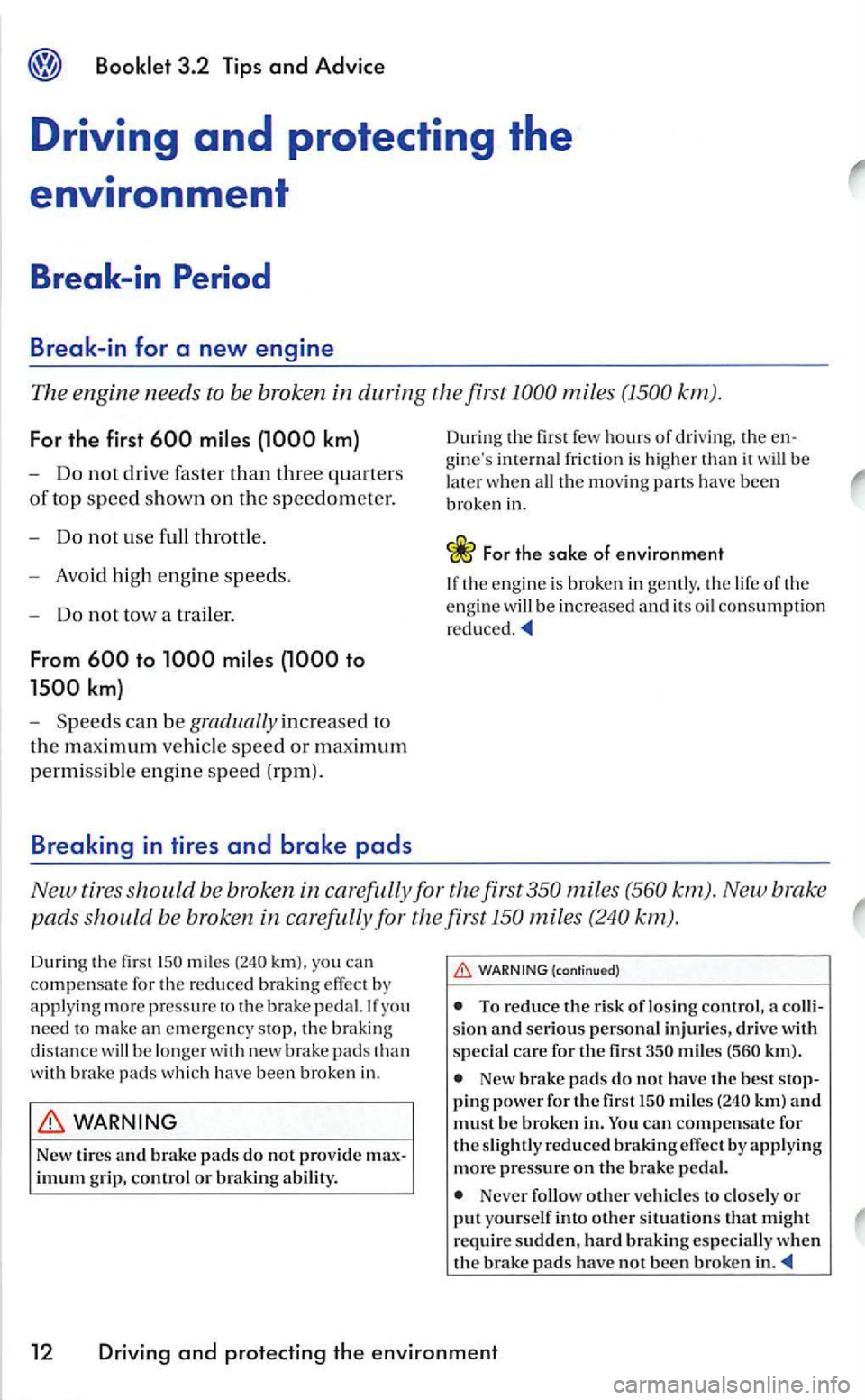
miles
can b e gradually in creased to
th e maximum vehicl e s
peed or maximum
permissibl e engin e speed (rpm ).
Breaking in tires and brake pads
Durin g the fir st few h o u rs of dri ving, the g ine 's inte rnal fric tion is hi gher than it will be
l a te r w he n a ll th e m ovin g part s have been bro ke n in.
For the sake of environment
th e eng in e is bro ke n in gentl y, the lif e of the engine will be in creased and it s oil co nsumption
New tires should be broken in carefull y for the fir st miles (560 km). New brake
pads b e broken in carefu lly for the first miles (240 km).
Durin g th e fir st miles km l. you can
c ompe nsate for the reduced brak ing effect by apply in g m ore press ure th e brake pedal.l fyo u
need to make a n em ergency slOp, the brak ing
di sta nce will b e longe r w ith new brake pads than
wit h brake pads wh ic h have been b roke n in.
WARNING
New tires and brake pads do not provide imum gri p, control o r braking
(cont;n ued)
To reduce the ri sk of losing a
miles
New brake pads do not have th e best pin g power for the fir st km) and must be broken in. can compe nsate for the s lightly reduced braking effect b y applying more pressure on the brake pedal.
N eve r follow other vehicles to clos ely or put yours elf into other situati on s that might require sudden, h a rd braking especially when the brake pads have not been broke n in.
12 Driving and protecting the environment
Page 289 of 444
Booklet 3 .2 Tips and Advic e
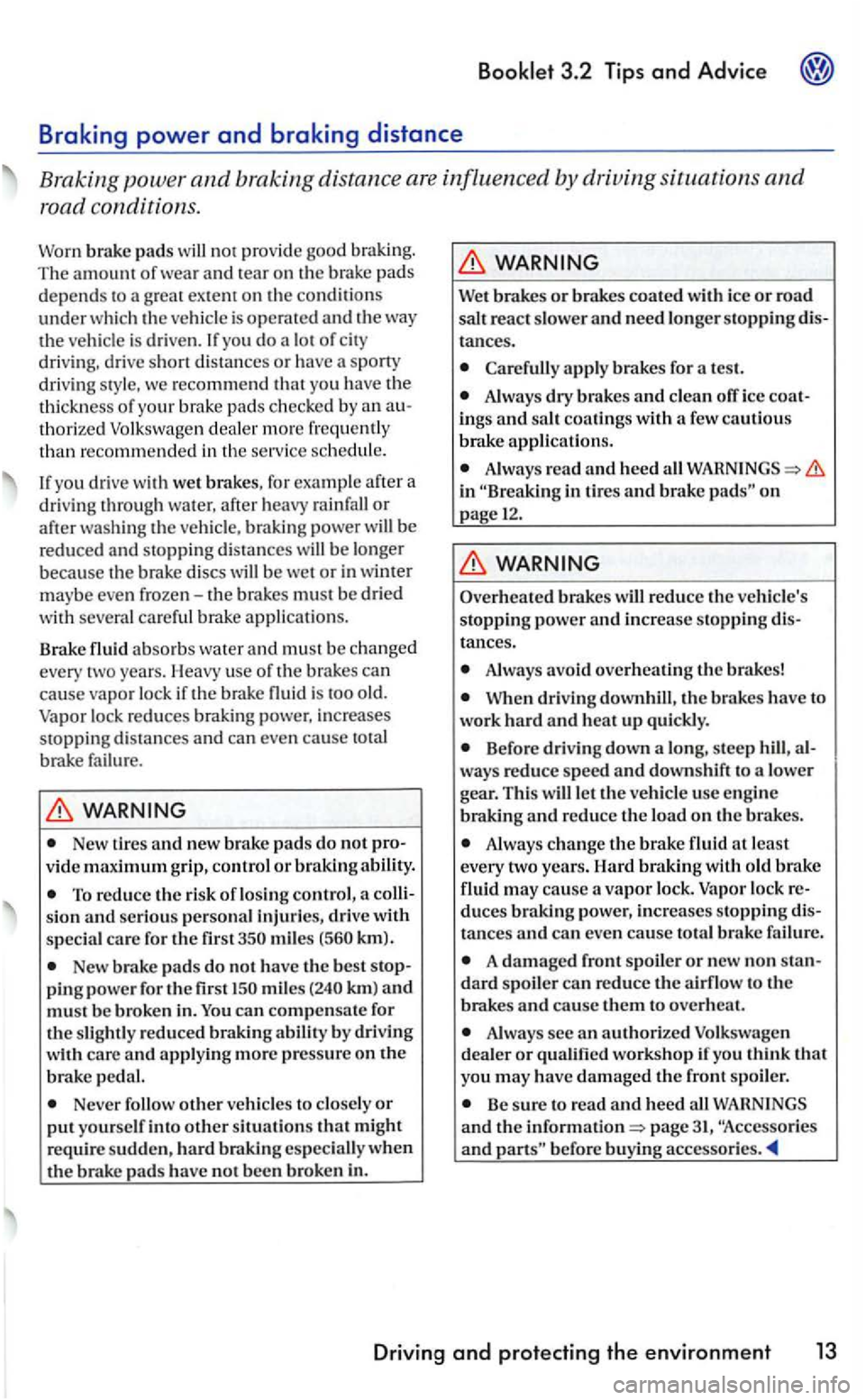
recommend that you have the
thi ckne ss of your brake pads checked by an au
t horized Vol kswagen dealer mo re fre quent ly
t h an recommende d in the serv ice sched ule.
you drive with wet brakes, for example afte r a
dri ving through water, after heavy rainfall or after washing the ve hicle, braking power be
reduced and s to ppin g distances will be longer
because the brake discs will be we t or in winter mayb e eve n frozen-the brakes must be dried
with several ca re ful brak e applicatio ns.
Brak e fluid absor bs water
and must be changed
every two years. Heavy use of the brakes can cause vapor lock if the brake fluid is too old.
Vapor lock redu ces braking power, increases
stopping distances and ca n even cause total
brake failure.
New tires and new bra ke pads do no t pro
v id e m aximum gri p, control o r b raking abil ity.
To red uce the risk of l osi ng control, a s io n an d se rio us perso nal injuries, drive with
specia l ca re for the first 350 miles (560 km).
New brake pads do not have th e best sto p
ping power for the fir st ISO mile s (240 km ) and
m ust be b roken in. can compensate for the slightly reduced braki ng abil ity by dri ving care and applyin g more pressure on th e
brake pedal.
Never follow oth e r veh icles to close ly or
p u t you rse lf in to other s ituations th at might
requ ire su d den , hard bra king especially when the brake pads have not been broken in.
apply brakes for a test.
Always dry brakes and clea n off icc coat
i ngs an d salt coatings with a few cautious brake applications.
A lways read and heed in in tire s and brake on page 12.
Always avoid overheati ng the brakes!
When driving downhill, t11 e brakes have to
work har d and h eat up quickly.
Before driving down a lo ng, steep hill, al
ways reduce speed and downshift to a lower
gear. This will let the vehicle usc engine
Always ch ange th e brake fluid at l east
every two years. Hard braki ng wi th o ld flui d may cause a va po r lock . Vapor loc k duces powe r, inc reases stoppin g di stan ces and can even cause tota l b rak e failure.
A damaged front spoiler or n ew non standard spoiler can reduce t h e airflow to th e
brakes and cause them to ove rh eat.
Always see an authorized Volkswag en
dealer or qualified workshop
Be sure to re ad and heed all and th e page
Driving and protecting the environm ent 13
Page 334 of 444
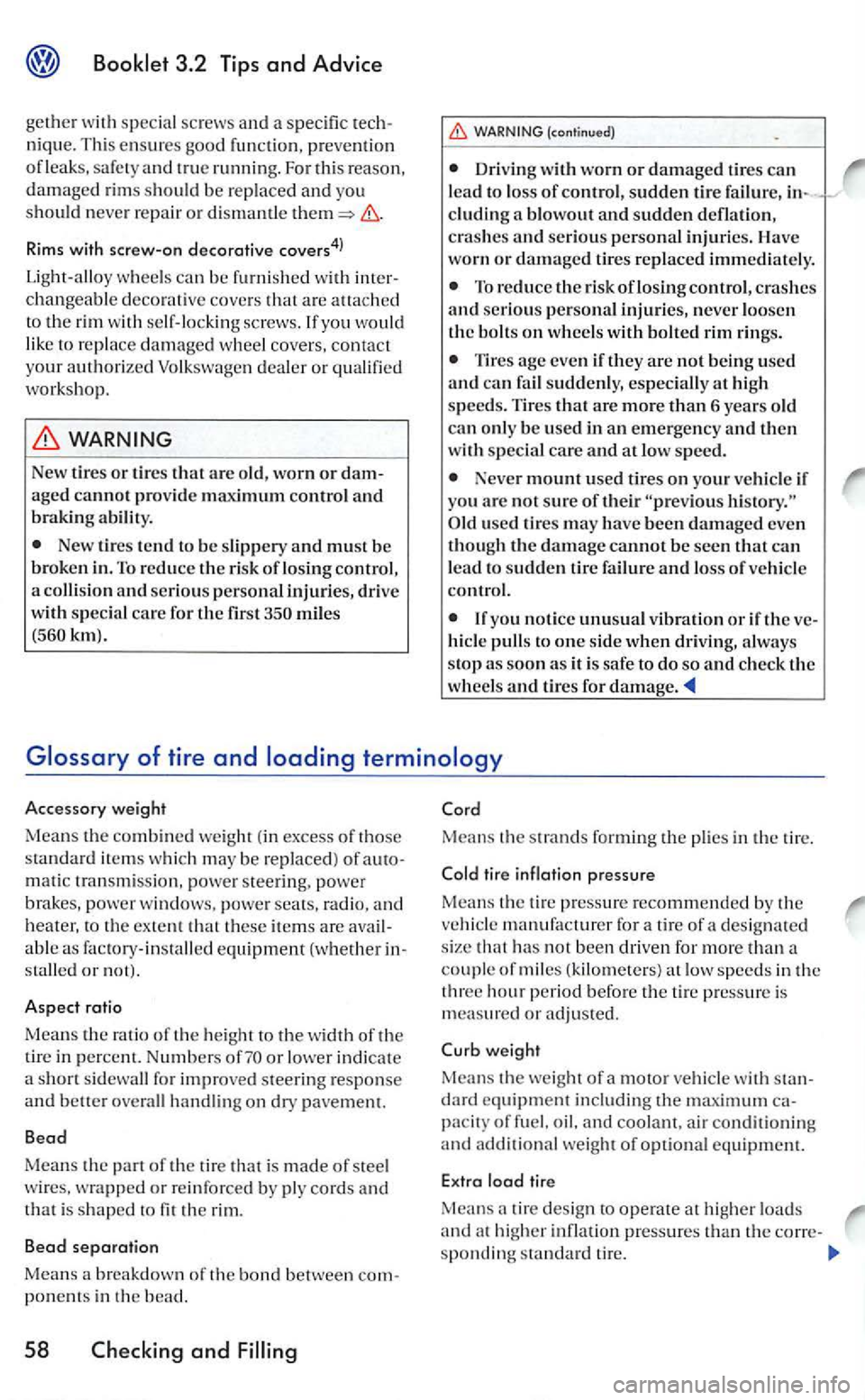
changea ble deco rat ive cove rs a re att ached to th e rim with s elf- locking sc rews . lfyou would ro re pla ce damaged wheel covers, contact your authorized Volkswa gen d eale r or
WARNING
New ti res or tires tha t are old, worn or aged cannot provide maximum control and braking ability.
New tires tend to be s lipp ery and must be broken in . To reduce the risk of losing co ntrol,
a co llisio n and serio us personal injuri es, drive with sp ecia l care for the first km).
(cont inued )
Driving with worn or damaged tire s can lead to lo ss of control, sudden tire failur e, cluding a blowou t and sudden deflation ,
c ras hes and seriou s personal injuries. Have wo rn or damaged tires rep laced imme di ate ly.
To redu ce the riskoflosingcontrol, crashes and s erio us personal injuries, never loose n
th e bolts on w heels with bolted rim rings.
more than 6 years old can onl y be used in an em erg en cy and then
w ith specia l care and at low speed.
Neve r m ount u se d tires on your ve hicle if
yo u are not sure of their used tires may have been damaged ev e n
t h oug h the damage cannot be seen th at can
lead to sudden tir e failure and loss of ve hicl e control.
hicl e pull s to one sid e when dri ving, always
s top as soo n as it is safe to do so and ch eck the
whee ls and tires for damage.
Accessory weight
Means the combined we ight ( in excess of those
sta ndard ite m s w hi ch may be repl aced) of mati c tran smission. power steering. po wer
bra kes, power windo ws. p owe r seats , radio, and heater, to th e ex te nt th at th ese item s are
or lowe r indica te
a short s id ewall for improved steering respo nse and better ove rall handling on dry pave ment.
Bead
Mean s the pa rt of the tire t hat is m ad e of stee l
wires , w rap ped or re inforce d by pl y cords and that is shap ed to fit t he rim.
Bead separation
Mean s a breakdow n of th e bond between
Means the strand s forming the in th e tire.
weight
Me ans th e weig ht of motor vehicl e w ith dard equ ipment including the m aximum pacity of fu el, oil. and coolant . a ir conditio nin g
a nd additional weight of opt io n al equipm ent.
E xtra load lire
M ea ns tire desi gn to operate at higher loads and at hi gher inflat ion pressure s th an th e corre -
s ponding sta ndard tire.
Page 335 of 444
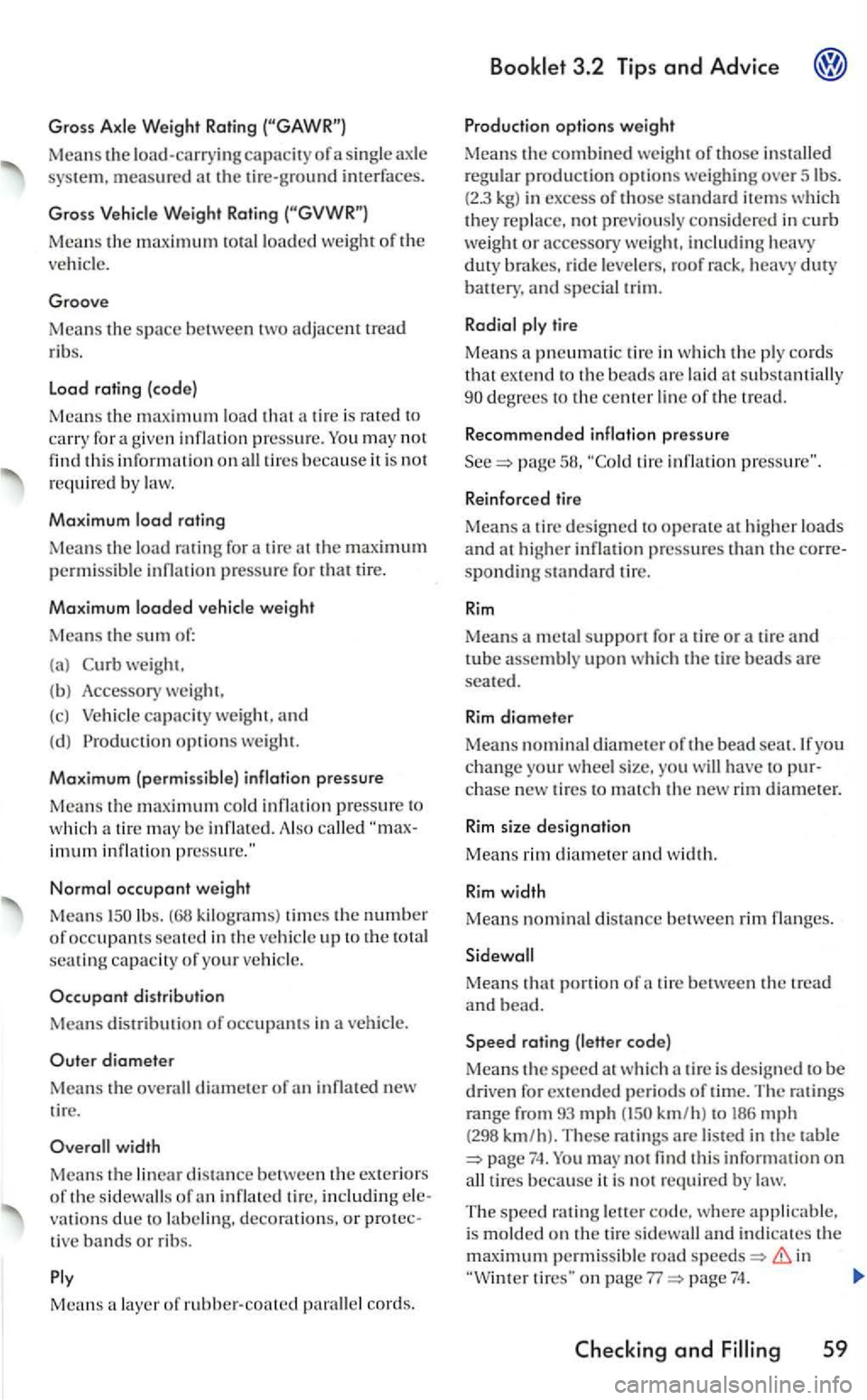
Gross Axle W eight Ra ting
Mea ns the load-carryin g capacity of a sing le ax le
Mean s th e maximumlOtalloaded weight of the
ve hicle.
Groove
Means the space between adjacent tread
r ib s.
L
oad ratin g (cod e)
Means the load th at a tire is rated to
carry for a give n inflation pressure. You may no t find thi s information o n all tires because it is not require d b y
Maximum load ratin g
Means the load rating for a tire the m aximum permiss ib le inflation p ressure for that tire.
Maximum loaded vehicle weig ht
Means th e sum of:
( a)
weig ht.
( b ) Accessory
weight,
(c) Vehicl e capacity weig ht. and
(d ) Production o pti ons
b e inflat ed. A lso called imum inflatio n pressure."
Normal oc cupant weight
Means lb s. kilog ra ms} times the n u m ber of occupants sea te d i n the ve hicl e up to the seating capacity of your vehicle.
O c
cupant distr ib ution
Means dist ributio n of occupants in veh icle.
Outer d iameter
Means the overall diameter of an inflated new tir e.
inflated including vations due to or tive bands or rib s.
P ly
M
ean s layer uf parallel cord s.
Productio n optio ns weight
Means the com bined weight of those installed
regular produc tion options weighing over Sibs. (2.3 kg) in excess of those standard items whic h they replace, not previously considered in curb weight or accessory
pne u matic tire in which the pl y cords th at ex tend to the beads a rc laid at substa n tially degrees to the center lin e of the tread.
Re commended inflat io n p ressure
page tire inflation p ressure".
Reinforc
ed tir e
Means a tire designed to operate at higher loads and at higher inflation pressures than the sponding tire.
Rim
Means a m etal support for a tire or a tire and tube assembly upon whic h the tire beads are seate d .
Rim d iameter
Means nominal diameter oft he bead seal. you change your w heel size. you will have to
Means that portion of tire between the tread
and bead.
which
km/h) mph ( 298 k.m/ h ). These rat ings are lis ted in the table 74. You may not find this information on all tire s because it is not required by law.
The speed r ating lett er cod e, where is molded on the tir e s idewall and indicates the maxjmurn permissible road in on page 77 74.
Checking and
Page 336 of 444
3.2 Tip s and Advice
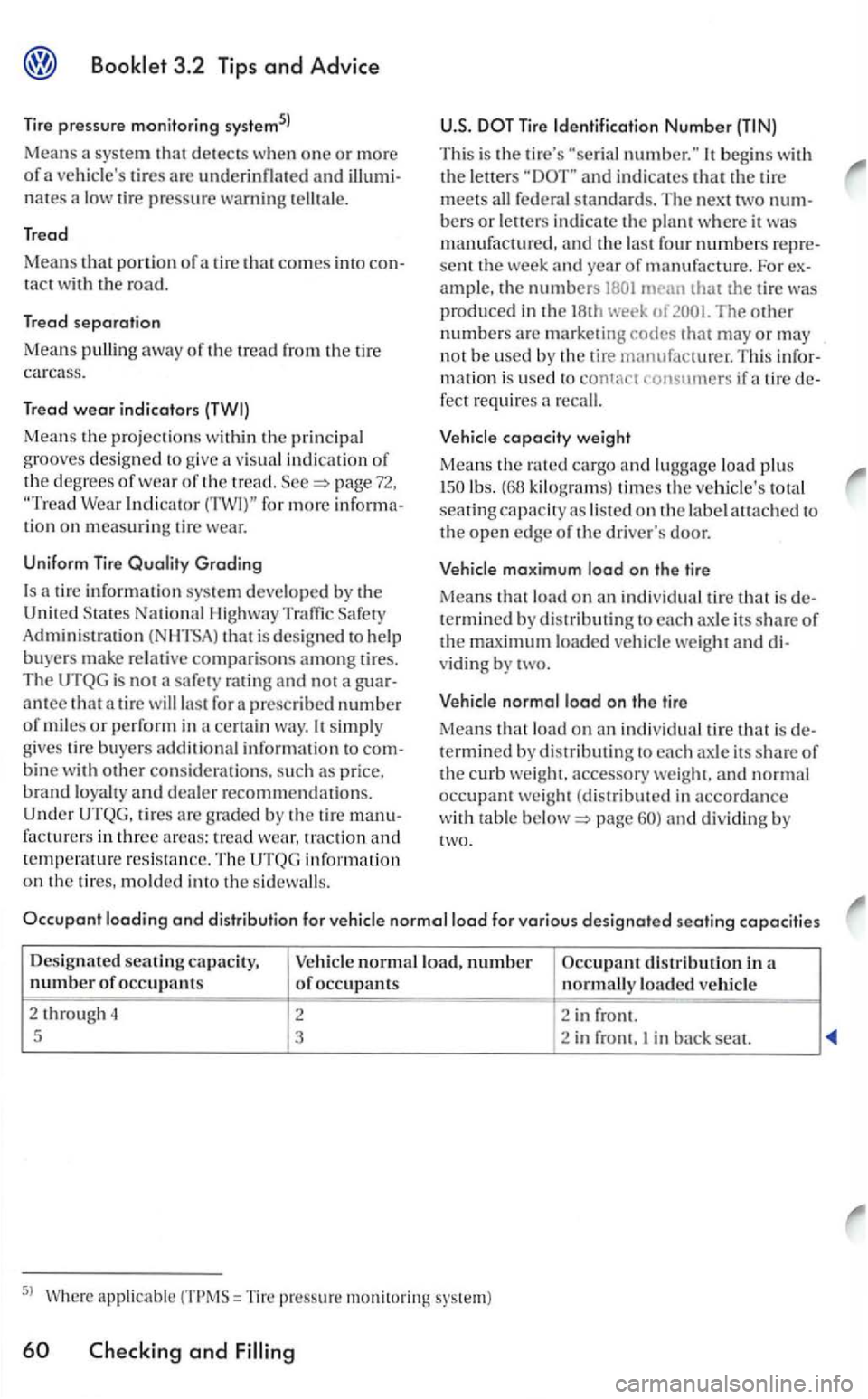
Tir e pressure monitoring
tires are underinflated a nd nates a low tire pressure warning tellt ale.
Tread
Means that porti on of tire that comes into tact the road.
Tread separation
Means pulling away of the tread from the tire carcass.
Tread wea r indicators
visual indication of the degrees o f w ear of th e tread. page 72,
Wea r for more tio n on measurin g tire wear.
Un iform
Tire Quality Grading
that is designed to help buyers make re la ti ve comparisons among ti res. The UTQG is not s afety rating and not a
antee that a tire la st for a prescrib ed number of miles o r perform in simply
g ives tire buyers additional information to bin e w ith other consideratio ns. such as price. brand loya lty and dealer recommendations. Under UTQG, tires arc graded b y th e tire fac turers in three areas: tre ad wear, traction and temperature resistance. The UTQ G information o n the tires, molded into the s idewall s.
This is the tire's "ser ia l begin s w ith the letters
sent week and year of manufacture. For ample . the rnran that the tire
pro duced in the 18th The other numbers arc m arketin g codes that no t be used by th e tire manufacturer. T his mation is used to if a tir e fect requires a recall .
Vehicle
capacity weight
Means the cargo and load plu s lb s. (68 kilograms) times the total
s
eatin g capacity as lis ted on the label attached to the ope n edge o f the driver's door.
Vehicle
maximum load on the tire
Mean s that load o n an indi vidual tire that is t ermined b y di stri buting to each axle its share of the maxim um loaded weight and viding by
normollood on th e tir e
Means that load o n an indiv idual tire that i s termined by di stribut ing to axle its sh a re of the curb weigh t. accesso ry weight. and normal occupant weight (di stributed in accordance with table page and di viding by
Occupant loading and distribution for vehicle normal load
normal load, number Occupant distributio n in number of occupants of occupants normally loaded
2 through 4
2 2 in fro nt.
5
3 2 in front. I in
=Tire pres sure
Checking and
Page 337 of 444
3.2 Tips and Advice
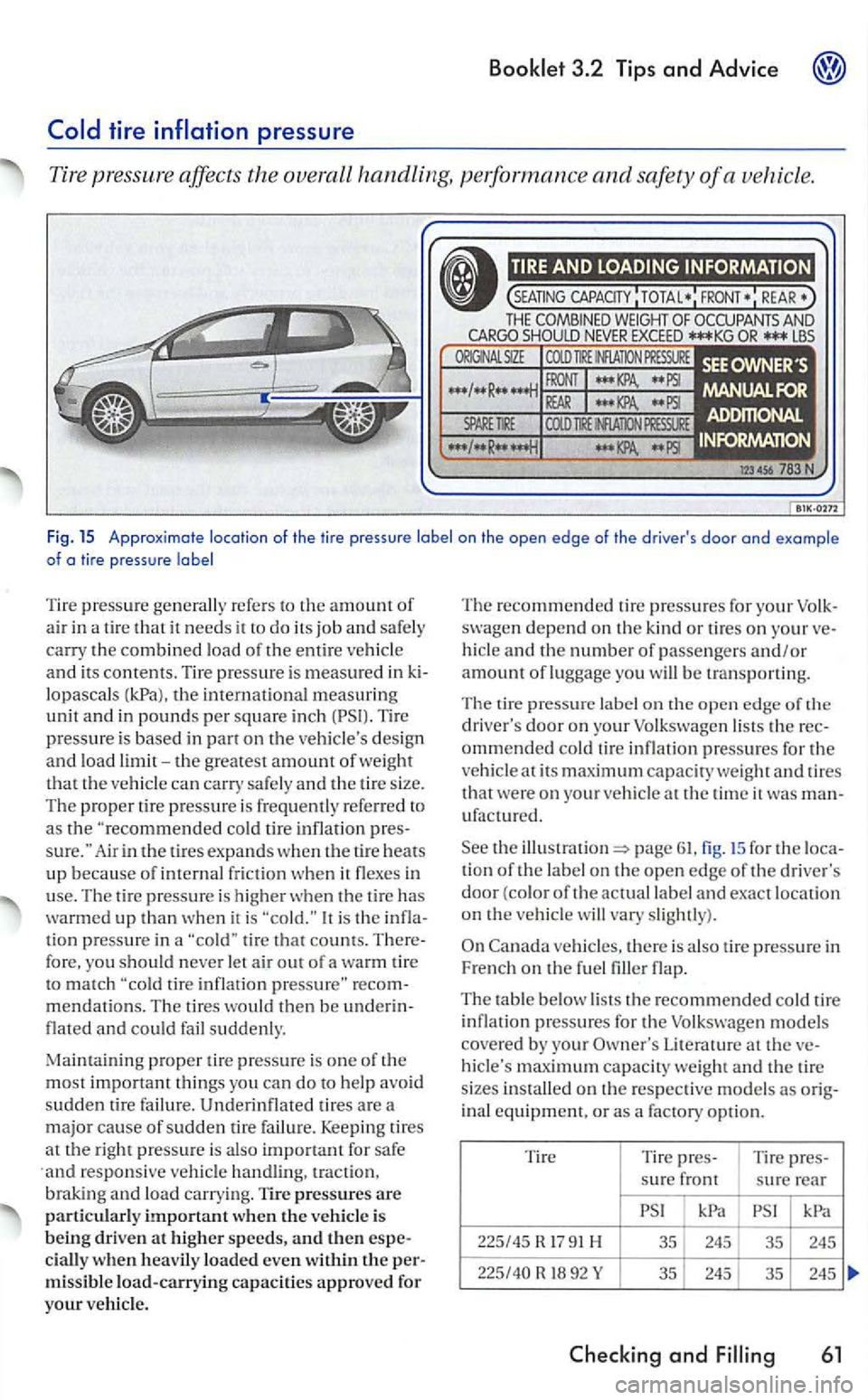
refers to the amount of air in a tire that it needs it to do its job and safe ly carry the combined load of the entire
on the d esign and load limit-the greatest amount of we ight that the can carry safel y and the tire size.
Th e proper lire pressure is frequently re ferred to a s the "recommended co ld tire inflation
It is the tion pre ssure in a tire that counts .
respo nsiv e
is being driven at higher speed s, and th e n cially w hen heavily loaded even within the missible load-carrying capacit ies approved for your vehicl e. T
he r
ecommended tire pressures for your d epend on the kind or tires on your h icl e and the number of passengers and/or amount ofluggage you will be t ransporting.
Th e tire
pressure label on the open ed ge of th e
driver's door on your Volk swagen lists the ommended co ld tir e infl ation pressures for the
at th e tim e it was ufactured.
page fig. 15 for the tion of the label on the open edge of the driver's door (colo r of the actual label and exact locat ion on the
flap.
The table below lists the recommended cold tire
i nflatio n pressures for the models covered by your maximum capacit y we igh t and th e tire
sizes on t h e res pective models as inal equipment, or as a factory opti on.
T ir e Tire
pres-Tire pres-
s ur e front sure rear
kPa
17 91 35 245 35 245
6
1