tires VOLKSWAGEN GOLF 2004 Owner's Manual
[x] Cancel search | Manufacturer: VOLKSWAGEN, Model Year: 2004, Model line: GOLF, Model: VOLKSWAGEN GOLF 2004Pages: 444, PDF Size: 92.7 MB
Page 334 of 444
changea ble deco rat ive cove rs a re att ached to th e rim with s elf- locking sc rews . lfyou would ro re pla ce damaged wheel covers, contact your authorized Volkswa gen d eale r or
WARNING
New ti res or tires tha t are old, worn or aged cannot provide maximum control and braking ability.
New tires tend to be s lipp ery and must be broken in . To reduce the risk of losing co ntrol,
a co llisio n and serio us personal injuri es, drive with sp ecia l care for the first km).
(cont inued )
Driving with worn or damaged tire s can lead to lo ss of control, sudden tire failur e, cluding a blowou t and sudden deflation ,
c ras hes and seriou s personal injuries. Have wo rn or damaged tires rep laced imme di ate ly.
To redu ce the riskoflosingcontrol, crashes and s erio us personal injuries, never loose n
th e bolts on w heels with bolted rim rings.
more than 6 years old can onl y be used in an em erg en cy and then
w ith specia l care and at low speed.
Neve r m ount u se d tires on your ve hicle if
yo u are not sure of their used tires may have been damaged ev e n
t h oug h the damage cannot be seen th at can
lead to sudden tir e failure and loss of ve hicl e control.
hicl e pull s to one sid e when dri ving, always
s top as soo n as it is safe to do so and ch eck the
whee ls and tires for damage.
Accessory weight
Means the combined we ight ( in excess of those
sta ndard ite m s w hi ch may be repl aced) of mati c tran smission. power steering. po wer
bra kes, power windo ws. p owe r seats , radio, and heater, to th e ex te nt th at th ese item s are
or lowe r indica te
a short s id ewall for improved steering respo nse and better ove rall handling on dry pave ment.
Bead
Mean s the pa rt of the tire t hat is m ad e of stee l
wires , w rap ped or re inforce d by pl y cords and that is shap ed to fit t he rim.
Bead separation
Mean s a breakdow n of th e bond between
Means the strand s forming the in th e tire.
weight
Me ans th e weig ht of motor vehicl e w ith dard equ ipment including the m aximum pacity of fu el, oil. and coolant . a ir conditio nin g
a nd additional weight of opt io n al equipm ent.
E xtra load lire
M ea ns tire desi gn to operate at higher loads and at hi gher inflat ion pressure s th an th e corre -
s ponding sta ndard tire.
Page 335 of 444
Gross Axle W eight Ra ting
Mea ns the load-carryin g capacity of a sing le ax le
Mean s th e maximumlOtalloaded weight of the
ve hicle.
Groove
Means the space between adjacent tread
r ib s.
L
oad ratin g (cod e)
Means the load th at a tire is rated to
carry for a give n inflation pressure. You may no t find thi s information o n all tires because it is not require d b y
Maximum load ratin g
Means the load rating for a tire the m aximum permiss ib le inflation p ressure for that tire.
Maximum loaded vehicle weig ht
Means th e sum of:
( a)
weig ht.
( b ) Accessory
weight,
(c) Vehicl e capacity weig ht. and
(d ) Production o pti ons
b e inflat ed. A lso called imum inflatio n pressure."
Normal oc cupant weight
Means lb s. kilog ra ms} times the n u m ber of occupants sea te d i n the ve hicl e up to the seating capacity of your vehicle.
O c
cupant distr ib ution
Means dist ributio n of occupants in veh icle.
Outer d iameter
Means the overall diameter of an inflated new tir e.
inflated including vations due to or tive bands or rib s.
P ly
M
ean s layer uf parallel cord s.
Productio n optio ns weight
Means the com bined weight of those installed
regular produc tion options weighing over Sibs. (2.3 kg) in excess of those standard items whic h they replace, not previously considered in curb weight or accessory
pne u matic tire in which the pl y cords th at ex tend to the beads a rc laid at substa n tially degrees to the center lin e of the tread.
Re commended inflat io n p ressure
page tire inflation p ressure".
Reinforc
ed tir e
Means a tire designed to operate at higher loads and at higher inflation pressures than the sponding tire.
Rim
Means a m etal support for a tire or a tire and tube assembly upon whic h the tire beads are seate d .
Rim d iameter
Means nominal diameter oft he bead seal. you change your w heel size. you will have to
Means that portion of tire between the tread
and bead.
which
km/h) mph ( 298 k.m/ h ). These rat ings are lis ted in the table 74. You may not find this information on all tire s because it is not required by law.
The speed r ating lett er cod e, where is molded on the tir e s idewall and indicates the maxjmurn permissible road in on page 77 74.
Checking and
Page 336 of 444
3.2 Tip s and Advice
Tir e pressure monitoring
tires are underinflated a nd nates a low tire pressure warning tellt ale.
Tread
Means that porti on of tire that comes into tact the road.
Tread separation
Means pulling away of the tread from the tire carcass.
Tread wea r indicators
visual indication of the degrees o f w ear of th e tread. page 72,
Wea r for more tio n on measurin g tire wear.
Un iform
Tire Quality Grading
that is designed to help buyers make re la ti ve comparisons among ti res. The UTQG is not s afety rating and not a
antee that a tire la st for a prescrib ed number of miles o r perform in simply
g ives tire buyers additional information to bin e w ith other consideratio ns. such as price. brand loya lty and dealer recommendations. Under UTQG, tires arc graded b y th e tire fac turers in three areas: tre ad wear, traction and temperature resistance. The UTQ G information o n the tires, molded into the s idewall s.
This is the tire's "ser ia l begin s w ith the letters
sent week and year of manufacture. For ample . the rnran that the tire
pro duced in the 18th The other numbers arc m arketin g codes that no t be used by th e tire manufacturer. T his mation is used to if a tir e fect requires a recall .
Vehicle
capacity weight
Means the cargo and load plu s lb s. (68 kilograms) times the total
s
eatin g capacity as lis ted on the label attached to the ope n edge o f the driver's door.
Vehicle
maximum load on the tire
Mean s that load o n an indi vidual tire that is t ermined b y di stri buting to each axle its share of the maxim um loaded weight and viding by
normollood on th e tir e
Means that load o n an indiv idual tire that i s termined by di stribut ing to axle its sh a re of the curb weigh t. accesso ry weight. and normal occupant weight (di stributed in accordance with table page and di viding by
Occupant loading and distribution for vehicle normal load
normal load, number Occupant distributio n in number of occupants of occupants normally loaded
2 through 4
2 2 in fro nt.
5
3 2 in front. I in
=Tire pres sure
Checking and
Page 337 of 444
3.2 Tips and Advice
refers to the amount of air in a tire that it needs it to do its job and safe ly carry the combined load of the entire
on the d esign and load limit-the greatest amount of we ight that the can carry safel y and the tire size.
Th e proper lire pressure is frequently re ferred to a s the "recommended co ld tire inflation
It is the tion pre ssure in a tire that counts .
respo nsiv e
is being driven at higher speed s, and th e n cially w hen heavily loaded even within the missible load-carrying capacit ies approved for your vehicl e. T
he r
ecommended tire pressures for your d epend on the kind or tires on your h icl e and the number of passengers and/or amount ofluggage you will be t ransporting.
Th e tire
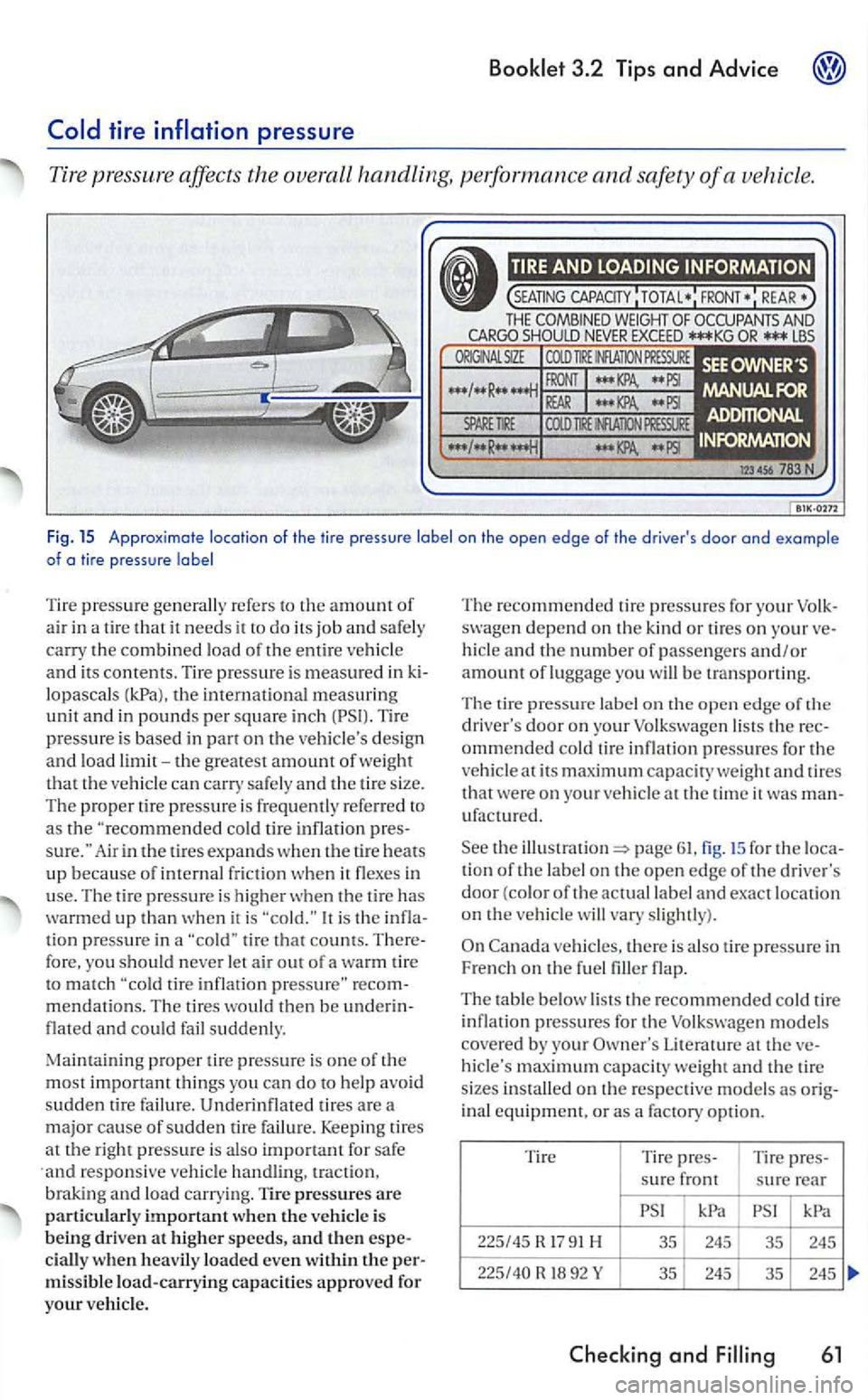
pressure label on the open ed ge of th e
driver's door on your Volk swagen lists the ommended co ld tir e infl ation pressures for the
at th e tim e it was ufactured.
page fig. 15 for the tion of the label on the open edge of the driver's door (colo r of the actual label and exact locat ion on the
flap.
The table below lists the recommended cold tire
i nflatio n pressures for the models covered by your maximum capacit y we igh t and th e tire
sizes on t h e res pective models as inal equipment, or as a factory opti on.
T ir e Tire
pres-Tire pres-
s ur e front sure rear
kPa
17 91 35 245 35 245
6
1
Page 338 of 444
3.2 Tips and Advice
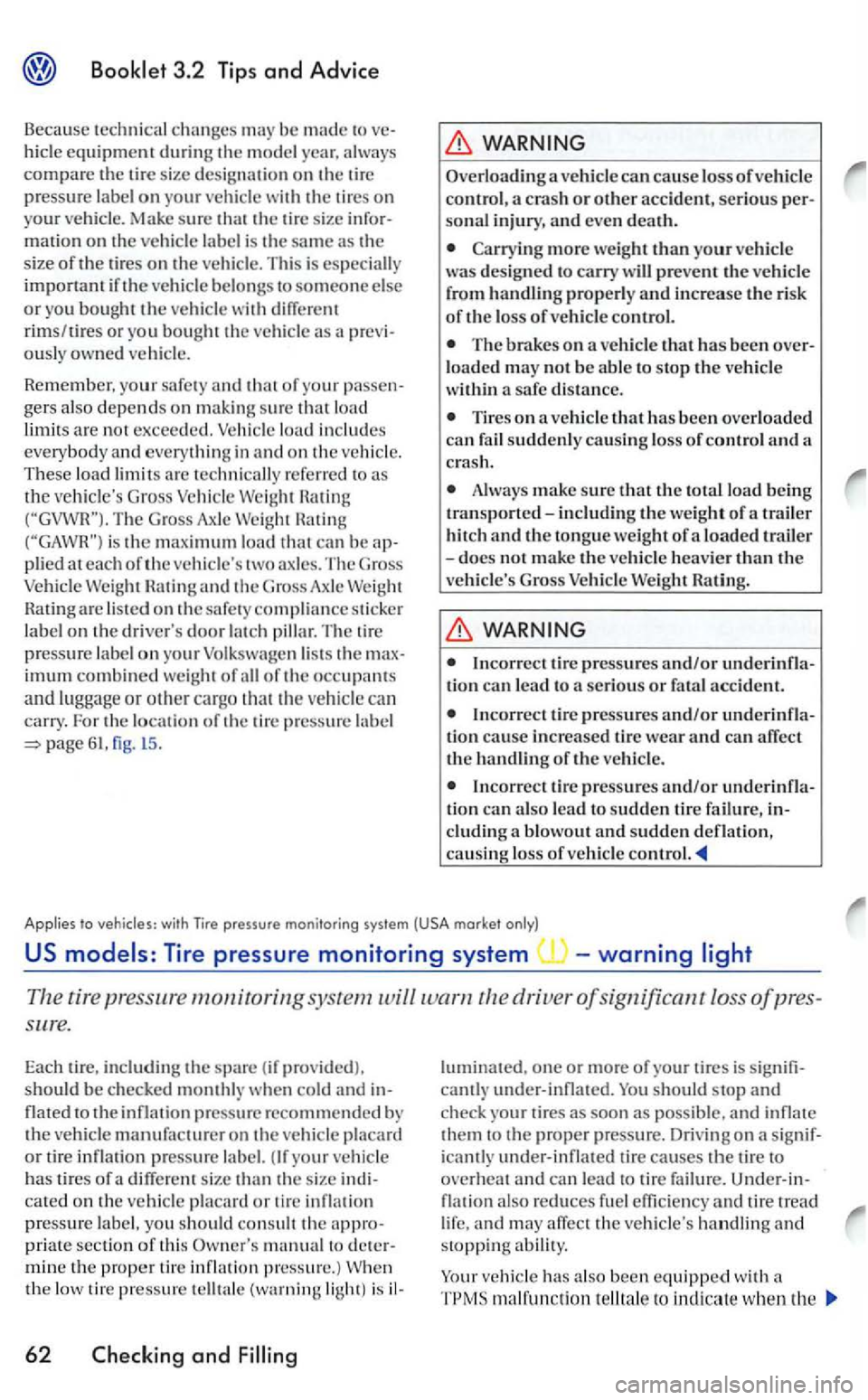
Because technical changes may be made to vehicle equipment during the model year, always compare the tire size desig nation on the tir e pressure label on your vehicle with the tire s on your vehicle. Make sure
a previousl y owned ve hicle.
Remember, your safe ty and t h at of your passengers also depends on making sure that load
limit s are not exceeded. Vehicle load includes everybody and everything in and on the vehicle.
T hese load limit s arc techni call y referred to the ve hicle's Gross Vehicl e Rating Hatin g is th e maximum load that
Hating are listed on th e s afet y compliance sticker
label on t h e driver's door
fig. l5 .
WARNING
Overloading a vehicl e can cause loss of vehicle control,
more we ight than your vehicle was des ign ed to carry w ill prevent the vehicle from handling properly and increase the risk of the loss of vehicle control.
The on a vehicle that has been over
loaded may not be abl e to stop the vehicle within a safe distance.
Tires on a vehicle that has been overloaded can fail suddenly cau sin g loss of control and a crash.
Always make sure that the total load being transp o rted-including the weight of a trailer hitch and the to ng u e weight of a loaded trailer -docs not make the vehicle heavie r than the vehicle's Gross Vehicle
WARNING
Inco rrect tire pressures and/or underinflation can lead t o serious or fata l accident.
Incorrect tire pressures and/or underinflation cause increased tire wear and can affect the ha nd lin g of the ve hicle.
Applies to
The tire pressur e monitoring syste m driver ofsignificantloss of pres
sure.
Each tire, including the spare ( if provided),
should be c heck ed
your vehicle has tire s of a diff erent s ize than the s ize indi cated on the vehicle placard or tire inflation pressure lab el, you should consult the appropriate sec tion of this
and
luminatcd. one or m ore of your tires is signifi
cantly under-inflated. should stop and check your tires as soon as possible , and inflate them to the pro p er p ressure. Driving on a sig nif
icantly under- inflated tire causes the tire to overheat and can lead to tire failure. Under- in-
flation al so reduces fuel effic iency and tire tread life , and may affe ct th e vehic le's handling stopping ability.
ve hicle has also been equipped with a malfunction te llt ale to indi cate when
Page 339 of 444
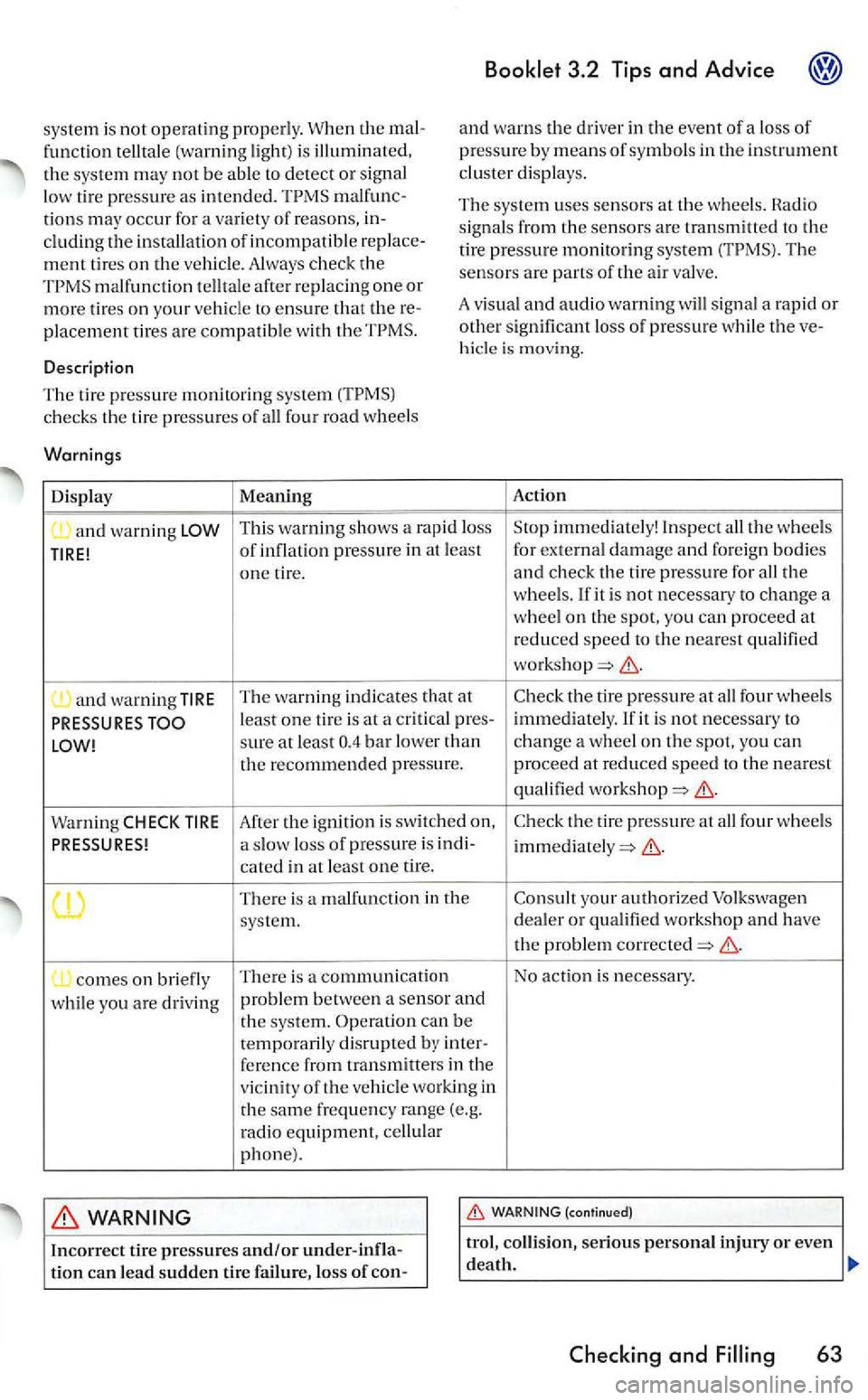
syste m is not operating properly. When the malfunct ion telltale (warning light) is illuminat ed, the system may not be able to detect or signal
low tire pressure as intended. malfunc
tions may occur for a var iety of reasons, including the installation of incompatible replacement tires on the vehicle. Always check the
and warns the driver in the event of a lo ss of pressu re by means of symbols in the instrument cluster dis plays.
Descri
ption
The system uses sensors at th e whee ls . Rad io
signals from the sensors are transmitted to the tire pressure monitoring system Th e sensors are parts of the air valve.
A visua l
and audio warning will signal a rapid or other significant loss of pressure while the ve
hicle is moving .
The tir e pressure monitorin g system
This warning shows a rapid loss Stop immediately! Inspect all the wheels
T
IRE! of i nflation pressure in at least for e
xt ernal damage and for eign bodies
one tire. and check the tire pressure for all the wheels. If it is not necessary to change a
w heel on th e spot, you can proceed at reduced speed the nearest qualified
and warnin g TIRE The warn ing indicates that at Chec
k the tire pressure at all fou r whee ls leas t one tire is at a criti ca l pres- immediately. If it is not necessary to sure at least
Warning CHECK TIRE After the ig n it ion is switched Check the tire pressure at all fou r wheels a slow loss of pressure is indi-
There is a malfunct ion in the Consult your a uthorized Volkswagen
system. dealer or qualified workshop and have
the p ro ble m corrected
comes on briefly There is a communica tion No action i
s necessaty.
while you are
driving problem between a sensor and the system. Operation can be temporarily di srupted by inter-
f ere nce from transmitters in the
v icinity of the vehicl e working in
t h e same frequency range (e.g.
rad io equipment, cell ula r phone).
WARNING
Checking and 63
Page 340 of 444
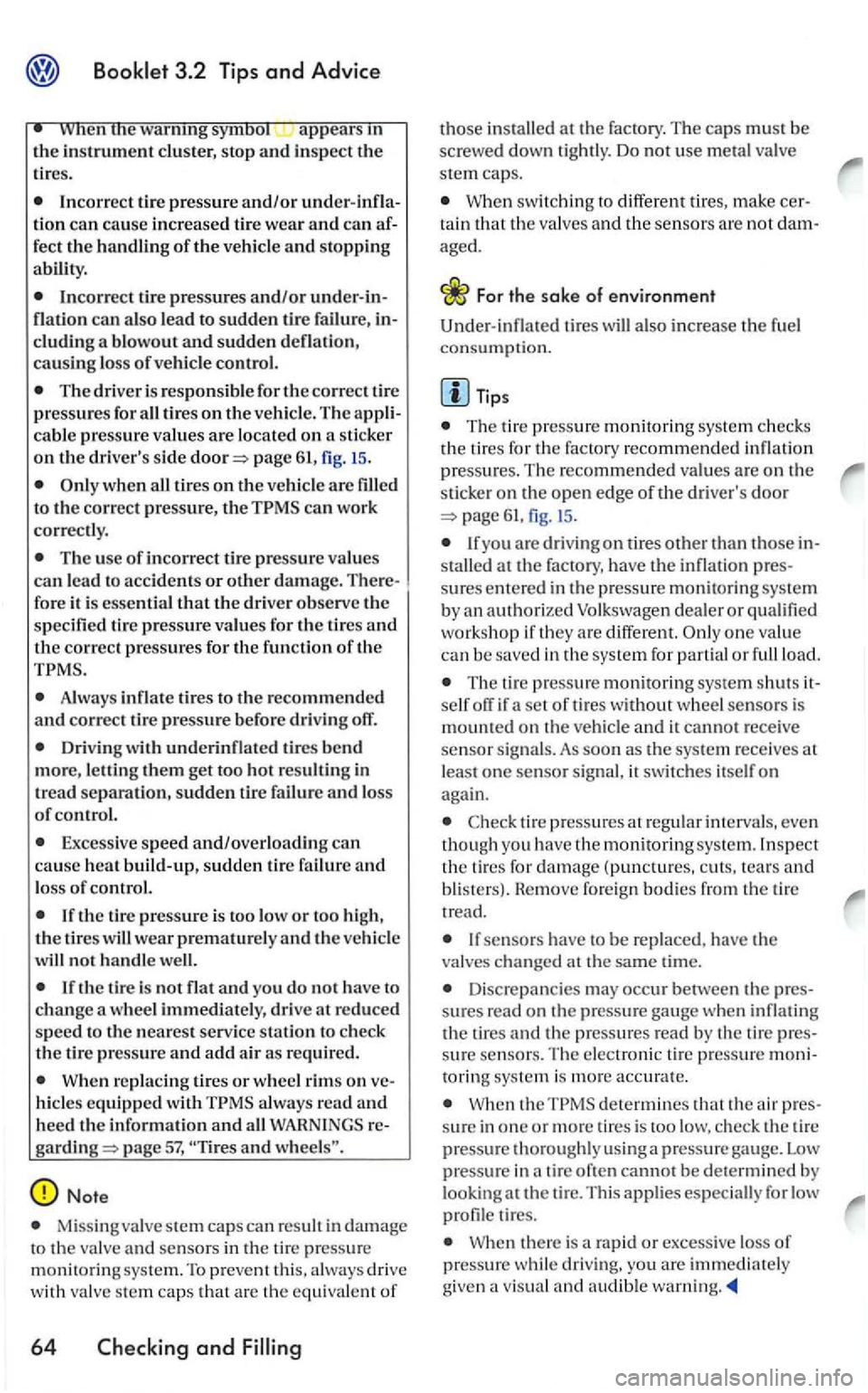
the instrument cluster, stop and insp ec t th e
tir es.
can also lead t o sudden tire failur e, in
cluding a blowout and sudden deflati on, causing loss of ve hicle control.
The driv er i s responsible for the correct tire pressures fo r all tire s on the vehicl e. Th e appli
cable pressure valu es are locat ed on a sticker on the driver' s sid e page 61, fig . 15 .
w hen all on the ve hicl e are filled
to the correct pressure, th e can work
corre ctly.
A lways inflat e tire s to the recomme nd ed
and correct tire pres sure before driving off.
in tread separa tion, sudden
Excess ive speed and/overloadin g can
ca use heat build-up , sudden tir e failur e and lo ss of control.
If th e tire is no t flat and you do not have to change a w hee l immediate ly , drive at reduce d
s peed to tJ1e neares t se rvic e statio n to ch ec k the tir e press ure and add air as req uired.
Whe n r epl acing tir es or wheel rim s on ve
hicles equipped with always read and heed the information and all repage 57, and
Note
M iss in g va lve stem caps can result in damage
to the valve and senso rs in the tire pressure
monitor ing sys tem. To preve nt thi s. a lways drive
wit h valve stem caps that are th e equiva le nt of
64
tho se installed
When switc hin g to diff erent tires, make cer
tain that the valves and the se nsors are not dam
ag ed .
For the sake of environment
Unde r-inflated tires will a lso in crease the fu el
consumption.
Tips
The tir e press ure mon itoring system ch ecks
th e tir es for the fac to ry recommend ed in flat ion pressures. The recommended val ues are on th e sticker on the o pen edge of th e driver's door
61, fig.
you are driving on tires other than those in
s talled at th e factory, have the inflati on pres
s ure s entered in the press ure monitor ing sys tem
by an authorized Vol kswage n dea ler or qua lified
works hop if they are different.
Th e tire pressure monitor ing system sh uts itself off if a set of tir es without whee l sensors is
mounted on th e veh icle and it cannot receive senso r sig nals. As soon as the syste m rece ives at
lea st one se nsor signa l, it switches itself on
again.
tir e pressures at regu lar int ervals, even
though you have the monitoring system. In spec t
th e
tires for damage (punctu res , cuts, t ea rs a nd
blis ter s). He move foreig n bodi es from the tir e
tread.
senso rs have to be rep laced, have the valves ch anged at th e sa me tim e.
Disc repancies may occur between the pres
sures read on the press ure ga uge when inflating the tires and th e pressures read by the tire pressu re sensors. The electro nic tire pressure monitoring system is m ore accurate.
When deter min es tha t the air pres
s u re in o ne or more tires is too low, ch eck the tire
pressure thoroughly using a pressu re Low pressure in a tire often cannot be determi ned by
looking at the tire. This applies especially for low
profile tires.
When there is a rap id or excessi ve loss of pressure while driving. you are immediately
g iven vis u a l and aud ible warn ing .
Page 343 of 444
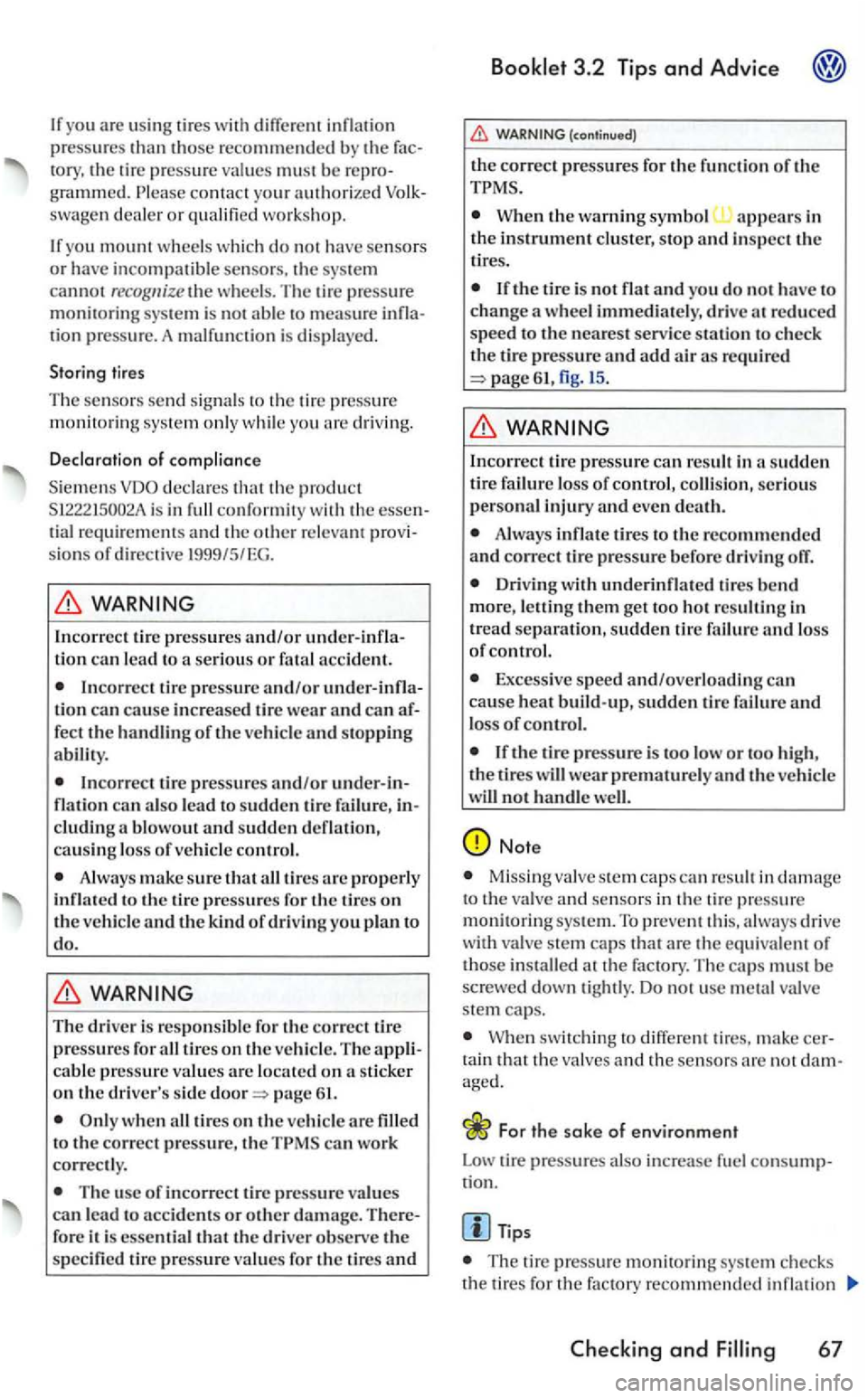
you are using tires w ith inflatio n
p ressures than those recommended by the tory, the tir e press ure val ues must be re programmed. swagen dealer or q ualified workshop.
you mount wheels whic h d o not have sen sors or have incompatible sensors . th e sys tem cannot recognize the wheel s. The tir e pressure monitoring sys te m is not abl e to measure infla
tion press ure. A malfun ction is di sp la ye d.
S t
oring tires
T he se nsors se nd signa ls to t h e tir e press ure
monitori ng sys te m only whi le you arc driv ing .
D eclaration of complianc e
Siemens declares that the product is in full c onfo rmit y w ith the essential requi rements and the other re levant prov i
sio ns of directi ve 19 99/5/EG.
WARNING
In correc t tire pressures and/or unde r- inflati o n can lead t o
an d can
Incorrect t ire p ressures and/o r under-i n
flatio n ca n also lead to sudden tir e failure, bl owout and sudden d eflati on, causing loss of ve hicl e control.
Always make sure that a ll tires are properl y
inflat ed t o tire press ures fo r th e tires o n
t h e vehicl e and the kind of driv in g yo u plan to
do.
WARNING
The d rive r is responsib le for the correct tire
press ures for all tires on th e ve hicle. The cable pressure values arc loc ate d on sticke r
o n the dri ver's sid e page 61.
correctly.
The use of in correct tire pressure values can lead to acci den ts or other damage. There
f o re it i s esse ntial that the d river observe the
s p ecified tire p ressure va lues fo r the tires an d
Booklet 3.2 Tips and Advice
WARNI NG (continued)
the correc t pressures fo r the functi on of the
W hen the
the ti re is not flat and you do no t have to
c h an ge a w heel immed ia tely, drive
required fig. 15.
WARNING
Incorrect tire pressure can result in sudde n
t ire failur e loss of control, co llisio n, seri ous
personal i njury an d even death.
A lways in flat e tires to the recommended and correct tire pressure before dri ving
D rivi ng with unde rinfl atc d ti res b end m ore, le ttin g them get too h o t res ulting in tread sep aration, sudden tire failure and loss
o f co ntrol .
Exces sive speed and/ overloading can cause heat build-up , sudden tire fa ilure a nd
l oss of control.
not handl e we ll.
Missin g valve ste m caps can resu lt in damage to th e va lve and sensor s in the tire pressure mon itorin g sys te m. To pre vent t his, alwa ys dri ve
with valve stem caps that are the equi valent of th ose insta lled va lve
s te m caps.
Whe n switc hin g to t a in that the va lve s and the sensors not aged.
For the sake of environment
Low tire pressures also increase fuel consump
tion.
The tire pressu re monitoring syste m checks
th e tires for the fac tory recommend ed inflation
Page 344 of 444
3.2 Tips and Advice
pressures. The recommended values are on the
s ticker on th e open edge of the driver's door 61, fig. 1 5 .
yo u are driving on tire s other than those in
s tall ed at the factory, have the inflation pres
sures entered in the pressure monito rin g sys te m by a Volk sw agen Serv ice® fac ilit y if they are dif
ferent . O nl y one va lue can be save d in the syste m for partial or full load.
The tire pressure monitoring sys te m shuts itself off if a se t of tire s w ithout wheel sensors is mounted on the vehicle and it cannot receive sensor s ignal s. As soon as th e sys te m recei ve s at
tir e press ures at regular interva ls. even though yo u have the monitoring sys te m. Inspect the tire s for damage (punctures. cuts. tears and blister s). Remove foreign bodies from the tire
tread .
sensors have to be repla ced. have the valve s changed at the same time.
Discre pancies may occur betwee n th e pres
sures read on the pressure gauge when inflating the tires and the pressure s read b y the tire pres
sure sensors. The e lectroni c tire pressu re moni
torin g sys te m is more accurate.
The corr ect tire pressure for the tires originally installed on your vehicle is Liste d on
th e tire pr
essure label on the open edge of the driver's door.
The recommended tire pressure s arc on the tire
pres sure lab el and in the page 6 1, T hi s means that the pressure must be c hecke d and adjusted w hen tire has not been driven for more t han a couple of miles (k ilometers ) at low speeds during the previo us three hours. Air in the tires
expands when the tire heat s up as a result of in
ternal friction as it flexes in use. The tire pressure is high er w he n the tir e has war med up than when it is
tir e that counts. There for e, you should nev er le t a ir out of
a warm tir e to matc h p a ge 61. The tire s
would the n be underinflatcd and could fail sud
denly.
The tir e pressure la b e l o n your Volkswagen lists the recommended co ld tire inflation pressures for the new, orig in al equipment tires we re on yo ur ve hicl e at the tim e it was m anufa ctured.
For the location of the page 61, fig . 15 .
Most tir
es lose air naturally over time. They can
also lose some air if you drive ove r a pothole or h it a c urb whil e pa rking. is usually not possible
t o see w hether the radia l tires u se d today are un
derinflated jus t b y looki ng at them.
Therefore, be sure to check tire pressur es at least once a month and always be for e goin g on a lo ng
68 Checking and
trip. Mak e sure to ta ke the numbe r of p eople and the amount of lu ggage into ac count whe n ad justing tire pressure for a trip -eve n one that you wou ld not consider to b e page and ve hicle load for more important information.
Vehicles that h ave full hub caps have va lve ex
t ende rs in stead of dust caps. To ch ec k tire pressure or add ai r. yo u do not need to remove the
extender. Be sure to re in stall v a lve dus t cap s
aft er checkin g or adjustin g tir e pressure.
A lways use an
accurate tire pressure gauge whe n manually c hecking and adju sting inflatio n pres -sures.
let air our of the tire slowly with the edge of the tir e and keep checkin g the pressure until you rea ch the pressure that is correct for the load (passenge rs
and lu gga ge) and kind of dri vin g yo u pla n to do.
th e pressure in an y tire is to o low, no te the dif
fere nce be tween the pressure in the co ld tir e and the pressure you need and add the air that yo u
need to r e ac h the correc t p res sure for the ve hicle
lo ad (passengers and luggage) for the tires on
your ve hicle as listed on the on your ve hicl e and in thi s manual and th e kind of dri vin g yo u plan
Page 345 of 444
Never excee d the maximum inflation pressure listed o n the tire sidewall for
that the ve hicle manufacturer. no t the tir e m anufacturer. determines the co rrect
tir e
pressure for the tire s on your vehic le
the required tire pressure from the tire pressure label on the open ed ge of the driver's
door.
Place the air pressure gauge on the dust caps -the re is no need
The tire pressures should only be ch ecked when the tires are co ld. T he s lightl y raised pres
sures of warm t ires mus t not be red uced.
Adjust the tire pressure to the load you are
carrying.
Vehicle with
Head the required tir e pres sure from the tire
pressure on the ope n edge of the driver's
d oor.
Turn the va lve stem cap counter-cloc kwise to
remove i t from the ti re va lve.
Place the air pressure gauge on the valve.
The tire pressures should onl y be c hecked and adjusted when the tire s are cold. The slightl y
raised pressures of warm tires must not b e re
duced.
Adju st the tir e pressure to the load you are
carryin g.
the valve stem cap on the valve.
When should check the tire pressure?
The correct tire pressure is especi ally important
at high speeds. The pressure sh oul d there fore be ch ecked at least once a month and always before
s tarting a journey. Do not forge t check the tire pressure on th e spare whee l7l
When should odjust the tire pressures?
Adju st
the tire pressure to the load you are car
ry ing. Af ter changing a
addition on vehicles with TPMS,
yo u should sp ecify new tire
sudden tire failure loss of control, collision, serious personal injury even death.
Always fill tires to the recommende d and correct tire pressure before dri ving ofT.
Driving with underinflated tires bend m ore, letting them get too hot resulting in
tread separation, sudden tire failure tire
failure and loss of control.
Excessive speed and/or overloading can heat build-up, sudden tire failu re including a blowout and sudden deflation and
loss o f co ntrol.
If the tir e pressure is too low or too high, the tires w ill wear prematurely and the ve hicle
will not handle we ll.
with tire pressure monitoring system To prevent this, make sure that factory
For the sake of environment
Tip s
For vehicles
may find differences between the pres
s ur e read ings fro m a hand-held pressure gauge
a nd the pressure readings disp laye d in the in
s trument The tire pres sure monitoring syste m is more acc urat e.
the is too
applicable =Tire press ure monitoring
applicable
69