airbag VOLKSWAGEN GOLF 2004 Repair Manual
[x] Cancel search | Manufacturer: VOLKSWAGEN, Model Year: 2004, Model line: GOLF, Model: VOLKSWAGEN GOLF 2004Pages: 444, PDF Size: 92.7 MB
Page 176 of 444
3.1
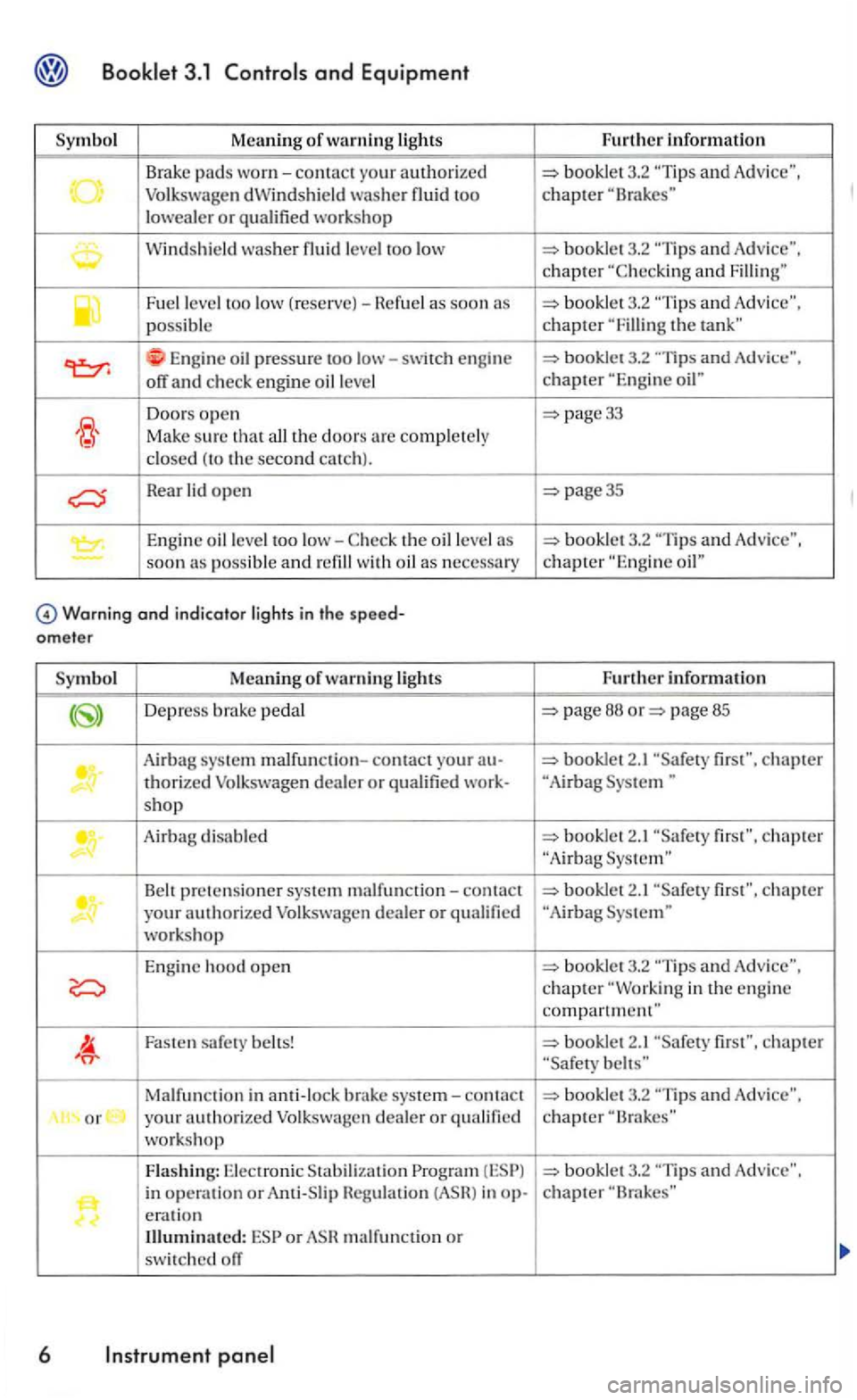
M eaning o f warning lights
Brake
pads worn-contact your authori zed Volkswagen dWindshield was her fluid too lowealer or qualified workshop
Windshield washer fluid level too low
Fuel level too low (reserve)-Hefuel as soon as possibl e
Engin e oil press ure too low-engine
off and ch eck en gine oil leve l
Do ors open
Make su re tha t all the doors completely cl osed (to the second catc h ).
lid open
Engine oil level too low-
Warning and indicator light s in the
Meaning of warning lig h ts
Dep ress ped a l
Airbag system malfunction-contact your au -
thorized Volkswagen dealer or qualified work-shop
Airbag disabled
Belt prete n sioner system malfu nction-contact your authorized Volkswagen dealer or qualified workshop
En gine hood open
Fasten safet y belts!
Malf unction in anti-loc k brake syste m -contact
o r your auth orized Volk swagen dealer or qualifi ed
work shop
Flashing: Electroni c Stab iliza tion in operation or Hegulat io n in op-eration Illuminated: or m alfunct ion or
sw itched off
6
and
3 .2 chapter and
3.2 and chapter the
booklet 3.2 chapter
page33
page35
3.2 and Advice" , chapter
page 88 page 85
2.1 fir st" , c hapte r
chapter "Airbag
booklet2.1
booklet 3.2 and Adv ice",
chapter
2. 1 first", chapter
bookl et3.2 and
bookle t3 .2 and A dvice" . chapter
Page 195 of 444
Applies to vehicles' with
and drive 1:
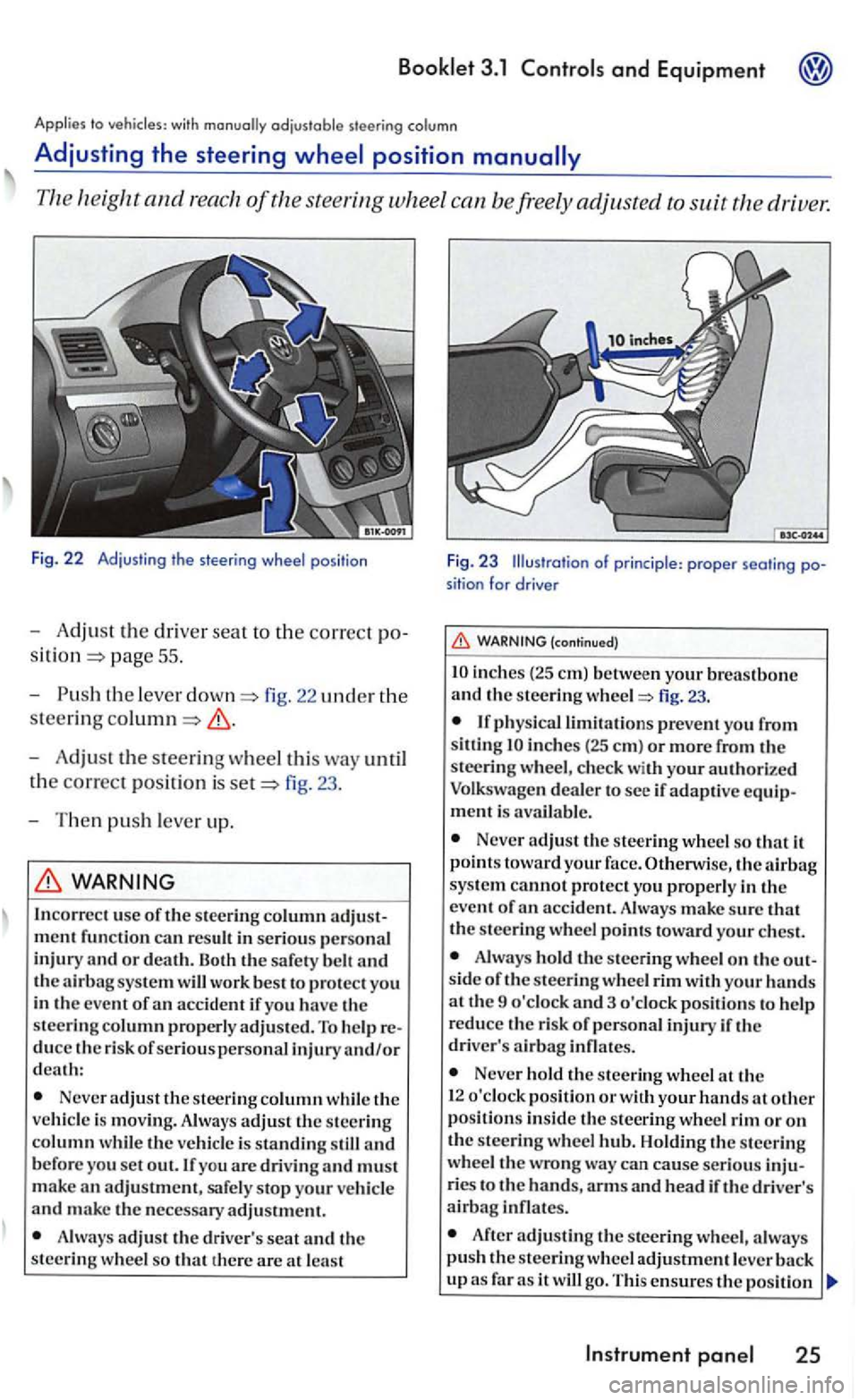
Fig. 22 Adjust in g t he s tee ring wheel pos itio n
-Adjust the dri ver seat to the correct po
pag e 55 .
- Push
the leve r fig. 22 uncl er the
steering
-Adjust the steering wheel this way until
t h e
correct posit ion is fig. 23 .
- T hen
push lever up.
WARNING
In correc t use of the stee ring column
Neve r adjust the steer ing column while th e
ve hicl e is movin g. Always adjust th e steering column w hil e th e veh icle is standing still and b efore you set out. If you are drivin g and must
m ake an adjustment, safe ly stop your ve hicl e and make the necessary adjustment.
A lways adjus t th e driv er's seat and th e
steering w hee l so that th ere are at lea st
F ig. 23 Illustration of princi ple : proper seati ng position for drive r
(continued)
inch es (2 5 em) betwe en your breastbone and th e s teering fig. 23.
inches (25 em ) or more from the
steeri ng w heel, c hec k with your authori ze d
Volkswagen deale r to see if adaptive equipment is avai la ble .
Never adjust the steering wheel so that it
p oin ts toward your face. Otherwise, the sys te m cannot protect yo u properly in the
e ve nt of
Alwa ys hold the s teering wheel o n the out
s id e of the s teering whee l rim with your hands at th e 9 o'clock and 3 o 'clock pos itions to help
r educe th e risk of p ersonal injury if th e
driver' s
Never hold the stee rin g wheel th e
1 2 o'clock pos ition or w ith your hands at other position s in side th e s teering wheel rim or on the steerin g wheel Holdin g th e s teerin g
wheel the wrong wa y ca n cause serious inju
ries t o the hands, arm s and hea d if the driver's airbag infl ates.
After adjusting the stee rin g wheel, a lwa ys push the s teerin g wh eel adjustment leve r
Instrument
Page 201 of 444
Booklet 3.1
(continued)
If you ever notice that the doors no t erly closed when th e vehicl e is movin g, stop as soo n as it is sa fe to do so and close th e door properly.
rious person al in jury.
The power lock ing button locks all th e h icle doors. Locking doors from the in side can he lp prevent unintended door o pening during
a co llision and can als o prevent unwa nted
entry from th e outsid e. Locked doors ca n,
how ever, delay ass istance to ve hicle pants and rescue from th e outside in an
Never leave children , di sabled persons or anyon e who cannot help themselves in the hicl e. The doors can be locked with the power
lo ck butt on. Thi s co uld leave people trapped in the ve hicle in an emergency. trapped
in the vehicle can be exposed to very high or low temperatures.
Heat build-up in the passe nger
hicle that are much high er than th e outside
temperatures , parti cularly in summer. peratures can quickly reach leve ls that ca n
(con tinued)
cause unconscio usn ess and death,
Neve r allow passe nge rs t o remain in a
locked vehicle. Locked doo rs can de lay
any airbag deploys. the vehicle doors lock automat ically, automatically un less the
When you lock you r veh icle with the ce ntra l
l ocking button:
The doors and the rear lid can not be
opened from the outside (for your safe ty, for examp le. when stopped at a traffi c light).
you try to lock the vehicle using the
Page 225 of 444
Booklet 3.1
passe nger's seat can
b e adju ste d in many ways to suit the physical
need s of the vehicl e occ upants. position is
very important for:
fast and easy operat ion of all control s on the instrument panel,
safe driving ,
optimum prote ction from the s afet y belts
and airb ag booklet 2.1
Driv ers or passengers who are unbelted, out of position or too close to the airb ag can be seri
ously injured or killed by an airbag as it unfolds. To help reduce the risk of serious personal injury:
Always adjust th e driver's seat and the steeri ng whe el so that there are a t lea st in ches (25 em) betwe en you r brea stbone and the ste erin g w heel.
Always hold the steering wheel on the out
s ide of th e s teering wheel rim with your hands at the 9 o'clock and 3 o'clock position s to he lp
reduce the risk of personal inju ry if the driver 's airbag inflates.
Never hold the steering wheel
Passengers must always sit in an upright position and never lean agains t or pl ace an y
(co ntinued)
part of their body too close to the area where the airbags are loca ted.
Alway s make sure there are at least inch es (25 em) between instrument panel.
Eac h passenger must always sit on a sea t of their own and prope rly fasten and wear the safety belt belon ging to that scat.
Before driving, always adjust the front
seats and head r estraints properly.
Never adju st th e sea ts while the vehicle is
moving. sea t may move unexpec tedly and yo u could lose control of the vehicle.
Always keep your feet on the floor in front of the sc at. Never rest on tl1e in strument panel, out of the window, etc. The airbag
s ystem and safety belt will not be able to pro
te ct you properly and can even increase the
ri sk of injury in
Never drive with backres t reclined or tilted far backJ The the backres ts are t ilted back, greater risk of injury due to
incorrect positioning ofthe safety belt and im
proper seating position.
b elts only offer maximu m prot ec
tion when the se atback is securely lat ch ed in
Children must alway s ride in child seats.
Seats and storage 55
Page 228 of 444
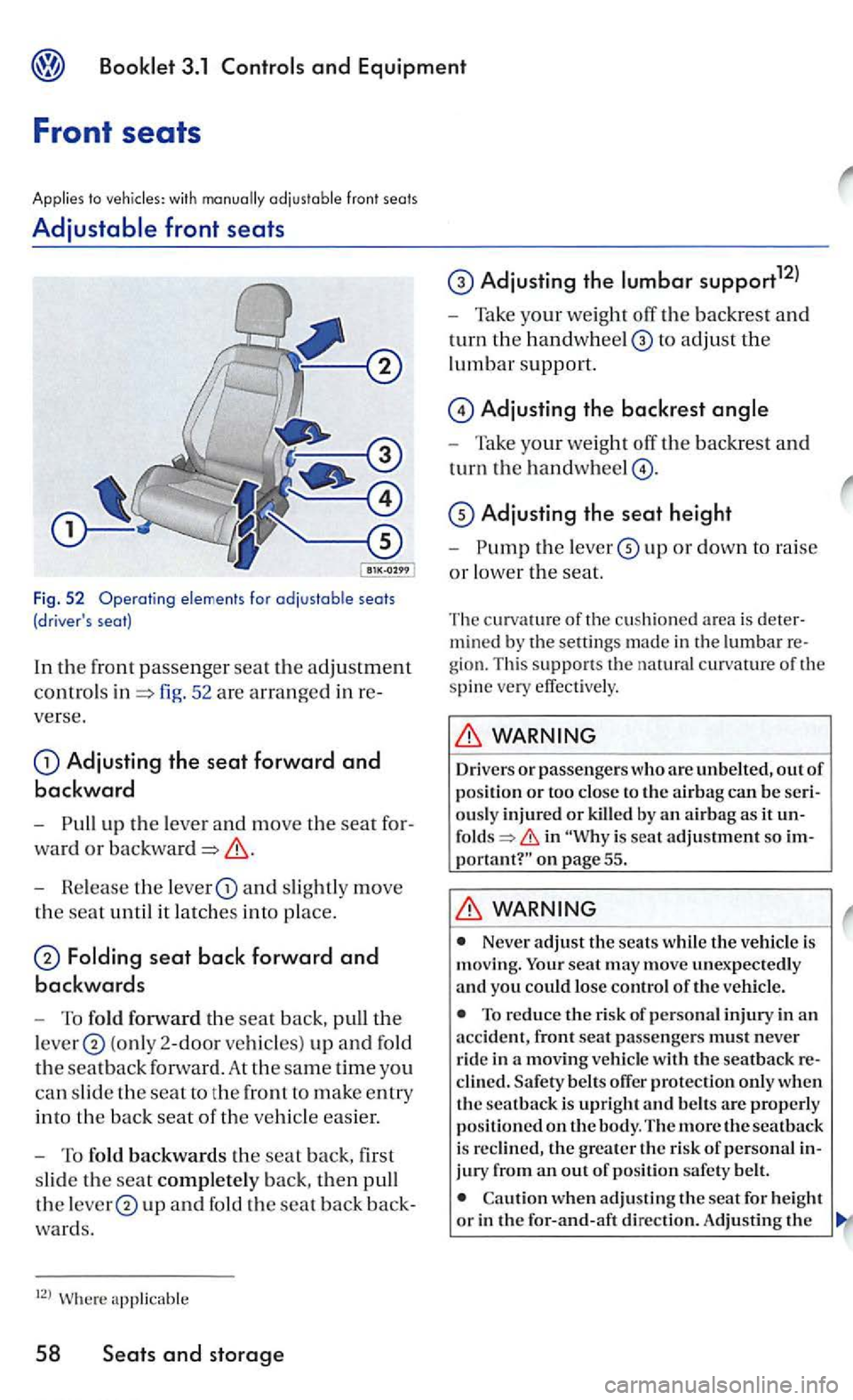
adjustable front seats
fig. 52 are arranged in
Adjusting the seat forward and
backward
-up the lever and move the seat
ward or
- Release the lever and slig htl y move
the seat until it la tches into place .
seat bock forward and
backwards
-To fold forward th e seat back, pull tl1e
(only 2-door vehicles) up and fold
th e
seatback At th e same time you
can slid e th e seat to th e front to make entry
into t he bac k seat of the vehicl e easier.
- To fold backwards the seat back, first
s lide the seat completely back, then pull
th e up and fold th e seat back
W here appl icabl e
58 and storage
Adjusting the support12l
-Take your weight off the backrest and
turn the to adjust the
lumbar support.
Adju sting the backrest
- Take your weight off the backrest and
turn the
up or down to raise
or lower the seat.
T he curvature of the cu shioned area is mined by the senings made in th e lumbar gio n. This s up pons the natural curvature of the spine ve ry effect ively.
WARNING
Drivers or passen gers who are unbelted, out of positio n or too close to the airbag can be
in is seat adjustment so on page 55 .
WARNING
Never adjust the seats whil e th e ve hicle is
moving. seat may mov e unexpected ly
a nd you could lose control of the vehicle.
To reduce the risk of personal injury in an accide nt, front seat passengers must n eve r
ride in a moving ve hicl e with the seatback
jury from an out of position safety belt.
when adjusting the seat for height or in the far-and-aft di rec tio n. Adjusting th e
Page 236 of 444
and Equipment
Other storage areas
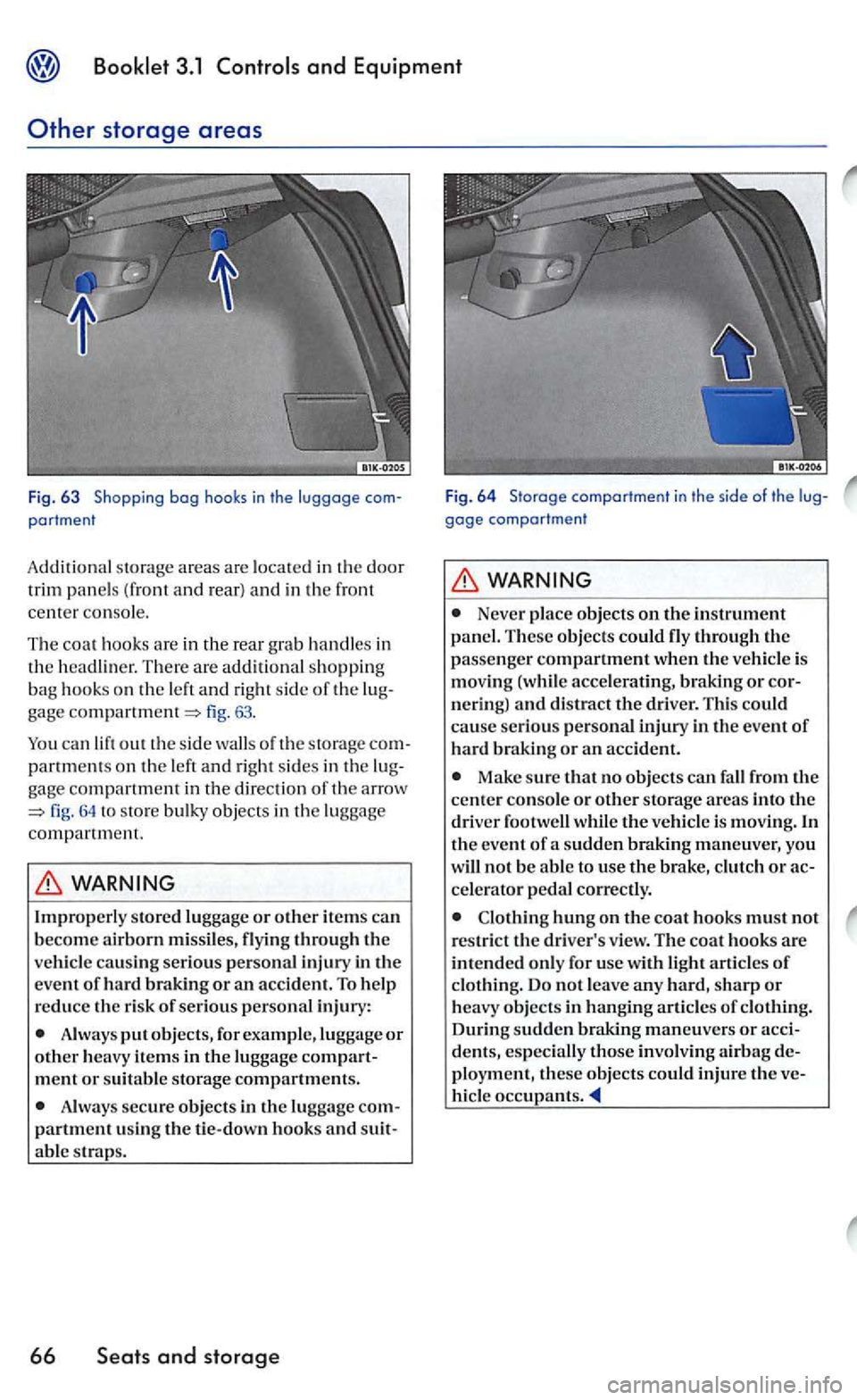
Fig. 63 Shopping bog hooks in the luggage portment
Additiona l s torage areas are located in the door
trim panel s (f ront and rear ) and in the front
center console.
The coat hooks are
in the rear grab hand le s in th e There are add itional shopping
bag hook s on the and right side of the fig. 63.
out the s ide of the storage partm ent s on the and right sides in the
fig. 64 store bulky objects in the luggage
com partm ent.
Always put objects, for example, lug gage or other heavy items in the luggag e compartment or suitabl e storage compartments.
Always secure objects in the lu ggage partment using the tie-down hooks and able straps.
66
gage comportment
Never place objects on the instrument
panel. These objects could fly through the
passeng er compartm ent when th e is mov ing (w hile acce lerating, braking or n ering) and
Make sure that no objects fall from the cente r console o r other sto rage areas into the
dri ver footwell while the is m ov ing. In the event of a sudden brakin g maneuver, you
w ill not be able to usc tl1e brake,
hung on tl1e coat hooks must not rest rict the dri ver's view . The coat hooks arc intended only for usc with light of
of During sudden braking maneuvers or acci-
d e nts, especially those inv olv in g airbag de
ployment , these objects could inj ure the ve-occupants.
Page 256 of 444
and Equipment
sta rtin g a co ld engin e, it may be a little
n o isy for the first few seconds until oil pressure has built up i n the hydraulic va lve lift ers . T his is normal and n o cause for concern.
I f
the engine does no t sta rt after seconds. switch off the ig niti on, wait seconds, then try
again.
I f yo u
have problem s booklet 3.2 and ch apter
g in e.
Never sta rt or le t the e ng in e run in fin ed or e n closed area. Exhaust from the poi so no us,
co lorless and odorless gas. Carbon can cause unco nsciou sness and death.
Never leave the ve hicl e unatt ended wit h the eng in e runnin g. The vehi cle could move
suddenly or an unus u a l o pe ra tin g condition
Switching off the engine
-Let the vehicle com e to a comple te sto p.
- T
urn th e ig nit ion key to pos iti on @
- Be sure to apply the par k in g brake
w he neve r yo u r
emove the key from the
nition.
Af te r the en gi ne is switched off the rad iator fan
m ay cont inu e to run for up co
Never sw itch off the engine before the vehicle
has com e to a complete stop. can lose tro l of the vehicle , crash and be seriou sly jured.
86 Driving
Neve r u sc "startin g assist fluid s." They are potentially explo sive and can cause a ve hicle cond it ion.
Note
can damage the engin e if you d rive hig h
e ngin e speeds, at full thro ttle or by over- loading
t h e e ngi ne whe n the engine is cold.
T he cann ot be sta rt ed usin g
To avoid the sta rt er, re lease the nition key as soon as the engin e starts.
For the sake of environment
Do not warmup the engine by running it w ith the ve hicle standing s till. Drive off as soon as yo u
s tart the engine. This help s the e ngine reac h
WARN ING (continued )
The airbag s and sa fety belt prc te n si one rs
will not work w hen th e ig n itio n is s wit ch ed off.
The brake booster does not wo rk w hen th e
engi ne is turned off. A lo t more brake pedal press ure will be necessa ry to sto p the vehicle.
T he power steering syste m does not work
whe n the eng in e is turned o ff and you w ill
need m ore force to s teer the vehicl e.
the ke y is remove d , the steerin g
wheel column will lock up and you will not be able to s teer th e ve hicle.
Neve r park whe re th e hot exhaust system could ignite flammable mate ria ls, su ch as brus h , leaves, dry grass, spilled fue l e tc.
Note
If the engine has been dri ven hard for a lo ng riod, th e engine co uld over hea t when it is
switched off. To reduce th e risk of eng ine damage. be sure co Ieee h e e ng in e idl e for about
2 min ute s befo re yo u sw itch it
Page 290 of 444
For dri ving safely. always follow the specified
maintenance int erva ls in your mainte na nce booklet 1.1 ciall y for changin g the brake fluid. Hard u se, maril y stop and go driv ing, o p eratio n in very dusty area s. trailer towing as well as other tions may make it necessary to short en nance in te rvals-see your a u th orize d swage n dealer.
Your
l ow ing po int s befo re yo u drive off:
lights and turn signal s.
Make sur e that all ligh ts and all windows are
clea n.
Adjust the mirro rs.
Make sure th at the a ir intake slots between the e ngin e hoo d and the w in d shi eld are free of leaves . s n ow and ice.
wa rnin g and indicato r light s whe n
s ta rti ng the e ng in e.
Your personal driving styl e and attitude have a
lot
to do with safety.
Th eref ore, for yo
ur ow n safety:
Wear your safety belts and wear the m
book let 2.1 chapter
Make sure that all passenge rs their safe ty be lls properly. eve n those sitting in the book le t2.1 chapter Passengers not wear ing safety bells
Make sure that chil dren always sit on the rea r seat properly restrain ed by
Neve r transport chil d in a r ear-faci ng c hild or infant seat on the fron t passe nger seat booklet2.1
Adjust you r seat that yo u can easily reach
all control s while yo u are as far away from the airbag as pos sibl e but not close r than
bookle t2.1 and bookle t3. 1
The seatin g position is ve ry important for th e
a ir bag book let2.1 chapter" Air bag
Always adjust the head rest ra int s to the rect heig ht. For maximum pro tection. adjust the
head restrai nt so the upper e d ge is as eve n
w ith the top of your head a s pos sibl e, but no lower than eye level and so that it is as close th e back of your head booklet 2.1
Always make s ure that th e movem ent of the
p ed als is not re stricted in any booklet 3.1 Equipment",
Sto re lu ggage and light it em s properly in the
lu ggage compartment and on th e roof bookle t3. 1 and Luggag e compartment " and book let3.1 and Equipment", chapte r " Roof
If you drink, do not drive!
The use of alco hol. drugs and certai n tions will seriou sly impa ir percepti on , reac tio ns and dri ving ability, substantially in creasin g the risk of an acc ident, cras h and persona l injury.
Do not driv e if you are tired.
Make frequ ent rest sto ps, least afte r every two hours of dri ving.
Always
adapt vehicle speed to traffic, rood and
weather conditions.
R e
member, that especially on sm oot h. slipp ery
roa ds, ve hicl e ha ndl ing and brak ing depend a
g reat deal o n tire adhes ion. wet roads, the
f ront w heels can h ydropla ne, especi ally at
hi ghe r speeds. th is happen s, yo u will then no
lon ger be abl e to steer or brake properly.
Alwa ys observe the p osted speed limits and common sense. good judg m ent can mean the diff ere nce b e tween arriving safely at your d estination and being seriou sly injured in a cras h or othe r kind of accident.
14 Driving and protecting the environment
Page 304 of 444
WARNING (continued)
partment.
Always le t the engin e cool down ple te ly befor e opening the engine
hood. Hot components will burn skin on
W hen the engine has coo led dow n and you are ready to open the eng in e hood:
- He move
the key from the ignition.
- Appl y th e
parking brak e firml y and put the selector in
-Keep c hildr en and others away from the vehicle.
WARNIN G (cont inued)
Neve r reach into the a rea around or touch
th e radi ator fan. w it h th e blad es can
r es ult in seriou s personal injury. Always
moved from the ign ition.
For the sake of environment
gre a se and oil dep osits can r un off when th e engi ne is was hed. The polluted waste water must pass th rough an oil se pa ra tor before posal. Have the engin e cl ea ned only by an
- Use a cl ean, damp cloth to clean plastic
parts and th e in strument panel.
- If thi s does not work, use a special
WARNING
so lvents on surfaces where airb ags are located can change the way airb ags deploy in
a crash.
with woode n interior ri m
thi s does not provide sa tisfac tory
sults, use a gentle soap solution.
28
(con tinued)
Neve r clean the instrument pan el a nd the
s u rfaces above airbag modul es with cleaning
products containing so lvents.
contain ing solvents will change
the p roperti es of the plas tics and may cause pla stic parts t o break and fly around w he n the
a irbag deploys in a cras h causing injury .
Note
products th at contain so lvents will damage plas tic mate ria ls .
product s that contain solvents will damag e plas tic materia ls .
Page 308 of 444
Booklet 3.2 Tips and Advice
Repairs and technical modifications
Repairs and modifications must always be carried out according to the
Ele ct ronic nent s are linked toge ther in network s and othe r
sys te m s m ay be negati vely affe cte d by im proper
modification s or improperl y ries. T his c an seriou sly impair safety and lead to
e xces sive wear of components.
th e su spension sys tem can change the way that the airbag sys tem perform s
in a cra sh. Fo r example, using tir e- rim tion s not approved by Volk sw agen, low ering the ch anging the s tiffn ess of the the springs, su spension strut s,
s hock absorbers can change the forces tha t a re measure d by the airbag sensors and se n t to the contro l unit. Some su spension ch a nge s can. for
exa mpl e, increase the force leve ls measured b y the sensors and m ake the airbag sys tem deploy
in cras hes in whi ch it w ould not deploy if the changes had not been made. Other kinds of change s m ay reduce the force leve ls m easured
by the sensors and p reven t th e airbag from plo ying when it should.
We recommend that nece ssary work be
can cause malfunctions leading to
Never s u spension components that d o not have the sa me performance is tic s as the components install ed on your Never use tire-rim tions that have not been approved by swagen.
care, servic in g and repair dures can increase th e risk of personal injury and death by preve nting an airb ag from ploying w he n needed or deploying an airbag unexpectedly.
the suspen sion cluding use o f unapproved tir e-rim tions change a irbag performance and
Be sure to read and heed the inf ormation and all bookle t chapter
32 Accessories , new parts, repairs and modifications