ECU VOLKSWAGEN GOLF 2005 Owner's Manual
[x] Cancel search | Manufacturer: VOLKSWAGEN, Model Year: 2005, Model line: GOLF, Model: VOLKSWAGEN GOLF 2005Pages: 444, PDF Size: 92.7 MB
Page 240 of 444
and Equipment
WARNING (continued)
Never leave your vehicle unattended cially with the rear lid left open. A could crawl into the vehicle through the luggage compartment and pull the rear lid or window
shut becoming trapped and unable to get ou t. Being trapped in vehicle lead to serious p e rsonal injury.
Never let children play in or around the
hicle.
Neve r let passengers ride in the luggage compartment. Vehicle occupants must
Tie-down hooks
WARNING (continued)
be p roperly restrained in one of the vehicle's s e a ting positions. r
Note
objects o n the luggage compartment cover could damage the wires of the rear
Tips
Do not cover the slo ts in f ront of the rear because this can p revent air
f r
om escaping the ve hicl e.
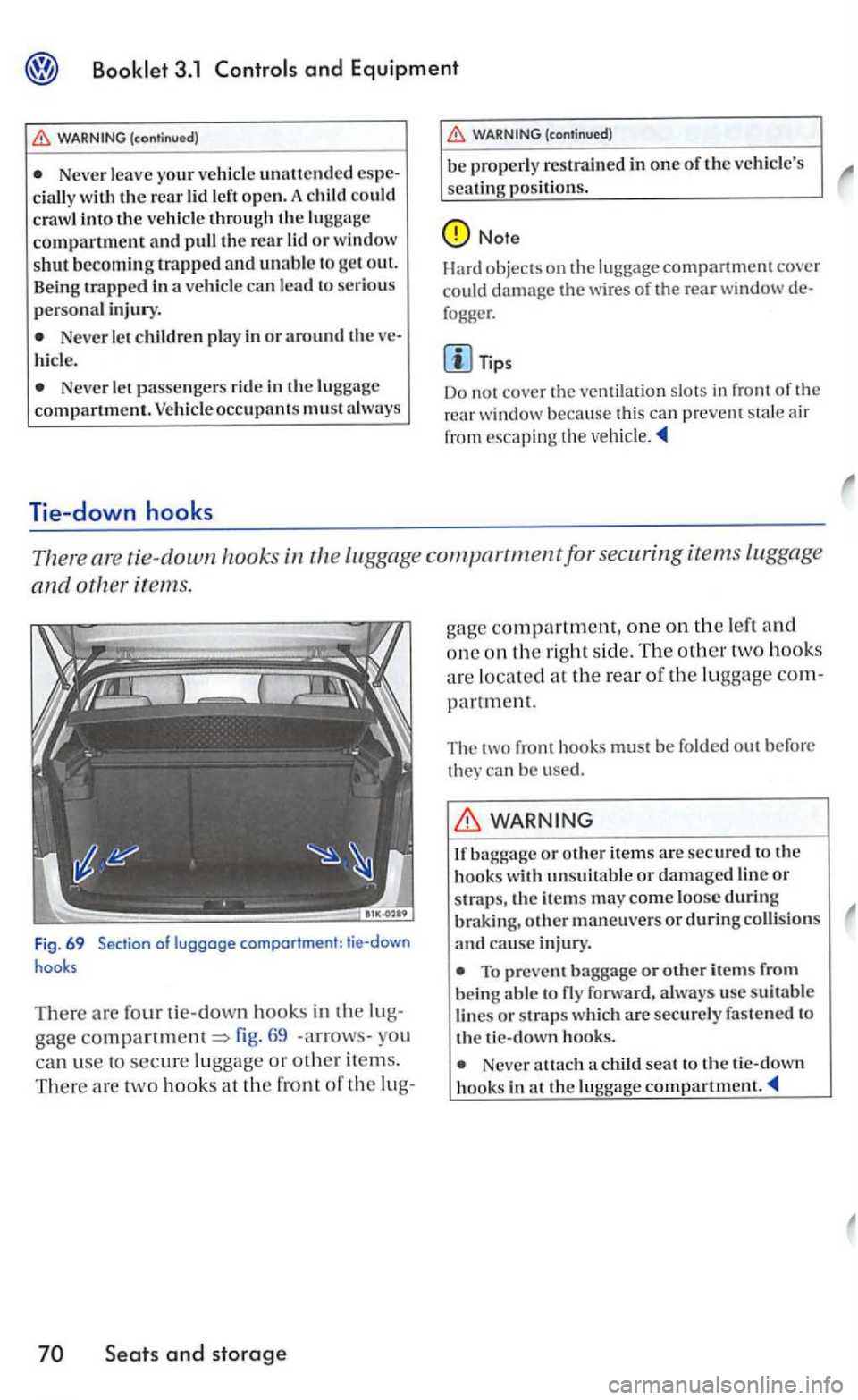
There are tie-down hooks lu ggage compartment for securing items luggag e
and items.
F ig . 69 Section of luggage comportment : tie -down
There are four tie-dow n hooks in the lug
gage fi g. 69 -arrows-you
can use to secure luggage o r other items.
T here are two hooks at the front oft h e lug-
WARNING
If baggage or other it em s are secured to the hooks unsuitable or damaged lin e or straps, the items may come loose during braking, other maneuvers or during collisions and cause injury.
To prevent baggage or ite m s from being able to fly forward, always use suitable
lines or s trap s which are securely fastened to the tic-down hooks.
Neve r a child seat to the tie-down hooks in at the luggage compartment.
Page 242 of 444
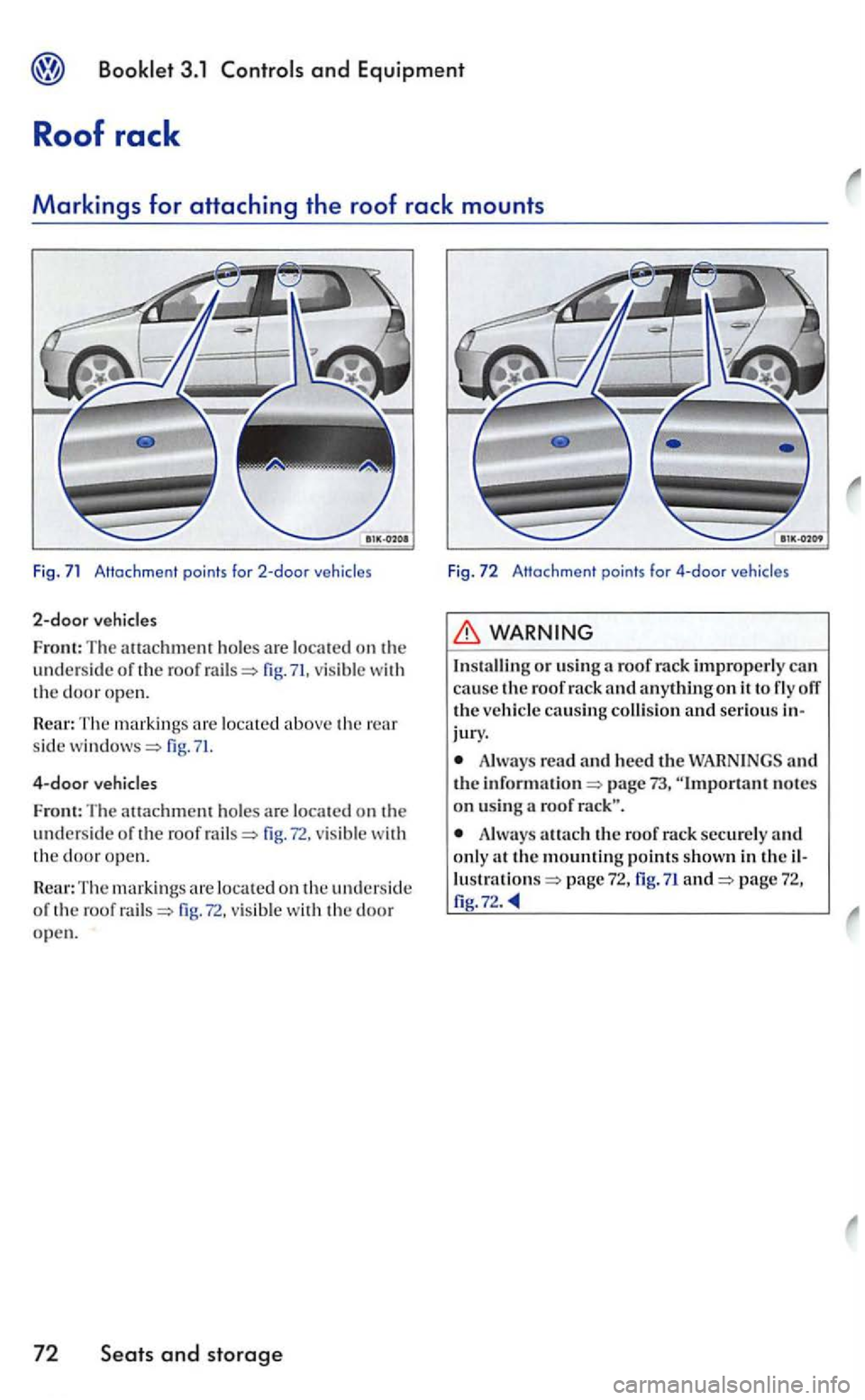
2-door vehicles
Front: The attachment ho les are locat e d on th e unders id e or the roof fig. 71, vis ible w ith the door open.
Rear: T he markings loca te d above the rear
s id e fig.
4-door vehicles
Front: The atta chment ho les a re locat ed on the underside o f th e roof fig. visib le w ith the door op en .
R
ear: Th e markings are loca te d on the unde rs id e
o r th e fig. vis ibl e w ith the door open.
72 Seats and storage
Fig. 72 Attachment points for 4-door
Installin g or using a roof rack improperly can cause the roof rack and anything on it to fly off the vehicl e causing colli sion and serious jury.
Always read and heed the WARN INGS and page 73 , "Important notes on u sin g a roof
Alwa ys attach the roof rack securely the mounting points shown in the page 72 , fig. 7l and=> page 72,
Page 243 of 444
vehicle has s pecia l roof rails for the roof
ra ck attachme nt s. Th erefore , standard roof riers cannot b e used.
T he sp ec ia l attachments are th e basis of a
co mpl ete ro of rack system. Spec ial fixtu res must
then b e added in order to sa fe ly tra n sport
recommend yo u use genuine Volk swagen roof rack sys te m s. you wa nt to u se a diff ere nt roof ra ck . make sure that it ca n b e fitt ed securely to your ve hicle and that it does not dam ag e your vehicle.
semb ly in stru ctions provided by th e turer with the Literature for in your hicle .
When should
the roof rack be removed?
it is not needed (to sa ve fuel, reduc e
w ind noise and av oid theft).
Befor e dri vin g throu gh an a utomatic car
wa sh .
In stalling or u sing a roof rack improperly can
ca use the roof and anything on it to fly off
WARN ING (continued)
the ve hicle causing and serio us
Alway s attach the roof rack securel y and onl y at the mountin g points shown in th e lustration s page 72, fig . 71 and 72, fig. 72.
Always install roo f ra ck and roo f rack tures carefull y following the instructions vid ed with the roo f rack
Always make su re that all bolts and
Install only roo f racks expressly approved by Volkswage n for your ve hicle.
Note
vehicl e is higher whe n th e roof ra ck is
in stalle d, es pecially whe n it is load ed. To reduce
th e r is k of ve hicle damage, please bea r thi s in
mind when drivin g through garage doors or other confined spaces.
and storage 73
Page 244 of 444
Booklet 3.1 Control s and Equipment
Securing the
Loads transported on the roof rack must be attached. The vehicle's han
dling is affec ted when transporting loads .
Always secure the cargo in th e center of the roof
rack.
Th e maximum permi
ssibl e roof load for your ve
hicle is 165 lb s. (75 kg). The load limit applies to th e combined weig ht of the carrier sys te m a nd
t h e load itse lf.
Each m ou nt can bea r a max im um loa d lbs.
imum weig ht limit for the roof rack
causing
A lw ays make sure that all and fas
t e n ers are pro perl y in stalle d and properl y
ti ght en ed befo re eve ry trip at e ac h sto p during
a long trip.
A lw ays properl y install s p ecial fixtures fo r items su ch a s bi cy cles, skis, surfboard s, etc.
Never use straps o r other things that are
d am age d, not stro n g e nough or n ot s uit able to
a tt ac h item s to a roof rack .
Transporting heavy bulky loads on the roo f
will change the way the ve hicle handles by
s hifting th e ve hicle's center or grav ity,
74 and storage
WARNING (continued )
changing its aerodynamics and th e way it reacts to sid e winds.
th at i s large, heavy , b ulky, lo n g or
Alw ays adapt your drivin g and sp eed to
w ha t yo u a rc carrying on th e roof as as to
road, t raffic, weath er a nd wind conditi ons.
Alwa ys avoid sudden brakin g or driving maneu ve rs .
A lwa ys make sure that loads arc p roperl y
dis tr ibuted and tha t heavier items are in the fro nt .
Never exceed th e maximum roofload for th e ve hicle kg). maximum axle loads or th e maximum gross vehic le weig ht booklet3.3
Note
Do n ot le t the rear lid strike the roof load
w hen open . This co uld damage the vehicle .
Damage to the vehicle resulting from im-
proper i n stallation o r roof rack attachments or
roof rack syste ms is no t covered b y th e warranty.
Your ve hicle is hig her when th e roof rack is
i n stalled, especially when it is loaded. To reduce the ris k or ve hicle damage, please bea r this in
min d when driv ing through garage doors or o ther confined spaces .
For the sa ke of envir o nment
Driv ing w ith
the roof rack increases fu e l consumption. you do not n eed it, do not leave it on the
Page 272 of 444
3.1 and Equipment
Replacing th e battery
Remote contro l
Reverse
Automatic transm issio n 93
Roorload 74
Roor rack 72, 74
Roar rack mounts 72
s
Chil d sarety lock 33
adjustm ent 55, 58
heatin g
Front 59
Securing load 74
Se lector lever lock 89
Se lector lever postions 92
Serv i
ce Interval D is p lay
Service position
menu 18
Speed warnin g 2 1
Starting th e en g in e
the ignition 85
S t
eering 25
S t
eering lock 84
S t
eerin g w heel h eight adju stm ent 25
S t
oppin g the en gin e 86
vis o r 49
S
unroor
Suns hade
power roar 41
Swi tc h lightin g 3
Switc hes Emergency 45
L ig
ht s w it c hes 43
index
outs id e mirrors 53
roar windows 3 8
Switching orr th e engin e
the ig ni tio n
Tie-dow n hooks
Transportin g long items 63
T
runk li d 35
Turn signal and high beam leve r 46
Turn signal s 46 ligh t 46
u
Unpleasant odor 83
w
light Cru ise contro l 96
Doo rs 33
lights 4 Emergency 45
Instrum ent clu ster 4
T u
rn sig n als 46
messages
t ext s in th e di sp la y
parking on slo pes 95
When should re ruel th e tank or the
vehicle?
wiper and w asher sys te m 49
Windshi eld wip ers 49
positio n
52
ti re s warning 14
Page 292 of 444
An improperly installed or incorrec t hitch from the towi ng vehicle leading to serious personal injuries.
Neve r in stall a on your vehicle . The vehicl e was not designed for these kin ds
o f trailer hitches. The hitch attachment to tear loose from the
ve hicl e.
When you n o longer need t o tow trailer, re
move the trailer hitc h . Alway s seal all bolt holes to prevent water and deadly exhaust fumes entering the ve hicle.
Operating instructions
Maximum trailer weight
You can only tow typical class I or class 2 trailers
with your vehicle.
T he m ax
imum gross trailer we ight and the tongue load must n ever exceed the specifica
tion s listed bookle t3 .3 "Tec hnical
Neve r exceed the gross ve hicl e we ight, w hi ch i s the we ight o f th e vehicle, includin g driver, passenge rs, luggage, trailer hit ch and tongu e we ight of the loaded trailer.
At alt itudes above ft. m), redu ction of of combined towin g weight (ve hicl e plu s trailer) for the beginning of every m ) should be observed.
Trailer l
oad distribution
Be sure the load in the traile r is held securel y in place to guard agains t be it forw ard.
b ackwar d or sideways. A load that shift s can make it hard or even impossibl e to control your vehicl e, parti cularly in an e m erge ncy situ ation.
W ith the tow vehicle empty and the trailer
l oade d , we ight distribution is es pecially bad. If
yo u absolut ely mus t driv e w ith this combina
tion, d rive with extra
Do not use a trailer whic h has LED (light emitting diodes) taillig ht s. This type of t a illi ght can damage the electrical co ntrol unit of your veh icle.
If the traile r socke t is in co rrectly connected .
damage co uld result to the ve hicles electrical
system.
I f th e maximum power consumption for the
trail er is pag e 15, damage could result to the e lectrica l sys te m of th e ve hicle.
Never connect the e lectr ical sys te m for th e
t raile r directly to the electrica l c o nne ctions for the rear lights or to other unsu itable power sources. Use onl y a su itab le trailer soc ket to pro
vide power to the trailer .
Tongue load
For bes t ve hicle ha ndli ng when towing a trail er, adjus t the trailer load so tha t th e tongue load is at the maximum allowable or slightly lower. You can ge t an approx imation of the to ngu e load
with a ba throom scal e or yo u can measure the load at a tru cking company or we ighing station.
The tongu e load incre ases the weigh t of the rear axle and correspondingly reduces the other load that your ve hicle ca n
The max im um tong ue load on ly a ppl ies if both of the ho les o n the o uter upright wall of th e rear side rail are used to secure the trailer hitch.
Tire pressu re
tow ing a trailer, inflate t h e tires of your ve
hicle to the col d tire press ure lis ted under on the sticker o n the open ed ge of the
dri ver's door. Inflate trailer tires to trai ler and tire manufactur ers' specificat ions.
lights
A lw ays check
the headlight settin gs wit h the tr ai le r hooked up before driving off. Adju st as n ecess ary so th a t yo u can see th e road ahead but not blind on coming
C he ck and make sur e th a t all veh icle and trailer lights are workin g properly -especially the brake light s.
16 Driving and protecting the environment
Page 297 of 444
Booklet 3.2 Tips and Advice
ment s o f your New Veh icl e Warra nty in the eve nt
o f co rros io n r ep air s or if re paint in g sh ould be
n ecessary.
TI1e best way to p ro tec t th e veh icle against
T he lo nger thi ngs like insects. bird
d ro ppings. tree sap, roa d di rt, in d ust rial
cluding stro ng su nlight) increas e co rros ive f ec ts.
After roads have been sa lted it is impo rtant to
wash th e unde rbod y of th e veh icle thoroughly.
WARNING
Ve hicl e ca re produc ts ca n be dang erous. pro per use can result in seriou s pe rso na l jury and/or p oisoning .
Alw ays stor e ve hicle care produc ts in a safe
place in ori ginal -containers th at are securely
cl osed.
Always keep ve hicle care products out of th e reach of childr en .
(contin ued }
Alway s read and heed all the in stru ction s
and all
When u sing products which giv e off
harmful fumes, alway s work outdoors or in a
w ell ventilat ed area.
Neve r use fu el, turpentine, e n gin e oil, n ail poli sh re m ove r or other volatile fluids for hicl e care. Th ey are poi sonous and hi ghl y
flammabl e. Th ey could cause fires and
ve hicl e movement can ca use
Always turn off the engin e, apply th e parkin g brak e firmly and remove the key from the ig niti on b efor e w ashing your ve hicl e, o r
p erformin g any mainten ance or re p airs.
hicle su rface is dry.
For the sake of environment
When buying vehi cle care p rod uc ts, try to lec t th ose th a t are no t harmful to the m ent.
Neve r d is pose vehicle care prod ucts with din ary ho useho ld was te. Alway s follow th e u fact urer 's instruc tion s and heed all
Page 316 of 444
WARNING (continued)
Never reach into the area around or tou ch the radiator fan. Contact w ith the blade s can resuh in se riou s personal injury. Always m ember that the radiator fan is controll ed and can turn on
m oved from the ignit ion.
Never unscrew the coolant expa nsio n tank cap when th e engin e is hot. A hot engine will heat the coo la nt and put it under pressure . mov in g a cap that i s under pressure ca n rcsuh in seriou s personal injury and/or burns.
A lway s prote ct face, hand s and arms from hot esca ping coolant or steam b y cove ring the ca p with a large, thick rag.
Turn the cap slow ly a nd very carefully in a
counter- clo ckw ise direction whil e applying
light downward pressure on the top of the cap.
Never spill on hot engine parts o r hot
e xhau st sys te m . S pilled
Neve r short-circuitthc elec trica l sys te m ,
es peciall y w here th e jumper cabl es are tached -th e balleri es could explode!
Neve r leave any objects in the e ngine partment, for exam ple cleaning rag s and too ls. Objects
Neve r work unde r the veh ic le unless you
h ave safely secured th e ve hicl e from movin g.
I f yo u must work under th e ve hicl e wit h th e
w hee ls on th e ground, always make sure the vehicl e is on leve l ground, th e wh eels arc
b locked from movin g and th e key is not in the
ignition.
Always support your ve hicle with safety
s tands if you have to wo rk underneath it. The
ja ck suppli ed with the ve hicle is not s tron g enough for this purpose and can co llap se causin g se riou s personal injury.
If you have to perform a check or r ep a ir
w hen th e e ngine is running, there arc more
ri sks from
the ro tating parts, such as the drive
WARNING (con tinued)
Neve r to uch the e lec tr ica l w ir in g of the ig ni tio n sys tem.
Always make sure that j ewe lry, loose clothing and lo ng hair do not get caught in
rota ting engine pans. Before startin g any work remove jewelry, tie back and cover
hair, and do not wear clothing that can hang down and get caught in mov ing gin e parts.
Always use extre me cauti on if the erator pedal has to be depresse d to perform
a ch eck. The vehicle could move suddenly, eve n if the parking brake is applied.
If wor k on the fu el sys te m or th e electrica l
syste m is necessa ry:
Always discon nect th e balleries. Make
sure th e vehicle is unlo cked when
Neve r sm oke .
Neve r work nea r heaters, wa te r h eaters of other open names .
A lways have an approve d fire ext guis her nearby.
To avo id electrical shock and personal jury w hil e the eng ine is running or being
s tarted :
n ever touch ignition cables,
never to uch othe r component s of the
high vohage electronic ignition syste m,
never touch the gas discharged (Xeno n) headlights wiring.
Note
Whe n chang ing or topp ing orr service fluids. make absolutel y ce rtain that you fill the fluid s
into the corr ect reservoirs. Using incorrec t fluids will resuh in serious malf unct ions and engine
damage!
For the sake of environment
Service fluid leaks are harmful to the environ-
ment. Reg ularl y check the ground undernea th
your vehicle . you find spots of oil or other
fluids. have your vehic le checked by your rized dealer or a qualified
Page 318 of 444
the engine hood down th e
pressure fro m the strut is reduced.
- Then the en g in e hood
in
If the engine hood does not close properly, open
it agai n and close it properly. the engi ne
hood i s yo u can sec that it fits with the other body pans.
Engine
If the en gin e hood is not closed prope rly, it could up and block your while driv ing cau sing a crash and serious person a l injuries.
Afte r closing the engine hood, always
c heck that the latch has properly gaged. The engine hood must be with the
surrounding body p a rts.
If you ever n otice that the engin e hood latch is not properl y secured w he n the vehicl e
i s mov in g, stop at once and close it.
Neve r le t anyone get in the way of the gine hood when clos in g
Th e engine oil use d co nform to exact specifications.
en g in e was with an meets
can usc thi s oil over all ature ranges for normal driving.
If you need to add between oil changes, use only a hi gh synt hetic-based oil w ith rect specificatio ns that express ly complies with oil qua li ty standard gine oil v iscosity grade is able. yo u can also use as long as it meets oil quality standard
arc synthetic engine oils. This does no t mean, however, that every synthetic engine oil will meet
and
always be sure that yo u u se an
th e term s must appear o n the oil container si ngly o r
in combination w ith other designations:
Gasoline engine
General recommendations
or
Page 322 of 444
3.3
additives
Volkswagen
does not recommend the use of oil additives. They may adversel y affec t your New Vehicl e
Befor e worki ng in the engine compart
m ent, a lw ays read and heed all
Spilled oil is a fire hazard.
Changing the engine oil
(continued)
The oil filler cap must b e properly secured
to prevent oil from being sprayed o n the hot e ngine and exhaust system w hen the engin e is running.
th e oil is above pag e 44, fig. 6 do not start t he engine-thi s c ould damage the cata lytic convert er a nd the en g ine! a n au
t h orized Volkswage n dealer or a qualified work
s hop.
Fo r the sake of environment
Do not the oil leve l ge t above Other
wise oil can be drawn in throu gh the cra nkcase breather and escape in to the atmosp he re
throug h the exhaust system.
Th e engine oil must be changed at the interuals listed in the Maintenanc e Booklet .
The engine oil must b e changed according to the int erv a ls s pecified in your Maintenance booklet book le t 1.1.
Thi s is ve ry important beca use th e lubricatin g
prop ertie s of oil decreas e gra dually during
n ormal ve hicl e use . yo u arc not sure w hen you
hav e yo ur oil changed , ask your authorized Volkswagen Service A dvisor.
Und er
som e c irc um sta nc es the engin e oil
shoul d b e changed more frequently. more often if yo u drive mostly short distances. ope ra te the ve hicle in dusty area s or mostly under s top -and-go traffic conditi ons, or w hen
yo u use vehicle where stay
below fre e zin g point for long period s.
D eterg e
nt addit ive s in the oil will make fr es h oil
look dar k after the engine has been running for a short tim e. This is norm al and is not a reaso n to
c h a nge the oil more often than recommend ed .
46 Checking and
Before working in the engine compart
m ent, alway s read and heed a ll
yo u must chan ge the en gin e oil in your ve
hicl e:
Alwa ys wear eye protectio n.
To reduce the riskofburns from ho t engine
oil l e t the e ngine cool down to the to u ch.
W hen r emoving the oil dra in plu g with your fin gers, stay as far away as possibl e. Al
ways keep your forearm paralle l to the ground to help prevent hot oil from running down your arm.
Dra in the oil into a containe r designed for this purpose, one large enough to ho ld at least the tota l amount of oil in your engine.
To reduce the risk of poisoning, n e ver u se
empty food or beverage containe rs that might mis lead someon e into drinking from th em .