air condition VOLKSWAGEN GOLF 2006 User Guide
[x] Cancel search | Manufacturer: VOLKSWAGEN, Model Year: 2006, Model line: GOLF, Model: VOLKSWAGEN GOLF 2006Pages: 444, PDF Size: 92.7 MB
Page 83 of 444
and regularly sends dealers the latest
serv ice information about Volkswagen vehicles.
Now you too. can get these bulletin s.
cover w id e of your car, costly repairs.
inexp en sive repairs or which, if done early. may avoid costly future repairs. Some bulletins describe re pai rs about new or unexpected conditions. describe proved repair procedures o r parts
appl y to conditions affecting a
s m all number of ve hicles. Your dealer or a technician may have to determine if a
week on the lmernet from the Volkswagen Technical Literature Ordering Center at:
vw.ddslld.com
if you prefer, you can contact our literature distribution service at:
Te le
phone: I F ax: I
find on the website
A list of Volkswagen bulletins for 1985 and lat er m ode l years, cove ring all North American Volk swagen models.
Ordering and pric ing information on how to buy
Ordering and pric e information for p a ir Manuals on paper C D orDVD.
swagen Electrical Wiring Diagr am s.
Manuals
Maintenance Booklets
Warranty Manuals
Sound Sys tem Man uals
These bulletins are intended for technicians. They are not meant for SUAL do- it-yourselfe r. Qualified technicians have the equipment, tools, safe ty i nstruction s, and kn ow- how to do a job properly and safely. Improperly p erformed repairs or
also impair the economy, durability or reliabilily of your vehicle and may void the warranty of your car. If you arc not sure tha t you can perform
Service 31
Page 91 of 444
driver.
For your safety and the safety of your pas
sengers, before driving always:
- Make sure
that all lights and signals are
operating corr ect ly.
- Make su re
that the tire pres sure is cor
r
ect.
- Make sure that all windows are clean
and afford good visibility to the outside .
- Secure all luggage and
other items care
page
re
stra int correctly to protect children
53.
- S it properly in your seat and make sure
that your passengers do the same
4.
- Fasten your safety belt and wear it prop
erly. Also instruct your passenge rs to
fasten their safety belts properly
Safe driving is directly related to the condition of the vehicle, the driver as well as
the driver' s ability to concentra te on the road without being distracted.
The driver is responsible for the safety of
the vehi cle and all of its occupants. If your
ability to drive is impa ir ed, safety risks for
everybody in
the vehicle in crease and you
a lso becom e a hazard to everyo ne else
on
the There fo re:
- Never let yourse lf be di stracted by pas
sengers
or by using the Infotainm ent
syste m or a cellular tel ephone.
- Never drive w
hen your driving ability is
impa ired (by medication s, alco hol,
drugs,
etc.) .
- Observe a
ll traffic laws, rules of th e road
and speed limit s and plain common sense. -
Alway s
adjust you r speed to road, traffic
a
nd weathe r conditions.
- Take frequen t breaks on long trip
s.
Don't drive for more than two hours at a
s tretch.
-
Do n ot drive when you are tir ed, unde r
pressure
or when you are stresse d.
WARNING
Impaired driving safety increases the risk of serious personal injury and death whenever a
vehicle is being used
Page 116 of 444
2.1 Safety first
Airbag system
Important things to know
Airbags are only supplemental re straint s. For airbags to do their job,
sen gers, befor e dri vin g a lw ay s:
- Adju st th e driver' s
seat and steering
w heel
5.
- Wear y
our safety be lt s properly
13.
- Always properly use the correct child
re straint
to protect page 53.
a co llisio n airbags mu st
times.
keep in g roo m be tween your bo d y and the
s teerin g w heel and the front of the passe nge r the ai rb ag can and completely and pro vid e supplemental page 4, occupant seatin g For details on th e o perati on of the seat adju stment control s and
important th at page 53,
There is a tha t the dri ver and th e passengers can and must d o t o h elp the individual safe ty feature s work
seating position is important so that the fron t airb ag on the drive r sid e c an do its job.
28 Airbag system
you h ave a physical impairment o r condition that prevents you from sitti ng properly on the
driver seat w ith the safe ty
may be necessary .
your au th o rize d dealer or qualified workshop, or the to mer
When the ai rbag syste m deploys, a gas generato r the ai rbags. brea k ope n the padded cove rs, and
shie ld again without interruptio n.
o f thi s tak es place in the of a n eye, so fast th at many people don 'teven realize that the airbags ha ve deplo yed. The airb ags also
reducing th e forces actin g o n the occupant d ur in g t he crash . th is way th ey help to re duce the ris k of in ju ry
t o the head and uppe r bo dy in t he cra s h. Airbags
d o not protect the arms or the lowe r parts of th e
body.
Both f ront a irb ags no t fro nta l
collisio ns. The tr igger ing o f the airbag sys te m
d epend s o n the an d re gis te re d by the electronic
contro l unit.
b ags
Page 118 of 444
page 53.
Eve n though your vehicl e is equipped wit h an Advanced Airbag System, make certain that all childre n , especially those 12 years and younger, a lways ride in the back seat properly restrained for their
if an infant up to about one year of age restrained in on e of the rearward-fac ing or forward-facing infant re
straints lis ted in Federal Mo tor Standard 208 with which the Advanced Airbag Sys te m in your was certified has been installed on the front passenger seat. For a listing of the child restraints that were used certify compli ance with the
55.
The PASSENGER
will stay on if the front passenger seat is not occupied,
will stay o n if the tot al weight o n the front passenger seat is that of a typical year-o ld infant restrain ed in one of th e rearward-facing or forward-fa cing infant restraints listed in
w ill go off if the front passenger seat is occupied by a n adult as re gis te red by the weightsen sin g page 40,
can stay on if the weight on the seat is more than th e typical! year-o ld infant re-
strained i n one of the child restraints li sted in 208 but less than weigh t of a small
the total weigh t on the front passenger seat is more tha n that of a typica l
208, the front airbag on the passenger side can deploy (the PASSENGER
light does not come on) even if the weight is less than the weight of a small adult. I f the PASSENGER light does not come o n, th e front airbag o n the passenger side has not been turned off by th e e lectronic control unit and can deploy if the control unit senses an impact that meets the conditions stored in its
memory.
For example, the airbag may deploy if:
a small chil d that is heavie r than a typical year-old infant is on the front passenger seat restrained in one of the c hild seats liste d in 20 8 page 55 or
a child who has outgrown child restraints is on the front passenger seat.
If the front passenger airbag is turned off, the PASSENGER and sta ys on.
The front airbag on the passenger sid e w ill deplo y if the PASSENGER BAG lig ht does not come on and sta y on even if a small or teenager, or passenger who is not sitting up
right w ith their back against a non-recl in ed bac kre st with th eir feet on the in
front of the seat i s on the
deployment occurs in those crashes that ta ke place at lowe r decelera ti o ns as defined in
Page 141 of 444
The rear seat is generally the safest place in a collision.
The physical principle s of what happens when you r vehicle is in an acc ident apply also to 15. safety belts?". But unlik e adults and teenage rs, their muscle s and bones are not fully deve loped. many respects
d ent s than are adults.
Becau
se c hildr en's bodies oped, they must use restrain t systems especially des igned fo r their size . weight , and b ody ture . Many countries and all sta te s of the United and pro vinces of Canada have law s
tems for infant s and small childr en .
a frontal crash at a speed of20- 35 mph 56 km /h l the forces acting on a 13-pound (6 kg)
infant w ill be more than times th e weig ht of the child . Thi s means th e weight of the chi ld
wo uld suddenl y be more than pounds kg). Under these conditions, only
tions to be s ure the seat is right for your child's page 56, safety instru ctio ns for using child b e s ure to
bags, and th e installation of child restraints in
thi s booklet.
Ther e is a l ot you n ee d to know about the va nced Airba gs in your vehicl e and how they
work when infant s and children in child
in your vehicle and th e very important inform ation about child ren on the front
they are extremel y important fo r your safet y and the safet y o f your passenger s, cially infant s and sm all children .
Acciden t s tati stics have shown that d ren are generally safer in the rear seat area than in the front seating position. Always
All vehicle occupants and especially dren must be restrained properly whenever riding in a vehicle. An unrestrained or properly restrained child could be injure d b y striking the interior or by being ejected from the ve hicle during a sudden maneuver or
strained child is also at greate r risk of injury or death through contact with an infl ati n g
airbag.
s uit abl e child restrai nt properly ins talled and used at one of the rear seating pos itions prov ides th e hig hest degree of protect ion for
infant s and small childre n in most accident situations
Children on the fro nt seat ofanycareven with
Advanced Airbags can be seriously injured or even killed when an airbag inflates.
A child in a rearward-facing child seat be
The infl ating a irbag
safety 53
Page 171 of 444
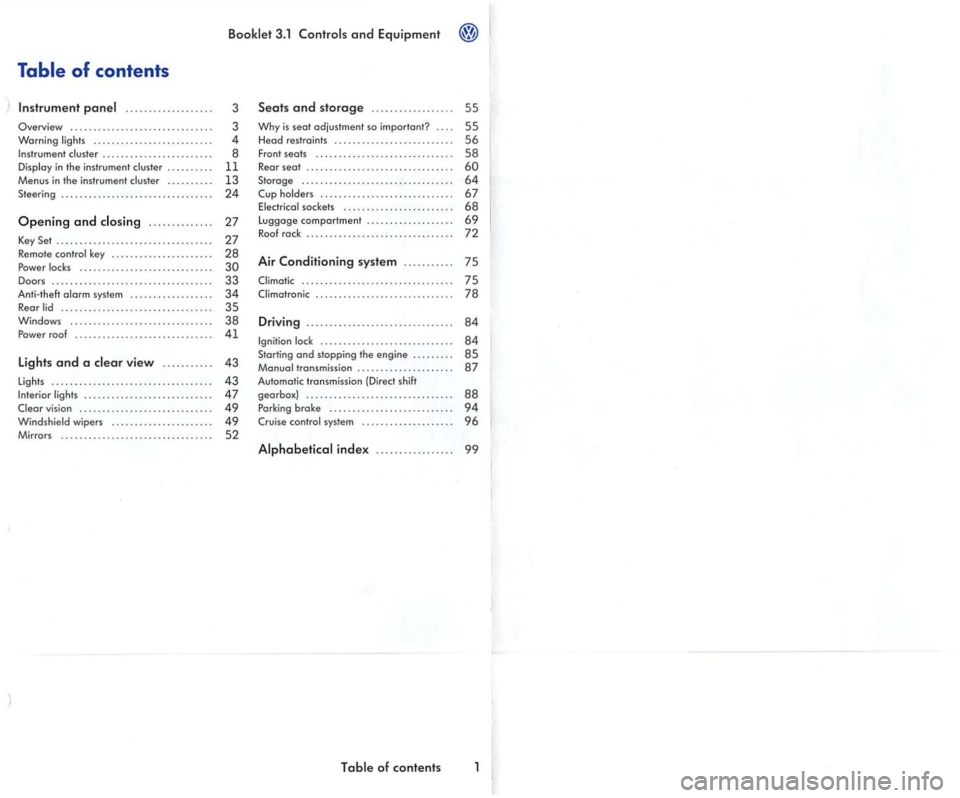
Table of contents
.................. .
Overview .......................... o
Warning ..
.............. ......... . in the instrument ..... o
Menus in the in strum ent
Opening and .... o o
Key Set ........................ o o
Remote
Power ........................ o
Doors ... ...................... o Anti-theft sys tem ............. Rear .......................
Windows ............... .. . Power roof ........
Lights and a view .......... .
Ligh ts ........................... .......
vision .............. o
Mirrors ............................
3ol and Equipm ent
3
3
4
8
11
13 24
27
27
28
30
33
34
35 38 41
43
43
47
49
49 52
Seats and storage ............. .... .
Why is seat adjustment so important? ... .
He
ad re straints .......... ............... .
Fro
nt seats ............................. . Rear seat .................. ............. .
Storage ................................ .
Cup .................. o soc kets ........ o o
Luggage comportment .................. .
Roof rock .....................
Air Conditioning system .......... .
........................ o
Driving ........... o .................
........................... .. Starting and stopping the en gin e ........ . transmission .................... .
Auto matic transmission
(Direct shift
gearbox} ............................... .
Parking
broke ................ ... .
Crui se system ................... .
55
55
56
58
60 64
67 68
6 9
72
75
75
78
84
84
85 87
88 94
96
of contents
Page 191 of 444
and Equipment
Average ruel co nsumption
Miles to empty
Distance trave le d
Average speed
S peed warning
min Driving time
Th e
displa y shows the amount or time that has gone by s ince the ig nition was sw itched on.
The m aximum displa y va lue in both memories
i s 99 hours and 59 minutes. The memory will reset itselrback to zero once thi s va lue has been rea ch ed.
gallons miles km) Current fuel con
sum ption
Th e di spla y w
ill sh ow the consumptio n in gallons (liters) per
book le t3.2 and chapter
0 gallons/100 miles (0 km) Average fuel
consumption
T he ave rage ruel c
onsumption will appear you have drive n approximately ya rds
(meters). Dashes w ill appear in th e displa y that time. The di spla y
Miles Miles {kilometer s) to empty
Th e m il
es ( kilom ete rs) to empty is calc ulated
u sing th e ru el ta nk contents and current ru el consumption. shows how rar the ve hicl e can travel u sin g the same speed and dri ving co ndi
ti o ns as
yo u have
dri ven approxi mately yards ( mete rs).
Dashe s w ill appear in the dis p lay until that time. The disp lay will b e updated every 5 seconds
while the ve hicle is m ov ing.
Speed warning
Th e s
peed wa rning can be set so yo u will see and hear wa rnin g whe n yo u reach the desired speed . For example. this settin g co uld be used to
l e t yo u know iryou exceed the posted speed
limit. When you r eac h the desired sp eed. press on th e multi
fun ction steering wheel. and hold th e button to erase th e sto re d speed.
temperature di splay
T he t e
mperature range is F to to At outside tempera ture s be tween-F and and a (ice warning) appears in addition to the outs id e tempera ture di splay. Thi s symbol ro r approximately 5 seconds and
F
W he n the ve hicl e is s tanding still o r tra velin g at
very low speed s, the temperature di spla yed may be slig htl y hi gh er than the actual outsid e te m
p erature as a result or heat radiate d rrom the engin e.
Roads and bridges can be dangerously icy even the outside air temperature is above r r eez ing.
Jryou use th e outside temperature di sp la y
t o tell you about rrost conditions, remember that roads can even ice over at temperatures above F (+
A lways remember, eve n if the
Neve r rely exclu siv el y on this the outsid e temperature display.
Always reduce your s peed and dri ve with special care under weathe r conditions w hen the c hances that you will encounter icy road surfaces a re greater.
In strument 21
Page 234 of 444
3.1
glove
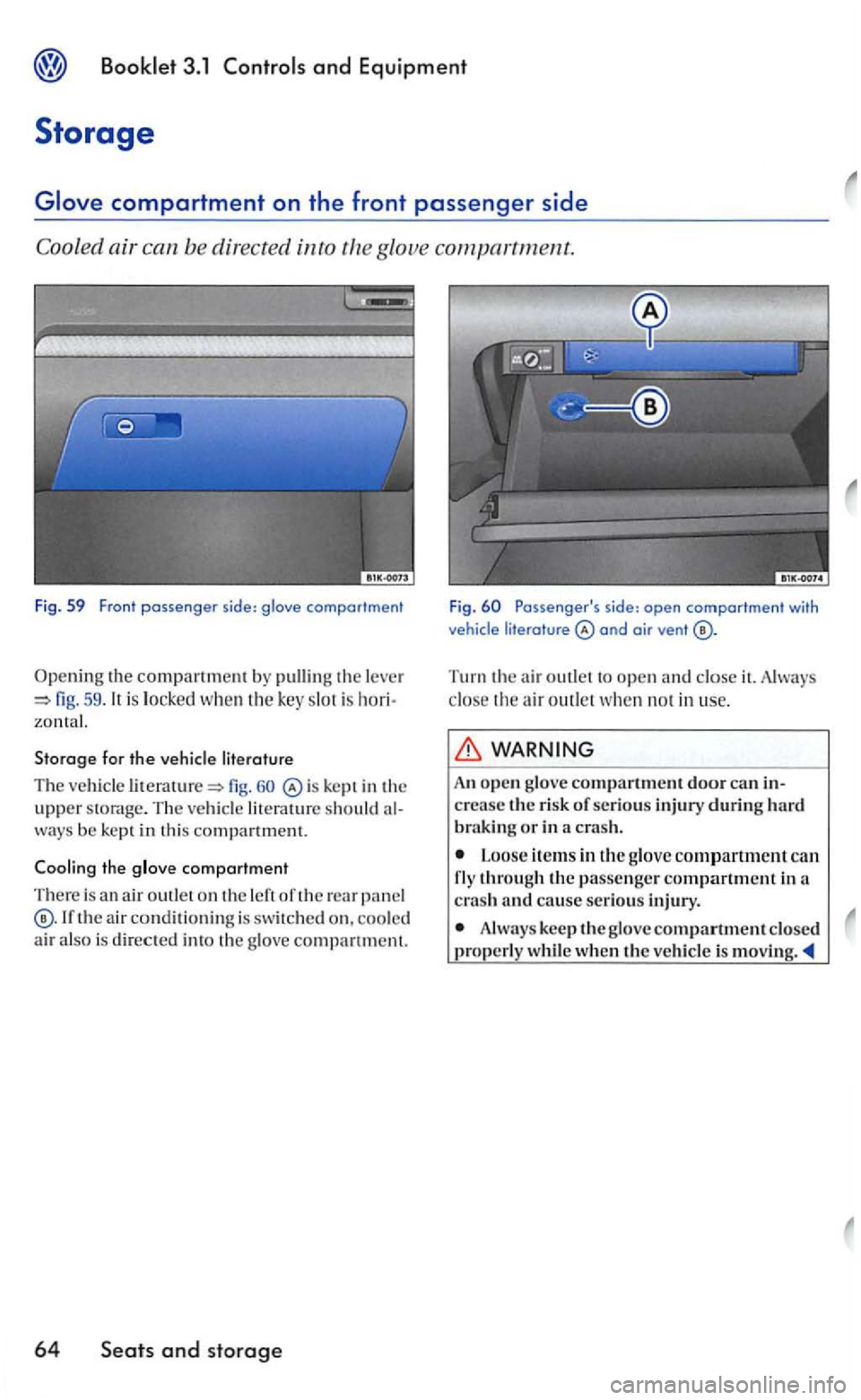
Fig. 59 Front
59 .
kept in th e upper sto rage. T he ve hicl e lit erature should ways be kept in thi s compartment.
Cooling the glove comportment
There is an a ir outle t o n the left o f th e rear panel the air conditioning is swit ch ed on, coole d
a ir a lso is dir ected into the glove compartment.
64 Seats and storage
Fig. Passenger 's side: open comportment with
vehicle literature
Turn the air outl et t o open and close it. Always
close the
air outl et w hen not in use.
A n open glove compartment door can cre ase the risk of serious injury during hard brakin g or in a crash.
Loose items in the g love compartment can fly thro ug h the passenge r compartment in a
c rash cause serious injury.
A lway s kee p the glove compartment closed prope rl y whi le whe n the ve hicl e is
Page 245 of 444
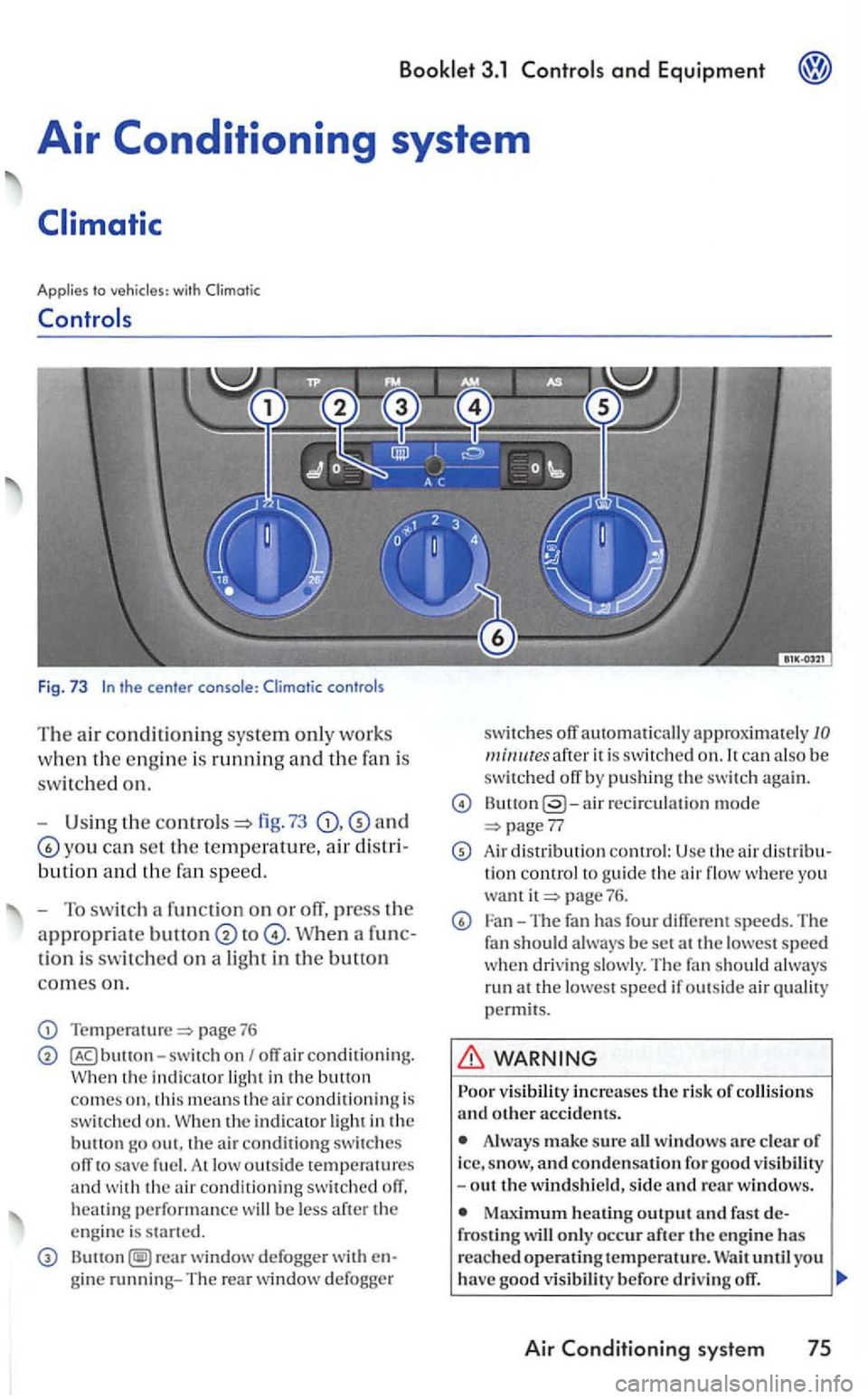
Applies to with
Fig. 73
fig. 73 and
yo u can se t the temperature, air d is t
bution a nd the fa n sp eed.
-
To s wit ch a fun ction on or off, press the
appropriate to
tion is switc hed on a light in the button
comes on.
Temperature=> page 76
switc h on I off air conditioning. the indi cator
the indicator
At low outs id e temperatures and wit h th e air conditioning switched off, heating performan ce will be less
rear window defogge r with
ca n al so b e
s witched off by pushing the s witch again.
air recircu lation mode 77
Air distri bution control: Usc the air d is tribu tion control to guide the air flow whe re yo u want page 76.
Fan-The fan has four different speeds. The
f a n should always be set at the lowest speed w hen dri vin g s lowly. The fan should a lways
run at the l owest speed if out sid e air
Always make sure all windows are clear of icc, sn ow, and conden sation for goo d -out th e winds hield, side and re a r windows .
frosting will onl y occ ur after th e engin e has
rea ch ed operatin g temperature. until yo u
h ave good v is ib ilit y before drivin g off.
Air Conditioning system 75
Page 246 of 444
Thoroughly familiarize yourself with the operation of the heating and ventilation system, including the de fog ! defrost features you
Heating and
(continued)
Always read and heed the informati o n and
all page 83,
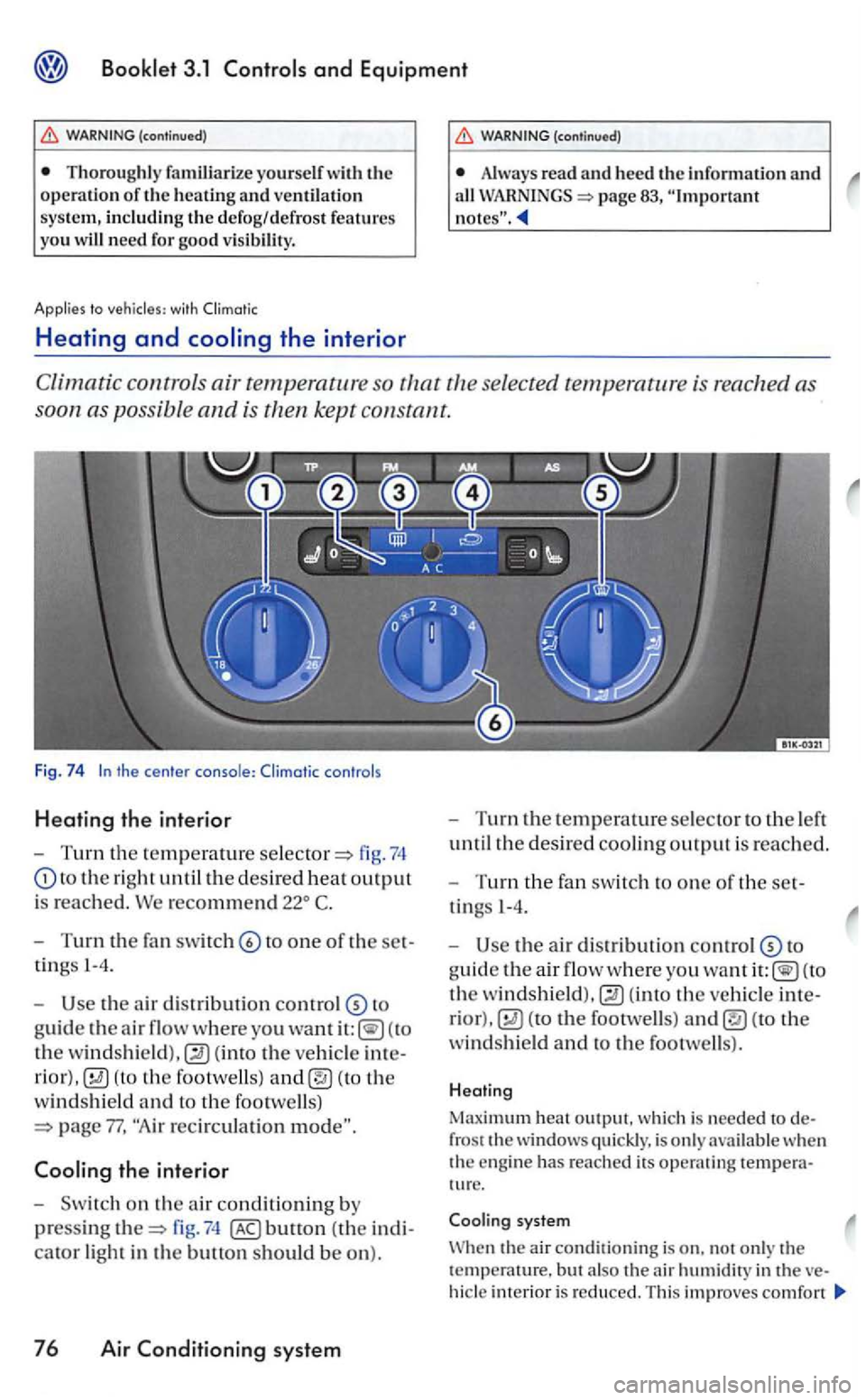
Climatic controls air temperature so that
the center console: Climatic controls
Heating the interior
Tu rn the te mperature g. 74
to the right until th e desired heat output
is reached. We recommend C.
Turn the fa n switch to one of the set
tin gs
l-4.
Use the ai r distribution to
guide the a ir
the
(to the
w
inds hi eld an d to the footwells)
77, recircu lation
fig. 74 (the indi
cato r
light in the button should be on).
76 Air system
Turn the t emperature selector to the left
until
the d esired cooling output is reached.
Turn the fan switch o ne of th e set
tings
l -4.
Use the to
g uid e
the air flow where you want (to
th e
the footwells)
which is needed to defrost the windows qu ickly, is only available when the en g in e has reached its operating temperature.
Coaling system
the air conditionin g is o n. not o nl y th e