engine compartment VOLKSWAGEN GOLF 2006 User Guide
[x] Cancel search | Manufacturer: VOLKSWAGEN, Model Year: 2006, Model line: GOLF, Model: VOLKSWAGEN GOLF 2006Pages: 444, PDF Size: 92.7 MB
Page 325 of 444
Always protect face, hands and arms from hot escaping coolant or steam by covering the cap with a large, thick rag.
(contin ued)
Turn th e cap slow ly and very carefully in a
counter-clockwise direction while applying
light
down ward pressure on the top of th e cap.
Never spill antifreeze or coolant on the haust system or hot eng ine parts. Under some conditions, the ethyle n e glyco l in en gin e
coolant can catch fire.
Checking the
The correct coolant level is important for correct functioning of the engine cooling
system.
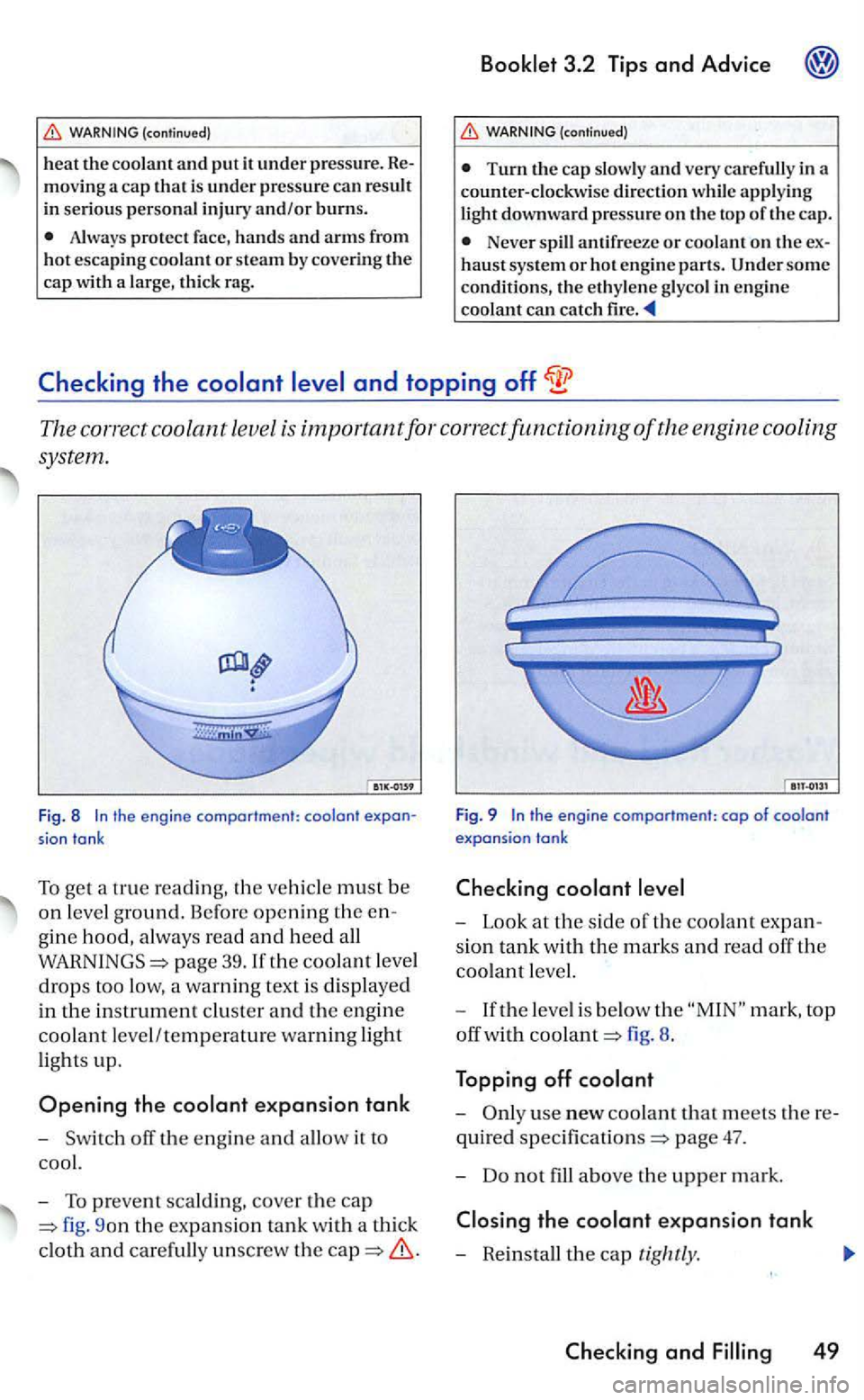
Fig. 8 t h e engin e compartment: coolant
sian tank
To get a true reading, the ve hicle must be
on l eve l ground. Before opening the
gine hood, always read and heed all
page 39.1f the coolant level
drops too low, a warning text is displayed
in the in strument cluster and the engine
coolant leve l/temperature warning ligh t
lights up.
Opening the expansion tank
- Switch
9on the expansio n tank with a thick
cloth
and carefully unsc rew the
Fig. 9 the engine compartment: cap of coolant expansion tank
- Look at the side or the coolant
sion tank w ith the marks and read off the
coolant level.
-
If the level is below the mark, top
off wi
th fig. 8.
Topping off
-
the
and
Page 326 of 444
booklet 3.3 ''Te chnical
page 47. Do not use a diffe rent
t y p e of additive if p lu s is not available. t his case use only wate r a nd bring the coolant concen trat ion back up correct level as soon a s poss ible by topping off wit h s pecified page 47 .
Alway s
mark. the
excessi ve coola nt will b e presse d out of cooling syste m when
Stop! Before working in the engine compartment, always read and heed all
W hen mixed w ith other incorrect additives co lo rofG 12 plus w ill ch a nge brown.
w ill res ult in engine damage!
has been engine coo l engine.
L arge coolan t lo sses are sig n of leaks in the cooling sys tem. Have th e cooling sys tem check ed
Do not add any type of leak sealant
t o your ve hicle's engine coolant. Adding radiator re pair fluid may adversely
The water for cleaning th e windshield shou ld alway s be mixed with windshield
washer fluid.
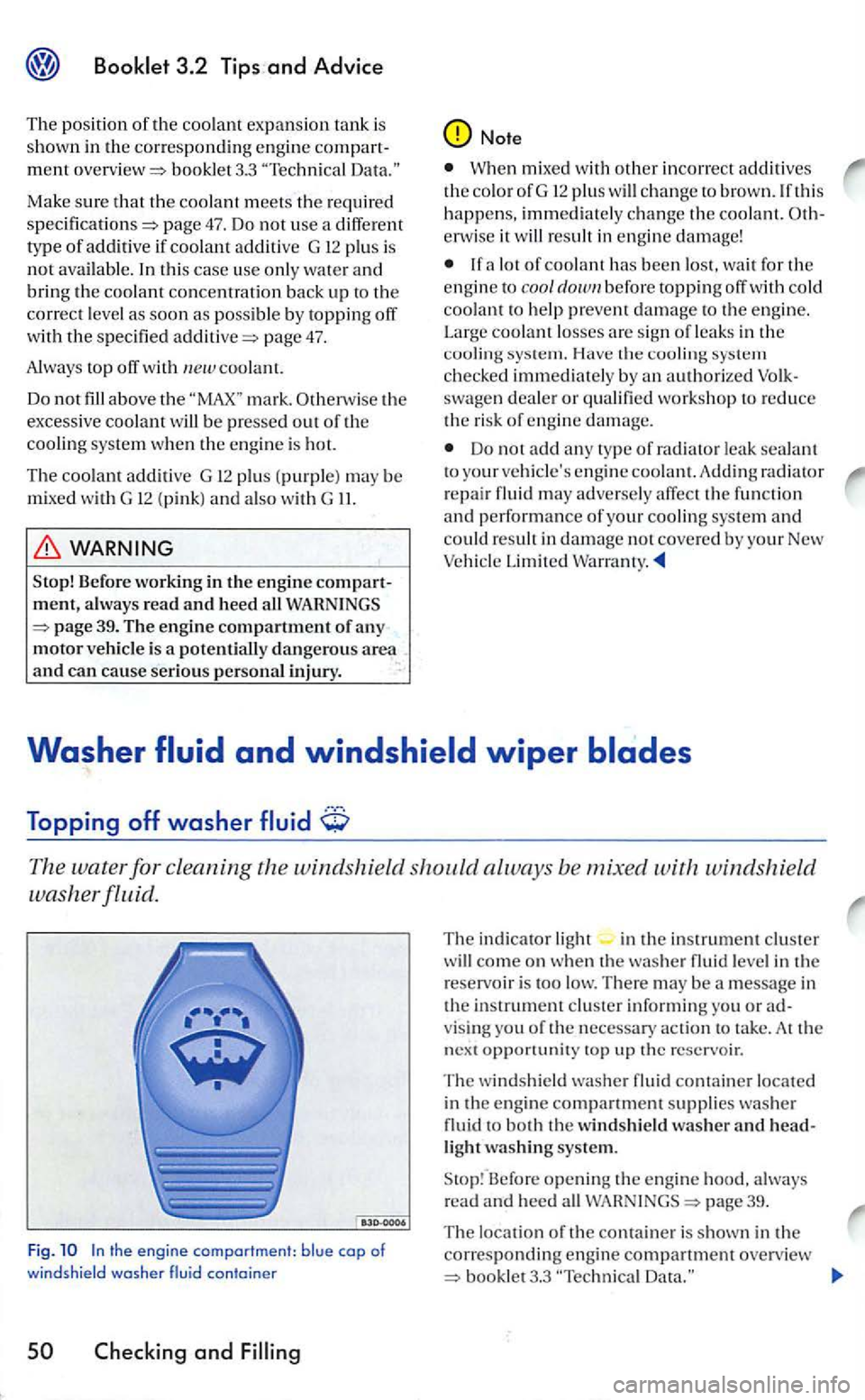
Fig. the engine comportment: b lue cop of w indshie ld washer container
The in dicator ligh t in cluster come on w he n the was her fluid leve l in th e
r eservoir is
cluster informing you or a d
v is in g yo u of the next opportunity top up the reservo ir.
The wind shield washe r flu id locat ed
i n engin e compartment suppli es was he r fluid t o both windshield washer and hea d
li ght washing system.
Before opening the engine page 39.
T he loca
tion of th e conta iner is shown in th e
corresponding engine bookle t3.3 "Tec hnica l
Page 329 of 444
drive if you have clear vis io n through all the windows.
A defect ive or d irt y w iper blade can scratch
t h e rear glass.
Never clean gla ss panel with fuel. nail polish remove r, p aint thinn er o r similar flu ids.
Thi s ca n damage th e w iper bla d es.
Never move the w iper or the wiper arm your hand can dam age it.
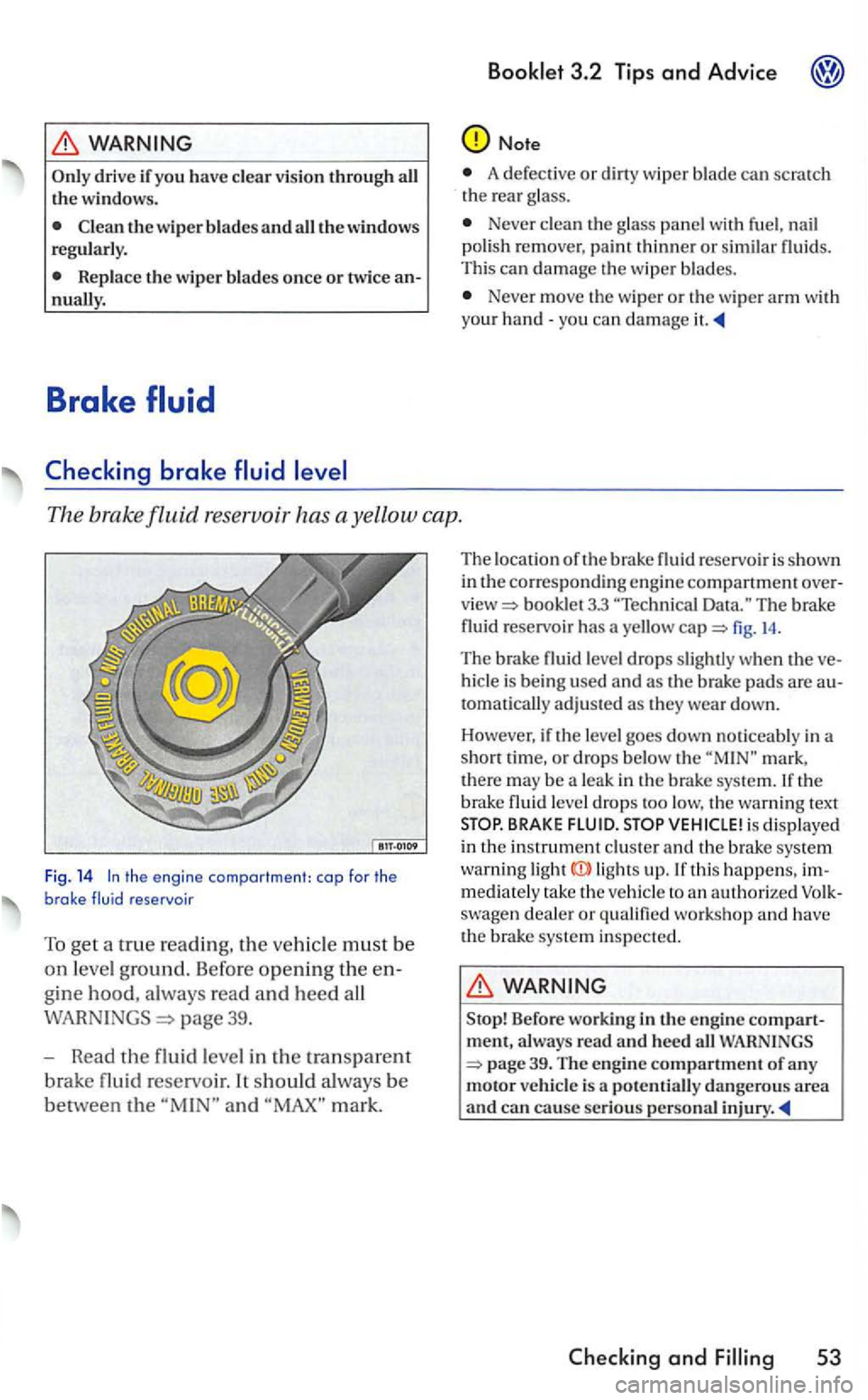
The brak e fluid reservoir has a ye llow cap.
Fig. 14 the engine compartment: cap for the brake fluid reservoir
To get a true reading, the m ust b e
on leve l ground. Before opening th e en
g
ine hood, a lways read and heed all
page 39.
- Read
the fluid leve l in the tra nsparent
bra ke fluid re servoir. It should always be
between the and mark.
Th e lo cation of th e brake fluid reservoi r is shown
in
bookl et 3.3 The brake
fluid reservoir has a yello w fig. 14 .
The brake fluid lev el drops s lightl y when th e ve
hicl e is bein g used and a s th e brake pad s are autom atically adju sted a s they wear down.
Ho wev
er, if th e le ve l goes down noticeably in a
s ho rt time, or drops below th e mark ,
th ere may be a leak in the brake system. If the b rake fluid leve l d rops too low, the wa rnin g text BRAKE FLUID. is displayed
in the instrument clu ste r and th e b rake system warni ng ligh ts up. If t his happens, immediately rake th e ve hicle to an au thorize d swage n deale r or q ualifi ed wo rkshop a nd have
th e brake system inspected.
Stop! Before wo rkin g in th e engin e compartment, a lways read and heed all WARNINGS
53
Page 330 of 444
3.2 Tips and Advice
The brake fluid be changed every two years.
We recommend that you have the brak e changed b y an authorize d Volkswagen dealer.
S top! Be
fore openin g th e e ngin e hood, always
read and heed all page 39.
Brake fluid
absorbs m oisture. time, it will absorb wate r from the air. the wa ter content in the brak e fluid is too high, the brake sys te m
c
ould corrode. Too much wa te r in the brak e fluid
a lso consid erably reduces the boilin g point of the brake fluid. Very heavy use of th e brak es with
old brake fluid may cause vapor lock . Vapo r lock
reduces braking power, in cre ases stopping tances and can eve n cause total brake failu re.
For this r
eason the brake fluid must be repla ced
every two years.
use brak e fluid the s pecification U S standard 116 4. The brake fluid must be new.
Stop ! Befor e working in the engine compartment, always read and h eed all WARNINGS 39. The engine compartment of any motor vehicl e is a potentiall y dangerous area and can cause seriou s persona l injury .
Brake failure can result from old or incorrect brake fluid.
fica tio n
(continued)
A lwa ys check with your authorized swage n deale r to make sure that you arc u sing the correct brake fluid.
The correct brake fluid is also listed on the
labe l on the brak e fluid reservoir.
Always store brake fluid in the closed
To reduce th e risk of poisoning, neve r us e empty food or beverage containers that mi ght mislead someone into drinking from them.
A lwa ys keep bra ke flu id out of the reach of childr en.
Alway s change th e b rake fluid as required in the maintenance bookl et. Heavy braking w ith old brake fluid may cause a vapor lock that reduces braking power, increases ping distances and can even cause tota l brake failure.
Note
Brake fluid can damage the pai nt. Wip e off any
brake fluid from rh c paint immedia tely.
For the sake of environment
B rake fluid
must be drained and disposed of in
th e proper manner obse rv ing env ironmental
Page 366 of 444
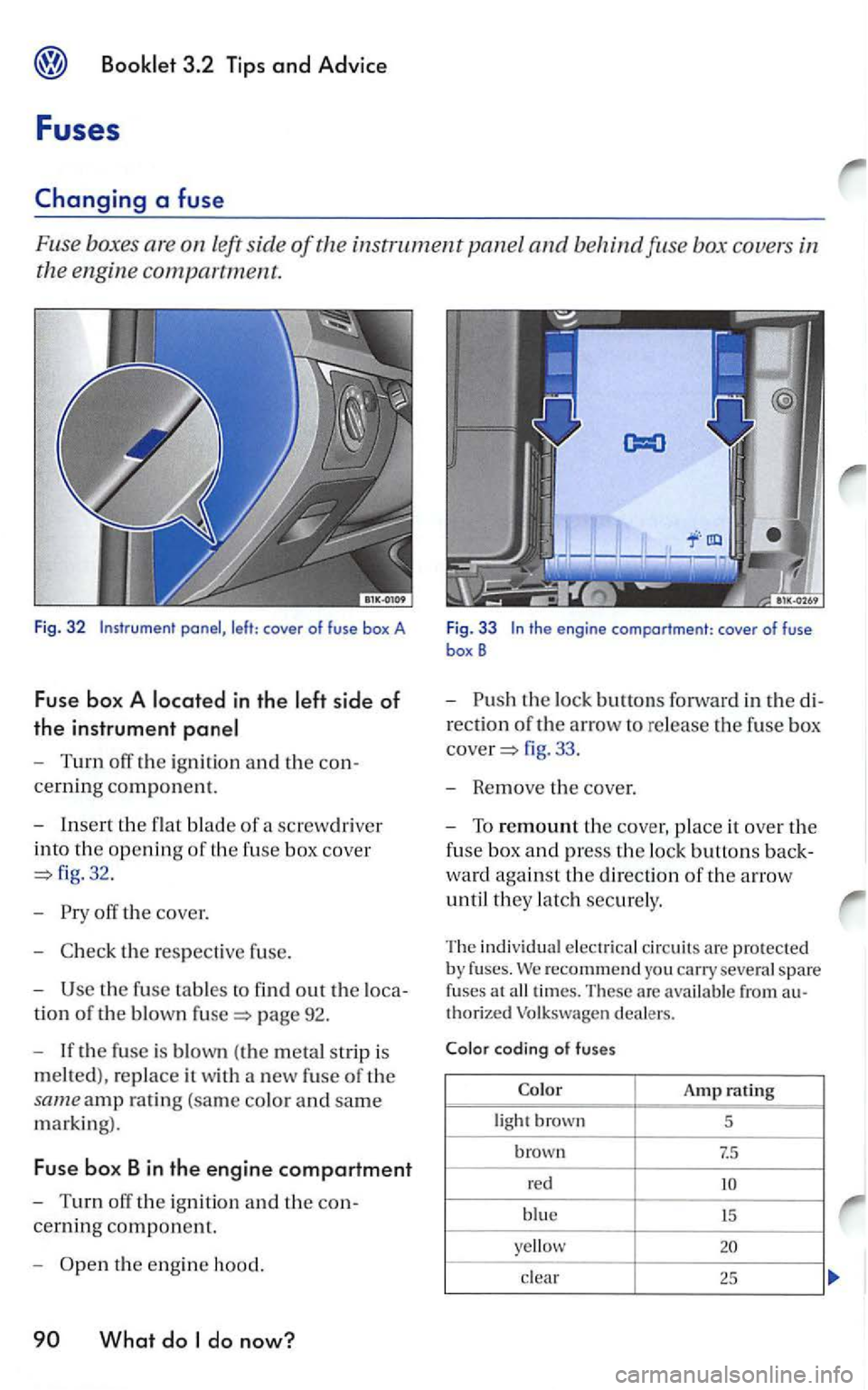
left side of the instrument panel and behind fu se box covers in
the engine
compa rtment.
Fig. 32
- Turn off the igni tion and the con
cerning component.
-
Insert the flat blade of a screwdri ver
into
the openin g of th e fuse box cove r
32.
-
the respeclive fuse.
-
the fuse tables to find out the loca-
tion of the blown page 92.
- If
the fuse is blown (the m etal strip is
melted) , replace it w ith a new fuse of the
same amp ra tin g (sa m e co lo r and sam e
marking).
Fuse bo x Bin the engine compartment
-Turn off the ign ition an d the con
cerning component.
-th e eng in e hood.
fig . 33 .
- Remove
the cover.
-To remount the cover, place it ove r the
fuse box and press th e lock buttons back
ward aga inst the directio n of the arrow
until
they latch securely .
Th e indi vidual electric a l c ir cuit s are pro tected by fuses. recommend you carry severa l spare
f uses at
clear 2 5
Page 370 of 444
Booklet 3.2 Tips and Advice
Changing
Light bulbs should be changed by a qualified technician
m an y cases changing a light bul b
invol ves remov in g other pa ns of the car to
recommen d light bulbs o nl y be chan ge d
b y an authorized Volkswage n dea le r or qual ified workshop.
Before changin g a light bulb. yo u must sw itch ofT the light (lig ht switch in
tical light bulbs w ith sam e s pecificati o ns. The
s p ecifi catio ns arc prime d on the lig h t bulb . ther on the glass bulb or o n th e m eta l base.
is advi sable to alw ay s carry a box of
for traffi c safe ty. swage n dealer for re comm ended light bulbs.
Additional light specificati o ns
light bulbs in the headli gh ts or in verse lights can hav e fac tory-set s pecifi cntion s that diffe r fro m conventi onnllight bulbs. Th e corresp onding model identifi cation is either on the bulb bas e or on th e bulb itself.
LL = LongLife bulbs w ith a lo nger life compared to con ve ntional light bulb s.
Blue =
Light bulbs w ith blui sh -w hite abl e for di scharge light s (Xenon/Bi-Xcno n light s).
Stop! Before workin g in the engine always read and heed all
94 What do
(cont inued)
page 39. The engine compartment of any motor vehicl e is a p otentiall y dangerous area and can cause serious personal injury.
Gas discharge la m ps (Xen on) get power from a high voltage source that can cause rious personal injury and even death if dled improperly.
bulbs arc under hi gh pressure and can exp lode if handled improperly.
Always have a qualified technician r eplace burnt-out light bulbs, especially gas discharge
lamp s (Xenon) and bulbs.
Neve r remove the headlight unless you know exactly how to carry out the job and have the correct tool and li ght bulbs.
yo u arc uncertain about what to do, have the work performed by an auth orize d swagen d ealer or a qualified workshop. rious personal injury m ay result from erly performe d work.
There arc parts w ith sh arp edges on the headlight h ousin g in the en gi ne compartment and on the rear light h o usings.
Do not touc h glass bulb with bare hands. can clo ud the o uter surface of the bul b when thus afTccting the refle ction , and th us reducing the power of illuminat ion.
A bulb can only be re placed b y a bulb of the sam e ty pe . The m odel identifica tion is either o n the bulb base or on the bulb itself.
Page 377 of 444
If th e e ng ine docs not stan, rum off the aft er ab o ut se cond s a nd try again about seconds.
39. The engine compartment of an y
motor vehicle is a potentiall y dangerous area and can cause seriou s personal injury.
tery explos ion:
Always make sure that the battery viding starting ass istance has the same voltag e as the di scharged battery (12 V) and
appr oximate ly the same capacity (see battery
lab el).
Never jump start a ve hicl e wit h a fro zen
battery. The battery can explode. If a battery i s or h as been frozen, re place it.
Batteries give off exp losive hydrogen gas.
Always keep sparks, open flame and
s moking mate rial s away from batteries.
(continued)
Never short out the battery poles by necting the positive and negative pole s
with each other.
Always follow the jumper cables '
Never connect the negativ e cable from the other vehicle directly to the negativ e terminal of th e di sc harged battery. The hydrogen from the battery is exp los ive.
Never attach the negativ e cabl e from the ve hicl e provid.ing starting assis tanc e to parts of the fuel system or to the brake hoses or brake lines.
Never the non-in sulated parts ofthe battery clamps to touc h. Never allow the jumper cable attached to the positive battery
terminal to contact metal parts of the vehicle.
Always rout e the jumper cables so that
they cannot tangled up w ith moving parts in the engin e compartment.
Note
Install ing jumper cables imp roper ly can
ca use expe nsive damage to the vehicl e's trical system.
Do not let the vehicle s tou ch each othe r. e rwise current could flo w between th e cars as soon as the plus(+) te rminal s arc
What do
Page 385 of 444
Allo y w heels 26
Auto m
atic car w as h 22
Bumper 23
27
seat cove rs 29
Engine
compartment 27 Exterior 22
Fabric
trim 29
Instrument panel 28
Leat her 29
Outside mirrors 25 part s 28
belt s th e ve hicl e 22
25
tri m 28
and protection 2 1
scat covers
29
numbe r
For anti -
theft wheel bolt s
pressure 6 1
47
L eve l 49
L
oss 49
light 48
temperature
in structions 48
Tr
ailer t o w in g 48 light 48
recorders 34
D
Da ta Link for agnosti c II
D etermin in g correct load limit 71
D ifferentia l lock 6
D rive
econom ically 19
D rive
economi cally and he lp protec t th e environment 19
D
riving o u ts id e of the or Precautions
3 .2 Tips and Advice
light 5
Elec tron ic di
fferential lock 6
Electroni c
Control 9
Electronic
Stabili zat ion
How it work s 6
Em erge ncy
Lockin g drive r's door 88
Opening leve r for the rear lid 89
Unlo ckin g
driver's door 88
Emergen cy clos ing 88
E m erg
ency locking doors 88
E m erge ncy op
ening 88
E m erge ncy
unlocking of rear lid 89
E ngin e
Break-in 12
E ngine
compartment
27
Pr eca utions yo u s ho ul d tak e when working inside th e engine compartment 39
I add pl ain water to the engin e
c o ol
ant?
losses
light 4 1
E n gin e m a
nagem ent 9
E n gin e oil 42
Adding 45 Additi ves 46
leve l 44 43
Dip stick 44
How do I k now how much oil my engine is consuming? 43
c h an ge 46
Specificati on s 42
S pecificat i
ons gasolin e engine 42 kind of engine oil should put in my
ve hicle? 42
Page 386 of 444
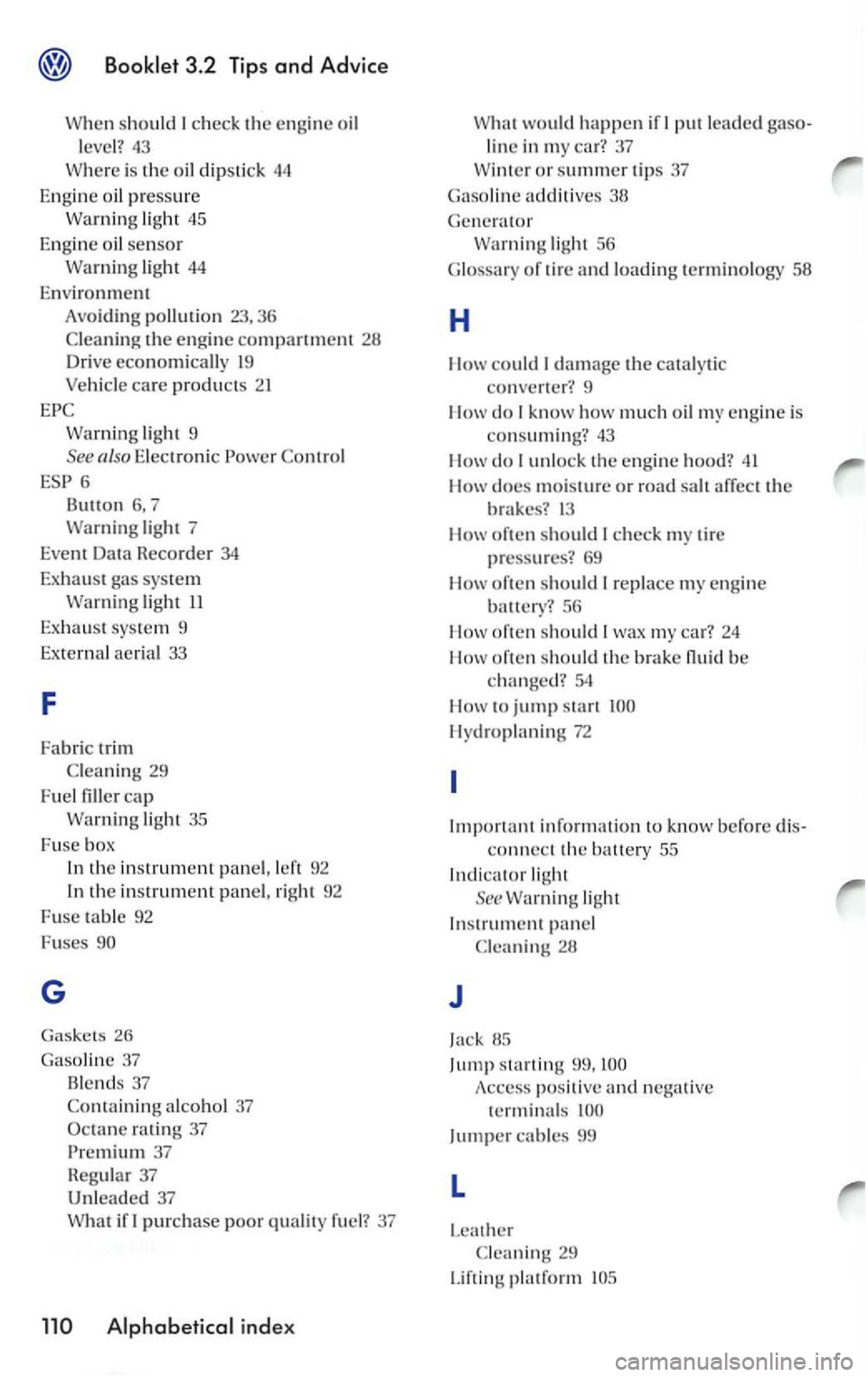
sh o uld I check the engine oil
level? 43
ligh t 45
Engine oil sensor li g h t 44
Environment Avoiding pollution 23, 36
the eng in e compartment 28 Drive economically 19
light 9
also E lectron ic
light 7
Even t Data Hecorder
34
Exhaus t system
light II
Exhau st system 9
Externa l
aeria l 33
F
Fabric trim
light 35
Fuse b ox
I n the in strument p anel , left 92
In the in strum ent pan el, rig h t 92
table 92
Fuses
G
Gaskets
Gasoline 37
Blends 37 alcohol 37
rating 37
37
Hegular 37 Unleaded 37 ifl purchase poor qua lity fu el? 37
woul d happen if I put leaded gaso
l
ine in my ca r? 37
or summer tips 37
Gasoline addi tives
Generator light 56
G lossary oft ire and loading terminology 58
H
I low co uld I damage the cata lytic
conve rter? 9
I low do I know how much oil en gi ne is
consuming'? 43
How do I unlock the en gine hood? 41
How doe s moisture or road salt affec t the brakes? 13
How ofte n should I check my tire
pressures? 69
How often should I replace my engine
battery?
56
How oft e n should I wax my 24
I low ofte n should th e brak e nuid be
c h anged?
54
I low to jump start
light
I n st
rument pane l 28
J
Jack
Jump starti n g
Access positive and negative
terminals
Jumper cables
L
Leather