engine VOLKSWAGEN GOLF 2007 Workshop Manual
[x] Cancel search | Manufacturer: VOLKSWAGEN, Model Year: 2007, Model line: GOLF, Model: VOLKSWAGEN GOLF 2007Pages: 444, PDF Size: 92.7 MB
Page 289 of 444
Booklet 3 .2 Tips and Advic e
recommend that you have the
thi ckne ss of your brake pads checked by an au
t horized Vol kswagen dealer mo re fre quent ly
t h an recommende d in the serv ice sched ule.
you drive with wet brakes, for example afte r a
dri ving through water, after heavy rainfall or after washing the ve hicle, braking power be
reduced and s to ppin g distances will be longer
because the brake discs will be we t or in winter mayb e eve n frozen-the brakes must be dried
with several ca re ful brak e applicatio ns.
Brak e fluid absor bs water
and must be changed
every two years. Heavy use of the brakes can cause vapor lock if the brake fluid is too old.
Vapor lock redu ces braking power, increases
stopping distances and ca n even cause total
brake failure.
New tires and new bra ke pads do no t pro
v id e m aximum gri p, control o r b raking abil ity.
To red uce the risk of l osi ng control, a s io n an d se rio us perso nal injuries, drive with
specia l ca re for the first 350 miles (560 km).
New brake pads do not have th e best sto p
ping power for the fir st ISO mile s (240 km ) and
m ust be b roken in. can compensate for the slightly reduced braki ng abil ity by dri ving care and applyin g more pressure on th e
brake pedal.
Never follow oth e r veh icles to close ly or
p u t you rse lf in to other s ituations th at might
requ ire su d den , hard bra king especially when the brake pads have not been broken in.
apply brakes for a test.
Always dry brakes and clea n off icc coat
i ngs an d salt coatings with a few cautious brake applications.
A lways read and heed in in tire s and brake on page 12.
Always avoid overheati ng the brakes!
When driving downhill, t11 e brakes have to
work har d and h eat up quickly.
Before driving down a lo ng, steep hill, al
ways reduce speed and downshift to a lower
gear. This will let the vehicle usc engine
Always ch ange th e brake fluid at l east
every two years. Hard braki ng wi th o ld flui d may cause a va po r lock . Vapor loc k duces powe r, inc reases stoppin g di stan ces and can even cause tota l b rak e failure.
A damaged front spoiler or n ew non standard spoiler can reduce t h e airflow to th e
brakes and cause them to ove rh eat.
Always see an authorized Volkswag en
dealer or qualified workshop
Be sure to re ad and heed all and th e page
Driving and protecting the environm ent 13
Page 291 of 444
WARNING (c o ntinu ed )
Alwa ys read and heed all W ARN IN GS an d additional information regarding sa fet y booklet 2 . I
yo u plan to tow a
tr ailer, p lease re m ember th a t yo ur car will be performing a serv ice for which it was not
ra b ility, ha ndl ing, econ o m y and performa nce.
Tra
ile r towin g not o nl y places more stress on the ve hicl e, it als o calls fo r more concentratio n fr o m the driver.
For these re a so ns, always follow th e o pe ra ting
and d rivi ng instructio ns given and use common sense.
Trail er hit ch
trail er hit ch on your ve hicle.
D o not use a bumper hitch.
The hitch must be installed so, it does not
interfe re the impact-absorbin g bumper system. Do not make any ch an ges to th e ve hicl e
ex haust and b rake system s. Fro m time to tim e, check that all hi tch-mounting bo lt s remain curely fas te ned .
When you are no t towin g
Engine cooling system
Tow ing a tra iler makes the engine wo rk ha rder. is important that th e engine cooling system is u p
t o the job. Ma ke s ure that th e coo ling system has enough fluid .
Traile r bra kes
Never connect the tr a iler light syste m direc tly to the light syste m of your ve hicle . Be su re to check wit h your authorized Volkswage n dealer for rec t w iring, switches
you alwa ys have clear v is ion to th e rear.
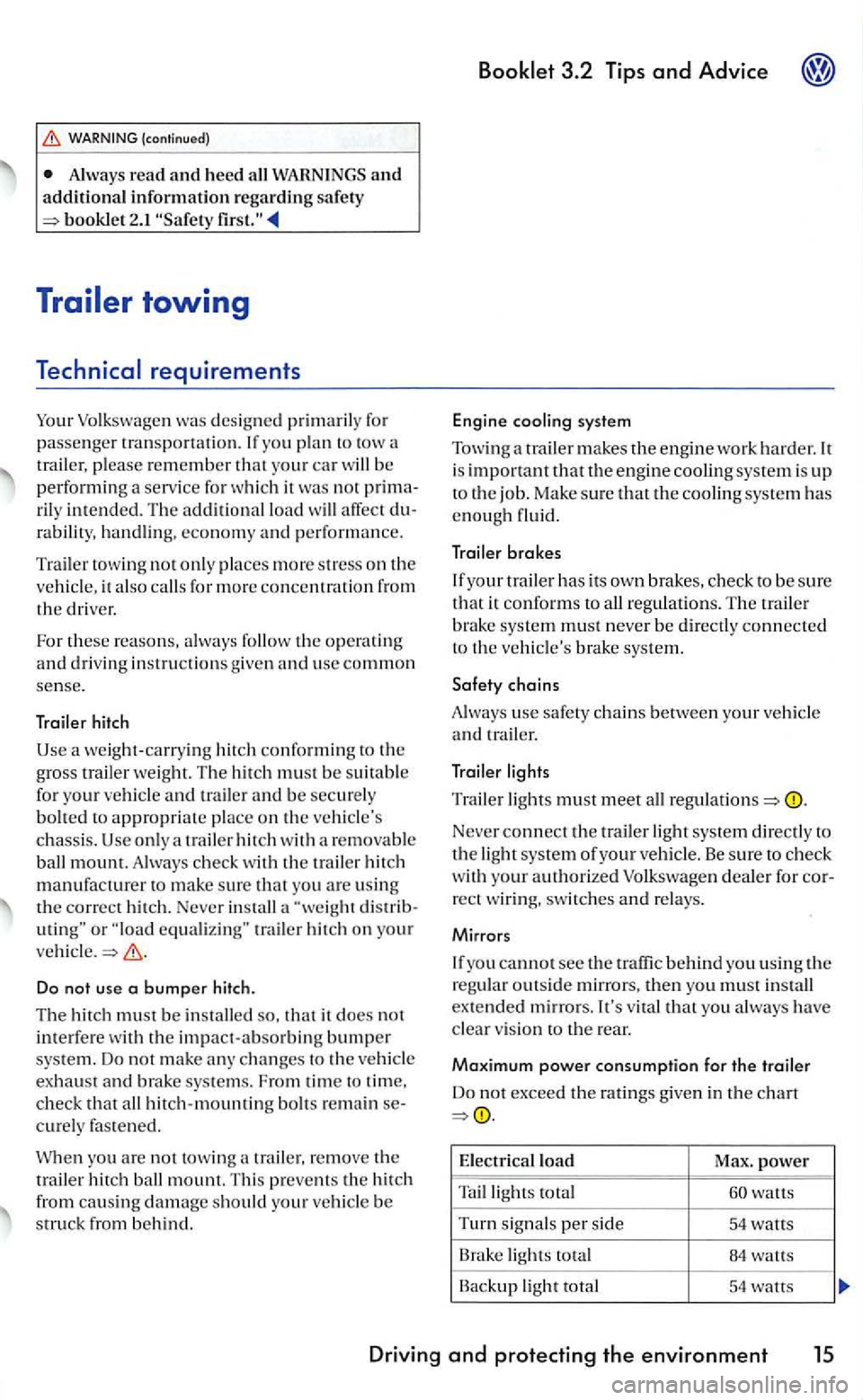
Maxim um power consumption for the traile r
Do not exceed the ratings given in the c hart
E lectric al load
Max . power
T ailligh ts total watts
T urn sig na ls p
er sid e 54 watts
B rak e lig hts total 84
Backup light total 54 walls
Driving and protecting the environ ment 15
Page 293 of 444
Safety chains
Be sure trailer safe ty cha ins are prop erly necte d fro m the trailer to th e hitch on th e hicle. Leave enoug h slack in th e c hain s to turn
corners. When you install safety ch a in s, mak e sure they will not dragon th e road whi le you are
driv ing.
Th e chains shou ld c ross
under th e trai le r to ng ue
to prevent it from dropping to the ground in case of separa tion from the hit ch .
Electronic Stabilization
Always leave th e mak es it easie r to stabilize the
t railer sho uld it start to swerve or sway.
Always adjust your speed and driving style to
road, traffic and weather conditions. Never le t the extra safety that and
A rig is eas ier to o pe rate and trol. Thi s means that th e tow vehicle should be loaded to the exte nt possibl e and permi ssibl e
w hil e keepin g th e t raile r as lig ht as possibl e under the ci rcumstances . Whenever possible, tran sfe r so me cargo to the luggage compartm ent
o f th e tow vehicle whil e observ ing tongue load requireme nts and ve hicl e loading ation s.
The hig her th e spee d, the more diffi cult it comes for the driver to control the rig. Do not drive at the maximum permissible
Always appl y brake s early . W hen dri ving
downhill , down shift into lower gear (selector leve r positi on
The cooli ng effect of th e fa n cannot
b e in cre ase d by dow nshif tin g because fan speed
i s independent of engine speed. Therefore,
Riding in a trailer is dangerous and may be
A person who is not properly restrained in
a moving vehicle risks serious personal injury and even death in a crash.
Never let anyone ride in your vehicle
without being properly restrained .
Never allow a passenger to rid e in a trailer.
Exceed ing the maximum permissible weight ratings and maximum permissibl e trailer
weights can result in accident s leading to rious personal injury.
Never le t the actual Gross Axle W eight Rating at the front and rear axles exceed the
permissible weights. Also never let their bination exceed the Gross Weight
Rating.
Always remember that the vehicle's
w he n dri vin g uphill, you can alwa ys drive in the
hi ghes t possibl e gear wit h low engin e speed. the coo lant tempe rature warni ng light in th e strument clu ster start s flas hin g in red, pull off
th e ro ad, s top and let th e engine idle for ab o ut 2 minutes to preve nt a heat buildup and eng in e
damage.
R educe your speed even more under vorab le load , weather or wind conditions
particularly when going downhill.
Be especial ly careful when passing other vehicles. Reduce vehicle speed immediately if the trail er shows the slightest sign of sway ing.
N ev e r try to stop the sway ing by ating.
Always heed speed limits.ln some a reas speed limits for vehicle s towing
Driving and protecting the environment 17
Page 294 of 444
Booklet 3.2 Tip s and Advice
vehicl e handles diff ere ntl y wh en towin g a
tr ai ler because of the additional weigh t and weight distribution. Safe ty, pe rform ance and econo m y will greatl y depend on how carefull y
yo u load your trailer and op erat e your rig.
Before you actually to w your trail er, p ractic e
turning. stopping and b ack ing up in an area away from traffic until learn the feel of your vehicle and trail er unit.
Backing
up i s diffi cult and requi res practi ce.
Stee rin g whil e backing up is gen erall y opposite of that when backin g your vehicl e with out a
trailer.
Keep
more distance between your vehicl e and the one in front of yo u. will need more room to stop.
To compensate for the trail er. you will need a
larger than normal turning radius.
When passing, remember that you cannot erate as fast as you normally would because of the added load. Make sure yo u have enough
room to pass. After passing. allow plenty of room for you r trailer before c hanging lanes again.
Avoid je rk y s tart s, sharp turn s or rapid lan e changes.
Parking
After parking. always block th e wheels of both ve hicl e and trail er. Do not park with a traile r on a slope. If it cannot be a voided, do so only after doing th e follo wing:
Apply fo ot brake .
Have someone place chocks under both hicl e and trail er whee ls .
With the c hock s in place, s lo w ly re lease brak es until wheel blo cks absorb the load.
Turn w heels to curb (ve hicl e facing downhill)
o r to the stre et (when facing uphill).
Appl y parkin g brak e firmly.
automatic transmi ssion in
If you move the selecto r leve r of the automatic tran smission to
position.
Restarting
When restarting after parkin g on a slop e, reverse
the proc edure:
S tart the engine.
S hift transmission into gear.
le a se the parking brake and slowly move away from the wheel block s.
Stop and hav e someone re trie ve the wheel
b lock s.
Note
Neve r to w trailer during the break-in period of your vehicl e.
If yo u tow a trailer , yo ur Volksw age n m ay quire more frequent maimenance due to the
ext ra load.
Always check local reg ulations regardi ng
trailer to w in g.
Applies to vehicles: with anti-theft a larm system and a traile r towing set
Linking your trailer to the vehicle's anti-theft alarm system
The anti-theft alarm syste m will be triggere d as soon as the ele ctrical connec tion
between the trailer
and
or qualified
wo rkshop, if you want to inte grat e your trai le r to th e ve hicle's anti-theft a larm
Connecting your trailer to the anti-theft alarm syste m
If yo u ve hicle was built to include both the th eft al arm system and a trailer towin g th en t he trail er towing package (if available) is
in tegrated into the anti-theft alarm sys te m . Thi s
18 Driving and protecting the environment
Page 295 of 444
is what you mus t do if you going to tow
Inse rt the trailer connector completely into the vehicle trailer socket.
Lock th e ve hicle with the remote key.
The trail er is now integ rat ed int o th e theft alarm system
For more information about the anti-theft alarm bookl et3. 1 chapter "Anti -theft Alarm
Disco nnecting your trailer from the anti-th eft
alarm system
Unlock th e vehicle with the remote key.
The anti-theft alarm sys tem is now ofT.
Note
Mod ify ing the electrical system improperly can cause expe nsive damage to the veh icle's trical sys tem. recommend yo u have your thorized Vol kswagen dealer o r qualified
driving sty le,
Co nditions of use (wea ther, road s urface) .
Technical conditions.
Think ahead when driving
A ve hicl e uses most fuel when accel erating. If
yo u think ahead when driving. you need to brake less and accelerate less. pos-
Regular servicing
B y having your vehicle serviced regularly by a authorized dealer you can es tabl is h the basis for a good fuel economy even you start drivin g. v iced e ngine give s yo u th e be nefit of better fuel
efficie ncy as well as maximum re liabilit y and greater resale value. B
y
adopting an economica l driv ing style and ticipat ing the traffic ahead, you can easily duce fuel consumption by Thi s section sug ges ts som e w ays to reduce th e impact on th e
e nvironment while reduci ng operatin g costs at
the same
s ibl e, let the vehicle roll slo wly to a stop. for
light is
A n engine that is no t properly maintained can usc up to 10% more f uel than necessary.
the oil level every time you get gas consumption dep ends la rgely on the e ngin e load and engine
Driving and protecting the environment 19
Page 296 of 444
3.2 Tips and Advice
A cold engine use more fuel until its operating temperature at whic h fuel
Warranty coverages
Volkswage n is covered by the warranties:
Limi ted Warranty Again st Corrosion tion
Emiss ion Control Warranty
consumption will improve. Also impo rtan t is the outsid e temperature. The colder the outside temperature, th e g reater the fuel consumption.
Em iss ions Warranty
Califo rnia Emissio ns Control Warranty
Emissions
20 Driving and protecting the environment
Page 303 of 444
Improper us e of power was hers can ca use riou s, invisib le and permane nt tir e damage leading to tire failure and los s of vehicle
Neve r wash tires with a jet that sprays the water out in a direct strea m eve n from a ta n ce or fo r a v ery sh ort time.
3.2 Tips and Advice
tances.
Carefull y apply brakes for a te st.
few cautious brake applicat ions.
A lwa ys read and heed all 13,
The underbody of the ve hicl e is coated to help prot ect it from corrosion and
damage.
The undercoat ing could be da m age d during
normal use but, particularly when dri vin g
road. recommend th at the undercoa ting un
th e ve hicle and the prot ective coat ings on th e
s u sp en sion be in sp ec te d, an d re paired if n eces
sary, bef o re and after the winter season.
R
epair wo rk and additio nal undercoating
s hou ld be carried out onl y by an a uth orized Volkswage n deale r or qualified workshop .
the engine compartment
The sys tem gets very ho t when the hicle is drive n and can cause fir e res ultin g in serious pe rso na l injury.
Neve r a ppl y additional undercoating or rust proofin g on or near the exl ta u st manifold,
exl ta ust pip es, catalytic conve rter or heat shie ld s.
Be especially carefu l w hen cleaning the engine compartment!
Anti-corrosion treotment
The engine compartment is treated at t h e page 39.
Good corro sion protection is pa rti cularl y impor
tant in th e w inter where road salt is used. To ve nt salt damage , th e en tir e e ng in e ment should be th orou ghly cleaned befor e and after th e salt ing perio d.
Your authorized
Volk swag en dealer has th e right cleane rs and prese rva tives and th e
ommend hav ing this w ork perform ed by an thorize d Volkswage n dea ler.
Corr osio n prot ection i s re mov ed when th e engin e compart m ent is cleaned with grea se
s ol ve nts. th e engin e is cleaned , m ake s
ur e th at corrosion protec
tion is app lied to surfaces, seams, jo in ts and co mponents in the
e n g in e compartment.
Plenum
Remove leaves from th e plenum in front of the w indshie ld unde r th e e ngin e hood. Hcmovi ng
l eaves and d ebris reg ularl y he lp s preve nt th e
wate r dr ain ho les from beco min g bloc ke d, and it
h elps to preve nt debris from gettin g in sid e th e
ve hicl e throu gh th e heati ng and ventilation ducts.
The en gin e compartment of any motor ve hicl e
is a potentially dangerous area and can cause seriou s perso nal injury .
Page 304 of 444
WARNING (continued)
partment.
Always le t the engin e cool down ple te ly befor e opening the engine
hood. Hot components will burn skin on
W hen the engine has coo led dow n and you are ready to open the eng in e hood:
- He move
the key from the ignition.
- Appl y th e
parking brak e firml y and put the selector in
-Keep c hildr en and others away from the vehicle.
WARNIN G (cont inued)
Neve r reach into the a rea around or touch
th e radi ator fan. w it h th e blad es can
r es ult in seriou s personal injury. Always
moved from the ign ition.
For the sake of environment
gre a se and oil dep osits can r un off when th e engi ne is was hed. The polluted waste water must pass th rough an oil se pa ra tor before posal. Have the engin e cl ea ned only by an
- Use a cl ean, damp cloth to clean plastic
parts and th e in strument panel.
- If thi s does not work, use a special
WARNING
so lvents on surfaces where airb ags are located can change the way airb ags deploy in
a crash.
with woode n interior ri m
thi s does not provide sa tisfac tory
sults, use a gentle soap solution.
28
(con tinued)
Neve r clean the instrument pan el a nd the
s u rfaces above airbag modul es with cleaning
products containing so lvents.
contain ing solvents will change
the p roperti es of the plas tics and may cause pla stic parts t o break and fly around w he n the
a irbag deploys in a cras h causing injury .
Note
products th at contain so lvents will damage plas tic mate ria ls .
product s that contain solvents will damag e plas tic materia ls .
Page 310 of 444
3.2 Tips and Advice
Notice about data recorded by
sta te laws restrict the re tri eva l or down
load ing of data stored by EDH's that were in
s talled in a ve hicle for the exp ress purpose of re
tri ev ing data after an accident or crash event w ithout the consen t.
A lth
ough you r ve hicl e is not equipped w ith an EDH. it is equipped with a number of electronic control modules for various veh icle sys tems su ch for example. engine function. em iss io n control, as well as for the a irb ags and safe ty
b elts.
T h
ese electronic control modules record ve
hi cle -related data during normal ve hicl e opera
tion for diagnostic and repair purposes. Therecording capacity of the electronic control module s is limit ed to data (n o sound is recorded ) and
only a small amount of data is actually record ed
over
o f the data then stored may re late to ve hicle speed, direction. braki ng as well as restraint system use
only be read and downloaded with spe
cia l equ ipment.
your ve hicle is equ ipped with the necessa ry te lemet ry equipment and you have subscribed to the appropriate service.
your veh icle's location will be transmitted to the service center. Additionally, the occurrcnccofnn incident in which airbagdeployment been registered will be automatically signaled to the service center to e nable emer ge ncy serv ice or other assistance to be di spatched to your location if needed. For more inform ation refer to your Telematics Serv ice Agreemem with
34 Accessories, new part s, repairs and modification s
Page 312 of 444
Booklet 3.2 Tips and Advice
display come s on, turn off the engine and
t ig ht en th e fuel filler cap prop erly.
the cap is prop erly and comple te ly closed
a nd the ig nition has been switc h ed on agai n th e
wa rning message will disappear after abo ut
Improper refueling or handling of fuel can
cause fire, e xplosion and severe burns.
Always make sure the fuel cap is sc rewed
o n
Fuel is hi ghly flammable and can cause
eling and/or to insert the pump nozzle fully
into the filler neck could cause fuel flow and fuel s pray. Fuel spray and flowing fuel are dangerou s beca use they can cause fire or serious injury.
For safe ty reason engine must be turned off when refueling .
Never use a ce llular te lephon e or radio w hile refueling. The electrom ag ne ti c tion can caus e sp arks that can ig nite fuel pors and cause a fire .
Never get back into your ve hicl e while eling. If in exceptional circumstances you must ge t back in your vehicl e while refu eling, make ce rtain that you close door and touch metal to di scharge stati c electricity for e tou chin g the filler nozzle again. electricity can cause sparks can ignit e fuel
vapors released during refuelin g.
Never smoke or h ave an open flame where in or near you r vehicle when refu elin g or fillin g a portable fuel container.
36
For your safety, we strongl y recommend that you do not travel with a portable fuel
cially in cras h.
If , under exceptional circum stances, you must transport a portable fuel co ntain er,
pl ease observe the foUowing:
- Never
fill a portable fuel container while
it is anywhere in or on the ve hicl e (for ampl e, in the lu ggage compartment, or on the trunk). electricity can build up while filling and can ig nite fuel vapors
ca usin g a fire.
- Always pl
ace a portabl e fuel container on ground b efor e
-Alway s keep the filler nozz le co mplet ely
in side the portab le container b efo re and during fillin g.
- If filling a
portable container made of
metal , the filler nozzle must a lway s be in
contact with the container. This will help prevent static e lec tricity from disc ha rgin g and ca use a fire.
- Never
cial laws regarding the use, storage and transporta tion of fuel containers .
- Make certain
the fuel container meets
industry standa rd s F852-86).
Remove fu e l spills f rom the paint ately to prevent pai nt dam age.
Never run the tank completel y dry. An ular gas supply co uld cause misfiring. A s res ult ,
u n burn ed ga s co uld get into the ca ta lytic vener a nd cause damage .
For the sake of environm ent
Do no t try to p ut in more fuel after the au to m atic fille r no zzle has switched off; this may ca use fuel to over flow and pollut e th e enviro nment parti c-
ularl y when it ge ts hot outside.