automatic transmission VOLKSWAGEN GOLF 2009 User Guide
[x] Cancel search | Manufacturer: VOLKSWAGEN, Model Year: 2009, Model line: GOLF, Model: VOLKSWAGEN GOLF 2009Pages: 516, PDF Size: 105.12 MB
Page 283 of 516
Brake system malfunction
you brake and find that vehicle doesn't brake
nearly as
come on
and a m essage may appear in the instrument ter display. you believe the vehic le is safe to
d rive, immediately take it to the nearest authorized
Volkswagen dealer or authorized Volkswagen
Service
f or repair. Drive slowly and very
carefully , for the longer stopping distance ,
and be ready to push longer and harder on the
brake pedal to slow the vehicle down.
Brake booster
The brake booster works only when the engine is
running . in creases the force on the brakes above
and beyond the pressure put on the brake pedal by
the driver .
New brake pad s do not provide maximum braking performance.
miles You can
compensate for the reduc ed braking force by putting more pressure on the brake
pedal.
other vehicles too closel y or put yourself into other situations that might require sudden, hard braking , especially
when the brake pads have not b ee n broken
in.
Overh eated brakes reduce the vehicle's stopping power and increa se stopping distances considerably.
that are long or s teep, always reduce speed
and shift into lower gear (manual or automat-
184 While driving
ic transmission). This let the vehicle use
engine braking and reduce the load on the brakes. Otherwise, the brake system could overheat and possibly fail.
A damaged front spoiler or a non-standard spoiler can redu ce airflow to th e brakes and make them overheat.
Wet brakes or brakes coated with ice or road
salt react slower and need longer stopping distances.
apply the brakes to tes t them .
Driving when the brake booster is not working increases stopping distances and can
cause accidents and serious per sonal inju
rie s.
Nev er let the vehicle coas t when the
the bra ke booster is not working (suc h
a s wh en th e vehic le is being towed) , a lot more pedal force is needed to slow down and stop.
Neve r the brake s by keeping your foot on the brak e pedal when you do not want to brak e. Constant pres sure on the brake ped al
ca n make the brak es overheat. Riding the bra kes substantially r educe brakin g performance, increase stopping distance, and can
cause complete brake system failure .
that are long or s teep, always reduce speed and shift into lower gear (manua l or automatic tran smission). This gine brakin g and reduce the load on t he brakes. Otherwise, the brake system cou ld
o ve rheat and possibly fail. use the brakes when you n eed them to slow the vehicle down more or to stop.
Page 295 of 516
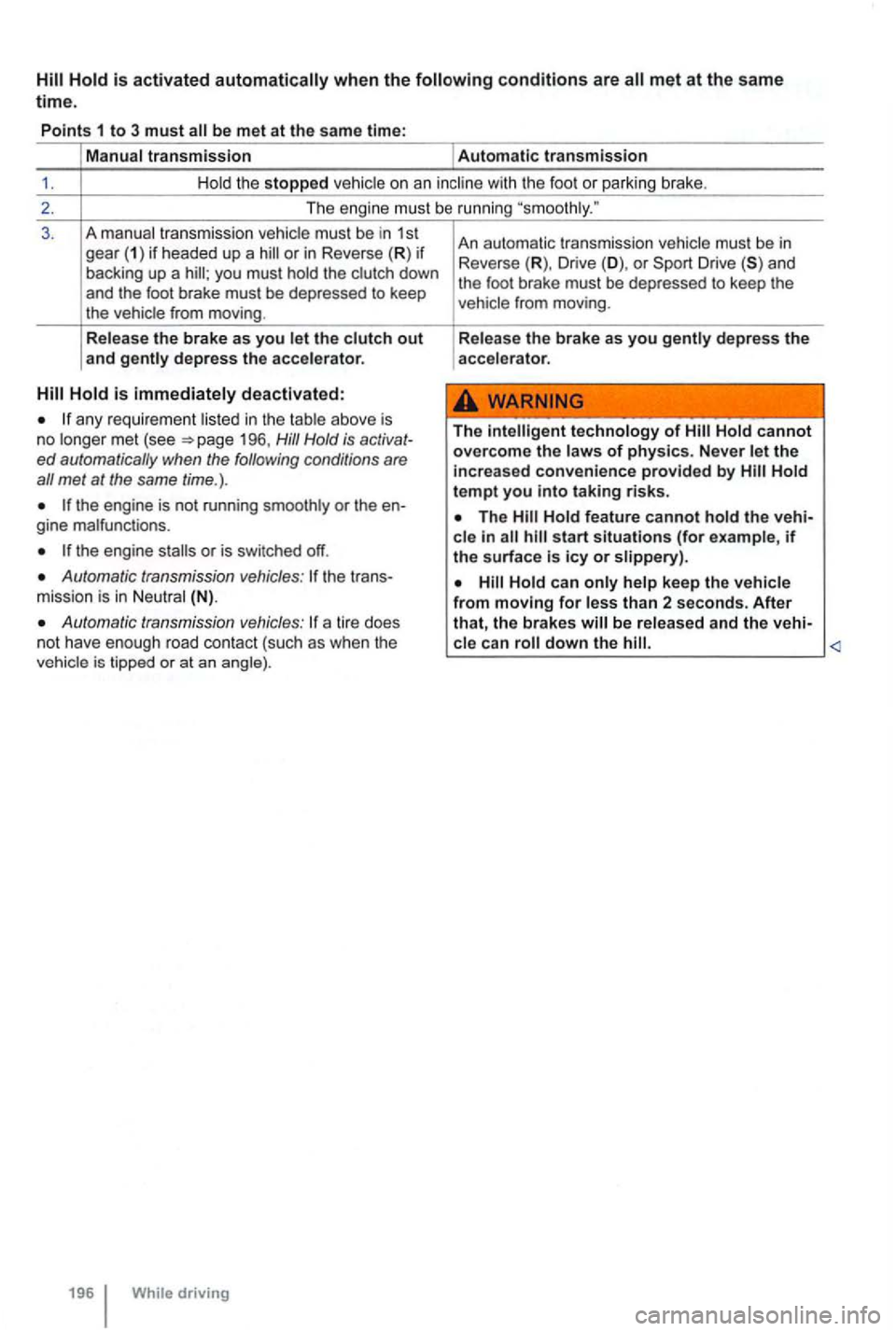
conditions are
3. A manual transm iss ion vehic le must be in 1st
gear (1 ) i f headed up a or in Reverse (R ) if backing up a you must hold the clut ch down
and the foot brake must be depressed to keep
the vehic
le from moving.
' Rel
ease
the brake as you let the clutch out and gently depress the accelerator.
any requi rement lis ted in the tab le above is
no longer met (see 196 , ed automatically when the following conditions are all met at the same time.).
gine malfunctions .
Automatic transmission vehicles: the mission i s in Neutral (N).
Automatic transmission vehicles:
and
the foot brake must be depressed to keep the
vehic le from moving .
Relea
se the brake as you gently depress the accelerator.
cle in start situations (for example, if the surface icy or slippery).
down the
Page 322 of 516

Never open or close the engine hood if To reduce th e risk of electrica l shock and steam or coolant is escaping. Hot steam or personal injury
-Never touch ignition cables. Never ant escaping from the engine. touch other components of the high
Always the eng ine down com-age electronic ignition syste m .
opening the hood.
-Never touch the wiring of the Discharge (Xenon) headlights.
system burn skin on contact.
you are read y to open the hood: Moving parts in th e engine compartment can
- Firm ly apply the parking brake a nd shift cause serious personal injury on contact. the transmission into Park (P) (automatic)
vehicles with Keyless Access, make member that the radiator fan is temperature-
s
ure that the remote contro l vehicle key is controlled and can come on sudden ly even
out of range of th e vehicle and that the ve- when the engine
has been switched off for a
hicl e cannot be started by depres sing the 44. ignition.
-
Always keep children and others away you have to perform a check or repair from the engine compartment and never when the engine is runn ing, there are more leave them unsupervised. risks from the rotating parts, such as the
hair do not get caught in
ries. rotating engine
parts. B efore starting an y
- Turn
the cap
fluids onto hot parts of the engine o r exhaust system can
cause a fire. -
Always use
extreme caution if the ac-
ce lerato r pedal has to be depressed to perform a check. The vehicle will start to move even if the parking brake i s on.
Never leave any objects in the engine compartment, for examp le cleaning rags and tools. Objects left b ehind can cause malfunc-lions, engine damage, and even fires.
High voltage sy stems in the engine com part-ment can ca use electrica l shocks or even
electrocution, severe burns, other serious in-juries, and eve n deathl
Neve r short-circuit the electrica l syste m .
B e especially ca reful when using jumper ca-
Operating fluids and some materials in the engi ne compartment can catch fire easily, causing burns an d other serious personal in-juries
Do not smoke .
b les. The
vehicle 's battery could exp lode! Never work next to open flames or sparks .
223
Page 403 of 516
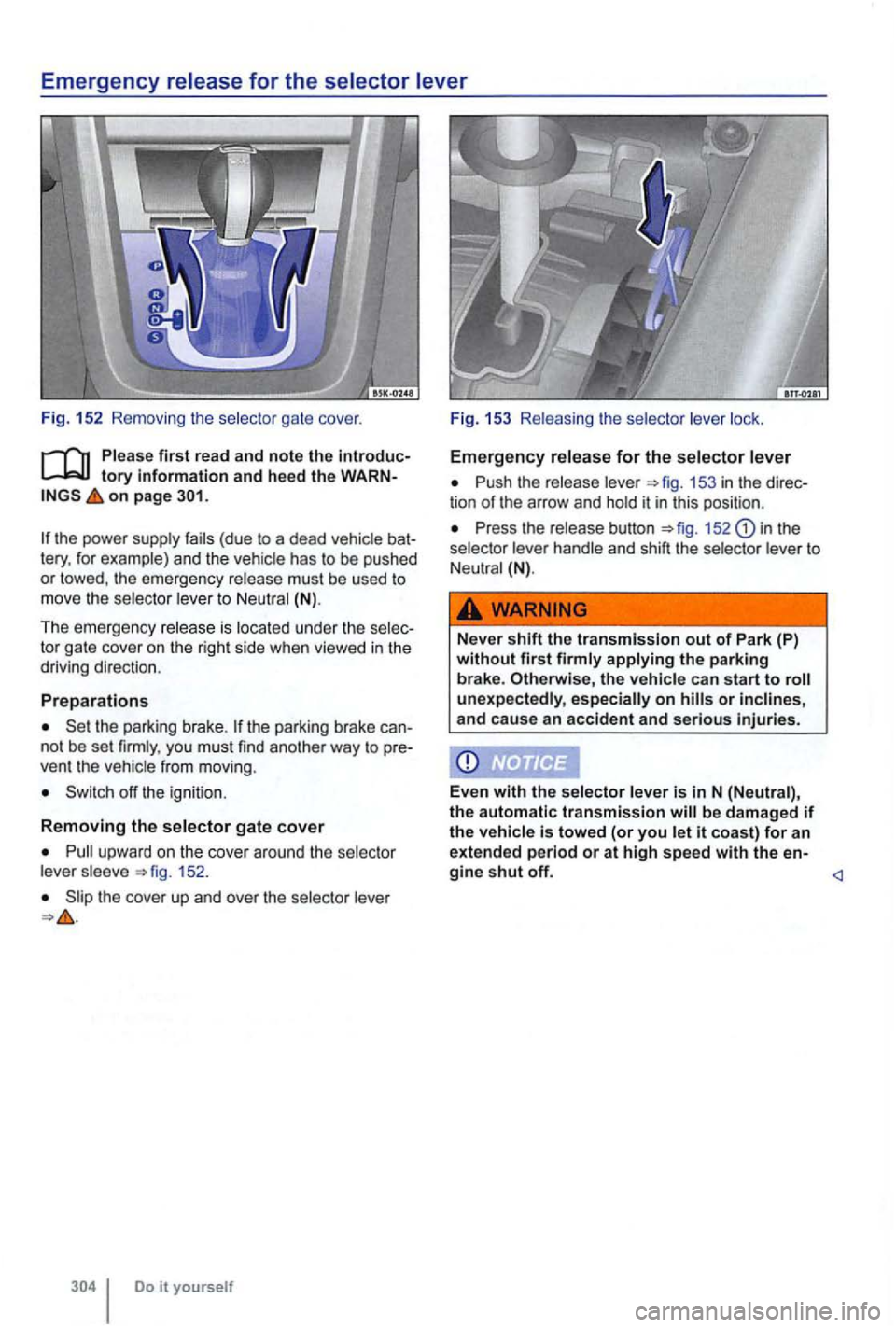
Emergency
on page
the power supply fails (due to a dead vehicle bat
tery , for example) and the vehicle has to be pushed or towed , the emergency release must be used to move the selecto r lever to N eutral (N).
Th e emerge n
cy release is located under the selec
tor gate cover on the right side when viewed in the
driving direction .
Preparations
Set the parking brake. the parking brake can
no t be set firmly , you must find another way to pre
vent the vehic le from moving .
Switch off the ignit ion.
Removing the selector gate cover
Pull upward on the cover aroun d the selec tor
lever sleeve fig. 152 .
Slip the cover up and over the selector lever
Push the release lever 153 in the direc
t ion of the arrow and hold it in this position .
Press the release button fig. 152 the
selector lever handle and shift the selector lever to Neu tral (N) .
WARNING
Never shift the tran smi ssion out of Park (P) without first firmly applying the parking
brake . the vehicle can start to roll unexp ectedly, especially on hills or inclines,
a nd cause an accident and serious injuries.
Ev en
with the selector lever is in N (Neutra l), the automatic transmission will b e damaged if the vehicle is towed (or you let it coast) for an extended period or at high speed with the en-
gine shut off.
Page 420 of 516
N
After replacing a headlight bulb or other light bulb, always make sure that the rubber covers or plastic caps have been properly and secure-
Indicator light
to help prevent water from getting into the electrical connections and headlight housing and damaging the electrical system.
on
Lights up Possible cause Proper response
Light bulb of the exterior vehicle lighting not Replace the light bulb that isn't working .
working .
When the ignition is switched on, several warning
and indicator lights come on briefly for a function
check . They go
out after a few seconds.
WARNING
Failure to heed warning lights and instrument cluster text messages can cause the vehicle to break down in traffic and result in a
can result in vehicle damage.
indicated. However, indicator light come on if LEO s fail.
on
Checklist
for replacing a light bulb. Please carry out these steps only in the order listed
1.
179.
3.
4.
5.
6 .
7.
8.
9 .
position
122 .
Automatic transmission :
the transmission into Park (P) 171.
the engine and remove the key from the ignition switch 165.
Manual transmission: Engage a gear
122.
Let the burned
out light cool down.
Check
if the fuse is blown 317 .
Replace the burned
out light according to
Practical tips 321
Page 429 of 516
Towing
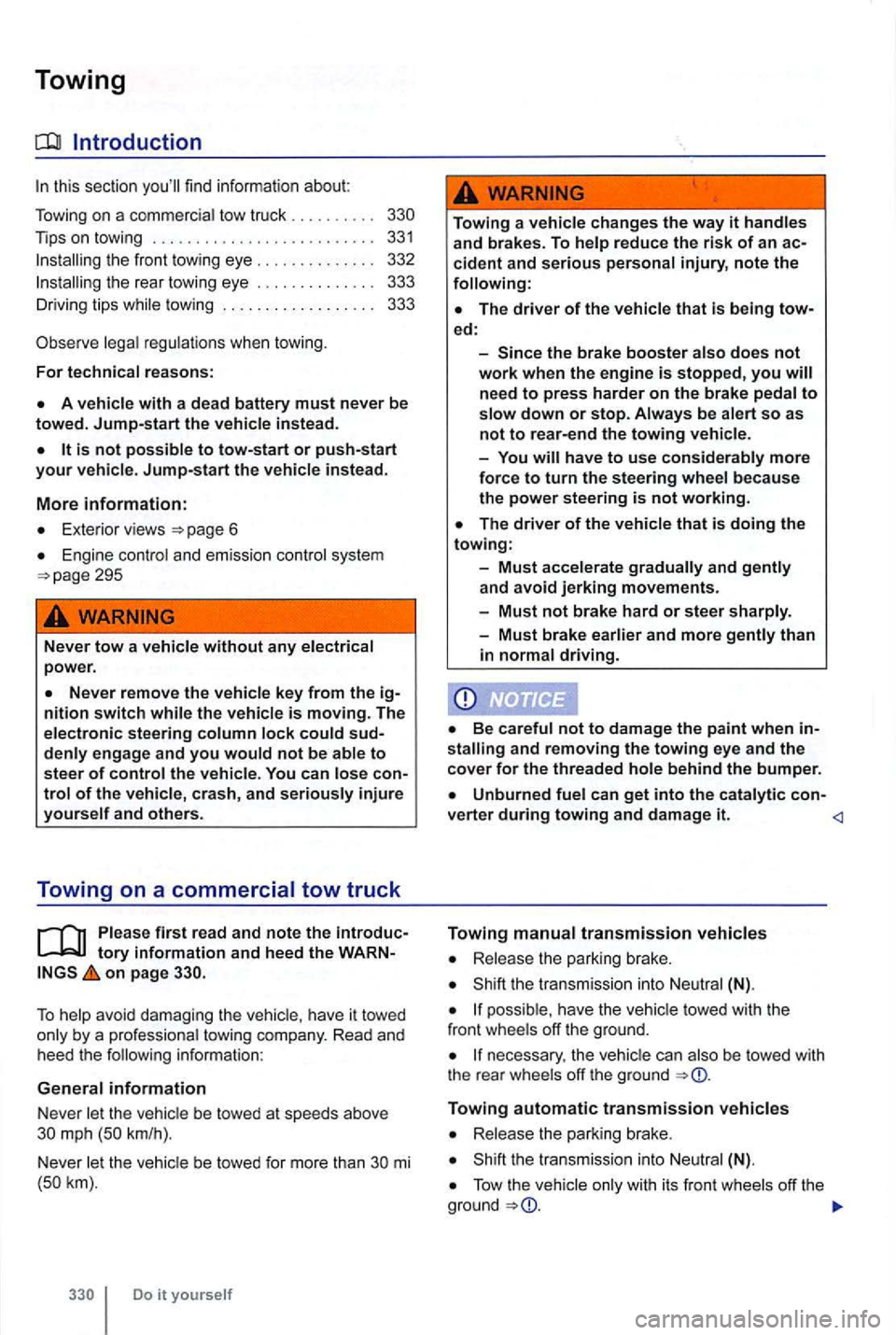
this sectio n you 'll find informat ion about:
T owing on a comme rc ia l tow truc k . . . . . . . . . .
Tips on towing .......................... 33 1
Installing the front tow ing eye . . . . . . . . . . . . . . 332
Installing th e rear towing eye . . . . . . . . . . . . . . 333 Driving tips towing 333
Exterior views
295
WARNING
Never tow a vehicle without any electrical
power.
denly engage and you would not be able to steer of control the vehicle. trol of the vehicle, crash , and seriously injure yourself and others.
Towing on a
on page
To help avoid damaging th e vehicle , h ave it towed
o n ly by a professional towing company. Read and
heed the following
information:
General information
N ever let the vehic le be towed at speeds above
km).
Towing a vehicle changes the way it handles
and brakes . To help reduce the risk of an cident and serious personal injury, note the following:
ed:
-
will have to use considerably more
force to turn the steering wheel because
the power steering is not working.
stalling and removing the towing eye and the cover for the threaded hole behind the bumper.
Towing manual transmission vehicles
Release the parking brake .
the transm ission into Neutral (N).
necessary, the vehicle can also be towed with the rea r wheels off the grou nd
Towing automatic transmission vehicles
Release the parking brake.
the transm issio n into Neutral (N).
Tow the vehicle only with its fron t wheels off the
gro und
Page 430 of 516
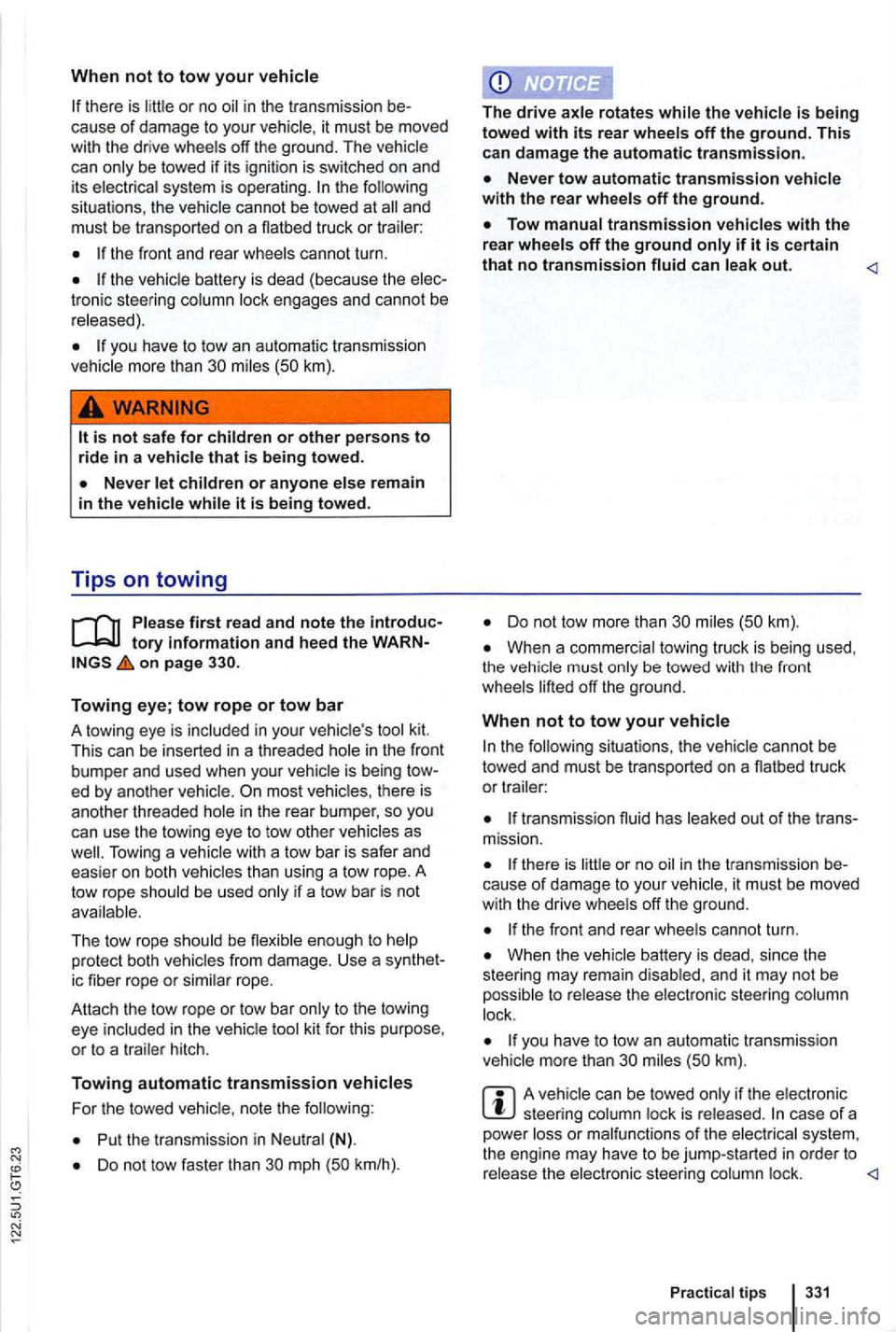
When not to tow your
there is in the tr ansmission be
cause of damage to you r it must be moved
with the drive wheels off the ground . The vehicle
can only be towed if its ignition is switched on and
i ts electrica l system is operating. the following
situat ions, the vehicle cannot be towed at
the front and rear whee ls can not turn .
the vehic le battery is dead {because the elec
troni c steering column lock engages and cannot be
r e leased).
you have to tow an automatic transmission
vehic le more than 30
first read and note the introduc
on page
Towing eye; tow rope or tow bar
A towing eye is included in your vehic le 's tool kit. This can be inserted in a threaded hole in the front
bumper and used when your vehicl e is being tow
ed by ano ther vehicle.
The tow rope should be flexib le enough to he lp
protect both vehicles from damage. Use a synthet
ic fiber rope or similar rope .
Attach the tow rope or tow bar only
to the towing
eye in the vehic le
For the towed vehic le, note the following :
Put the transmission in Neu tral (N) .
Do not tow faster than 30 mph (50 km/h). The
drive rotates while the i
s being towe d with its rear wheels off the ground. This can damage the automatic transmission .
can
Do not tow more than 30 miles (50 km).
When a commerc ial towing truck is being used,
the must be towed with the front
wheels
transmiss ion fluid ha s out of the trans
mission.
the re is in the transmissio n be
cause of damage to your vehicle, it must be moved
w ith the drive whee ls off the ground.
the front and rear whee ls cannot turn.
When the vehicle battery is dead , since the
steering may remain disabl ed, and it may not be
poss ib le to rele ase the electronic steering column
lock.
you have to tow an auto matic transmiss ion
veh icle mor e than 30 miles (50 km).
A veh icle can be towed only if the electronic steer ing column lock is r e leased. case of a
power system,
the engine may have to be jump-started in order to release the electronic steering column lock .
Page 436 of 516
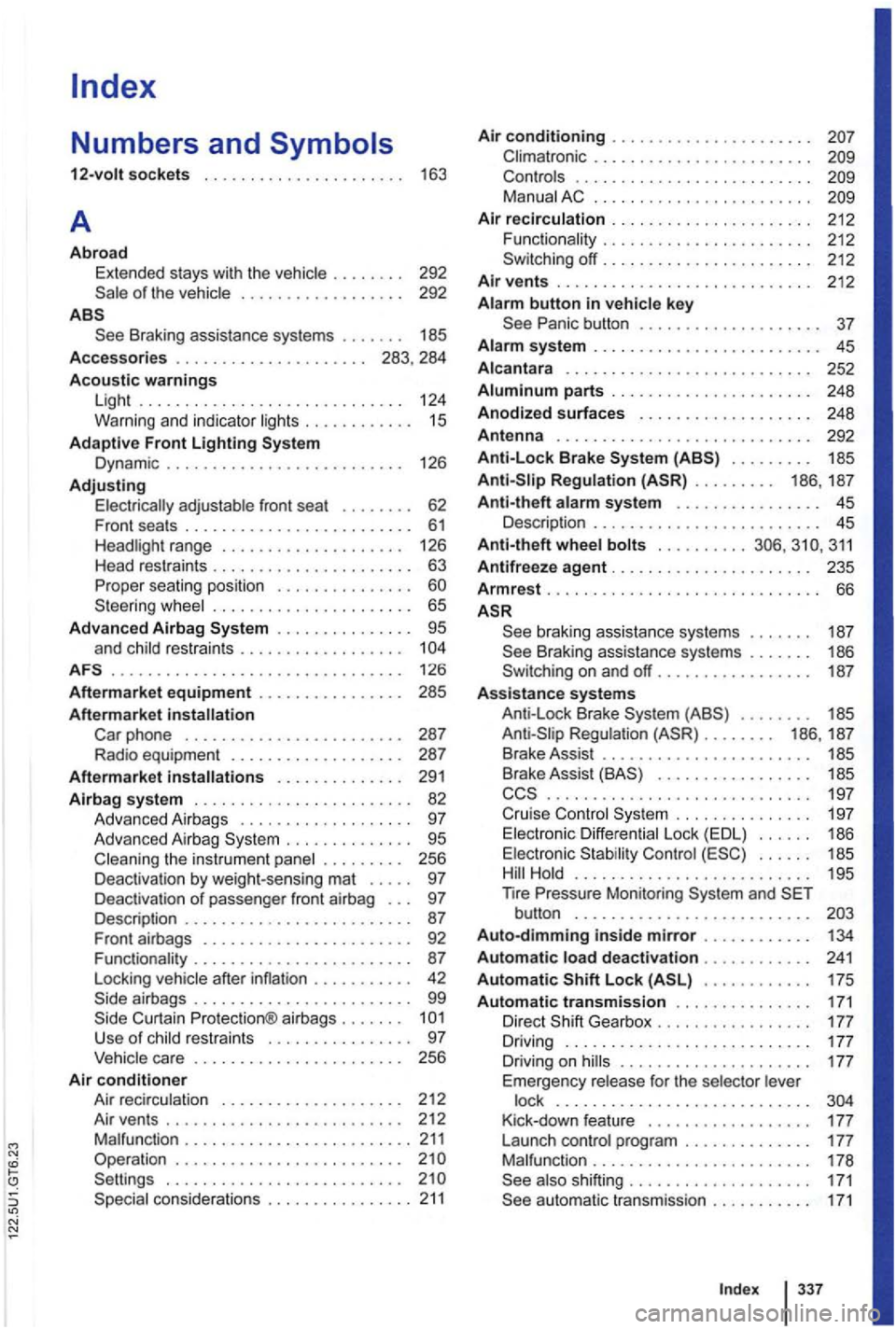
of the vehic le . . . . . . . . . . . . . . . . . . 292
Braking assistan ce sy ste ms . . . . . . . 185
Accessories . . . . . . . . . . . . . . . . . . . . . 283, 284
Acoustic warnings Light . . . . . . . . . . . . . . . . . . . . . . . . . . . . . 124
Warning and indicator lights . . . . . . . . . . . . 15
Adapti ve Front Lighting Dynami c . . . . . . . . . . . . . . . . . . . . . . . . . 126
Adjusting Electr ically ad justable front seat . . . .
. . . 63 sea ting position . . . . . . . . . . . . . . .
. . . . . . . . . . . . . . . 95
a nd child restrain ts . . . . . . . . . . . . . . . . . ........... ..................... 126
Afte rm arket equipment . . . . . . . . . . . . . . . . 285
Aftermar ket installation ph one . . . . . . . . . . . . . . . . . . . . . . . . 287
R adio equipment . . . . . . . . . . . . . . . . . . . 287
Aftermarket installations . . . . . . . . . . . . . . 291
Airbag system . . . . . . . . . . . . . . . . . . . . . . . . 82
Adva nced Airbag s . . . . . . . . . . . . . . . . . . . 97
Advanced Airbag . . . . . . . . . . . . . . 95
C le a ning the instrument panel . . . . . . . . . 256
D ea ctivation by we ight -sensing mat . . . . . 97
Deactivation
of passenger front airbag . . . 97
Descr ipt ion . . . . . . . . . . . . . . . . . . . . . . . . . 87
Front airbags . . . . . . . . . . . . . . . . . . . . . . . 92
Fun ction ality . . . . . . . . . . . . . . . . . . . . . . . . 87
Locking ve h icle afte r inflatio n . . . . . . . . . . . 42
airbags . . . . . . . . . . . . . . . . . . . . . . . . 99 Curt ain airbags . . . . . . .
. . . . . . . . . . . . . . . . . . . . . . . . . . conside rations 211
Air conditioning . . . . . . . . . . . . . . . . . . . . . . Climatron ic . . . . . . . . . . . . . . . . . . . . . . . .
Man ual . . . . . . . . . . . . . . . . . . . . . . . .
Air recirculation . . . . . . . . . . . . . . . . . . 212
Fun ctio nality . . . . . . . . . . . . . . . . . . . . . . . 212
off.. . . . . . . . . . . . . . . . . . . . . . 212
Air vents . . . . . . . . . . . . . . . . . . . . . . . . . . 212 Alarm button in vehicle key
. . . . . . . . . . 248
Anodized surfaces . . . . . . . . . . . . . . . . . . . 248
Antenna . . . . . . . . . . . . . . . . . . . . . . . . . . . . 292
Anti-Lock Brake . . . . . . . . . 185
. . . . . . . . . 186 , 187
Anti-th eft alarm system . . . . . . . . . . . . . . . . 45
Descr iption . . . . . . . . . . . . . . . . . . . . . . . . 45
Anti-th e
ft wheel bolts .....•.... 311
Antifreeze agent . . . . . . . . . . . . . . . . . . . . . . 235
Armrest.................. ...... ...... 66
braking assistan ce syste ms . . . . . . . 187 Braking assistan ce sy ste ms . . . . . . . 186 on and off... . . . . . . . . . . . . . . 187
A ss ista nce
systems Anti -Lock Brake . . . . . . . . 185 Regulation (ASR )........ 186, 187
Br ake Assi st . . . . . . . . . . . . . . . . . . . . . . . 185
Brak e Ass ist
. . . . . . . . . . . . . . . . . 185 ccs . . . . . . . . . . . . . . . . . . . . . . . . . . . . . 197
C ru ise Control . . . . . . . . . . . . . . . 197 Elect ronic Diff eren tial Lock (EDL) . . . . . . 186 Ele ct ronic Stabil it y Cont rol . . . . . . 185 H old . . . . . . . . . . . . . . . . . . . . . . . . . . 195 nre button . . . . . . . . . . . . . . . . . . . . . . . . . .
Auto-dimming inside mirror . . . . . . . . 134 Autom atic load deactivation...... . . . . . 241
Autom atic Lock . . . . . . . . . . . . 175 Automatic transmission . . . . . . . . . . . . . 171
Dir ect . . . . . . 177 Driving . . . . . . . . . . . . . . . . . . . . . . . . . . . 177 Driving on . . . . . . . . . . . . . . . . . . . . . 177 Emergency release for the sele cto r lever
l ock . . . . . . . . . . . . . . . . . . . . . . . . . . . .
Page 444 of 516
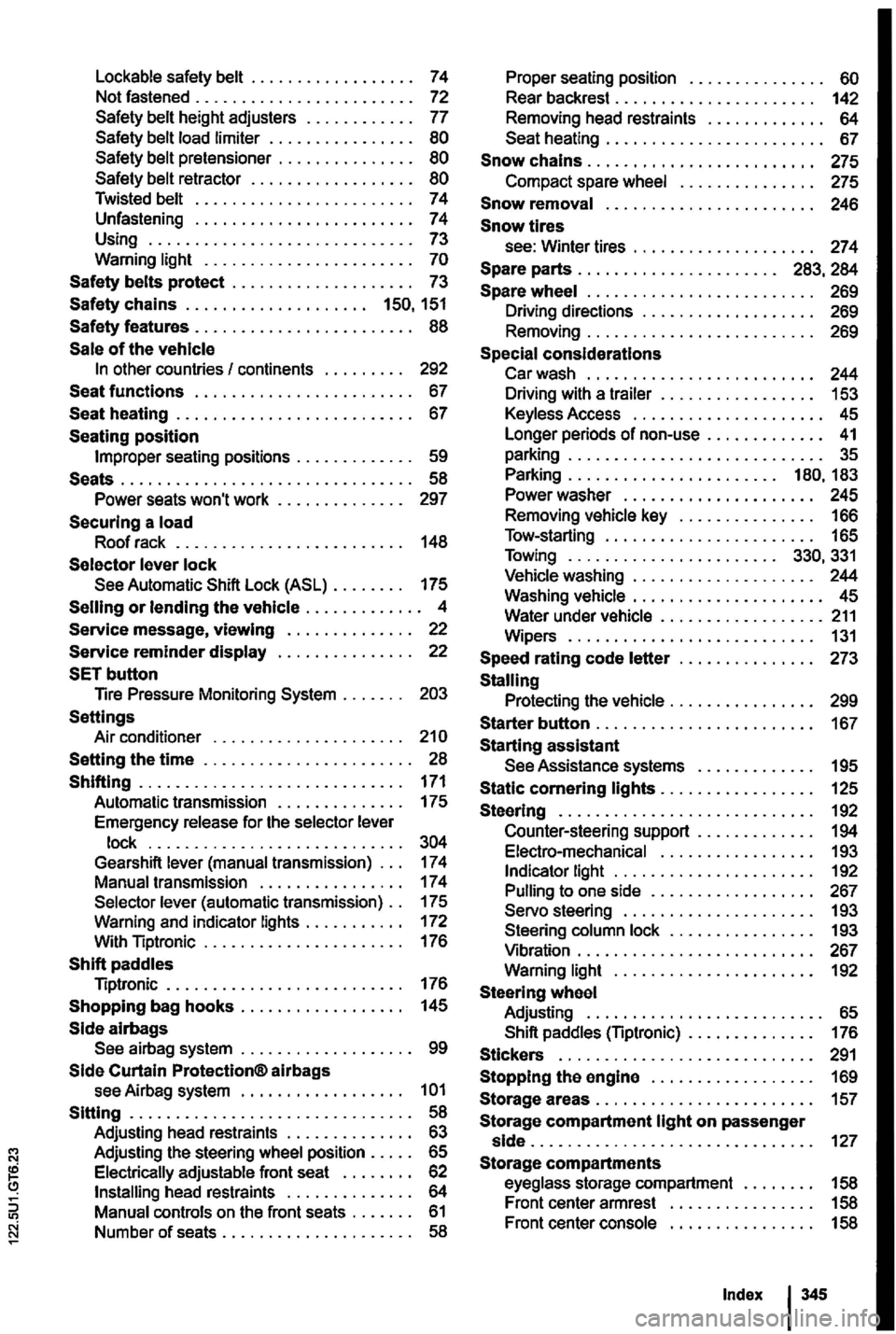
Lockable safety belt . . . . . . . . . . . . . . . . . . 7 4
Not fastened . . . . . . . . . . . . . . . . . . . . . . . . 72
. . . . . . . . . . . . . . . .
. . . . . . . . . . . . . . . . . . . . . . . . . . . . . 171
Automatic transmission . . . . . . . . . . . . . . 175
Emergency release for the selector lever
lock . . . . . . . . . . . . . . . . . . . . . . . . . . . .
. . . . . . . . . . . . . . . . . . . . . . . . . . . . . . . 58
Adjusting head restraints . . . . . . . . . . . . . . 63 Adjusting the steering wheel position . . . . . 65 Electrically adjustable front seat . . . . . . . . 62
. . . . . . . . . . . . . . . . . . . . . . . . . . . . 192
Counter-steering support . . . . . . . . . . . . . 194
Electro-mechanical . . . . . . . . . . . . . . . . . 193