brake light VOLKSWAGEN GOLF 2009 User Guide
[x] Cancel search | Manufacturer: VOLKSWAGEN, Model Year: 2009, Model line: GOLF, Model: VOLKSWAGEN GOLF 2009Pages: 516, PDF Size: 105.12 MB
Page 281 of 516
Failure to heed warning lights or t ex t WARN-can result in vehicle damage .
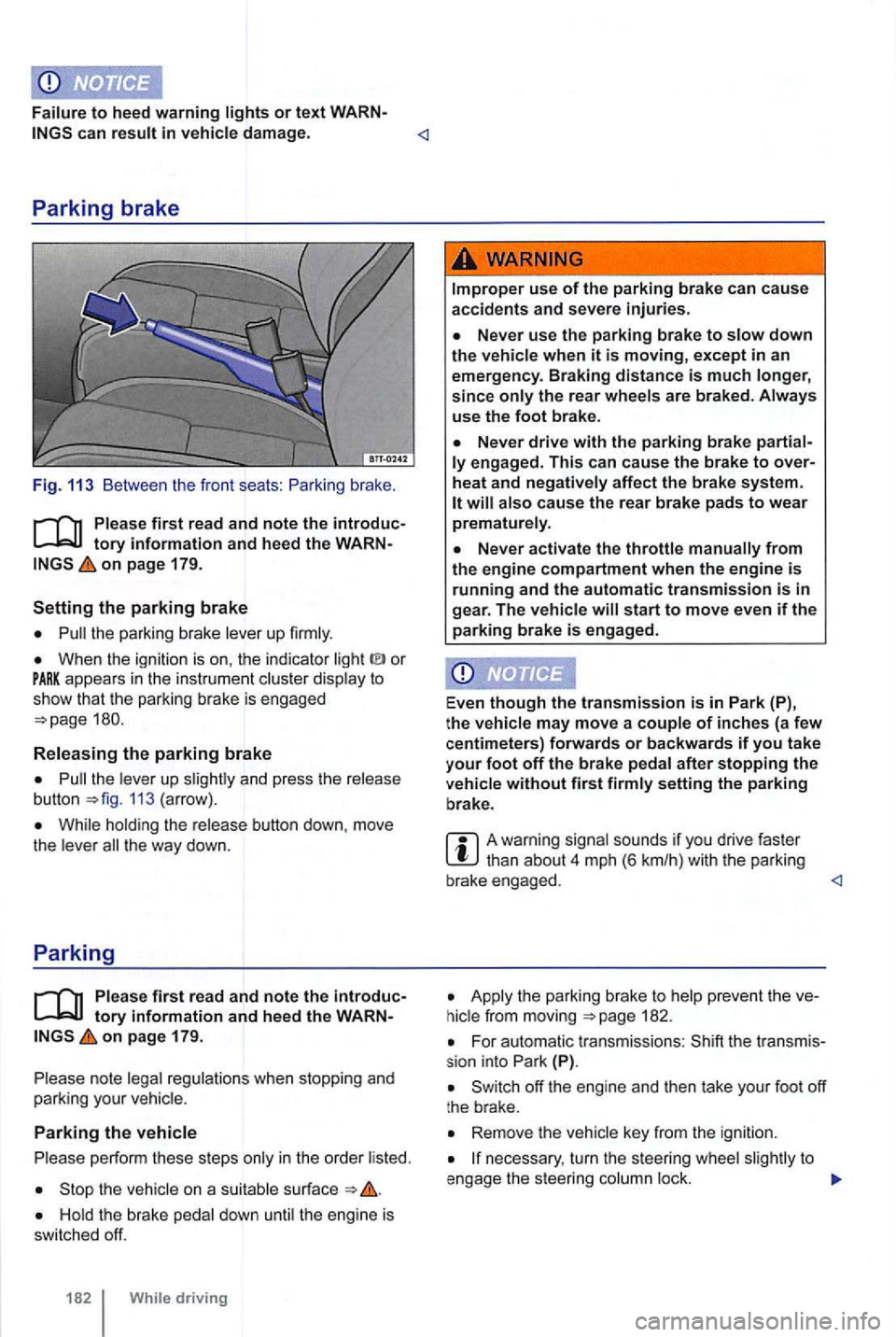
Fig. 113 Between the front seats :
on page 179.
the parking brake lever up firmly.
When the ignition is on , the indicator or appears in the instrume nt c luster display to show th at the park ing brake is engaged
the leve r up 113 (arrow) .
While hold ing the release button down, move
t h e lever t he way down.
Parking
Ple ase firs t r ea d and note the introductory info rm ation and heed the WARNon pa ge 179.
note legal regulations when stopping and
parking your vehicle.
Parking the vehicle
p erform these steps only in the order listed.
the vehicle on a suitab le surface
the rear wheels are braked . Always
use the foot bra ke.
engag ed. This c an cause the brak e to over
heat and neg ati vely affec t the b rak e sys te m .
start to move even if the parking brake is e ngag ed .
Even
though the tra nsmission is in P ark (P),
t h e vehi cle may move a couple of inche s (a fe w
c entimeters) forwards or backwards if you take
your f oot off the brake pedal after stopping the
ve hicl e without fir s t firmly setting the parking
b rake .
A warning signal sounds if you drive faster
Apply t he parking brake to 182.
For automatic transmissions : (P).
Remove the vehicle key from the igni tion.
necessary , turn the steer ing whee l to
e ngage the steer ing column lock.
Page 292 of 516
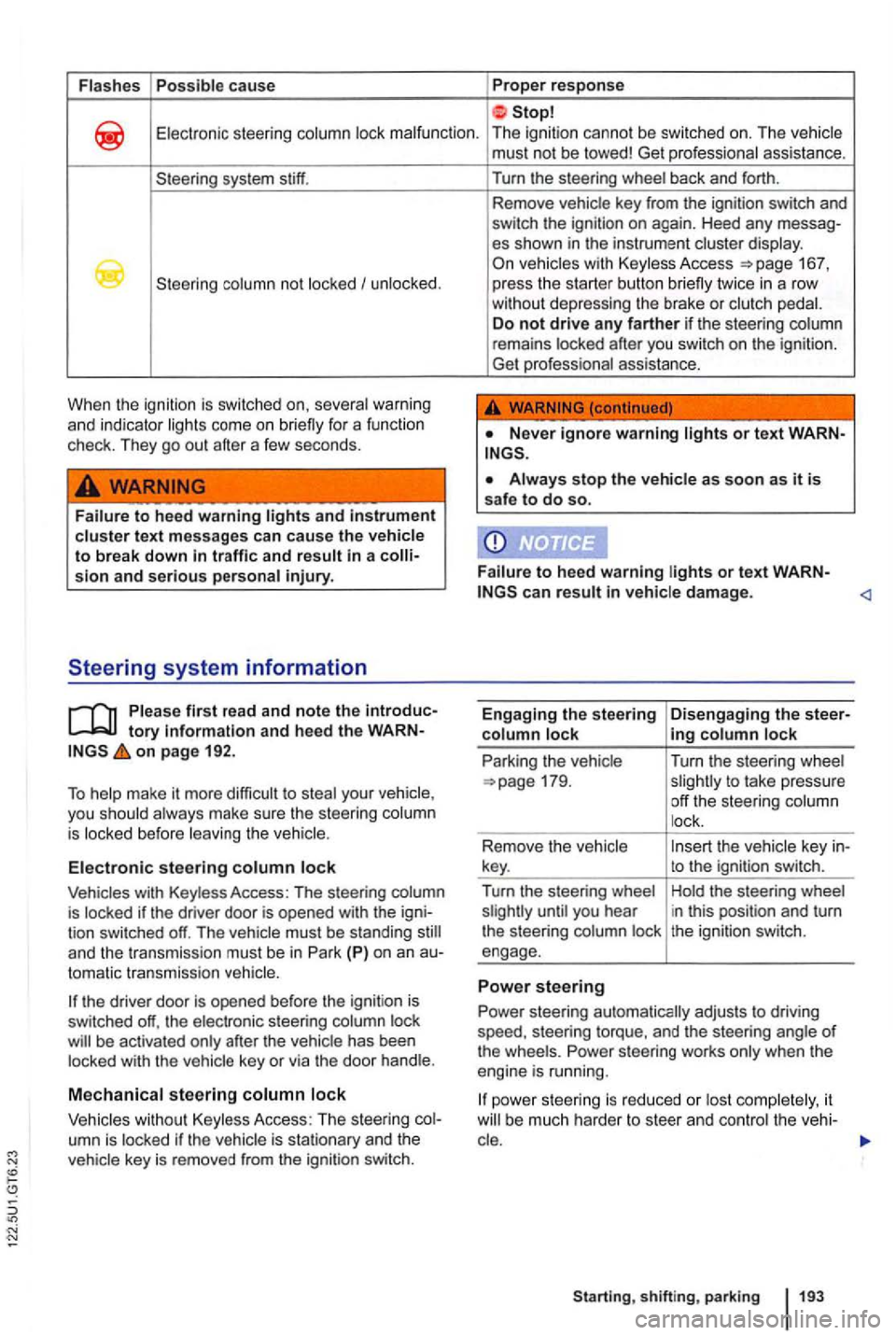
Flashes Possible ca use Proper response
Electronic steering column lock malfunction . The ignition cannot be switched on. The vehicle
system stiff.
column not locked I unlocked .
When the
ignition is switched severa l warni ng
a n d indicator lights come on briefly for a function
check . T hey go out after a few seconds.
Failure to heed warning lights and instrument cluster text messages can ca use the vehicle to break down sion and serious personal injury.
tory Information and heed the on page 192.
To
tomatic transmiss ion vehicle.
press the starter button briefly twice in a row
without depressing the brake or clutch pedal.
D o
not drive any farther if the steering column
remains locked after you switch on the ignition.
Get professional assistance.
Always stop the vehicle as soon as it is safe to do so.
F a
ilure to heed warning lights or text can resu lt vehicle damage .
Engaging the steering
co lumn lock
Park ing the vehicle
ing column lock
Turn the steering wheel
slightly to take pressure
off the steering column
l ock .
to the ignition switch.
Hold the steer ing wheel
i n this position and turn
the ignition switch.
Power steering automatically adjusts to driving
speed , steering torque, and the steering angle
of the wheels . Power steering works only when the
engine is running .
it
Sta rting, sh ift ing , park ing
Page 294 of 516
Driver assistance systems
Starting assistance systems
Volksw age n Informatio n pag e 24
pa ge 179
Vehicle batt ery
p age 2 58
Jump-s ta rting page 327
The
on p age 195 .
fo r examp le afte r
s topping at a traffic light. don't have to app ly
an d r elease th e park ing brake whil e depress ing the
accele ra tor . For
The dynam ic sta rting assistance feature s
cannot keep the vehicle from moving in all hill-start situations (for example, if the ground is slippery or icy).
Driving with too little fuel in the fuel tank in-
c rea se s th e risk of especially when driving up and down hills.
H old keeps th e bra ke a ppl ied for not quit e
2 seconds with the same force you u sed t o p reve nt the veh ic le f rom mov ing. This gives you time to
t ake your foot off the brake , let the clu tch out on a manual transm issio n veh ic le, a n d gently depress
the accele ra tor to get the veh icle m ovi ng agai n.
F urther more, if any requi remen t for engagi ng
Ho ld disengages and the brakes are automati no longer ho ld th e vehic le.
Driver ass is tance systems 195
Page 302 of 516
to heed warning and instrument text messages can cause the to break down traffic and sion and serious
or text
stop the as soon as it is
safe to do so.
or text can damage .
the ignition is switched on, an acous tic warning sounds when tir e pressure is tected. a system malfunc tion is detected , no
aco ust ic warn ing sounds .
Driving fo r a lon ge r period of tim e o n roug h roa ds or w ith a dynamic and sporty s tyle can
m ake th e system te mpora rily unavai lable .
Th e in dicato r light
fu nc tio n, b ut
Tire Pressure Monitoring
the
on
page
Your Tire Pressure Monitor
ing
4 tires
Brake
tires . The
tread circumference
of a tire can
change :
one side of the
than the other .
than the other (such as when towing a
has been
mounted .
a
a tire was changed.
the tire pressure was changed , or
were rotated or
was not reset.
warnings be
cause snow chains increase tire cir-
cumference.
Dri ver assistance syste m s
Page 322 of 516

Never open or close the engine hood if To reduce th e risk of electrica l shock and steam or coolant is escaping. Hot steam or personal injury
-Never touch ignition cables. Never ant escaping from the engine. touch other components of the high
Always the eng ine down com-age electronic ignition syste m .
opening the hood.
-Never touch the wiring of the Discharge (Xenon) headlights.
system burn skin on contact.
you are read y to open the hood: Moving parts in th e engine compartment can
- Firm ly apply the parking brake a nd shift cause serious personal injury on contact. the transmission into Park (P) (automatic)
vehicles with Keyless Access, make member that the radiator fan is temperature-
s
ure that the remote contro l vehicle key is controlled and can come on sudden ly even
out of range of th e vehicle and that the ve- when the engine
has been switched off for a
hicl e cannot be started by depres sing the 44. ignition.
-
Always keep children and others away you have to perform a check or repair from the engine compartment and never when the engine is runn ing, there are more leave them unsupervised. risks from the rotating parts, such as the
hair do not get caught in
ries. rotating engine
parts. B efore starting an y
- Turn
the cap
fluids onto hot parts of the engine o r exhaust system can
cause a fire. -
Always use
extreme caution if the ac-
ce lerato r pedal has to be depressed to perform a check. The vehicle will start to move even if the parking brake i s on.
Never leave any objects in the engine compartment, for examp le cleaning rags and tools. Objects left b ehind can cause malfunc-lions, engine damage, and even fires.
High voltage sy stems in the engine com part-ment can ca use electrica l shocks or even
electrocution, severe burns, other serious in-juries, and eve n deathl
Neve r short-circuit the electrica l syste m .
B e especially ca reful when using jumper ca-
Operating fluids and some materials in the engi ne compartment can catch fire easily, causing burns an d other serious personal in-juries
Do not smoke .
b les. The
vehicle 's battery could exp lode! Never work next to open flames or sparks .
223
Page 343 of 516
Washing the vehicle
tory information and heed the on page 243 .
T he longer insect splatter , bird droppings, tree sap,
r oad dirt , indust rial deposits , tar , soot , road
and othe r aggressive materials stay on your cle, the more damage they do to the paint finish.
H igh temperatures (includi ng strong sunlight)
oughly.
Car wash
Pay close attention to the information provided
by the car wash operator . B efo re goi ng throu gh a
ca r was h, b e s ure to take th e usual precautio ns t o
avoid damag e , such as closi ng the windows ,
The paint finish is toug h enough th at the vehicle can
the wheels and under the door
After the vehi cle ha s been washed , the wet brakes or, in winter, brake discs or pads ed with ice, react slower and need longer stopping distances .
WARNING
Always dry the brakes and clean off any ice coatings with a few careful applications of the brake . Make sure not to endanger other motorists or cyclists or disobey legal require-
ments .
edges under the vehicl e can cut ex-
posed skin.
Always protect your hands and arms from cuts on sharp metal edges when cleaning the under-body , the inside of the wheel housings,
etc.
The water temperature must not be more
than
Ne ver clean headlights with a dry cloth or sponge . Always use a w et cloth o r s ponge . For best result s use soapy water.
When washing or rinsing the vehicle in cold weather , do not
cult to open the vehicle!
To help prevent vehicle damage
in a car wash:
in the car wash to help prevent damage to wheel rims and tires!
Make sure there is enough clearance for the
height and width of the vehic le .
To help prevent paint damage to the engine
hood, place wiper blades against the shield after they have dried. Do not let them
snap back into place .
Lock the rear hatch to prevent unintentional
opening in the car wa sh .
Page 344 of 516
Washing with a power washer
tory information and heed the on page 243.
A lways
M ake sure th ere is e nough dista nc e to soft .
N ever u
se concentrated jet nozzles or dirt
use of power washers can cause serious invisible permanent damage leading to tire and loss of vehicle control. This can cause accidents and serious personal in-jury.
blasters" to clean tires .
Even spraying from a relatively long distance for a very short time can do visible or invisi-
After the vehicle has been washed, the wet brakes or, in winter, brake discs or pads coat-ed with react slower and need longer stopping distances.
Always dry the brake s and clean off any coatings with a few careful application s of the brake. Make sure not to endanger other motorists or cyclists or disobey require-ments.
P le a se first read and note the
on page 243 .
C lea
ning windows and outside mirrors
Water temperature should not be more than
To help prevent damage to the paint, do not wash the vehicle in direct sunlight.
When using a power washer or steam er, only spray the sensors directly for a short period of time and always keep the nozzle at least 4 inches em) from the sensor.
Do not clean icy or snow-covered windows with a power washer.
hav e
a bsorbe d an oily resid ue t ha t sme ar th e glass
s u rfaces .
U
se w indow cleaner or a s ilicone remover to mov e r ubbe r, oil, grease and silico ne dep osits
care and maint enanc e 245
Page 428 of 516
the engine
the engine of the vehicle with the good
battery that is providing help and let it run at idle
speed .
Turn on the ignition of the vehicle with the dead
b attery. the engine starts, wait 2 to 3 minutes
the engine does
not start within about seconds , turn off the tion and wait at least 1 minute ; then try again .
Removing the jumper cables
Before you remove the jumper cables. swi tch
off the headlights (if they are on) .
the vehic le with the dead batte ry , switc h on
t he heater fa n and the rea r window defroster. This
he lps
to m in im ize voltage spikes when the cables
a re disconnected.
With the engine running , remove the jumper
nected .
Disconnect the black (- ) cab le f rom the vehicle
wit h the dead battery .
Disconnec t the black (-) cable from the other
vehicle (vehicle with the good battery) .
Disconnect the red(+) cable from the other
Disconnect the red (+ ) cable from the vehicle
with the dead battery .
Close the battery cover.
Improper use of jumper cables when starting a vehicle with a dead battery can
cause the battery to explode , leading to
Always wear proper eye protection. Never
lean over the vehicle battery.
Attach the jumper cables in the correct
Never connect the negative cable from the
vehicle providing starting assistance to parts of the fuel system or to the brake hoses or brake lines.
Never
sistance.
Avoid electrostatic discharge in the may cause the hydrogen gas escaping from the vehicle battery to ignite.
Never jump-start a vehicle with a battery
that is damaged or frozen or that was frozen
and has thawed. The battery can explode.
Always the instructions of the jumper cable manufacturer.
Never connect the negati ve cable from the other vehicle directly to the negative terminal of the dead battery . The hydrogen gas from
the battery is explosive.
Never short out the battery terminals by connecting the positive(+) and negative
Practical tips 329
Page 436 of 516
of the vehic le . . . . . . . . . . . . . . . . . . 292
Braking assistan ce sy ste ms . . . . . . . 185
Accessories . . . . . . . . . . . . . . . . . . . . . 283, 284
Acoustic warnings Light . . . . . . . . . . . . . . . . . . . . . . . . . . . . . 124
Warning and indicator lights . . . . . . . . . . . . 15
Adapti ve Front Lighting Dynami c . . . . . . . . . . . . . . . . . . . . . . . . . 126
Adjusting Electr ically ad justable front seat . . . .
. . . 63 sea ting position . . . . . . . . . . . . . . .
. . . . . . . . . . . . . . . 95
a nd child restrain ts . . . . . . . . . . . . . . . . . ........... ..................... 126
Afte rm arket equipment . . . . . . . . . . . . . . . . 285
Aftermar ket installation ph one . . . . . . . . . . . . . . . . . . . . . . . . 287
R adio equipment . . . . . . . . . . . . . . . . . . . 287
Aftermarket installations . . . . . . . . . . . . . . 291
Airbag system . . . . . . . . . . . . . . . . . . . . . . . . 82
Adva nced Airbag s . . . . . . . . . . . . . . . . . . . 97
Advanced Airbag . . . . . . . . . . . . . . 95
C le a ning the instrument panel . . . . . . . . . 256
D ea ctivation by we ight -sensing mat . . . . . 97
Deactivation
of passenger front airbag . . . 97
Descr ipt ion . . . . . . . . . . . . . . . . . . . . . . . . . 87
Front airbags . . . . . . . . . . . . . . . . . . . . . . . 92
Fun ction ality . . . . . . . . . . . . . . . . . . . . . . . . 87
Locking ve h icle afte r inflatio n . . . . . . . . . . . 42
airbags . . . . . . . . . . . . . . . . . . . . . . . . 99 Curt ain airbags . . . . . . .
. . . . . . . . . . . . . . . . . . . . . . . . . . conside rations 211
Air conditioning . . . . . . . . . . . . . . . . . . . . . . Climatron ic . . . . . . . . . . . . . . . . . . . . . . . .
Man ual . . . . . . . . . . . . . . . . . . . . . . . .
Air recirculation . . . . . . . . . . . . . . . . . . 212
Fun ctio nality . . . . . . . . . . . . . . . . . . . . . . . 212
off.. . . . . . . . . . . . . . . . . . . . . . 212
Air vents . . . . . . . . . . . . . . . . . . . . . . . . . . 212 Alarm button in vehicle key
. . . . . . . . . . 248
Anodized surfaces . . . . . . . . . . . . . . . . . . . 248
Antenna . . . . . . . . . . . . . . . . . . . . . . . . . . . . 292
Anti-Lock Brake . . . . . . . . . 185
. . . . . . . . . 186 , 187
Anti-th eft alarm system . . . . . . . . . . . . . . . . 45
Descr iption . . . . . . . . . . . . . . . . . . . . . . . . 45
Anti-th e
ft wheel bolts .....•.... 311
Antifreeze agent . . . . . . . . . . . . . . . . . . . . . . 235
Armrest.................. ...... ...... 66
braking assistan ce syste ms . . . . . . . 187 Braking assistan ce sy ste ms . . . . . . . 186 on and off... . . . . . . . . . . . . . . 187
A ss ista nce
systems Anti -Lock Brake . . . . . . . . 185 Regulation (ASR )........ 186, 187
Br ake Assi st . . . . . . . . . . . . . . . . . . . . . . . 185
Brak e Ass ist
. . . . . . . . . . . . . . . . . 185 ccs . . . . . . . . . . . . . . . . . . . . . . . . . . . . . 197
C ru ise Control . . . . . . . . . . . . . . . 197 Elect ronic Diff eren tial Lock (EDL) . . . . . . 186 Ele ct ronic Stabil it y Cont rol . . . . . . 185 H old . . . . . . . . . . . . . . . . . . . . . . . . . . 195 nre button . . . . . . . . . . . . . . . . . . . . . . . . . .
Auto-dimming inside mirror . . . . . . . . 134 Autom atic load deactivation...... . . . . . 241
Autom atic Lock . . . . . . . . . . . . 175 Automatic transmission . . . . . . . . . . . . . 171
Dir ect . . . . . . 177 Driving . . . . . . . . . . . . . . . . . . . . . . . . . . . 177 Driving on . . . . . . . . . . . . . . . . . . . . . 177 Emergency release for the sele cto r lever
l ock . . . . . . . . . . . . . . . . . . . . . . . . . . . .
Page 437 of 516
Shifting . . . . . . . . . . . . . . . . . . . . . . . . . . . 175
Towing . . . . . . . . . . . . . . . . . . . . . . . 331 Vehicle key safety in terlock . . . . . . . . . . . 166
B
Background . . . . . . . . . . . . . . . . 127
Brak ing assistance systems . . . . . . . 185
Battery Rep laceme nt in rem ote cont rol vehicle key 39
Before taking the vehicle in to the shop . . 297
Belt pretensioners
D isposal . . . . . . . . . . . . . . . . . . . . . . . . . . .
Belt warning . . . . . . . . . . . . . . . . . . . . .
Bottle holder . . . . . . . . . . . . . . . . . . . . 161
Brake
Brake booster . . . . . . . . . . . . . . . . . . . . . . 184
Brake nuid . . . . . . . . . . . . . . . . . . . . . . . . 187
Brake nuid level . . . . . . . . . . . . . . . . . . . . 187
Brak e pads . . . . . . . . . . . . . . . . . . . . . . . . 183
Braking assistance systems . . . . . . . . . . . 185
Bre aking
in the brake pads . . . . . . . . . . . 183
Chang ing brake nuid . . . . . . . . . . . . . . . . 188
brake . . . . . . . . . . . . . . . . . . . . . . 18 2
Warning l igh t . . . . . . . . . . . . . . . . . . . . . .
Brake Assist (BAS) . . . . . . . . . . . . . . . . . . . 185
Brake booster . . . . . . . . . . . . . . . . . . . 184 , 185
Brake fluid . . . . . . . . . . . . . . . . . . . . . . . . . . 187
Spec ificati ons . . . . . . . . . . . . . . . . . . . . . . 187
Brake
system . . . . . . . . . . . . . . . . . . . . . . . . 185
Malfunction . . . . . . . . . . . . . . . . . . . . . . . 184
Braking . . . . . . . . . . . . . . . . . . . . . . . . . . . . . 179
Braking assistance systems . . . . . . . . . . . 18 5
Break-in period
E ngine .
.......................... 283
The fir st few miles (k ilometers ) . . . . . . . . 283 . . . . . . . . . . . . . . . . . . . . . . . . . . . . . 263
Breakdown the vehicle . . . . . . . . . . . . . . . . 299
Breaking in
B rake pads . . . . . . . . . . . . . . . . . . . . .
. . 183
Breaking in the brake pads
Care
. . . . . . . 136
Catalytic
converter . . . . . . . . . . . . . . . . . . . 296
I ndicator light . . . . . . . . . . . . . . .
. . . . 157
. . . . 288
Center
armrest . . . . . . . . . . . . . . . . . . . . . . . . 66
Center
console . . . . . . . . . . . . . . . . . . . . 12, 13
Changing a
light bulb Indicator light . . . . . . . . . . . . . . . . . . . . . . 321
Changing a wheel . . . . . . . . . . . . . . . . . . . .
. . . . . . . . 313
Wheel bolls 311 Wheel change . . . . . . . . . . . . . . . . . . . . . 315
Chang i
ng bulbs changing light bulbs . . . . . . . . . . . . .
Changing light bulbs . . . . . . . . . . . . . . . . . . fr on t bumper . . . . . . . . . . . . . . . . . . . . . 323 . . . . . . . . . . . 325 th e headlight . . . . . . . . . . . . . . . . . . . . 322 the rear hatch . . . . . . . . . . . . . . . . . . . . 324 License plate ligh t . . . . . . . . . . . . . . . 326 . . . . . . . . . . . . . . . . . . 324, 325
Characteristics Rad io reception . . . . . . . . . . . . . . . . . . . . 292
Checking
leve l . . . . . . . . . . .
. . . . . . . . . . . . 31 Gelling ready . . . . . . . . . . . . . . . . . . . . . . . 31 an eme rgen cy . . . . . . . . . . . . . . . . . 299
Lifting veh icle with jack . . . . . . . . . . . . . . 313
Light bulb replacement . . . . . . . . . . . .
. . 321 for changing a wheel 311 Safety belts . . . . . . . . . . . . . . . . . . . . . . . . 73
U phol stery . . . . . . . . . . . . . . . . . . . . . . . 252
Checks
while refueling . . . . . . . . . . . . . . 217
Child res
traint and fron t airbag . . . . . . . . . . . . . . . . . . . .
Child safety lock . . . . . . . . . . . . . . . . . . . . . . 48