brake VOLKSWAGEN GOLF 2009 Owner's Manual
[x] Cancel search | Manufacturer: VOLKSWAGEN, Model Year: 2009, Model line: GOLF, Model: VOLKSWAGEN GOLF 2009Pages: 516, PDF Size: 105.12 MB
Page 277 of 516
Remove your left foot from the brake => The accelera te from a stop at the maximum
rate .
you have accelerated , swi tch
weather, road, and traffic conditions permit and other drivers not be gered by your driving and the vehicle's
tory on page 171.
Emergency shift program
selec to r ment
of the forward gears.
some cases, vehicles with a Direct
is then impossible to drive
the vehicle backwards .
any event , have the automatic transmission
checked by an authorized
Overheating of Direct automatic transmission
The automa tic transmission may overheat ,
for example , due to frequent starts , extended o r stop-and-go traffic. Overheating is and, if by a text message in the in strument ditional warning chime may sound. and let the
tr ansmission coo l down =>
is switched off, when the road is slippery.
you have accelerated, switch back on again.
with the
wards. This can cause the automatic sion to overheat and be damaged.
in Neutral (N), not be lubricat-ed and be damaged .
the vehicle does not move in the desired tion , the system may not have engaged the drive
position Press the brake pedal and select the drive position again.
does not move in the desired rection , there is a system malfunctio n.
ther park the vehicle in a safe place or drive faster than 12 mph km/h) .
the tex t message and acoustic warning seconds or so, you must park the vehicle in a safe place as soon as you can safely do so and stop the engine .
L et the transmission cool down.
To help prevent damage to the sion, do not drive the vehicl e agai n until the
acoustic warning has s topped. As long as the
e ngine is overheated, avoid stop and start driv-ing and avoid low speed s pace") .
Page 278 of 516
Braking, stopping, and parking
this sectio n
Parking brake . . . . . . . . . . . 182
P arking . . . . . . . . . . . . . .
. . . . . . . . . . . . . . . . . 182
About the brakes . . . . . . . . . . . . . . . . . . . . . . . . 183
Braking assistance systems
Switching
L ock Brake System (ABS) . Br ak e Assist System
(BAS ), Ele ctronic Differential Lock (EDL), R eg ulatio n (ASR) and Electronic C ontrol
(ESC).
More information:
Trai ler towi ng 149
Starting assistance systems 1 95
Tires and whee ls 258
Driving with bad brakes or worn brake pads can cause a and serious personal
injury.
lights up in the instrument cluster display, whether alone or together with a text message, immediately contact an authorized Volkswagen dealer or authorized Facility to have the brake pads checked and, if necessa
ry, replaced .
Parking improperly can cause serious sonal injury.
lock and you
haust system or catalytic converter could
fu el, etc.
riously injure you and your passengers.
sonal injury.
mote control vehicle key, trapping passengers in the vehicle in an emergency. For ample, depending on the time of year, people trapp ed in the vehicle can be exposed to very high or very low temperatures.
children.
Starting, shifting, parking 179
Page 279 of 516
you are
prevent dam age, stop before the tires of yo u r
v ehicle touc h a parking bar rier or curb.
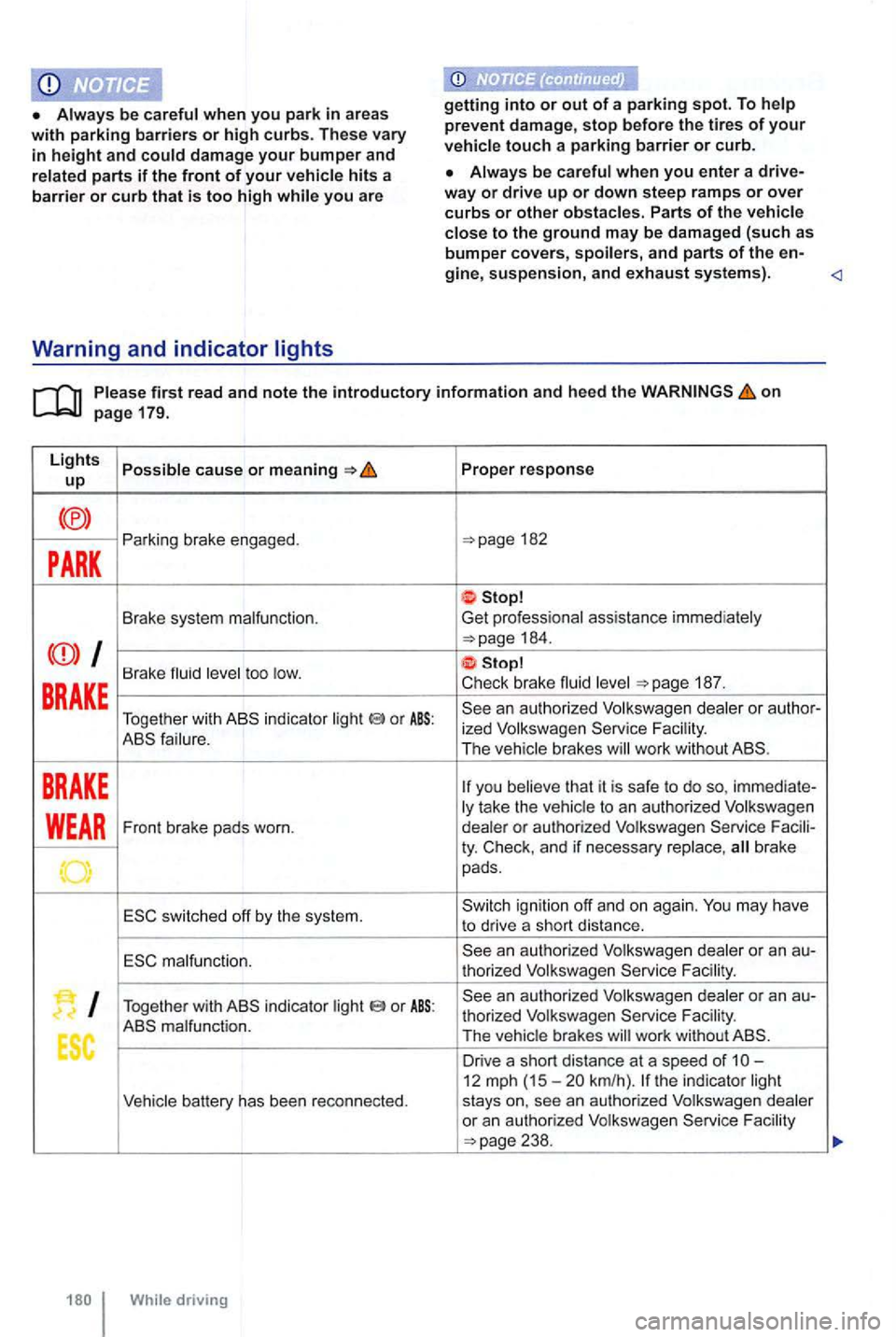
on page 179.
Lights
Possible cause or me aning Prope r re s ponse up
<®> Parking brake engaged.
Brake fluid too Check brake
or ABS: ized Volkswagen failure.
The brakes wor k withou t
BRAKE
Facili-ty. Check, and if necessary replace. brake pads.
switc hed off by the system.
malf unction . an aut horized Volkswage n deale r or an au-
thorized Volkswagen Facility .
Together with or ABS : Facility. malfunction.
The vehic le brakes
Driv e a s hort distance at a speed of 1 -
12 mph (15-km/ h). th e indicator light battery has been reconnect ed. stays see
an authorized Volkswagen dealer or an authorized Volkswagen 238.
Page 280 of 516
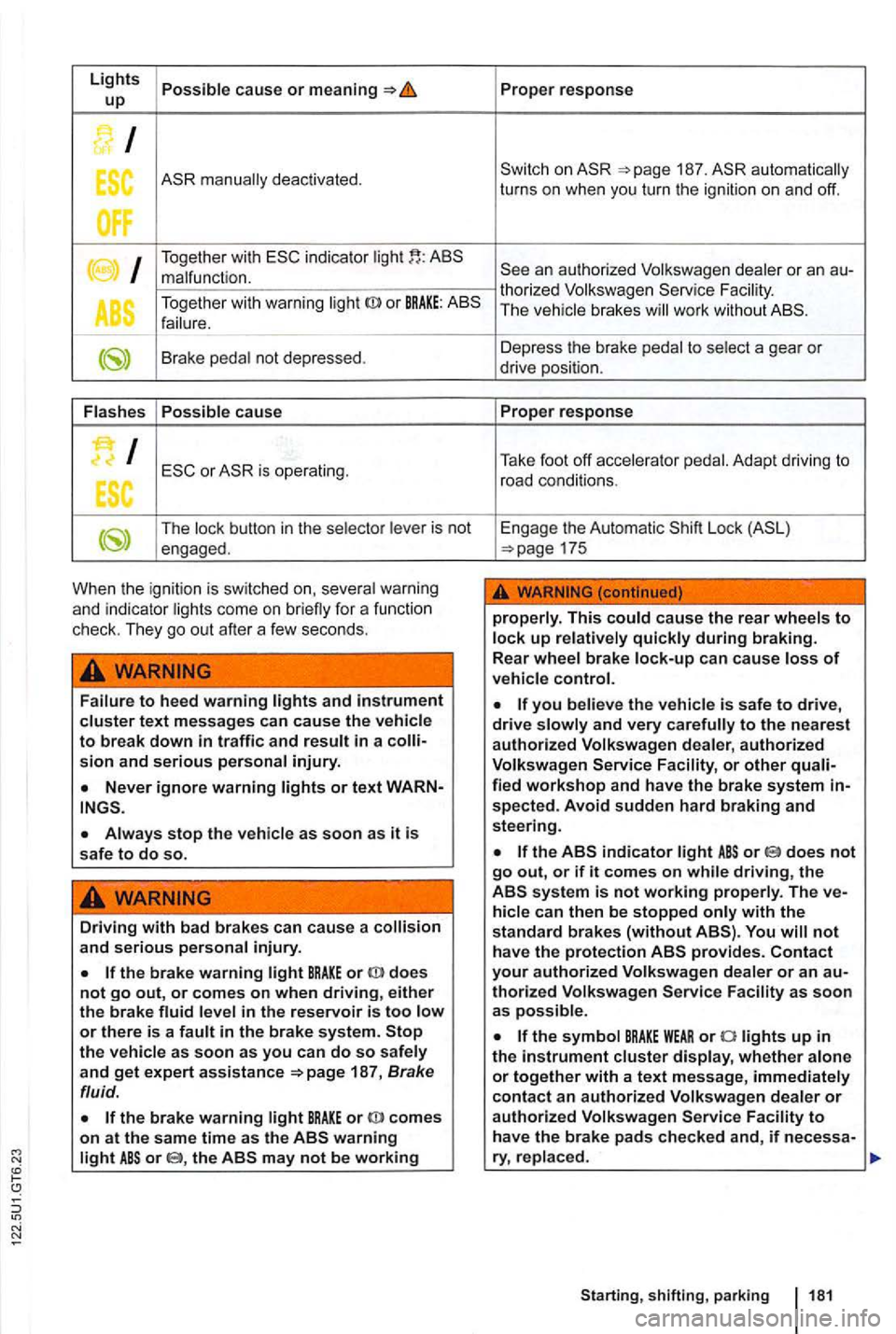
Lights cause or up
I
ES deactivated.
I Together with indicator malfunction .
T ogethe r with warning
or BRAKE:
Brake not dep ressed.
cause
I
The butt on in the is not
engaged .
When the ign ition is switch ed on,
text messages can cause the to break down in traffic and
or text WARN
stop the as soon as it is safe to do so.
Driving with bad brakes can cause a and serious
the brake warning BRAKE or does not go out, or comes on when driving, either the brake or there is a the as soon as you can do so and get expert assistance 187, Brake
fluid.
the brake warning comes on at the same time as the or the
187 . automatically
turns on when you turn the ignition on and off.
an authorized Volkswagen or an thorized Volkswage n The brake s work without
to
Adapt driving to
road conditions.
E ngage the Automatic
Lock
This up brake
you is safe to drive, drive and very authorized Volkswagen Service or other
spected. Avoid sudden hard braking and steering.
or does not go out, or if it comes on while driving, the system is not working can then be stopped with the
s tandard brakes (without not have the protection
thorized Volkswagen Service as soon as
Starting, shifting, parki ng 181
Page 281 of 516
Failure to heed warning lights or t ex t WARN-can result in vehicle damage .
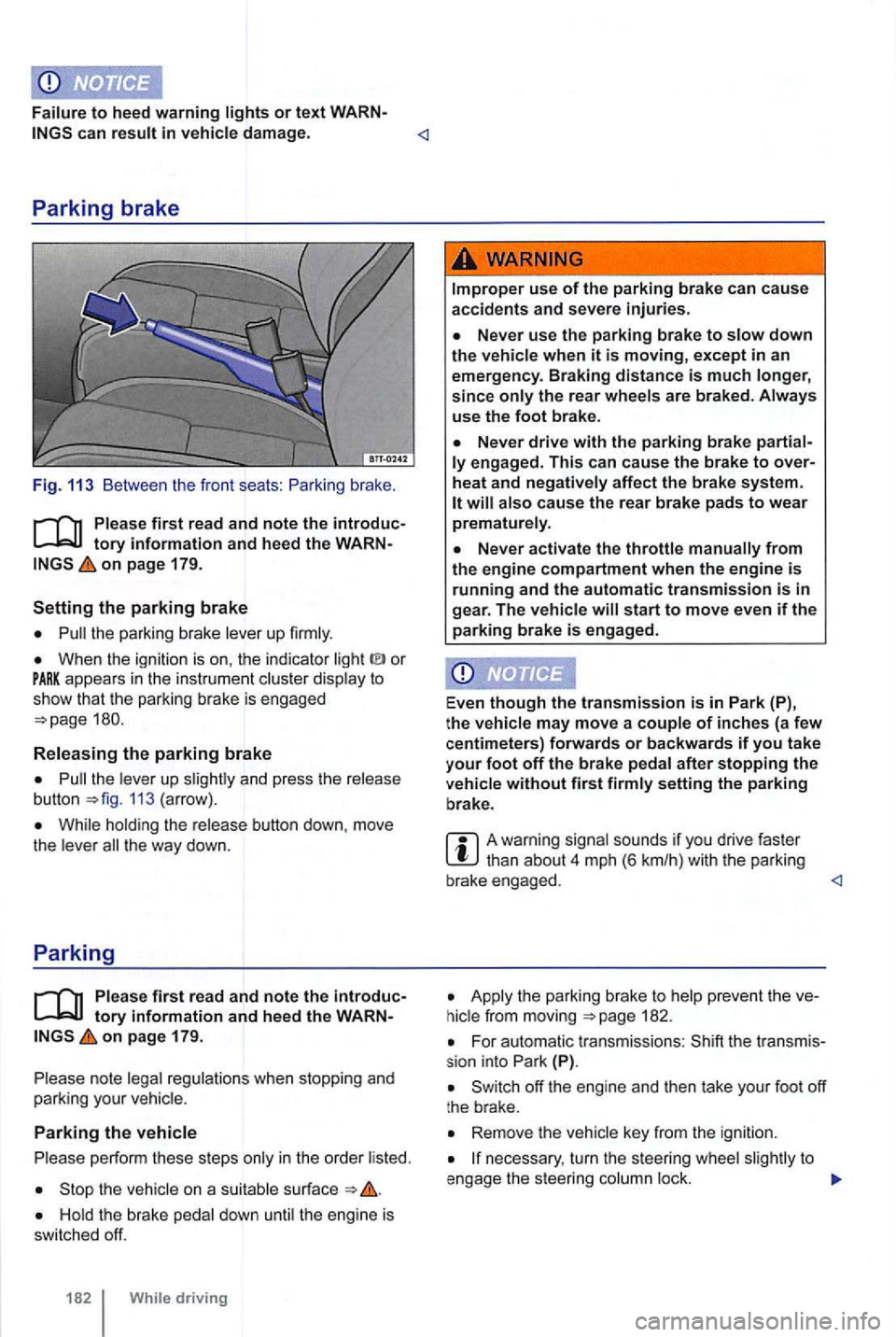
Fig. 113 Between the front seats :
on page 179.
the parking brake lever up firmly.
When the ignition is on , the indicator or appears in the instrume nt c luster display to show th at the park ing brake is engaged
the leve r up 113 (arrow) .
While hold ing the release button down, move
t h e lever t he way down.
Parking
Ple ase firs t r ea d and note the introductory info rm ation and heed the WARNon pa ge 179.
note legal regulations when stopping and
parking your vehicle.
Parking the vehicle
p erform these steps only in the order listed.
the vehicle on a suitab le surface
the rear wheels are braked . Always
use the foot bra ke.
engag ed. This c an cause the brak e to over
heat and neg ati vely affec t the b rak e sys te m .
start to move even if the parking brake is e ngag ed .
Even
though the tra nsmission is in P ark (P),
t h e vehi cle may move a couple of inche s (a fe w
c entimeters) forwards or backwards if you take
your f oot off the brake pedal after stopping the
ve hicl e without fir s t firmly setting the parking
b rake .
A warning signal sounds if you drive faster
Apply t he parking brake to 182.
For automatic transmissions : (P).
Remove the vehicle key from the igni tion.
necessary , turn the steer ing whee l to
e ngage the steer ing column lock.
Page 282 of 516
transmission into 1st gear (on
and the out.
keys with you when
Before stopping the en gine, turn the steer ing so th at, if the starts to into the curb :
turn the fro nt
Facing
The
on page 179.
New
brake pads do not provide to km)
and must first be To some extent,
you can make up for th e somewhat reduced
formance by more pressu re to t h e brake But, during the break-in period, the
be the brakes are ken in. Avoid hard braking a nd situatio ns that might
requ ire hard brakin g (such as
on operati ng
condit ions and the way the
you
serv ice
damage your bumper and related parts if the front of your vehicle hits a barrier or curb that is too high you are
getting into or out of a parking spot. To
to the ground may be damaged (such as bumper covers, spoilers, and parts of the en-
gine , suspension, and exhaust systems).
icy. Wet or icy brakes must be dried as soon as by high speed.
Make sur e nobody is behind you and that you do
not enda nge r
or othe rs
t her e is on th e roads and you are not braking brake move any
Brake disc corrosion (rust) and dirt to occur if the is not driven much or is driven fo r short
distances with the brakes have not
been used and th ere is some rust on the discs, the brake discs and pads once in a by
shifting, parking
Page 283 of 516
Brake system malfunction
you brake and find that vehicle doesn't brake
nearly as
come on
and a m essage may appear in the instrument ter display. you believe the vehic le is safe to
d rive, immediately take it to the nearest authorized
Volkswagen dealer or authorized Volkswagen
Service
f or repair. Drive slowly and very
carefully , for the longer stopping distance ,
and be ready to push longer and harder on the
brake pedal to slow the vehicle down.
Brake booster
The brake booster works only when the engine is
running . in creases the force on the brakes above
and beyond the pressure put on the brake pedal by
the driver .
New brake pad s do not provide maximum braking performance.
miles You can
compensate for the reduc ed braking force by putting more pressure on the brake
pedal.
other vehicles too closel y or put yourself into other situations that might require sudden, hard braking , especially
when the brake pads have not b ee n broken
in.
Overh eated brakes reduce the vehicle's stopping power and increa se stopping distances considerably.
that are long or s teep, always reduce speed
and shift into lower gear (manual or automat-
184 While driving
ic transmission). This let the vehicle use
engine braking and reduce the load on the brakes. Otherwise, the brake system could overheat and possibly fail.
A damaged front spoiler or a non-standard spoiler can redu ce airflow to th e brakes and make them overheat.
Wet brakes or brakes coated with ice or road
salt react slower and need longer stopping distances.
apply the brakes to tes t them .
Driving when the brake booster is not working increases stopping distances and can
cause accidents and serious per sonal inju
rie s.
Nev er let the vehicle coas t when the
the bra ke booster is not working (suc h
a s wh en th e vehic le is being towed) , a lot more pedal force is needed to slow down and stop.
Neve r the brake s by keeping your foot on the brak e pedal when you do not want to brak e. Constant pres sure on the brake ped al
ca n make the brak es overheat. Riding the bra kes substantially r educe brakin g performance, increase stopping distance, and can
cause complete brake system failure .
that are long or s teep, always reduce speed and shift into lower gear (manua l or automatic tran smission). This gine brakin g and reduce the load on t he brakes. Otherwise, the brake system cou ld
o ve rheat and possibly fail. use the brakes when you n eed them to slow the vehicle down more or to stop.
Page 284 of 516
When th e front brakes are serviced , you
checked The best way to check for brake pad wear is to have your author-
Braking assistance systems
first read and note the introductory information and heed the WARNon pag e 179.
The and EDL braking assistance systems work
to improve road dynamics to of skidding and of when the engine is running . driving situations ,
you to get the
the
has of physics. not
may not be
or snow,
(r ides on a cushion of water instead of the road surface) , not be because contact with the pavement has been interrupted and the
as with difficult driving situations as it can at speeds. When towing a to if you were not towing a
to visiroad, traffic , and weather conditions . cannot override the in crease the trac tion , o r keep a
of keeping the and on the road ized
inspect the pads through the openings in the necessary, the can be taken
off for a more thorough inspection.
extreme maneuvers by using the driver's
s teeri ng inputs to
can provide any assistance, you may not experience the benefits of
and/or works together wi th the EDL, and XDL systems (see the time and cannot be switched off. certain situations when you need traction cannot be achieved, you can switch off by pressing the button on again when you no traction .
Anti-Lock Brake
to keep the to maintain the driver's to steer and the This means the is
down hard and
Do not "pump" the brake
the
notice a
cannot shorten the stopping distance
under all conditions. The stopping distance may even be for instance , when driving on gravor on snow covering an icy or pery surface.
Brake Assis t
can you press the brake very detects an emergency situation. brake system pres
sure , maximizing braking power and reducing the stopping distance. This way, and efficiently.
Page 285 of 516
Do not reduce pressure on the brake
up on the brake.
Lock (EDL and XDL)
EDL is applied during regular straight -line
traction (spinning) and redirec ts the drive force to other drive wheels. extreme cases , EDL swi tches off to keep the brake from
switches on again .
XDL is an extension of the Electronic Differential
Lo ck sys tem . X DL does not react to drive wheel
s lippage when driving straight ahead .
XDL
detects slippage of the inside front wheel during
fast corne ring . X DL app lies enough brake pressure
to
this wheel in order to stop the slippage. This
Driving fast on icy, or wet roads can to a of control and result in serious persona l injury for you and your passengers.
Always adjust your speed and driving
style to roa d , traffic, weather, and visibility conditions. Never the additiona l sa fety that and EDL can
come the of physics and always prevent and wet
roads are dangero us eve n with and the o ther syste ms!
to A vehicle that has
1861 While driving
tance from the vehicle in front of you.
cele rator Even with these syste m s,
th e wheels may start to spin, le ading to a
The effectiveness of ca n be significantly reduced if other components and sys te m s that a ffect vehicle dynamic s, including but not limite d to bra kes , tires, and other te m s mention ed above , are not properly
maintained or fun ctioning.
Always remembe r that vehicle alterations or modifications can affect the functioning of the EDL, and systems.
Changing the vehicle su spension or using an unappro ved tire I wheel combination can
c han ge the way the EDL ,
and system s work and re duce their fectiveness .
The effectiveness of is als o
tires in orde r for and to work erly . Diff eren ces in the tread circumference of the
tir es can cause the system to r educ e the engine
p ower when it is not expected .
is not working, and EDL not work .
may hear noises when these systems are
Page 286 of 516
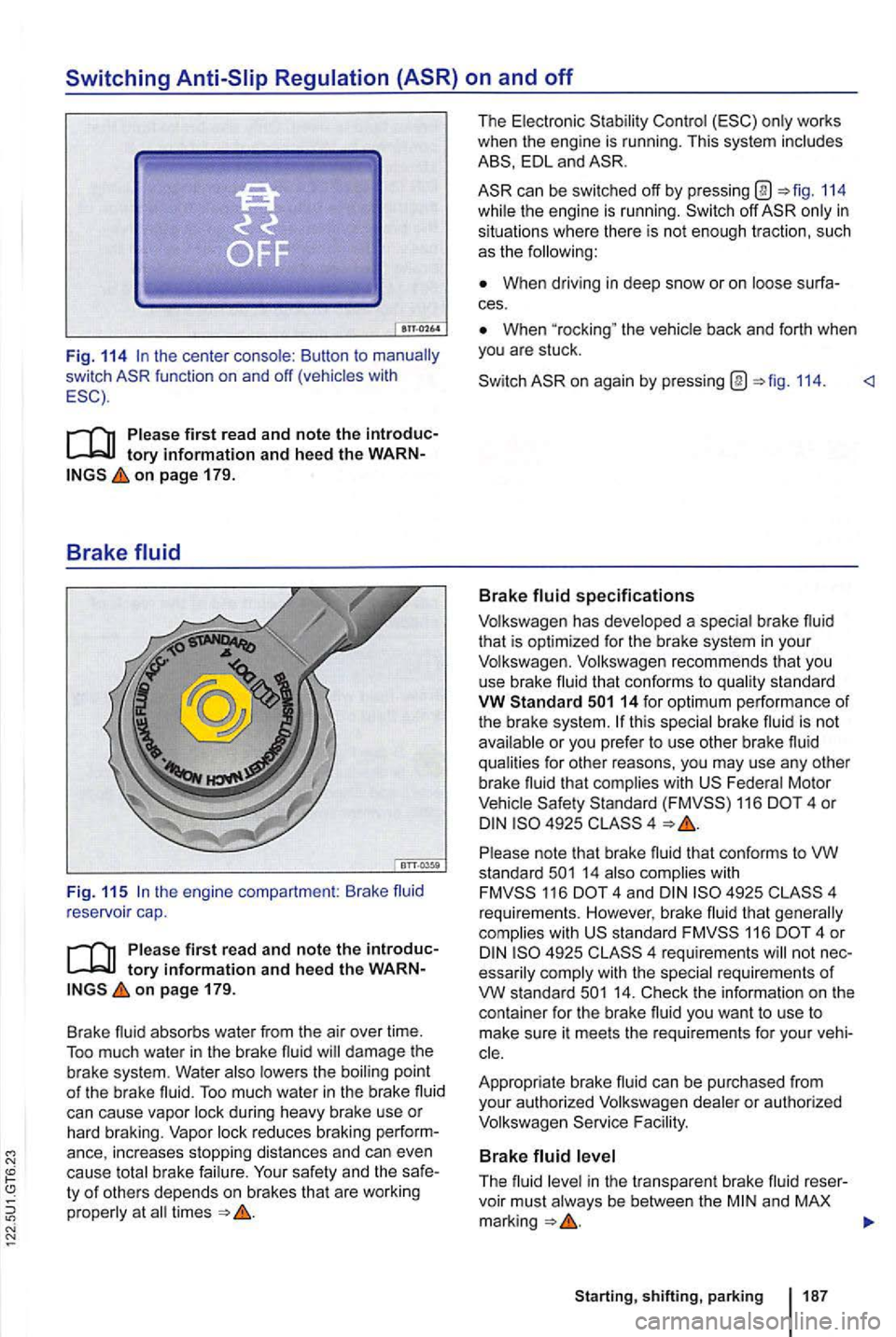
Switching
Fig. 114
on page 179.
Brake fluid
Fig. 11 5
on pag e 179.
Brake fluid
absorbs water from the air over time.
To o much water in the brake fluid will damage the brake system. Water also lowers th e boiling point of the brake fluid. Too much water in the brake flu id can cause vapor lock during heavy brake use or hard braking. Vapor lock reduces braking
ty of others depends on brakes that are worki ng
properly at all times
The Electronic
EDL and
can be switched off by pressi ng @ 114
wh ile the engine is running. off
When driving in deep s now o r on loose
When the vehicle back and forth when you are stuck.
on again by pressing @ 114.
Volkswagen has developed a special brake fluid
that is optimized for the brake system in your Volkswagen. Volkswagen recommends that you
use brake fluid that conforms to qua lity standa rd VW Standard
F ederal Motor Vehicle 116 4 o r
14 also complie s wi th 116 4 and 4925 4
requ irements . However. brake fluid that generally complies with s ta ndard 116 4 o r 4925 essarily comply with the special requirements of VW s ta ndard
cle.
Appropriate bra ke fluid
can be purchased from
you r authorized Volkswagen dealer or authorized
Volkswagen
The f lu id level in the transparent brake fluid voir must always be between the and MAX marking