steering VOLKSWAGEN GOLF 2012 User Guide
[x] Cancel search | Manufacturer: VOLKSWAGEN, Model Year: 2012, Model line: GOLF, Model: VOLKSWAGEN GOLF 2012Pages: 516, PDF Size: 105.12 MB
Page 157 of 516
Adjusting the seating position
Introduction
this section find inf ormation about:
Examp les
of improper seat ing pos itions . . . 59
Pr ope r seating position . . . . . . . . . . . . .
Manual contr ols on the driver and passe nger
seat . . . . . . . . . . . . . . . . . . . . . . . . . . . . . . . . . . . 61 Ele ctrica l co ntr ols o n the driver and front
passenger seats . . . . . . . . . . . . . . . . . . . . . . . . 62
Adj ustin g
the head restra ints . . . . . . . . . . . . . 63
R emoving and re in stalling head restraints . . . 64
Adj usting the stee
ring whee l position . . . . . . . 65
Cen te r armrest . . . . . . . . . . . . . . . . . . . . . . . . . . 66
Number of seats
Th e vehicle
has a t otal of 5 seat ing posit ions: 2 in front and 3 in the rea r. Eac h seating pos ition has a
safety belt.
More information:
funct ions 67
page 69
Ai r ba g syste m 82
safety and child restraints
WARNING
Improper seat ing pos itions increase the risk of severe or fatal injuries in a crash or other accidents,
times .
Never
Always secure children in the vehicle with a n approved and suitable restraint system appropriate for their age, weight, and height 82 .
Always keep your feet on the in front of the seat. Never rest them on the seat,
Always adjust seat , safety belts, and head straints properly before driving and make sure that
inches (25 em) betw een the front pa ssenger' s breastbone and the in strument panel.
ches (25 em) between your breastbone and the steering wheel.
Adjust the driver's seat so that you can push the pedals while keeping your knee(s) slightly bent. The
di stance to the instrument panel in the knee
a rea must be at least 4 inche s
these requirements cannot be met for physical reason s, contact an authorized
Volk swagen dealer or an auth orized gen Facility to see whether adaptive equipment is avai la bl e.
Always hold the steering wheel on the side of the steering wheel rim with your hands at the 9 o'clock and 3 o'clock positions to help reduce the risk of personal injury if the driver's airbag inflates .
Never hold the steering whee l a t the
12 o'clock position or with your hands at e r places inside the steering whee l rim or on the steering wheel hub. Holding the steering wheel the wrong way can cause serious rie s to the hand s, arm s, and head if the
Pointing the steer ing whe el t oward your face dec reases the of the driver's bag to h elp protect you in a
Never drive with backrest s reclined or ed back farthe r than necessary to drive
Page 159 of 516
first rea d and note the introductory information and hee d the WARNon page 58.
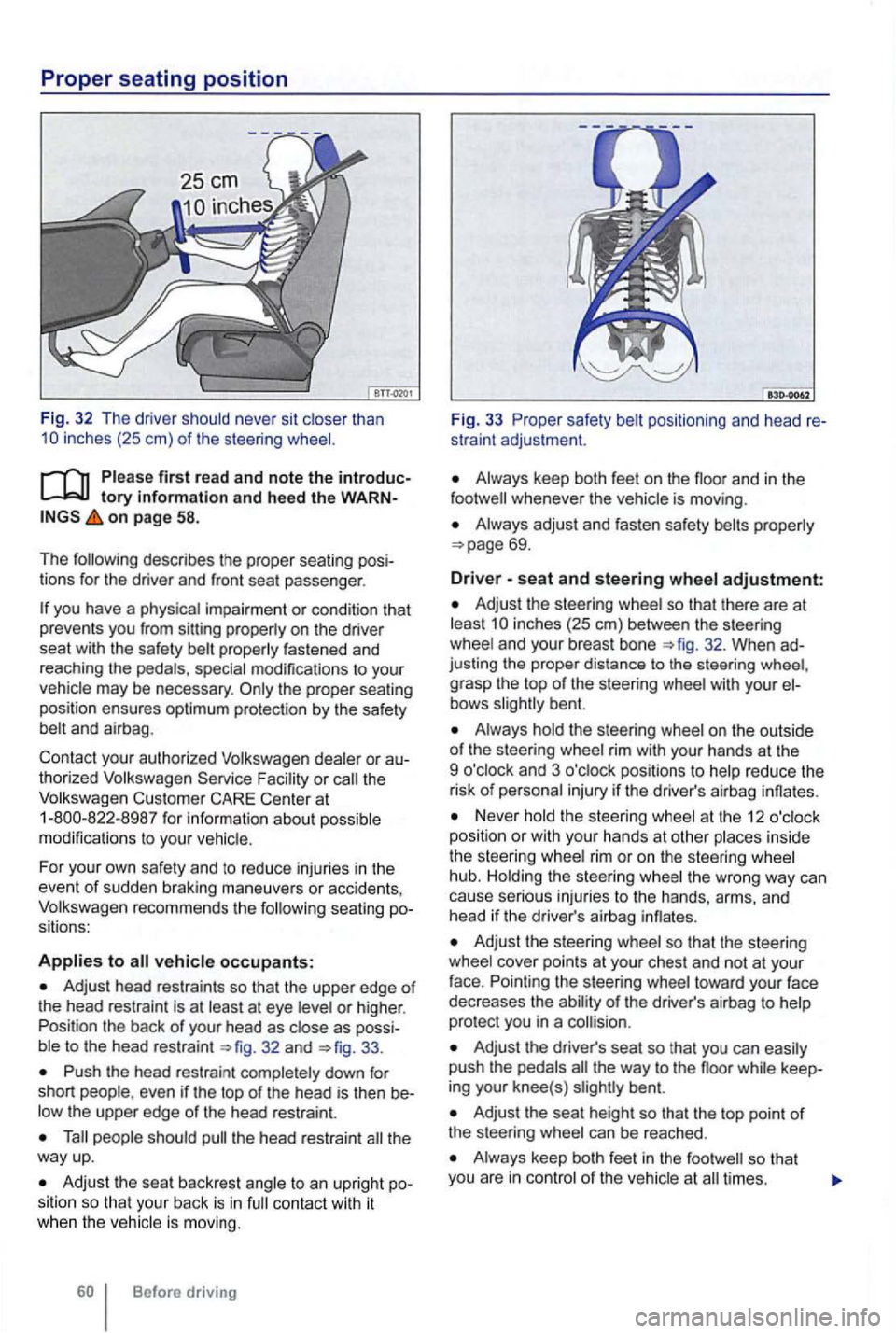
The following describes the proper seating posi
tions for the driver and front seat passenger .
special modifications to your
vehicle may be necessary .
to
Adjust head restraints so that the upper edge of the head restraint is at least at eye
32 and 33.
Push the head restrai nt completely down for
short even if the top of the head is then be
people should the head restraint the way up.
Adjust the sea t backrest angle to an upright position so that your back is in contact with it when the veh icle is moving.
Before driving
Fig. 33 P roper safety
Always keep both feet on the whenever the vehicle is moving .
Always adjust and fasten safety belts properly
adjustment:
Adjust the steering whe el so that there are at least inches (25 em) between the steeri ng
wheel and your breast bone
grasp the top of the steering wheel with your bent.
Always hold the steering wheel on the outside of the steering wheel rim with your hands at the
9 o'clock and 3 o'clock positions to help reduce the
risk
of personal injury if the driver's airbag innates.
Never hold the steering wheel at the 12
and
head if th e driver's airbag innates.
Adjust the steering wheel so that the steering
wheel cover points at your chest and not at your
face. Pointing the steer ing wheel toward your face
dec reases the ability
of the driver's airbag to help
protec t you in a
Adjust the driver's seat so tha t you can easily push the pedals the way to the noor while keep
ing your knee(s) bent.
Adjust the seat height so that the top point o f
the steering wheel can be reached .
Always keep both feet in the times.
Page 164 of 516
Driving without head restraints or with properly adjusted head restraints increases
the risk of serious injuries in a
tory information and heed the on page 58.
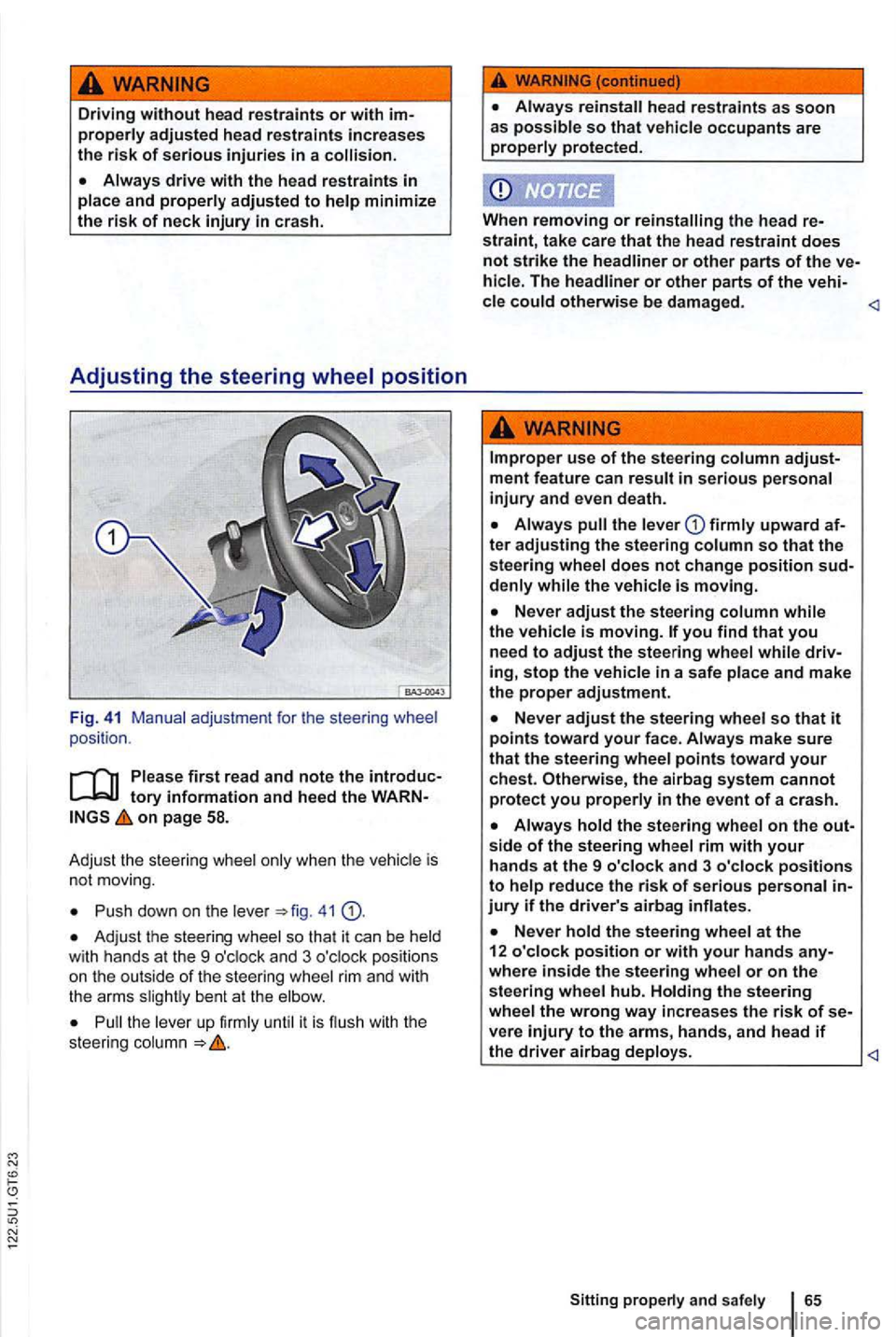
Adju st the steerin g whee l only w he n the veh icl e is
no t m ovi ng.
Push dow n o n the leve r 41
Adj ust th e steering whee l so th a t it ca n b e held w ith hands at the 9 o'cloc k and 3 o 'clock positio ns
o n the out side of the steering wheel rim and with
t he arms slightl y b ent at the elbow .
Pull the leve r up firml y until it is flu sh with th e
stee ring colum n
the lever
denly while the vehicle is moving.
Never adjust the steering wheel so that it points toward your face . Always make sure that the steering wheel points toward your chest. Otherwise, the airbag system cannot protect you properly in the event of a crash.
side of the steering wheel rim with your hands at the 9 o'clock and 3 o'clock positions to help reduce the risk of serious personal
where inside the steering wheel or on the steering wheel hub. Holding the steering wheel the wrong way increases the risk of vere injury to the arms, hands, and head if the driver airbag deploys.
Page 171 of 516
What happens to passengers not wearing a safety
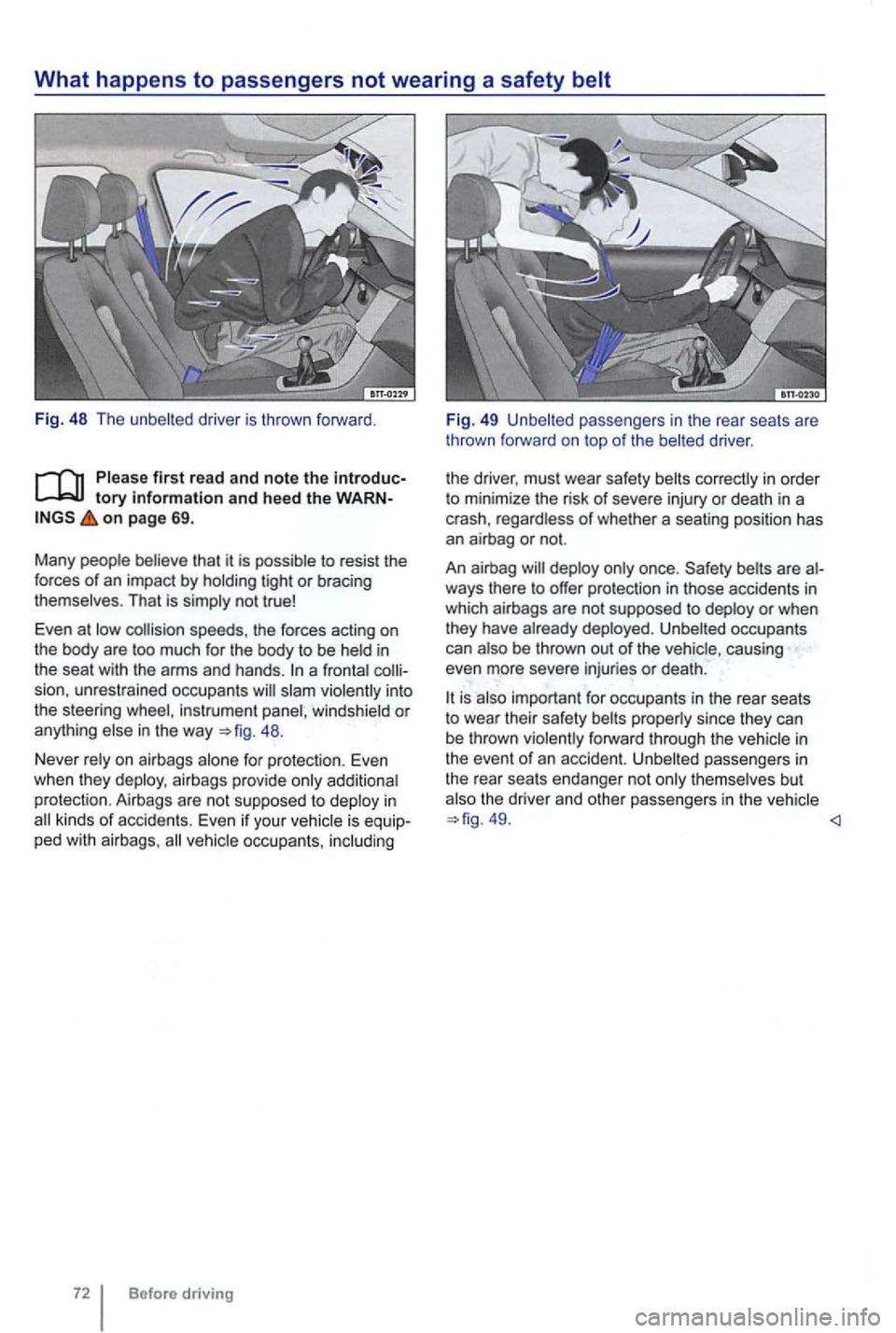
driver is thrown forward.
tory and hee d the WARN on p age 69 .
Many
That is
in
the seat with the arms and hands . a into
the steering instrument in the way 48.
Never on airbags airbags provide protection. Airbags are not supposed to in kinds of accidents. Even if your
Befo re driving
Fig . 4 9 passengers in the rear seats are
th rown forward on top of the
in orde r
to min imize the risk of severe injury or death in a
crash , regardless
of whether a seating position has
an airbag or not.
An airbag
is since they can
be thrown forwa rd through the passengers in the rear seats endanger not but the driver and other passengers in the 49.
Page 181 of 516
Airbag system
infants, rest ra ints and
. . . . 84
BAG . . . . . . . . . 85
Airbags and how they wo
rk . . . . . . . . . . . . . . . 87
The dangers of usi
ng restra ints o n the
front seat . . . . . . . . . . . . . . . . . . . . . . . . . .
F ront airbags . . . . . . . . . . . . . . . . . . . . . . . . . . . 92
Advanced Airbag
is equipped with a front airbag for the
drive r and front seat passe nger. The front airbags
can provide
head restraint s and , fo r
t h e driver , th e steer ing are used
and have been
restraints . They are not a substitute
for safety that must be worn even th ough the
f ro nt seat ing positions are equipped with front air
bags.
More information:
Driving 31
Prop er seating position
Parts , acc essor ies, repairs and modifications
Consumer inf ormation
airbags provide
worn safety 69, belts.
make sure that ev
ery p erson in the fa stens
82 Before driving
the safety
This even when just driving around town. Therefore ,
is
too
increase the risk of personal injury in a
or instrument
you cannot sit upright more than inches (25 em) from the steering and with your back against the backrest, inves tigate whether adaptive equipment may be you reach the and increa se your seating distance from the steering
you are unrestrained ,
re ceive serious injuries and if you are up agains t the
airbag or too to it when it
proper69, belts.
sea t on the front passe nger sea t be
seriously injured and ca n be
make certain that
dren are not properly res trained , they may be
seve rely injured or
in front of the seat to
Page 186 of 516
Airbags and how they work
on page 82.
Front airbags and how they work
Airbags are restraints . They are
not a substitu te for safety belts that must be worn
even though the front seating positions are
ped with front airbags . The front airb ags can
head restraints and, for the
driver, the steering are properly used and
have been
the airb ags that break open the
padded covers on the stee ring a nd the strume nt The front airb ags inflate between
the stee ring
and the front passe nger.
Front airbags in combination with properly worn
safe ty down and the occupant's for
ward movement. Together they to pre vent the
dri ver and front seat passenger from hitting parts
of the veh icle inter ior, thereby reduci ng the forces
acting on the occupa nts dur ing a crash. this way,
they to reduce the risk of inju ry to the head
and upper body during a crash. Airbags do not body parts. is i mport an t to remember that the
o f an eye, so fast that
many don't even real ize that the airb ags
have deployed. The airbags deflate after deployment so that the front occupants can
see through the w inds hield again without inte rrup
tion .
Airbags infl ate with a great
and the
front of th e passenger compartment, the airbag can inflate and provide protection during certain fronta l sions 69, belts.
Make sure th at nothing is in th e way of the airbags
when they deploy. For example , th ings on your be pushed into your body or
ment when the airb ag inflates and cause serious
personal in ju ry .
T he areas outlined in red (dotted
59 and indicate the airbag deploym ent zone .
N eve r
heavy or objects) on the doors, on the win dshie ld, over or near the area marked in red (do tted lin es).
you have a physical impairment or condition that
prevents you from sittin g on the driver
seat with the safety proper ly fas te ned and
r eac hing the pedals, special modifications to you r
ve hic
le may be necessary. The safety
o r thori zed Volkswagen or th e
Volkswage n Customer Center at for infor mation abo ut poss ible
modifications to your vehicle.
When airbags
Deployment of th e front airba gs and the activation
o f the safety cele rat ion measured by the crash sensors and reg
i ste red by the e lect ronic control unit. Cras h sever it y
depe nds on speed and decelerati on as as th e
m ass and sti ffn ess of the vehicle or object involved
i n th e crash .
T he front airbags
sions , in rollovers or if the ign itio n is sw itched off.
T he front airbags not inflate in fro nta l sions. The triggering of the airbag system depends
on the
and registered by the electronic contr ol unit. thi s ra te is th e refe ren ce program
med into the con tro l unit , the airbags not be
t r igge red, even though the veh ic le m ay be d amaged as a Veh icle age, repair costs o r eve n th e of damage is not necessarily an ind ica tion of wheth er an
a irbag inflate or not. is not possible to fine a ra ng e o f veh icle speeds that cover every
possible kind and of imp act tha t trigge r the airbags , since the circu mstances vary considerably between one collisio n and other . factors
of impact ,
Page 187 of 516
When an airbag deploys , fine dust is released.
This is normal and is not caused by a fire in the hicle . This dust is made up mostly of a powder
used to lubricate the airbags as they deploy. This
dust could irritate skin and eyes and cause
ciently when used with properly worn safety belts
and a proper seating position in Introduct ion on page 58
equipment
Your safety and the safety of your passenge rs
shouldn't be left to c hance. Advances in
gy have made a number of featu res availab le to
help reduce the risk of injury in a collision . The
Sophisticated safety belts for
belt pretensioners for driver and front
passenger .
Advanced front airbag system for driver and
front passenger .
ger.
Airbag indicato r
BAG light.
Electronic control unit and associa ted sensors.
Before driving
Head restraints with height adjustmen t
Adjustable steering column.
LATCH/U CRA lower universal and top tether
anchorages for child safety seats at the rear
These features
can't work as a system if they are not always
be tu rned
off if the weight on the front passe nger seat is less
than the amount programmed in the elect ronic
con t
rol unit . Th e front airbag on the passenge r side
will also be turned off if the combine d weigh t of an
i nfant
of about one year of age in one of the child
seats that was used to certify the Advanced Airbag
ard BAG
Never rely on airbags alone for protection.
69, Safety belts.
ery per son in the vehicle is properly seated on a sea t of his or her own, properly fastens the safety belts belonging to that seat before the vehicle starts to move, and keeps the belts properly fasten ed while riding i n the hicle. This applies eve n when just driving around town. Therefore, always wear your safety belts and make sure that everybody in your vehicle is properl y restrai ned .
too close to the steering wheel or strument panel decrease the ness of the airbags and will increase the risk of personal injury in a collision.
Page 188 of 516
or instrument
you cannot sit upright more than ches (25 em) from the steering gate whether adaptive equipment may be to you reach the and
you are unrestrained ,
be seriously injured and
even be if you are siting too
bag wear safety
if the front airbag inflates -even with an Advanced bag
make certain that children age 12 or younger ride in the rear seat.
when the airbag
sit as far as possible from the steering
sit upright with your back against the backrest of your seat.
prevent serious injuries to the head , legs and hips if the airbag inflates.
Objects between you and the airbag crease the risk of injury in a crash by ing with the way the airbag and/or by being pushed into you as the airbag
when the is in use.
instrument or seat backrests or between those areas and someone in the vehicle. These objects if an airbag inflates.
or transport objects on the front passenger seat. make sure that there is nothing on the front passenger seat that to the airbag system that the
seat is occupied by a person when it in fact is not, or to is. The weight of such objects can cause the passenger front airbag to be turned on when it should be off, or can cause the airbag to work in a
way that is different from the way it have worked without objects on the seat.
make sure that nothing is on the front passenger seat when the backrest is
The fine dust created when airbags
To reduce the risk of breathing problems, those with asthma or other respiratory tions should get fresh air right away by or opening windows or
Page 194 of 516
N
The fine dust created when airbags deploy
can cause breathing problems for people
w ith asthma or other breathing conditions.
To red uce the risk of breath ing problems ,
those with asthma or other respiratory condi-lions shoul d g et fresh air right away by get-ling out of the vehicle or opening windows or doors.
you are in a
the residue should ge t your eyes, flush them with water .
Airbags that have deployed in a c rash must be replaced .
by a
tra ined technician who has the necessary tools and diagnostic equipment to properly replace any airbag on your vehicle and as-sure system effectiveness in a crash .
Never permit sa lvag ed or recycled airbags to be in your vehicle .
Advanced Airbag
tory information and heed the WARNon pag e 82 .
Th e fro nt pass e
nger sea t in yo ur vehicl e has a
Und eployed air bag modules and safety pre tensione rs are cla ssified as Perchlora te
Material . handli ng may
requ irements regarding
h andl ing and disp osal of the veh icle or parts of it s
r estraint system , includ ing airbag modu les and
safe ty
S ervice Faci lit ies are
The front Advanced Airbag System also includes:
Crash senso rs i n the fr on t o f the veh ic le tha t measur e vehicle accelera tio n/dece le ratio n to p ro
vide inf ormation to the Adva nce d Airbag Syste m
a bo ut the seve rity o f th e crash .
An elec troni c cont ro l u nit , w ith i nte gra te d crash
senso rs for front and side im pacts . T he co ntr ol unit
" decides " whe ther
to fire jus t the front airbags
base d on t he info rm ation recei ved from the crash
sensors . Th e con trol unit also "dec id es " whe ther the safety belt pretensi one rs shou ld be activated .
An Advanced Airbag with ga s generator inside
the steering
An Adva nced Airbag with gas generato r inside
th e in str u men t panel for th e f ro nt passenger .
Sitting properly and safely
Page 224 of 516
are not bright enough to le t you see ahead or be see n by others when it is dark.
not let you see far enough
Lights and
tory information and the WARNon page 122.
Daytime running
lamps are or in the front bumper fo r t he daytime running lights
( DRL ).
Turning on DRL
ahead for safety,
at dusk or when it i s dark .
are on, a vehicle cannot be seen by others
cool or humid weathe r, th e insides of the
lighting system.
When the dayt ime running are switched on,
only these separa te lamps com e on =>
Th e daytime running lights are switched on when
ever the ign itio n is swi tched on and the ligh t sw itch is in position The indicator or in th e instrument cluster indicates that the feature is active =>page 122.
Turning
off DRL
P ress and ho
ld the turn signa l leve r and high beam Press and hold the turn signa l lever and high beam
switc h up and to the back (right turn sign al and switch down and to the back (left turn signa l and
headlight flasher). headlight flasher).
the ignit ion on f or about 3 seconds and then off again .
th e ignition on.
- Turn the ligh t swi tch to the posi tion.
the parki ng brake.
vehicl e may have fog lights under the front
bumpe r that are also static corneri ng l ight s. A t
speeds below about 25 mp h km/h ), th e l igh t on
one side of t he
yo u turn to the right , the righ t fog light -
Release the parking brake.
-
Turn the light swit ch to the tD pos ition.
-the igni tio n off.
comes on; turn left and the left fog l
ight comes on .
T he light dims and goes out when the steering
whee l is st
raig ht ened out again.
T he static cornering lights work only when the
are on. The static corneri ng lights do not come on when the switch is in the position or when the fog lights themselves have
been switched on =>page 124.
Light s and vision