check engine VOLKSWAGEN GOLF MK5 2006 User Guide
[x] Cancel search | Manufacturer: VOLKSWAGEN, Model Year: 2006, Model line: GOLF MK5, Model: VOLKSWAGEN GOLF MK5 2006Pages: 444, PDF Size: 92.7 MB
Page 41 of 444
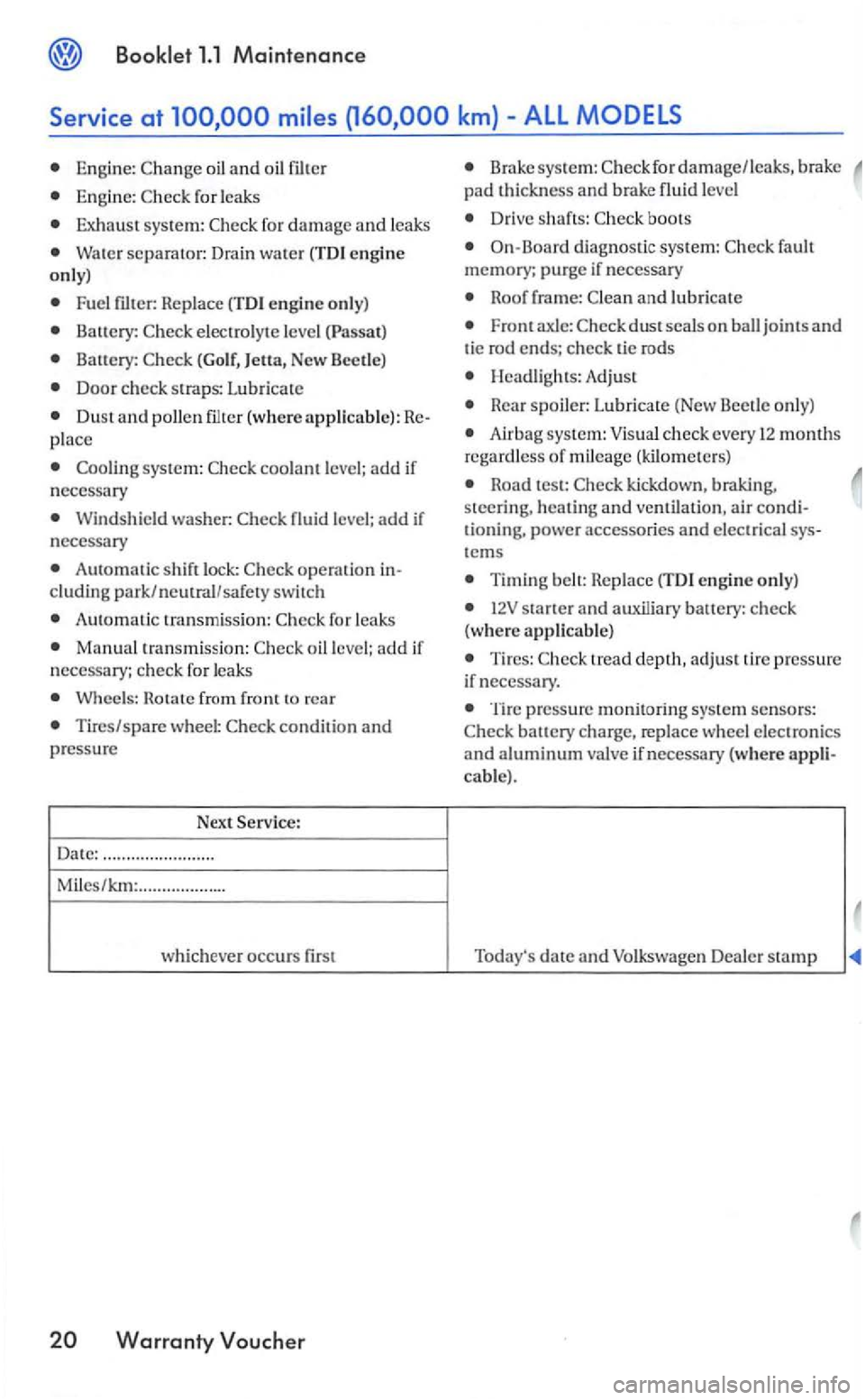
Engine: oil and oil filter
Engine: for leaks
Exhaust system: fo r damage and leaks
Water separator: Drain water (TDI e ngi ne only)
Fuel
electrolyte level
Battery: (Golf, )etta, New
Door check straps: Lubricate
s ystem:
Windshield washer:
Automatic sh ift lock:
Automatic transmiss ion:
Manual transmiss ion:
Wheels:
Tires/spare wheel :
Date: .................. ... ...
Miles/km: .................. .
which ev
er occurs first
Brake system: for damage/leaks, brak e pad thickness and brake fluid
Drive shafts: boots
On-Board diagnos tic system: fault
memory; purge if nece ssary
Roof frame: and lubricate
Front axle: jo int s and tie rod ends; ch eck tie rods
Hea dligh ts : Adjust
Rear sp oile r: Lub ricate (New Beetle only)
Airbag system: Visual check every 12 months regardless of mileage (kilom eters)
Road test: kickdown , braking, steering, heating and ventilation , air conditioning, powe r accessories and electrical systems
Timing belt: Replace (TDI engine only)
starter and auxiliary banery: check
( w here applicable)
T ires: tread dept h, adjust tire pressure
if nec essary _
Tire pressure monitoring system sen sors: battery charge, replace wheel electronics and aluminum valve if necessary (whe re appli
cable) .
date and Volkswagen Dealer stamp
Page 265 of 444
Booklet 3.1 Controls and Equipment
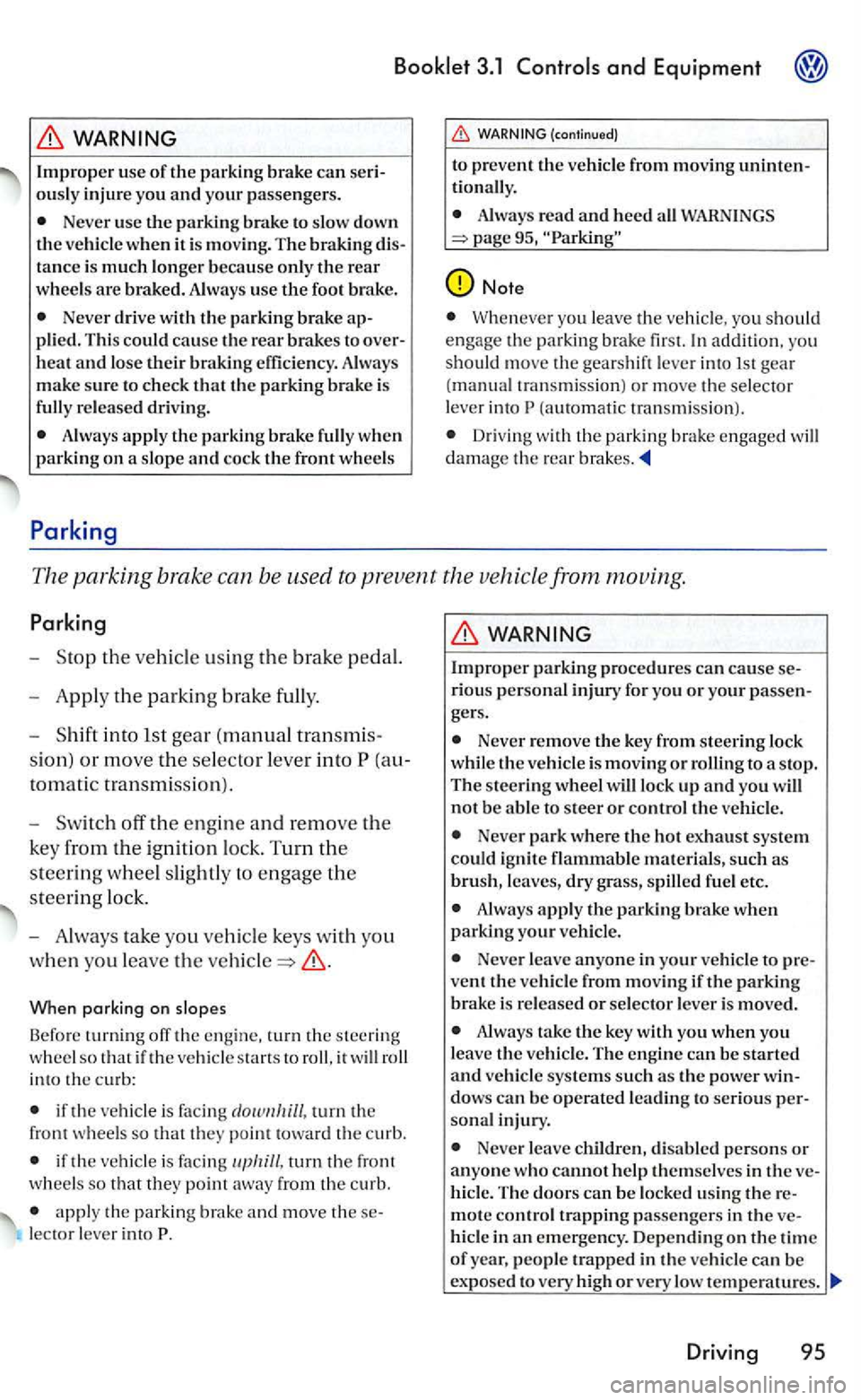
WARNING
Improper use of the parking brake can seri
ousl y injur e yo u and your passenge rs.
Neve r use the parking brake to slo w down
th e ve hicle when it is mov ing. The braking tanc e is much longer because only the rear wheel s are braked. Alwa ys use the foot brake.
Neve r drive with the parking brake plied. This could cause the rear brakes to overheat and los e their braking efficiency. Always
make sure to check that the parkin g is
fully re le a sed dri vin g.
Always apply the parking brake fully when
parking on a slope and cock the front wheels
Parking
(co ntinue d)
to prevent the vehicle from moving
Always read and h ee d WARNINGS
Whe never you leave th e veh icle, you should engage the parkin g
(aut om ati c tra nsm ission) .
Driving w ith the parking brake engaged will damage the rear
The parking bra ke can be used to prevent th.e vehicle from moving.
Parking
-the vehicle using the brake
-Apply th e parkin g brake full y.
-
into lst gear (m anual transmi s
sio n)
or move the se lector lever into
When parking on slo pes
Before turn ing off the engine, turn the steering
w hee l so that if th e vehicle starts roll, it will roll into the curb:
if the vehicle is facing turn the
f ront wheels so that they point toward the curb.
if th e veh ic le is facin g
apply the parkin g brake and m ove theselector leve r into
WARNING
Improper parki ng procedures can cause riou s personal injury for yo u or your passe n
gers.
Neve r remove the key from steering lock
while the ve hicl e is moving or rolling to a s top . The steering wheel will lock up and yo u will not be abl e to steer or contro l th e vehicle.
Neve r park where the hot exhaust system could ig nit e flammable materi als, such as brush, leaves, dry g ra ss, spill ed fue l e tc.
A lwa ys apply the parking brake when parking your vehi cle.
Neve r leave anyone in your vehi cle to vent the ve hicle from movin g if the parking brake is released or selector lever is moved.
Always take th e key with yo u when you leave the vehicle. The engin e ca n b e started and veh icle syste m s s uch as the powe r dows can be operated leadi ng to serious sonal injury.
Neve r leave childre n, disabl ed person s or anyone w ho cannot h elp th e mselves in the hicle. The doors can be locked using th e re-
m ote control trapping passe ngers in the h icle in an emerge ncy . Depending on the tim e of year, peo ple trapped in th e vehicle can be ex po sed to very high or very low temperatures.
Driving 95
Page 277 of 444
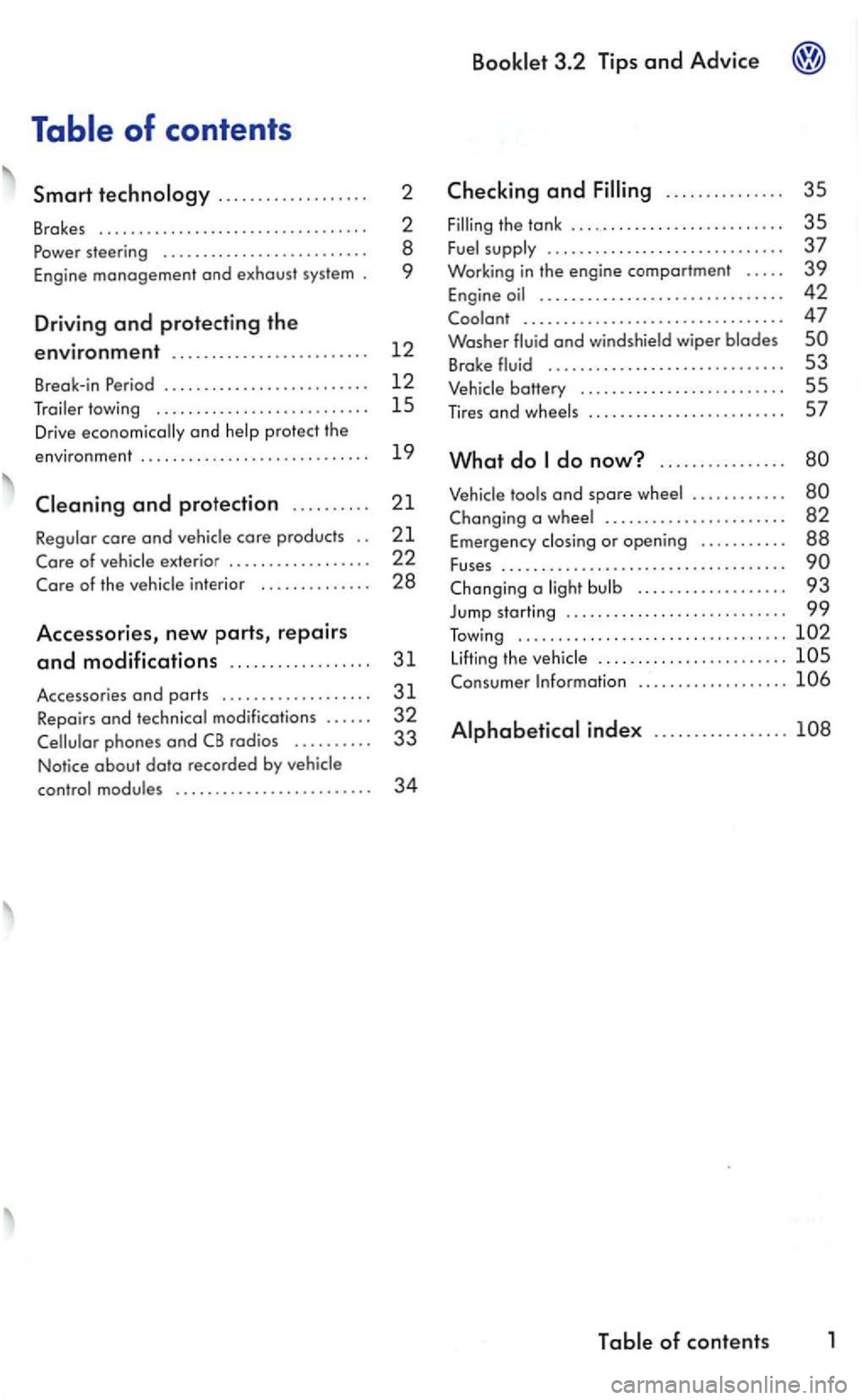
. . .. . . . . . . . . . . . .. . . 2
Brak es . .. . . .. .. .. . .. .. .. . .. .. .. . .. .. ... . 2 steering . . . . . . . . . . . . . . . . . . . . . . . . . . 8
Eng ine
management and exhaust sys tem . 9
Driving and protecting the
environment .. . .. .. .. .. .. .. .. . . . .. .. . 12
Break-in Period .. . .. .. .. .. .. .. .. .. .. .. .. . 12
towing .. .. . .. .. .. .. . .. . . .. . . .. .. . 15
Driv e economically and
core and
exterio r . . . . . . . . . . . . . . . .. . 22
Core of the in terior . . . . . . . . . . . . . . 28
Acce ssories, new parts, repairs
and modifications .. .. .. .. .. .. .. .. .. 31
Accessories and ports . . . . . . . . . . . . . . . . . . . 31
Repair s ond technical modifications . . . . . . 32
phones and
modules . . . . .. .. . . . . . . . . . . . . . . .. . 34
Checkin g and .. .. .. .. .. .. .. . 35
supply .. .. .. .. .. .. .. . .. .. .. .. .. . .. .. 37 Working in the engine comportment . . . . . 39
Engine .. .. .. .. .. .. .. .. .. .. . .. . .. .. .. . 42
................................. 47
Washer and windsh ield wiper blades
Broke . . . . . . . . . . . . . . . . . . . . . . . . . . . . . . 53
and spore . . . . . . . . . . . .. . .. . . .. .. .. .. . .. . .. .. 82
Emergency or opening . . . . . . . . . . . 88
Fuses . . . . . . . . . . . . . . . . . . . . . . . . . . . . . . . . . . .
. . .. . .. .. .. .. .. .. .. 93
Jump starting .. . .. .. . .. .. . .. . .. .. .. . .. .. . 99 Towing .................................. ........................
index .................
Page 283 of 444
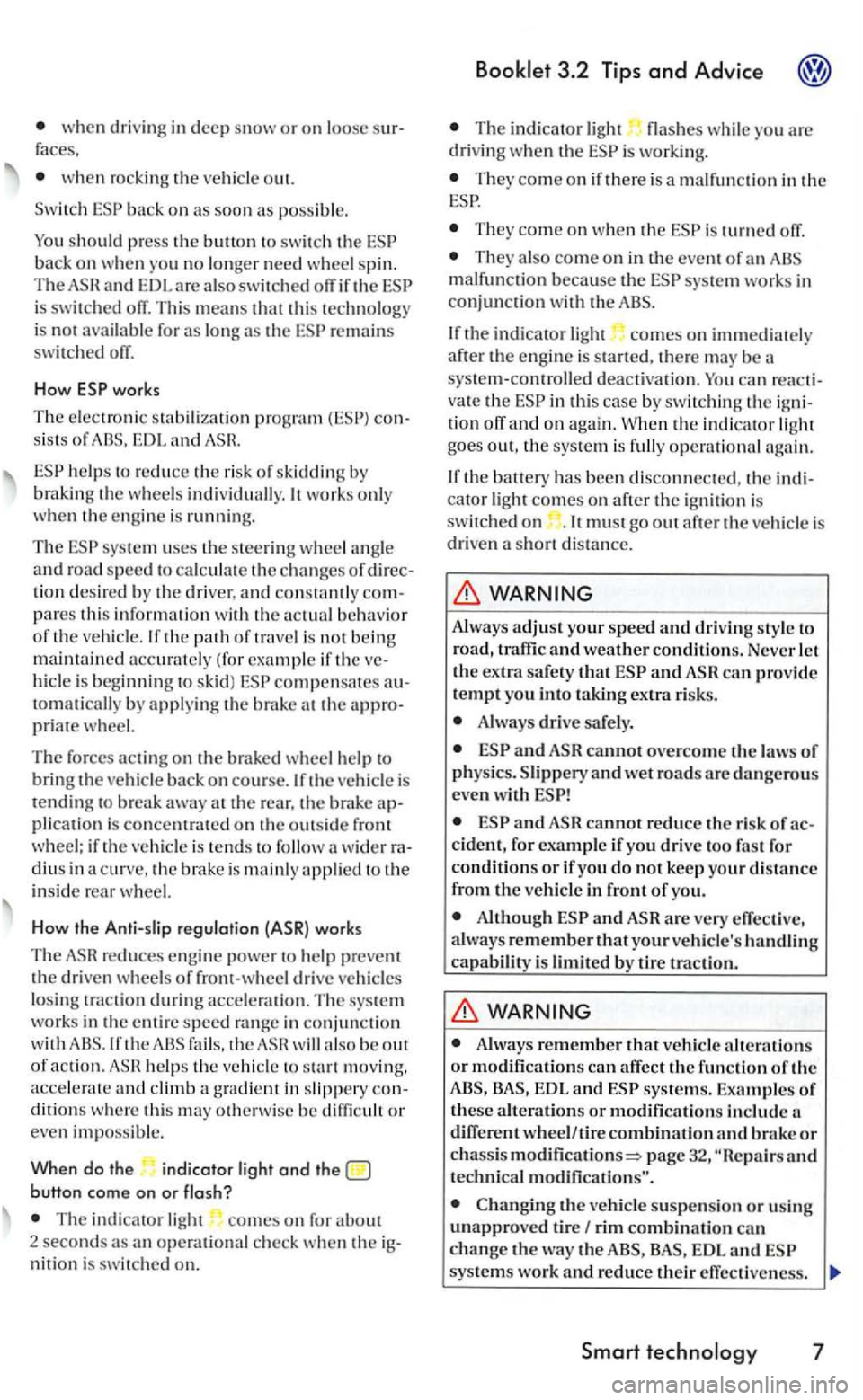
when dri ving in deep snow or on loose faces.
w he n r ocking the ve hicl e out.
Switch
ba ck on w he n yo u no longer need wheel s pin. The
remains switch ed oiT.
Ho w
works
The electroni c stab ilization progra m
helps to reduce the ris k of skiddin g braking th e w heels individually. works o nl y
w he n th e e ngine is ru nning.
The sys te m uses th e steering whee l an gle and road speed to calculate th e changes of tio n desired by the driver, and constantl y pares thi s informat ion with the actual behavior of the vehicl e. accurately ( for example if the hicle is beginni ng to skid ) tomatically by applyin g th e at the priate wheel.
The forces acti ng on the braked wheel help to
b rin g the vehicle back on course. th e ve hicl e is tending away at the rear, the brake
wide r dius in a curve. th e brake is mainly applied to the
in sid e wheel.
How the Anti-slip regulation
reduces engine powe r to he lp preven t the driven wheels of front-wheel d rive vehicles
losing traction during acceleration. The sys te m works in the entire speed ra nge in conjunctio n
with fails , the will a lso be out of action. h elp s the ve hicl e to moving. accele rat e and climb a grad ient in slipp ery d itions wh ere thi s may o therwise be diffi cult or even imposs ibl e.
When do the indicator light and the button come on or flash?
T he indicator light comes on for about
2 seconds as o perati o nal check when the
3.2 Tips and Advice
The indicator ligh t flashes while yo u are driv ing when the is wo rking.
They come on if there is a malfun ction in the
They come on when the
Th ey also come o n in the event of an malfunction because the system works in conjunction with the ABS.
the indicator light comes on immedia tel y
a fter the engine is started , th ere m ay be a
sys tem-controlled deactivation. You can vate the tion off and on agai n. th e in dicator ligh t
goes out , the sys te m is full y ope rational again.
the battery has been disconnected, th e
A lways adjust your speed and driving style to road, traffi c and weather conditions. Never le t the extra safety that can provide tempt you into taking extra risk s.
Alway s drive sa fe ly .
and
cannot reduc e the ris k of cident, for example if you drive too for conditions or if you do not keep your distance from the vehicle in front of yo u.
Although
Always remember that vehicle alterations or modificatio ns can affec t the functio n of the EDL and
different wheel/ tire combination and brake or chassis modifications=> page 32, and technical modifi cations".
Changing
EDL and sys te m s work and reduce their effecti veness.
Smart
Page 289 of 444
Booklet 3 .2 Tips and Advic e
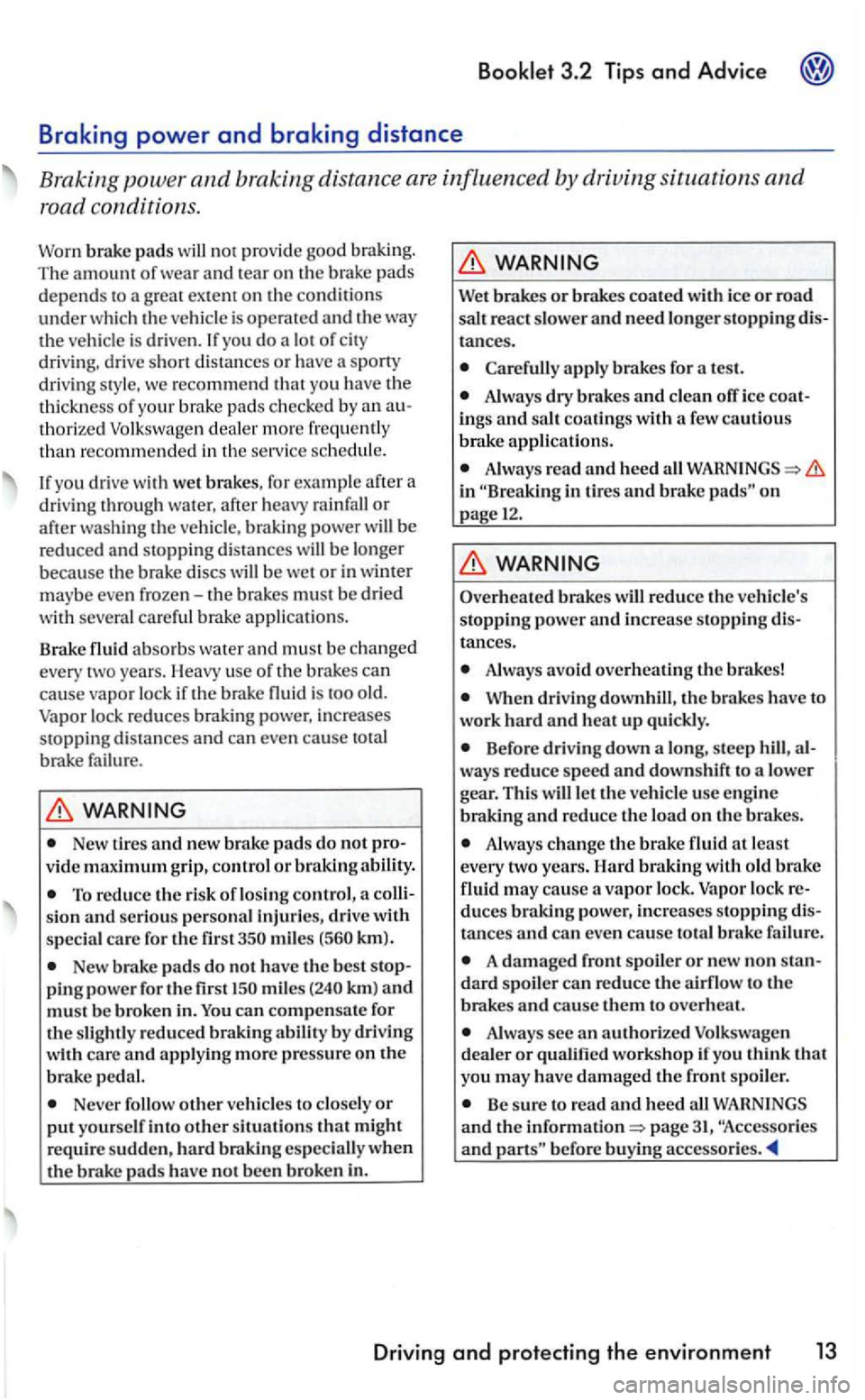
recommend that you have the
thi ckne ss of your brake pads checked by an au
t horized Vol kswagen dealer mo re fre quent ly
t h an recommende d in the serv ice sched ule.
you drive with wet brakes, for example afte r a
dri ving through water, after heavy rainfall or after washing the ve hicle, braking power be
reduced and s to ppin g distances will be longer
because the brake discs will be we t or in winter mayb e eve n frozen-the brakes must be dried
with several ca re ful brak e applicatio ns.
Brak e fluid absor bs water
and must be changed
every two years. Heavy use of the brakes can cause vapor lock if the brake fluid is too old.
Vapor lock redu ces braking power, increases
stopping distances and ca n even cause total
brake failure.
New tires and new bra ke pads do no t pro
v id e m aximum gri p, control o r b raking abil ity.
To red uce the risk of l osi ng control, a s io n an d se rio us perso nal injuries, drive with
specia l ca re for the first 350 miles (560 km).
New brake pads do not have th e best sto p
ping power for the fir st ISO mile s (240 km ) and
m ust be b roken in. can compensate for the slightly reduced braki ng abil ity by dri ving care and applyin g more pressure on th e
brake pedal.
Never follow oth e r veh icles to close ly or
p u t you rse lf in to other s ituations th at might
requ ire su d den , hard bra king especially when the brake pads have not been broken in.
apply brakes for a test.
Always dry brakes and clea n off icc coat
i ngs an d salt coatings with a few cautious brake applications.
A lways read and heed in in tire s and brake on page 12.
Always avoid overheati ng the brakes!
When driving downhill, t11 e brakes have to
work har d and h eat up quickly.
Before driving down a lo ng, steep hill, al
ways reduce speed and downshift to a lower
gear. This will let the vehicle usc engine
Always ch ange th e brake fluid at l east
every two years. Hard braki ng wi th o ld flui d may cause a va po r lock . Vapor loc k duces powe r, inc reases stoppin g di stan ces and can even cause tota l b rak e failure.
A damaged front spoiler or n ew non standard spoiler can reduce t h e airflow to th e
brakes and cause them to ove rh eat.
Always see an authorized Volkswag en
dealer or qualified workshop
Be sure to re ad and heed all and th e page
Driving and protecting the environm ent 13
Page 291 of 444
WARNING (c o ntinu ed )
Alwa ys read and heed all W ARN IN GS an d additional information regarding sa fet y booklet 2 . I
yo u plan to tow a
tr ailer, p lease re m ember th a t yo ur car will be performing a serv ice for which it was not
ra b ility, ha ndl ing, econ o m y and performa nce.
Tra
ile r towin g not o nl y places more stress on the ve hicl e, it als o calls fo r more concentratio n fr o m the driver.
For these re a so ns, always follow th e o pe ra ting
and d rivi ng instructio ns given and use common sense.
Trail er hit ch
trail er hit ch on your ve hicle.
D o not use a bumper hitch.
The hitch must be installed so, it does not
interfe re the impact-absorbin g bumper system. Do not make any ch an ges to th e ve hicl e
ex haust and b rake system s. Fro m time to tim e, check that all hi tch-mounting bo lt s remain curely fas te ned .
When you are no t towin g
Engine cooling system
Tow ing a tra iler makes the engine wo rk ha rder. is important that th e engine cooling system is u p
t o the job. Ma ke s ure that th e coo ling system has enough fluid .
Traile r bra kes
Never connect the tr a iler light syste m direc tly to the light syste m of your ve hicle . Be su re to check wit h your authorized Volkswage n dealer for rec t w iring, switches
you alwa ys have clear v is ion to th e rear.
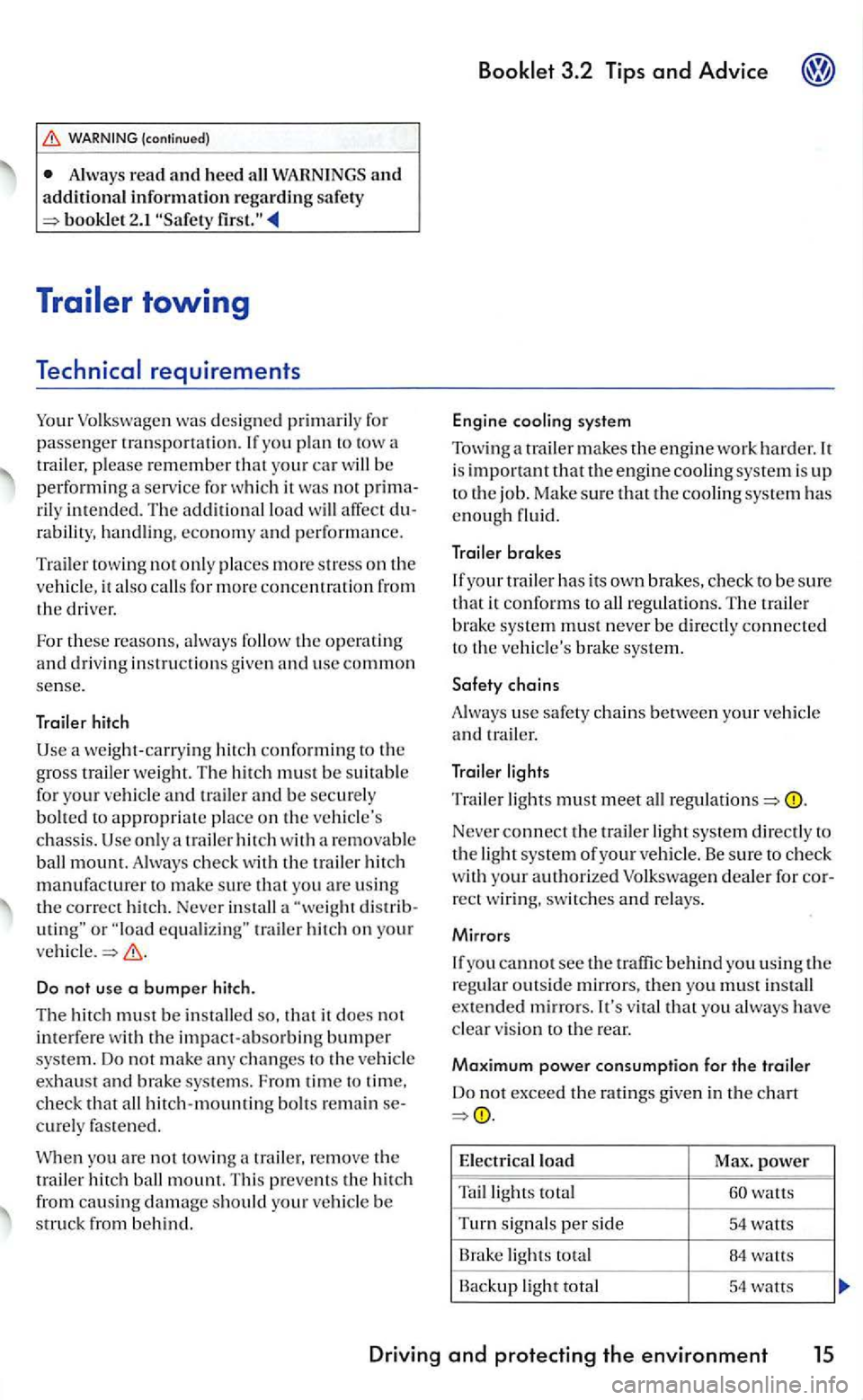
Maxim um power consumption for the traile r
Do not exceed the ratings given in the c hart
E lectric al load
Max . power
T ailligh ts total watts
T urn sig na ls p
er sid e 54 watts
B rak e lig hts total 84
Backup light total 54 walls
Driving and protecting the environ ment 15
Page 294 of 444
Booklet 3.2 Tip s and Advice
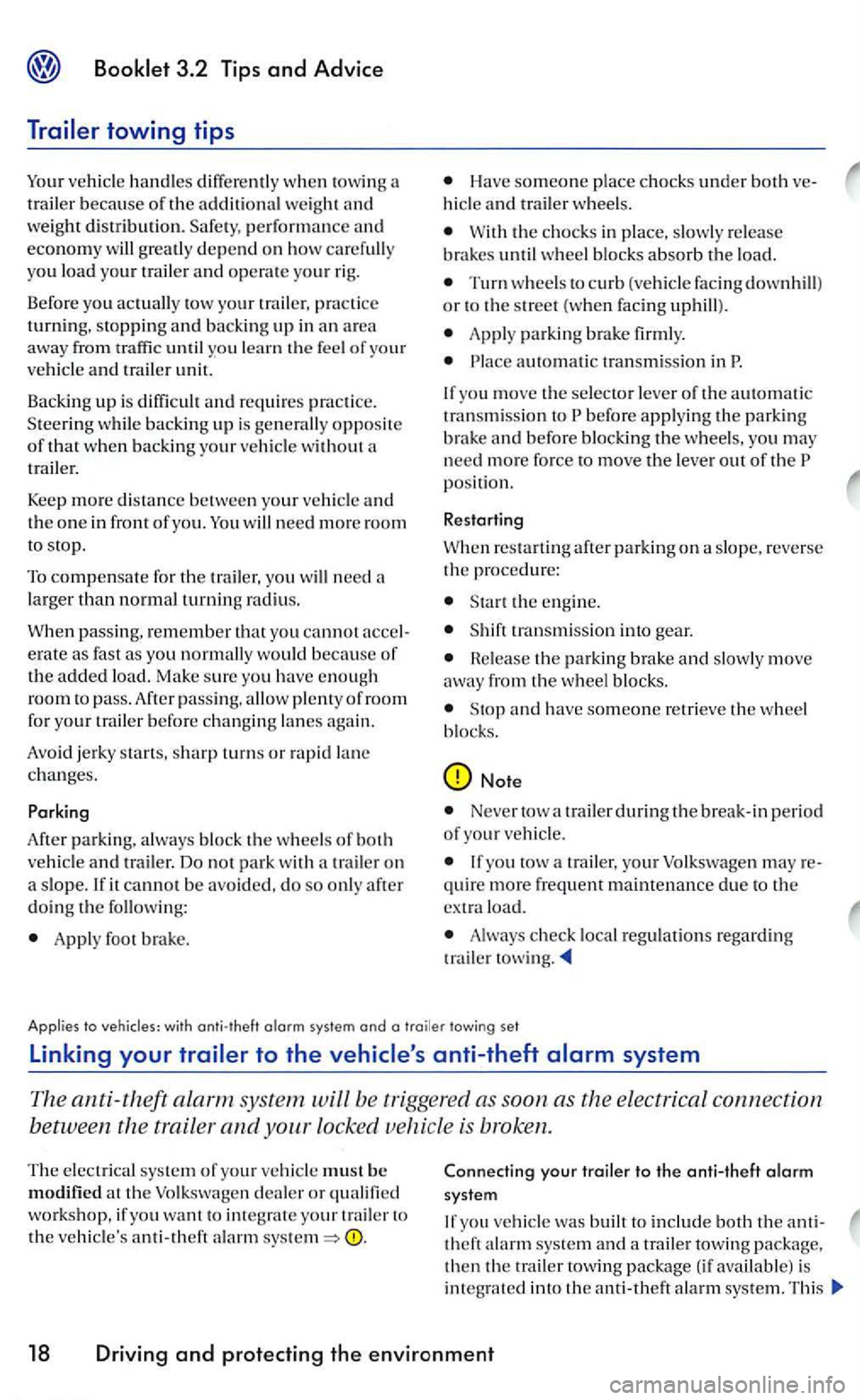
vehicl e handles diff ere ntl y wh en towin g a
tr ai ler because of the additional weigh t and weight distribution. Safe ty, pe rform ance and econo m y will greatl y depend on how carefull y
yo u load your trailer and op erat e your rig.
Before you actually to w your trail er, p ractic e
turning. stopping and b ack ing up in an area away from traffic until learn the feel of your vehicle and trail er unit.
Backing
up i s diffi cult and requi res practi ce.
Stee rin g whil e backing up is gen erall y opposite of that when backin g your vehicl e with out a
trailer.
Keep
more distance between your vehicl e and the one in front of yo u. will need more room to stop.
To compensate for the trail er. you will need a
larger than normal turning radius.
When passing, remember that you cannot erate as fast as you normally would because of the added load. Make sure yo u have enough
room to pass. After passing. allow plenty of room for you r trailer before c hanging lanes again.
Avoid je rk y s tart s, sharp turn s or rapid lan e changes.
Parking
After parking. always block th e wheels of both ve hicl e and trail er. Do not park with a traile r on a slope. If it cannot be a voided, do so only after doing th e follo wing:
Apply fo ot brake .
Have someone place chocks under both hicl e and trail er whee ls .
With the c hock s in place, s lo w ly re lease brak es until wheel blo cks absorb the load.
Turn w heels to curb (ve hicl e facing downhill)
o r to the stre et (when facing uphill).
Appl y parkin g brak e firmly.
automatic transmi ssion in
If you move the selecto r leve r of the automatic tran smission to
position.
Restarting
When restarting after parkin g on a slop e, reverse
the proc edure:
S tart the engine.
S hift transmission into gear.
le a se the parking brake and slowly move away from the wheel block s.
Stop and hav e someone re trie ve the wheel
b lock s.
Note
Neve r to w trailer during the break-in period of your vehicl e.
If yo u tow a trailer , yo ur Volksw age n m ay quire more frequent maimenance due to the
ext ra load.
Always check local reg ulations regardi ng
trailer to w in g.
Applies to vehicles: with anti-theft a larm system and a traile r towing set
Linking your trailer to the vehicle's anti-theft alarm system
The anti-theft alarm syste m will be triggere d as soon as the ele ctrical connec tion
between the trailer
and
or qualified
wo rkshop, if you want to inte grat e your trai le r to th e ve hicle's anti-theft a larm
Connecting your trailer to the anti-theft alarm syste m
If yo u ve hicle was built to include both the th eft al arm system and a trailer towin g th en t he trail er towing package (if available) is
in tegrated into the anti-theft alarm sys te m . Thi s
18 Driving and protecting the environment
Page 314 of 444
you are unable to determine whether or not a particular fuel blend meets the tions above, ask your service station or its fu el
s uppli er.
Do not use fuel for which the contents cannot be identifi ed.
F uel syste m damage and performance lems result ing from the use of fu els different
from those specified above are not the b ili ty of Volkswagen and are not covered under the New Vehicle or the Emi ssio n
Fo r the sake of environment
Just one tank f ull of leaded gas will seriou sly duce th e efficiency of the catalytic co nve rter.
you notice a lo ss of fuel economy or ability and performance problems using one of these fuel blends, we recommend th a t yo u
switc h to unblended
Gasoline additives improve the quality of the gasoline.
Gasolin e qualit y influences engine behavior, ficie ncy, performance and service life. For this
reason you should always use good quality line containin g additives. These additi ves will
h elp to prev ent corrosion, keep the fuel system clean and pre vent deposit s from building up in
the engine.
good quality gasolin e with additives is not availab le, or if eng in e probl em s arise, additives may be added to the gaso lin e.
38 Checking and
will also receive information on t o use them.
Do
Page 316 of 444
WARNING (continued)
Never reach into the area around or tou ch the radiator fan. Contact w ith the blade s can resuh in se riou s personal injury. Always m ember that the radiator fan is controll ed and can turn on
m oved from the ignit ion.
Never unscrew the coolant expa nsio n tank cap when th e engin e is hot. A hot engine will heat the coo la nt and put it under pressure . mov in g a cap that i s under pressure ca n rcsuh in seriou s personal injury and/or burns.
A lway s prote ct face, hand s and arms from hot esca ping coolant or steam b y cove ring the ca p with a large, thick rag.
Turn the cap slow ly a nd very carefully in a
counter- clo ckw ise direction whil e applying
light downward pressure on the top of the cap.
Never spill on hot engine parts o r hot
e xhau st sys te m . S pilled
Neve r short-circuitthc elec trica l sys te m ,
es peciall y w here th e jumper cabl es are tached -th e balleri es could explode!
Neve r leave any objects in the e ngine partment, for exam ple cleaning rag s and too ls. Objects
Neve r work unde r the veh ic le unless you
h ave safely secured th e ve hicl e from movin g.
I f yo u must work under th e ve hicl e wit h th e
w hee ls on th e ground, always make sure the vehicl e is on leve l ground, th e wh eels arc
b locked from movin g and th e key is not in the
ignition.
Always support your ve hicle with safety
s tands if you have to wo rk underneath it. The
ja ck suppli ed with the ve hicle is not s tron g enough for this purpose and can co llap se causin g se riou s personal injury.
If you have to perform a check or r ep a ir
w hen th e e ngine is running, there arc more
ri sks from
the ro tating parts, such as the drive
WARNING (con tinued)
Neve r to uch the e lec tr ica l w ir in g of the ig ni tio n sys tem.
Always make sure that j ewe lry, loose clothing and lo ng hair do not get caught in
rota ting engine pans. Before startin g any work remove jewelry, tie back and cover
hair, and do not wear clothing that can hang down and get caught in mov ing gin e parts.
Always use extre me cauti on if the erator pedal has to be depresse d to perform
a ch eck. The vehicle could move suddenly, eve n if the parking brake is applied.
If wor k on the fu el sys te m or th e electrica l
syste m is necessa ry:
Always discon nect th e balleries. Make
sure th e vehicle is unlo cked when
Neve r sm oke .
Neve r work nea r heaters, wa te r h eaters of other open names .
A lways have an approve d fire ext guis her nearby.
To avo id electrical shock and personal jury w hil e the eng ine is running or being
s tarted :
n ever touch ignition cables,
never to uch othe r component s of the
high vohage electronic ignition syste m,
never touch the gas discharged (Xeno n) headlights wiring.
Note
Whe n chang ing or topp ing orr service fluids. make absolutel y ce rtain that you fill the fluid s
into the corr ect reservoirs. Using incorrec t fluids will resuh in serious malf unct ions and engine
damage!
For the sake of environment
Service fluid leaks are harmful to the environ-
ment. Reg ularl y check the ground undernea th
your vehicle . you find spots of oil or other
fluids. have your vehic le checked by your rized dealer or a qualified
Page 319 of 444
Engine
ternal combustion engines use a certain amount of oil.
th e break-in period,
when consumption has sta bili zed.
conditions, t he rate of
as its viscosity, th e
residue and by the oxidation level of the oil. As engines consumption may
increase over time
of thes e it is not rate of sumption. For reaso n, w e urge you to check the oil le vel in your engin e at regular interval s, prefe ra bl y every time yo u and always
fore go ing o n a trip.
The
en gine
pressure is too low. S to p the en gine ately, check th e en g in e o il leve l and add if
n ecessary . If th e e ng ine oil level is no rmal, but
th e light con tinues to flash, do not continue to
o pera te t he ve hicl e. Engine damage
so that th e cause of your concern can be pro perly
ment of consumpt ion requires great care and may take sometime. consumption
Sto p! Be fore workin g in the e ngine ment, always read an d heed all WARN INGS 39. The e ng in e compart m en t of any moto r ve hic le is a potentially dangero us a rea and can cause serious pe rsonal inju ry.
0Note
The eng ine in you r to all of it s movin g pa rts. fore th e en g in e must be ch ecked and kept at th e required
Make it a habit to have the engine
Lack of engine
and