tow VOLKSWAGEN GOLF MK5 2006 Owner's Manual
[x] Cancel search | Manufacturer: VOLKSWAGEN, Model Year: 2006, Model line: GOLF MK5, Model: VOLKSWAGEN GOLF MK5 2006Pages: 444, PDF Size: 92.7 MB
Page 265 of 444
Booklet 3.1 Controls and Equipment
WARNING
Improper use of the parking brake can seri
ousl y injur e yo u and your passenge rs.
Neve r use the parking brake to slo w down
th e ve hicle when it is mov ing. The braking tanc e is much longer because only the rear wheel s are braked. Alwa ys use the foot brake.
Neve r drive with the parking brake plied. This could cause the rear brakes to overheat and los e their braking efficiency. Always
make sure to check that the parkin g is
fully re le a sed dri vin g.
Always apply the parking brake fully when
parking on a slope and cock the front wheels
Parking
(co ntinue d)
to prevent the vehicle from moving
Always read and h ee d WARNINGS
Whe never you leave th e veh icle, you should engage the parkin g
(aut om ati c tra nsm ission) .
Driving w ith the parking brake engaged will damage the rear
The parking bra ke can be used to prevent th.e vehicle from moving.
Parking
-the vehicle using the brake
-Apply th e parkin g brake full y.
-
into lst gear (m anual transmi s
sio n)
or move the se lector lever into
When parking on slo pes
Before turn ing off the engine, turn the steering
w hee l so that if th e vehicle starts roll, it will roll into the curb:
if the vehicle is facing turn the
f ront wheels so that they point toward the curb.
if th e veh ic le is facin g
apply the parkin g brake and m ove theselector leve r into
WARNING
Improper parki ng procedures can cause riou s personal injury for yo u or your passe n
gers.
Neve r remove the key from steering lock
while the ve hicl e is moving or rolling to a s top . The steering wheel will lock up and yo u will not be abl e to steer or contro l th e vehicle.
Neve r park where the hot exhaust system could ig nit e flammable materi als, such as brush, leaves, dry g ra ss, spill ed fue l e tc.
A lwa ys apply the parking brake when parking your vehi cle.
Neve r leave anyone in your vehi cle to vent the ve hicle from movin g if the parking brake is released or selector lever is moved.
Always take th e key with yo u when you leave the vehicle. The engin e ca n b e started and veh icle syste m s s uch as the powe r dows can be operated leadi ng to serious sonal injury.
Neve r leave childre n, disabl ed person s or anyone w ho cannot h elp th e mselves in the hicle. The doors can be locked using th e re-
m ote control trapping passe ngers in the h icle in an emerge ncy . Depending on the tim e of year, peo ple trapped in th e vehicle can be ex po sed to very high or very low temperatures.
Driving 95
Page 267 of 444
3.1
Applies to w ith cruise control system and without display in th e instrument cluste r
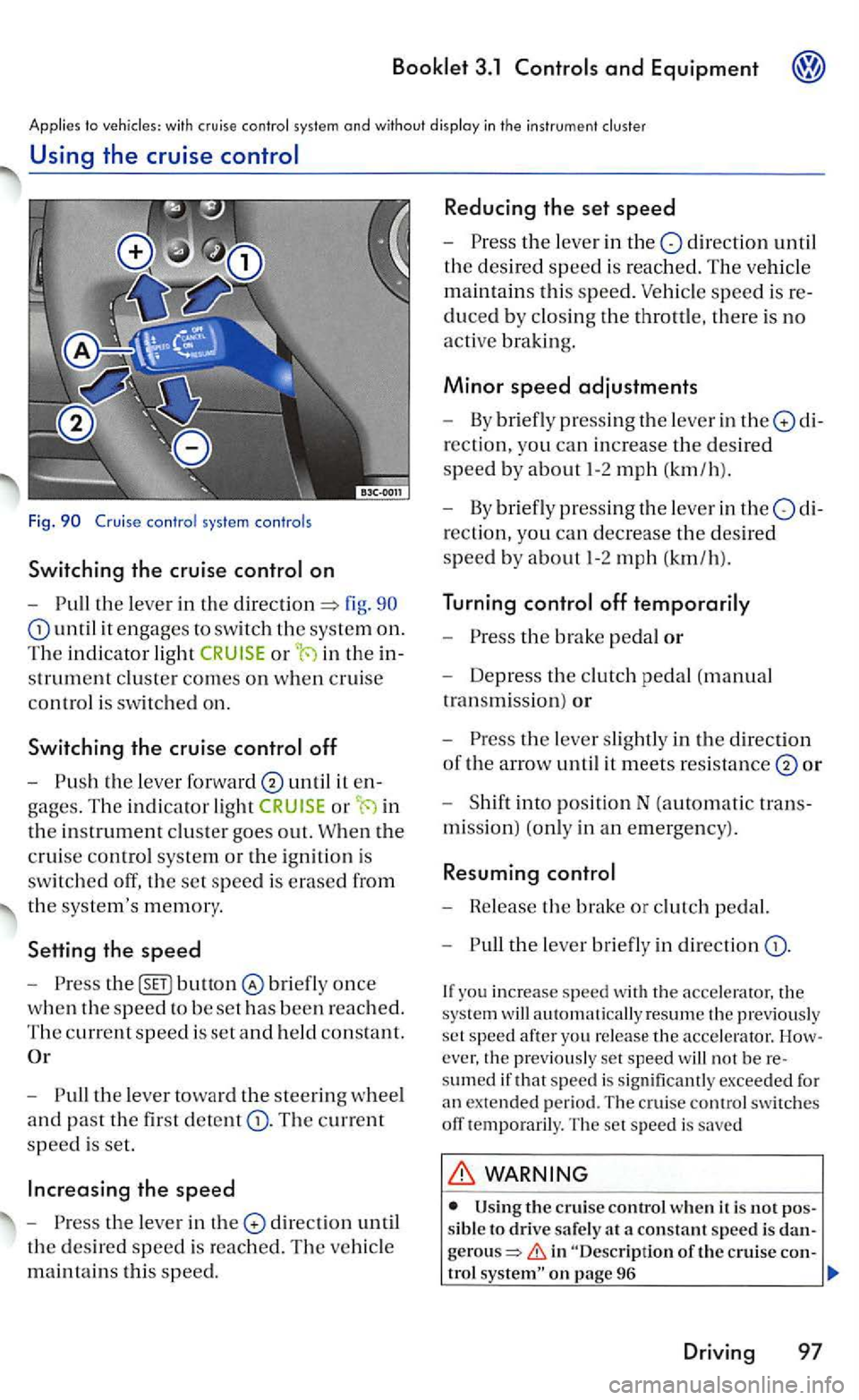
Using the cruise
Fig.
on
- Pull the le ve r in the fig. 90
until it engages to switch the system on.
The in dicato r light in the
strument cluste r comes on w he n cruise
co ntrol is switche d on.
Switching the cruise
until it
or in
the in strument clu ste r goes out. W hen the
c rui
se control syste m or the ig niti on i s
sw itch
ed off , th e set speed is erased from
t h e syste
m's m em ory.
Setting the speed
- Press bunon once
w hen th e s peed to be se t has been reached .
The current sp ee d is set and h eld co nsta nt.
- Pull the leve r toward the steerin g w heel
and past the fir st d etent The current
speed is set.
directio n until
the desir e d speed is reac hed. The ve hicl e
m ain tain s thi s spee d.
Reducing the set speed
- Press the leve r in the dir ectio n until
th e desired speed is reached. T he ve hicle
m aint a
ins thi s s pee d. Vehicle speed is
duced b y clos in g th e throttle, there is no
acti ve bra king .
Minor speed adjustments
-By briefl y press ing the leve r in the
rection, yo u can increase th e des ired
speed b y about 1-2 mph (km /h ).
- By briefl y
pressing the leve r in the
-Press the brake pedal or
-Depress the clutch pedal (manual
tran smi ssi
on) or
- Press the leve r slightl y in the direction
of the arrow un til it m ee ts resis tance or
- Shift into posit io n N (automatic
mi ssion) (only in an em erge ncy).
Resuming
- Release th e brake or clutc h pedal.
- Pull
the le ve r briefly in direction
ever, the previou sly set speed will not be sumed if that s peed is s ignificantl y exce ed ed fo r
a n extended perio d. The cruise cont rol switc hes off tempo raril y. The set s p ee d i s saved
WARNING
sibl e to drive safe ly at a constant speed i s gerou s=> in "Desc ription of the crui se con-trol
Driving 97
Page 277 of 444
. . .. . . . . . . . . . . . .. . . 2
Brak es . .. . . .. .. .. . .. .. .. . .. .. .. . .. .. ... . 2 steering . . . . . . . . . . . . . . . . . . . . . . . . . . 8
Eng ine
management and exhaust sys tem . 9
Driving and protecting the
environment .. . .. .. .. .. .. .. .. . . . .. .. . 12
Break-in Period .. . .. .. .. .. .. .. .. .. .. .. .. . 12
towing .. .. . .. .. .. .. . .. . . .. . . .. .. . 15
Driv e economically and
core and
exterio r . . . . . . . . . . . . . . . .. . 22
Core of the in terior . . . . . . . . . . . . . . 28
Acce ssories, new parts, repairs
and modifications .. .. .. .. .. .. .. .. .. 31
Accessories and ports . . . . . . . . . . . . . . . . . . . 31
Repair s ond technical modifications . . . . . . 32
phones and
modules . . . . .. .. . . . . . . . . . . . . . . .. . 34
Checkin g and .. .. .. .. .. .. .. . 35
supply .. .. .. .. .. .. .. . .. .. .. .. .. . .. .. 37 Working in the engine comportment . . . . . 39
Engine .. .. .. .. .. .. .. .. .. .. . .. . .. .. .. . 42
................................. 47
Washer and windsh ield wiper blades
Broke . . . . . . . . . . . . . . . . . . . . . . . . . . . . . . 53
and spore . . . . . . . . . . . .. . .. . . .. .. .. .. . .. . .. .. 82
Emergency or opening . . . . . . . . . . . 88
Fuses . . . . . . . . . . . . . . . . . . . . . . . . . . . . . . . . . . .
. . .. . .. .. .. .. .. .. .. 93
Jump starting .. . .. .. . .. .. . .. . .. .. .. . .. .. . 99 Towing .................................. ........................
index .................
Page 278 of 444
3.2 Tips and Advice
Smart technology
Brakes
Brake booster
The brake booster increases th e brake pre ssure
yo u pu t on th e brak e pedal. works only whe n the engi ne is running.
t h e brake booster is not working or if the hi cle to be tow ed. you will have to push the
b rake pedal harder to mak e up fo r the lack of boos ter assistance.
Braking with out the brake booste r needs much lon ger braki ng distanc e and requires
Warning
the brake pad wear indicator only tors th e front brake pads, the rear brak e pads in spected the sam e time.
There may be m essage in the in strument clu ste r inform ing yo u or advis ing yo u of the essary action to
(co ntinue d)
you to push the brake ped al harder tha n normal.
Never le t the ve hicle coast w ith the engine sw itch ed off.
ample if the vehicle is being towed, you will
have t o pus h the brake pedal much harder than
Driv in g with bad can cause collis ion a nd seriou s persona l injury.
the brake pads in specte d ate ly by an au thorize d Volk swagen d ealer or qualified works ho p if the brake pads worn symbo l l ights
Warning Brake system BRAKE or ((D)
The if parking brake is applied, if th e
the brake system .
This warning light BRAKE or up if:
The park ing brake is booklet and c h a pter "Parkin g th e ve hicle is dri ven faste r than about 4 m ph (6 km/h) with th e parkin g brake a warning sound. There may be message in the ins tru ment clus te r info rmin g yo u or vis ing yo u of the necessa ry action t o
If the brak e flui d leve l is too page 53.
2 Smart
If there is a m alfunction in the brake system , the warni ng in the instrument cluste r will comes on. You also
th e ve hicle and do not continu e to dri ve. Contact yo ur authorized swage n dealer or a qualified work shop. th ere is failur e, the indicator ligh t comes
Page 284 of 444
(continued)
T he effecti ve ness of is also d etermine d
b y the tires page 57, and
is very effec tive, always m ember that your veh icle's handling bility is limit ed b y tir e traction.
Note
I n
order to en sure th at an d ASR functio ns
correc tly, all four wheels must b e fitted with the same tire s. Any differences in the rolling radiu s of the tire s can cause the system to reduce gin e power-eve n when this is not th e best th in g
to do under t h e circumstances.
veh icles wit h powe r stee ring, th e amoun t of power ass istance is regula ted
chanical us ing an electr ic motor. The ad tages of thi s s teering system include the fact that n o hydra ulic components su ch as hoses . oil ta iners, filt ers or h ydraul ic flu id s are requir ed. Furt he rmo re, this is a conside rable decr ease in
e n ergy required . The elect romechan ical steering
system, in contrast to the hydraulic system (which requires a constant flow of fluid). only
co nsumes en ergy when the ve hicle is ac tually
b e in g s teered.
The f u e l consumption is reduced as a res ult.
If the
electromechanical power steering sys tem fails, the power ass is ted steer ing sys tem will still work. If th e engine is sw itched off, the power steering does not functio n and the steering
wheel is very hard to turn.
Indicator light
or comes on
The indi cator light comes o n for a few seconds when th e ignition is sw itched on.
If the indica tor light ( or does not go out or comes on while you are driving, th ere is a
prob le m in the ele ctro -mechanical steering. steering assis t may be reduced (light J or be lo st completely (li ght
swage n dealer. If th e yellow warning light stays
off after restart in g an d drivin g a short distanc e,
8 Smart
With th e en g in e not running (e.g. when the car is bei ng towed). there is a lso no power assist able.
Turning the s teerin g wheel i s ve ry difficult when th e power steering sys te m i s not wo rkin g and it is harde r t o control the ve hicl e.
Neve r let the vehicle coast w ith the en gi ne swit ch ed off.
If yo u d o no t pay att entio n to the warning lights w hich have com e o n, includin g th e
warnin g messages appearing in the d is play, this could lead t o personal injury or damage to
your vehicle .
Note
Do not keep the steering wheel turned the way to the le ft or righ t for more than 15 seco nd s
when th e e ngine is running. Doing so could damage th e powe r steering system.
If th e
Page 285 of 444
light monitors the
lights up when the ignit ion is sw itched on to
s how that the light is work ing properly. should
go ou t when the engin e ha s s tarted running.
a fault develops in the e ngin e management system while yo u are driving, thi s warning light
will light up. thorized dealer or qualified
the
t a nk completely empty.
- Do no t put in too much engine oil
45,
- Never tow the ve hicl e to sta rt use
jumper cables page
you notice misfiri ng, uneven running or loss of power whe n the vehicle is moving, slo w down
immedi at ely and have the ve hicle inspecte d b y the neares t authorized
chapter"Warning
cape int o the atmosphere.
A catalytic convert er ge ts very h ot and can
cause fir e causin g serious person al injury. Th
ere
may be a message in the in strument cluster inform ing you or advising you of th e essary ac tion to take.
yo u do not pay attention to the warning
li ghts which have come on, including th e warning messages appearing in th e d isplay, this could lead t o personal injury or damage to your vehic le.
(cont inued)
Never park whe re
Neve r apply additional undercoating or rust proofing o n or near the exhaust manifo ld,
ex hau st pipes, catalytic converter or heat s hi elds.
Note
Never drive until the tank is completely
e mpty becau se irregular fu el supply could cause the engine t o misfire. This allow s raw, unburned fu el to get into the ex haust sys tem and damage the catalytic conve rter.
the oil leve l is above page 44, fig. 6 not start the engine- t his could damage the catalytic co nverte r and the engine!
To avoid damage to the catalytic converter
37,
Page 290 of 444
For dri ving safely. always follow the specified
maintenance int erva ls in your mainte na nce booklet 1.1 ciall y for changin g the brake fluid. Hard u se, maril y stop and go driv ing, o p eratio n in very dusty area s. trailer towing as well as other tions may make it necessary to short en nance in te rvals-see your a u th orize d swage n dealer.
Your
l ow ing po int s befo re yo u drive off:
lights and turn signal s.
Make sur e that all ligh ts and all windows are
clea n.
Adjust the mirro rs.
Make sure th at the a ir intake slots between the e ngin e hoo d and the w in d shi eld are free of leaves . s n ow and ice.
wa rnin g and indicato r light s whe n
s ta rti ng the e ng in e.
Your personal driving styl e and attitude have a
lot
to do with safety.
Th eref ore, for yo
ur ow n safety:
Wear your safety belts and wear the m
book let 2.1 chapter
Make sure that all passenge rs their safe ty be lls properly. eve n those sitting in the book le t2.1 chapter Passengers not wear ing safety bells
Make sure that chil dren always sit on the rea r seat properly restrain ed by
Neve r transport chil d in a r ear-faci ng c hild or infant seat on the fron t passe nger seat booklet2.1
Adjust you r seat that yo u can easily reach
all control s while yo u are as far away from the airbag as pos sibl e but not close r than
bookle t2.1 and bookle t3. 1
The seatin g position is ve ry important for th e
a ir bag book let2.1 chapter" Air bag
Always adjust the head rest ra int s to the rect heig ht. For maximum pro tection. adjust the
head restrai nt so the upper e d ge is as eve n
w ith the top of your head a s pos sibl e, but no lower than eye level and so that it is as close th e back of your head booklet 2.1
Always make s ure that th e movem ent of the
p ed als is not re stricted in any booklet 3.1 Equipment",
Sto re lu ggage and light it em s properly in the
lu ggage compartment and on th e roof bookle t3. 1 and Luggag e compartment " and book let3.1 and Equipment", chapte r " Roof
If you drink, do not drive!
The use of alco hol. drugs and certai n tions will seriou sly impa ir percepti on , reac tio ns and dri ving ability, substantially in creasin g the risk of an acc ident, cras h and persona l injury.
Do not driv e if you are tired.
Make frequ ent rest sto ps, least afte r every two hours of dri ving.
Always
adapt vehicle speed to traffic, rood and
weather conditions.
R e
member, that especially on sm oot h. slipp ery
roa ds, ve hicl e ha ndl ing and brak ing depend a
g reat deal o n tire adhes ion. wet roads, the
f ront w heels can h ydropla ne, especi ally at
hi ghe r speeds. th is happen s, yo u will then no
lon ger be abl e to steer or brake properly.
Alwa ys observe the p osted speed limits and common sense. good judg m ent can mean the diff ere nce b e tween arriving safely at your d estination and being seriou sly injured in a cras h or othe r kind of accident.
14 Driving and protecting the environment
Page 291 of 444
WARNING (c o ntinu ed )
Alwa ys read and heed all W ARN IN GS an d additional information regarding sa fet y booklet 2 . I
yo u plan to tow a
tr ailer, p lease re m ember th a t yo ur car will be performing a serv ice for which it was not
ra b ility, ha ndl ing, econ o m y and performa nce.
Tra
ile r towin g not o nl y places more stress on the ve hicl e, it als o calls fo r more concentratio n fr o m the driver.
For these re a so ns, always follow th e o pe ra ting
and d rivi ng instructio ns given and use common sense.
Trail er hit ch
trail er hit ch on your ve hicle.
D o not use a bumper hitch.
The hitch must be installed so, it does not
interfe re the impact-absorbin g bumper system. Do not make any ch an ges to th e ve hicl e
ex haust and b rake system s. Fro m time to tim e, check that all hi tch-mounting bo lt s remain curely fas te ned .
When you are no t towin g
Engine cooling system
Tow ing a tra iler makes the engine wo rk ha rder. is important that th e engine cooling system is u p
t o the job. Ma ke s ure that th e coo ling system has enough fluid .
Traile r bra kes
Never connect the tr a iler light syste m direc tly to the light syste m of your ve hicle . Be su re to check wit h your authorized Volkswage n dealer for rec t w iring, switches
you alwa ys have clear v is ion to th e rear.
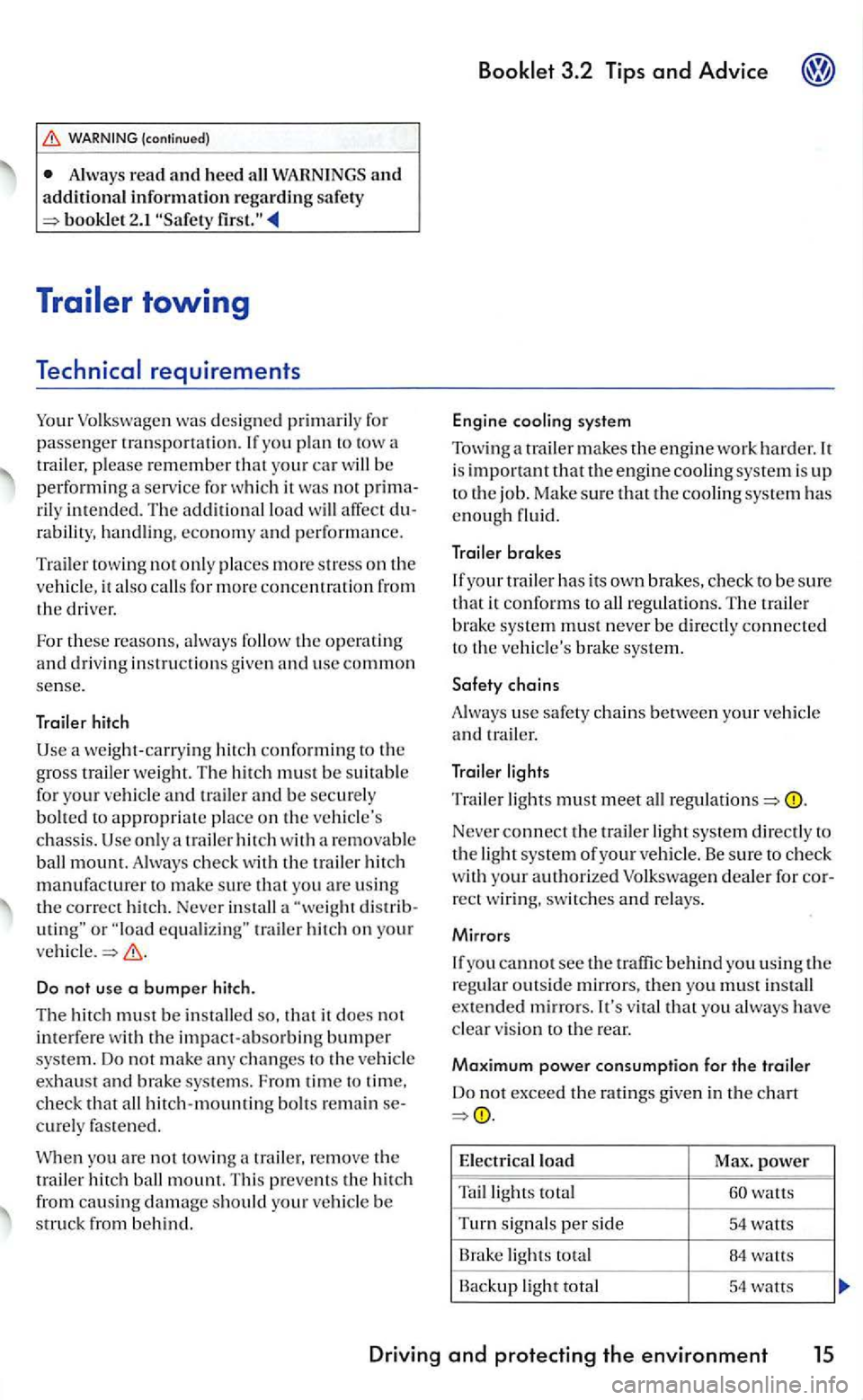
Maxim um power consumption for the traile r
Do not exceed the ratings given in the c hart
E lectric al load
Max . power
T ailligh ts total watts
T urn sig na ls p
er sid e 54 watts
B rak e lig hts total 84
Backup light total 54 walls
Driving and protecting the environ ment 15
Page 292 of 444
An improperly installed or incorrec t hitch from the towi ng vehicle leading to serious personal injuries.
Neve r in stall a on your vehicle . The vehicl e was not designed for these kin ds
o f trailer hitches. The hitch attachment to tear loose from the
ve hicl e.
When you n o longer need t o tow trailer, re
move the trailer hitc h . Alway s seal all bolt holes to prevent water and deadly exhaust fumes entering the ve hicle.
Operating instructions
Maximum trailer weight
You can only tow typical class I or class 2 trailers
with your vehicle.
T he m ax
imum gross trailer we ight and the tongue load must n ever exceed the specifica
tion s listed bookle t3 .3 "Tec hnical
Neve r exceed the gross ve hicl e we ight, w hi ch i s the we ight o f th e vehicle, includin g driver, passenge rs, luggage, trailer hit ch and tongu e we ight of the loaded trailer.
At alt itudes above ft. m), redu ction of of combined towin g weight (ve hicl e plu s trailer) for the beginning of every m ) should be observed.
Trailer l
oad distribution
Be sure the load in the traile r is held securel y in place to guard agains t be it forw ard.
b ackwar d or sideways. A load that shift s can make it hard or even impossibl e to control your vehicl e, parti cularly in an e m erge ncy situ ation.
W ith the tow vehicle empty and the trailer
l oade d , we ight distribution is es pecially bad. If
yo u absolut ely mus t driv e w ith this combina
tion, d rive with extra
Do not use a trailer whic h has LED (light emitting diodes) taillig ht s. This type of t a illi ght can damage the electrical co ntrol unit of your veh icle.
If the traile r socke t is in co rrectly connected .
damage co uld result to the ve hicles electrical
system.
I f th e maximum power consumption for the
trail er is pag e 15, damage could result to the e lectrica l sys te m of th e ve hicle.
Never connect the e lectr ical sys te m for th e
t raile r directly to the electrica l c o nne ctions for the rear lights or to other unsu itable power sources. Use onl y a su itab le trailer soc ket to pro
vide power to the trailer .
Tongue load
For bes t ve hicle ha ndli ng when towing a trail er, adjus t the trailer load so tha t th e tongue load is at the maximum allowable or slightly lower. You can ge t an approx imation of the to ngu e load
with a ba throom scal e or yo u can measure the load at a tru cking company or we ighing station.
The tongu e load incre ases the weigh t of the rear axle and correspondingly reduces the other load that your ve hicle ca n
The max im um tong ue load on ly a ppl ies if both of the ho les o n the o uter upright wall of th e rear side rail are used to secure the trailer hitch.
Tire pressu re
tow ing a trailer, inflate t h e tires of your ve
hicle to the col d tire press ure lis ted under on the sticker o n the open ed ge of the
dri ver's door. Inflate trailer tires to trai ler and tire manufactur ers' specificat ions.
lights
A lw ays check
the headlight settin gs wit h the tr ai le r hooked up before driving off. Adju st as n ecess ary so th a t yo u can see th e road ahead but not blind on coming
C he ck and make sur e th a t all veh icle and trailer lights are workin g properly -especially the brake light s.
16 Driving and protecting the environment
Page 293 of 444
Safety chains
Be sure trailer safe ty cha ins are prop erly necte d fro m the trailer to th e hitch on th e hicle. Leave enoug h slack in th e c hain s to turn
corners. When you install safety ch a in s, mak e sure they will not dragon th e road whi le you are
driv ing.
Th e chains shou ld c ross
under th e trai le r to ng ue
to prevent it from dropping to the ground in case of separa tion from the hit ch .
Electronic Stabilization
Always leave th e mak es it easie r to stabilize the
t railer sho uld it start to swerve or sway.
Always adjust your speed and driving style to
road, traffic and weather conditions. Never le t the extra safety that and
A rig is eas ier to o pe rate and trol. Thi s means that th e tow vehicle should be loaded to the exte nt possibl e and permi ssibl e
w hil e keepin g th e t raile r as lig ht as possibl e under the ci rcumstances . Whenever possible, tran sfe r so me cargo to the luggage compartm ent
o f th e tow vehicle whil e observ ing tongue load requireme nts and ve hicl e loading ation s.
The hig her th e spee d, the more diffi cult it comes for the driver to control the rig. Do not drive at the maximum permissible
Always appl y brake s early . W hen dri ving
downhill , down shift into lower gear (selector leve r positi on
The cooli ng effect of th e fa n cannot
b e in cre ase d by dow nshif tin g because fan speed
i s independent of engine speed. Therefore,
Riding in a trailer is dangerous and may be
A person who is not properly restrained in
a moving vehicle risks serious personal injury and even death in a crash.
Never let anyone ride in your vehicle
without being properly restrained .
Never allow a passenger to rid e in a trailer.
Exceed ing the maximum permissible weight ratings and maximum permissibl e trailer
weights can result in accident s leading to rious personal injury.
Never le t the actual Gross Axle W eight Rating at the front and rear axles exceed the
permissible weights. Also never let their bination exceed the Gross Weight
Rating.
Always remember that the vehicle's
w he n dri vin g uphill, you can alwa ys drive in the
hi ghes t possibl e gear wit h low engin e speed. the coo lant tempe rature warni ng light in th e strument clu ster start s flas hin g in red, pull off
th e ro ad, s top and let th e engine idle for ab o ut 2 minutes to preve nt a heat buildup and eng in e
damage.
R educe your speed even more under vorab le load , weather or wind conditions
particularly when going downhill.
Be especial ly careful when passing other vehicles. Reduce vehicle speed immediately if the trail er shows the slightest sign of sway ing.
N ev e r try to stop the sway ing by ating.
Always heed speed limits.ln some a reas speed limits for vehicle s towing
Driving and protecting the environment 17