warning light VOLKSWAGEN GOLF MK5 2006 Workshop Manual
[x] Cancel search | Manufacturer: VOLKSWAGEN, Model Year: 2006, Model line: GOLF MK5, Model: VOLKSWAGEN GOLF MK5 2006Pages: 444, PDF Size: 92.7 MB
Page 288 of 444
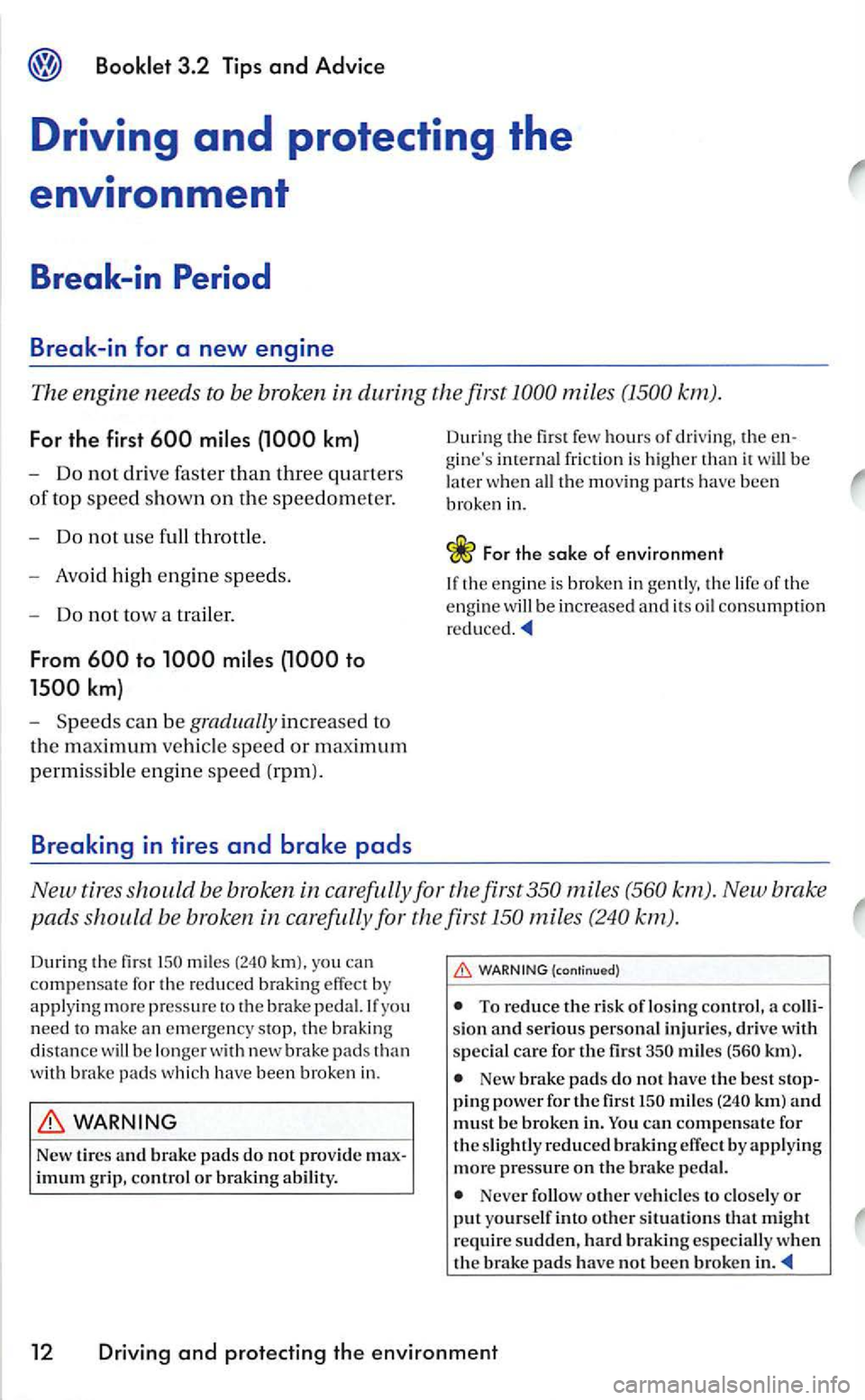
miles
can b e gradually in creased to
th e maximum vehicl e s
peed or maximum
permissibl e engin e speed (rpm ).
Breaking in tires and brake pads
Durin g the fir st few h o u rs of dri ving, the g ine 's inte rnal fric tion is hi gher than it will be
l a te r w he n a ll th e m ovin g part s have been bro ke n in.
For the sake of environment
th e eng in e is bro ke n in gentl y, the lif e of the engine will be in creased and it s oil co nsumption
New tires should be broken in carefull y for the fir st miles (560 km). New brake
pads b e broken in carefu lly for the first miles (240 km).
Durin g th e fir st miles km l. you can
c ompe nsate for the reduced brak ing effect by apply in g m ore press ure th e brake pedal.l fyo u
need to make a n em ergency slOp, the brak ing
di sta nce will b e longe r w ith new brake pads than
wit h brake pads wh ic h have been b roke n in.
WARNING
New tires and brake pads do not provide imum gri p, control o r braking
(cont;n ued)
To reduce the ri sk of losing a
miles
New brake pads do not have th e best pin g power for the fir st km) and must be broken in. can compe nsate for the s lightly reduced braking effect b y applying more pressure on the brake pedal.
N eve r follow other vehicles to clos ely or put yours elf into other situati on s that might require sudden, h a rd braking especially when the brake pads have not been broke n in.
12 Driving and protecting the environment
Page 291 of 444
WARNING (c o ntinu ed )
Alwa ys read and heed all W ARN IN GS an d additional information regarding sa fet y booklet 2 . I
yo u plan to tow a
tr ailer, p lease re m ember th a t yo ur car will be performing a serv ice for which it was not
ra b ility, ha ndl ing, econ o m y and performa nce.
Tra
ile r towin g not o nl y places more stress on the ve hicl e, it als o calls fo r more concentratio n fr o m the driver.
For these re a so ns, always follow th e o pe ra ting
and d rivi ng instructio ns given and use common sense.
Trail er hit ch
trail er hit ch on your ve hicle.
D o not use a bumper hitch.
The hitch must be installed so, it does not
interfe re the impact-absorbin g bumper system. Do not make any ch an ges to th e ve hicl e
ex haust and b rake system s. Fro m time to tim e, check that all hi tch-mounting bo lt s remain curely fas te ned .
When you are no t towin g
Engine cooling system
Tow ing a tra iler makes the engine wo rk ha rder. is important that th e engine cooling system is u p
t o the job. Ma ke s ure that th e coo ling system has enough fluid .
Traile r bra kes
Never connect the tr a iler light syste m direc tly to the light syste m of your ve hicle . Be su re to check wit h your authorized Volkswage n dealer for rec t w iring, switches
you alwa ys have clear v is ion to th e rear.
Maxim um power consumption for the traile r
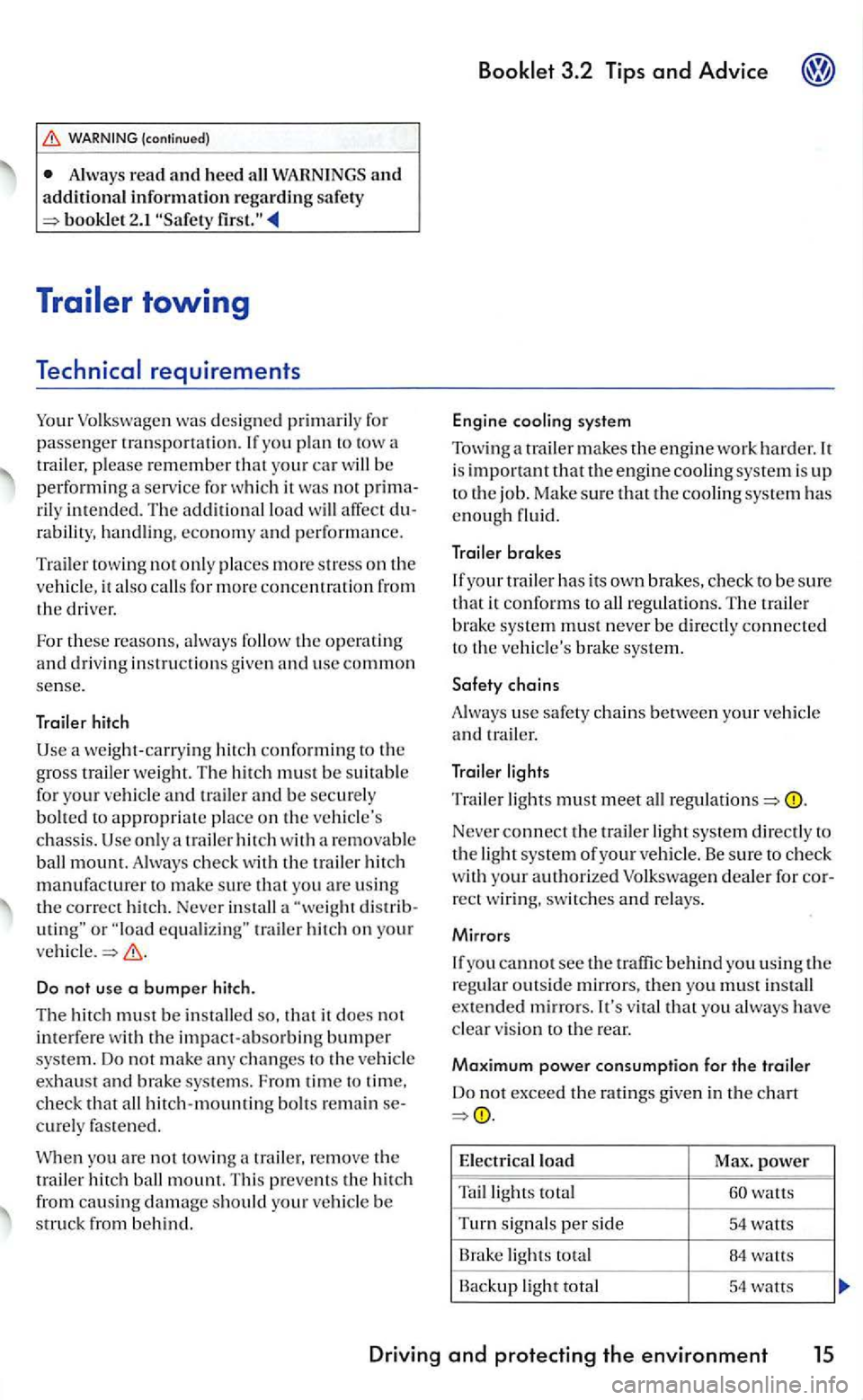
Do not exceed the ratings given in the c hart
E lectric al load
Max . power
T ailligh ts total watts
T urn sig na ls p
er sid e 54 watts
B rak e lig hts total 84
Backup light total 54 walls
Driving and protecting the environ ment 15
Page 297 of 444
Booklet 3.2 Tips and Advice
ment s o f your New Veh icl e Warra nty in the eve nt
o f co rros io n r ep air s or if re paint in g sh ould be
n ecessary.
TI1e best way to p ro tec t th e veh icle against
T he lo nger thi ngs like insects. bird
d ro ppings. tree sap, roa d di rt, in d ust rial
cluding stro ng su nlight) increas e co rros ive f ec ts.
After roads have been sa lted it is impo rtant to
wash th e unde rbod y of th e veh icle thoroughly.
WARNING
Ve hicl e ca re produc ts ca n be dang erous. pro per use can result in seriou s pe rso na l jury and/or p oisoning .
Alw ays stor e ve hicle care produc ts in a safe
place in ori ginal -containers th at are securely
cl osed.
Always keep ve hicle care products out of th e reach of childr en .
(contin ued }
Alway s read and heed all the in stru ction s
and all
When u sing products which giv e off
harmful fumes, alway s work outdoors or in a
w ell ventilat ed area.
Neve r use fu el, turpentine, e n gin e oil, n ail poli sh re m ove r or other volatile fluids for hicl e care. Th ey are poi sonous and hi ghl y
flammabl e. Th ey could cause fires and
ve hicl e movement can ca use
Always turn off the engin e, apply th e parkin g brak e firmly and remove the key from the ig niti on b efor e w ashing your ve hicl e, o r
p erformin g any mainten ance or re p airs.
hicle su rface is dry.
For the sake of environment
When buying vehi cle care p rod uc ts, try to lec t th ose th a t are no t harmful to the m ent.
Neve r d is pose vehicle care prod ucts with din ary ho useho ld was te. Alway s follow th e u fact urer 's instruc tion s and heed all
Page 311 of 444
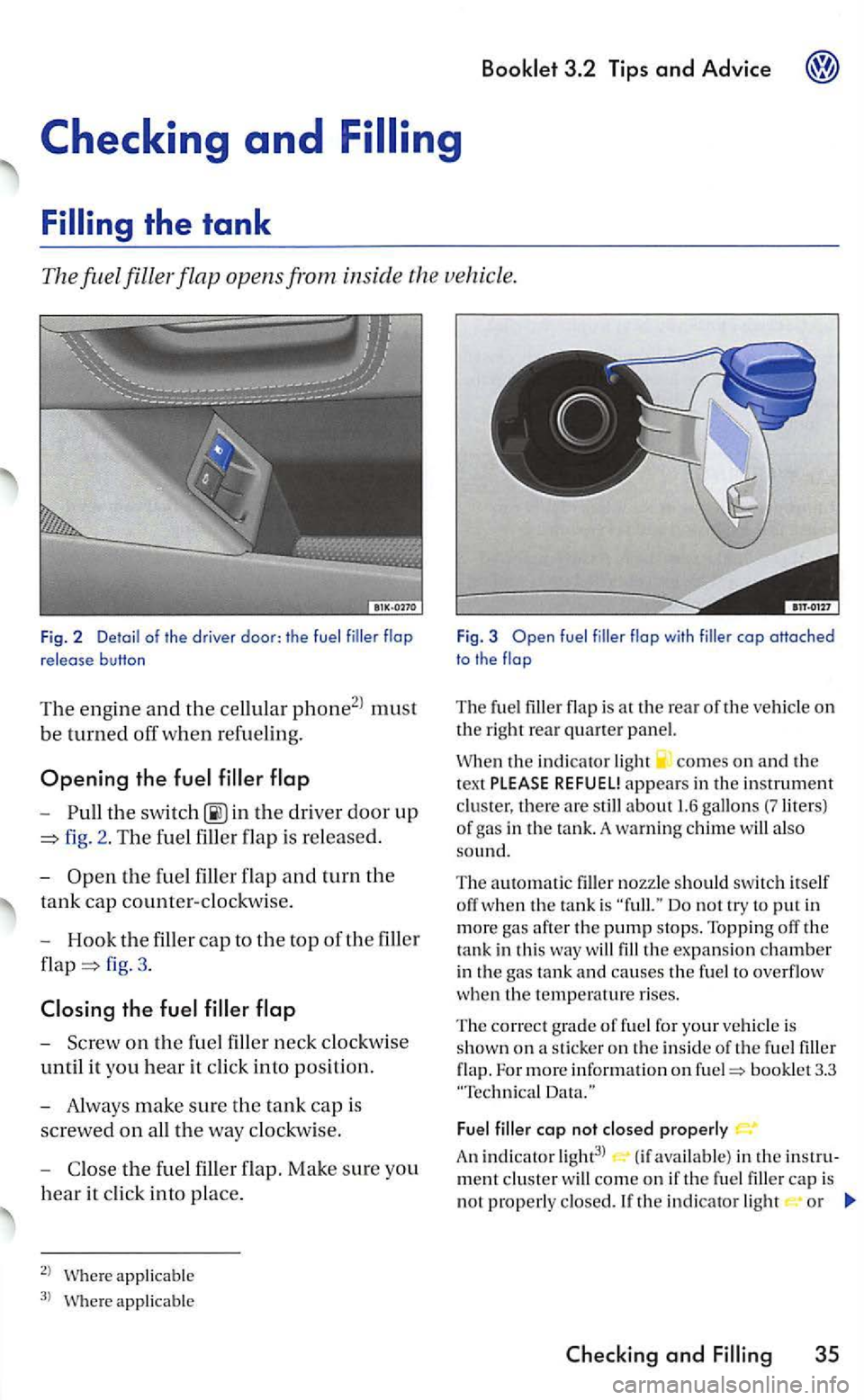
-in the driver door up
fig. 2. T he fuel filler flap is re leased.
-
Open t h e f uel filler flap and turn the
tank cap counter-clockwise.
- Hook
the fille r cap to the top of th e filler
fig. 3.
the
-Screw o n the
applicable
applic able
Fig . 3 fue l flop with cop oHoched
to the
The fu el flap is a t the rear of the vehicle on the right rear quarter panel.
th e indi cator light comes on and th e
t ex t PLEASE REFUEL! appears in the in strume n t
clu ster, there are s till ab out 1.6 gallo ns (?liters) of g as in the tank. A warning ch im e will also so und.
The automatic nozzle shoul d swi tc h itself off w hen the ta nk is
the expansion chamber
i n the gas ta nk and causes the fuel to overflo w when the temperature rises.
T
he correct g rade of fu el for your vehicle is
show n on a stick er o n th e inside of the fu el flap. For m ore informatio n on bookle t 3.3
Fuel filler cop not closed prope rl y
A n in d ic a to r light3l (if available) in the
Checkin g and 35
Page 316 of 444
WARNING (continued)
Never reach into the area around or tou ch the radiator fan. Contact w ith the blade s can resuh in se riou s personal injury. Always m ember that the radiator fan is controll ed and can turn on
m oved from the ignit ion.
Never unscrew the coolant expa nsio n tank cap when th e engin e is hot. A hot engine will heat the coo la nt and put it under pressure . mov in g a cap that i s under pressure ca n rcsuh in seriou s personal injury and/or burns.
A lway s prote ct face, hand s and arms from hot esca ping coolant or steam b y cove ring the ca p with a large, thick rag.
Turn the cap slow ly a nd very carefully in a
counter- clo ckw ise direction whil e applying
light downward pressure on the top of the cap.
Never spill on hot engine parts o r hot
e xhau st sys te m . S pilled
Neve r short-circuitthc elec trica l sys te m ,
es peciall y w here th e jumper cabl es are tached -th e balleri es could explode!
Neve r leave any objects in the e ngine partment, for exam ple cleaning rag s and too ls. Objects
Neve r work unde r the veh ic le unless you
h ave safely secured th e ve hicl e from movin g.
I f yo u must work under th e ve hicl e wit h th e
w hee ls on th e ground, always make sure the vehicl e is on leve l ground, th e wh eels arc
b locked from movin g and th e key is not in the
ignition.
Always support your ve hicle with safety
s tands if you have to wo rk underneath it. The
ja ck suppli ed with the ve hicle is not s tron g enough for this purpose and can co llap se causin g se riou s personal injury.
If you have to perform a check or r ep a ir
w hen th e e ngine is running, there arc more
ri sks from
the ro tating parts, such as the drive
WARNING (con tinued)
Neve r to uch the e lec tr ica l w ir in g of the ig ni tio n sys tem.
Always make sure that j ewe lry, loose clothing and lo ng hair do not get caught in
rota ting engine pans. Before startin g any work remove jewelry, tie back and cover
hair, and do not wear clothing that can hang down and get caught in mov ing gin e parts.
Always use extre me cauti on if the erator pedal has to be depresse d to perform
a ch eck. The vehicle could move suddenly, eve n if the parking brake is applied.
If wor k on the fu el sys te m or th e electrica l
syste m is necessa ry:
Always discon nect th e balleries. Make
sure th e vehicle is unlo cked when
Neve r sm oke .
Neve r work nea r heaters, wa te r h eaters of other open names .
A lways have an approve d fire ext guis her nearby.
To avo id electrical shock and personal jury w hil e the eng ine is running or being
s tarted :
n ever touch ignition cables,
never to uch othe r component s of the
high vohage electronic ignition syste m,
never touch the gas discharged (Xeno n) headlights wiring.
Note
Whe n chang ing or topp ing orr service fluids. make absolutel y ce rtain that you fill the fluid s
into the corr ect reservoirs. Using incorrec t fluids will resuh in serious malf unct ions and engine
damage!
For the sake of environment
Service fluid leaks are harmful to the environ-
ment. Reg ularl y check the ground undernea th
your vehicle . you find spots of oil or other
fluids. have your vehic le checked by your rized dealer or a qualified
Page 317 of 444
Booklet 3.2 Tips and Advice
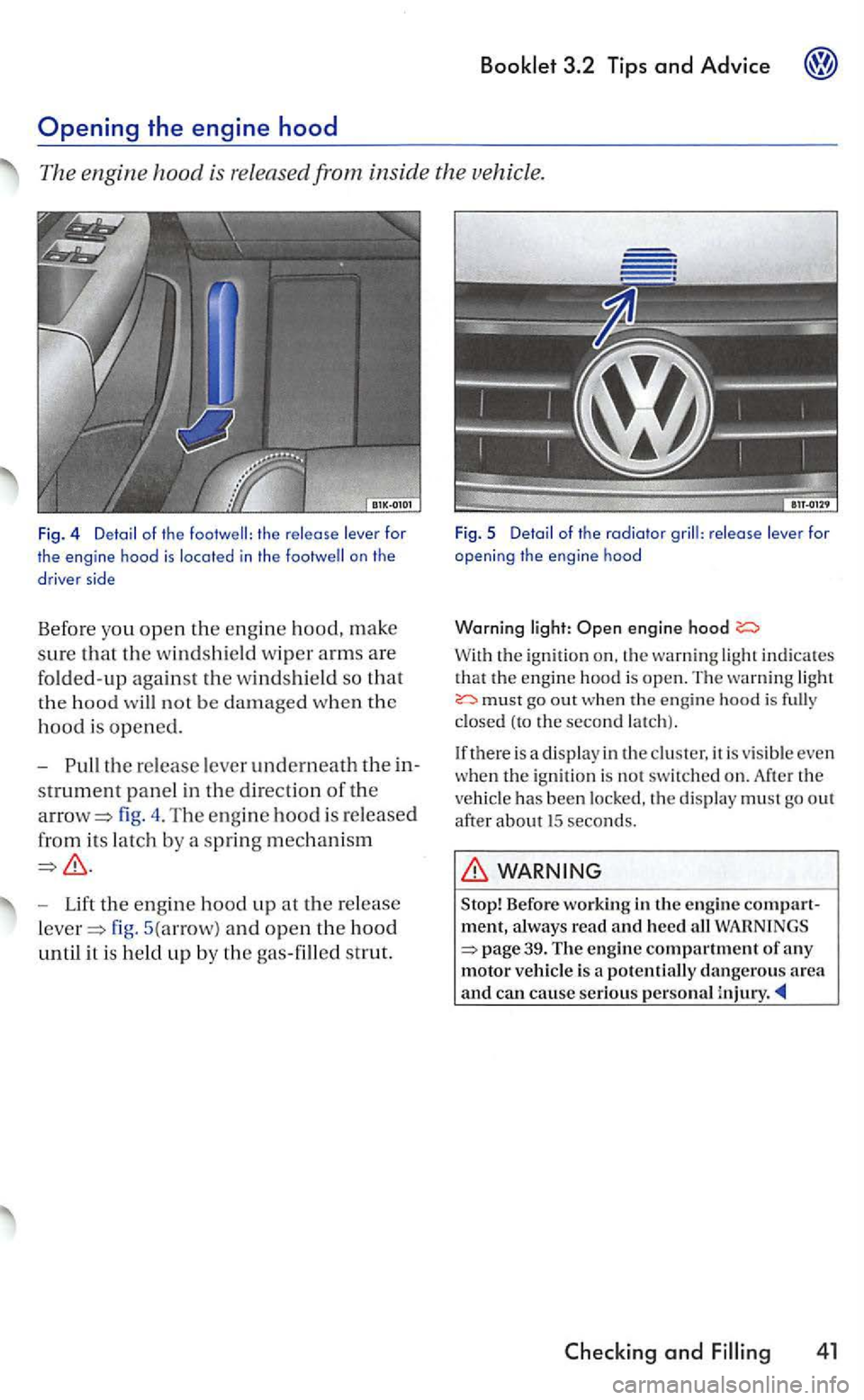
th e release lever for
the engine hood is located in the on the
d rive r side
Befor e you open the engine hood, make
sure that the w indshi eld wiper arms are
folded-up against the winds hi eld so that
the hood will not be damaged when the
hood is opened.
fig . 4 . The engi ne hood is released
from its latch by a s
pring mechanism
Lift the engin e hood up at the re lease
fig. 5(arrow) and open the hood
until it is held up by the gas-filled strut.
Fig . 5 Detail of the radiator release lever open ing the en gine hood
Warning engine hood
With the ignition on, the warnin g light indicate s
that the engine hood is open. The warning light must out when the engine hood is closed (to the second latch ).
If there is a displa y
in the cluster, it is visible even
when the ignit io n is not switched on. After the
vehicle has been locked, the disp lay must go out after about 15 seconds .
WARNING
Before working in lhe engine compartment, always read and heed all WARNINGS 39. The engine compartment of any motor vehicl e is a potentially dangerous area and can cause se riou s personal injury.
Page 320 of 444
The engine oil dipstick indicates the leve l of the oil.
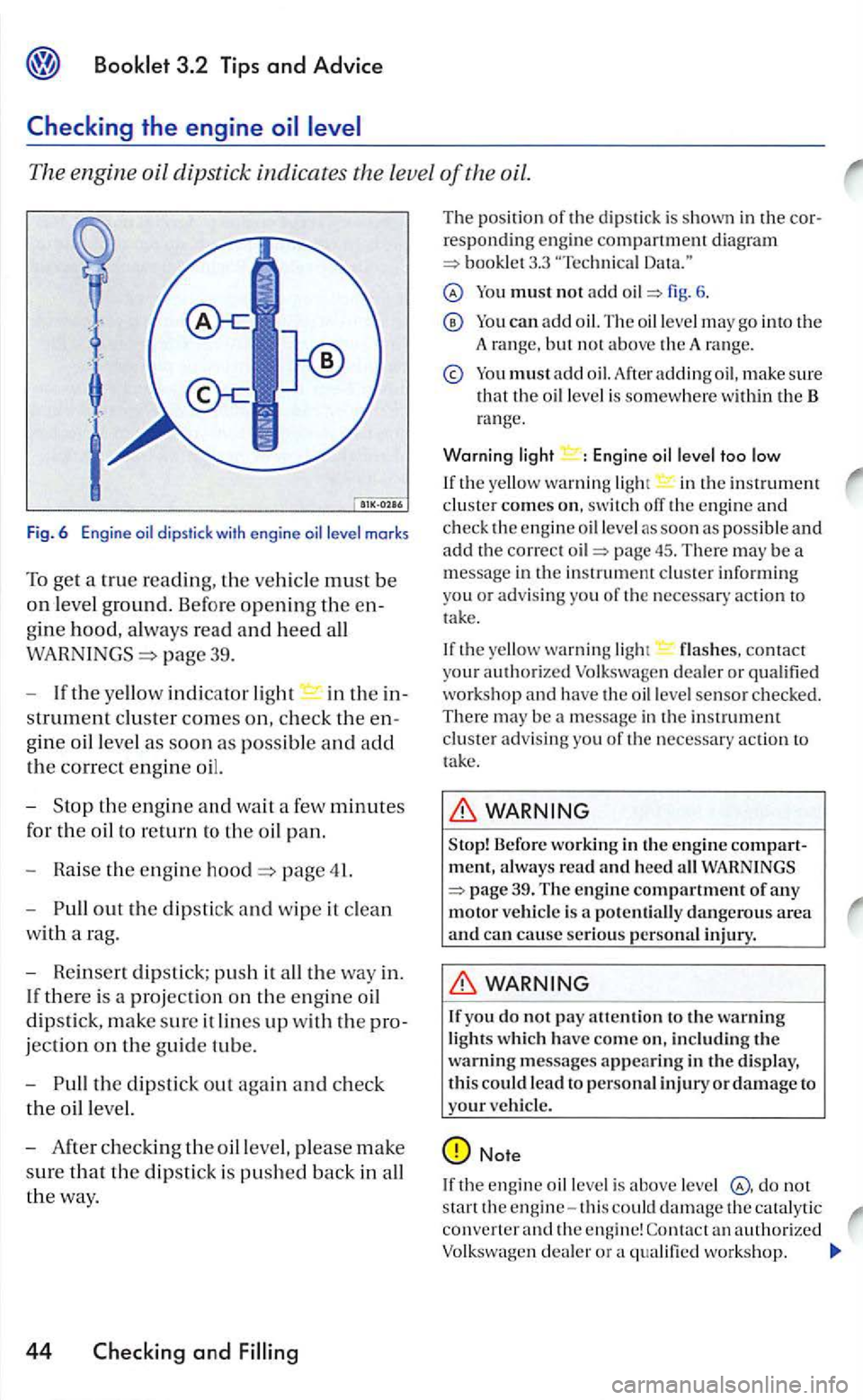
Fig. 6 E ngine level marks
To get a true reading, the ve hicl e must be
on leve l ground. Before opening the en
gine hood, always read and heed all
page 39.
If the yellow indicator light in th e in-
s
trument cluster comes on, check the e n
gine o
il leve l as soon as possible and add
the correct engin e oil.
the eng in e and wait a few minutes
for
the oil to return to the o il pan.
p a ge 41.
out the dipstic k and w ip e it clean
w ith a rag.
Rein se rt dips tick; push it all the way in.
If
ther e is a projection on the en gin e oi l
dipstick, make sure it lines up with the pro
jection on the guide tube.
the dipsti ck out aga in and ch eck
the o il l evel.
You must not add fig. 6 .
You can add
You m ust add oil. adding oil, make sure the level is somewhere within t h e B range.
Warning light : Engin e oi l level too low
If the yellow warn in g ligh t in the instrument cluster comes on, switc h ofT the engine and check the engine level as soon as possible and add the correct page 45. There may be a message in the instrumem cluste r informing you or advis ing you of the necessary action to
take.
If the yello w
warning ligh t flashes, contact your authorized Volkswa gen dealer or qualified workshop and have the oil leve l sensor checked. There be
WARN IN G
Before workin g in th e e ng in e compartm ent, always read and heed 39. T he engin e compartment of any motor vehicl e is potentiall y dangerous are a and can cause serio us personal injury.
WARN ING
If you do not pay attentio n to the warning light s which ha ve com e o n, incl ud in g the warning messages appearing in the d isplay, this could lead t o personal in juryordamage to
your ve hicle.
Note
If the engine oil is above level not
start the engine-this could damage the catal ytic converter and the engi ne!
Page 321 of 444
Tips
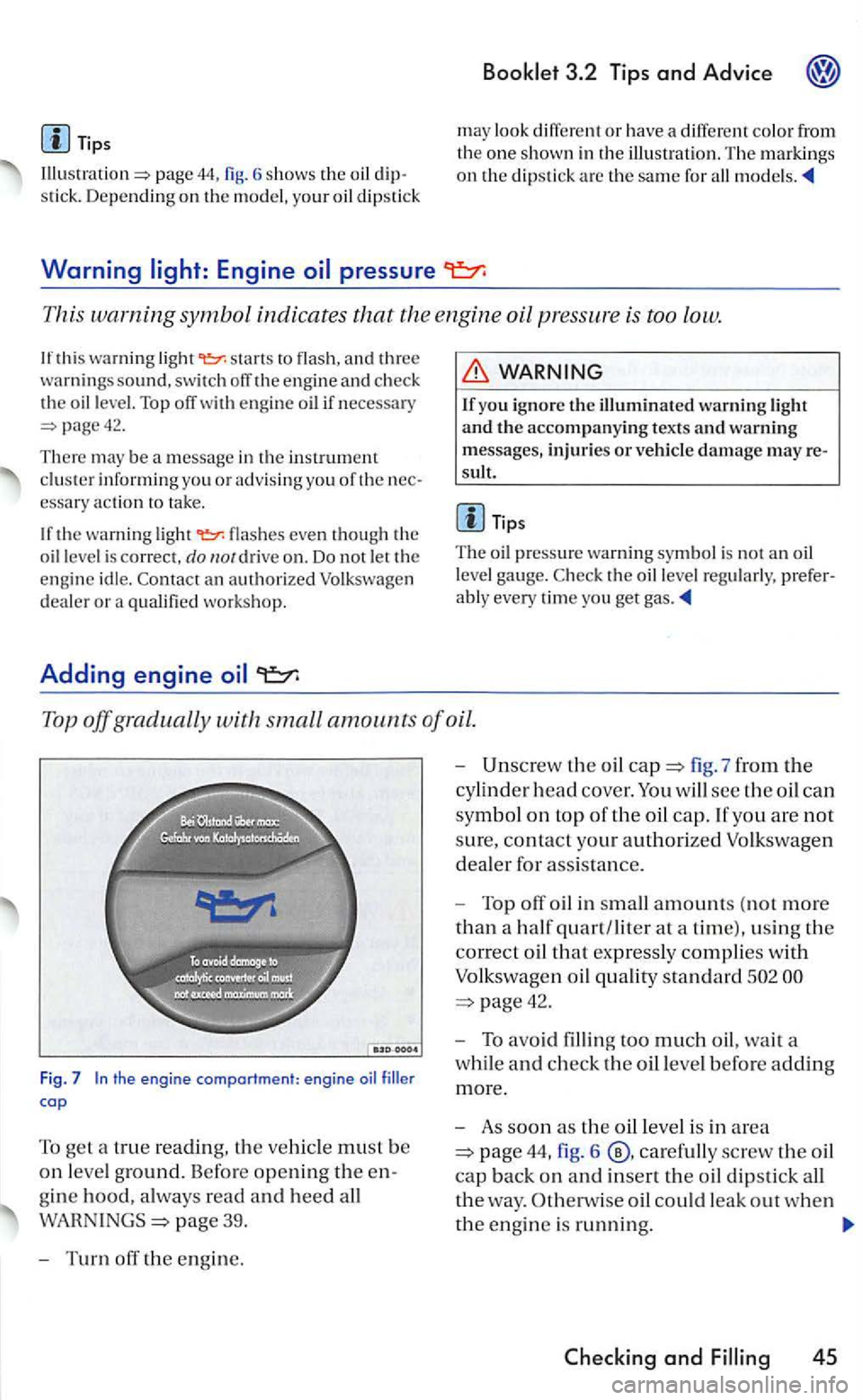
6 shows the oi l stick. Depending on the model, your dipstick
Booklet 3.2 Tips and Advice
may look different or have a different colo r from
t h e one shown in th e illustration. The markin gs on the dipstick are th e same for
Warning
This warning symbol indicates that the engine oil pressure is too low.
th is warning light start s to nash, and three warnings sound. switch off the engine and check the oil level. Top off with engine oil if necess ary
essary action to tak e.
If
the warning flas hes even the
oil le ve l is correct, do no/drive on. Do not ler the engine idle. Contact an authorized Volkswagen dealer or a qualified works hop.
Adding engine
WARNING
If yo u ignore the illum inated warning light and the accompanying texts and warning messages, injuries or vehicle damage may s ult.
Tips
The oil pressure warning symbol i s not an oil
level gauge. Check the oil leve l regu larly,
Top off gradually with small amounts of
Fig. 7
must b e
on leve l ground. Before opening the
WAHNINGS 39.
Turn off the e ngin e.
Un screw the oil fig. 7 from the
cy lind er head cover. see the can
symbol on to p of the oil cap. If you a re not
sure, con tact your authorized
off oil in amounts (not more
than a hal f quart/liter at a time). using the
correct oil that expressly complies with
quality standard
page42.
too much
As soon as the oil l evel is in area
d ipstick all
the way. Othetw ise oil could
and Filling 45
Page 324 of 444
Booklet 3.2 Tips and Advice
functional problem s or engine damage could be caused
Warning temperature
The warning symbol lights up if the coolant temperatur e is too high or if the
coolant level is too
Low.
Ther e is a fault if:
The wa rnin g symbol does not go out aga in afte r a few seconds.
The wa rnin g symbol light s up or flas hes whil e the vehicle is moving. Three warning s
This means th at eith er th e coolant leve l is too low or the coo lant temperature is too high.
Th ere may be a m essage in the i
nstrument
clu ste r inf orming you or advi sing you of th e
Coolant temperature too high
Fir st look at the coolan t tempe rature gau ge. The coolant temperature is too hi gh if th e need le is
o ver to th e fa r right on the dial. the vehicle,
switc h the engine wait for it to cool down. the coo lant level.
I f th e coo lant level is co rrect, th e over heating may be caused by a radia tor fan fault. the ra diator fan fuse and have it replaced if page
If th e wa rnin g light lights up again after driving
o n for short distan ce, stop the vehicle switch otT th e e ngine. an authorized Volkswagen dea le r or a qu alified worksh op.
when towing a trailer
If you have to c limb a lo ng g rad e w ith high temperatures in low gea r at high gin e ture booklet 3. 1 and If th e
w arning light in th e in st rument cluster flas hes, stop and a llo w the e ngine to coo l down
48 Checking and Filling
for minutes at idl e. For more inform ation 15.
alw ays read and heed all
Hot steam or coolant ca n cause seriou s burns.
Neve r open the engine hood if you see steam or coolant escaping from the engine compartment. Always wait until you no longe r see or hear steam or coolant escaping from the
e n gine.
Always let the engine to cool down pl ete ly before carefully opening the engin e hood. Hot components will burn tact.
When the engine has coo led down and you are ready to open the engine hood:
-
move the key f rom the ignitio n.
- Appl y
the parking brake firmly and put the selector in ( Park, automatic mission) or Neutral (manual
Never reach into the area around or tou ch
th e rad iator fan. with the blades ca n
re sult in serio us personal injury.
remembe r th at the radiator fan is temperature-controlled and can turn on
fo r a longer p eriod of tim e and the
key has been r emoved fro m the ig nition.
Never unscrew the coola nt expansion tank cap when the e ngin e is hot. A hot engine will
Page 325 of 444
Always protect face, hands and arms from hot escaping coolant or steam by covering the cap with a large, thick rag.
(contin ued)
Turn th e cap slow ly and very carefully in a
counter-clockwise direction while applying
light
down ward pressure on the top of th e cap.
Never spill antifreeze or coolant on the haust system or hot eng ine parts. Under some conditions, the ethyle n e glyco l in en gin e
coolant can catch fire.
Checking the
The correct coolant level is important for correct functioning of the engine cooling
system.
Fig. 8 t h e engin e compartment: coolant
sian tank
To get a true reading, the ve hicle must be
on l eve l ground. Before opening the
gine hood, always read and heed all
page 39.1f the coolant level
drops too low, a warning text is displayed
in the in strument cluster and the engine
coolant leve l/temperature warning ligh t
lights up.
Opening the expansion tank
- Switch
9on the expansio n tank with a thick
cloth
and carefully unsc rew the
Fig. 9 the engine compartment: cap of coolant expansion tank
- Look at the side or the coolant
sion tank w ith the marks and read off the
coolant level.
-
If the level is below the mark, top
off wi
th fig. 8.
Topping off
-
the
and