light VOLKSWAGEN GOLF PLUS 2004 Owners Manual
[x] Cancel search | Manufacturer: VOLKSWAGEN, Model Year: 2004, Model line: GOLF PLUS, Model: VOLKSWAGEN GOLF PLUS 2004Pages: 541, PDF Size: 98.86 MB
Page 223 of 541
In thi s section you'll find information on th e followi ng:
C o
ntrols ................................... .
Heating system operation
Air conditioner operation .. .................. .
Air vents .... .............................. .
Air recirculotion
and
228
23 1
232
232
ve hicle is equipped e ith er with a Climatic cli
mate co ntrol system or with a Climatronic climate co ntrol sys tem. ve hicles w ith tron ic clim ate co ntrol, syste m statu s m ess ages will appear
Volkswa gen Informa tion page
Windshi eld w iper and pag e
Exterior care an d page 262
increases th e risk of and other acci de nt s that cause seri ous pe rso nal in
jurie s.
Always make sure all win dow s are clea r of ice , s now and condensa tion fo r good visibil ity to the front, si des, and rear.
Maximum heatin g output and defrost ing
w ill only be possi ble after th e engine yo u
h ave good visibili ty before driving off.
Alwa ys make sure yo u know how to properl y
u se t he heating and ve ntilation syste m s as well as the rear window defogger that yo u will nee d
for goo d visibility.
While driving
Neve r use air recircu lation for lo ng peri ods of time. W hen the air conditioner is off and r ecirculation mode is on, co ndensation ca n qui ckly
form on th e windows an d great ly reduce visi
bility.
A lways switch off reci rculati on mode w he n it
i s not n eeded.
air causes d ri ve r fatigu e and reduces drive r alertness, w hich can cause accidents, collisions and seriou s personal injury.
Never swi tc h off the fa n for a lo ng pe riod of lim e and never use air reci rc ulation a lo ng pe
r iod of time because no fresh air will co me into
th e passe nger compartment.
Note
th e a ir conditioner
checked by an authorize d Volk swage n dealer or authorized Volkswage n Servic e Facility.
Air conditi oner repair requires speciali zed
kn ow le d ge and special tool s. Volkswagen recom
m ends that you sec an authorized Volkswagen
dealer or authorized Vol kswagen Service Facility.
Do no t smoke whe n air reci rc ulati on is
sw itched on. drawn int o th e ve ntilation
syste m can leave residue on th e e vaporator an d
on th e dust a n d pollen active carbon re
su ltin g in permanent odors when ever the air con
ditione r i s switched o n.
out side air no t b e dehumidified. To keep the windows from fogging over, Volk swage n rec
omme nd s leavi ng th e air conditioner (co m
pre sso r) switc hed on. button. The in-
dica tor light in the bunon mu st come on.
Page 226 of 541
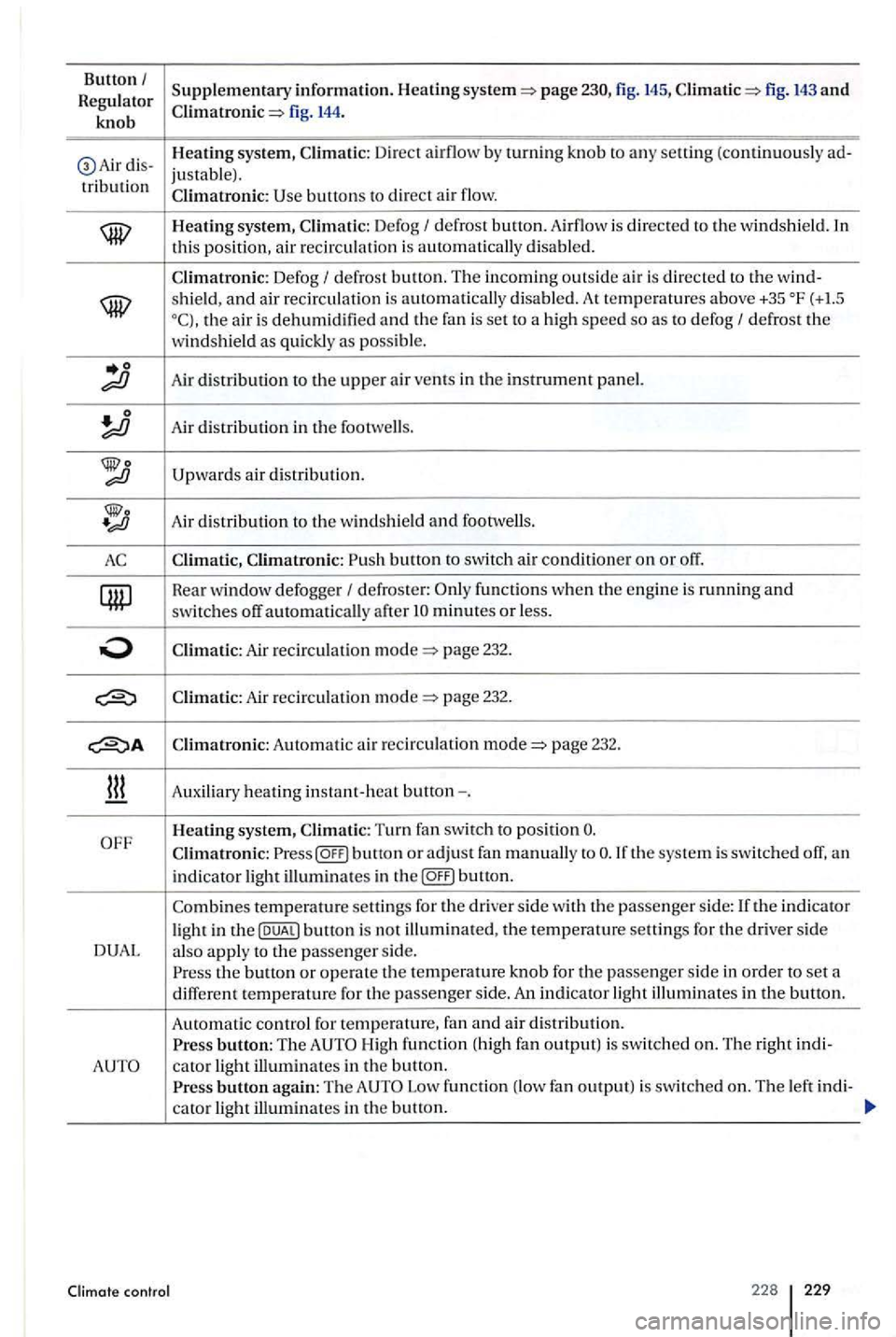
Button/ Supplementary information. Heating page 230, fig. 145, fig . 143 and Regulator knob fig . 144.
Air dis - H
eating system,
bullons to direct air flow.
Defog I defrost button. Airflow is directed to th e windshi eld . this position, air re cir culation is a utoma tically disab le d .
C limatronic: Defog
I defrost bulton. T he incomin g outsid e a ir is directed to the w ind-shie ld , and air recirculation is automatica lly disab le d. A t temperatures above +35 (+1.5 the air i s dehumidified and the fa n i s set to a hig h speed so as to defog I defrost the windshield as quickly as possible .
Air distribution to the upper a ir ve nts in the instrument panel.
A ir distribution in th e footw ells.
A ir distribution to the windsh ie ld and footwells.
bullon to swit ch air conditi oner o n or off.
Rear window defogger I defro ste r: fun ction s when the engine is nmning and switches off automatically after
Air rec ircu lation page 232.
Air r eci rc u lation page 232.
Climatron ic: Auto mati c air recircu lation page 232.
Auxil iary heating insta nt -h eat button-.
Heating system, Turn fan switch to position
or adj ust fan manually to the system is swit ched off, an
indi cator light ill
uminates i n th e button.
th e indicator
ligh t in th e butto n is no t illum in a te d, the tempera ture se11ings for the driver side a ls o apply to th e passenger side. th e button or operate th e temperature knob fo r the passenge r side in order to set a
differ ent temperature for the passenger sid e. An ind ica tor light illuminates in the button.
A
utomatic control for tempe rature, fa n and air distributi on. button: The High function (hi gh fan output) is switch ed on. The right indi -cator ligh t illuminat es in the b utton. button again: The
Page 228 of 541
Air conditioner operation
information and heed the WAHNINGS on page 226.
The cooling syste m for the passenger compart
ment o nl y functions when the engin e is running
and the fan is switched on.
The air conditioner is most efficient when the w indows an d the power sunroof are closed. However,
if th e vehicle is sta ti o nary and the passenger compartment becomes very hot due to sunlight, opening the w indows briefly may speed up the cooling proce ss.
Keep
the a ir intake slot in front of the windshield
free of i ce, snow and lea ves in order to maintain proper funct ioning of the heating and ventilation systems.
Settings for optimal driving safety
When yo u sw itch on the cooling system, both the temperature and humidity in the vehicle are reduced. Th is will help make passengers feel more comfo rtable and prevent windows from fogging
up.
For
Sw itch off a ir page 232.
fan to Ievell or 2.
T urn the temperature knob to t he center posi
tion.
all air vents in the in strument panel page232 .
Turn the air distribution knob to the des ired settin g.
butto n to turn on the air conditioner. The indicator light illumin ate s in the button.
For
th e button.
temperature to +72
pa ge232.
Sw itching between Fahrenheit and Celsius in Cli
matronic
The t empe ratu re disp lay is switched from to Fahrenheit and vice versa in the display of the factory- in stalled radio or naviga tion system via the in strument cluster page
control
H eating
Maximum heating output and fas t defrosting will
only be possib le a fte r the e ngin e has reached operating tempe rature.
T he e ng in e is not running.
T he fan is switc hed off.
The a ir conditi one r fuse has blown.
The ambien t a ir temperature is colder than (+3
T he air condition er compresso r has been tem
porarily switched off due to excess ive engin e coolant temperature.
The re is a nother malfunction in the ve hicle.
Ha ve the ai r conditioner checked by an authorize d
Volkswage n dealer or authorized Volkswage n Ser
v ice Facility.
Special considerations
Whe n it is very hot and humid outside, water con
d ensation can drip from the air condition er evaporator and form
The air condit ioner takes a few minutes to reach the selected temperature in the passenger compartment.
Due to residual m oisture in the air condi tione r, th e windshi eld may fog up after the
engi ne is s tarted.
23 1
Page 229 of 541
Air from the air vents flow s through the e ntire passenger compartment and leaves the vehicle through air vents under the rear w ind ow.
The a ir vents s hould not be covere d by clothin g or other
Air vents
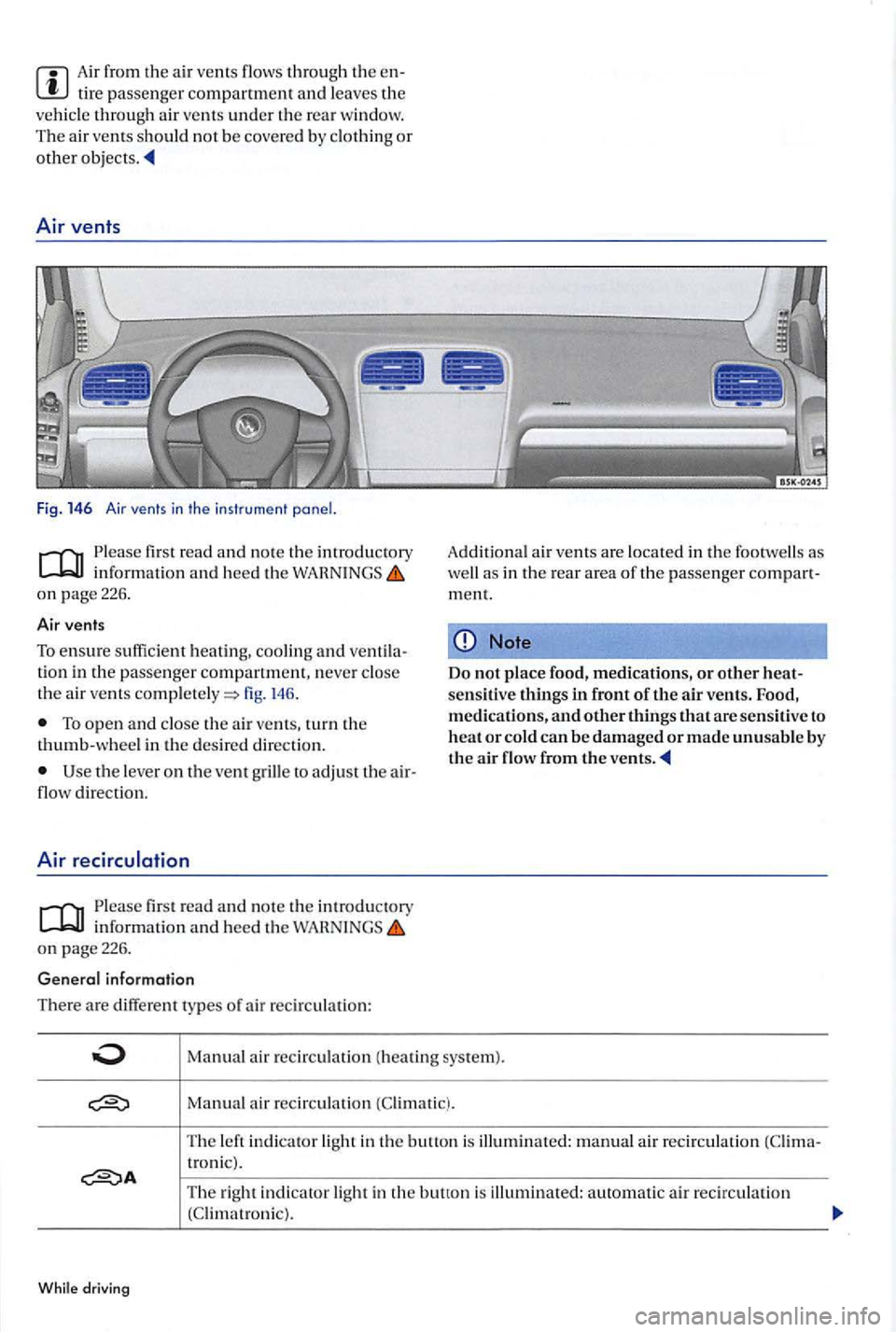
Fig. 146 Air vents in the instrument
Please fir st read and no te th e introductory informati on and heed the on page 226.
Air
vents
To e n sure s uffici ent heating, cooling and ve ntil ation in the passenger compartment, n eve r close the air vents fig. 146 .
To ope n and close the air vents. turn the thumb-wheel in the desired direction.
Use the lever on the vent grill e to adj ust the air
flo w direction.
Air recirculation
Pleas e fir st re a d and note the in trod uctory information and heed the on page 226.
General information
There are different t y p e s of air recirculati on : A
dditi onal air
vents are located in the foorwells as well as in the rear area of the passe nger compart
m ent.
Note
Do not place food, medications, or other heatsensiti ve things in front of the air vents. Food, medications, and other things that are sensitive to
heat or cold can be damaged or made unusable by the air flow from the
Ma nual air re circulati on (h eatin g sys te m ).
Manual air r e circulatio n
troni c).
Th e
right indi cato r light in the is illumin ate d : automatic air recir cul atio n
Page 230 of 541
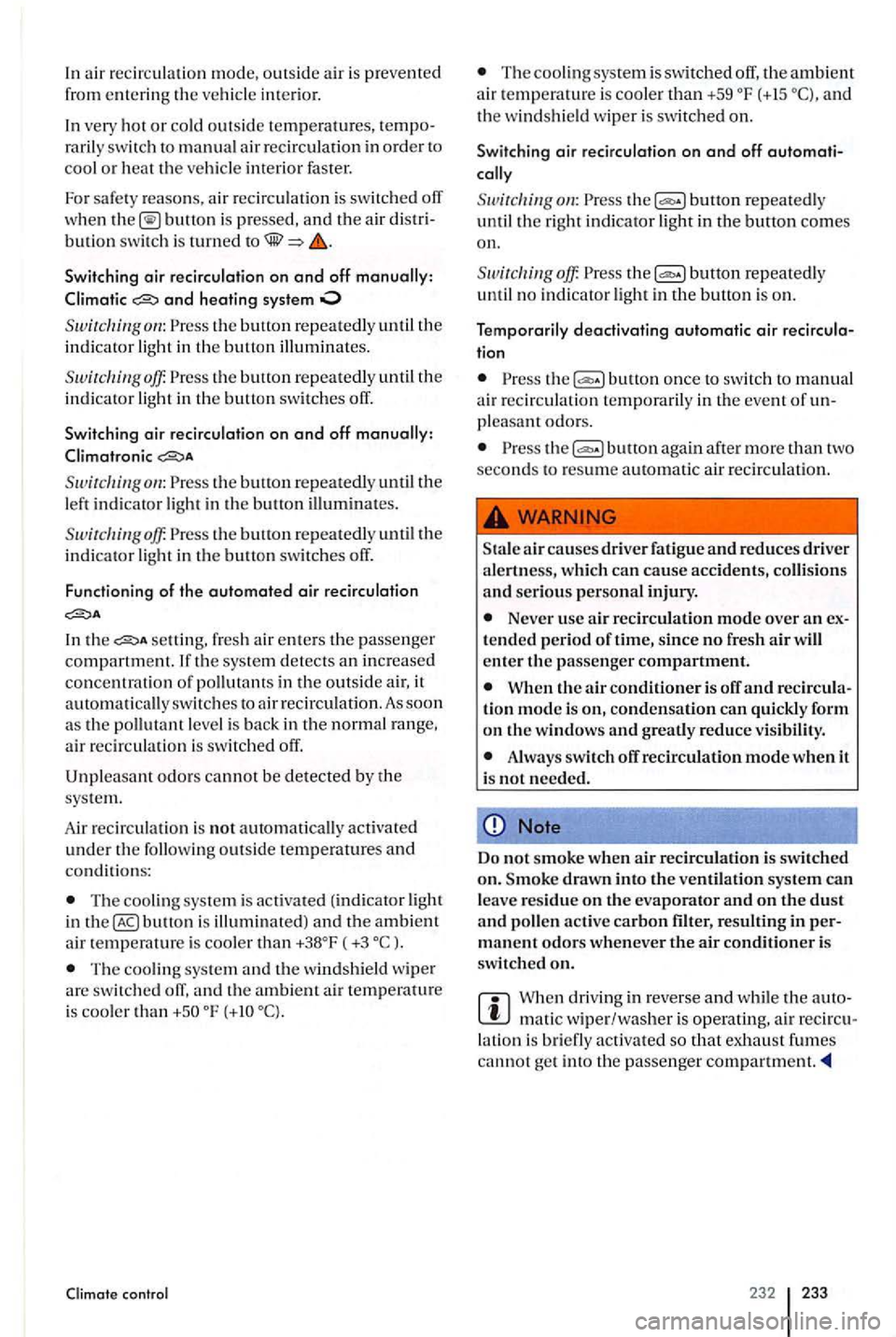
In air rec irculati on mod e, out sid e air is pre vente d
from ent
erin g the ve hicle inte rior.
In very hot or co ld out sid e t
emperature s, rarily sw itch to manual a ir recircula tion in orde r to cool o r heat th e ve hicle interior faster.
For safet y re aso ns, air recircu latio n is switch ed off when
and heating system
th e button repeated ly until the
indi cator ligh t in the button illumin ates.
the button re peatedly until the
indi cator light in the button switche s off.
Switching air recirculation on and off
the button re peatedly the left indi cato r light in the butto n iUuminates.
Swirclzin goff. the buHon repeatedly th e
i n d icato r ligh t in th e butto n swit ches off.
Functioning of the automated air recirculation
sett ing, fresh air ent ers the p assen ger compartment. If th e sys te m detects an in crease d
co ncentrat ion in the out side air, it automatically switches to air recirc ulation. As soon
a s th e po llut an t leve l is bac k in th e no rmal range,
air recirculati o n is switc h ed off .
Unpl
easa nt od ors can no t be detected by th e
sys tem.
A ir rec ir c ulati on i s n
ot automatically activated under th e followin g o utside tempe ratures and conditi ons:
The coo ling sys te m i s activa te d (indicato r light
in butt on is illum inated) an d th e ambient
air temperature is coo ler than ( +3 oc ).
The co oling sys te m and the w in dshie ld wipe r
are switc h ed off, and the ambien t a ir temperature
i s coo le r th an
Th e cooling sys te m i s switched th e am bient
a ir temperature is c oole r th a n +59 and
th e w indshi eld wip er is switched on.
Switching air recircu lation on and off
button repeatedly
until the rig ht ind icator light in th e button co mes on.
off. button re peate dl y
u ntil no indicat or light in the button is on.
Temporarily deactivating automatic air
butt on once to switch to m anual
a ir recirculatio n t emporarily in the event of
buH on aga in afte r more than two
seco nds to resume auto matic ai r recir cul atio n.
air ca uses driver fatigue and reduces dri ver
a lertness, which can cause accidents, collisions and serious personal injury.
Neve r use air recirculation mode over an tende d p eriod of lime, since no fre sh air will
e nt er the passen ge r compartment.
When the air conditioner is off and tion mode is condensat ion can quickly form on th e w indows and greatly reduce visibility.
Alwa ys sw itc h off recirculation mode when it
i s not needed.
Note
Do not smoke w hen air re circulation is switc hed draw n into the ventilation syste m can le ave residue on tl1e evaporator and on the dust and poll en acti ve carbon filter , resulting in mane nt odors wheneve r the air conditioner is switched
W hen driv in g in reverse and w hil e th e mati c wipe r/washer is op erating, air latio n is bri efly act ivate d so exh au st fumes canno t ge t into th e passenger
232 233
Page 231 of 541
At the gas station
Refueling
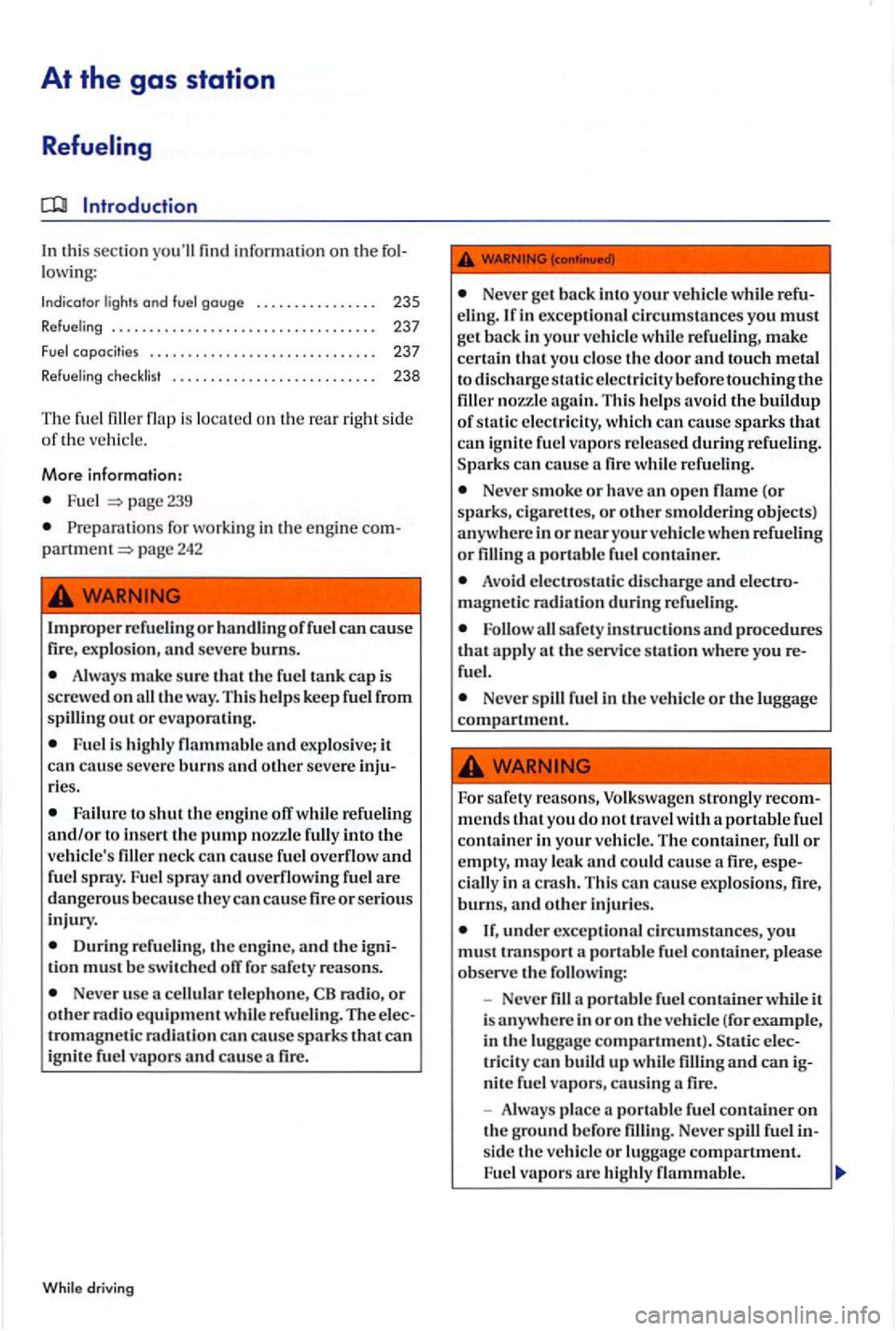
In this section yo u'll fin d information on the lowing:
Indicator lights and gouge . . . . . . . . . . . . . . . . 235
Refueling . . . . . . . . . . . . . . . . . . . . . . . . . . .
. . . . . . . . . 237
Refueling checklist . . . . . . . . . . . . . . . . . . . . . . . . . 238
The fue l filler flap is located on the rear ri ght side of th e ve hicle.
More info rmation:
Fuel page 239
Preparations for work ing in the engine page 242
Improp er refuel in g or ha ndl in g of fue l can ca use fire, explosion, an d severe burns.
Always m ake sure that the fuel tank cap is
screwed on all the way. This help s keep fu el from spillin g out or evapora ting.
Fuel is highly flammable and explosive ; it can cause severe burns and other seve re ries.
Failure to shut the e ngine off while refueling and/or to in se rt the pump nozz le into the vehicl e's filler n eck can cause fu e l overflow and fue l spray. Fuel spray and overflowing fuel are dangerous beca use they can ca use fire or seriou s
injury.
Durin g refuelin g, the e ngine, an d th e ti on must be swi tc hed off for safety reasons.
Never use a cell ular te leph one, radio, or other radio eq uipment while refueli ng. The
fire.
While driving
Neve r get back into your veh icle while eling . If in exce ptiona l circumstan ces you must
ge t back in your ve hicl e while refue ling, make cert ain that you close th e door and touch metal
to disc harge static electricity before touching the filler nozzle again. This helps avoid the buildup of stati c elec tricity , w hich can cause sparks that can ig nit e fuel vapors re leased during refueling .
Never smoke or have an open flam e (or
sparks, ciga re tt es, or oth er sm old erin g obj ects)
anywhere in or your vehicle when refueling
o r
Avoid elec trostatic discharge and
safety instructions and procedures that apply a t th e service statio n whe re yo u fuel.
Never spill fuel in the ve hicl e or the luggage compartment.
For safety
or empty, may leak and could cause a fire,
under exce ption al cir cumstances, yo u must tmnspo rt a po rt able fuel contain er, please observe the following:
- Neve r
fill a portable fuel container while it
i s anywhere in or o n the ve hicl e (for example,
i n the luggage compartment). tri city ca n build up while filling and can
Page 233 of 541
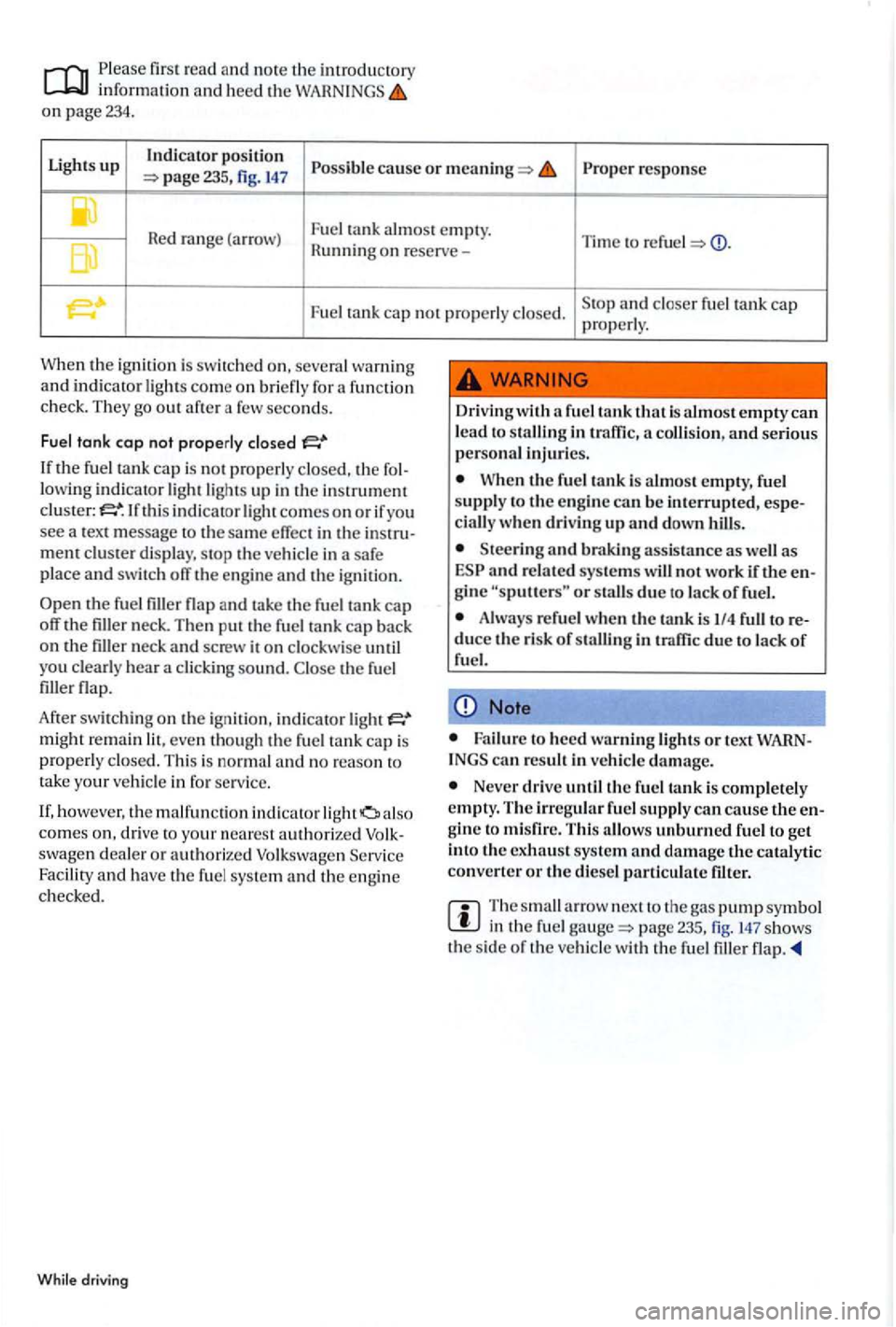
information and heed the WAHNINGS on page 234.
Lights
up Indicator pos itio n response 235, fig. 147
Hunning on reserve-
Fu el tank cap not pro perly closed. properly.
When the ignition is switched
a few seconds.
Fuel tank cap not properly
indicator ligh t comes on or if yo u see a tex t m essage to the same effec t in the in strument clu ste r d is play , stop the ve hicl e in a safe
p lace and switch ofT the en g ine and the ig n ition.
might remain even tho ugh the fu el t ank cap is properl y closed. This is no rm al and n o re ason to take your vehicl e in for se rvic e.
however, th e m alfun ctio n indicator light driv e to yo ur neares t authorized swagen dealer or authorize d Volkswage n Serv ice Facility and have fuel sys tem and the engine checked.
While driving
Driving with a fu el tank that is almost empty can
lead t o s tallin g in traffic, a co llisio n, and seriou s
p ersonal injuries.
W hen the fu el t ank is almost empty, fuel
supply to the engine can b e interrupted, especiall y w he n driving up and d ow n hill s.
Steerin g and braking assist ance a s we ll as and re lated syste ms w ill not work if the en
gine or s talls due to lack of fuel.
Always refuel w hen the tank is 1/4 full to re duce the risk of sta ll in g in traffic due to lack of fuel.
Note
----------------------~ Failure to heed warning lights or t ext WARN-can result in veh icle damage.
Never drive until the fuel tank i s com ple te ly
empty. The irregula r fu el supply can cause the e ngine to misfire. This allows unburned fuel t o ge t into the exhau st syste m and damage the cata lyti c
co nverter or the diesel p arti culate filt er.
The small next to the gas pump symbol in the fuel page fig. shows
th e sid e of the ve hicl e w ith the fuel filler flap.
Page 235 of 541
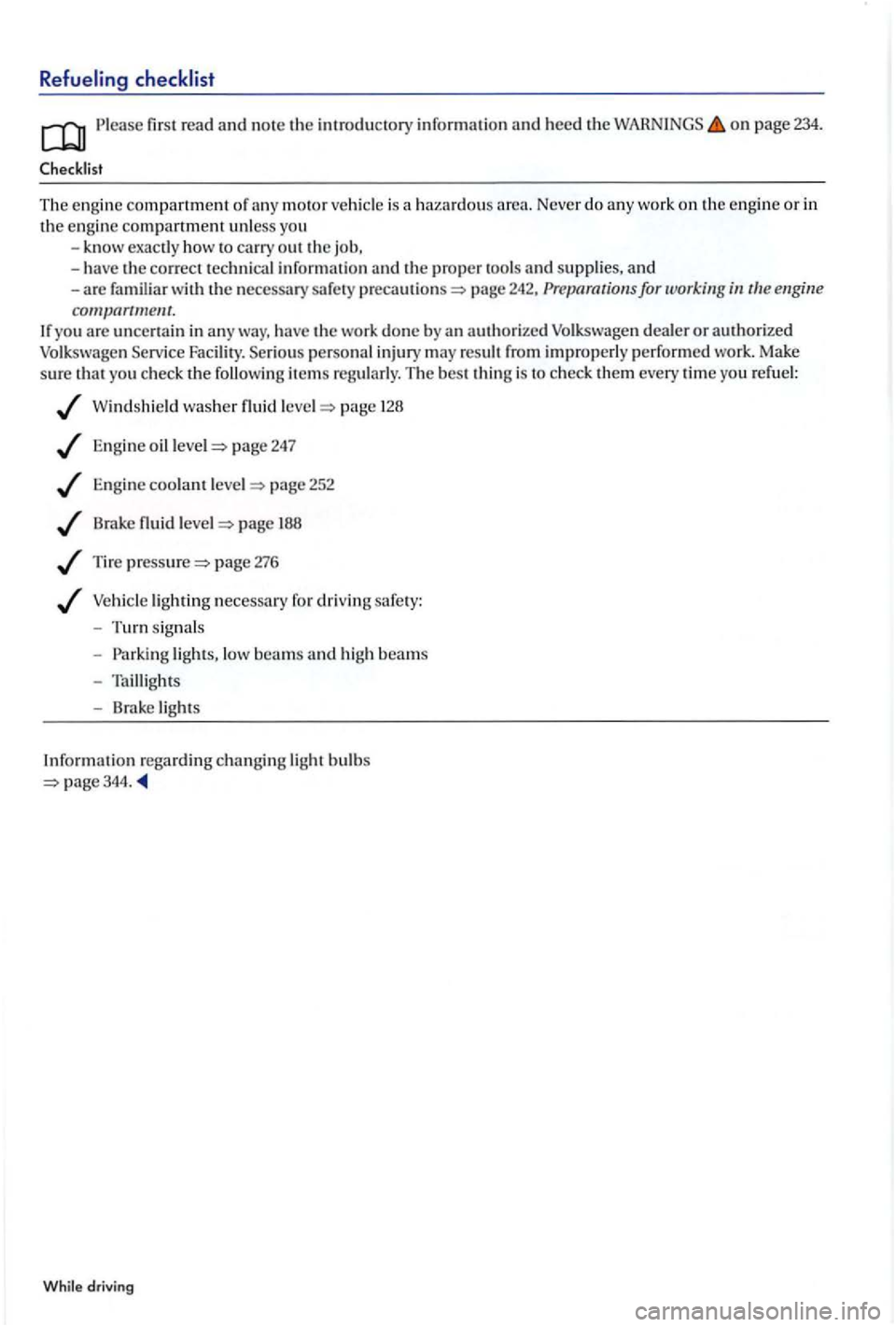
Refueling checklist
first rea d an d note the introductory information and heed the on page 234.
The engi ne compartment of moto r vehicle is a haza rdous engine or in the engin e compartment unless yo u -know exac tl y how to carry o ut the job,
-have the correct technical in formation and the proper too ls and supplies, and -ar e familiar with the necessary safety precautions page 242, Preparation s for working
have the work done by an authorized Volkswagen dealer or authorized Volkswag e n Serv ice Facility. Ser ious personal injury may result from improperly perform ed work. Make
s ure that y ou check the followin g item s re gu larly. The bes t thin g is to check them every time you refue l:
Wind sh ie ld was her fluid leve l page 128
E ng in e oil leve l page 247
Engin e coolant leve l page 252
Brake fluid level page 188
Tire pressure page 276
Vehicle lighting necessary for drivin g safe ty:
-Turn signal s
-
li ghts, low beams and high beams
- Taillights
- Brak e light s
Inf
ormat ion regard ing changing light bul bs page 344.
While dri ving
Page 239 of 541
Introduction
In thi s sectio n you'll find information on the lowing:
Warning light . . . . . . . . . . . . . . . . . . . . . . . . . . . . 244
Getting ready to work in the engine comportment 245
ond closing tho engine comportment . . . 246
A lways
pos iti on th e ve hicl e on a firm and leve l face befor e doin g a ny work in the e ngin e ment.
Th e e ngin e com p
artment of a ve hicle is a hazardo us
area. Neve r do any work on the en gine or in
the engine compartment unless you
- know exactly how to carry out the job, -have th e correc t tec hnica l information and the
prop er tools and supplies, and -are famili ar with the necessary safe ty
I f you are un certain in any way, have the work done by an aut horized Volkswage n dea le r or authorized Volk swage n Se rvice
Wind shi eld wiper and 128
Sta rtin g and stopping th e page 172
Brake 188
Vehicle
while 234
Engi ne
En gin e 252
Part s, accessories, repairs and modificat ions pag e303
Core, maint enance
Unintended vehicle movement during
Neve r work under the unless you have safely secured the vehicle from moving. If
you mus t work under the
are strong enough to support the weight of the vehicle. The jack supplied the vehicle is no t st ro ng enough for purpose and can collapse ca using seriou s personal in-
Th e engine
compartment of any motor vehicl e is
a potentially dangerous and can cause riou s per sonal injury .
Always use extrem e ca ution when doing any work in the engine comp artm ent. Alway s follow
c ommonl y accepted safety practice s and use common sense. Neve r risk personal injury.
Never perform any work in the engine partm ent unl ess you know exactly how to carry
o ut the job and hav e th e correct tec hni cal mation and the correct tools.
w age n dealer ,
We stron gly recommend th at you always
hav e gas disc harg e lamp s (Xenon) and
Page 240 of 541
Never open or close the engine hood if steam or coolant is escaping. Hot steam or coolant can cause serious burns. Always wait until you no longer sec or hear steam or coolant escaping
from the engine.
Hot parts of the engine and the exhaust
system will burn skin on contact.
When the engine has cooled down and you are ready to open the hood:
- Firmly
apply the parking brake and shift the transmission into Park
The engine coolant system is under pressure when the engine is hot. Never unscrew the coolant expansion tank cap when the engine is
hot. Hot coolant can spray out and cause severe burns and other serious injuries.
- Turn
the cap slow ly and very carefully in a
counter-clockwise direction while applying
light downward pressure on the top of the cap.
- A
lways protect your face, hands, and arms from hot escaping coolant or steam by
Never spill fluids on the engine or exhaust
system when Spilling fluids onto hot parts of the engine or exhaust system can cause a fire.
High voltage systems in the
engine com ment can cause electrical shocks or even
Never short-circuit the electrical system. Be especially careful when using jumper cables. The vehicle's battery could explode!
To reduce the risk of electrical shock and sonal injury while the engine is running or being started:
the engine compartment
- Never touch ignition cables. Never touch other components of the high voltage tronic ignition system.
- Never touch
the wiring of the gas
Never reach into t11e area around or touch the
radia tor fan. Contact with the blades can cause serious personal injury. Always remember that the radiator fan is temperature-controlled and can come on suddenly even when the engine has been switched for a while and the key has been removed from the ignition.
lfyou have to perform a check or repair when the engi ne is running, there are more risks from tl1e rotating parts, such as the drive belts, nator, radiator fan, etc ., and from voltage ignition system. Always use extreme care.
- Always make
sure that jewelry, loose clothing and long hair do not get caught in rotating engine parts. Before starting any work remove your je welry, take
parking brake is on.
Never leave any objects in the engine
left behind can cause malfunctions,
Do not smoke.
Never work next to open flames or sparks.
Never pour or spill operating fluids or other flammable liquids on the engine. These fluids can ignite on hot en g in e parts and cause ries .
242 243