brake light VOLKSWAGEN GOLF PLUS 2004 User Guide
[x] Cancel search | Manufacturer: VOLKSWAGEN, Model Year: 2004, Model line: GOLF PLUS, Model: VOLKSWAGEN GOLF PLUS 2004Pages: 541, PDF Size: 98.86 MB
Page 189 of 541
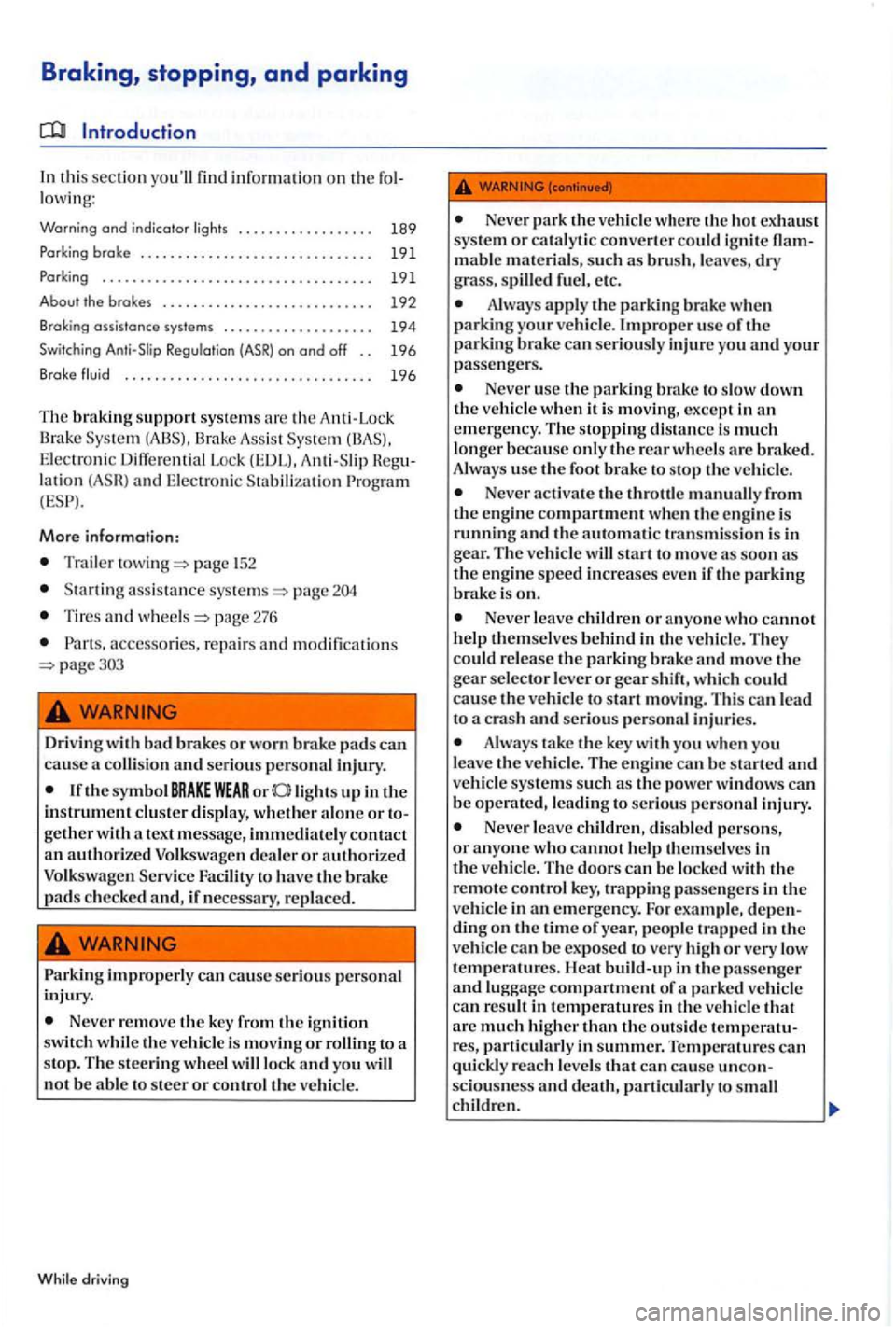
Braking, stopping, and parking
Introduction
In this section yo u'll find inform ation on fo l
lowi ng:
Warning and indicator lights . . . . . . . . . . . . . . . . . 189
Park in g brake . . . . . . . . . . . . . . . . . . . . . . . . . . . .
.. . . . . . . . . . . . . . . 19 1
About t
he brakes . . . . . . . . .. . . . . . . . . . . . .. . . . 192
Bra king assistance sys tem s . . . . . . . . . . . . . . . . . . . . 194
Switching Anti-Slip Regulation (ASR) on ond off . . 196
Brake fluid . . . . . . . . . . . . . . . . . . . . . . . . . . . . . . . . . 196
T he brakin g support syste ms are Brake A ss is t E lec tro nic Differ e n tial Loc k (EDL). Anti-Slip
M ore information:
Trail er page
pag e
Tires and page 276
acce ssories, r epa ir s and modifi catio ns
brakes or worn brake pads can
ca use colli sio n and serious personal inju ry.
light s up in the
in strument cluste r di splay, w heth er a lo n e or to
ge ther with tex t message, immediat ely conta ct an authorized Volk swage n dea ler or authorized
Volkswag en Se rvi ce Faci lity to have th e brake pad s ch ecke d and , if necessary, re pl aced.
WARNING
improperly can cause se riou s pe rso nal
injury .
Never re m ove key from the ignition switch while vehicl e is m ov ing or ro llin g to a
s top. The steering w heel w ill lock and you not be
Never park the vehicle w here the ho t ex ha ust
syste m or catalyti c convert er could ignit e flam
mabl e mater ia ls, su ch as brus h , leaves , dry grass, spilled fue l, e tc .
Always apply th e parki ng brake whe n
p a rki ng your veh icle. Imprope r u sc of th e
p a rking bra ke can se rio usly injur e you and your passe nge rs.
Never use the
e m ergency . The stopping dista n ce is muc h
longer b ec au se onl y the wheels arc braked . use the foot brake to sto p the vehicle .
Never the throttl e from
th e e ng in e
th e automati c transmission is in gear. The ve hicle will start t o move as soon the e ngine speed ev en i f th e brake is on.
Never leave childr en or anyo ne w ho canno t
h elp them se lve s beh in d in the vehicl e. They could re leas e the brak e move the gear selector leve r or shift , wh ic h could cause th e vehicle to start m ov ing. Thi s ca n lea d
to a cras h and seri ous personal injuri es.
Always take the key with you when yo u
leave th e ve hicle . The engine ca n be started and ve hicl e sys te m s s uch as the power wind ows can
b e operate d , le ad ing to seri ous perso nal injury.
Neve r leave childr en , di sabled perso ns, or a nyon e who cannot h elp them se lves in the vehicl e. T he doors can b e lo cke d wit h the re mote contro l ke y, trapping passe nge rs in the
ve hicle in an emerge ncy. For exa mpl e, dep ending on th e tim e of year, people trappe d in the
ve hicle can be ex pose d to very high or very temperatures. Heat build -up in the passenger and parked vehicl e result in temperatu res in the ve hicl e th at arc much hi gher than the outsid e tempe mtu
res, partic ul arl y in summer. T emperatures ca n
qui ckly reac h le v e ls that can cause uncon
scio usn ess ch ildr en.
Page 190 of 541
Note
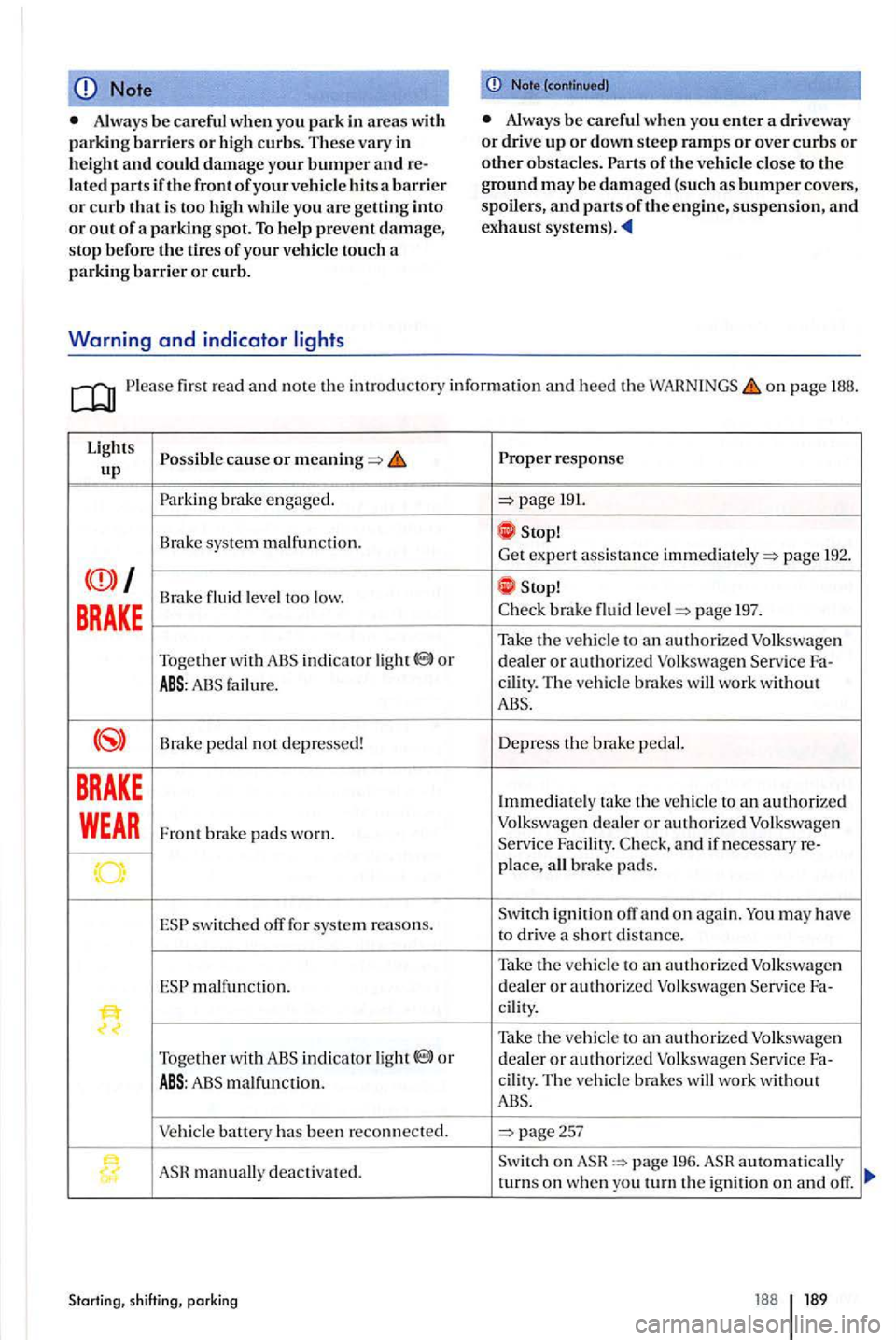
Always be careful when you park in areas with parking barriers or high cmbs. These vary in h eigh t and could damage your bumper andrelated parts ifLhe front of your ve hicl e hit s a barrier or curb that is too high while you are getting into or out of a parking spot . To help prevent damage, stop before the tires of your vehicle touch a parking barrier or curb.
Warning and indicator
Note (continu ed)
Always be careful when you enter a driveway or drive up or down steep ramps or over curbs or obstacles. of the vehicle close to Lhe ground may be damaged (s u ch as bumper covers,
spoilers, and parts of the engine, suspen sion, and exhaust
firs t read and note Lhe introdu ctory informat io n and hee d the WAHNINGS page 188.
Lig ht s
191.
Brak e syste m malfun ction. Stop!
Get
expert assi stance pag e 192.
Brake fluid leve l too low. Stop!
BRAKE brake fluid page 197.
Take the vehicle to an au thorized indicator light or dea ler or authorize d Volksw agen Service Fa-
ABS: failure. ci
lity. Th e ve hicl e brakes will work without ABS.
Brake pedal not depressed! Depress the brake
pedal.
BRAKE Immediate ly take the vehicle to an auth orized
WEAR Front brake pads wo rn. Volkswagen dealer or authorized Volk swage n
Serv ice Facility. and if necessary re-place, all brake pads.
switc h ed off for syste m r easo ns. Switch ignit ion off an d on again . You may have
to dri ve a short dis tan ce.
Take th e ve hicle to an authori zed Volksw age n malfunc ti on. dealer or a
uthorize d Volk sw agen Service Fa-cilit y .
Tak e the vehicl e to or d ea le r or a uthori zed Volksw agen Service Fa-
ABS:
page257
manually deacti va te d. S
witch on p age 196. a ut om atically
turns on w he n you turn the ig nition on and off.
Startin g, shift ing, parking 188 189
Page 191 of 541
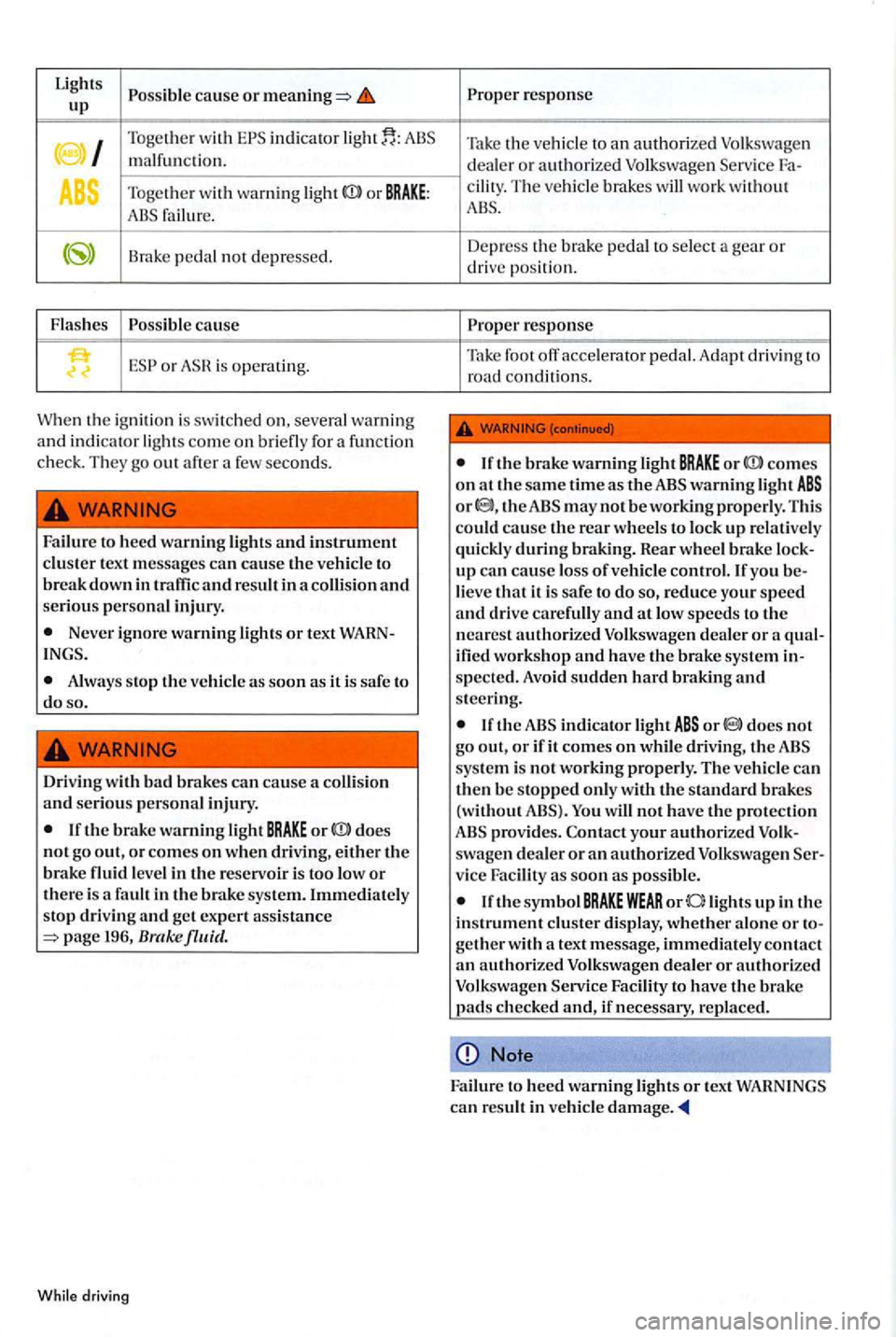
Lights cause or up
I
Together w ith indicator
m alfun ction.
T oge th
er with warning light
cause
or is opera ting.
W hen the ig nition
is sw itched on,
light s and instrument cluster text messages can cause the vehicl e to
break down in traffic and result in a collision and serious personal injury.
Never ignore warning light s or text WARN
Always stop the vehicl e as soon as it is safe to
do so.
Driving
with bad brake s can cause a collision and serious p ersonal injury .
does
not go out, or co mes on w hen driving, either the brak e fluid leve l in the reservoir is too low or there is a fault in the brake sys tem. Immediately
s top driving and get expert assista nce
response
Take the veh icle to an authori zed Volkswage n
d ealer or authori zed Volkswagen Service Fa-The ve hicl e brake s will work without
response
foot off accelerator pedal. Adapt driving to road conditi ons.
If the brake warnin g light BRAKE or co mes on at the same time as the warning light or th eABS may not be working properly. Thi s
could cause th e rear whee ls to lock up re latively
quickly during braking. Rear wheel brake lock
u p can cause loss of veh icle control. If yo u be
lieve that it is safe to do so, reduce your speed and d ri ve carefully and at low speeds to the neares t authorized Volkswagen dealer or a qual
the indicator light or does not go out , or if it comes on driving, the sys tem is not workin g properly. The vehicle can th en be stopped onl y with the standard brake s
(wi thout ABS). w ill not have the protection provides. Contact your authorized Volk
swage n dealer or an authorized Volkswagen vice Facility as soon as possib le.
lights up in the
in strument cluster display, whether alo ne or to gether with a te xt message, immediately contact an authorized Volkswagen dealer or authorized Volkswage n Facility to have the brake pad s ch ecked and, if necessary, replaced.
Note
Failure to heed warning lights or text WARNINGS can re sult in vehicle damage
Page 192 of 541
first read and note the imrod uctory
on pag e 188.
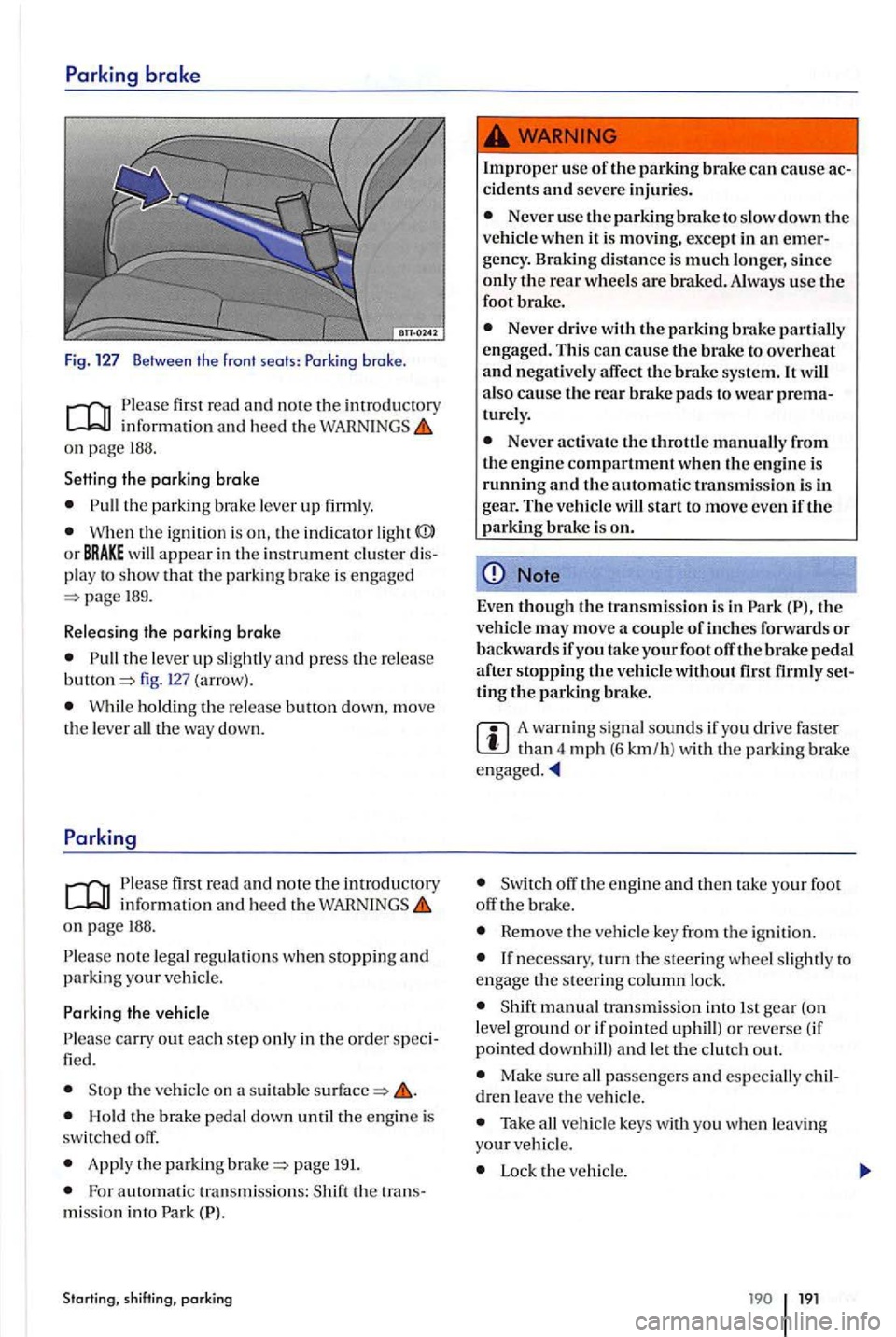
Setting the parking brake
the parkin g br ake lever up firml y.
Wh en th e ignitio n is on, the in dicator light
189.
R e leasing the parking
brake
the lever up slightl y and press the release fig. (arrow).
W hil e ho ldin g th e re lease butt on down, move
t h e leve r all th e way down.
info rmatio n and hee d th e on page 188.
n o te lega l regulations when stopping and parking your veh icle.
th e vehicle on a suitabl e
Hold th e brak e pedal dow n until the engin e is
switc h ed off.
App ly the parking page 191.
Fo r a utomatic tra nsmiss ions: th e tra ns
mi ssio n in to Park
Starting, shift ing, parking
Improper use of the parking brake ca n cause ac cidents and seve re injurie s.
Never use the pa rkin g brake to slow down the ve hicl e when it is moving , except in an emer
gency . Braking distance is much longe r, since only the rear wheels are brak ed. Always use the
foot brake.
Never drive with the parking brake partiall y
engage d. Thi s can cause the brake to overheat and negatively affect the brake syste m. It also cause the rea r brake pads to wea r prematurely.
Never acti va te t he throttl e manually from
th e e ngin e compartment when th e engine is running and the automatic tra n smissio n is in gear. The ve h icl e w ill start to move eve n iftl1 e parking brake is on.
Note
Even t11ough the transmi ssio n is in th e
ve hicl e may move a couple of inches forward s or backwar ds if you take your foot off the brake pedal after s toppin g the vehicle without set
ting tl1e parking brake.
A wa rning sig nal sounds if yo u driv e faste r th an 4 mph (6 km/h ) w ith th e parking brake
off the engin e and th en tak e yo ur foot
off brak e.
Rem ove the veh icle ke y from th e ign ition .
manual transm iss ion in to 1 st gea r (on
l evel ground or if pointed uphill) o r re ve rse (if
point ed
Make sure all passengers and esp ecially children leave th e ve hicle.
Take all ve h icle keys with you w he n le a vin g your ve hicl e.
Lock the ve hicl e.
19 1
Page 194 of 541
Brake booster
Th e brak e boo ste r w ork s o
nly wh en the engi ne is
running . It increa se s th e forc e on the brake s above and beyond the pre ssure put on th e brake pedal by
the driver.
If the brake booster is not working, or if th e ve hicl e
ha s to be towed, you have to push th e brak e
p ed a l hard er to make up for the lack of booster
New brake pads do not provide maximum braking performance.
New brake pads do not have the best ping power for the first km) and must be You can compensate for the slightl y reduced braking force by putting more pressure on the brake pedal.
Drive with
Never follow otl1er vehicles too closely or put yourself into other sit uation s that might require sudden, hard braking ,especially when the brake pads have not been broken
Overheated brakes
When driving downhill , the brakes have to
work es pecially hard and heat up quickly.
Before driving downhill, es peciall y on th at are long or steep, alwa ys reduce s peed and shift into lower gear (manual or automatic
transmission) so that the engine he lp s to brake
the vehicl e. Othenvise, the brake system cou ld
ov erheat and pos sibly u se the brakes
w hen yo u need them to slow the v ehicl e down
m ore or to stop.
A damaged front spoiler or a non- standard spoiler can reduce airflow to the brakes and
Starting, shifting, parking
Wet brakes or brakes witl1 icc or road salt
react slow er and n eed lo n ger stoppin g tances.
Ca refully apply the brakes to test th em.
Always dry brak es and clean off ice and salt
coat ings with a few cautious
tions permit.
Driving when the booster is no t working
in creases stopping distances and can cause dent s and seriou s personal injuries.
Never le t the vehicl e coast when the en gine is
switc hed off.
If the brake booster is not working (such as
w he n the vehicle is bein g towed), a lot more pedal force is needed to slow down and stop.
Note
Neve r the by keeping your foot on the to brak e.
Constant pressure on the brake pedal can make th e brakes overheat. This sub stantially reduce
braking performance, increase stopping di stan ce, and can cause co mpl ete failure of th e brake
s y stem.
Before driving downhill, especially on that are long or steep, always reduce speed and shift into lower gear (manua l or automati c
When th e front brake s are serviced , you should have the rea r brake pads inspected
rized Volksw agen deal er or au th orize d Volkswa gen
Service Facility vis uall y insp ec t th e pads through
th e o pe nin gs in the wh eel rim s or from nea th tl1e ve hicle. If n ecess ary, the wheels ca n be
t ake n off for a mor e thorou gh
192 193
Page 198 of 541
the info rm ation on the co ntainer for the brake fluid you want to use to
mak e sure it meets th e requirem ent s for your hicl e.
A ppro priat e brak e fluid can
be purchased from your authorized deal er or authori zed Facility.
Brake fluid level
The fluid
level in the transparent brake fluid voir must always be betw een th e MIN and MAX
some vehicle s, eng ine components blo ck th e
v iew of th e brake fluid reservoir and make it po ssibl e to see the brake fluid level. I f you cannot clearl y see the brake fluid leve l in the brake fluid reservoir, please see an authoriz ed deale r or authorized Facility.
The brake fluid level drop s slightl y when the hicle is being use d becaus e the brake pad s wea r
down and the brak es automatically adjust to thi s.
Changing brake fluid
Brak e fluid
must be changed a ccor ding to the
thori zed
Brake failure and reduced brake performance can be caused by not having enough brake fluid
in the reservoir or by old or incorrect brake fluid.
change brake fluid according to the service schedule in your Warranty and
lock reduces braking
standard 4925 another brake fluid can
standard 50114, 116 4 or 4925 4, do not use it.
The brake fluid must be new.
Always make sure that only the correct brake fluid is used. the container does not say that the brake fluid complies with standard 4925 4, do not use it.
Brake fluid is poi sonous.
To reduce the risk of poisoning, never use food, beverage or other non-original containers
to store brake fluid. might be misled
by the label on th e non-original container, or by the shape of the container, and drink the brake
fluid. This could occur even if you re-label the container as
dren.
Note
Brake fluid
Brake fluid can pollut e the en vironment.
196 197
Page 204 of 541
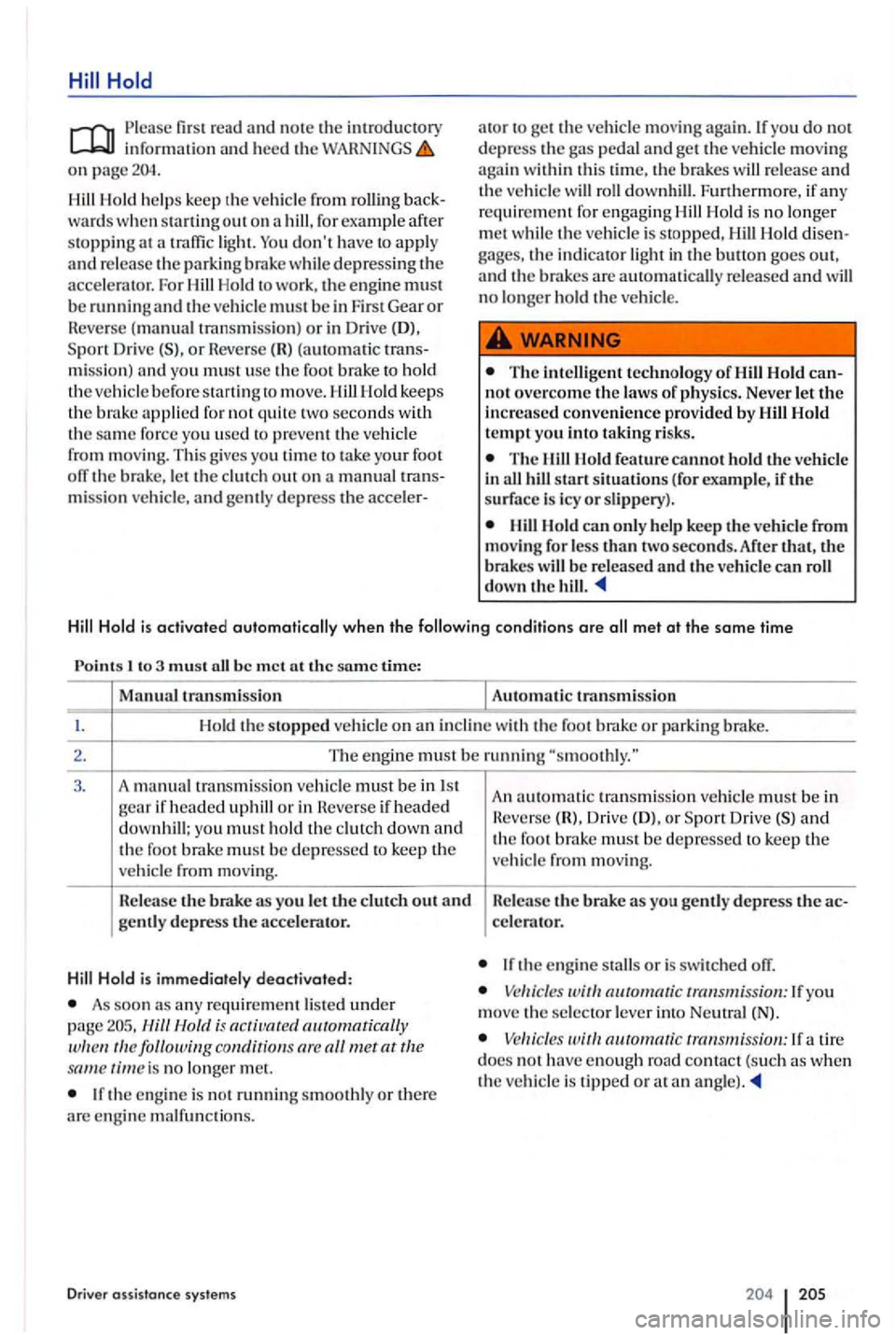
first r ead and n ote th e introducto ry in forma ti o n o n page
Hill Hold help s keep th e vehicl e from rollin g back
w ard s w hen sta rtin g out on a hill , for example aft er
s topping at a lig h l. don 't h ave to appl y
and r e le ase the parkin g brak e whi le dep re ss in g the For Hill Hold to work . th e e ng in e m ust
b e runni ng and the veh icle mus t b e in First Gea r or R eve rse (m anual tran smissio n) o r in Driv e (DJ. Dri ve (S), o r Reve rse (R) (a utomatic trans
mi ssion) and yo u must usc the foo t b ra ke to ho ld
th e ve hi cle befo re
force yo u u sed to pre ve nt the ve hicl e
from moving. This g ives you tim e to take your foo t
off the brake, le t t h e clu tc h out on a m anual t ran s
m ission ve hicle . and gently depress the acc ele r- a
to r to
p edal and ge t the ve hicl e moving
a ga in w ithin this time, the brake s will and the ve hicle will roll downhill. Furtherm ore , if re qu ire m en t f or e nga gin g Hill Hold is no lo nge r
m et while the vehicle is s toppe d, Hill Hold di sengages, the in dicator light in the butto n goes out,
a nd the brakes are automatically re leased and will no lo nge r h old the ve hicl e.
The intelligent technolo gy of
The llillllold feature cannot h old the ve hicl e
in all start situ ations ( for example, if the
surface is icy or s lip pery ).
Ho ld can only help keep the ve hicl e from mov ing fo r l ess than two seconds. Af te r tha t, the
b rakes be re lease d and the ve hicl e can roll
d ow n the hill .
Hill Hold is activated outomoli colly when the following conditions ore all met at the some tim e
I to 3 mus t b e m et a t the sa m e time:
M
anua l tran smissio n Automatic transmission
H old the stoppe d ve hicle on a n in cline w ith th e foot brake o r park in g brak e.
2.
3.
The e ngine must be run ning
if uphill o r in Revers e if headed
d o w nhill; you must hold th e clutch down and the foo t brak e must b e d ep ressed to keep th e
ve hicle from mo ving.
R elease the brake as yo u let the clutch out an d
g e ntl y de press the accelerator.
Hill Hold is imm ediat ely deactivated :
As soon an y re qu ire m en t liste d unde r page is a cti ua te d auto matically follo win g con d itio ns ar e time is no longe r m el.
If the engin e is not runnin g smoothl y or there
a rc e ng in e malfun ctions.
D river assista nce systems
A n autom atic transmissio n ve hicle must b e in
H e vc rse (R). Dr iv e (D ), or S po rt Drive ( S) and th e foot brak e m ust be d epresse d to keep the
ve hicle from movin g.
R el
ease the brake as yo u gentl y depress t11e celc rnt or.
If th e e ng in e s tall s or is swi t c he d off.
Vehicles ruitl1 automatic If you m ove the selector lever i nt o N eutral (N).
Vehicl es autom ati c tran smission: If a tir e docs no t h ave eno ug h ro ad contac t (s uch as w hen the ve hicle is tippe d or at an
Page 213 of 541
Introduction
th is section yo u'll fin d inform ation on the followi ng:
Warning ond indica tor lights . . . . . . . . . . . . . . . . . . 215
Cruise control operation . . . . . . . . . . . . . .
h elps maint ains
an indiv idually s tored con stan t sp ee d w hen
d ri vin g above 12 mph (km /h).
Th e
More information:
page 179
Parts, acce ssories. repa irs an d modificat io ns page 303
Using the cruise control when it is not possibl e
t o drive safely at a constant speed can b e dan
gerous
Never use cruise control when dri ving in
h eavy or varying traffic or when you cannot keep
a safe distance betwe en you and the ve hicle s ahead of you. Never use cruise contro l on ste ep , winding, or slippery roads (s uch grav el roads, wet roads, or sno\vy or icy road s) or on road s with standing
wat er.
Never use cruise control when driving off
road or on unpave d road s.
Always adjust your speed and the di stance yo u keep betwe en you and the vehicles ahead of you to the weather, and vis ibility condition s.
To he lp prevent unintended operation of crui se control , switch the s y stem off when it is not
It is dange rous to use the Resume feature
wh en th e prev iously set speed is too high for the exis ting traffic, or weather condi tion s.
When traveling downhill , tJ1e cru ise control may no t b e a ble to maintain a cons tant sp eed .
Th e vehicl e will spe ed up b ecause of it s o wn
weight. Downshift and/or usc the foot brake to
s low the ve hicle.
When travelin g downhill , the crui se control may not be able to a constant speed.
The vehicle may speed up b ecause of it s own
weight . Dow nshift and/or u se the foot brak e to
s lo w the vehicle.
Page 219 of 541
Tire Pressure Monitoring System (TPMS)
this section you'll find informati on on th e lowing:
. . . . . . . . . . . . . . . . . . . . . . . . . . . . . . . . . . . . . 221
Monitor ing System
Monito ring Sys te m indirectly c hecks the tire pressure of all
f our tires while you are driving by us ing the lock Brake Syste m (ABS) sensor s to monitor the
tr ea d circumf erenc e and vibration ch arac te ris tics of the indi vidua l tir es. warns if there is a nifi cant loss of pres sure in one or more tires while
the vehicl e is mo vin g. loss is s ig nale d b y
the ind icato r light as by an aco usti c
wa rni ng and text warnin gs in the in strument clu ster di spla y if your ve hicle has an MFD. The
origina l b en chmark pre ssure is th e recommended
m axi mum load cold tire inflati on pressure for the tire s that come with your vehicle that is lis te d on
th e tire pressure lab el on the dri ver door pill ar. By press ing the Reset button , yo u can ch ange the
b enchmark pressure to match th e c urr ent pressure of the tir es on you r page 222.
use of the Heset butto n i s explained below 222.
More informa tion:
page 137
Bra king, stopping and page 188
Ext e rior care an d page 262
page 276
pa ge303
Whil e driving
An acoustic warni ng sounds th e first time low tire pressure is detec ted. a system
Improp er tire care can cause sudden tire sure loss,
hicle control, accidents, and serious personal
injury .
tire inflation pressure regularl y when the tires are cold and alway s maintain the scribed tire pressure . Low tire pressure can cause tires to get too hot, res ultin g in tread ration, sudden lo ss of pres sure, and blowout s.
Thi s is because tires with excessively low
sure undergo more flexi ng, which can cau se the tir e to overheat and destroy the tire.
Always maintain correct cold tire inflation pressure as listed on the tire pressure label
Check tire inflation pressure regularl y when the tires are cold. Adjust tir e press ure in the cold
tir e to the recommended tire pressure for t11e tires installed on your vehicl e as necessary.
Neve r exceed the permissi ble maximum speed and load rating of the tires on your hicl e.
Imprope r us e of the Reset button can cause the to give false warnings or to give no
warning des pite dangerou sly lo w tire pressure
page222.
Und er- inflat ion increases fue l con sumptio n and tire wear.
to ring Syste m.
bedde d in the tir e tre ad but have n o t penetrated
int o the body of tire
Driving on u npaved roads for an extended
The te lltal e
s h ows a malfunc tion but switch es orr if road dit io ns or th e drivin g sty le c han ges or if th e tio n is switch ed on and orr
Tire Pressure Monitoring System (TPMS) and reset button
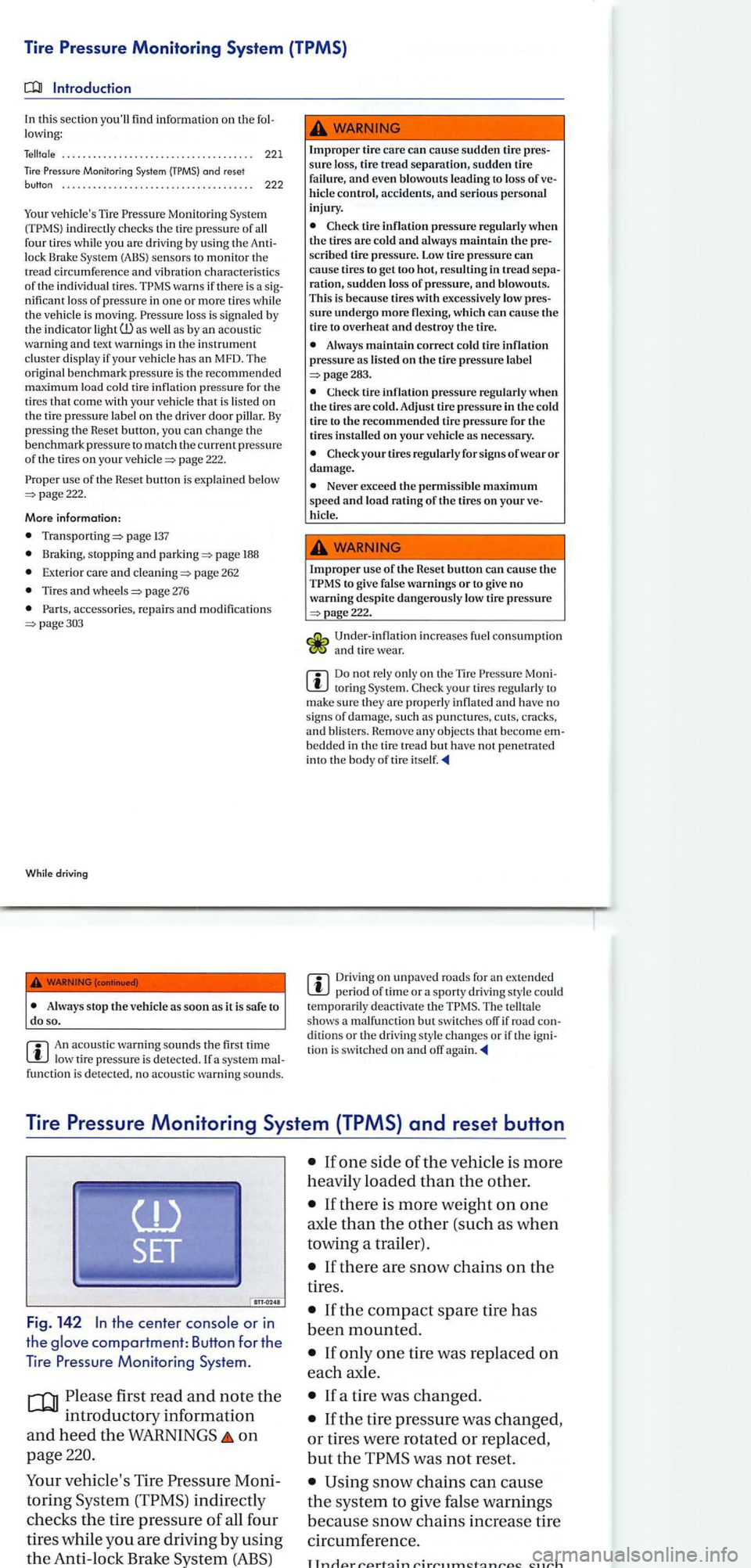
the center or in
the compartment: Button for th e
T
ire Pressure Monitoring System.
first r ead and note the
introductory informatio n
and heed the WARNINGS on
page
ve hicle's Tir e Moni
torin g
indirectly
c h ec ks
the ti re pressure of al l four
tire s while yo u are drivin g by us
ing
the Anti -loc k
If there is more weight on one
axle than the other (such as when
towin g a trailer) .
Page 235 of 541
Refueling checklist
first rea d an d note the introductory information and heed the on page 234.
The engi ne compartment of moto r vehicle is a haza rdous engine or in the engin e compartment unless yo u -know exac tl y how to carry o ut the job,
-have the correct technical in formation and the proper too ls and supplies, and -ar e familiar with the necessary safety precautions page 242, Preparation s for working
have the work done by an authorized Volkswagen dealer or authorized Volkswag e n Serv ice Facility. Ser ious personal injury may result from improperly perform ed work. Make
s ure that y ou check the followin g item s re gu larly. The bes t thin g is to check them every time you refue l:
Wind sh ie ld was her fluid leve l page 128
E ng in e oil leve l page 247
Engin e coolant leve l page 252
Brake fluid level page 188
Tire pressure page 276
Vehicle lighting necessary for drivin g safe ty:
-Turn signal s
-
li ghts, low beams and high beams
- Taillights
- Brak e light s
Inf
ormat ion regard ing changing light bul bs page 344.
While dri ving