warning VOLKSWAGEN GOLF PLUS 2004 User Guide
[x] Cancel search | Manufacturer: VOLKSWAGEN, Model Year: 2004, Model line: GOLF PLUS, Model: VOLKSWAGEN GOLF PLUS 2004Pages: 541, PDF Size: 98.86 MB
Page 33 of 541
identificatio n number (VlN)
Veh icle type, eng in e rating , tran smission
E n gine and tra nsm iss io n classificatio n cod es, pain t num ber, interior. In the exa mple,
3 1, fig.IO.
equipment, part num bers
Thi s ve
hicle data can also b e fou nd i n t he War ra nty
and Maintenan ce booklet.
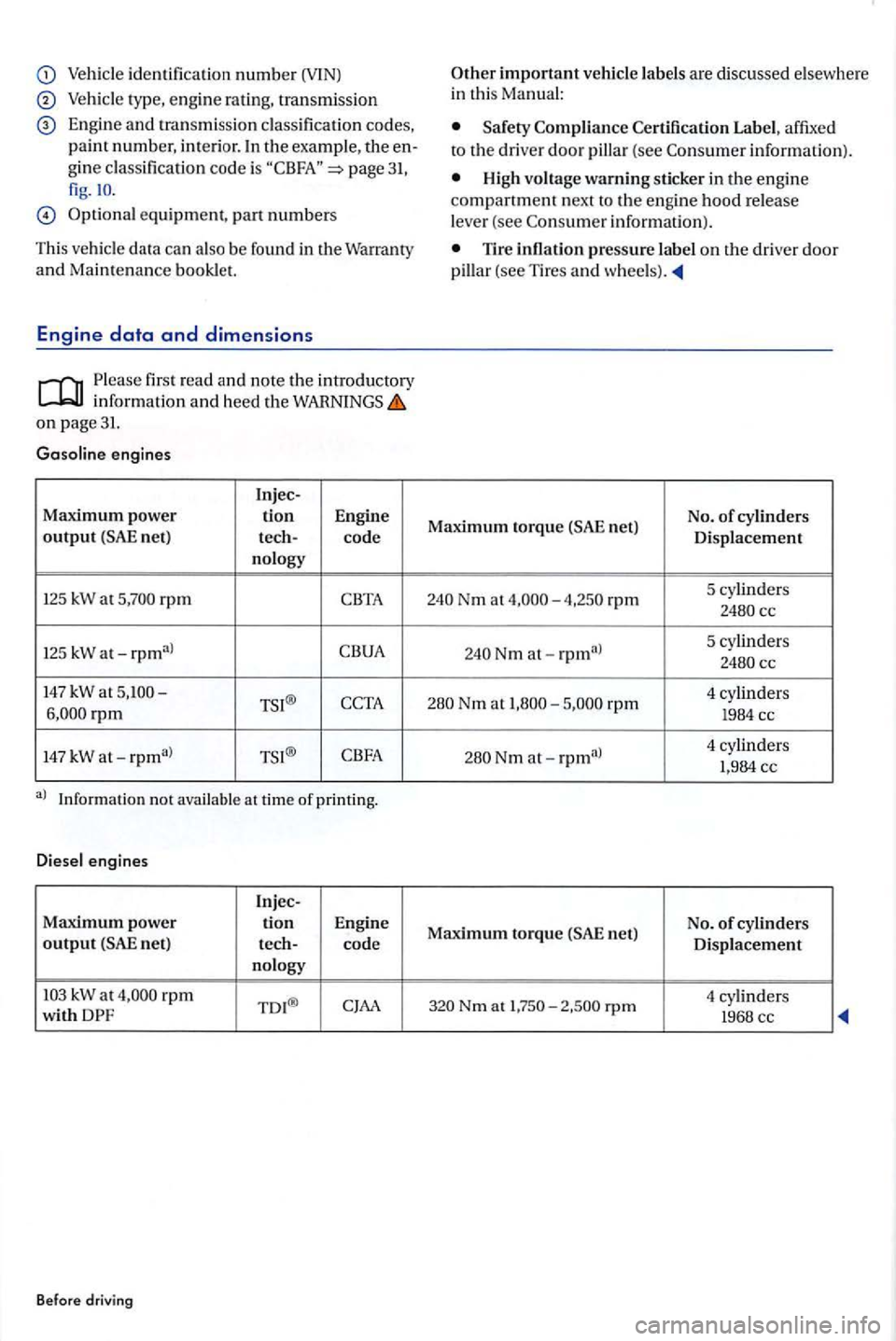
Engine data and dimensions
first read and note the in trod uctory inform ation and heed th e WARNINGS on page31.
G aso line engi nes
Injec -
Maxim um power
rp m
125 kW at-
147 kW at
kW at rpm T D I®
Before dri ving
Safety
i nfo rmatio n).
Hi gh vo ltage warning sticker in the en gin e compartment next to the eng ine hood r elease leve r (see in format ion) .
Tire infl ati o n pressure la b el o n th e driver door
pillar (see Tires and
Maximum torqu e net) N
o. of cy linders
Disp laceme n t
Nm at rpm 5 cy linders
5 cy linders
N m at-4 cylinders
1 ,984 cc
Max
imum torque n et) N
o. of cy lin ders
Di sp lacement
N m at rp m 4 cylinde
rs 196 8 cc
Page 44 of 541
Doors
Introduction
In thi s sec tion you'll find information on the fol
l owi ng:
Warning . . . . . . . . . . . . . . . . . . . . . . . . . . . . . . . 43
. . . . . . . . . .. . . . . . . .. . . . . . . . . . . 44
More information :
key page 34
page 38
E m erge ncy clos ing and 322
A
door that i s not closed properly suddenly when t h e ve hicle is moving and cause se
v ere injuries .
Make sure that th e door is safe ly and co m
p letel y la tc hed w he n closed. The closed door must be flush with the surrounding auto body parts.
or close doors only if n o one is in the way.
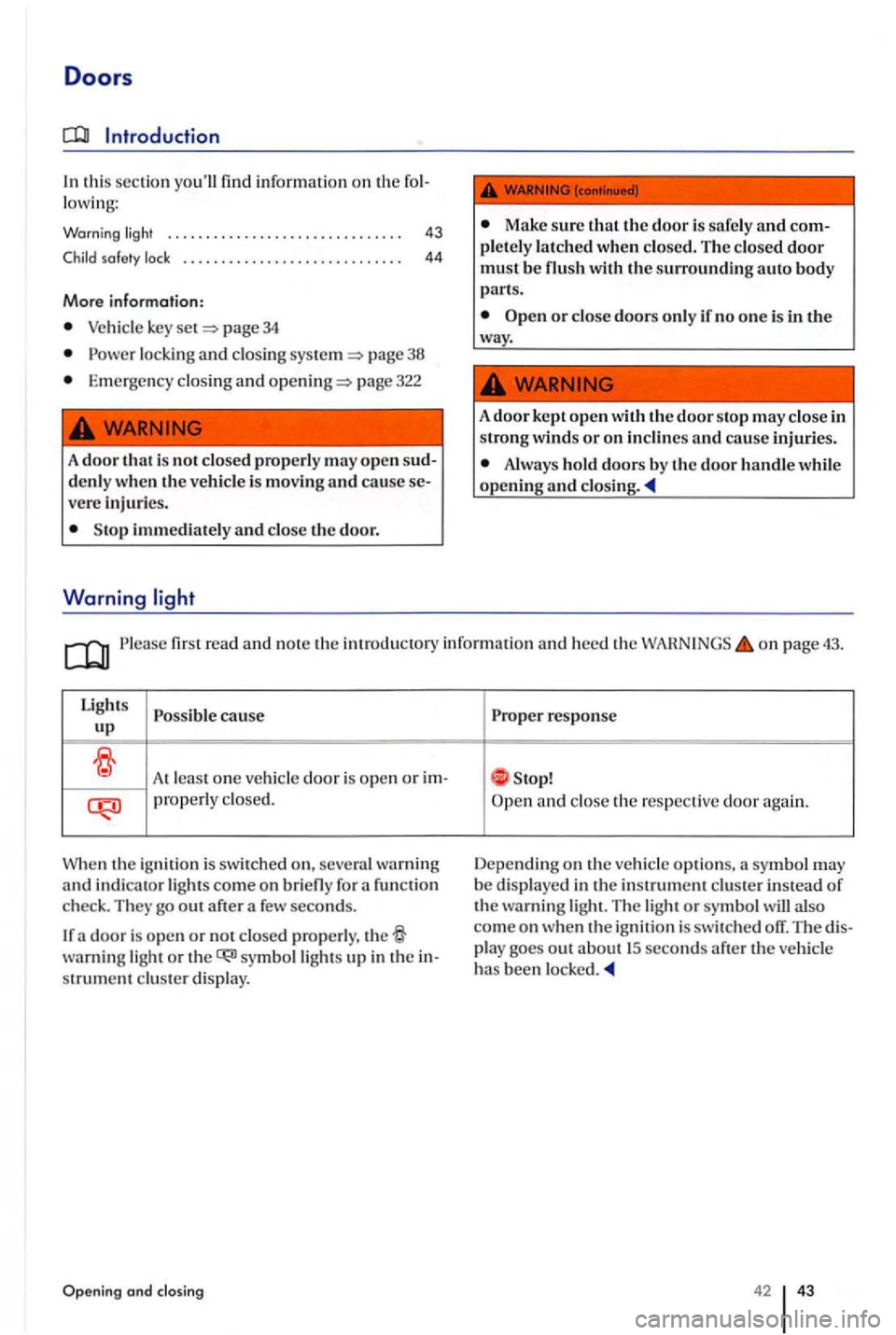
fir st read and note the introdu ctory information heed the on page 43.
Lig hts
cause up
At least one ve hicl e door is open or prope rl y closed.
Whe n th e ignit i
on is switched on, severa l warning and indicato r light s come on briefly for function
check. They
warning light or strument cluste r display.
Opening and
response
a nd clo se the respective door aga in.
Depending on the vehicle options,
42 43
Page 46 of 541
Rear hatch
this sectio n you'll find information on the following:
Warning light .............................. .
th e rear hatch .......•......... ......
Closing the rear hatch
More information:
Powe r loc kin g system page 38
page 137
Emergency closing and page 322
46
46
47
Improper or unsupervised unlocking, opening or closing of the rear hatch can cause accidents and severe injuries.
Never close the rear hatch by pushin g on the rear window with your hand. The rear window
could break and cause injuries.
After closing the rear hatch, always make sure that it is properly closed and locked so that it cannot open suddenly when the vehicle is moving. The closed rear hatch must be flu sh
with the surrounding auto body parts.
A lways keep the rear hatch closed while
driving to help keep poisonous exhaust gas from being drawn into the vehicle.
and closing
Never open the rear hatch when a luggage
rack is installed and load ed. for example,
there are bicycle s on a carrier on the rear it is possible that the rear hatch will not be able
to open automatically. An open rear hatch may fall on its own b eca use of the additional weight. The open rear hatch must be supported or the weight must be removed from the lu ggage rack
first.
Never leave your vehicle unattended or let
children play around your vehicle, especially
with the rear hatch left open. A child could crawl
into the vehicle and pull the rear hatch shut, becoming trapped and unable to get out. A closed vehicle can become very hot or very cold, depending on the season. in the summer, heat build-up in the passenger and luggage compartment of parked ve hicle can result in temperatures in the vehicle that are much higher than the outside temperatures. Temperatures can quickly reach levels that can cause unconsciousn ess and death, particularly
to small children.
Never leave children or anyone who cannot help themselves behind in the vehicle. They may lock the vehicle with the vehicle key or the power locking switch and lock themselves in.
Note
Before opening or closing the rear hatch, make sure there is enough room to do as for example when the vehicle has a trailer or is in a garage.
44 45
Page 47 of 541
Warning
Please fir st r ead and note th e introductory in rormatio n and heed the o n page 45.
Lights
Possible cause
u p
the ignition is sw itch ed on, several warning and indica to r ligh ts come o n brierly ror a ru nctio n
c h ec k. They go out a
the rear h a tc h is not clo se d prope rly . wa rnin g light in the i nstrumen t clu ste r o r the hicl e symbol in th e MFD comes o n showin g the ope n r ear hat ch .
D ep en d in g o n the ve hi
cle opti ons, a symbol m ay
b e di splayed in th e in strument clu ster in ste ad or
t h e warnin g lig h t. The ligh t o r symbol
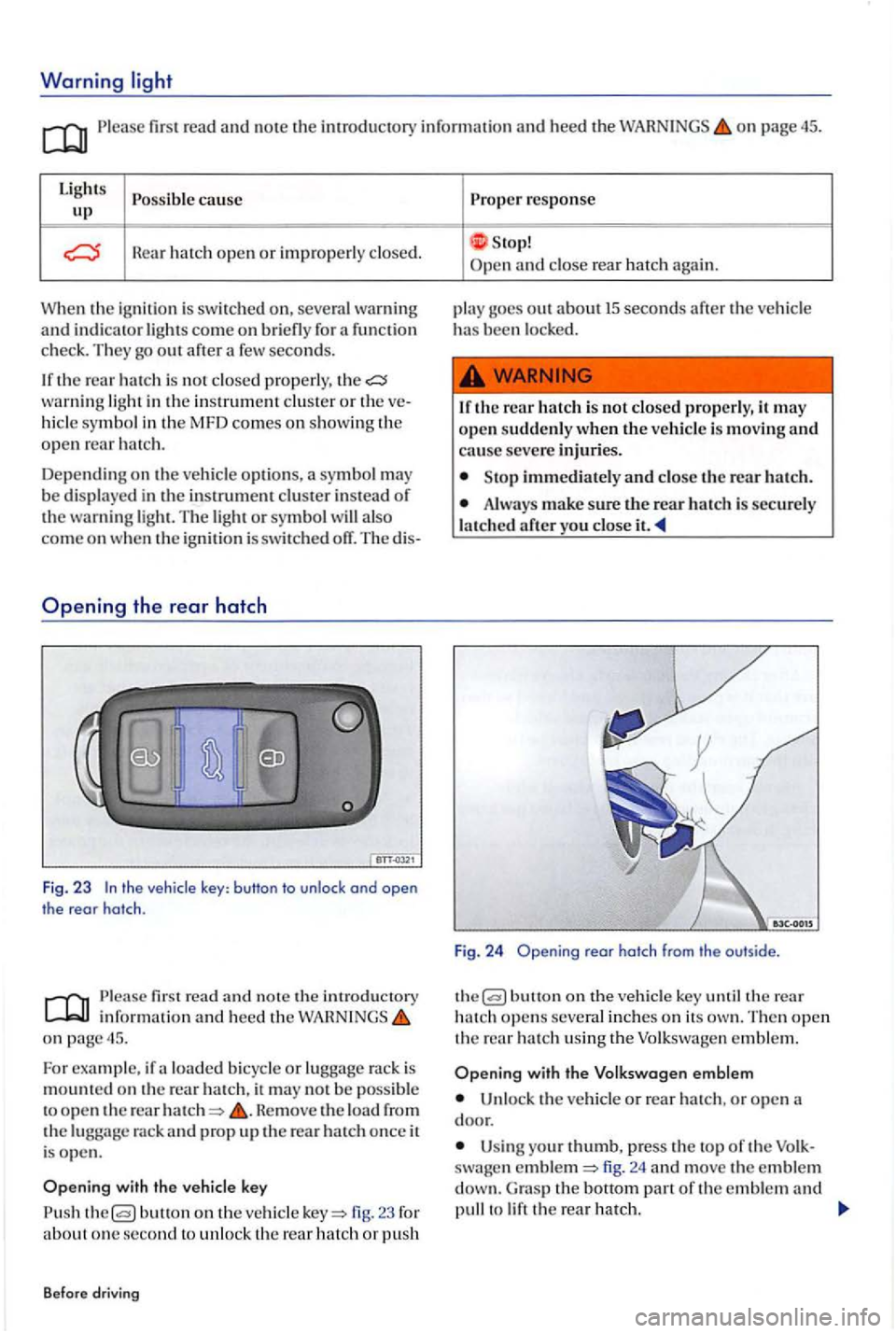
the vehicle key: button to unlock ond open
the rear hatch .
first read a nd n ote th e introducto ry inrorm atio n and heed t he o n page 45.
Fo r example, ir a lo ad ed b icy cle or lu gg age rac k is
m oun te d on the rear ha tc h , it m ay no t b e poss ible
t o o pe n th e rear He move the load rrom the rack and prop u p the rear ha tc h once it
i s ope n .
butto n on th e ve hicle 23 ror about o ne se cond to unl o ck th e re ar hatch or p ush
B efore dr
iving
Prope r response
S top! and close rea r hatc h again.
p la y goes o
ut ab o ut 15 seconds arte r the ve hicl e has been l ocke d.
1 r th e r
ear hatch i s not closed p ro perly, it m ay
o pe n sudde nly w hen the vehicle is movin g and cause seve re injuri es .
Sto p immedi ately and close t h e rear h atc h .
Alwa ys make sure the rear h atc h is sec u re ly
l a tc h ed
butt o n on the ve hicl e key th e rear hatch open s several in ch e s o n its The n open th e rear h a tc h usin g th e Volkswa gen e m ble m .
with the V olk swagen emblem
Un loc k th e ve h icl e or rear hatch , o r o pen
U sin g your thumb, p ress the to p or th e swa gen fig. 24 and move the e mble m G ra s p the bott o m part or th e e mble m and to
Page 48 of 541
Improper and unsuperv ised unl ockin g or openin g of the rear h atc h ca n cause severe ries.
bicycle or luggage rack is ins talle d on the rear hatc h , it may be h ard to se c that th e rear hatch I s unl atc h ed. An unlatch ed rear hatc h may
s ud whe n th e ve hicle Is
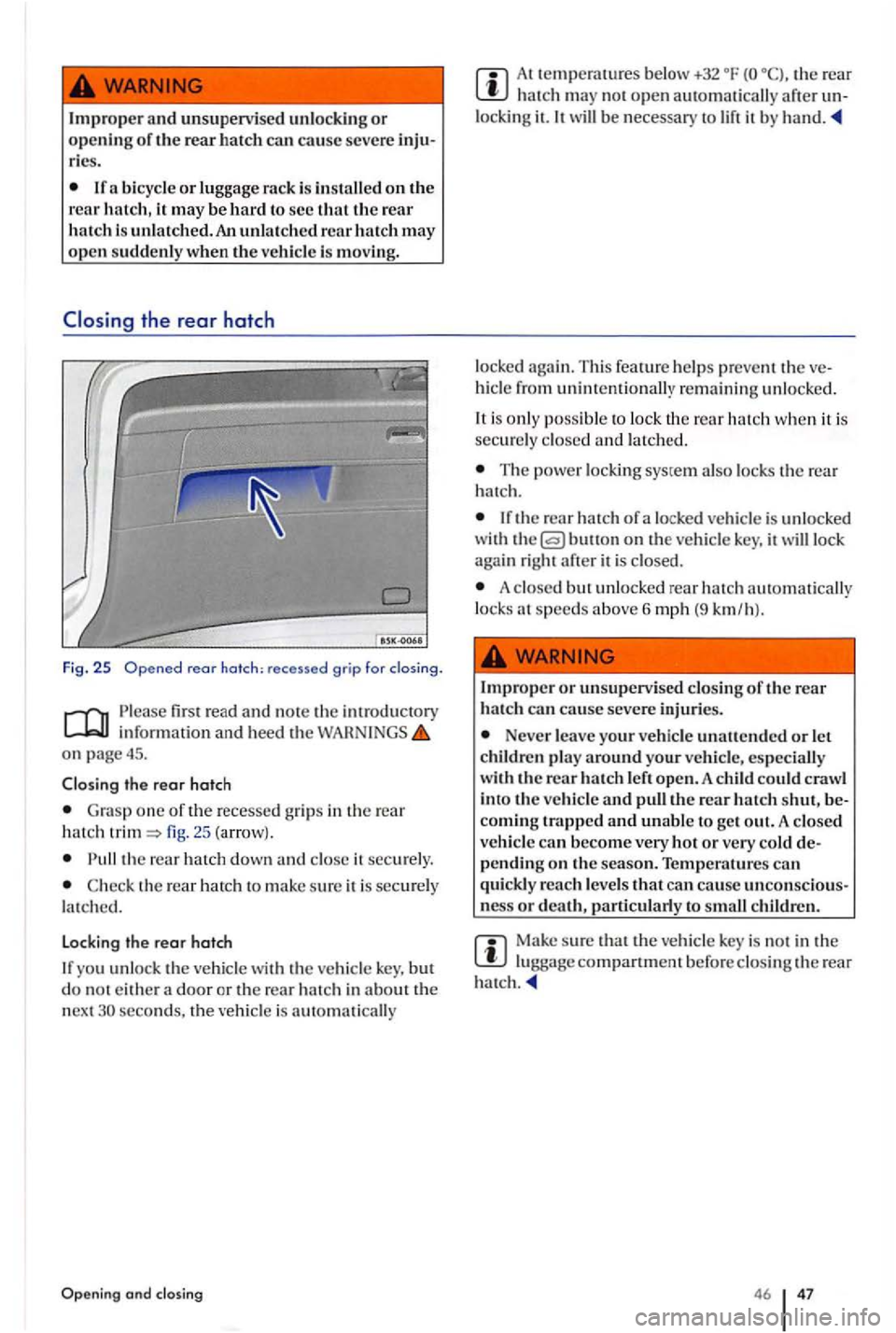
first read and note the introdu ctory informa tion and heed the WARNINGS on page 45.
Closin g t he rear hatc h
Grasp one of th e recessed grips in the rear h atc h fig. 25 (a rrow}.
th e rear hatch down and close it securely.
second s, the vehicle is au tomatically
and closing
At t emperatu res below +32 the rear hatch no t o pen automatically after
locked again. Thi s feature helps prevent the hicle from unintentionally re m ain ing unlocke d.
It is onl y poss ible to lock th e rea r hatc h when it is
secur ely closed and latche d.
The power locking system also locks the rear
h atc h.
If th e rear hatch of a locked vehicle is unlocked
w ith button on th e veh icle key, it will lock
agai n right after it is clo sed.
A closed b ut unlocked rear hatch automatically
l ocks at speed s above 6mph (9 k m lh}.
Impro pe r o r unsupervi sed clos ing o f th e rear
h a tc h ca n ca use seve re injuri es.
Never leave your ve hicle unan ended or l et
c h ildren pl ay around your ve hicle, especially
w ilh the re ar ha tc h l eft open. A child could crawl into the ve hicl e and pull the rear h atc h shut,
pending o n the season. Tempe ra tu res can
quickl y re ac h l evels that can ca use unco nscious-ness or death, to sm all child ren.
Make sure tha t compartment b e for e clo sing the rear
46 47
Page 59 of 541
Prope r sea ting posit ion
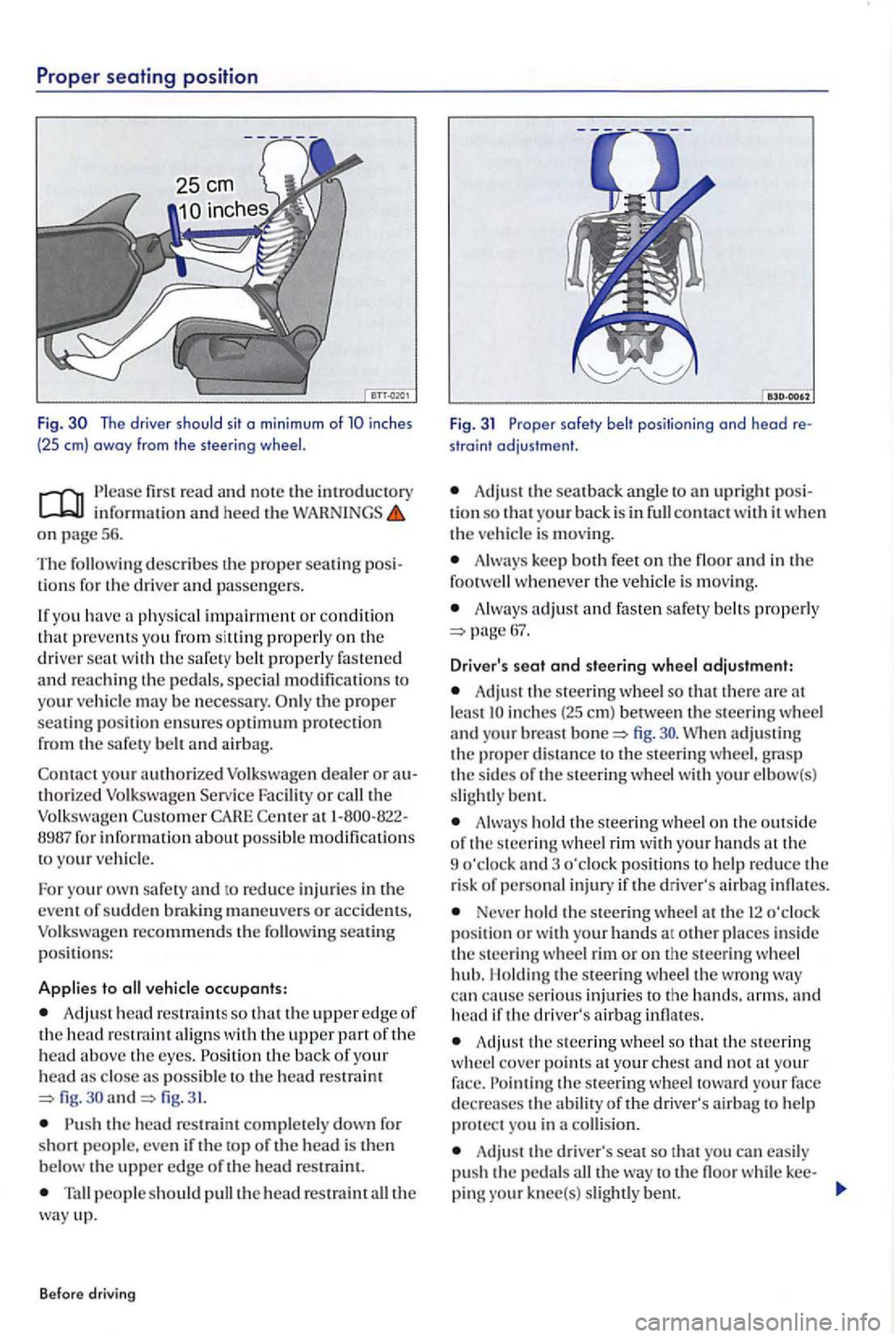
Fig. The driver should sit o min imum of inches
(25 em) away from the steering
first read and note the introductory information an d heed the WARNINGS on page 5 6.
Th e
describes th e proper sea tin g lio ns for the driver and passengers .
If yo u hav e
physical impairment or condition that preve nts you from siltin g properly on the driver wit h the safe ty belt properly fastened and re a ching th e pedals, special modificatio ns to
your ve hicle may be necessary. p roper seating positi on ensures optimum protection from the safety belt and airbag.
Con t
act yo ur authorized Volkswagen dealer o r authorized Volk swage n Serv ice Facility or the Volkswagen Custo m er CAHE Cente r 1-800-822-
8987 fo r informati on about poss ible modification s
t o your ve hicl e.
F o r yo u r
own safety and to reduce inj urie s in the
event of sudde n brakin g maneuve rs or accid ents, Volkswagen recommends the seating p o siti ons:
Applies to vehicle occupants:
Adj ust head re straint s so that the upper edge of the head restraint aligns with the upper part of the head above th e eyes . the ba ck of your head close as poss ible fig. and fig. 31.
the head re straint completely down fo r
short people. eve n if the top of th e head is the n
b elow the uppe r edge o f the head re strai nt.
people s ho uld pull the head restraint the way up.
Before driving
Fig. 31 Proper safety belt positioning ond head re
straint adjustment.
Adjust the sea t back ang le to upri ght posi
tion so that your back is in conta ct w ith it w he n the vehicle is moving.
Alw ays keep both feet on th e floor a nd in the
foot whenever the vehicl e is mov in g.
A lway s adjust a nd fasten safety belt s pro perly
A dju st the steering wheel so that the re are lea st fig .
Always ho ld th e s teering wheel o n the out sid e
o f th e s teerin g wheel rim with your hands the
9 o'cloc k and 3 o'cloc k pos ition s to help re duce the
r is k of personal injury if the driver' s airb ag infl ates.
Never ho ld the steering wheel a t th e 12 o'clock position or w ith your hands at ot her places in side the steerin g wheel rim or o n the steerin g whee l
hub. l lo ldin g the steerin g w hee l the wro ng can cause se rious injurie s to the arms. and head if the driver's airbag infl ates.
Adju st the s teerin g wheel so that the s teerin g
w heel cove r points the ste erin g wh ee l toward your face
d ecrea ses the abilit y of the driver's airba g to help protect you in a collision.
Adju st the driver's seat so that you can easily
pu sh the pedal s the way to th e floo r while kee-
pin g knee(s) slightl y bent.
Page 61 of 541
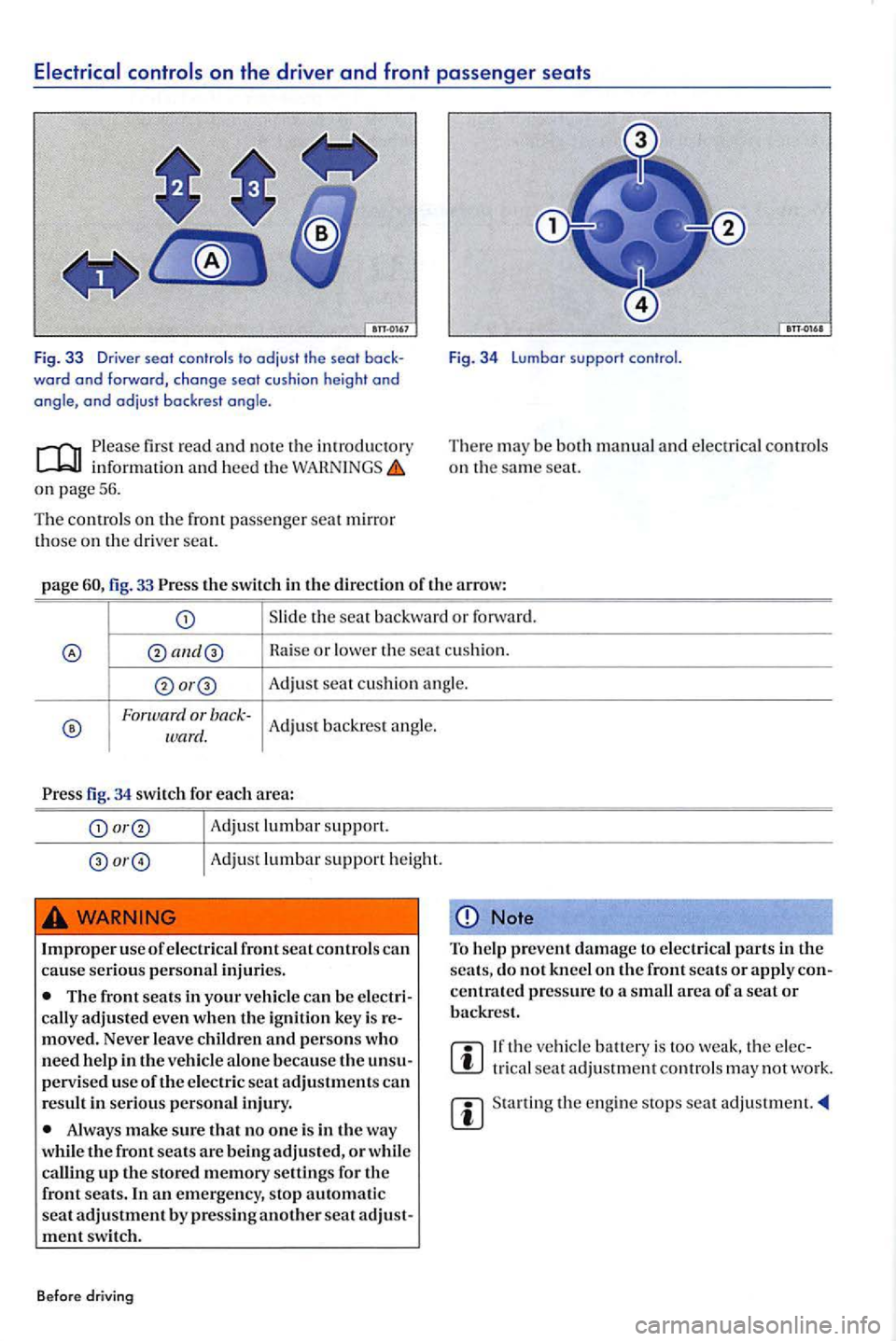
word and forward , change seat cushion height and angle, and adjust backrest angle.
first r ead and note the inf orm atio n and hee d t he WAH N INGS on pag e 56.
T he co ntrols
on f ront passe nge r seat mi rro r on th e driver se at.
F ig. 34 Lumbar su pport control.
T he re m ay be bo th manual and e lectri ca l controls
o n th e sa me seat.
page fig. 33 th e sw itch i n th e d irec tion of th e a rrow:
Slid e th e seat b ackwa rd or forw ard .
Haise or l owe r th e seat cu sh io n .
Adjust sea t c u shi on an gle .
Forw ard or bac k-Adju st b ack res t an gle. ward.
fig. 34 switch f or each area:
Adju st lumbar s upport .
Adjust l umb ar suppo rt heig ht.
WARNING
Im prope r use of e lec tr ica l front sea t control s ca n cause serio us pe rso nal inju ries.
T he front sea ts in your vehicl e ca n b e
moved. Neve r leave children and p erso ns w ho
need h elp in the ve hicl e alo ne beca use the p erv ise d u se oftheelec tric sea t adjustments can
re sult in seriou s personal inju ry.
way
w hil e the front seats are bein g adju ste d, o r w hil e
ca llin g up sto re d m em ory settings for the
fr ont seats . In an em erge ncy, sto p aut om atic
seal adjustment b y pre ss ing a nother seat
N ote
T o help prev ent damage t o e lec trical p arts in the
s ea ts , do no t kn eel o n the front seals o r a ppl y
tr ica l seat adju stm ent contro ls m ay not w ork.
th e e ng in e s to p s se at
Page 68 of 541
Safety
Introduction
this sec tion y o u'll find informatio n on th e lowing:
Warning light ................ .... .. , .. .. , . . . 68
F ro ntal collis ions and l ows of ph ys ics . . . . . . . . . . . . 69
Whot happens to passengers no t wearing a safety
b elt? . . . . . . . . . . . . . . . . . . . . . . . . . . . . . . . . . . . . . . .
. . . . . . . . . .
. . 7 5
Safety belt exte nder . . . . . . . . . . . . . . . . . . . . . . . . . . 7 6
Safety belt retractor , pre te nsio ner, load limiter . . . . 78
Serv ice and d isposal of belt prete nsioners . . . . . . . 78
th e co nditi on of all safe ry belt s re gul arly. If a
sa fe ty belt s h ows da m age to we bbin g, b in din gs,
r et rac tors or bu ckles, have the safe ty belt replaced
b y an auth orized Volkswagen deafer or an rized Volk swagen Service rized Volkswagen deale rs and authorize d sw age n Se rv ice Fa cilities
Adju stin g th e seatin g pos ition
A ir ba g page
safety and c hild page
erl y position ed safety belt increa ses th e risk of severe pe rsona l injury or death. S afety belt s
offer optimum protection only whe n they are
u sed pro perly.
Safety belt s are the singl e most effecti ve
m eans availabl e to reduce th e r is k of seriou s jury and dea th in automobil e accid ents. For
your protection and that of your passengers ,
hicl e is moving.
Sitting properly and safely
Every person in the vehicle must b e properly
seat ed on
for e the vehicl e starts to move, and must k eep the belt properl y fastened while riding in the hicle. This applie s to the drive r and all g ers, ev en when ju st dri ving around town.
Alwa ys secure children in the vehicl e with a
restraint s ys te m appropriate for their age,
weight and page
Never attac h the safety belt to the buckl e o f another seat. Attachin g the safety belt to the wrong buckle will reduce safe ty belt
Never le t any obje cts or liquids get into the
s a fety belt latch and pre v ent it from working
prop erly. Alway s keep the belts clean. Dirty belt s
m ay n ot work correctly and can impair the
Neve r remove a safety belt w hil e the ve hicl e
i s moving. Doing so will increas e your risk of being injured or kill ed.
Ne ve r strap more than one person, includin g
s mall child ren, into any single safety belt .
N eve r let children or ba bies ride sitting on your lap and never place
Several layers of heavy clothing may
Ne ver wea r belt s ove r rigid or breakabl e jects in or on your clothing, such as eye glas ses,
p ens, keys etc., as these may ca us e injury.
Never use comfort clips or device s that creat slack in tl1e shoulder belt. Howev e r, spe cial clips may be require d for the correct use of some
c hild restraint sy ste m s.
Always ke ep saf ety belt buckl es fre e of anything
that may prevent the buckle from la tchin g sec urely.
Safe ty belt s off er optimum protecti on only when th e scat b ack is upright and belts a rc correctl y position ed on th e body
66 67
Page 69 of 541
Damage to safety belt s reduces their ef
fectiven ess increase s the ris k of seriou s perinjury is
b ein g used.
Neve r safety belt s beco me damage d by
b ei ng caught in the door or seat hardware.
Torn or frayed safety te ar, and dam
aged safety hardware break in accident.
Warn ing
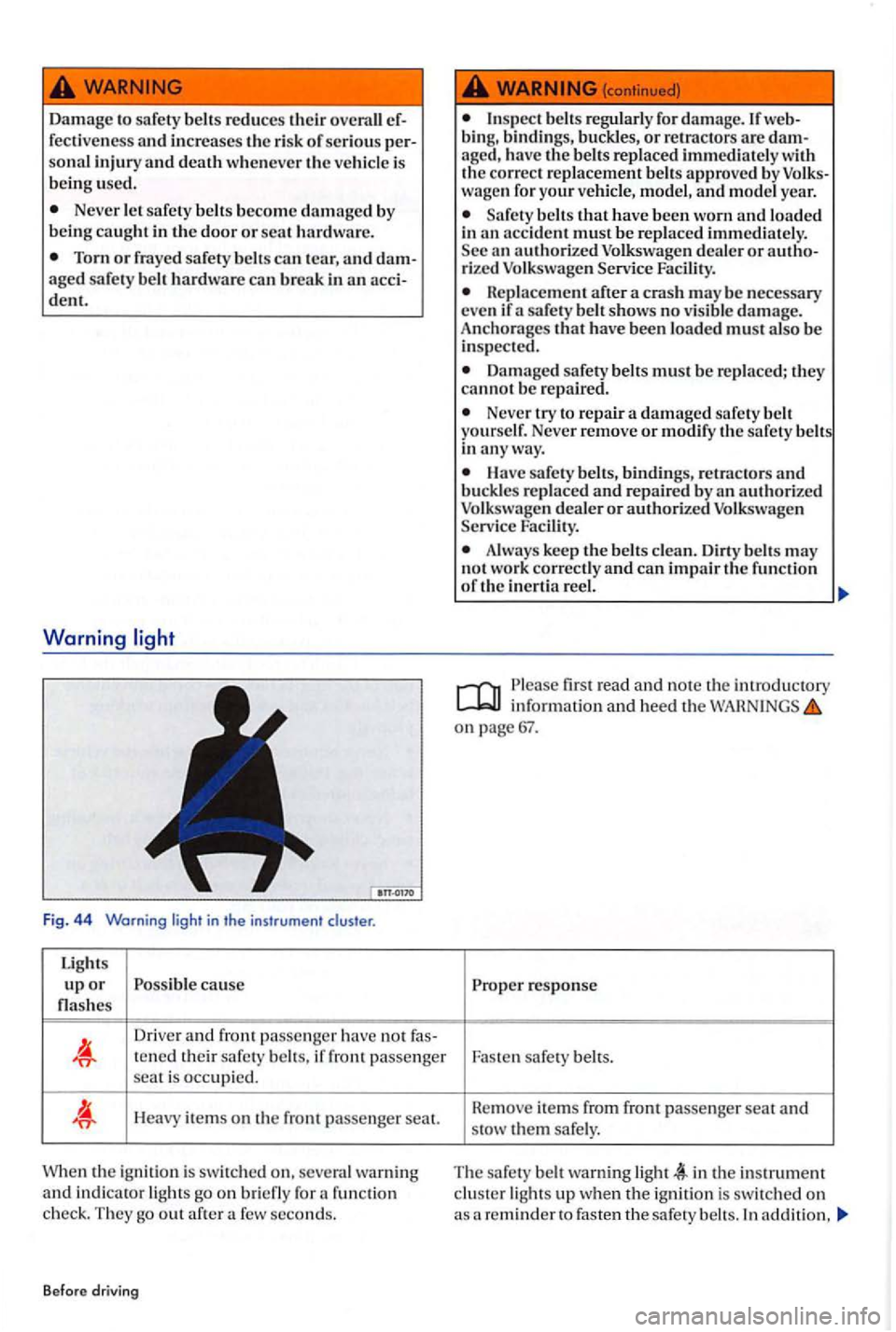
Fig. 44 Warning
Light s
u p o r cause
Driver and fron t pa sse nger have not fas-te n ed their safety if fron t passenger
sea t is occupied.
H eavy items on the front passenger seal.
the ignition is switched on. warning and in dica tor go on fun ction c he ck. They out after few seconds.
Before driving
for damage. If web
bin g, bindings, or re tra cto rs are damaged, have the approve d by wage n for your and year .
Safety that have bee n worn and in an accide nt must be
after a cras h may be nece ssary
eve n if safety sho ws no damage.
Anchorages that have been must
Damage d safety the y canno t b e re p air ed.
Neve r try to re pair a damage d sa fety Never remove or m odify th e safety
Have sa fety belts, binding s, retractor s and
or authorized Serv ice
k ee p the may
n ot work correct ly and ca n impair the function
o f th e in erti a
firs t rea d and note the introductory information and heed the on page 67.
Proper respo nse
Faste n safe ty
T he safety warning in the instrument
In add ition,
Page 70 of 541
you hear a warn ing chime. The warning light stop
when the driver and front passenger correctly fas ten their sa fety belts. If the safety belts have not been fastened when a speed of more than 15 mph is reached or if the safety be lts are unfastened
while the vehicle is moving , a warning chime for
up to seco nds. The belt warning light also
When the ignition is sw itched on, the warning
and of phy sic s
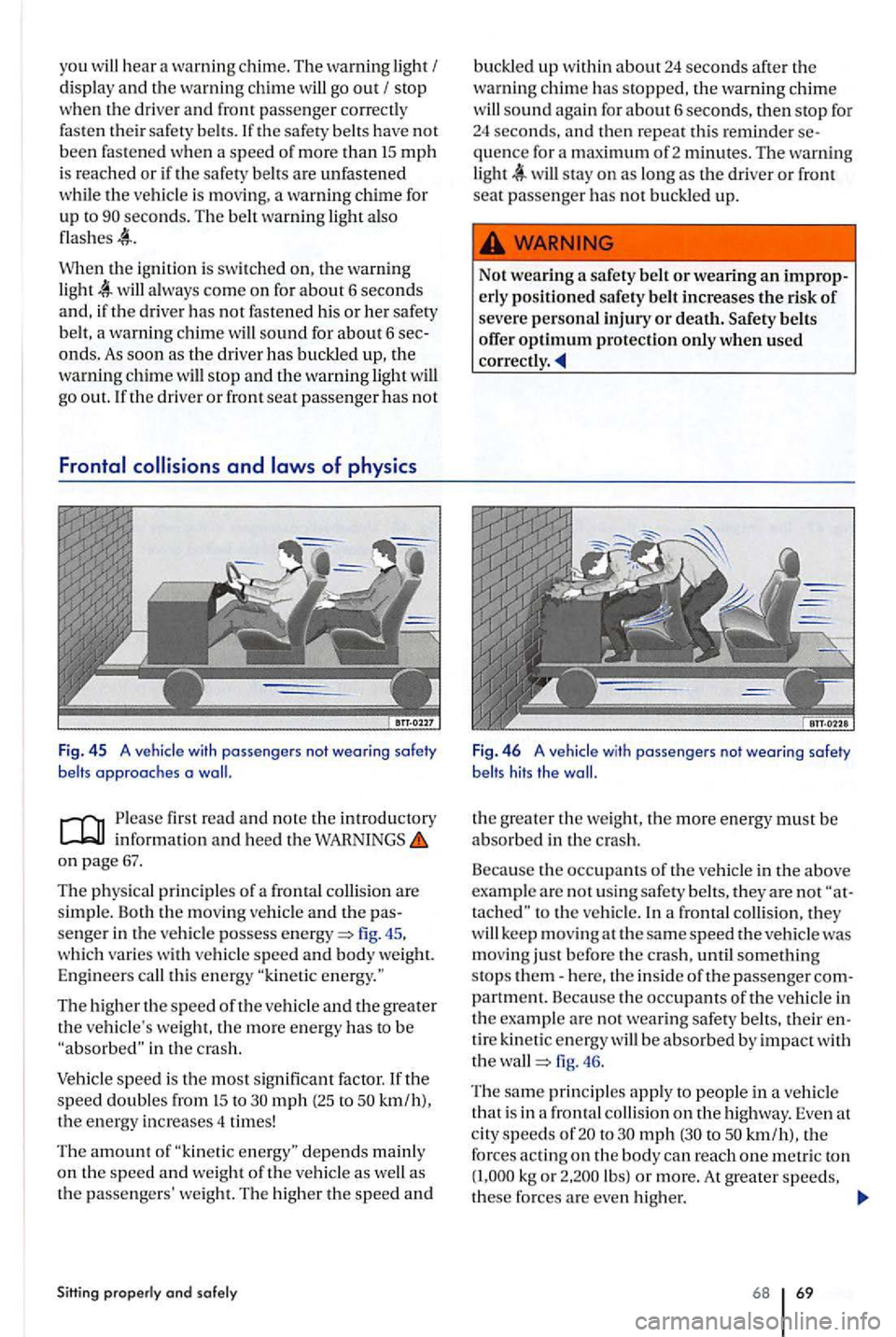
Fig. 4 5 A vehicle with passengers not wearing safety belts approaches a
on page 67.
The physical principles of a frontal
fig . 45.
which varies wit h vehicle speed and body weight.
Engineer s
The higher the speed of the ve hicle and the greater
the vehicle's weight. the more en ergy has to be in the cras h.
Vehicle speed i s th e most sig nificant factor. If the speed doubl es from to mph (25 to kmlh),
the energy increases 4 times!
The amount of as
the passengers' weight. The higher the speed an d
Sitting properly and solely
buckled up within about24 seconds after the
warn ing chim e has stopped, the warnin g chime sound again for about 6 seco nds, then stop for 24 seconds, and then rep eat this reminder sequence for a
Fig. 4 6 A vehicle with passengers not wearing safety
belts hits the
the greater the we ig ht, the more energy must be abso rbed in the crash.
Beca use the occupants of th e vehicle in the above
example a re not usi ng safety belts, they are not
kee p m oving at the same speed the vehicle was
mo vin g just before the crash, until somethin g
stops th em-here, the inside of the passenger com
partment. Because the occupants of the vehicle in
th e exa mpl e are not wearing safety belt s, th eir en
tire kine
tic energy be absorbed by impact with
the fig. 46.
Th e
same pri ncipl es app ly to p eople in a veh icle
th at is in a fron ta l
to mph to kmlh), the forces acting on th e bod y can reach one metri c ton kg o r lbs) or more. At grea te r speeds,
th ese forces are even hi ghe r.
68 69