brake VOLKSWAGEN GOLF PLUS 2004 Owner's Manual
[x] Cancel search | Manufacturer: VOLKSWAGEN, Model Year: 2004, Model line: GOLF PLUS, Model: VOLKSWAGEN GOLF PLUS 2004Pages: 541, PDF Size: 98.86 MB
Page 190 of 541
Note
Always be careful when you park in areas with parking barriers or high cmbs. These vary in h eigh t and could damage your bumper andrelated parts ifLhe front of your ve hicl e hit s a barrier or curb that is too high while you are getting into or out of a parking spot . To help prevent damage, stop before the tires of your vehicle touch a parking barrier or curb.
Warning and indicator
Note (continu ed)
Always be careful when you enter a driveway or drive up or down steep ramps or over curbs or obstacles. of the vehicle close to Lhe ground may be damaged (s u ch as bumper covers,
spoilers, and parts of the engine, suspen sion, and exhaust
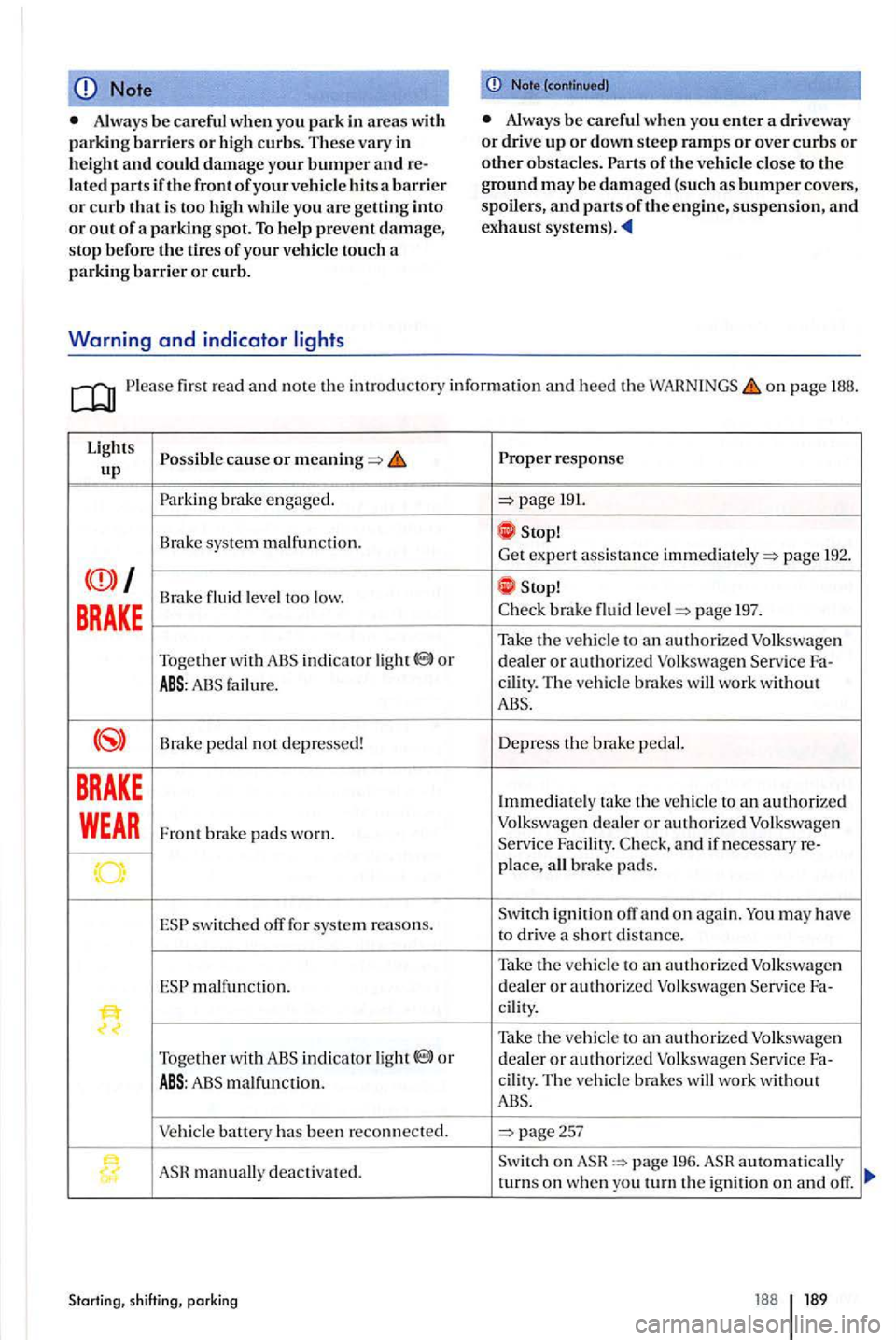
firs t read and note Lhe introdu ctory informat io n and hee d the WAHNINGS page 188.
Lig ht s
191.
Brak e syste m malfun ction. Stop!
Get
expert assi stance pag e 192.
Brake fluid leve l too low. Stop!
BRAKE brake fluid page 197.
Take the vehicle to an au thorized indicator light or dea ler or authorize d Volksw agen Service Fa-
ABS: failure. ci
lity. Th e ve hicl e brakes will work without ABS.
Brake pedal not depressed! Depress the brake
pedal.
BRAKE Immediate ly take the vehicle to an auth orized
WEAR Front brake pads wo rn. Volkswagen dealer or authorized Volk swage n
Serv ice Facility. and if necessary re-place, all brake pads.
switc h ed off for syste m r easo ns. Switch ignit ion off an d on again . You may have
to dri ve a short dis tan ce.
Take th e ve hicle to an authori zed Volksw age n malfunc ti on. dealer or a
uthorize d Volk sw agen Service Fa-cilit y .
Tak e the vehicl e to or d ea le r or a uthori zed Volksw agen Service Fa-
ABS:
page257
manually deacti va te d. S
witch on p age 196. a ut om atically
turns on w he n you turn the ig nition on and off.
Startin g, shift ing, parking 188 189
Page 191 of 541
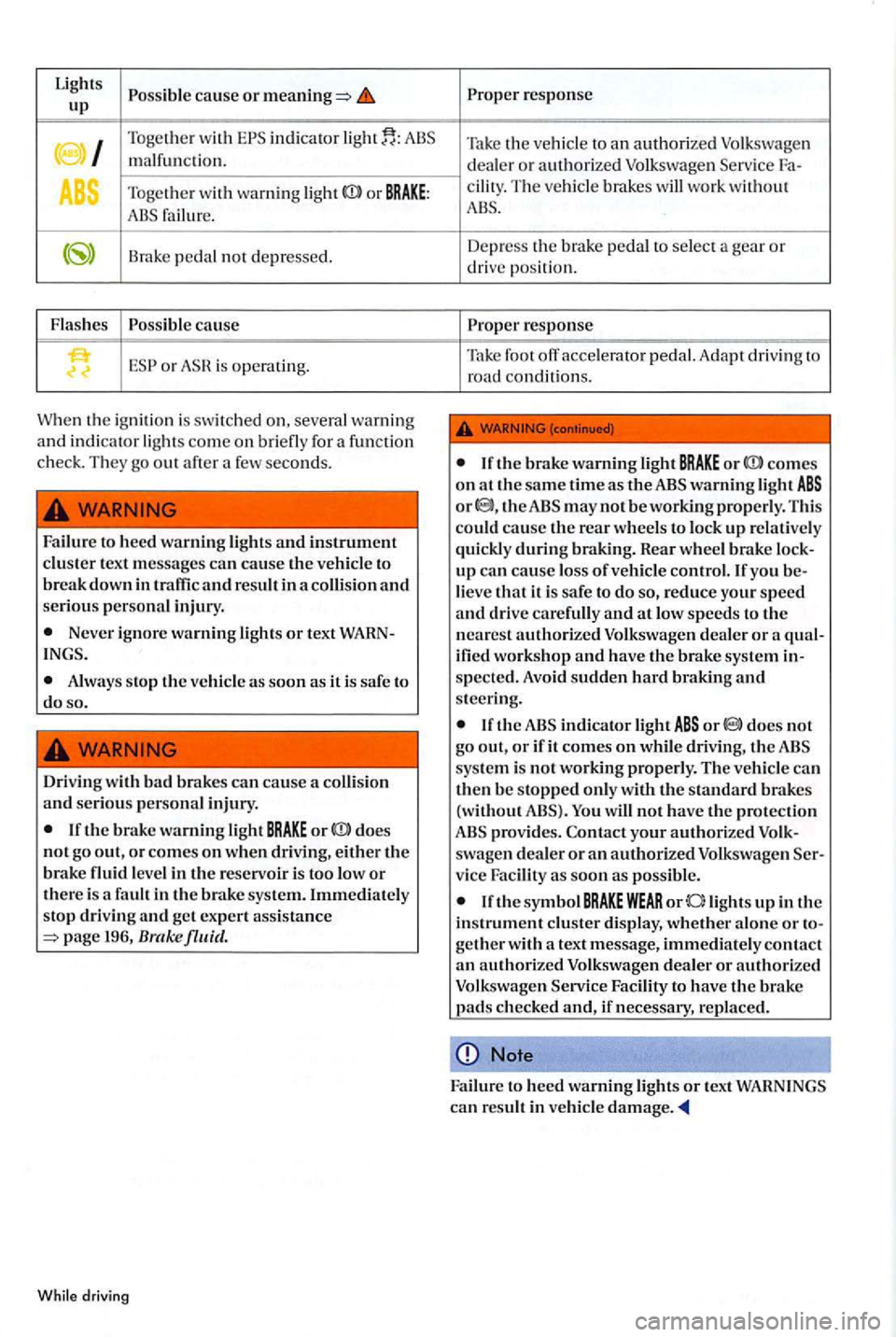
Lights cause or up
I
Together w ith indicator
m alfun ction.
T oge th
er with warning light
cause
or is opera ting.
W hen the ig nition
is sw itched on,
light s and instrument cluster text messages can cause the vehicl e to
break down in traffic and result in a collision and serious personal injury.
Never ignore warning light s or text WARN
Always stop the vehicl e as soon as it is safe to
do so.
Driving
with bad brake s can cause a collision and serious p ersonal injury .
does
not go out, or co mes on w hen driving, either the brak e fluid leve l in the reservoir is too low or there is a fault in the brake sys tem. Immediately
s top driving and get expert assista nce
response
Take the veh icle to an authori zed Volkswage n
d ealer or authori zed Volkswagen Service Fa-The ve hicl e brake s will work without
response
foot off accelerator pedal. Adapt driving to road conditi ons.
If the brake warnin g light BRAKE or co mes on at the same time as the warning light or th eABS may not be working properly. Thi s
could cause th e rear whee ls to lock up re latively
quickly during braking. Rear wheel brake lock
u p can cause loss of veh icle control. If yo u be
lieve that it is safe to do so, reduce your speed and d ri ve carefully and at low speeds to the neares t authorized Volkswagen dealer or a qual
the indicator light or does not go out , or if it comes on driving, the sys tem is not workin g properly. The vehicle can th en be stopped onl y with the standard brake s
(wi thout ABS). w ill not have the protection provides. Contact your authorized Volk
swage n dealer or an authorized Volkswagen vice Facility as soon as possib le.
lights up in the
in strument cluster display, whether alo ne or to gether with a te xt message, immediately contact an authorized Volkswagen dealer or authorized Volkswage n Facility to have the brake pad s ch ecked and, if necessary, replaced.
Note
Failure to heed warning lights or text WARNINGS can re sult in vehicle damage
Page 192 of 541
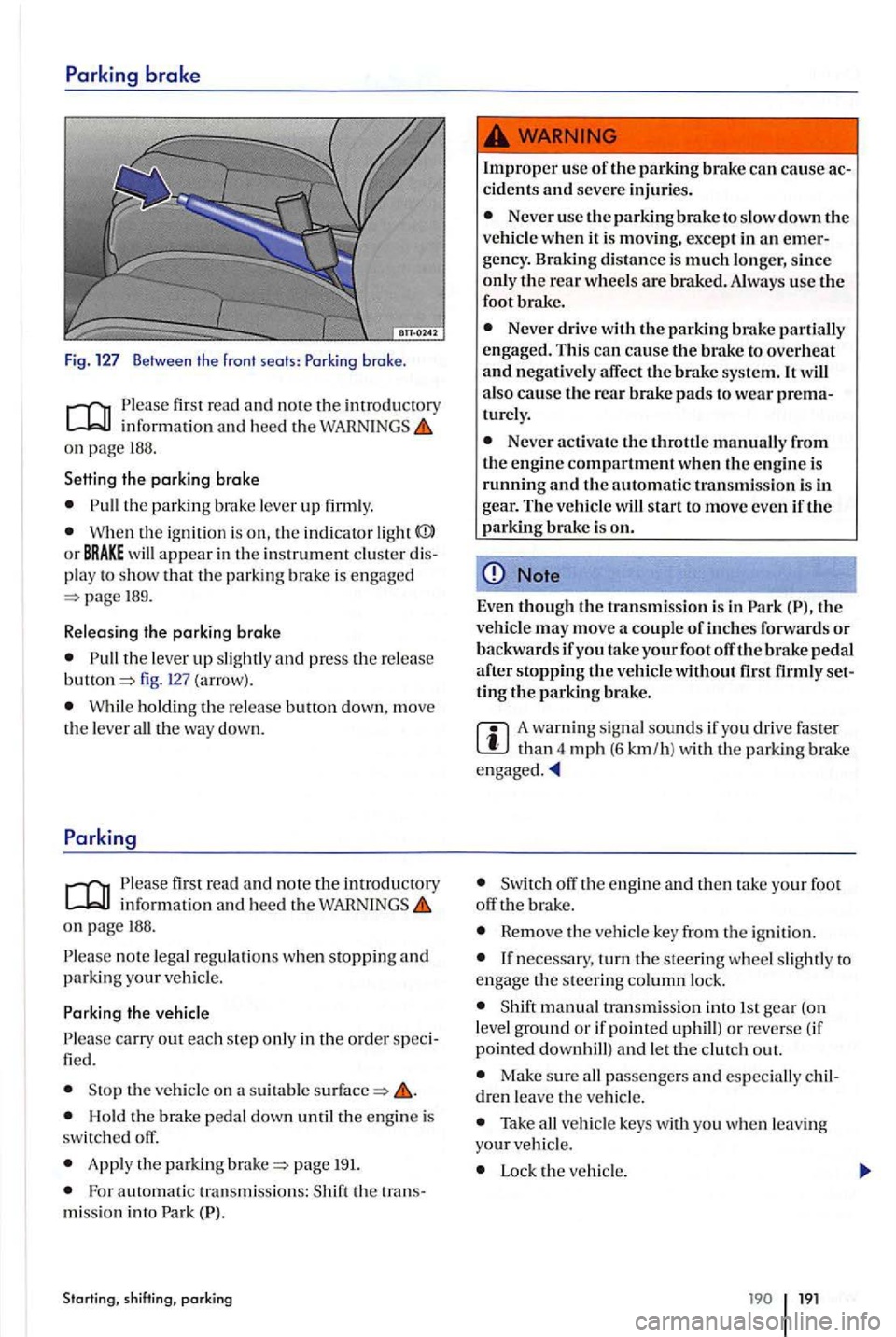
first read and note the imrod uctory
on pag e 188.
Setting the parking brake
the parkin g br ake lever up firml y.
Wh en th e ignitio n is on, the in dicator light
189.
R e leasing the parking
brake
the lever up slightl y and press the release fig. (arrow).
W hil e ho ldin g th e re lease butt on down, move
t h e leve r all th e way down.
info rmatio n and hee d th e on page 188.
n o te lega l regulations when stopping and parking your veh icle.
th e vehicle on a suitabl e
Hold th e brak e pedal dow n until the engin e is
switc h ed off.
App ly the parking page 191.
Fo r a utomatic tra nsmiss ions: th e tra ns
mi ssio n in to Park
Starting, shift ing, parking
Improper use of the parking brake ca n cause ac cidents and seve re injurie s.
Never use the pa rkin g brake to slow down the ve hicl e when it is moving , except in an emer
gency . Braking distance is much longe r, since only the rear wheels are brak ed. Always use the
foot brake.
Never drive with the parking brake partiall y
engage d. Thi s can cause the brake to overheat and negatively affect the brake syste m. It also cause the rea r brake pads to wea r prematurely.
Never acti va te t he throttl e manually from
th e e ngin e compartment when th e engine is running and the automatic tra n smissio n is in gear. The ve h icl e w ill start to move eve n iftl1 e parking brake is on.
Note
Even t11ough the transmi ssio n is in th e
ve hicl e may move a couple of inches forward s or backwar ds if you take your foot off the brake pedal after s toppin g the vehicle without set
ting tl1e parking brake.
A wa rning sig nal sounds if yo u driv e faste r th an 4 mph (6 km/h ) w ith th e parking brake
off the engin e and th en tak e yo ur foot
off brak e.
Rem ove the veh icle ke y from th e ign ition .
manual transm iss ion in to 1 st gea r (on
l evel ground or if pointed uphill) o r re ve rse (if
point ed
Make sure all passengers and esp ecially children leave th e ve hicle.
Take all ve h icle keys with you w he n le a vin g your ve hicl e.
Lock the ve hicl e.
19 1
Page 193 of 541
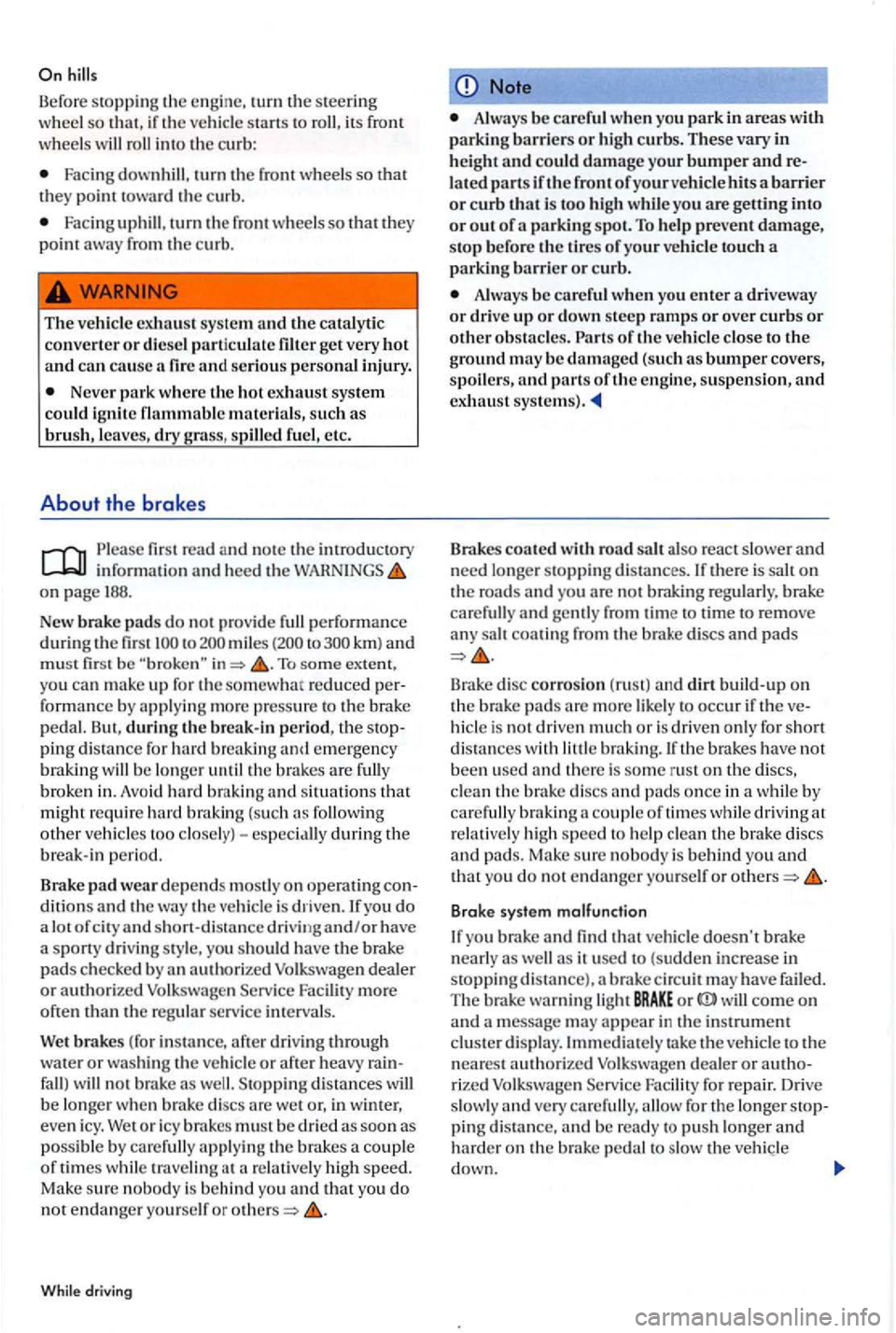
Befo re stopping th e en gine, turn the s teerin g
w heel so th at, if the ve hicl e sta rt s to its w heels w ill int o th e curb:
Fac ing turn the fro nt whee ls s o th a t
they point t oward the curb .
Fa c in g uphill , turn the front whee ls so that th ey
p o int away from the curb .
WARNING
The vehicl e exh aust system and the catalyt ic
co nverter or diesel particulate filter get very hot and can cause a and serious personal injury.
Never park where the ho t exhaust system could ignite flammable m aterial s, su ch as brush, leaves, dry grass , spilled fuel, etc.
About the brakes
read and note th e introductor y information and hee d th e on page 188.
New d o not provi de to miles to km) and m ust firs t be
hard braking and situ atio ns that
mi ght re quir e hard braking (such follow in g other vehicles too closely)-during the break-in period .
pad wear depe nd s m ostly o n operatin g the vehicle is d riven.lfyou do a l ot o f ci ty and shor t-dis ta nce driv ing and/or have
a sp o rt y driv in g s ty le, yo u sh ould have th e brake
p ad s checke d by a n authorized Vol ksw age n d eal er or a u thori ze d Volkswagen Service Fa cilit y m ore
o fte n than the regula r servi ce interva ls.
Wet
r e la tive ly hi gh speed.
Mak e sure nobo dy is be hind you and that yo u do
not endanger yo urself or
Not e
Alwa ys be careful when you park in areas with parking barriers or high curbs . T hese vary in heig ht and could damage your bumper lated parts if the front of your ve hicl e hits a barrier or curb that is too high while you are getting into or out of parking spot. To help prevent dam age,
s top b efore the tires of your ve hicle touch a parking barrier or c urb.
Alwa ys be c areful when you enter a or down steep ramps or over curbs or other obstacl es. o f th e v ehicl e close to the ground be damaged (such as btm1per covers,
s p oi lers, and parts of the en gine, suspension, and exhaust sys tems).
coa ted with road sa lt also react slowe r and need lo nge r stopping dis ta n ces. there is salt o n
t h e ro ads and you are no t b raki ng reg ularly , b ra ke carefully and ge ntl y from tim e to tim e to rem ove
a n y salt coa ting from the bra ke discs an d pad s
Brake d isc corro sion (rust) and dirt buil d-up on
th e br
ake pads are m ore like ly to o ccur if th e hide is no t dri ven muc h or i s drive n only fo r sh o rt dista nces w ith littl e brakin g. th e brake s have not
been use d and th ere is so me ru st o n t he di scs, clean th e brak e discs and p ad s o nce in a whi le by carefully braking co upl e of times whi le dri v in g at
r e lati vely hi gh sp ee d to help clean the bra ke di scs
and pad s. Mak e sure n o bod y is behind you and that you do no t enda nger yo urself or
B rake system malfunction
you brake and
th e ve hicl e to the n earest authorize d Volkswage n dea ler or
p in g d is ta nce, and be ready to pus h lo nger and harder on th e brak e pedal to slow th e ve hicl e
d own.
Page 194 of 541
Brake booster
Th e brak e boo ste r w ork s o
nly wh en the engi ne is
running . It increa se s th e forc e on the brake s above and beyond the pre ssure put on th e brake pedal by
the driver.
If the brake booster is not working, or if th e ve hicl e
ha s to be towed, you have to push th e brak e
p ed a l hard er to make up for the lack of booster
New brake pads do not provide maximum braking performance.
New brake pads do not have the best ping power for the first km) and must be You can compensate for the slightl y reduced braking force by putting more pressure on the brake pedal.
Drive with
Never follow otl1er vehicles too closely or put yourself into other sit uation s that might require sudden, hard braking ,especially when the brake pads have not been broken
Overheated brakes
When driving downhill , the brakes have to
work es pecially hard and heat up quickly.
Before driving downhill, es peciall y on th at are long or steep, alwa ys reduce s peed and shift into lower gear (manual or automatic
transmission) so that the engine he lp s to brake
the vehicl e. Othenvise, the brake system cou ld
ov erheat and pos sibly u se the brakes
w hen yo u need them to slow the v ehicl e down
m ore or to stop.
A damaged front spoiler or a non- standard spoiler can reduce airflow to the brakes and
Starting, shifting, parking
Wet brakes or brakes witl1 icc or road salt
react slow er and n eed lo n ger stoppin g tances.
Ca refully apply the brakes to test th em.
Always dry brak es and clean off ice and salt
coat ings with a few cautious
tions permit.
Driving when the booster is no t working
in creases stopping distances and can cause dent s and seriou s personal injuries.
Never le t the vehicl e coast when the en gine is
switc hed off.
If the brake booster is not working (such as
w he n the vehicle is bein g towed), a lot more pedal force is needed to slow down and stop.
Note
Neve r the by keeping your foot on the to brak e.
Constant pressure on the brake pedal can make th e brakes overheat. This sub stantially reduce
braking performance, increase stopping di stan ce, and can cause co mpl ete failure of th e brake
s y stem.
Before driving downhill, especially on that are long or steep, always reduce speed and shift into lower gear (manua l or automati c
When th e front brake s are serviced , you should have the rea r brake pads inspected
rized Volksw agen deal er or au th orize d Volkswa gen
Service Facility vis uall y insp ec t th e pads through
th e o pe nin gs in the wh eel rim s or from nea th tl1e ve hicle. If n ecess ary, the wheels ca n be
t ake n off for a mor e thorou gh
192 193
Page 195 of 541
Braking assistance system s
fir st read and n o te the introductory information and heed the
on page
T he and EDL braking tance system s work onl y w he n th e engine is ning. These sys te m s can sig nificantl y improve
vehicle namics to help reduce the probability of skidding and loss o f vehicl e control. works only w hen the engine is running. driving situations, including w hen the veh icle is beginning to spin (yaw) out of control.
gin e power and by providing steering assistance to help hold the ve hicle on the driver's intended
course.
has limitation s.
will not always be able to help out under all tions you m ay come up against. For example, may no t a lways be able to hel p you mas te r tions w he re there is sudde n change in the
cannot perform the sa me
way it would on a dry surface. the vehicl e
cornering. ularly on winding road s, cannot always deal as
e ffectiv ely wi th diffi cult drivin g situations it can
a t lower speed s. When towin g a is not able to help you regain control as it would if yo u were not towing a trailer.
Alway s
adjust your speed bility, road, cannot overcome the laws of phys ics, increa se the available
stead, improves the possibil ity o f keeping th e
vehi cle under control and o n th e road during treme maneuvers b y using th e driver's s teerin g puts to help keep the vehicle going in the int ended direction .lf you a re tra velin g at a speed that causes yo u to run off th e road before can provide any
EDL , and XDL syste m s (sec be lo w). is switc hed on all the tim e. certain situati ons
w he n you need less traction or additional tract ion cannot be achieved, you can swit ch off by pressing page 196, fig. l28. B e
s
ure to switch ASR on again when you no longer
need less traction.
Anti-lock
brake system (ABS)
ABS helps to keep the wheels from l ocking up and helps to maintain t h e driver's ability to steer and control the vehicle . Thi s means the vehicle is less lik ely to skid, even during hard
th e brake pedal down hard
Do not the brake pedal or letup on it!
S teer the vehicl e while pushing down hard on the brake pedal.
ABS sto ps working if you re lease or let up on th e brake.
When is doing i t s job, you will notice
noise. T he stopping di stance may even be lo nger, for instance, when dri ving on
pin g distances.lfyou press the pedal very quickly, BAS detects an e m ergency situ ation.
pedal! BAS
s w itches off automaticall y as soon
reduces en gine power d irected to spinning wheels and adjus ts power to the road conditions.
Eve n under poor ro ad conditions,
Page 196 of 541
can be swi tched on or off
196.
Electr onic differential lock (EDL ond XDL)
EDL is applied during regular straight-li ne at ion. brake s a drive wheel that has lost
trac tio n (sp inn ing) and r edi rects the drive force to
o th er drive whee ls. In ext re m e cases, EDL from h eating. As soon
loss of contro l a nd result in serious sonal inju ry for yo u and yo ur passe ngers.
A lw ays adjust your s peed and driv in g s ty le to
road, traffic,
r is ks.
B rakin g ass istance syste m s cannot come th e laws of p h ys ics an d always prevent loss
o f vehi cle control. Slipp ery and wet roads are
s till da ngero us eve n with
te ms!
D rivin g to o fast on wet roads cause th e
w heels to lose contact w ith the road and A vehicl e that h as los t road contact
canno t b e brake d, steered , or controlled .
Start ing, sh ifti ng, parkin g
These syste ms cannot red uce th e risk of
Althoug h th ese syste m s a re very eff ec tive
a nd can h elp yo u control tile ve hicle in man y
diffi cult situatio ns, always remember th at your vehicle
W hen acce le ra tin g o n a slippery surface, fo r
exam ple o n icc and sn ow, depress the
''
can b e sig nificantl y duced if other components and sys tems that
ti onin g.
A lways re m ember th at ve hicl e
syste m s.
Cha nging the vehi cle su sp ens io n or using an unapproved tire w heel combinati on ca n
c h a ngethewayth eABS, EDL, and syste ms work and reduce their effecti ve ness.
T he effective ness of page 276 .
All fo ur w hee ls must b e equip ped with tic a l tir es in order for to wo rk
properly. Differences in th e
g ine powe r w he n it is not expected.
I f is not working, and EDL will also not work.
active.
Page 197 of 541
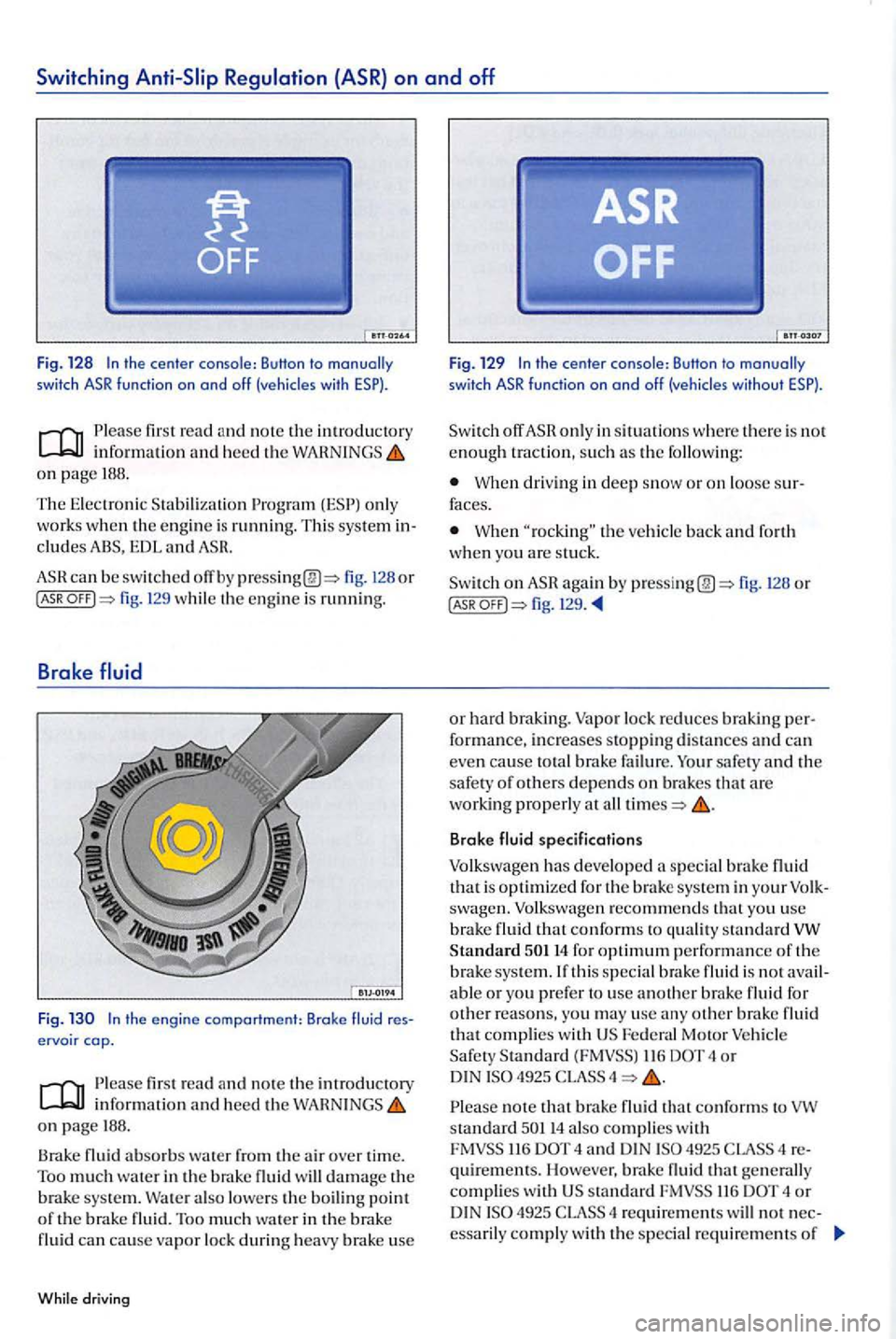
Switching
the center console: Button to with
Please fir st read and no te the introductory informatio n and heed the on page
The Electronic Stabili zation Program
cludes
can b e switched off by fig. (ASR fig. 129 whil e th e engi ne is running.
B rake
ervoir cop.
Please fir st r ead and note the introductory information and heed the on page 188.
Brake fluid
absorbs wate r from the air over time. Too much water in the brake fluid will damage the brake system. Wa te r a lso lowers th e boiling point o f the brake fluid. Too much wate r in the brake
fluid can cause vapor lock during heavy brake use
Whi le driving
Fig. 12 9 the center console: Button to switc h function on and without
off only in situations w here there is not enough traction, s u ch as the fo llo wing:
When driving in deep snow o r o n loose faces.
W hen
on again by fig. 128 or (ASR fig. 129 .
or hard braking. Vapo r lock reduces braking
safety and the safe ty of others d e pends o n brakes that are working properly at all
Brake
swagen. Volkswagen recommends that yo u use brake fluid that conforms to quality standard 14 for optimum p erformance of the brake system. If this s pecial brake fluid is not
Motor Vehicle 116 4 or 4
Please note that brake fluid that conforms to standard 14 a lso complies w ith 116 4 and DIN 4 quirements. However, brake fluid that generally complies with 116 4 or 4925 CLASS 4 requirements w ill not essarily comply with the s pecial requirements of
Page 198 of 541
the info rm ation on the co ntainer for the brake fluid you want to use to
mak e sure it meets th e requirem ent s for your hicl e.
A ppro priat e brak e fluid can
be purchased from your authorized deal er or authori zed Facility.
Brake fluid level
The fluid
level in the transparent brake fluid voir must always be betw een th e MIN and MAX
some vehicle s, eng ine components blo ck th e
v iew of th e brake fluid reservoir and make it po ssibl e to see the brake fluid level. I f you cannot clearl y see the brake fluid leve l in the brake fluid reservoir, please see an authoriz ed deale r or authorized Facility.
The brake fluid level drop s slightl y when the hicle is being use d becaus e the brake pad s wea r
down and the brak es automatically adjust to thi s.
Changing brake fluid
Brak e fluid
must be changed a ccor ding to the
thori zed
Brake failure and reduced brake performance can be caused by not having enough brake fluid
in the reservoir or by old or incorrect brake fluid.
change brake fluid according to the service schedule in your Warranty and
lock reduces braking
standard 4925 another brake fluid can
standard 50114, 116 4 or 4925 4, do not use it.
The brake fluid must be new.
Always make sure that only the correct brake fluid is used. the container does not say that the brake fluid complies with standard 4925 4, do not use it.
Brake fluid is poi sonous.
To reduce the risk of poisoning, never use food, beverage or other non-original containers
to store brake fluid. might be misled
by the label on th e non-original container, or by the shape of the container, and drink the brake
fluid. This could occur even if you re-label the container as
dren.
Note
Brake fluid
Brake fluid can pollut e the en vironment.
196 197
Page 203 of 541
Driver assistance systems
Starting assistance systems
Introduction
In thi s section find informatio n on th e lowing :
. . . . . . . . . . . . . . . . . . . . . . . . . . . . . . . . . . .
More informat ion:
Volkswagen Info rmation page 21
Brak ing, s topping and
Vehicl e page 257
Tires and
accesso ries, repairs and modifica tions page 303
p age 353
The intelligent technolo gy of the dynamic starting assis ta nce features cannot overcome t11e laws of physics. Never let th e increa se d
Uni ntended veh icle move ment ca n cause rious personal inju ry.
driving
The dynamic s tarting assistance f eatures are no s ub stitute for carefu l and att ent ive driving. Alwa ys adapt your sp ee d and driving s tyle to
v isi bilit y, weather, ro ad, and condition s. The dynamic start ing assistance features can not keep the vehicl e fro m moving in all hillstart situations (fo r exa mple, if the ground is
s lippe ry or icy). Unint ended vehicle movement ca n cause seriou s personal injury. Neve r activate the throttle m anually from the e ngine compartment whe n the e ngin e is running and th e automatic tra nsmission is in gea r. T he vehicle will start to m ove as soo n as the en gine speed in creases , eve n if th e brake is o n.