ignition VOLKSWAGEN GOLF PLUS 2004 Owner's Manual
[x] Cancel search | Manufacturer: VOLKSWAGEN, Model Year: 2004, Model line: GOLF PLUS, Model: VOLKSWAGEN GOLF PLUS 2004Pages: 541, PDF Size: 98.86 MB
Page 176 of 541
hide key can be removed from the ig nition
sw itch only when th e tra nsmiss ion is in Park
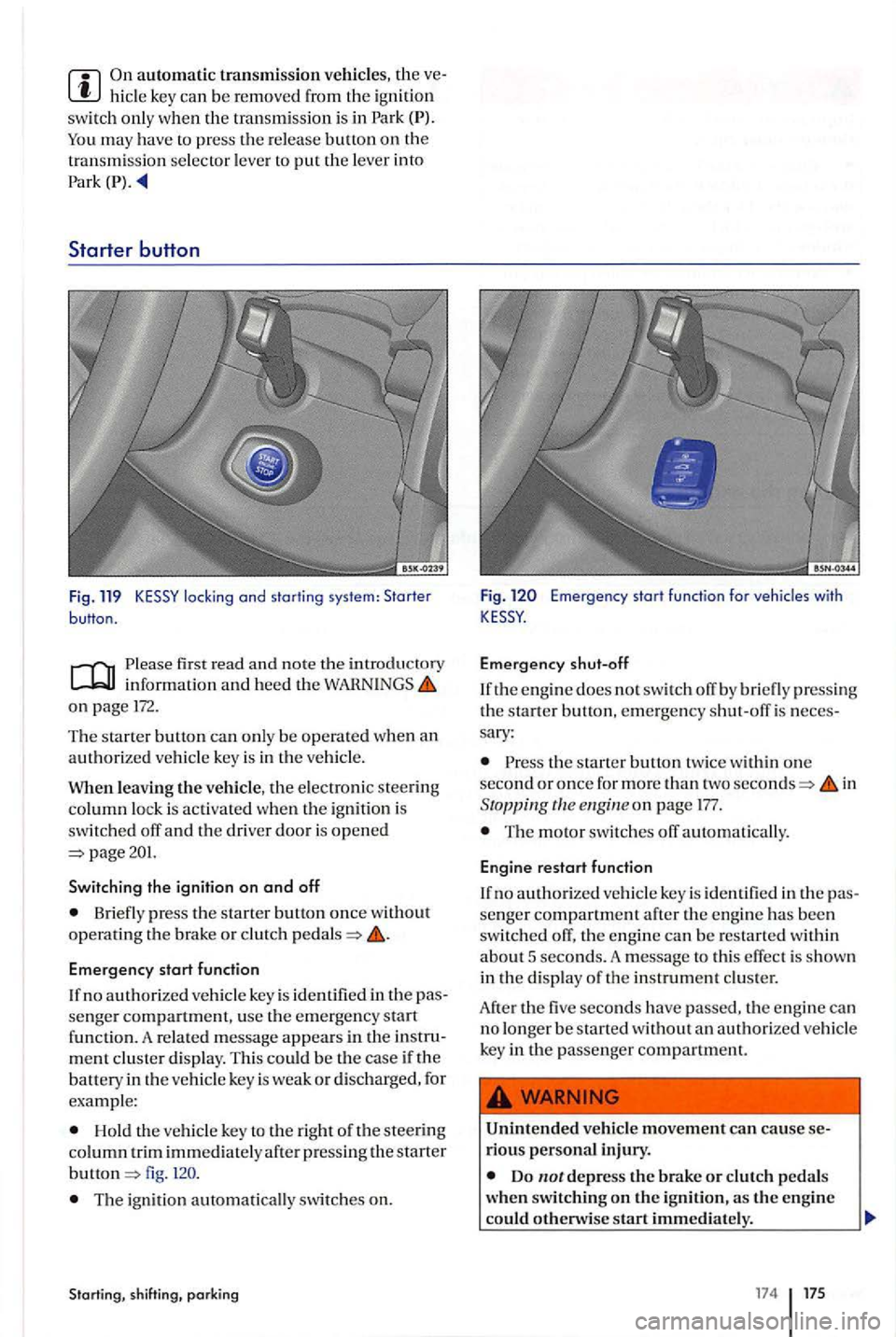
locking and starting system: Starter button.
first read and no te th e in trod uctory inform ation and heed the on page 172.
The starter button can only be opera ted when an authorized vehicle key is in t h e vehicl e.
leaving the ve hicl e, the e lectronic stee rin g
co lumn lock is ac tiva te d when th e ign ition is switch ed off and the driver door is opened page201.
Switching the ignition on and off
Briefly press the s ta rt er button once w ithout opera ting th e brak e or clutch
Emergency start function
If n o authorized vehicle key is identifi ed in the pas
se nger compartment, use th e e merge ncy start functio n . A re lated message appears in the in stru ment cluster disp lay. This could be the case if th e
battery in th e ve hicl e key is wea k or discharged, for
e xample:
Hold the vehicle key to the righ t of the stee rin g
column trim immedi a te ly after press ing the star te r button fig .
T he ign ition automatically switc h es on.
Starting, shi fting, parking
Fig . Emerge ncy start function for vehicles with
Emergency shut-o ff
If the en g ine does no t sw itch off by bri efly pre ssing the s tart er bulton, emergen cy shut-off is neces
sary :
the starte r buuon twice withi n one
second o r once for more than two seconds=> in Stoppingtlleengineon page 177.
The moto r switch es off automatically.
Engine restart function
If no authorized vehi cle key is identi fied in the pas
se nger compartment after the engine has been
switc hed off, the e ng in e can b e res ta rted w it hin about 5 seconds. A message to this effect is sh own
in the di sp lay of th e in stru ment clu ster.
After the five seconds hav e passed, the en gin e ca n
no longer be starte d without an authorize d ve hicle
key in the passenger compartment.
Unintended vehicl e movement can ca use se
rious personal inju ry.
Do
__ e_n_v_is_e_s_t_a_rt_i_m __
17 4 175
Page 179 of 541
If the engine has been driven hard for long time, the engine co uld overheat when it is stopped. To reduce the risk of engine damage, le t the engine id le in for about 2 minutes before you switch ofT the ignition.
read and n o te the int rod uctory information and heed th e on page 172.
The immobilize r helps to pre vent the en g in e from bein g s tarted and driven w ith an unauthorized ve
hicle key.
Th ere is mi croc hip insid e the ve hicle key. T he chip deactivates the immobilize r automatically
w hen the ve hicl e key is inserted int o the ig nition swit ch .
The electron ic immobilizer is automatically acti
vated when the ve hicle key is pulle d out of the ig
niti on switch. ve hicles with the vehicle
key mus t be outsid e the page 41.
While driving
ve hicles wit h automatic transmi ssions,
the engine has been switched ofT, the radiator fan in the engi ne com partment may ke ep running for several minutes, or may start run
nin g afte r th e ve hicl e has been parke d for a w hile, even if th e ig nition is switch ed ofT a nd the ignition
key has been removed. The rad iator fan shuts off automatically when the en g ine has coole d down enough .
Th e e ng in e can there fore onl y be started with a correct ly coded genuine Volk swagen ve hicle key. ve hicle keys are availab le from authorized Volkswage n dea lers, authorized Volk swage n vice Fac ilities, and from certain independent repair facilit ies and locksmiths who a re qualified to m ake vehicle page 34.
I
fan unauthorize d ve hicle key is used, SAFE or Im mobiliz er active ! appears in the in strument clu ste r display. The ve hicl e cannot be operated w ith this key.
Using gen uine Volkswage n key s helps minimi ze the risk of malfu nctions .
Page 180 of 541
Shifting
Introduction
In this section you'll find information on
. . . . . . . .
Pedals . . . . . . . . . . . . . . . . . . . . . . . . . . . . . . . . . . . . . . 181
Manual transmi ssion: Gearshift lever . . . . . . . . . . . . 182
Automa tic transmission: Selector lever . . . . . . . . . . . 182
with Tiptronic . . . . . . . . . . . . . . . . . . . . . . . . . 185
Driving with automatic transmission . . . . . . . . . . . . . 186
E xplanatory no tes in thi s chapter also apply rect Gearbox.
When the ignition is switched on and th e
T he backup light comes on.
Th e air co nd itionin g sys te m sw itch es ically r ecirculat ing air verse.
The rear window wiper swi tches on when
sis t sys te m , a nd camera For
Instrum em s
Brak ing, and
D is tance
H everse driving assista nl (Rea r Assist)
Clima te comrol
Eng in e contro l and emission cont rol sys tem
Eme rgen cy closi ng and page 322
accelera tion can cause skidding and loss of t ract ion, especially on slipp ery roads, sulling in loss of vehicl e control , collision s,
and seriou s personal injury.
kick -d own feature or fast ti on onl y if vis ibility, weather, road , and traffi c
co nditi ons permit.
Neve r
or apply the p edal often or lo ng. Constant brakin g ca uses the brakes to over hea t. This subs ta nti ally duce performance, increase stop1> ing
d is tance, and cau se complete failure of th e
Note
Neve r the brakes by keeping your foot
o n brake ped al when you do not want to brake.
Thi s
Before driving downhill , es peci all y on that are lon g or steep, alw ays reduce speed an d into lower gear (manual or auto mati c mission) so that th e engin e help s to brake hi cle. Otherwi se, th e brake system could over hea t and possibl y fail. use th e when yo u
n eed them slow v ehicl e dow n more or
Page 183 of 541
first rea d and not e the introductory informatio n and heed the on page
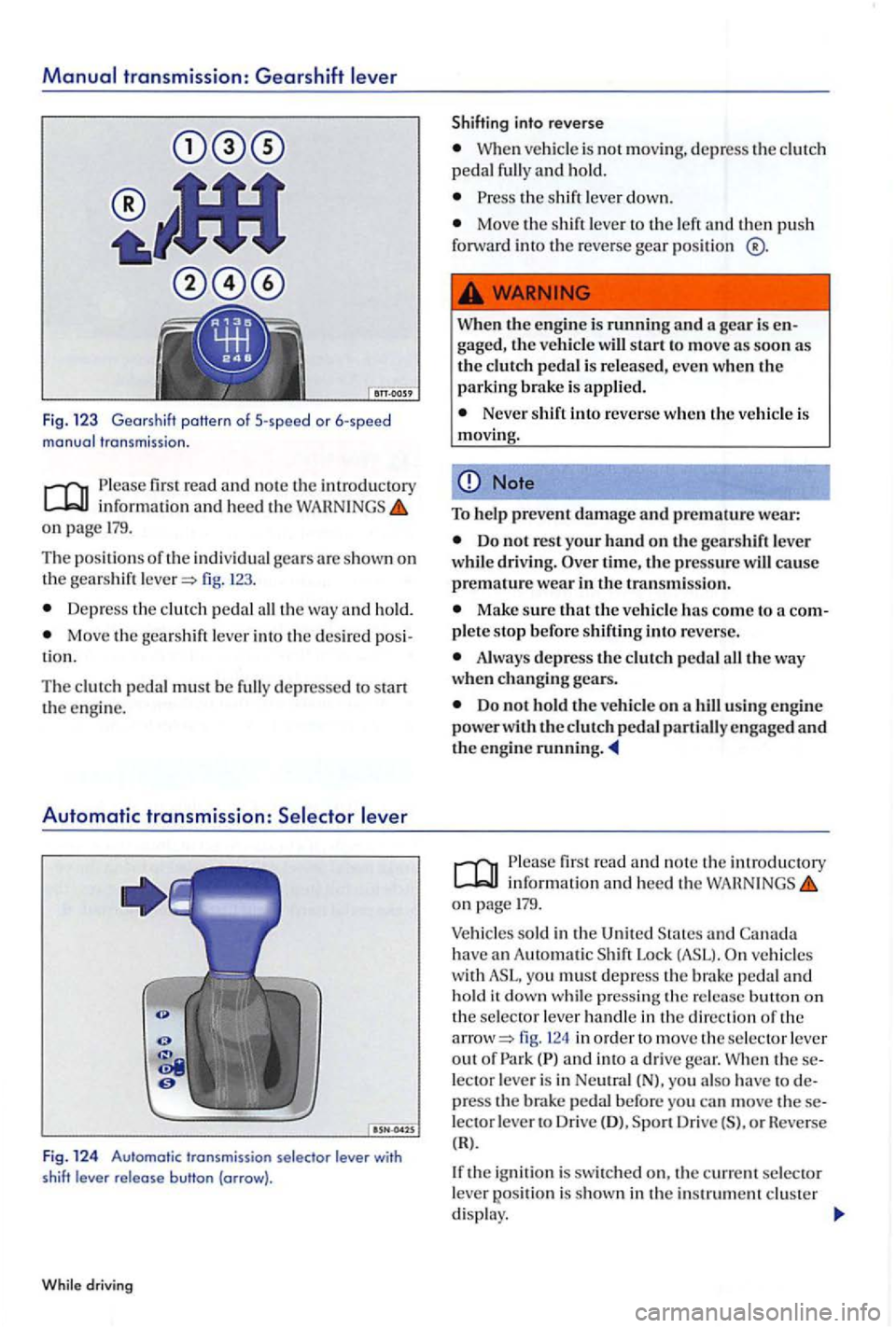
The pos ition s of the indiv idual gea rs are s hown on th e gea rs h ift fig.
Dep ress the pedal th e way and ho ld.
Move the lev er in to the des ired tion.
Th e clut ch
pedal mus t be depresse d to stan the eng ine.
Automatic transmission :
Fig . 124 Au tom atic transmissio n selector lever with
shift
When vehicle is not m ovin g. depress th e and ho ld.
th e shift le ve r d own.
Move the leve r to the and th en push
forwar d int o the reverse gear position
When the engine running and a gear gaged , th e vehicle will start to mov e as soon as the pedal is released, even when the parking brake is appli ed.
Never shift into reve rse when th e vehicle is
moving.
Note
T o h elp prevent damage and premature wear:
Do not re st your hand on the gear shift leve r
whil e dri ving.
Make sure th at the vehicle has come to a
Always depress th e pedal
Do not hold the ve hicl e on a
fir st rea d and no te t he int roduc tory information and hee d th e on page
sold in the United and have an Automatic Lock ve hicles with you must depress the brake pedal and ho ld it d ow n whil e press ing th e rclense
fig. in ord er to move th e selec to r leve r
o ut of and int o drive gea r. W hen lector leve r is in Ne utral (N). you also have to press th e brak e pedal before you can move lecto r leve r to Dr ive (D ), Drive o r neverse (R).
If th e ignition is switched on. the c urrent selec tor lever
Page 189 of 541
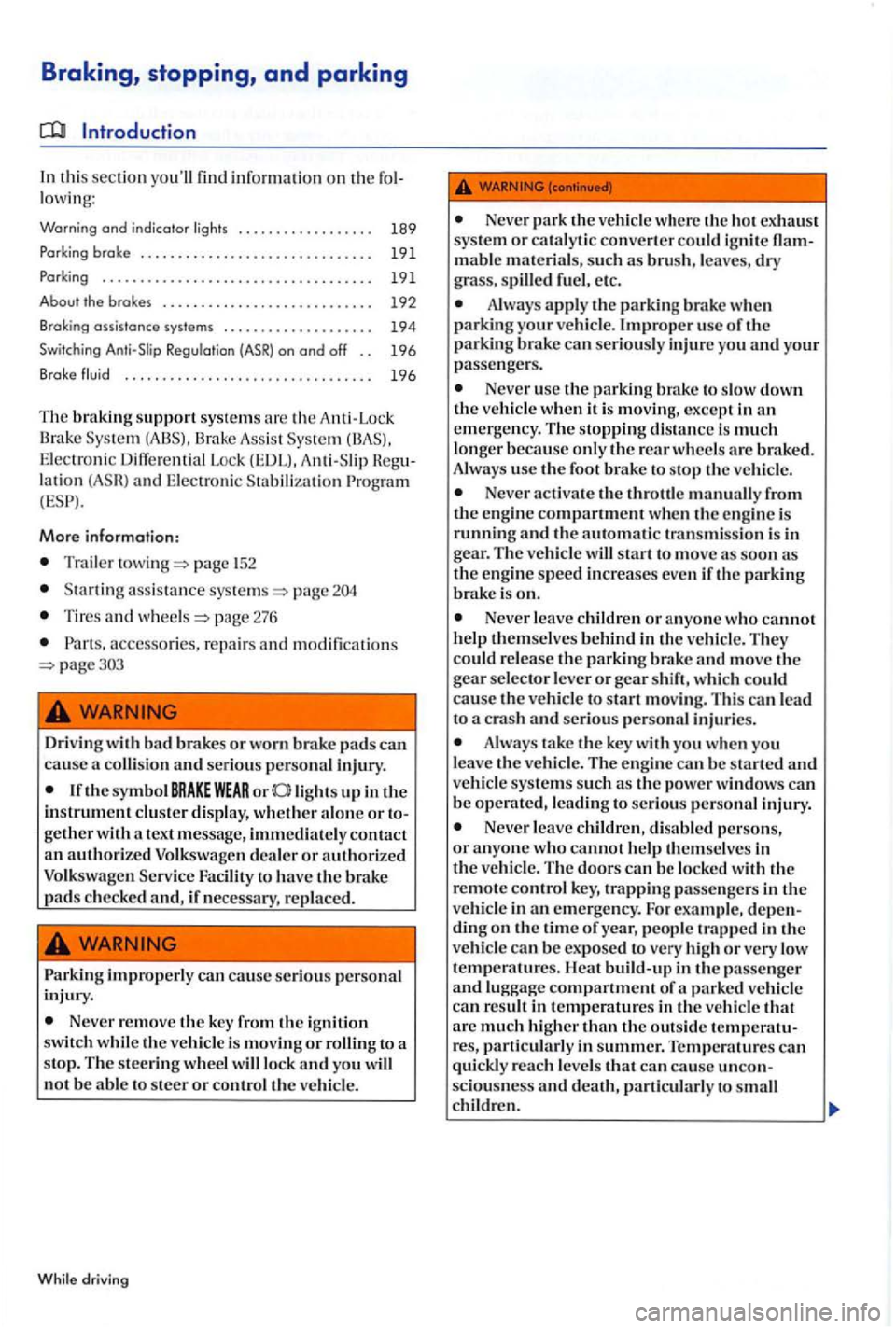
Braking, stopping, and parking
Introduction
In this section yo u'll find inform ation on fo l
lowi ng:
Warning and indicator lights . . . . . . . . . . . . . . . . . 189
Park in g brake . . . . . . . . . . . . . . . . . . . . . . . . . . . .
.. . . . . . . . . . . . . . . 19 1
About t
he brakes . . . . . . . . .. . . . . . . . . . . . .. . . . 192
Bra king assistance sys tem s . . . . . . . . . . . . . . . . . . . . 194
Switching Anti-Slip Regulation (ASR) on ond off . . 196
Brake fluid . . . . . . . . . . . . . . . . . . . . . . . . . . . . . . . . . 196
T he brakin g support syste ms are Brake A ss is t E lec tro nic Differ e n tial Loc k (EDL). Anti-Slip
M ore information:
Trail er page
pag e
Tires and page 276
acce ssories, r epa ir s and modifi catio ns
brakes or worn brake pads can
ca use colli sio n and serious personal inju ry.
light s up in the
in strument cluste r di splay, w heth er a lo n e or to
ge ther with tex t message, immediat ely conta ct an authorized Volk swage n dea ler or authorized
Volkswag en Se rvi ce Faci lity to have th e brake pad s ch ecke d and , if necessary, re pl aced.
WARNING
improperly can cause se riou s pe rso nal
injury .
Never re m ove key from the ignition switch while vehicl e is m ov ing or ro llin g to a
s top. The steering w heel w ill lock and you not be
Never park the vehicle w here the ho t ex ha ust
syste m or catalyti c convert er could ignit e flam
mabl e mater ia ls, su ch as brus h , leaves , dry grass, spilled fue l, e tc .
Always apply th e parki ng brake whe n
p a rki ng your veh icle. Imprope r u sc of th e
p a rking bra ke can se rio usly injur e you and your passe nge rs.
Never use the
e m ergency . The stopping dista n ce is muc h
longer b ec au se onl y the wheels arc braked . use the foot brake to sto p the vehicle .
Never the throttl e from
th e e ng in e
th e automati c transmission is in gear. The ve hicle will start t o move as soon the e ngine speed ev en i f th e brake is on.
Never leave childr en or anyo ne w ho canno t
h elp them se lve s beh in d in the vehicl e. They could re leas e the brak e move the gear selector leve r or shift , wh ic h could cause th e vehicle to start m ov ing. Thi s ca n lea d
to a cras h and seri ous personal injuri es.
Always take the key with you when yo u
leave th e ve hicle . The engine ca n be started and ve hicl e sys te m s s uch as the power wind ows can
b e operate d , le ad ing to seri ous perso nal injury.
Neve r leave childr en , di sabled perso ns, or a nyon e who cannot h elp them se lves in the vehicl e. T he doors can b e lo cke d wit h the re mote contro l ke y, trapping passe nge rs in the
ve hicle in an emerge ncy. For exa mpl e, dep ending on th e tim e of year, people trappe d in the
ve hicle can be ex pose d to very high or very temperatures. Heat build -up in the passenger and parked vehicl e result in temperatu res in the ve hicl e th at arc much hi gher than the outsid e tempe mtu
res, partic ul arl y in summer. T emperatures ca n
qui ckly reac h le v e ls that can cause uncon
scio usn ess ch ildr en.
Page 200 of 541
Efficient driving
Please information and heed the on page 198.
Shifting faster
As a rule, the following applies: The higher gear is
a lways the more efficient gear. The rule of thumb for most vehicles is to drive in 3rd gear at mph f km/h, 4th gear at 25 mph f km/h, and 5th gear at mph f km /h.
If
and driving conditions permit, gears when upshifting also saves fuel.
Do
not run the gears up to their limit.
mati c transmissions .
Vehicles with gear recommendation aid in fuel fic ient dri ving by indicating the optimum time to shift gears.
livery to the engine is interrupted, which lowers
fuel consumption.
T herefore, when nearing a red stop light , for s tanc e, allow the vehicle to coast without using the accelera tor. Press the clutch pedal and release it only if the v ehicle is moving too slowly or the coasting distance is too long. The engine will then continue to run at idl e.
In situati ons
where the vehicle will be stopped for
a longer period of time, such as at a train cros sing,
physically switch off the engin e.
D efens ive driving
and with traffic
Fre
quent braking and accel eration increases fuel consumption sign ific antly. Just by driving sivel y and keeping a su fficiently large distance away fro m the vehicle in front of you can make up for the speed fluctuation s caused by taking your foot off the accelerator. Active braking and ating is then not necessarily required.
system information
The power stee ring syste m i s not hydrauli c.lt is an electro-mechanical syste m. The advantage of this
s te ering system is tha t no hydra uli c hoses, draulic oil, pumps, filters or other parts are quired . Th e e lectro-m echanica l system is more fue l effi cient. A hydraulic system requires constant oil pressure in the syste m; an electro -mechanical
s teerin g sys tem, however, needs power only whil e
s teering.
Th e el
ectro-mechanical power steering
chanical power steering works only when the gin e is running.
and smooth driving
Consistency is more important than speed. The more smoothly yo u drive, the less fuel the vehicle consumes.
When driving on the highwa y or freeway, a
stantly accelerating and braking. you can r each your destinatio n just as quickly by driving at a moderate, but steady speed.
The c rui se control syste m can a ssis t in
sciou s manner.
Some dev ices can increase fuel consumption when activated (examples):
C limate control air conditioning system:
trasting temperatures, it requires a large amount of energy, which is generated by the e ngin e. T he
tr emely different from that of the outside
windows increase fuel consumption.
Switch off seat heating once it has served its
purpose.
Sw itch off the windshield and rear window
Malfunctioning engine control.
Driving in the mountains.
Towing a trailer .
page 257
Towing and page 357
Turning the steering wheel is very hard when the power steering system is not working. This makes it harder to control the vehicle.
steering works only when the engine is running.
Never let the vehicle coast with the engine switched off.
Never remove the key from the ignition
switch while the vehicle is moving or rolling to a
stop. The steering column will lock and you will be unable to control the vehicle.
Page 202 of 541
Steering system information
first read and note the introductory informatio n and heed the on page
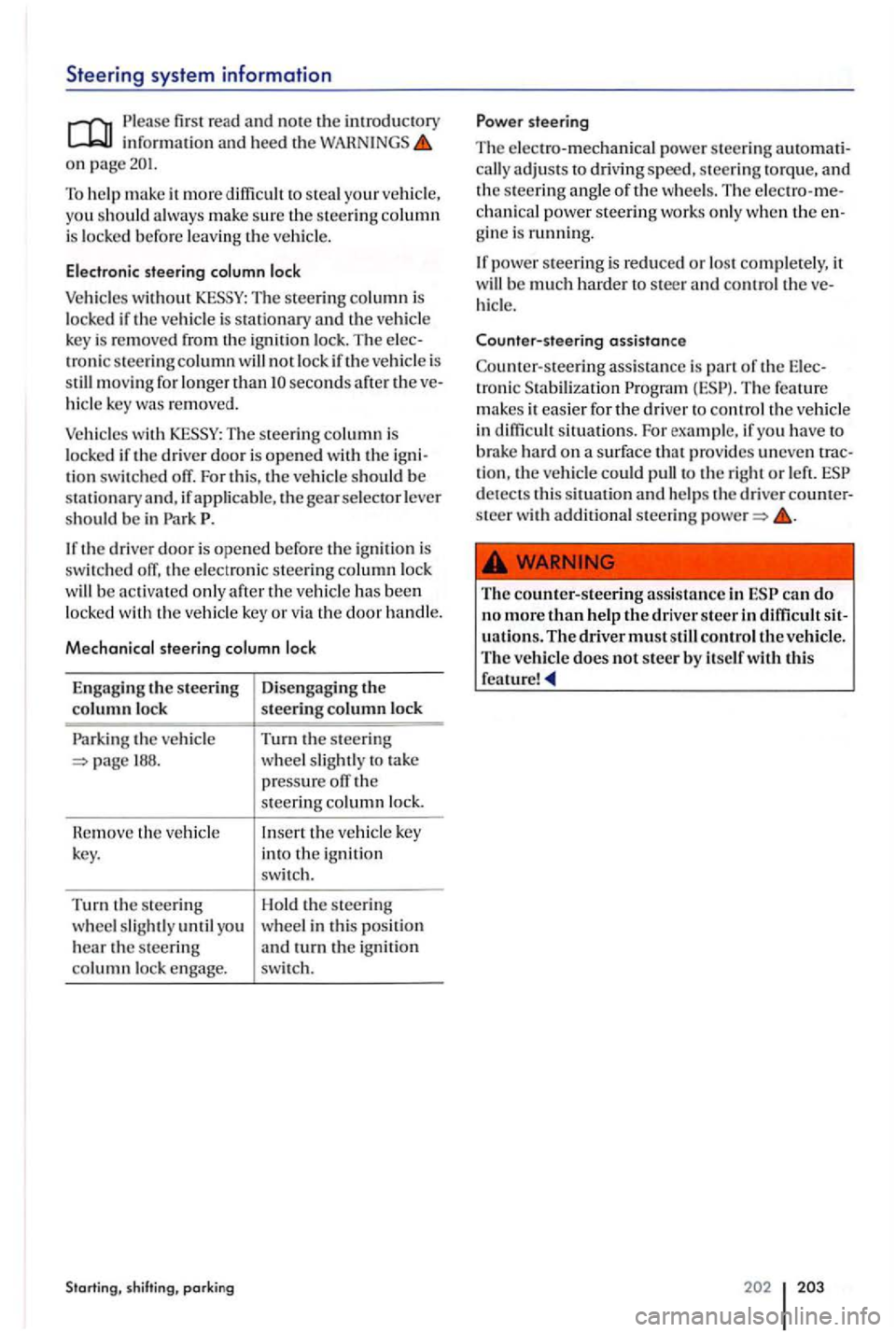
To help m ake it more diffi cult to s teal your ve hicl e,
you sh ould always make sur e the steering co lumn is locked before leaving the ve hicle .
Electronic steering column lock
Vehicles with o
ut The s teering column is
l ocked if the vehicle is stationary and the vehicle
k ey is removed from the ign ition lock. The elec
tr onic s teering column will not lock if the vehicl e is
s till mov in g for longe r than seconds after the ve
hicl e key was re moved.
Vehicles with
Th e s teering column is
l ocked if the dri ver door is ope ned with the ignitio n switch ed ofT. For this, the ve hicle should be
s tationary if applic abl e, the gear selector leve r
s h ould be in
If the driver door is opened befo re the ign ition is
sw itch ed
188.
H e
move th e ve hicl e
k ey.
Turn th e s teering
w heel s lig htl y until you
hear the steering
column l oc k en gage.
Starting, shifting , parking
Disengaging the
steering column lock
Turn the s teering
whee l s lightl y to take pressure ofT the
s teerin g column lock.
In
sert the ve hicl e key
into the ignition swit ch .
Ho ld th e s teerin g
wheel in thi s pos ition
and turn the ignition switch.
steering
The e lectro-mechanical power steering auto m ati
c ally adjusts to dri ving speed, steering torque , and the steering angle of the wheels . The e lectro-me
c hanical power steering work s only w hen the en
gine is running.
If power steering is reduced or lost comple tely, it
will b e much harder to steer and co ntrol the ve
hicl e.
Counter-steering
assistance
T he feature
m akes it easier for the dri ver to control the vehicle
in difficult situation s. For exampl e, if yo u h ave to
brak e h
ard on a surface that provides uneve n t rac
tion, the ve hicle could pull to the right or l eft. detect s th is situation and h elps th e dri ver counter
s teer with additi onal steerin g
The counter-steering ass istance In
Page 210 of 541
Operating instructions
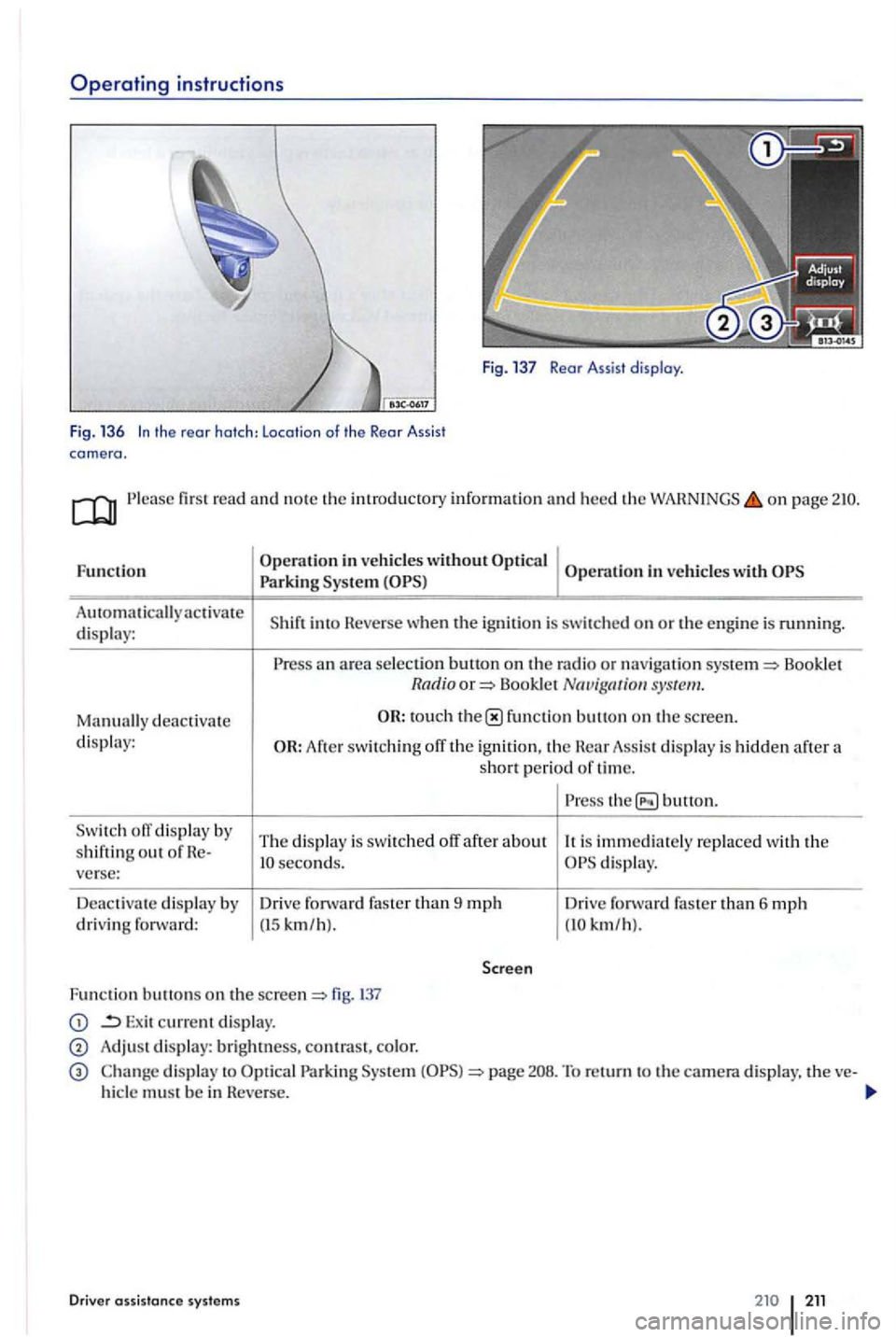
Fig. 137 Rear Assist display.
Fig. 136
fir st read and note th e introd uc to ry info rmation an d heed the on page
Fu nc tion
A
uto mati cally display:
Man uall y dea c tivate dis p la y:
ofT d is p la y by
s h if tin g o ut of verse:
D ea c tiv a te di spla y by
d riv in g fo rward:
. . h Pa rk in g System ve uc es wtt
R eve rse whe n the ignition is sw itch ed on or the engine is running.
a n area se lection button o n the rad io or n av igation Book let Radio Book let syste m .
Afte r switc h in g off the ignition, th e Hear Assis t di spl ay is hidden aft e r a short period of ti m e.
T he di splay is
swit ch ed off after about seconds.
Driv e f
orward faste r than 9 mph (15 km /h ).
button.
is immediately re p lace d with the di sp lay.
Dri ve fo rward fas te r than 6 mph km/h ).
Fun c
tion bu tto ns o n the fig.
Exit current display.
Adjust dis p lay: brightness, contra st, color.
di sp la y to Park in g To return to the camera d is p la y, t he hicl e m ust b e in Heve rse.
Drive r syst ems 211
Page 218 of 541
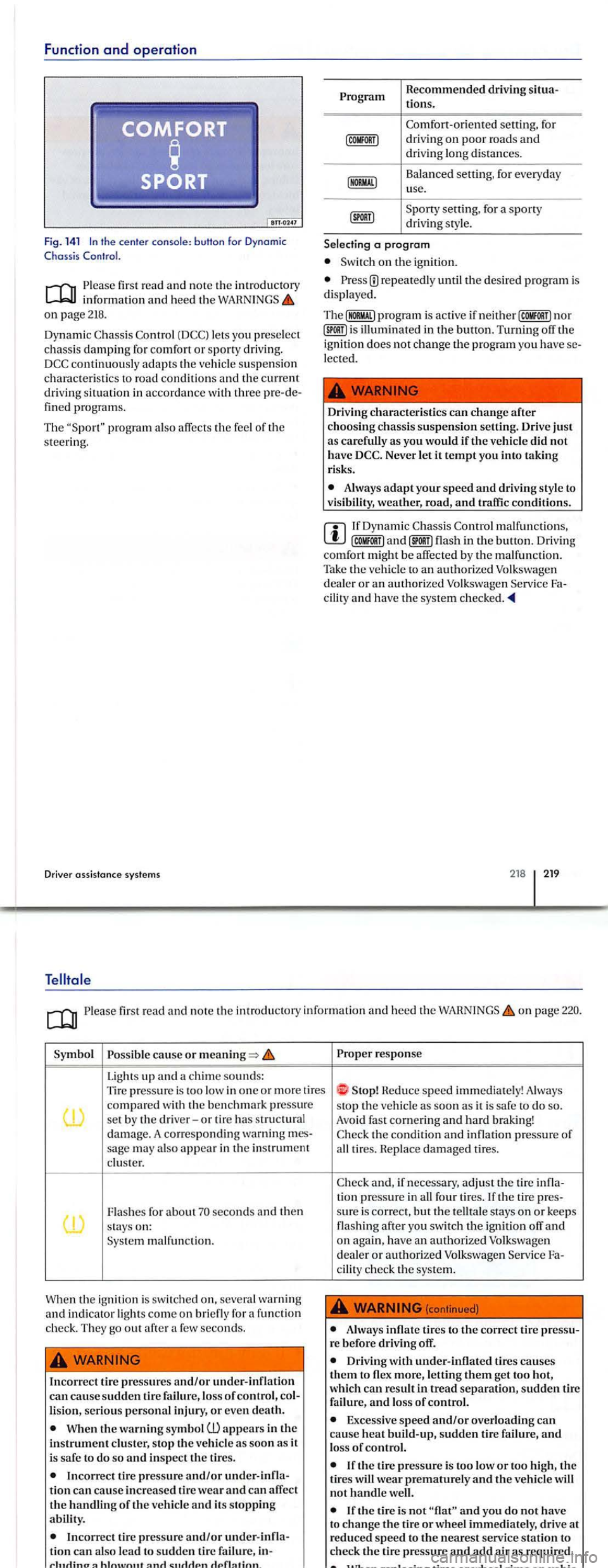
Function and operation
Fig. 141 In the cen te r co nsole : b uHon fo r Dynomic C hoss is
Please read and note th e introductory inf ormati on and hee d t he on page 218.
D ynamic C hassis Control lets you prese lec t
chassi s dam ping for comfo rt or sporty driving .
pro grams.
T he
program also affec ts th e feel of the steering .
Driver assis tanc e systems
Program R
ecommended driving
Comfort- oriented setting, for driving on poor roa ds and driving lon g di sta nces .
Balanced
setting, for everyday
u se.
a program
o n th e ignition.
re p ea te dl y th e des ired progra m is
disp laye d.
Th e
nor illumin ated in the button. Turning off the
i g nition does no t chan ge the program you have lec ted.
Driv ing characteristics can
change after choosing chassis suspension setting. Drive just as carefully as you would if the vehicle did not
h ave Neve r let it tempt you into takin g
risks.
Always adapt your speed and driving style to
visibil and traffic condit ions.
malfunctions , flash in the button. Driving comfo rt might be affec te d b y th e malfunction. Tak e th e ve hicl e to an authorized Volk swage n
d ea ler or an authorize d Volkswa gen
218 219
Please read and note the introdu ctory information and h eed the WARNINGS on page
Poss ible cause or
Lights up and a chime sounds: Tire pressure is too in one o r more tires compa re d wi th th e ben chmark press ure
se t by the driver-or ti re has stru ctural
damage. A co rre spo ndi ng warning
sa ge may also app ear in the instrument cluster.
Fla s hes for abo ut seconds and then stay s on: malfun ction.
W h
en the ignition i s s witched on, severa l warning
a nd ind icato r light s come on briefly fo r funct ion
c h ec k. Th ey go out after a few seco nds.
Incorrec t lire pressures and/or under- inflati on can cause sudden tire failure , loss of control , lisio n, seriou s personal injury, o r even death.
When the warning symb ol
In correc t tir e pressure a nd/or tio n can ca use incre a se d tir e wear and ca n affe ct the handling of th e ve hicle and its stoppin g
Incor rec t tir e pressure and/or ti o n can also lead t o sudden tir e fa ilu re,
Proper response
Heduc e speed imm ediately! Always
s t
op th e vehicle as soon as it is safe do so . Avoid fas t cornerin g and hard braking!
tion press ure in all four tires. If th e tir e
cilit y c heck the sys tem.
(continued)
Always inflate tires to the correct tire re befor e drivin g off .
Driv in g with under-inflat ed tire s causes them to flex more, letting the m get too hot,
which can
Excessive speed and/or over loading can
ca use heat build -up, sudden tire failure , and lo ss of control.
If the tire pressure is too low or too high , th e tires wear prematurely and the vehicl e will
not handl e we ll.
If the tire is not and yo u d o no t h ave
t o ch an ge the tire or whee l immediat ely , drive a t
reduced spee d to the nearest serv ice station to
c h eck th e tir e pressure and add
Page 233 of 541
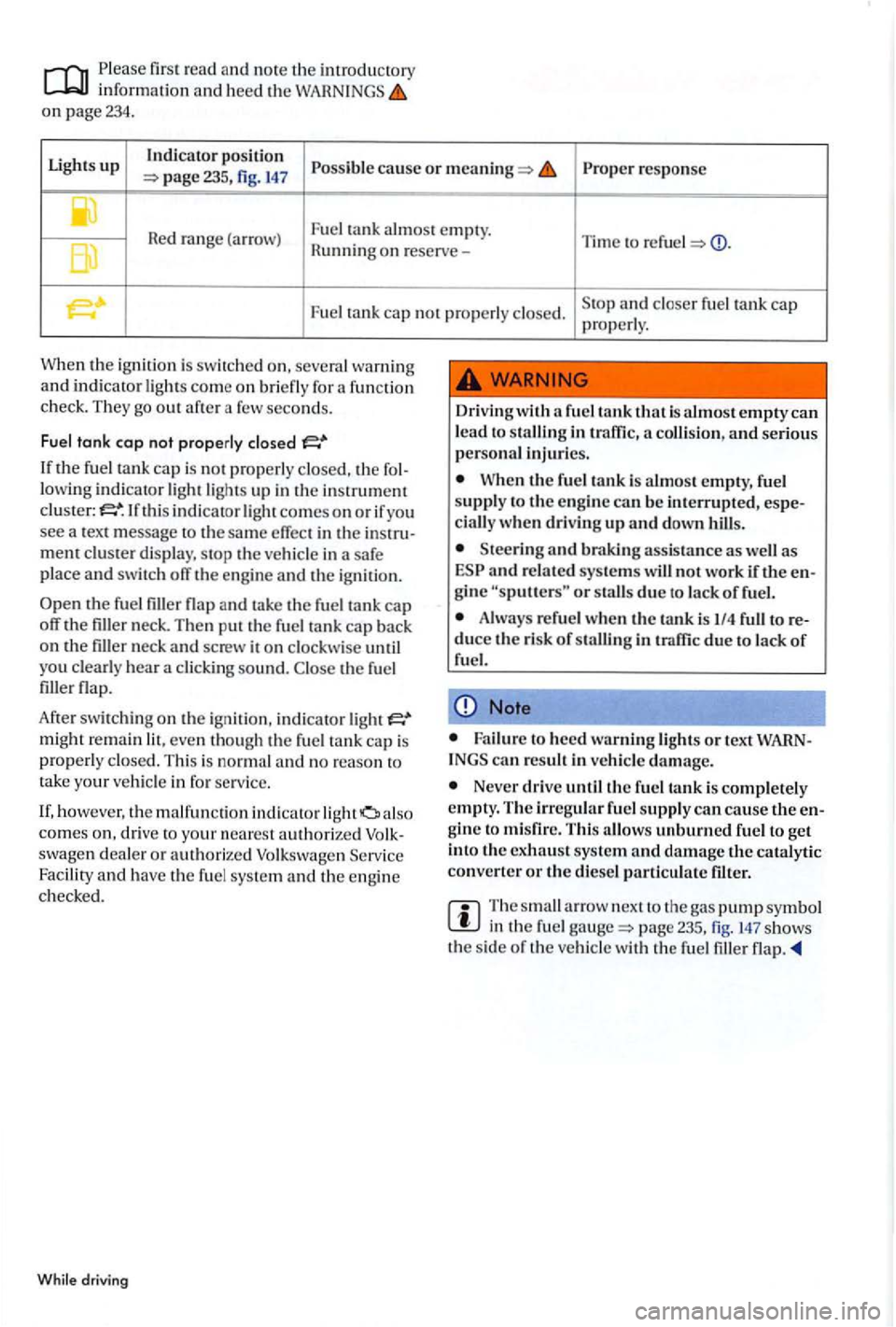
information and heed the WAHNINGS on page 234.
Lights
up Indicator pos itio n response 235, fig. 147
Hunning on reserve-
Fu el tank cap not pro perly closed. properly.
When the ignition is switched
a few seconds.
Fuel tank cap not properly
indicator ligh t comes on or if yo u see a tex t m essage to the same effec t in the in strument clu ste r d is play , stop the ve hicl e in a safe
p lace and switch ofT the en g ine and the ig n ition.
might remain even tho ugh the fu el t ank cap is properl y closed. This is no rm al and n o re ason to take your vehicl e in for se rvic e.
however, th e m alfun ctio n indicator light driv e to yo ur neares t authorized swagen dealer or authorize d Volkswage n Serv ice Facility and have fuel sys tem and the engine checked.
While driving
Driving with a fu el tank that is almost empty can
lead t o s tallin g in traffic, a co llisio n, and seriou s
p ersonal injuries.
W hen the fu el t ank is almost empty, fuel
supply to the engine can b e interrupted, especiall y w he n driving up and d ow n hill s.
Steerin g and braking assist ance a s we ll as and re lated syste ms w ill not work if the en
gine or s talls due to lack of fuel.
Always refuel w hen the tank is 1/4 full to re duce the risk of sta ll in g in traffic due to lack of fuel.
Note
----------------------~ Failure to heed warning lights or t ext WARN-can result in veh icle damage.
Never drive until the fuel tank i s com ple te ly
empty. The irregula r fu el supply can cause the e ngine to misfire. This allows unburned fuel t o ge t into the exhau st syste m and damage the cata lyti c
co nverter or the diesel p arti culate filt er.
The small next to the gas pump symbol in the fuel page fig. shows
th e sid e of the ve hicl e w ith the fuel filler flap.