wheel VOLKSWAGEN GOLF PLUS 2004 Owner's Manual
[x] Cancel search | Manufacturer: VOLKSWAGEN, Model Year: 2004, Model line: GOLF PLUS, Model: VOLKSWAGEN GOLF PLUS 2004Pages: 541, PDF Size: 98.86 MB
Page 191 of 541
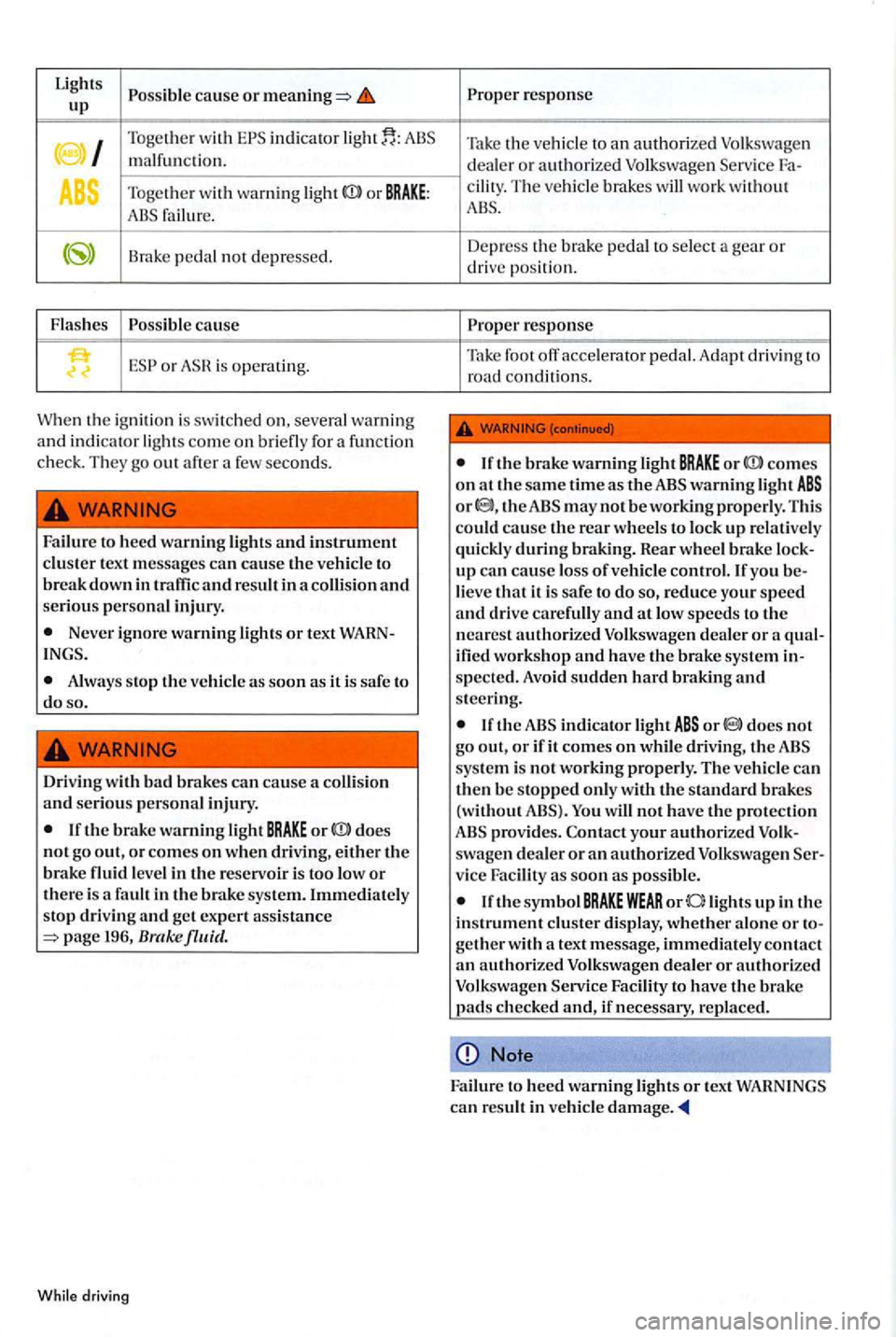
Lights cause or up
I
Together w ith indicator
m alfun ction.
T oge th
er with warning light
cause
or is opera ting.
W hen the ig nition
is sw itched on,
light s and instrument cluster text messages can cause the vehicl e to
break down in traffic and result in a collision and serious personal injury.
Never ignore warning light s or text WARN
Always stop the vehicl e as soon as it is safe to
do so.
Driving
with bad brake s can cause a collision and serious p ersonal injury .
does
not go out, or co mes on w hen driving, either the brak e fluid leve l in the reservoir is too low or there is a fault in the brake sys tem. Immediately
s top driving and get expert assista nce
response
Take the veh icle to an authori zed Volkswage n
d ealer or authori zed Volkswagen Service Fa-The ve hicl e brake s will work without
response
foot off accelerator pedal. Adapt driving to road conditi ons.
If the brake warnin g light BRAKE or co mes on at the same time as the warning light or th eABS may not be working properly. Thi s
could cause th e rear whee ls to lock up re latively
quickly during braking. Rear wheel brake lock
u p can cause loss of veh icle control. If yo u be
lieve that it is safe to do so, reduce your speed and d ri ve carefully and at low speeds to the neares t authorized Volkswagen dealer or a qual
the indicator light or does not go out , or if it comes on driving, the sys tem is not workin g properly. The vehicle can th en be stopped onl y with the standard brake s
(wi thout ABS). w ill not have the protection provides. Contact your authorized Volk
swage n dealer or an authorized Volkswagen vice Facility as soon as possib le.
lights up in the
in strument cluster display, whether alo ne or to gether with a te xt message, immediately contact an authorized Volkswagen dealer or authorized Volkswage n Facility to have the brake pad s ch ecked and, if necessary, replaced.
Note
Failure to heed warning lights or text WARNINGS can re sult in vehicle damage
Page 192 of 541
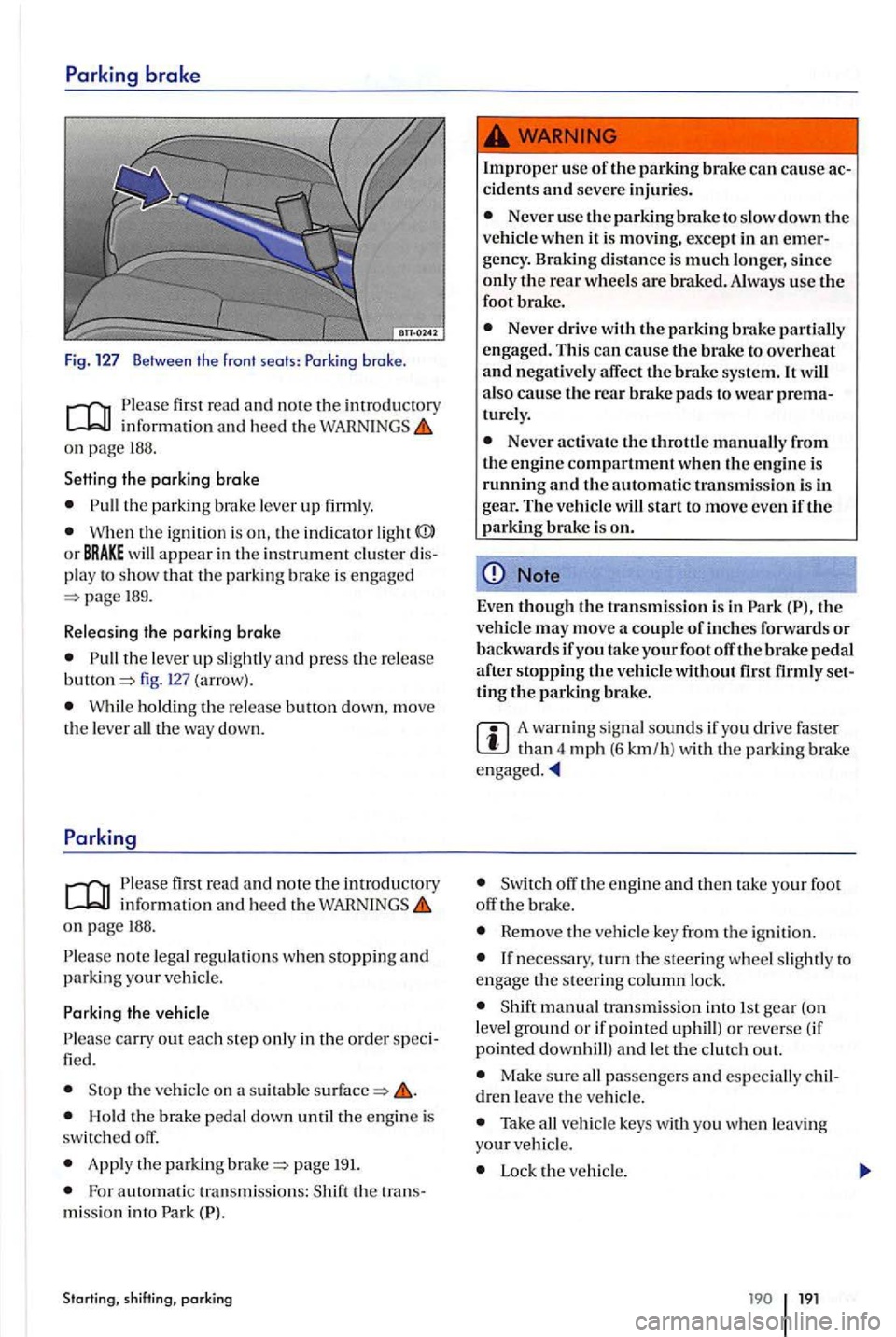
first read and note the imrod uctory
on pag e 188.
Setting the parking brake
the parkin g br ake lever up firml y.
Wh en th e ignitio n is on, the in dicator light
189.
R e leasing the parking
brake
the lever up slightl y and press the release fig. (arrow).
W hil e ho ldin g th e re lease butt on down, move
t h e leve r all th e way down.
info rmatio n and hee d th e on page 188.
n o te lega l regulations when stopping and parking your veh icle.
th e vehicle on a suitabl e
Hold th e brak e pedal dow n until the engin e is
switc h ed off.
App ly the parking page 191.
Fo r a utomatic tra nsmiss ions: th e tra ns
mi ssio n in to Park
Starting, shift ing, parking
Improper use of the parking brake ca n cause ac cidents and seve re injurie s.
Never use the pa rkin g brake to slow down the ve hicl e when it is moving , except in an emer
gency . Braking distance is much longe r, since only the rear wheels are brak ed. Always use the
foot brake.
Never drive with the parking brake partiall y
engage d. Thi s can cause the brake to overheat and negatively affect the brake syste m. It also cause the rea r brake pads to wea r prematurely.
Never acti va te t he throttl e manually from
th e e ngin e compartment when th e engine is running and the automatic tra n smissio n is in gear. The ve h icl e w ill start to move eve n iftl1 e parking brake is on.
Note
Even t11ough the transmi ssio n is in th e
ve hicl e may move a couple of inches forward s or backwar ds if you take your foot off the brake pedal after s toppin g the vehicle without set
ting tl1e parking brake.
A wa rning sig nal sounds if yo u driv e faste r th an 4 mph (6 km/h ) w ith th e parking brake
off the engin e and th en tak e yo ur foot
off brak e.
Rem ove the veh icle ke y from th e ign ition .
manual transm iss ion in to 1 st gea r (on
l evel ground or if pointed uphill) o r re ve rse (if
point ed
Make sure all passengers and esp ecially children leave th e ve hicle.
Take all ve h icle keys with you w he n le a vin g your ve hicl e.
Lock the ve hicl e.
19 1
Page 194 of 541
Brake booster
Th e brak e boo ste r w ork s o
nly wh en the engi ne is
running . It increa se s th e forc e on the brake s above and beyond the pre ssure put on th e brake pedal by
the driver.
If the brake booster is not working, or if th e ve hicl e
ha s to be towed, you have to push th e brak e
p ed a l hard er to make up for the lack of booster
New brake pads do not provide maximum braking performance.
New brake pads do not have the best ping power for the first km) and must be You can compensate for the slightl y reduced braking force by putting more pressure on the brake pedal.
Drive with
Never follow otl1er vehicles too closely or put yourself into other sit uation s that might require sudden, hard braking ,especially when the brake pads have not been broken
Overheated brakes
When driving downhill , the brakes have to
work es pecially hard and heat up quickly.
Before driving downhill, es peciall y on th at are long or steep, alwa ys reduce s peed and shift into lower gear (manual or automatic
transmission) so that the engine he lp s to brake
the vehicl e. Othenvise, the brake system cou ld
ov erheat and pos sibly u se the brakes
w hen yo u need them to slow the v ehicl e down
m ore or to stop.
A damaged front spoiler or a non- standard spoiler can reduce airflow to the brakes and
Starting, shifting, parking
Wet brakes or brakes witl1 icc or road salt
react slow er and n eed lo n ger stoppin g tances.
Ca refully apply the brakes to test th em.
Always dry brak es and clean off ice and salt
coat ings with a few cautious
tions permit.
Driving when the booster is no t working
in creases stopping distances and can cause dent s and seriou s personal injuries.
Never le t the vehicl e coast when the en gine is
switc hed off.
If the brake booster is not working (such as
w he n the vehicle is bein g towed), a lot more pedal force is needed to slow down and stop.
Note
Neve r the by keeping your foot on the to brak e.
Constant pressure on the brake pedal can make th e brakes overheat. This sub stantially reduce
braking performance, increase stopping di stan ce, and can cause co mpl ete failure of th e brake
s y stem.
Before driving downhill, especially on that are long or steep, always reduce speed and shift into lower gear (manua l or automati c
When th e front brake s are serviced , you should have the rea r brake pads inspected
rized Volksw agen deal er or au th orize d Volkswa gen
Service Facility vis uall y insp ec t th e pads through
th e o pe nin gs in the wh eel rim s or from nea th tl1e ve hicle. If n ecess ary, the wheels ca n be
t ake n off for a mor e thorou gh
192 193
Page 195 of 541
Braking assistance system s
fir st read and n o te the introductory information and heed the
on page
T he and EDL braking tance system s work onl y w he n th e engine is ning. These sys te m s can sig nificantl y improve
vehicle namics to help reduce the probability of skidding and loss o f vehicl e control. works only w hen the engine is running. driving situations, including w hen the veh icle is beginning to spin (yaw) out of control.
gin e power and by providing steering assistance to help hold the ve hicle on the driver's intended
course.
has limitation s.
will not always be able to help out under all tions you m ay come up against. For example, may no t a lways be able to hel p you mas te r tions w he re there is sudde n change in the
cannot perform the sa me
way it would on a dry surface. the vehicl e
cornering. ularly on winding road s, cannot always deal as
e ffectiv ely wi th diffi cult drivin g situations it can
a t lower speed s. When towin g a is not able to help you regain control as it would if yo u were not towing a trailer.
Alway s
adjust your speed bility, road, cannot overcome the laws of phys ics, increa se the available
stead, improves the possibil ity o f keeping th e
vehi cle under control and o n th e road during treme maneuvers b y using th e driver's s teerin g puts to help keep the vehicle going in the int ended direction .lf you a re tra velin g at a speed that causes yo u to run off th e road before can provide any
EDL , and XDL syste m s (sec be lo w). is switc hed on all the tim e. certain situati ons
w he n you need less traction or additional tract ion cannot be achieved, you can swit ch off by pressing page 196, fig. l28. B e
s
ure to switch ASR on again when you no longer
need less traction.
Anti-lock
brake system (ABS)
ABS helps to keep the wheels from l ocking up and helps to maintain t h e driver's ability to steer and control the vehicle . Thi s means the vehicle is less lik ely to skid, even during hard
th e brake pedal down hard
Do not the brake pedal or letup on it!
S teer the vehicl e while pushing down hard on the brake pedal.
ABS sto ps working if you re lease or let up on th e brake.
When is doing i t s job, you will notice
noise. T he stopping di stance may even be lo nger, for instance, when dri ving on
pin g distances.lfyou press the pedal very quickly, BAS detects an e m ergency situ ation.
pedal! BAS
s w itches off automaticall y as soon
reduces en gine power d irected to spinning wheels and adjus ts power to the road conditions.
Eve n under poor ro ad conditions,
Page 196 of 541
can be swi tched on or off
196.
Electr onic differential lock (EDL ond XDL)
EDL is applied during regular straight-li ne at ion. brake s a drive wheel that has lost
trac tio n (sp inn ing) and r edi rects the drive force to
o th er drive whee ls. In ext re m e cases, EDL from h eating. As soon
loss of contro l a nd result in serious sonal inju ry for yo u and yo ur passe ngers.
A lw ays adjust your s peed and driv in g s ty le to
road, traffic,
r is ks.
B rakin g ass istance syste m s cannot come th e laws of p h ys ics an d always prevent loss
o f vehi cle control. Slipp ery and wet roads are
s till da ngero us eve n with
te ms!
D rivin g to o fast on wet roads cause th e
w heels to lose contact w ith the road and A vehicl e that h as los t road contact
canno t b e brake d, steered , or controlled .
Start ing, sh ifti ng, parkin g
These syste ms cannot red uce th e risk of
Althoug h th ese syste m s a re very eff ec tive
a nd can h elp yo u control tile ve hicle in man y
diffi cult situatio ns, always remember th at your vehicle
W hen acce le ra tin g o n a slippery surface, fo r
exam ple o n icc and sn ow, depress the
''
can b e sig nificantl y duced if other components and sys tems that
ti onin g.
A lways re m ember th at ve hicl e
syste m s.
Cha nging the vehi cle su sp ens io n or using an unapproved tire w heel combinati on ca n
c h a ngethewayth eABS, EDL, and syste ms work and reduce their effecti ve ness.
T he effective ness of page 276 .
All fo ur w hee ls must b e equip ped with tic a l tir es in order for to wo rk
properly. Differences in th e
g ine powe r w he n it is not expected.
I f is not working, and EDL will also not work.
active.
Page 200 of 541
Efficient driving
Please information and heed the on page 198.
Shifting faster
As a rule, the following applies: The higher gear is
a lways the more efficient gear. The rule of thumb for most vehicles is to drive in 3rd gear at mph f km/h, 4th gear at 25 mph f km/h, and 5th gear at mph f km /h.
If
and driving conditions permit, gears when upshifting also saves fuel.
Do
not run the gears up to their limit.
mati c transmissions .
Vehicles with gear recommendation aid in fuel fic ient dri ving by indicating the optimum time to shift gears.
livery to the engine is interrupted, which lowers
fuel consumption.
T herefore, when nearing a red stop light , for s tanc e, allow the vehicle to coast without using the accelera tor. Press the clutch pedal and release it only if the v ehicle is moving too slowly or the coasting distance is too long. The engine will then continue to run at idl e.
In situati ons
where the vehicle will be stopped for
a longer period of time, such as at a train cros sing,
physically switch off the engin e.
D efens ive driving
and with traffic
Fre
quent braking and accel eration increases fuel consumption sign ific antly. Just by driving sivel y and keeping a su fficiently large distance away fro m the vehicle in front of you can make up for the speed fluctuation s caused by taking your foot off the accelerator. Active braking and ating is then not necessarily required.
system information
The power stee ring syste m i s not hydrauli c.lt is an electro-mechanical syste m. The advantage of this
s te ering system is tha t no hydra uli c hoses, draulic oil, pumps, filters or other parts are quired . Th e e lectro-m echanica l system is more fue l effi cient. A hydraulic system requires constant oil pressure in the syste m; an electro -mechanical
s teerin g sys tem, however, needs power only whil e
s teering.
Th e el
ectro-mechanical power steering
chanical power steering works only when the gin e is running.
and smooth driving
Consistency is more important than speed. The more smoothly yo u drive, the less fuel the vehicle consumes.
When driving on the highwa y or freeway, a
stantly accelerating and braking. you can r each your destinatio n just as quickly by driving at a moderate, but steady speed.
The c rui se control syste m can a ssis t in
sciou s manner.
Some dev ices can increase fuel consumption when activated (examples):
C limate control air conditioning system:
trasting temperatures, it requires a large amount of energy, which is generated by the e ngin e. T he
tr emely different from that of the outside
windows increase fuel consumption.
Switch off seat heating once it has served its
purpose.
Sw itch off the windshield and rear window
Malfunctioning engine control.
Driving in the mountains.
Towing a trailer .
page 257
Towing and page 357
Turning the steering wheel is very hard when the power steering system is not working. This makes it harder to control the vehicle.
steering works only when the engine is running.
Never let the vehicle coast with the engine switched off.
Never remove the key from the ignition
switch while the vehicle is moving or rolling to a
stop. The steering column will lock and you will be unable to control the vehicle.
Page 202 of 541
Steering system information
first read and note the introductory informatio n and heed the on page
To help m ake it more diffi cult to s teal your ve hicl e,
you sh ould always make sur e the steering co lumn is locked before leaving the ve hicle .
Electronic steering column lock
Vehicles with o
ut The s teering column is
l ocked if the vehicle is stationary and the vehicle
k ey is removed from the ign ition lock. The elec
tr onic s teering column will not lock if the vehicl e is
s till mov in g for longe r than seconds after the ve
hicl e key was re moved.
Vehicles with
Th e s teering column is
l ocked if the dri ver door is ope ned with the ignitio n switch ed ofT. For this, the ve hicle should be
s tationary if applic abl e, the gear selector leve r
s h ould be in
If the driver door is opened befo re the ign ition is
sw itch ed
188.
H e
move th e ve hicl e
k ey.
Turn th e s teering
w heel s lig htl y until you
hear the steering
column l oc k en gage.
Starting, shifting , parking
Disengaging the
steering column lock
Turn the s teering
whee l s lightl y to take pressure ofT the
s teerin g column lock.
In
sert the ve hicl e key
into the ignition swit ch .
Ho ld th e s teerin g
wheel in thi s pos ition
and turn the ignition switch.
steering
The e lectro-mechanical power steering auto m ati
c ally adjusts to dri ving speed, steering torque , and the steering angle of the wheels . The e lectro-me
c hanical power steering work s only w hen the en
gine is running.
If power steering is reduced or lost comple tely, it
will b e much harder to steer and co ntrol the ve
hicl e.
Counter-steering
assistance
T he feature
m akes it easier for the dri ver to control the vehicle
in difficult situation s. For exampl e, if yo u h ave to
brak e h
ard on a surface that provides uneve n t rac
tion, the ve hicle could pull to the right or l eft. detect s th is situation and h elps th e dri ver counter
s teer with additi onal steerin g
The counter-steering ass istance In
Page 229 of 541
Air from the air vents flow s through the e ntire passenger compartment and leaves the vehicle through air vents under the rear w ind ow.
The a ir vents s hould not be covere d by clothin g or other
Air vents
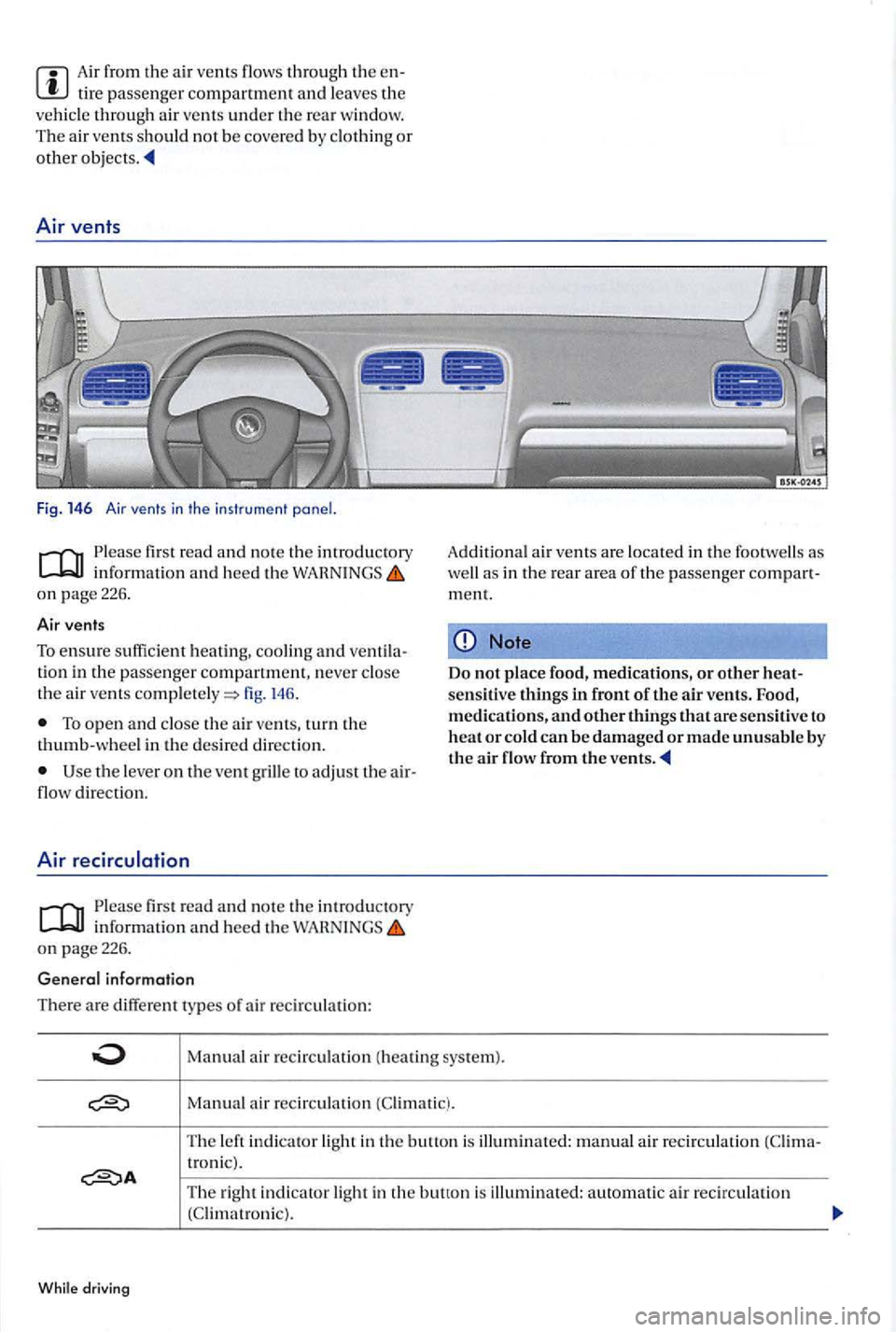
Fig. 146 Air vents in the instrument
Please fir st read and no te th e introductory informati on and heed the on page 226.
Air
vents
To e n sure s uffici ent heating, cooling and ve ntil ation in the passenger compartment, n eve r close the air vents fig. 146 .
To ope n and close the air vents. turn the thumb-wheel in the desired direction.
Use the lever on the vent grill e to adj ust the air
flo w direction.
Air recirculation
Pleas e fir st re a d and note the in trod uctory information and heed the on page 226.
General information
There are different t y p e s of air recirculati on : A
dditi onal air
vents are located in the foorwells as well as in the rear area of the passe nger compart
m ent.
Note
Do not place food, medications, or other heatsensiti ve things in front of the air vents. Food, medications, and other things that are sensitive to
heat or cold can be damaged or made unusable by the air flow from the
Ma nual air re circulati on (h eatin g sys te m ).
Manual air r e circulatio n
troni c).
Th e
right indi cato r light in the is illumin ate d : automatic air recir cul atio n
Page 234 of 541
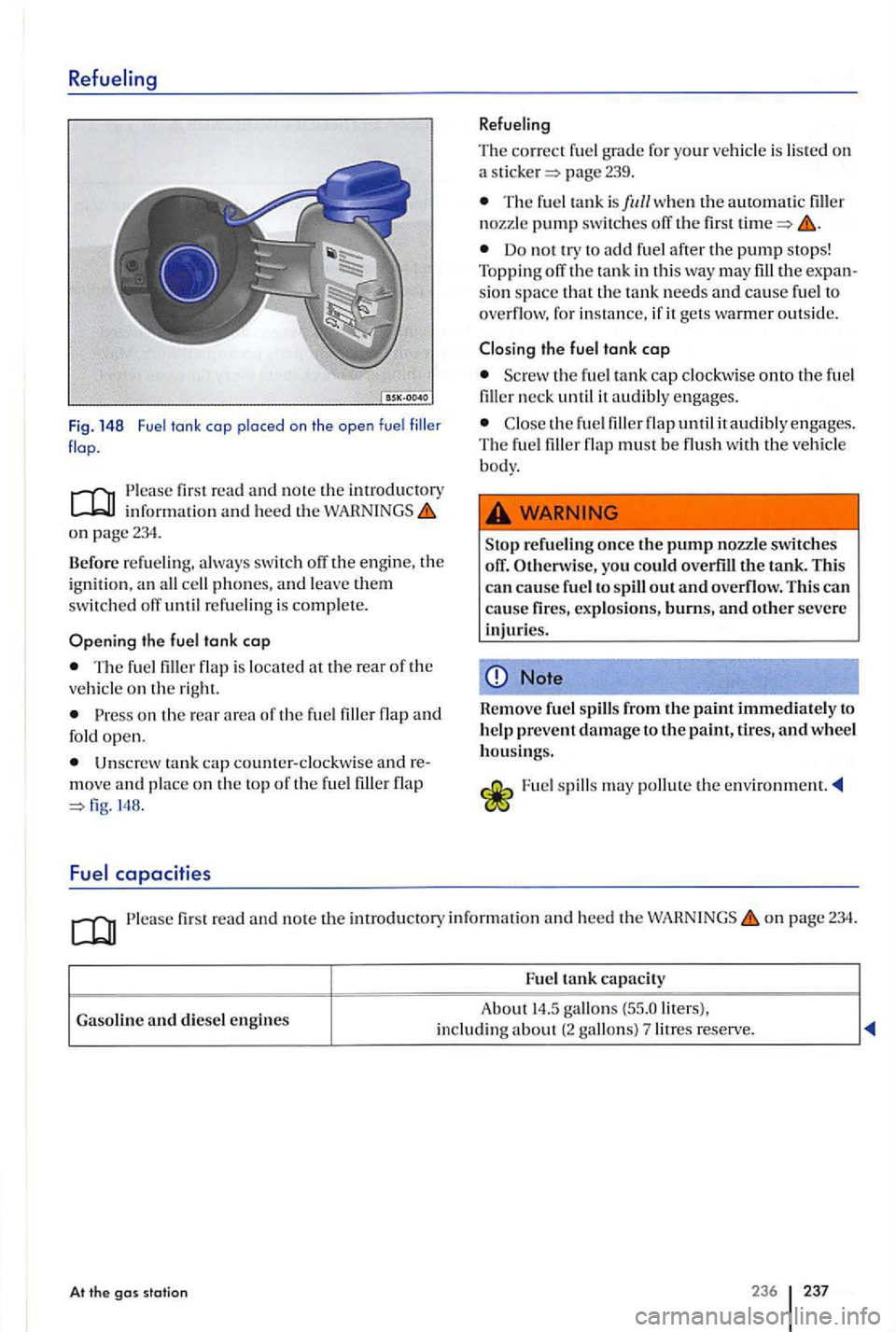
Fig. 148 Fuel tank cap placed on the ope n fue l
Please first read and note the introductory information and heed th e on page 234.
Before refueling, always switch off the eng in e, the
i gnition , a n all cell phones, and leave the m
switc h ed off until refue lin g is complete.
Opening th e fuel tank cop
The fuel filler flap is loca ted at t h e rear of the ve hicl e on the rig ht.
Pr ess on the rear area of th e fu el fille r flap and fo ld open.
flap
capacities
Refueling
Th e correct fu e l grade for your ve hicle is lis te d on a page 239.
The fue l tank is w he n the automatic filler
no zzle pump switche s off the first
Do not t ry to add fu el afte r the pump stops!
Topping off the tank in thi s way may ftll the expan
s ion space that the tank need s and cause fuel to
ov erfl ow, fo r insta nce, if it gets warmer outsid e.
C lo sing the fuel tank cop
onto the fuel filler n eck until it audibl y enga ges.
th e fu el fille r flap until it aud ib ly e nga ges.
T he fuel filler flap must be flu sh with the ve hicle
body.
refu elin g once the pump nozzle switch es
off. you could
Note
Remov e fu el sp ill s from the paint immediately to
h e lp prevent damage to the paint, tires, and wheel hou sing s.
P lease firs t rea d and no te the introduc tory inform ation and heed the on page 234.
F u e l t a
nk capaci ty
A
bout liters ),
i nclud ing about (2 gallons) re se rve . Gaso line and diesel e n g ines
A t th e gas station 236 237
Page 259 of 541
In this section information on th e fol
l owing:
Washing the vehicle . . . . . . . . . . . . . . . . . . . . . . . . . 263
Washing with a power washer ................ .
Cleaning windows
and outside mirrors ......... .
Cleaning
and changing the winds hield wiper
b l
ades .......................
. . . . . . . 267
Cleaning wheel rims . . . . . . . . . . . . . . . . . . . . . . . . . 268
Care of rubber door and window seals . . . . . . . . . 268
De-icing door lock cylinders . . . . . . . . . . . . . . . . . . . 268
Undercoating . . . . . . . . . . . . . . . . . . . . . . . . . . . . . . . 268
Cleaning the engine comportment ....... -. . . . . 269
Regu l
ar and expert ca re helps to preserve the value of your vehicle. expert care may also be o ne of th e requirements of you r New Vehicle Lim ited if co rros ion re pair or repa intin g is neces
s ary.
Veh icle care produc ts avai lable fro m your au
th orized Volkswagen d eale r or A uthorized
Int erio r care and page
Preparations for work ing in the e ngine compage 242
Parts. accessorie s. repair s and modifications
Vehicle care produc ts ca n be dangerous. Im
proper usc c a n cause accid ents, burns, poisonin g, or oth er seri ous persona l injuries.
Alway s sto re vehicle care products only in o rigina l co ntainers that are securely closed.
Alway s read and heed all th e in structions and all o n the pac kag e.
To reduce the risk of poiso ning, never usc empty food or beverage containers that might m is lead someone int o frum
A lways keep vehicl e ca re products out of the reach of childre n .
Never usc fuel, turpentine, eng in e o il, nail poli sh r emov er or ot her vo la til e fluid s for ve
hicl e ca re. They are po isonous and hi ghl y flam
mable.
Improper care and cleaning of ve hicl e component s can impact the safe ty feature s of the ve
hicl e and cause serio us personal injury.
A lways clea n and maintain vehicl e component s according to manufacturer's instructions.
use ap1>roved or recomm ended
clean ers.
Vehi cle care products containing s olvents can damage plastics and other ve hicl e th e material s.
Wash th e ve hicl e only des ig nated was h loca tio ns to preve nt wa ter con
t a minated with oil. grease and fuel from enterin g the storm drain sewe r system. In some are a s it is
a gains t th e to wash motor ve hicles anywhere than other than sp ecified design ated car
was hing locatio n s.
choo se those that are no t harmful to the environ ment.
Never th row out ve hicl e care produ cts with ordina ry house ho ld waste. Always read and hee d all th e in structi ons and on the