rear stop light VOLKSWAGEN GOLF PLUS 2006 Owners Manual
[x] Cancel search | Manufacturer: VOLKSWAGEN, Model Year: 2006, Model line: GOLF PLUS, Model: VOLKSWAGEN GOLF PLUS 2006Pages: 541, PDF Size: 98.86 MB
Page 85 of 541
light does not
come
on ...
the ligh t
vice Facili ty.
The light should
BAG light shou ld come on w he n the ign ition is on and an adult is
the lig ht
co mes on and sta ys on unde r these circ um stances,
mak e sure that :
th e adult on the front passenger seat is
the adult is not we igh t off the seat by holding o n to t he passe nge r assis t handle abov e the front passe nger doo r or supporting their weight on th e armres t o r hold in g onto the ass ist ha ndle on the in strument panel;
t h e safet y belt is be in g properly wo rn and that th ere is no t a lo t o f s la c k in the s afet y be lt webbing;
Access ory seat covers or cu sh ions or other
thi ngs that m ay cause an incorrect reading or pression on the weight-se nsin g mat under the
fir st read and note the introd uc tory inform ation an d heed the on page 80.
Front airbags and how they work
Airbags are only supplem ental restra ints. They are not a substit ute for safety belt s that must be w orn even though th e front seatin g po sitions are equip ped wi th front airb ags. The fron t a ir bags can provid e additional prote ct ion for the chest and head of the drive r and the fr ont seat passe nger when seat s, safety belt s, h ead restraints and, for
th e dri ver, th e s teering wheel, are properly used and have been properly adju sted.
Before driving
the statu s of the Adva nced Air bag has changed whi le the vehicle is moving, the BAG ligh t blinks for about 5 seconds to catch the driver's attention . If this pens, a lways stop as soon as it is safe to do so and check the steps described above.
light does not go ofT when an adult who is not very sm all is sitting on the front passen ge r seat after taking the steps described above, make sure the adult is properly seat e d and restrained a t one of the rear seating
position s.
Have the airbag system inspected by your authorized Volkswagen dealer or authorized Volkswag en
sen ge r seat d ete cts an empty seat, th e front airba g on the passenger sid e will be tu rned off, and the light stay on.
sen ge r safety belt itself is buckled and the front passe nge r seat is no t occupied, the
the air bag sys te m deploys in a collis io n , a
ga s ge nerator fills th e a ir bags that break open the padded cove rs on the steering w heel and th e strume n t panel. The front airbags inflate between
th e s teerin g w heel and th e driver and between th e
in strumen t panel a nd th e front passenger.
Fron t air bag s in combination wit h properly wo rn
sa fety be lt s s low down and limit the occupant's forward movement. Toge ther they help to prevent th e driv er
Page 97 of 541
To reduce the risk of se riou s injury, make sure
tl1at the or
front
p asse nger seat and
SENGER
rized Volkswagen dealer or swagen Service Facility immediately.
light or
on the front passenger seat.
install the child restraint system on the rear seat!
first re ad and note th e introdu ctory
on pag e
Changes in weight on the passenger seat during travel ca n switch the passe nger front airbag on or so that it does no t deploy when it should or deplo ys when it should
o n your la p or trans
port things on the passenger seat. weight registered b y the weight-sensing
Never reduce weight on the passenger seat
by hold ing the handle above the passenger door,
suppo rting body weight on the armrest , or by holdin g th e grab handl e on the instrument panel.
Alway s m ake sure that child restraint s are correc tly regi stered by the weight-sensing mat. If the statu s of tl1e Advanced Airbag System has
changed while the vehicl e is moving, the SENGER light blinks for about 5
seconds to catc h the dri ver's attention. If this happens, always stop as soo n as it is safe to do so and check t o make sure that the airbag on/off status is correct for the passeng er riding on the
front passe nger seat
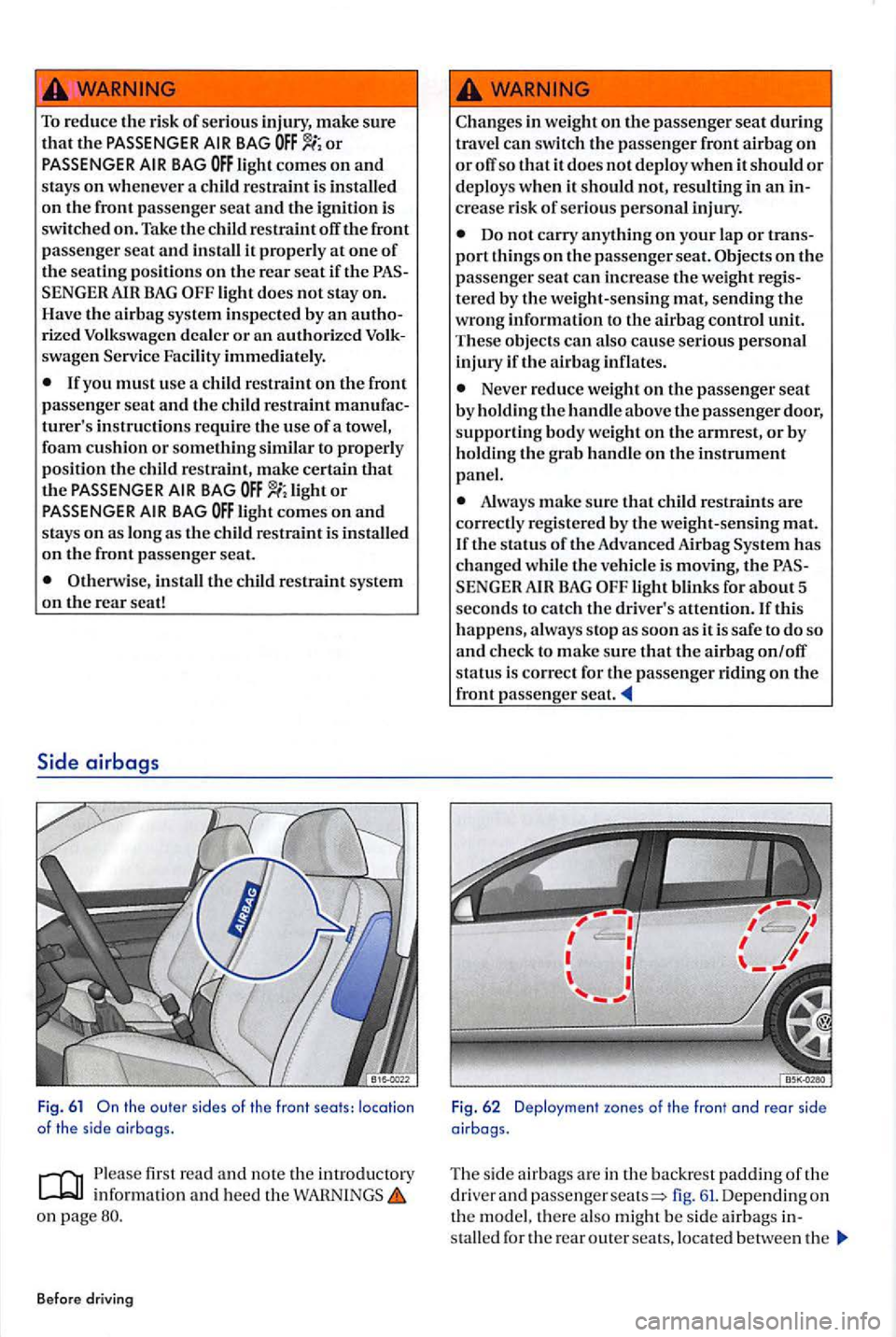
Fig . 62 Dep loymen t zones of the front ond rear side
o irbogs.
Th e side airbags are in th e ba ckre st paddin g of the
drive r a nd passe nge r fig. 61. Dep endin g on
t h e model, th e re al so migh t be side airb ags
Page 154 of 541
Never drive fa ster than mph mph -
Never try to stop the swaying by accelerating.
fir st read a nd note the imroductory informatio n and heed the on page
If the ve hicle was fac tory-equipped with a trail er
hi tch, all technical and lega l require m em s fo r
trailer towi ng have already been m et.
use a trai le r hitc h w hich is approve d for the
g ro ss wei ght rating of the trailer yo u want to tow. The hit ch mus t be s uitabl e fo r your vehicle and
tr ailer and be securely bolt ed to the ve hicle's chassis. use a trail er hitc h with a re movable ball mount. Alway s check and follow the trail er
hi tch manufacturer's information. Neve r in stall a o r tra ile r hitch on yo u r vehicle.
D o n
ot use a bumper-mounted trai le r h itch
Never insta
ll a trailer hitch on the bumper o r or on th e bumper mountings. The traile r hit ch mus t not in terfe re wit h the impact-absorbing bumper syste m . D o not make any changes to the ve hicl e exhaust and brake sys te m s. From time to time, check that all hitch m oumin g bolts are securely fas ten ed . W hen not towing. re m ove the trailer hi tch. Thi s help s ke ep the hitch from causin g damage if your ve hicl e is hit from behind.
Eng ine cooling syste m
Tow ing a tra
iler makes the e ngin e
If you arc dri ving a new ve hicle or ave-do not tow
a t railer
mil es
need
load it h as to pull.
When you are not towin g, remove the trailer
models need trail er hit ch to tow or tow -s tart other ve hicl es. may
Trailer brakes
If your trail er has its own brake s, make sure it
meet s all regulati ons. Th e trailer bmke sys te m
mu st never be directly connecte d to the ve hicle's brake system .
Safety c
hain s
A lways u
se safety chains be tween yo ur vehicle and
th e trailer.
Trail er rear lights
Tra
ile r lights must meet all regulation s.
Neve r
connect the tmil er l ights directly to the e lec
trica l s ys tem of your ve hicl e. Be su re to check wit h
your authorized Volkswagen dealer or authorized Volk swagen Faci lit y about correct w iring, sw itches and re lay s.
Outside mirrors
I f
the s ta ndard ou ts id e mirror, addition al outs ide m irrors are needed and required b y law in so me coumrie s I states I provin ces. The o uts id e
mirr o rs mus t b e adjuste d b efore driv in g and g ive good v iew to the rear.
Max im um power consump tio n f or th e trailer
D o no t excee d the power ratin gs liste d in the chart below.
E l
ectrical consumers power con-sumptio n
Taillight s
Turn signals pe r sid e 54 wat ts
Page 180 of 541
Shifting
Introduction
In this section you'll find information on
. . . . . . . .
Pedals . . . . . . . . . . . . . . . . . . . . . . . . . . . . . . . . . . . . . . 181
Manual transmi ssion: Gearshift lever . . . . . . . . . . . . 182
Automa tic transmission: Selector lever . . . . . . . . . . . 182
with Tiptronic . . . . . . . . . . . . . . . . . . . . . . . . . 185
Driving with automatic transmission . . . . . . . . . . . . . 186
E xplanatory no tes in thi s chapter also apply rect Gearbox.
When the ignition is switched on and th e
T he backup light comes on.
Th e air co nd itionin g sys te m sw itch es ically r ecirculat ing air verse.
The rear window wiper swi tches on when
sis t sys te m , a nd camera For
Instrum em s
Brak ing, and
D is tance
H everse driving assista nl (Rea r Assist)
Clima te comrol
Eng in e contro l and emission cont rol sys tem
Eme rgen cy closi ng and page 322
accelera tion can cause skidding and loss of t ract ion, especially on slipp ery roads, sulling in loss of vehicl e control , collision s,
and seriou s personal injury.
kick -d own feature or fast ti on onl y if vis ibility, weather, road , and traffi c
co nditi ons permit.
Neve r
or apply the p edal often or lo ng. Constant brakin g ca uses the brakes to over hea t. This subs ta nti ally duce performance, increase stop1> ing
d is tance, and cau se complete failure of th e
Note
Neve r the brakes by keeping your foot
o n brake ped al when you do not want to brake.
Thi s
Before driving downhill , es peci all y on that are lon g or steep, alw ays reduce speed an d into lower gear (manual or auto mati c mission) so that th e engin e help s to brake hi cle. Otherwi se, th e brake system could over hea t and possibl y fail. use th e when yo u
n eed them slow v ehicl e dow n more or
Page 191 of 541
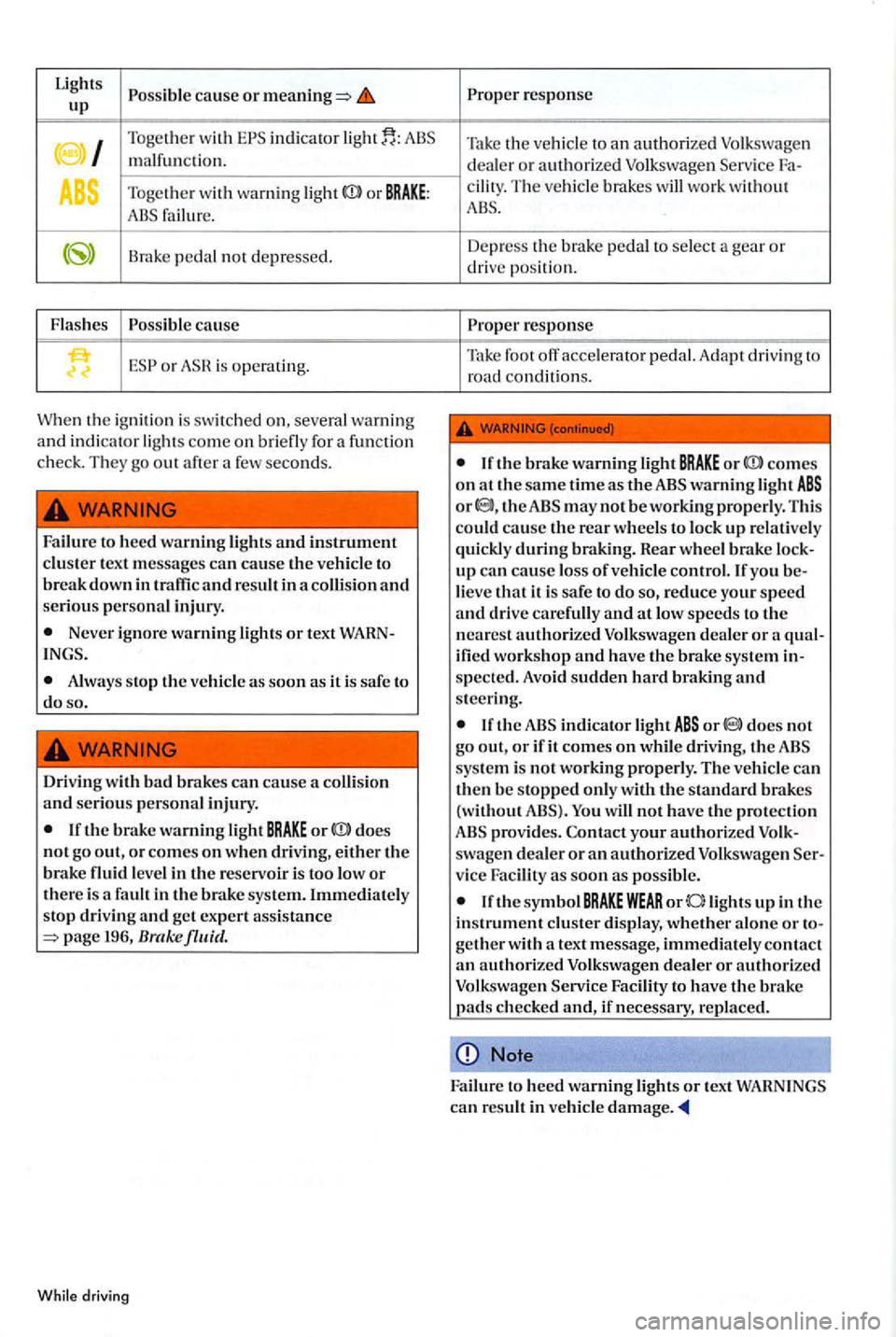
Lights cause or up
I
Together w ith indicator
m alfun ction.
T oge th
er with warning light
cause
or is opera ting.
W hen the ig nition
is sw itched on,
light s and instrument cluster text messages can cause the vehicl e to
break down in traffic and result in a collision and serious personal injury.
Never ignore warning light s or text WARN
Always stop the vehicl e as soon as it is safe to
do so.
Driving
with bad brake s can cause a collision and serious p ersonal injury .
does
not go out, or co mes on w hen driving, either the brak e fluid leve l in the reservoir is too low or there is a fault in the brake sys tem. Immediately
s top driving and get expert assista nce
response
Take the veh icle to an authori zed Volkswage n
d ealer or authori zed Volkswagen Service Fa-The ve hicl e brake s will work without
response
foot off accelerator pedal. Adapt driving to road conditi ons.
If the brake warnin g light BRAKE or co mes on at the same time as the warning light or th eABS may not be working properly. Thi s
could cause th e rear whee ls to lock up re latively
quickly during braking. Rear wheel brake lock
u p can cause loss of veh icle control. If yo u be
lieve that it is safe to do so, reduce your speed and d ri ve carefully and at low speeds to the neares t authorized Volkswagen dealer or a qual
the indicator light or does not go out , or if it comes on driving, the sys tem is not workin g properly. The vehicle can th en be stopped onl y with the standard brake s
(wi thout ABS). w ill not have the protection provides. Contact your authorized Volk
swage n dealer or an authorized Volkswagen vice Facility as soon as possib le.
lights up in the
in strument cluster display, whether alo ne or to gether with a te xt message, immediately contact an authorized Volkswagen dealer or authorized Volkswage n Facility to have the brake pad s ch ecked and, if necessary, replaced.
Note
Failure to heed warning lights or text WARNINGS can re sult in vehicle damage
Page 192 of 541
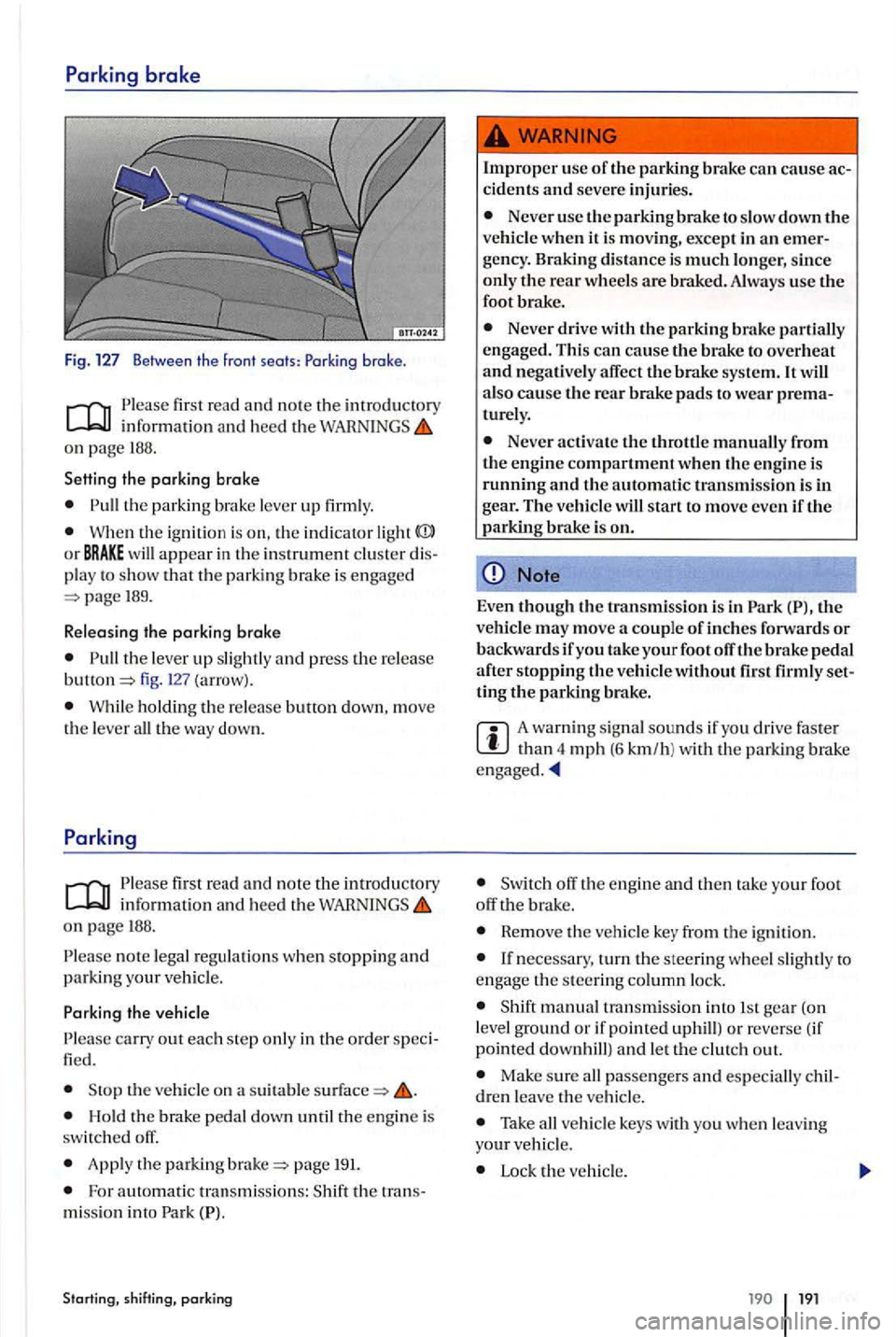
first read and note the imrod uctory
on pag e 188.
Setting the parking brake
the parkin g br ake lever up firml y.
Wh en th e ignitio n is on, the in dicator light
189.
R e leasing the parking
brake
the lever up slightl y and press the release fig. (arrow).
W hil e ho ldin g th e re lease butt on down, move
t h e leve r all th e way down.
info rmatio n and hee d th e on page 188.
n o te lega l regulations when stopping and parking your veh icle.
th e vehicle on a suitabl e
Hold th e brak e pedal dow n until the engin e is
switc h ed off.
App ly the parking page 191.
Fo r a utomatic tra nsmiss ions: th e tra ns
mi ssio n in to Park
Starting, shift ing, parking
Improper use of the parking brake ca n cause ac cidents and seve re injurie s.
Never use the pa rkin g brake to slow down the ve hicl e when it is moving , except in an emer
gency . Braking distance is much longe r, since only the rear wheels are brak ed. Always use the
foot brake.
Never drive with the parking brake partiall y
engage d. Thi s can cause the brake to overheat and negatively affect the brake syste m. It also cause the rea r brake pads to wea r prematurely.
Never acti va te t he throttl e manually from
th e e ngin e compartment when th e engine is running and the automatic tra n smissio n is in gear. The ve h icl e w ill start to move eve n iftl1 e parking brake is on.
Note
Even t11ough the transmi ssio n is in th e
ve hicl e may move a couple of inches forward s or backwar ds if you take your foot off the brake pedal after s toppin g the vehicle without set
ting tl1e parking brake.
A wa rning sig nal sounds if yo u driv e faste r th an 4 mph (6 km/h ) w ith th e parking brake
off the engin e and th en tak e yo ur foot
off brak e.
Rem ove the veh icle ke y from th e ign ition .
manual transm iss ion in to 1 st gea r (on
l evel ground or if pointed uphill) o r re ve rse (if
point ed
Make sure all passengers and esp ecially children leave th e ve hicle.
Take all ve h icle keys with you w he n le a vin g your ve hicl e.
Lock the ve hicl e.
19 1
Page 200 of 541
Efficient driving
Please information and heed the on page 198.
Shifting faster
As a rule, the following applies: The higher gear is
a lways the more efficient gear. The rule of thumb for most vehicles is to drive in 3rd gear at mph f km/h, 4th gear at 25 mph f km/h, and 5th gear at mph f km /h.
If
and driving conditions permit, gears when upshifting also saves fuel.
Do
not run the gears up to their limit.
mati c transmissions .
Vehicles with gear recommendation aid in fuel fic ient dri ving by indicating the optimum time to shift gears.
livery to the engine is interrupted, which lowers
fuel consumption.
T herefore, when nearing a red stop light , for s tanc e, allow the vehicle to coast without using the accelera tor. Press the clutch pedal and release it only if the v ehicle is moving too slowly or the coasting distance is too long. The engine will then continue to run at idl e.
In situati ons
where the vehicle will be stopped for
a longer period of time, such as at a train cros sing,
physically switch off the engin e.
D efens ive driving
and with traffic
Fre
quent braking and accel eration increases fuel consumption sign ific antly. Just by driving sivel y and keeping a su fficiently large distance away fro m the vehicle in front of you can make up for the speed fluctuation s caused by taking your foot off the accelerator. Active braking and ating is then not necessarily required.
system information
The power stee ring syste m i s not hydrauli c.lt is an electro-mechanical syste m. The advantage of this
s te ering system is tha t no hydra uli c hoses, draulic oil, pumps, filters or other parts are quired . Th e e lectro-m echanica l system is more fue l effi cient. A hydraulic system requires constant oil pressure in the syste m; an electro -mechanical
s teerin g sys tem, however, needs power only whil e
s teering.
Th e el
ectro-mechanical power steering
chanical power steering works only when the gin e is running.
and smooth driving
Consistency is more important than speed. The more smoothly yo u drive, the less fuel the vehicle consumes.
When driving on the highwa y or freeway, a
stantly accelerating and braking. you can r each your destinatio n just as quickly by driving at a moderate, but steady speed.
The c rui se control syste m can a ssis t in
sciou s manner.
Some dev ices can increase fuel consumption when activated (examples):
C limate control air conditioning system:
trasting temperatures, it requires a large amount of energy, which is generated by the e ngin e. T he
tr emely different from that of the outside
windows increase fuel consumption.
Switch off seat heating once it has served its
purpose.
Sw itch off the windshield and rear window
Malfunctioning engine control.
Driving in the mountains.
Towing a trailer .
page 257
Towing and page 357
Turning the steering wheel is very hard when the power steering system is not working. This makes it harder to control the vehicle.
steering works only when the engine is running.
Never let the vehicle coast with the engine switched off.
Never remove the key from the ignition
switch while the vehicle is moving or rolling to a
stop. The steering column will lock and you will be unable to control the vehicle.