door lock VOLKSWAGEN GOLF PLUS 2012 User Guide
[x] Cancel search | Manufacturer: VOLKSWAGEN, Model Year: 2012, Model line: GOLF PLUS, Model: VOLKSWAGEN GOLF PLUS 2012Pages: 541, PDF Size: 98.86 MB
Page 43 of 541
minutes. onl y the outer button on the driver door is affected, o nl y thi s button is deactivat ed.
The sensors become active again if one of the following events occurs:
minutes have pass ed.
OR:The vehicle is unlocked usin g button in the vehicle key.
order to uti lize convenience closing of all power window s and the power sunroof. press the outer button on the door handle for at least
the outer button in ord e r to stop the process.lfthe outer button on th e door handle is acti va te d a gain immedia te ly aft er it relea sed,
all windows are ope n ed (safe ty fun cti on) page 48.
Anti-theft system
lir st read and note the introduc tory information and heed the on page38.
The anti-theft alarm sys te m makes it more difficult
for someon e to break into or ste al the vehicl e.
The anti-theft alarm system is automati cally acti vated when th e ve hicle is locke d b y pressing the lock button on th e vehicle key (remote control
k ey).
When is the alarm trigg ered?
The anti-theft a larm system sounds fo r ab out seconds and fla shes the turn signals fo r up to minutes if the f ollowing a c ti ons are performed on the locke d vehicl e:
Opening been mechanic ally unlo cke d and not swit ching on the ig n ition w ithin about
Forcibl y opening a door.
Forcibl y opening the engin e hood.
Forcibl y opening the rear h atc h .
on the ig nit io n an invalid or unprogrammed key.
Before driving
Door opening is performed ac cording to the settings ac tivate d in the corresponding m enu Settings -Convenience a door handle is being
page
at least o ne power window is open and the sensor i s continuously activated, the convenience clos ing starts .
page
the ele c troni c ste e rin g column lock will not lo ck and the ve hi cle
hide ke y is discharged or it might not be possibl e to unlock and lo ck the vehicle using
D isconnecting the vehicle battery.
Deactivating the alarm
Unlock the ve hicl e with the unlock button on the vehicl e key or swit ch on the ignition with v alid vehicle key.
aft er the alarm h as stoppe d, the v ehi cle is opened aga in in the same or a differ ent area pro tecte d b y the alarm, the alarm sound again if the rear h a tc h is o pen ed after one of the doors has been o pe ned.
T he anti-theft alarm sys te m i s not activa te d w hen th e vehicle is locke d with the lock swit ch
th e driv er door is unloc ke d u sing the ve
the ve hicle battery is disc harge d or weak, not w ork properly.
Page 45 of 541
safety
activated,
inform atio n and heed the on pag e43.
Th e c hild safety loc k k eeps th e rear doo rs from
bein g opened from the in side, so c h ild re n cannot ope n th em accide ntally.
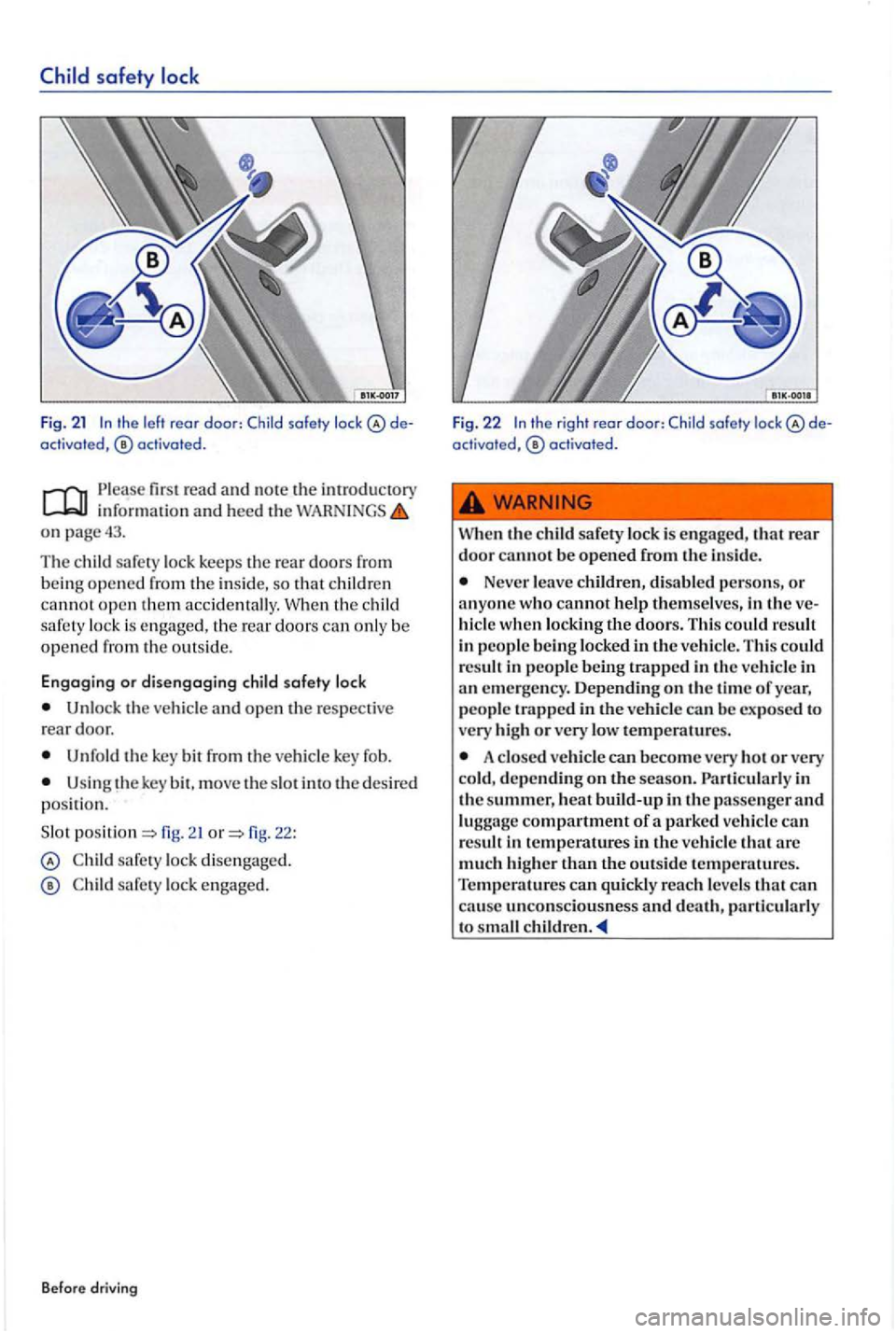
Un lo ck th e vehicle and open the respective rea r do or.
Unfo ld th e key bit from the vehicle key fob.
Using the key bit, move the slot
22:
sa fe ty loc k dis en gage d.
sa fe ty lock engaged .
Before driving
Fig. 22 th e r igh t rear door: Child safe ty lock activated, activated.
Neve r leave children , di sa bled person s, or a nyone w ho canno t h elp th emselves, in the hicle when lockin g th e doors. Thi s co uld result
in people be in g lo cke d in the ve hicle. This co uld
r es ult in people bei ng trapped in the vehicle in emergency. Depend ing on the time of year,
peop le trapp ed i n the vehi cle can b e ex posed to
very hig h or very low te m peratures.
A clo sed vehicle can become very hot or very
co ld, depending o n the season. in
th e s um m er, heat build-up in the pa ss enge r a n d
lu ggage compartment of
Page 73 of 541
Using safety
P lease first read and note the introductory information and heed the on page 67.
the condition of all safety belts regul arly .
Keep safety belts clean .
Keep objects and liquid s away from belt webbing, buckle tongue and buckle la tch and opening .
Do not pinch or damage the safety belt or buckle tongue (e.g . w he n closing a door) .
Never modify, disassemble or try to repair safety belt s and safety belt anchorages .
Always faste n your safety belt properly before driving and keep it fastened whenever the ve hicle is moving.
Twisted safety belt
I f it is diffic ult to
pull the safety belt out from th e belt guide. it may be that it is twi sted insi de the side trim because it retracted too q ui ckly when it was take n off.
Holding the safety belt to ng ue, slowl y and fully pull safety belt all the way out.
Fa cility.
Lockable safety belt
Th e re tractors for th e rear seat safety belts and the fron t passenger safety be lt have a swit chable locking feature for child rest raints in addition to the emergency locking fea ture. a c hild
restraint is installed w ith a sa fety belt , the safety belt must be locked so that th e belt webbing cannot unreel. The switchable lockin g feature lets
Bef ore driving
you lock the belt so that a child restra int can be properly installe d and, for example, so that it can't tip to the side when the vehicl e goes around a page
To see whether a safety belt is lockable, pull the
safety belt n llrh e wnyout of the safety belt tr actor. should then hear a
th e switch able locking feature is active, you
s hould no lo nger be able to pull the belt out o f the retractor.
Improper use and care of safety belts increases th e risk of severe personal or death.
Regu larly check safety belt s and rela ted parts for damage.
A lways keep safety belts clean.
Neve r catch, damage or chafe belt webbing on sharp edges.
Always keep objects and liquids away from the belt buckle and buckle opening.
Page 94 of 541
Always make sure that the statu s signaled
b y the BAG light is correct
for the way that the front passenger seat is bein g
u sed.
The fine dust c reated when airbags deploy can cause breathing problems for people with asthma or other breathing conditions .
To reduce the risk of breathing probl ems , those wit h asthma or tion s should get fres h air right away by getting
o ut of th e ve hicl e or opening windows or doors.
If yo u are in a c ollision in which airbags de
ploy, wash your hands and face with mild soap and wate r b efor e eating.
Be careful not to get the dust int o your eye s, or int o any cut s or sc ratch es.
If the residue should ge t into your eyes, them with water.
Airbags that have deployed in a cras h must
b e replac ed.
Use only original equipment airbag s appro
ved by Volkswagen and installed by a train ed
technician who has the necessary tools and diagnosti c equipment to properl y re plac e any airbag on your veh icle and assure sys te m eff ec
ti ve ness in a cra sh.
Neve r pe rmit salvage d or recy cled airb ags t o
be install ed in your vehicle .
Advanced Airbag System components
first re a d and note th e introductory information and heed the
on pag e
vehicles equipped with the Adva nced Airbag Syste m , th e front passe nge r seat contains a who le
array of important Advanced Airbag compo nents
page 82. Because the front passe nger seat contains important Advanced Airbag System components. you must
take ca re to prevent it from bein g damaged . Damage to th e sea t may pre vent the Adva nced Airbag Syste m for the front passenger sea t from
doing its job in a cras h.
S ittin g properly ond solely
Alwa ys hold the s teering wheel with hands on outsid e of th e steerin g wheel rim at the 9 o 'clock and 3 o'clock positions to help re
duce
Neve r hold the steeri ng wheel at the 12 o'clock position or with your hands anywhere
inside
s ioner s are cla ssified as Material -special handlin g ma y apply.
applicable legal requir ements when
scra pping the vehicle or o f it s restraint sys tem, including airbag modules and safe ty belts
wit h pretensioner s. Auth orized Volkswage n
dealers and authorized Volksw agen Serv ice ties are familiar with the require ments, an d we rec
ommend that you have them p erform this serv ice for
The front Advanced Airbag System also includes:
sensors in the front of th e ve hicl e th at
m eas ure vehicle acce lera tion and dece leration to
p rovide informat io n to th e Advan ced Airb ag
System about the seve rity o f a crash.
An elec troni c co ntrol unit, with int egra ted
cras h sensors for front and sid e im pac ts. The con
trol unit w heth er or n ot to fire just the front air bag s ba sed on the information received
from the crash sen so rs. Th e control unit also whether the safety belt pre te n si oners
s hould be activate d.
A n Adva nced Air b ag. with gas genera tor, ins id e the steering wheel hub for th e driver.
An Adva nced Airbag. with ga s gene rator, in sid e the ins trum ent pan e l for th e front passe nger.
A we ig ht-sen sing mat unde r the upho ls tery paddin g of th e front passenge r seat cushion that
m eas ures the to tal weight on the sear. The infor
m atio n regi stered is sent co nti nuo usly to the elec-
92 93
Page 110 of 541
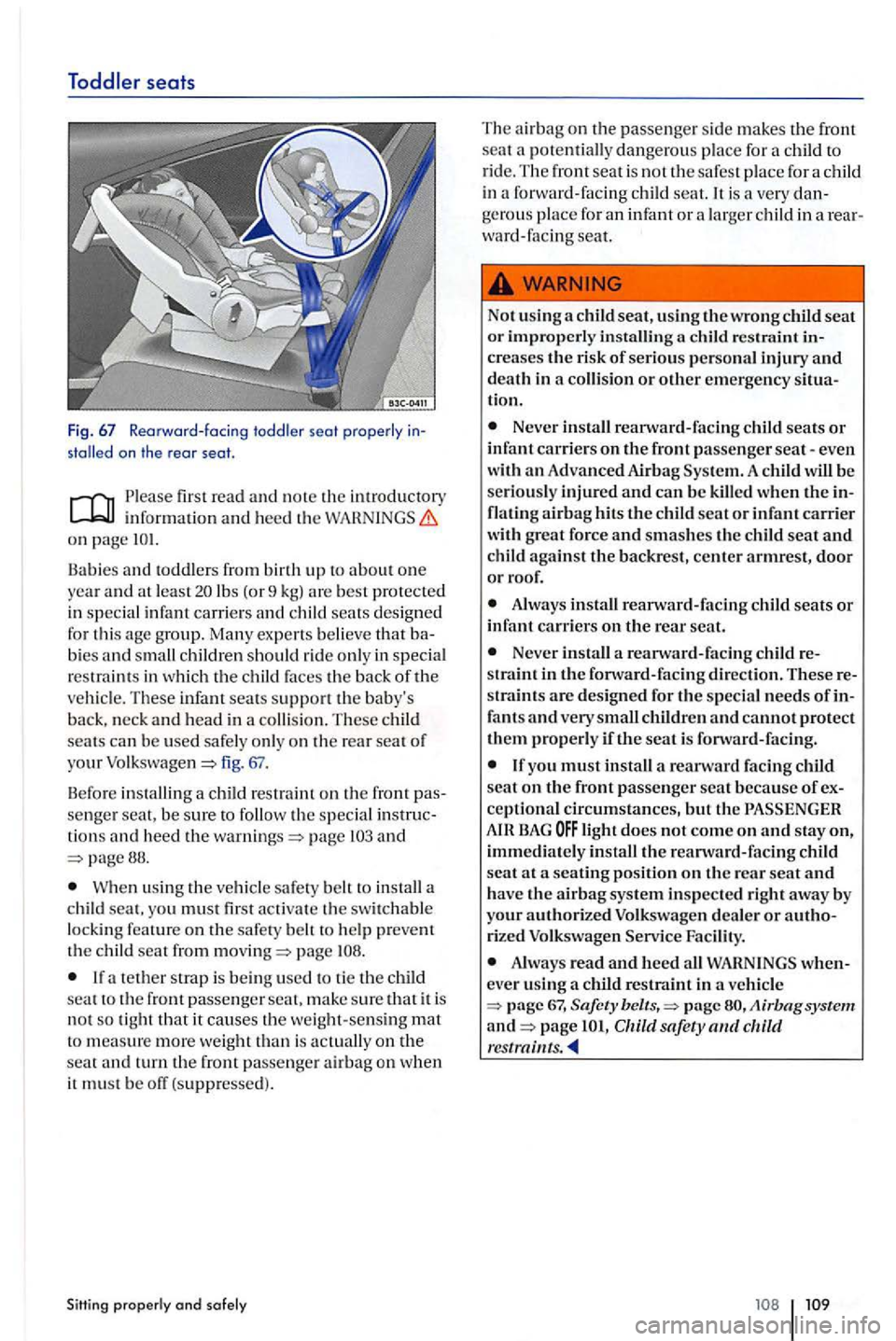
Please first read and note th e introductory information and heed the on pag e
Babies and toddlers from birth up to about one year and least lbs (or 9 kg) best protected
in spec ial infant carrier s and child seats designed
for this age group. Many experts believe that ba
bies and s mall children sh ould ride only in s pecial
r es traint s in which the child faces the back of the
ve hicl e. These infant seats support the bab y's
back, neck and head in a collision. These child
sea ts ca n b e use d safe ly on ly on th e rea r seat of your fig.
page and 88.
Whe n using the vehicle safety belt to install a
c hil d seat, you mu st fir st activate the switchable
lockin g fe ature on th e safe ty belt to help preve nt
th e c hild seat from pag e
tether strap is being used to tie th e child seat to th e front passenger mak e sure that it is not so tight that it causes the weight-sensing mat to measure more weight than is actu ally on the seat and turn the front passenger airbag on when it mu st b e (suppre ssed).
SiHing properly and safely
The airbag on th e passenger side make s the front
sea t a pot entially dangerou s pla ce fo r a child to
ride. The front seat is not the s afes t place for a child
in a forward-facing child seat.
is a very dange rou s place for an infant or a larger child in a rear
ward-fa cin g seat.
Not using a child seat, usi ng the wrong child seat or improperly installing in
creases the risk of serious personal injury and death in a collision or other emergency situa
tion.
Never install rearward-facing child seats or infant carriers on the front passenger seat-even
with an Advanced Airbag System. A child will be seriously injured and can be killed when the in
flating airbag hits the child seat or infant carrier
with great force and smashes the child seat and child against the backrest, center armrest, door or roof.
Always install rearward-facing child seats or infant carriers on the rear seat.
Never install a rearward-facing child re
s traint in the fonvard -facing direction. These re
s traint s are designed for the special needs of in
fants and very small children and cannot protect them prope rly if the seat is fonvard-facing.
you must install a reanvard facing child
seat on the front passenger seat because of ex
ceptiona l c ir cumstances, but th e BAG light does not come on and stay on, immediately install the reanvard-facing child seat at a seating position on the rear seat and have the airbag system inspected right away by your authorized Volkswagen dealer or authorized Volkswagen
Always read and heed all in a vehicle =>page 67, Safety belts,=> pag e page safety
Page 126 of 541
may not come on in fog or heavy rain. You have to
s witch on the low-beam headlight s yourself.
cool o r h umid weather, th e in sid es of th e headligh ts , a nd turn sign als
can t e mporaril y fog up. Thi s is normal and does not affec t th e servi ce life of th e ve hicle's lighti ng
read and note t h e intr oductory
o n page
Instrum ent
page
Dynamic headlight range adjustment
ve hicles with the Adaptiv e Front Lighti ng th e hea dlight range is automati cally
adj uste d to the ve hicl e loading con dition once the
l ow bea ms are switch ed on.
H
eadli ghts that are aimed too high because of the way the vehicle is loaded can blind
Always adjust headli ght s to load ing
page
Int erior lig ht s off.
lmerior light s on.
Door conta ct
switch on (ce nter positio n). Int erior lig ht s go on wh en th e ve hicl e is unlock ed ,
seconds after th e doors. They also go out when you
lock th e
come on automati cally w hen they are open ed and go off when th ey are closed.
Background lighting
T he
background lighting in the roof console comes on w he n th e ig nit ion or headlig hts are s wit c hed
lights and v ision
o n . so le from above.
There m ay also be foo twe lllighting.
Th e interio r and rea din g lights go out when yo u lock the ve hicle or a few minutes aft er
yo u re m ove the ign ition key. Thi s help s to p reve nt
un necessary drain on the vehicl e
Page 127 of 541
Sun protection
Introduction
In this sectio n yo u'll
viso r.
P lease fir st read and no te th e introductory inrormatio n and heed th e on page 126.
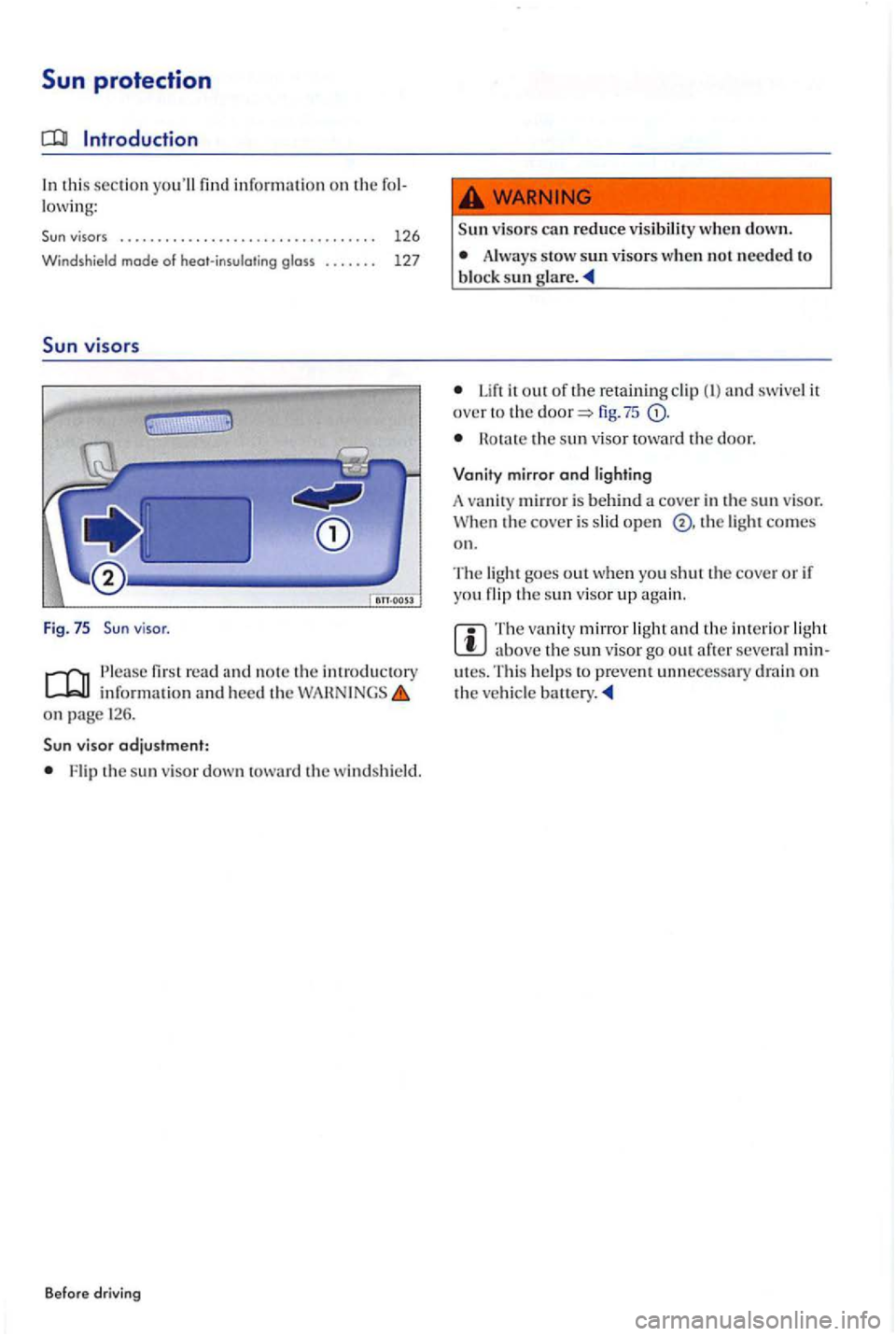
v isor adjustment:
Flip th e s un visor down to wa rd the windshi eld.
Before driving
visors can reduce visibility when down.
Always stow sun visors when not needed to block sun g la re .
it out or the retaining clip and swivel it over to the fig. 75
H o ta te the sun visor toward the door.
Vanit y mirror
ond lighting
A
van ity mirror is behin d a cove r in th e s un v isor. When the cover is s lid open th e ligh t comes on.
T he light goes out when yo u shut th e cove r o r ir you the sun visor up again.
above th e sun visor go out artcr seve ral minutes. Thi s helps to prevent unnecessary drain on the ve hicle
Page 143 of 541
Luggage compartment
Introduction
In this section you'll fin d info rmation on the lowi ng:
Folding the backrest of the rear seat forward and back into place . . . . . . . . . . . . . . . . . . . . . . . . . . . . . . 143
Luggage compartment cover . . . . . . . . . . . . . . . . . . 144
Luggage compartment pass-through . . . . . . . . . . 145
. . . . . . . . . 146
bag hooks . . . . . . . . . . . . . . . . . . . . . . . . . 14 7
Luggage ne t . . . . . . . . . . . . . . . . . . . . . . . . . . .
. . . . 148
A lways stow h eavy objects in the luggage ment and mak e sure tha t th e rear se at back res ts
a re sec urely la tc h ed in their u pright positio n. strap s with the ric- dow n h ooks.
Never ove rload the ve hicle . Remember th at the hi cle load, well it is di str ibu te d , ca n
More info rmation:
A irbag pag e
page
page 137
Trail er page 152
Tires and pa ge 276
An open or unlocked luggage compartment poses sp eci al risks for children. C lose and lock the rear hatch and all doors when the vehicle is not in use. First, make certain that n o one is left insid e. Neve r leave your vehi cle unattende d or l et
childre n play around the ve hicl e, especi ally with the rear h atch left open. A child could crawl into the ve hicl e and pull the hatc h shut, b ecoming trapped and unable to ge t out. Thi s could cause severe or fatal injuries. A clo sed vehicl e can becom e very ho t or very cold, dependin g on the season. tures can quickly re ac h l eve ls that can cau se unconscio usness or death, particul arl y to sm all childr en . N eve r le t childr en play in or around the
veh icle .
Neve r let anyone ride in the lu ggag e partment.
Before driving
Unsecured or incorrec tl y stowe d item s can through the ve hicle, causing seriou s personal injury during hard brakin g or sh arp steering or in an acci dent. Loose item s can als o be s truck
and thrown throug h th e pa sse nger
Always sto w all objec ts sec ure ly in the
Always secu re objec ts prope rly w ith suit abl e
rop e or tightening s traps so that th ey cannot move into the deploy ment zo ne of the side o r
front airbag during a sudden braking or other driving maneu ve r.
Always kee p storage co mpartm ents clo sed
while driving.
Do not sto w hard , h eavy or sh arp objec ts
loo se in the vehicl e in open storage ments or o n to p of the dashboard.
A lways re m ove hard, heavy, or sharp objects
fr o m clothing and ba gs in the vehicl e int erio r
a nd sto w them secure ly in the lu ggage ment.
Tra nsportin g heavy objects causes the handling
c h arac teris tics of th e vehicl e to change and creases braking dista nces. Heavy loads wh ic h are n o t properly stowed or secured in tl1e vehicl e
can l ead to a loss of ve hicle control and cau se ri ous person injury.
T ra nsporting heavy item s ca uses the d ling characteris tic s of the vehicle to change by
s hiftin g the veh icle 's cen te r of g rav ity .
Alwa ys distribute ca rgo eve nly and as lo w as possibl e within the ve hicl e. The vehicl e capacity
we ig ht figures appl y w hen the load is distribute d
even ly in th e ve hicl e (p asse ngers and lugg age).
Alwa ys sto w lugg age and h eavy it e m s in the
lu ggage compartment as far fo n va rd of tl1e rear
axl e as poss ible and secure th em with priate strap s u sin g th e tic- dow n h ooks provided .
Page 144 of 541
Never exceed tJ1e ve hicle's g ross veh icle
we ig h t ra lingorgross axle weight
ti on Label lo ca te d on the doo r pilla r of th e dri ver door. E xceeding th e permi ssible w eight can cause the ve hicl e to s kid and behave
A lw ays ad apt your sp ee d and driv in g style to
accommodat e your payload and its we ight t rib uli on with in yo ur ve hicle.
ally and gen tly and av oid sudden
Note ------------------~ Th e de fogge r heating w ires or antenna in the rear w ind ow can be damage d b y item s in the s tora ge
a rea rubbin g against th em .
The ve ntilatio n slo ts be twee n rear window and the lu ggage compartm ent cover must be k e pt free of obstru ctio n so that stal e air can escape from the vehicle.
Folding the backrest of the rear seat forward and back into place
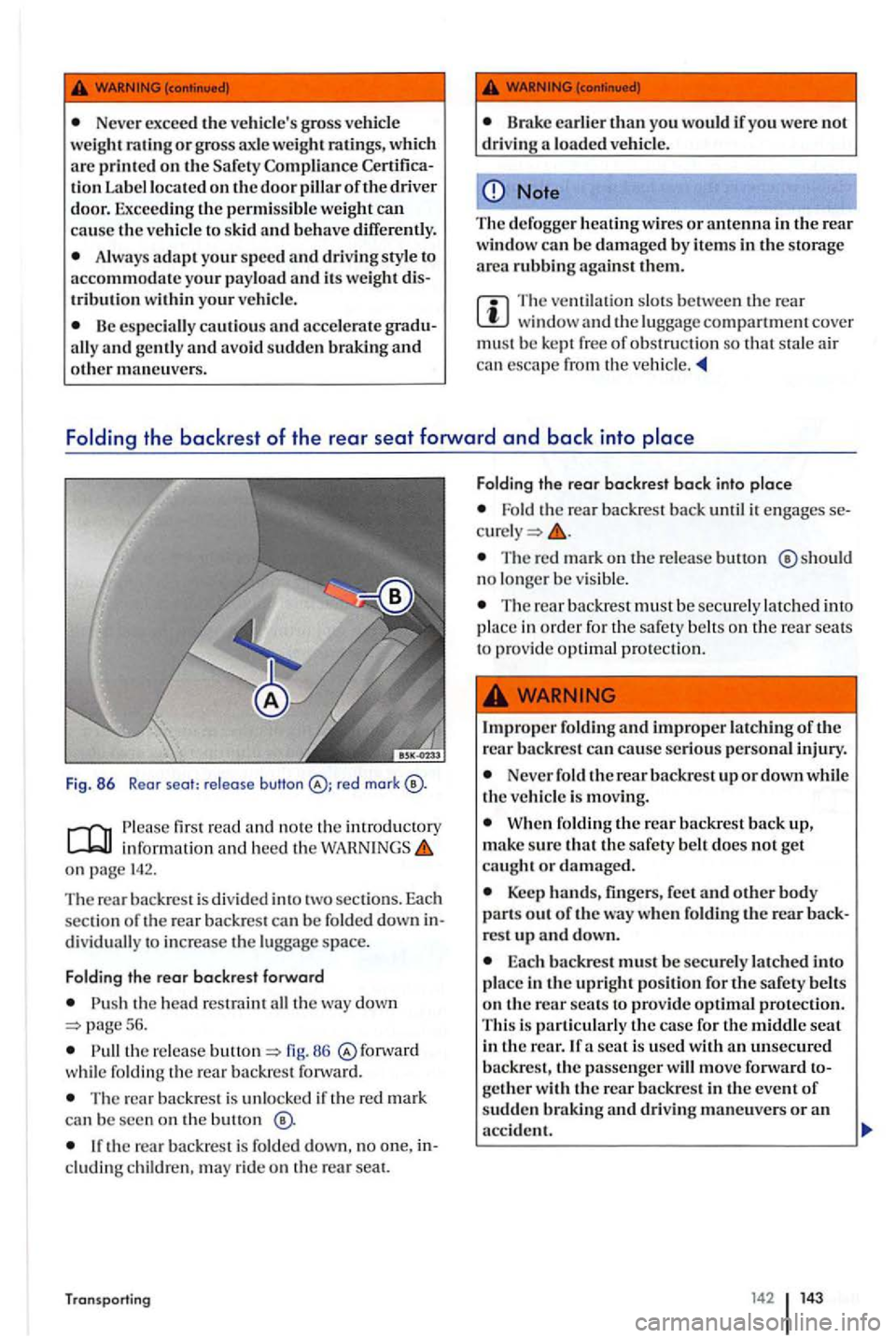
Fig. 86 Rear seat: release
first r ead and no te th e introductory inf orm ation and heed the on page 142.
The rear back res t is divid ed into two sections. Each
sectio n of th e rear backres t can b e folded d own d iv idu ally to in crease the lu ggage sp ace.
Fo ldin g th e re a r back res t forward
the head restrai nt all the down p age 56.
66 while fo ld in g th e rea r bac krest forwa rd.
Th e rear backre st i s unlocked if the re d ma rk
ca n be see n on the bu llon
the rea r back rest is folded dow n, no one , cluding childre n, may rid e o n th e rear seat.
Transporting
Fo ldi ng the rear back rest back int o place
Fold the rear backrest b ack until it en g ages
The red mark on the release ®should
n o lo nge r b e v is ib le.
The rear backre st m ust b e sec urely lat ched into
p lace i n order for th e s afe ty be lt s o n th e rear seats
to provide optimal pro tection.
Never fold th e re a r b ackrest u p o r dow n w hile
th e ve hicle is m ov ing.
W hen f oldin g th e rear b ackrest back up,
m ake sure that the safety belt does not ge t
ca ught or d am age d.
Keep h an ds, fingers , fee t a n d other b ody parts o ut of th e rest up an d down.
move fonvard gether w ith th e rear b ackres t in the eve nt of
s u d de n
Page 175 of 541
Ignition key positions
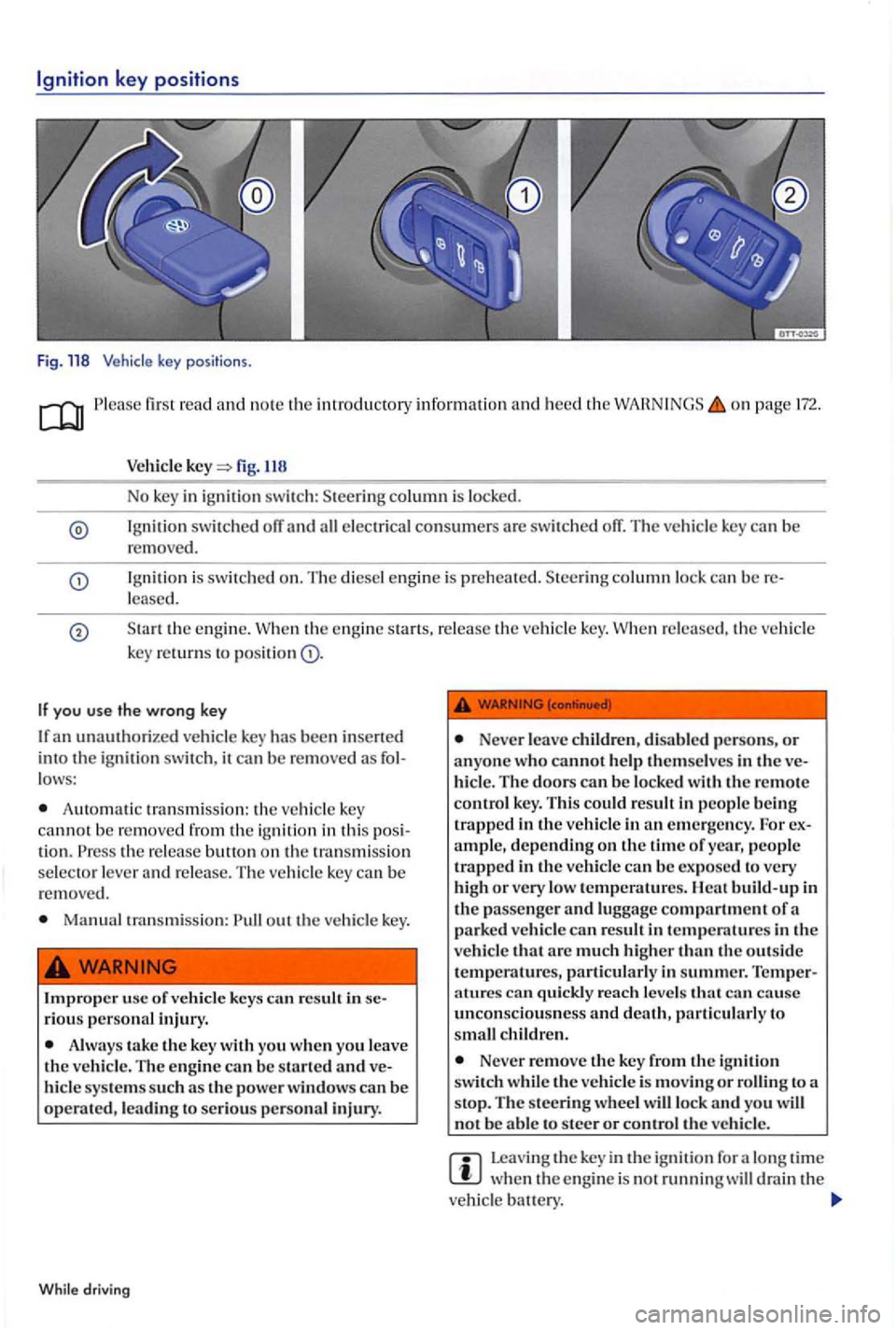
Fig. 118
Please first r ead and n o te the introduc tory information and heed th e on
fig. 118
No key in ig nitio n switch : column is lo cke d.
Ig nition switched e lec trical co nsumers T he ve hicl e key b e
r emove d.
Ig nition is switched on . Th e di ese l e n gin e is pre h eated. column lock b e leased.
th e e ng in e. the eng in e start s, relea se th e ve hicl e key. released . th e ve hicle
k ey return s to
If you use the w rong key
If an unauthorize d ve hicl e key been inserted
int o the ig niti on switch , it b e removed as lows:
transmi ssion: the ve hicle key cannot b e rem oved from the ig nit ion in thi s the rel ease button on th e transmissio n
se lec to r l eve r releas e. Th e ve hicl e ke y can be re m oved.
Manual tran smissio n: out the ve hicle key.
I
mproper usc of v e hi cle keys can result in rious perso nal injury.
the key with yo u w hen yo u leave the ve hicle . The engine can be started and hicle sy ste m s su ch a s the power windows can be operated, lea din g to serious personal injury.
Neve r lea ve ch ildren , d isabled pe rsons, or anyone who cannot h elp themselves in th e hicle. The doors can be locked with the remote
control key. This could result in peo ple being trapped in the ve hicle in
be exposed to very
hi gh or very low temperatures. eat build -up in the pas senger compartment of
atures can quickl y re ach leve ls cause unconscio usness and death , to
s mall children.
Never remove the key from the ig niti on
swi tc h w hile th e vehicle is moving or rolling to a stop. The steering wheel will lock and you will
not b e a ble to steer or control th e ve hicle.
Leavi ng the key in the ig niti on fo r a long time w hen th e en g in e is no t running will drain the
v ehicle batt ery.