steering wheel VOLKSWAGEN GOLF PLUS 2012 User Guide
[x] Cancel search | Manufacturer: VOLKSWAGEN, Model Year: 2012, Model line: GOLF PLUS, Model: VOLKSWAGEN GOLF PLUS 2012Pages: 541, PDF Size: 98.86 MB
Page 175 of 541
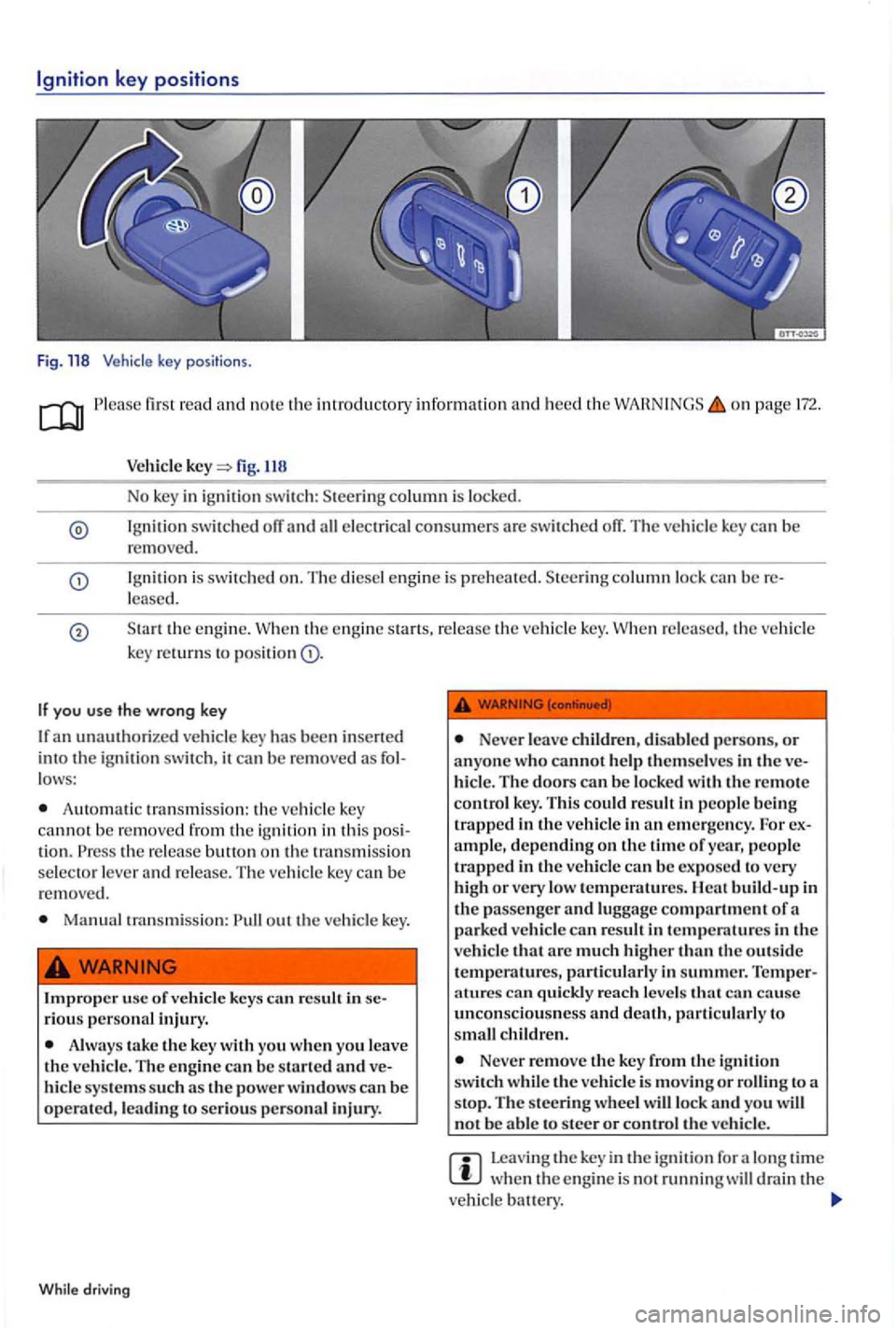
Ignition key positions
Fig. 118
Please first r ead and n o te the introduc tory information and heed th e on
fig. 118
No key in ig nitio n switch : column is lo cke d.
Ig nition switched e lec trical co nsumers T he ve hicl e key b e
r emove d.
Ig nition is switched on . Th e di ese l e n gin e is pre h eated. column lock b e leased.
th e e ng in e. the eng in e start s, relea se th e ve hicl e key. released . th e ve hicle
k ey return s to
If you use the w rong key
If an unauthorize d ve hicl e key been inserted
int o the ig niti on switch , it b e removed as lows:
transmi ssion: the ve hicle key cannot b e rem oved from the ig nit ion in thi s the rel ease button on th e transmissio n
se lec to r l eve r releas e. Th e ve hicl e ke y can be re m oved.
Manual tran smissio n: out the ve hicle key.
I
mproper usc of v e hi cle keys can result in rious perso nal injury.
the key with yo u w hen yo u leave the ve hicle . The engine can be started and hicle sy ste m s su ch a s the power windows can be operated, lea din g to serious personal injury.
Neve r lea ve ch ildren , d isabled pe rsons, or anyone who cannot h elp themselves in th e hicle. The doors can be locked with the remote
control key. This could result in peo ple being trapped in the ve hicle in
be exposed to very
hi gh or very low temperatures. eat build -up in the pas senger compartment of
atures can quickl y re ach leve ls cause unconscio usness and death , to
s mall children.
Never remove the key from the ig niti on
swi tc h w hile th e vehicle is moving or rolling to a stop. The steering wheel will lock and you will
not b e a ble to steer or control th e ve hicle.
Leavi ng the key in the ig niti on fo r a long time w hen th e en g in e is no t running will drain the
v ehicle batt ery.
Page 189 of 541
Braking, stopping, and parking
Introduction
In this section yo u'll find inform ation on fo l
lowi ng:
Warning and indicator lights . . . . . . . . . . . . . . . . . 189
Park in g brake . . . . . . . . . . . . . . . . . . . . . . . . . . . .
.. . . . . . . . . . . . . . . 19 1
About t
he brakes . . . . . . . . .. . . . . . . . . . . . .. . . . 192
Bra king assistance sys tem s . . . . . . . . . . . . . . . . . . . . 194
Switching Anti-Slip Regulation (ASR) on ond off . . 196
Brake fluid . . . . . . . . . . . . . . . . . . . . . . . . . . . . . . . . . 196
T he brakin g support syste ms are Brake A ss is t E lec tro nic Differ e n tial Loc k (EDL). Anti-Slip
M ore information:
Trail er page
pag e
Tires and page 276
acce ssories, r epa ir s and modifi catio ns
brakes or worn brake pads can
ca use colli sio n and serious personal inju ry.
light s up in the
in strument cluste r di splay, w heth er a lo n e or to
ge ther with tex t message, immediat ely conta ct an authorized Volk swage n dea ler or authorized
Volkswag en Se rvi ce Faci lity to have th e brake pad s ch ecke d and , if necessary, re pl aced.
WARNING
improperly can cause se riou s pe rso nal
injury .
Never re m ove key from the ignition switch while vehicl e is m ov ing or ro llin g to a
s top. The steering w heel w ill lock and you not be
Never park the vehicle w here the ho t ex ha ust
syste m or catalyti c convert er could ignit e flam
mabl e mater ia ls, su ch as brus h , leaves , dry grass, spilled fue l, e tc .
Always apply th e parki ng brake whe n
p a rki ng your veh icle. Imprope r u sc of th e
p a rking bra ke can se rio usly injur e you and your passe nge rs.
Never use the
e m ergency . The stopping dista n ce is muc h
longer b ec au se onl y the wheels arc braked . use the foot brake to sto p the vehicle .
Never the throttl e from
th e e ng in e
th e automati c transmission is in gear. The ve hicle will start t o move as soon the e ngine speed ev en i f th e brake is on.
Never leave childr en or anyo ne w ho canno t
h elp them se lve s beh in d in the vehicl e. They could re leas e the brak e move the gear selector leve r or shift , wh ic h could cause th e vehicle to start m ov ing. Thi s ca n lea d
to a cras h and seri ous personal injuri es.
Always take the key with you when yo u
leave th e ve hicle . The engine ca n be started and ve hicl e sys te m s s uch as the power wind ows can
b e operate d , le ad ing to seri ous perso nal injury.
Neve r leave childr en , di sabled perso ns, or a nyon e who cannot h elp them se lves in the vehicl e. T he doors can b e lo cke d wit h the re mote contro l ke y, trapping passe nge rs in the
ve hicle in an emerge ncy. For exa mpl e, dep ending on th e tim e of year, people trappe d in the
ve hicle can be ex pose d to very high or very temperatures. Heat build -up in the passenger and parked vehicl e result in temperatu res in the ve hicl e th at arc much hi gher than the outsid e tempe mtu
res, partic ul arl y in summer. T emperatures ca n
qui ckly reac h le v e ls that can cause uncon
scio usn ess ch ildr en.
Page 195 of 541
Braking assistance system s
fir st read and n o te the introductory information and heed the
on page
T he and EDL braking tance system s work onl y w he n th e engine is ning. These sys te m s can sig nificantl y improve
vehicle namics to help reduce the probability of skidding and loss o f vehicl e control. works only w hen the engine is running. driving situations, including w hen the veh icle is beginning to spin (yaw) out of control.
gin e power and by providing steering assistance to help hold the ve hicle on the driver's intended
course.
has limitation s.
will not always be able to help out under all tions you m ay come up against. For example, may no t a lways be able to hel p you mas te r tions w he re there is sudde n change in the
cannot perform the sa me
way it would on a dry surface. the vehicl e
cornering. ularly on winding road s, cannot always deal as
e ffectiv ely wi th diffi cult drivin g situations it can
a t lower speed s. When towin g a is not able to help you regain control as it would if yo u were not towing a trailer.
Alway s
adjust your speed bility, road, cannot overcome the laws of phys ics, increa se the available
stead, improves the possibil ity o f keeping th e
vehi cle under control and o n th e road during treme maneuvers b y using th e driver's s teerin g puts to help keep the vehicle going in the int ended direction .lf you a re tra velin g at a speed that causes yo u to run off th e road before can provide any
EDL , and XDL syste m s (sec be lo w). is switc hed on all the tim e. certain situati ons
w he n you need less traction or additional tract ion cannot be achieved, you can swit ch off by pressing page 196, fig. l28. B e
s
ure to switch ASR on again when you no longer
need less traction.
Anti-lock
brake system (ABS)
ABS helps to keep the wheels from l ocking up and helps to maintain t h e driver's ability to steer and control the vehicle . Thi s means the vehicle is less lik ely to skid, even during hard
th e brake pedal down hard
Do not the brake pedal or letup on it!
S teer the vehicl e while pushing down hard on the brake pedal.
ABS sto ps working if you re lease or let up on th e brake.
When is doing i t s job, you will notice
noise. T he stopping di stance may even be lo nger, for instance, when dri ving on
pin g distances.lfyou press the pedal very quickly, BAS detects an e m ergency situ ation.
pedal! BAS
s w itches off automaticall y as soon
reduces en gine power d irected to spinning wheels and adjus ts power to the road conditions.
Eve n under poor ro ad conditions,
Page 200 of 541
Efficient driving
Please information and heed the on page 198.
Shifting faster
As a rule, the following applies: The higher gear is
a lways the more efficient gear. The rule of thumb for most vehicles is to drive in 3rd gear at mph f km/h, 4th gear at 25 mph f km/h, and 5th gear at mph f km /h.
If
and driving conditions permit, gears when upshifting also saves fuel.
Do
not run the gears up to their limit.
mati c transmissions .
Vehicles with gear recommendation aid in fuel fic ient dri ving by indicating the optimum time to shift gears.
livery to the engine is interrupted, which lowers
fuel consumption.
T herefore, when nearing a red stop light , for s tanc e, allow the vehicle to coast without using the accelera tor. Press the clutch pedal and release it only if the v ehicle is moving too slowly or the coasting distance is too long. The engine will then continue to run at idl e.
In situati ons
where the vehicle will be stopped for
a longer period of time, such as at a train cros sing,
physically switch off the engin e.
D efens ive driving
and with traffic
Fre
quent braking and accel eration increases fuel consumption sign ific antly. Just by driving sivel y and keeping a su fficiently large distance away fro m the vehicle in front of you can make up for the speed fluctuation s caused by taking your foot off the accelerator. Active braking and ating is then not necessarily required.
system information
The power stee ring syste m i s not hydrauli c.lt is an electro-mechanical syste m. The advantage of this
s te ering system is tha t no hydra uli c hoses, draulic oil, pumps, filters or other parts are quired . Th e e lectro-m echanica l system is more fue l effi cient. A hydraulic system requires constant oil pressure in the syste m; an electro -mechanical
s teerin g sys tem, however, needs power only whil e
s teering.
Th e el
ectro-mechanical power steering
chanical power steering works only when the gin e is running.
and smooth driving
Consistency is more important than speed. The more smoothly yo u drive, the less fuel the vehicle consumes.
When driving on the highwa y or freeway, a
stantly accelerating and braking. you can r each your destinatio n just as quickly by driving at a moderate, but steady speed.
The c rui se control syste m can a ssis t in
sciou s manner.
Some dev ices can increase fuel consumption when activated (examples):
C limate control air conditioning system:
trasting temperatures, it requires a large amount of energy, which is generated by the e ngin e. T he
tr emely different from that of the outside
windows increase fuel consumption.
Switch off seat heating once it has served its
purpose.
Sw itch off the windshield and rear window
Malfunctioning engine control.
Driving in the mountains.
Towing a trailer .
page 257
Towing and page 357
Turning the steering wheel is very hard when the power steering system is not working. This makes it harder to control the vehicle.
steering works only when the engine is running.
Never let the vehicle coast with the engine switched off.
Never remove the key from the ignition
switch while the vehicle is moving or rolling to a
stop. The steering column will lock and you will be unable to control the vehicle.
Page 202 of 541
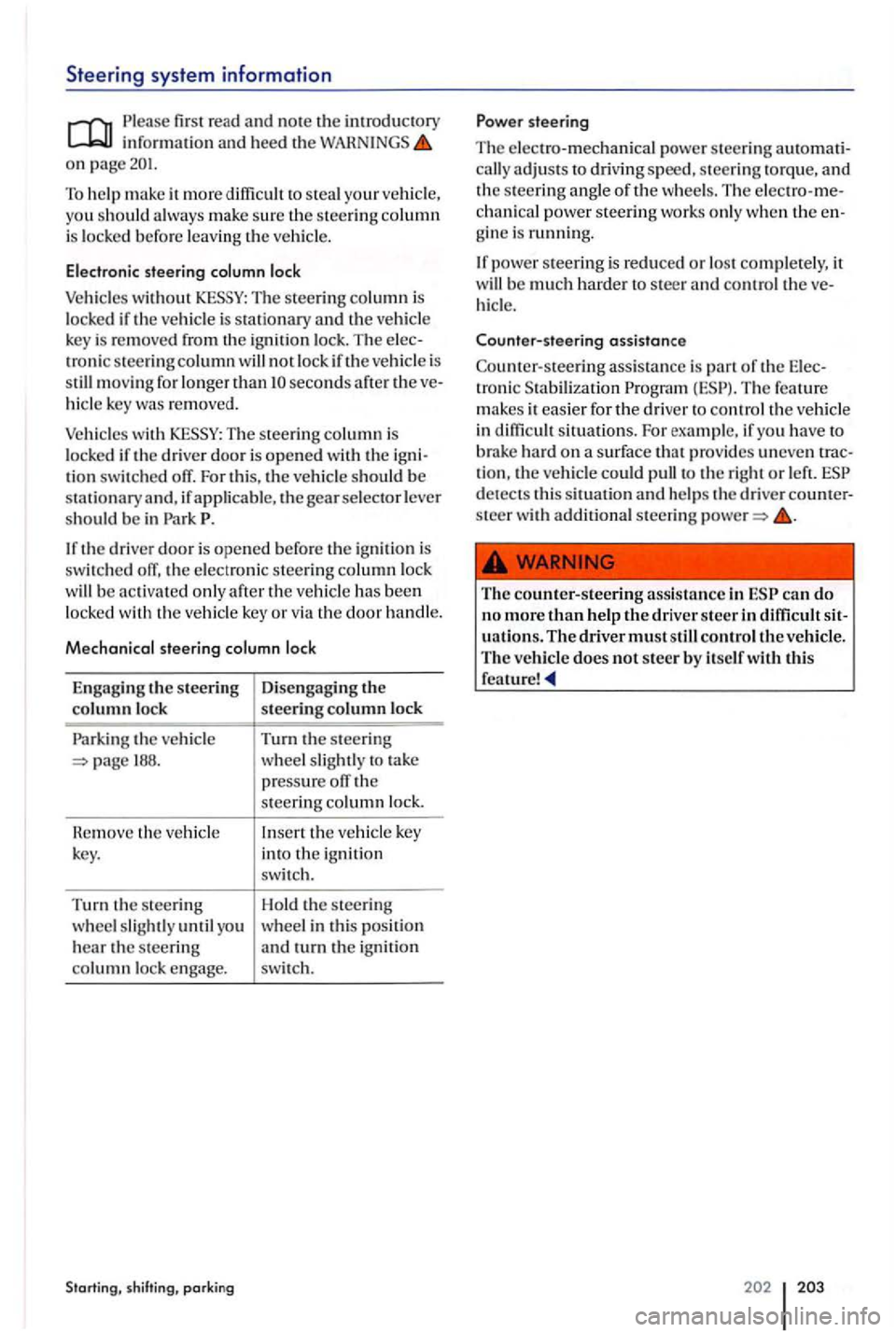
Steering system information
first read and note the introductory informatio n and heed the on page
To help m ake it more diffi cult to s teal your ve hicl e,
you sh ould always make sur e the steering co lumn is locked before leaving the ve hicle .
Electronic steering column lock
Vehicles with o
ut The s teering column is
l ocked if the vehicle is stationary and the vehicle
k ey is removed from the ign ition lock. The elec
tr onic s teering column will not lock if the vehicl e is
s till mov in g for longe r than seconds after the ve
hicl e key was re moved.
Vehicles with
Th e s teering column is
l ocked if the dri ver door is ope ned with the ignitio n switch ed ofT. For this, the ve hicle should be
s tationary if applic abl e, the gear selector leve r
s h ould be in
If the driver door is opened befo re the ign ition is
sw itch ed
188.
H e
move th e ve hicl e
k ey.
Turn th e s teering
w heel s lig htl y until you
hear the steering
column l oc k en gage.
Starting, shifting , parking
Disengaging the
steering column lock
Turn the s teering
whee l s lightl y to take pressure ofT the
s teerin g column lock.
In
sert the ve hicl e key
into the ignition swit ch .
Ho ld th e s teerin g
wheel in thi s pos ition
and turn the ignition switch.
steering
The e lectro-mechanical power steering auto m ati
c ally adjusts to dri ving speed, steering torque , and the steering angle of the wheels . The e lectro-me
c hanical power steering work s only w hen the en
gine is running.
If power steering is reduced or lost comple tely, it
will b e much harder to steer and co ntrol the ve
hicl e.
Counter-steering
assistance
T he feature
m akes it easier for the dri ver to control the vehicle
in difficult situation s. For exampl e, if yo u h ave to
brak e h
ard on a surface that provides uneve n t rac
tion, the ve hicle could pull to the right or l eft. detect s th is situation and h elps th e dri ver counter
s teer with additi onal steerin g
The counter-steering ass istance In
Page 357 of 541
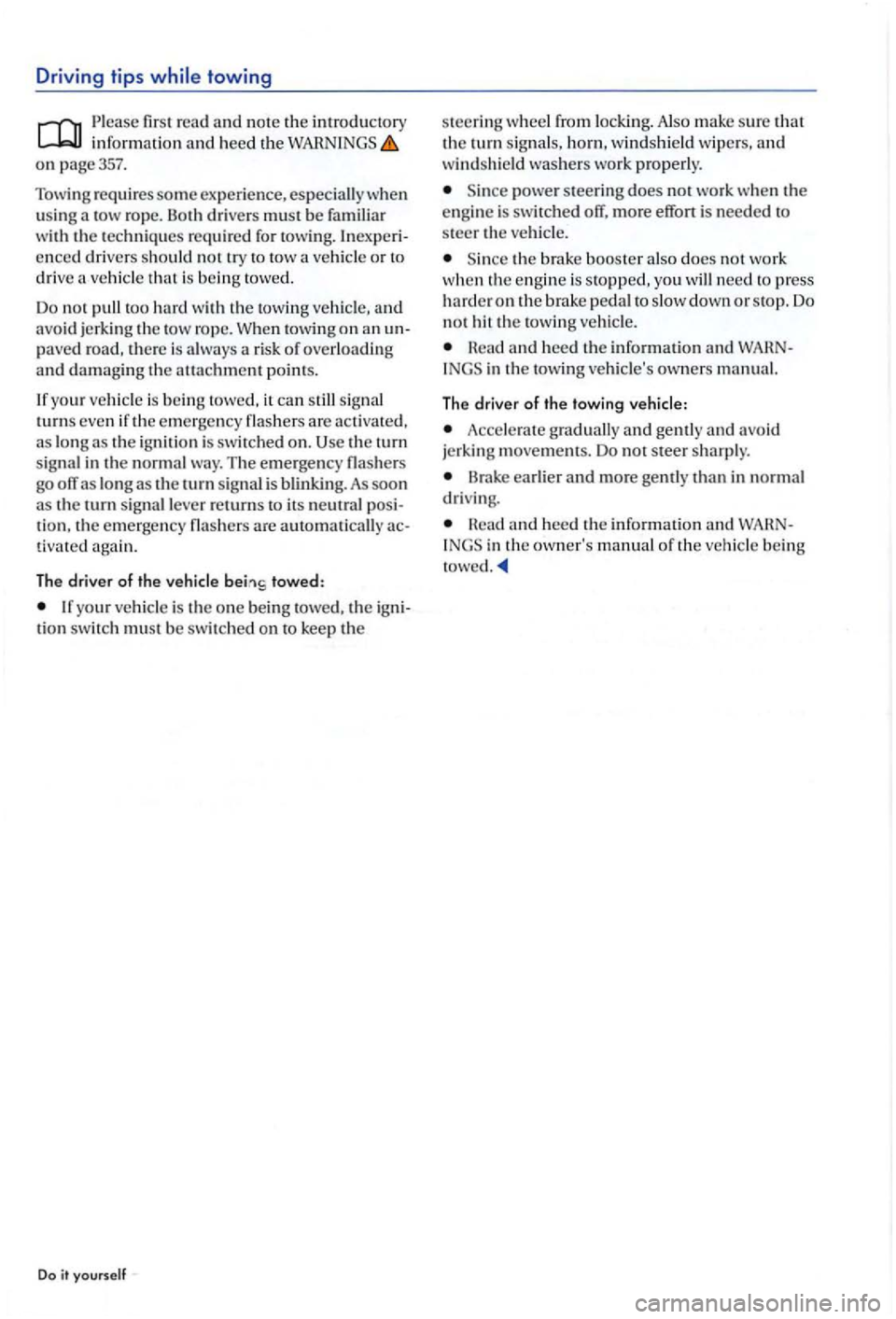
Driving tips towing
Please fir st read and note the introd uctory in form ation and heed the on p age357.
Tow
ing r equires som e ex perience, especiall y w hen
u sin g a tow rop e. Both drivers mus t be familiar
w ith the techniques required f or towin g.
paved roa d, there is always a risk of overloading and damaging th e a ttachment points.
your ve hicl e is bein g towe d, it can still sign al turns eve n if the em erge ncy flashers are activate d , as lo n g as the ig nit ion is switched on. the turn sig nal in the no rm al way. The e merge ncy flashers
go off as l ong as th e tu rn sig nal is blin kin g. As soon as the turn sig nal lever returns to its ne u tr a l tio n . the e merge ncy flash e rs are auto matically tiv ated agai n.
The driver of the vehicl e towed:
your vehicle is the on e being towed, the ti on switch m ust b e swit ch ed on to keep the
Do it yourself
s teeri ng wheel from loc king. Also m ake sure that the turn signal s, horn , winds hi eld wip ers, and w indshi eld was he rs wo rk properly.
power steering does not wo rk w hen th e
e ngi ne is swi tc h e d off, more e ffort is needed t o
s teer th e ve hicl e.
the brak e booster also does no t w ork when the engin e is s topped, you will need t o press harder o n the brak e ped al to slo wdown or stop. Do not hit the towing vehicl e.
Head and heed the inform ation and in the tow in g ve hicle's owners m anu al.
The driver of the towing vehicle:
Accele rat e g raduall y and gentl y a nd avoid
jerking move men ts. Do no t s teer s h arply.
Brake earli er and m ore ge ntl y than in normal driving.
Head and heed the informatio n and in the owner's m anual of the ve hicl e bein g
tow ed
Page 362 of 541
light bulb
License plate lamp .. ................. 35 1
light bulbs . . . . . . . . . . . . . . . . . . . 344 In front bumper ......... ............ 348
In
the body ............. ............
In the h ea d light ..................... 347
In th e r
ear hatch ....•................ 34 9
Tai
llights ....................... 349,
o il leve l ...................... 249
Driving safely ...... ............... 28, 29
Gell ing read y
..................... 28, 29
In an emergency ................
Lifting vehicle with jack . . . . . . . . . . 333, 334
Ligh t bulb re pla cement . . . . . . . . . . . . . . 346
Preparation s for changin g a wheel . . . . 331
Sa fe ty belts . . . . . . . . . . . . . . . . . . . . . . . . . . 72
Ti re mobility set. . . . . . . . . . . . . . . . . . . . . 338
Uphol stery ........................... 271
and th e Advanced Airbag System. . . . . .
anchorages..... 116
Sec urin g wi
th the Top Tether strap. . . . liB
safe ty lo ck . . . . . . . . . . . . . . . . . . . . . . . . 44
safety seat. . . . . . . . . . . . . . . . . . . . . . . .
the rear seat . . . . . . . . . . . . . . . . . . . . . lOB
seat
Booster
seat. . . . . . . .. . . . . . .. . . . . . .. . . 1L2
seat mounting................. 112
Infant carrier ........................
Securing wit h lo ckab le safet y belt . . . . . 114
Secu ring w ith safety b elt . . . . . . . . . . . . . 114
seats s eat mounting. . . . . . . . . . . . .
care. . . . . . . . . . . . . . . . . . . . . . . . . . . 267
lig h ter. . . . . . . . . . . . . . . . . . . . . . . . 169
Als o see: A ir co nd itio ning . . . . . . . . . . . . 226
sunroof . . . . . . . . . . . . . . . . . . . . . . . 51
Rear hatch . . . . . . . . . . . . . . . . . . . . . . . . . . . 47
Vehicle . . . . . . . . . . . . . . . . . . . . . . . . . . . 39,
hooks . . . . . . . . . . . . . . . . . . . . . . . . . . . . 165
.................................. 6
number . . . . . . . . . . . . . . . . . . . . . . . . . . 327
we ight
Determination (North America) .......
spare wheel
Dr iving style
........................ 288
. . . . . . . . . . . . . . . . . . . . . . . . . . . . . . . 19
information . . . . . . . . . . . . . . . . . 3ll
units . . . . . . . . . . . . . . . . . . . . . . . . . .
Engine coolant . . . . . . . . . . . . . . . . . . 252
Co
unter-steering assista nce. . . . . . . . . . . . .
h o ld er
Front center co nsole. . . . . . . . . . . . . . . . . 166
Rear center co nsole ................. . 167
weight . . . . . . . . . . . . . . . . . . . . . . . . . . .
D
Data recorded b y control units . . . . . . . . . .
Data recorded whil e driving. . . . . . . . . . . . .
Data recorde r . . . . . . . . . . . . . . . . . . . . . . . . . .
Dayt ime running lights. . . . . . . . . . . . . . . . . 124
Dynamic
Page 370 of 541
Water under vehicle . . . . . . . . . . . . . . . . . 231
Wipers ............................. 129
S peed rating code le tter ................. 293
Stalling
Protecting th e ve hicle ................
S teering ...............................
Cou nter- steering support ............
E lectro-mechanical. . . . . . . . . . . . . . . . . .
Indicator light. ......................
to one side ................... 286 Servo steering .......................
Steering co lumn lock .... ............
Steering wheel
A dju sti
ng . . . . . . . . . . . . . . . . . . . . . . . . . . . . 63 S hift paddles (Ti ptron ic) . . . . . . . . . . . . . 185
Sticke rs . . . . . . . . . . . . . . . . . . . . . . . . . . . . . . . 311
Storage areas . . . . . . . . . . . . . . . . . . . . . . . . . .
storage compartments . . . . . . . . . 165
Overhead console . . . . . . . . . . . . . . . . . . . 161
manual. . . . . . . . . . . . . . . . . . . . . 16 3
Pa sse nge r sid e . . . . . . . . . . . . . . . . . . . . . . 16 3 Storage compartment light . . . . . . . . . . . 125
Stow ing luggage . . . . . . . . . . . . . . . . . . . . . . . 13 8
protection. . . . . . . . . . . . . . . . . . . . . . . . . 126
brak e sys tem (ABS) . . . . . . . . . 194
Regulation . . . . . . . . . . . . . . . . . 196
194
Launch control program . . . . . . . . . . . . . 186
Assis t . . . . . . . . . . . . . . . . . . . . . . . . . .
Distance Control. . . . . . . . . . . . . . . .
Rear Assist . . . . . . . . . . . . . . . . . . . . . . . . . .
C urb weight. . . . . . . . . . . . . . . . . . . . . . . . .
Dimensions. . . . . . . . . . . . . . . . . . . . . . . . . . 33
Displacement . . . . . . . . . . . . . . . . . . . . . . . . 32 E ngin e data an d dimensions . . . . . . . . . . 32
Engine oil specifications . . . . . . . . . . . . . 248
Filling capacity. . . . . . . . . . . . . . . . . . . . . . 132
Fu el capacities . . . . . . . . . . . . . . . . . . . . . . 237 Gross vehicle we ight. . . . . . . . . . . . . . . . .
.............................. 32
Roof load . . . . . . . . . . . . . . . . . . . . . . . . . . . 15 1
Sa fety Compliance Certif ic ation Label. . 3 1
Tir e pressure . . . . . . . . . . . . . . . 283 Tongue load . . . . . . . . . . . . . . . . . . . . . . . . 152 Weights . . . . . . . . . . . . . . . . . . . . . . . . . . . .
Technical modifica tions . . . . . . . . . . . . . . . .
temperature . . . . . . . . . . . . . . . . . . 17
Temperature gauge
E n gin e coolant . . . . . . . . . . . . . . . . . . . . . . 252
hooks........................ 146
T ighteni ng torque Whee l bo lts . . . . . . . . . . . . . . . . . . . . . . . . . 332
372 373
Page 407 of 541
Confirm the Bluetooth connection on the phone.
A message appears on the phone that a pass
word must be entered for authoriza tion .
Enter the four-dig it password . T he factory set
lings are an incorrect password has been entered, the this case,
repeal the pairing process.
Confirm possible phone query with Yes if thi s
Blue tooth connect ion sh ould be made without
entering a password . When the ignitio n is switched
on, the Bluetoo th connec tion is
15.
The data stored in the phone contac ts is tr ans
ferred into the ve hicle.1
)
on page 4 and the introduction and WARNon page 12 first.
The
The mobil e phone is coupled with a micro
phone near the front interior light.
are broadcast over the speakers.
The playback of radio stations, COs, etc . on the
When the igniti on is sw itched on, you can use
the button on the steering wheel
The mobile phone package is active when the
ignition is on or if the ignition key is in the igni
tion after the ignition is switched off and the radio or switc h
ed on.
A is transfe rred to the
The music stored in the phone can be
reproduced via a su itable radio or navigat ion sys
tem in mobile phones that support the "Advanced
Audio Distribution
Depending on the mobile phone.
m anual
Up to fou r dev ices can be stored as known in the mobile phone package. Depending on the
radio or navigat ion system, "shortcut buttons " can
be stored for three or four devices.
anothe r
Up to
phone can be operated using the if a cradle is set in the mount
for the crad le. The phone to be paired must
not be in the while doing so. A cra-in
The charger with the outside antenna .
For charging cradles with an integrated charg
ing function , the battery of the mobile phone charg
es, if necessary, when the
ignition is on .
phone and the mobile phone package recognize the connection when the
igni tion is on and after the verification of th e Bluetooth connection (password entry ) 12. The
phone
manufacturer.
Create a connec tion using the phone menu in the instrument cluster 25.
Page 430 of 541
Introduction
Before using
Before using the device for the first time, the
basic safety instructions
Familiarize you rself w it h the device overview 6 .
Use data media suitable for Media mode
Driver distraction can cause accidents and serious personal injury. Operating the infotainment system while driving can distract the driver from the traffi c.
Always drive attentively and responsibly.
Select volume settings so that acoustic signals from the outside are audible (for ample, the siren s of emergency rescue cles) .
Setting the volume too high can da mage
the hearing. This can also extend to short posure of the ears to loud volumes.
Sudden volume fluctuations may occur when the audio source is changed or connected.
8.
Never let yourself be distracted from the traf-fie by connecting, inserting or removing the device while driving, which can cause acci-dents.
Connecting cables of external devices may obstruct the driver.
Unmounted or improperly mounted external
devices can be thrown through the ger compartment in the event of a sudden driving or braking maneuver or an accident, causing injury.
on the steering wheel, strument panel , seat backs or between these areas and the occupants. External devices can cause serious
The center armrest can interfere with the driv-er's elbow movement and thus cause acci-dents and severe injuries.
player repaired only by a spe-
cia list.
from the slot, always keep it straight and at a right angle to the front of the unit. Do not tilt it or it could become scratched.
a second while a is insert-ed or being ejected can destroy the
Introduction