tow VOLKSWAGEN GOLF PLUS 2012 User Guide
[x] Cancel search | Manufacturer: VOLKSWAGEN, Model Year: 2012, Model line: GOLF PLUS, Model: VOLKSWAGEN GOLF PLUS 2012Pages: 541, PDF Size: 98.86 MB
Page 130 of 541
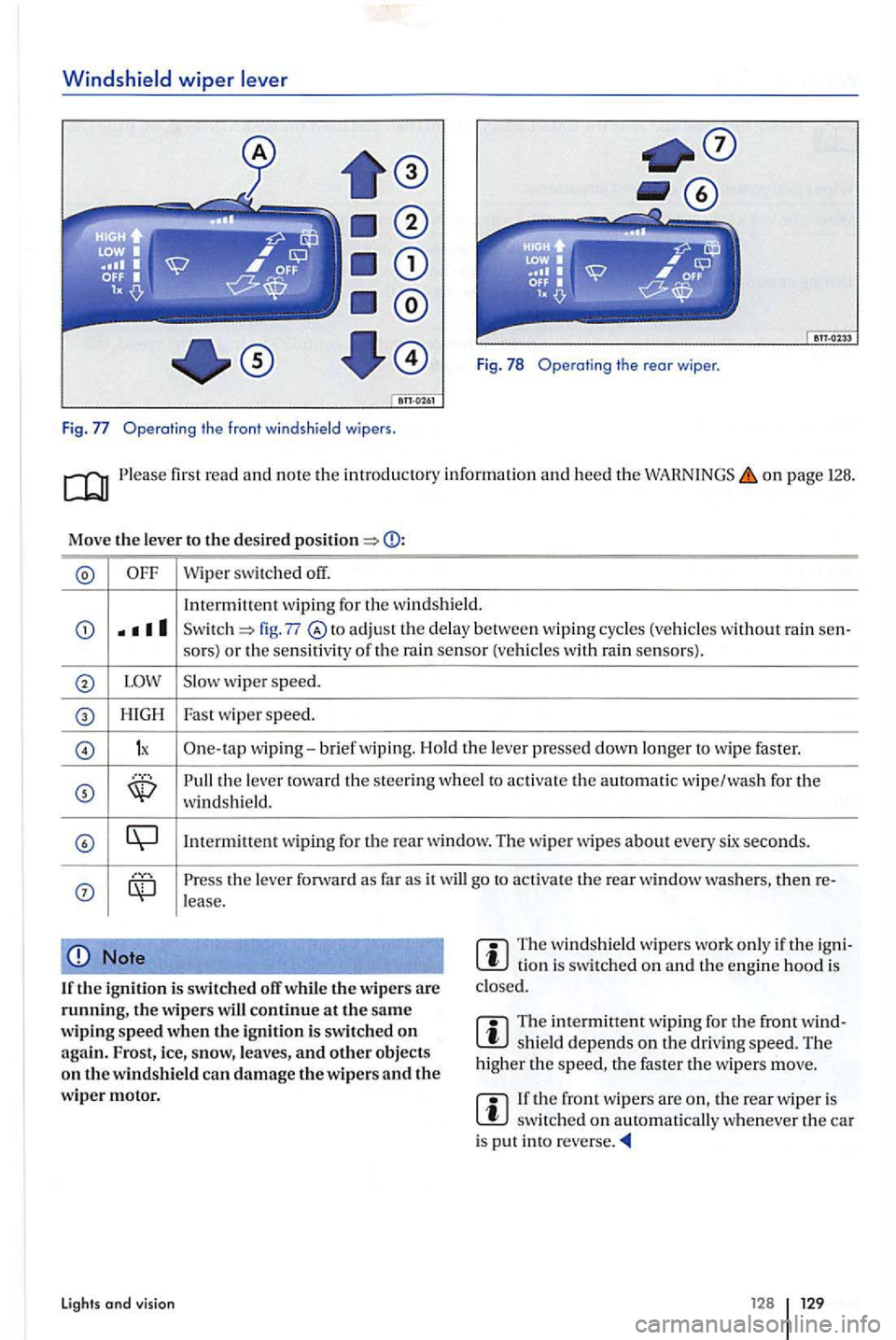
Windshield wiper lever
Fig . 78 Operating the rear wiper .
Fig. Operatin g t he front windsh ie ld wipers .
on page 128.
Move the leve r to t he des ired
Wipe r switched off.
In term itt
ent wiping for the w ind shield.
fig. 77 to adj ust the delay between wip ing cycles (vehicles wit hout rain sen-
so rs) or the sensit iv ity of th e rain sensor (vehicle s w ith rain senso rs).
w iper speed.
H IGH Fast wipe r speed.
1x One-ta p wip ing-brief wiping. Hold th e lever presse d down longer to wipe faster.
the le ve r towa rd t he stee ring whee l to activat e the au toma tic wipe/wa sh for the windsh ie ld.
the leve r forward as far as it will go to ac tiva te the rear window then re-lease.
Note
If the ig n it io n i s swi tc h ed off whil e the w ipers are th e w ipers continue a t the sa me
w ip ing sp eed when the ign ition i s swi tched on agai n.
The w in ds hield wipe rs work only if th e tio n i s sw itched on and th e engine hood is
clo sed.
Th e intermittent wip ing for the front shield depends on the driving speed. The
h igh er the the faster th e wipers move.
th e rear w ip e r is s witc hed on automatically w henever the car is pu t in to
Lights and visi o n 12 8
Page 131 of 541
Wiper functions
first read and note th e introductory informat ion an d heed the on page 126.
Wip
er p erformanc e in diffe rent situations:
W he n th e veh icle is
not mov ing : The wip er speed changes tempo ra ril y to the next lower speed.
W hil e
the washer sys te m is wo rking, the climate control
During automatic wipe/wash: sys
te m switches to recircul ation for about seconds h elp prevent th e w asher flu id odor from enterin g the ve hicl e int e-rior.
D urin g int e
rmittent wip ing: S
peed-dependent interval con tro l: The high er th e speed, the faste r the wipers m ove.
Heated washer nozzles
The heatin g tha ws frozen wash er nozzles, but not the fluid suppl y hoses. When the ig niti on is
sw itch ed on, th e heat applied to the was he r zles is au to mat ically regulate d d ep ending o n th e
outs id e ai r t emperature .
Headlight washer system
T he headlight washer sys te m clea ns the headli ght
glass.
I f th e ign it io n
and the headli ghts (high or lo w arc swit ch ed on, the headlight s time and every fifth time th e front windshi eld washers a re activa te d. Thi s happen s only when the low or hig h beams are on whe n th e
Windshiel d wi pe r service posit ion
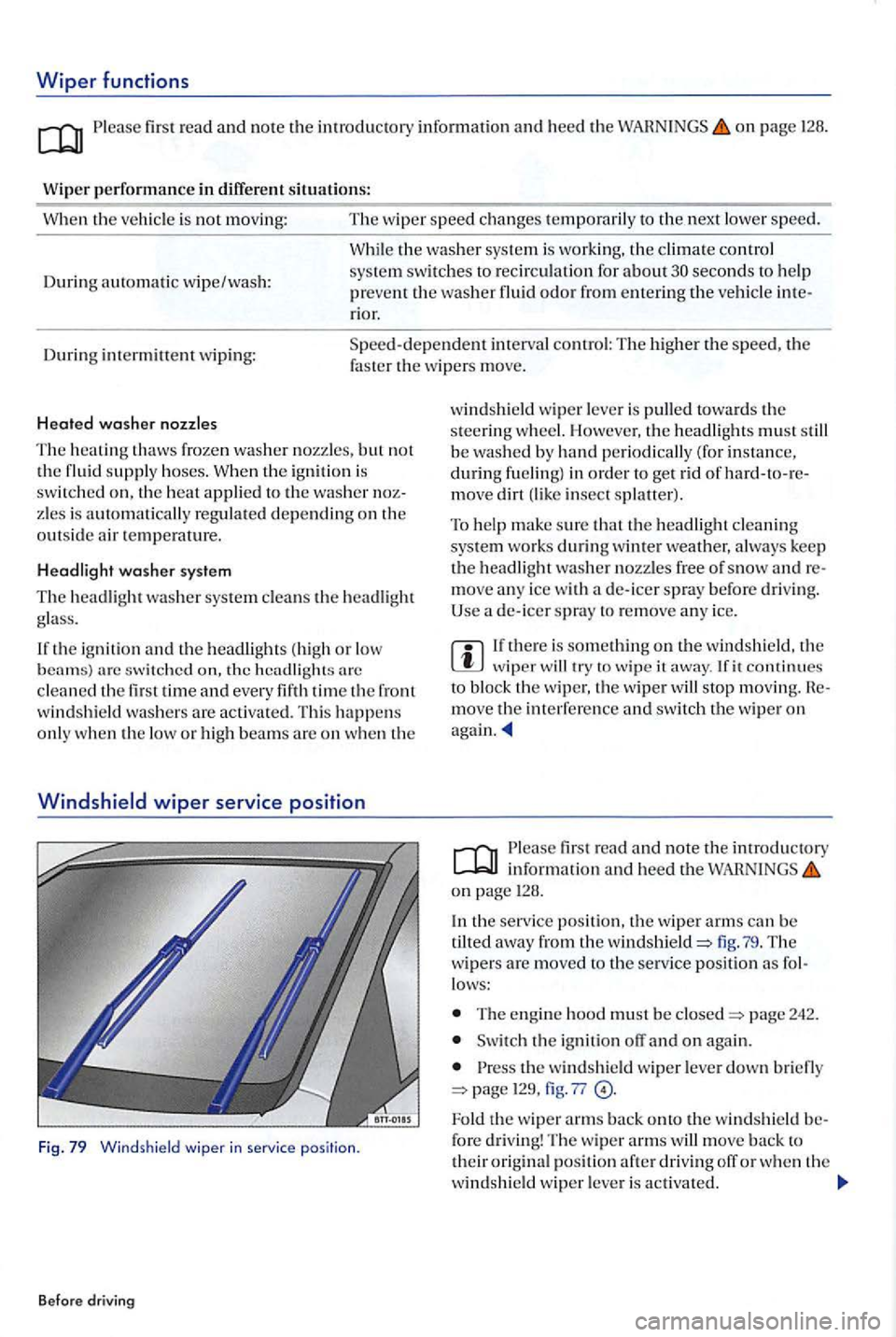
Fig. 79 Wind sh ield wiper in ser vice position .
Before driving
windshi eld wip er leve r is pulle d towards th e
s teering w heel. Howeve r, th e headli ghts must s till
b e was hed by ha nd periodically (for i nstance, during fue ling) in order to get riel of move dirt insect splaller).
T o hel p
make sure th at th e headli gh t cleanin g syste m wo rk s during winter weather, a lways keep the headlight washer nozzles fre e of snow move an y ice w ith de- icer spray before drivi ng.
Use a de- icer spra y to re m ove an y ice.
wiper will try to wip e it away . fit continues bloc k the wiper, th e wiper wil l s top moving. move th e in terfer ence and swit ch th e wip er on
firs t read and note the introductory in formation and heed th e o n page 128 .
I n
the service posit io n, th e wiper arms can be
tilted away from the windshield=> lig . 7 9 . The w ipers are move d to the ser vice pos it io n as lows:
T he e ngin e hood must b e closed=> page 242.
Switch the ig nition o n again .
th e windshie ld wiper leve r down brie fly page 129, fig . 77
Fold the wipe r arm s back onto the w indshi eld fo re driving! Th e w iper arms will move back t o their origin al positi on afte r dri vin g off or w he n th e
winds hi eld wip e r leve r is activa te d .
Page 136 of 541
Outside mirrors
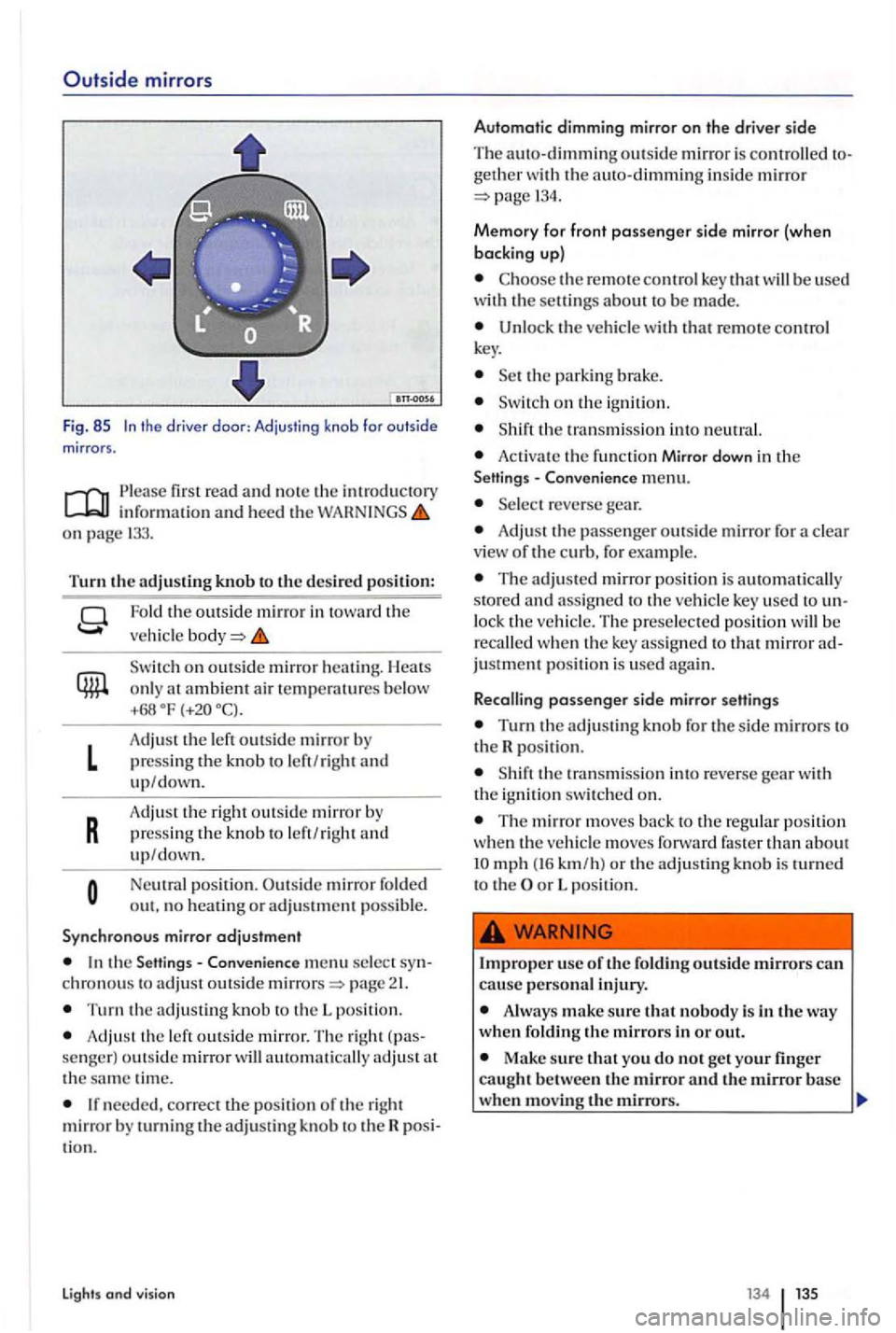
Fig. 85 the driver doo r: Adjusting knob for outside mirror s.
o n page 133.
Turn the adjusting knob to the desired po siti on :
L
R
Fold the outsi de mirror in toward the
veh i
cle
on outsid e mirror heating. Heats
o nl y at ambient air tempe ratures b e low +68
A dju st the left outside mirro r press ing the knob to le ft/righ t
pressing the knob to le ft/rig h t and up/down.
Neutral position . mirror fo ld ed out. no heatin g or adjustment possib le .
Syn ch rono us mirror adjustment
the Sett ing s- Conveni ence men u select chronous to adju st outside page
T urn the adj ustin g knob to th e L positi on.
Adjust th e left outs ide m irror. Th e righ t
th e sa m e tim e.
needed, correct the positi on of the right mirror turning the adjust in g kn ob to th e tio n.
Lights and vision
Automatic dimming mirror on the drive r side
Th e auto-dimming outs ide mirror is contr olled geth e r w ith the auto-dimming inside mirror 13 4.
Memory for front passenger sid e mirror (when
backing up)
the re m ote contr ol key that will be use d
with th e settin gs about be made.
Unloc k the veh icle with tha t re mote control
k ey.
o n the ign ition.
the transmiss ion into ne ut ral.
Acti vate the fun ctio n Mirror down in the - C onvenience menu.
reverse gear.
Adjus t the passenge r outsid e mirror for a clear view of the curb, for example.
The adjusted mirror positio n is automatically
s to red and ass igned to the ve hicl e key used to lock the vehicle. The preselecte d po sit ion w ill recalled w hen the ke y ass igned to that mirror justment pos it io n is used again .
Recalling
passenger s id e mirror setting s
Turn the adjusting for the sid e mirrors to the R posit ion.
T he mirror m ove s back to the re g ul ar position wh en the ve hicl e m oves forward faster than about mph (16 km /h) or the adjusting knob is to th e or L po sition.
use of the foldin g outside mirrors can cause persona l injury.
Alway s make sure that nobody is in the way w hen f oldin g the mirrors in or out.
Make sure that you do not get yo ur finger caught between the mirror and the mirror base when moving the mirrors.
Page 138 of 541
Transporting
Driving tips
In this sec tion yo u'll find informatio n on th e fol
l o w ing:
obj ects in th e luggage m ent and make su re
the vehic le lo ad, as well how it is di stributed, can vehicle hand ling and
page 45
F o lding th e pa sse nger backrest forward
page
Lugg age page
pag e
Trail er pag e
Tires and 27 6
Transporting
Uns ecured or in correc tly s tow ed item s can fly
through the vehicl e, causing serious personal injury during hard braking or sharp s teering or in an a cci dent. Loose items can also be s truck
a nd throw n through the passenge r compartment by an airbag if it infl ate s. To help reduce
the risk of inju ry:
all objects secure ly in the vehicl e. Always keep storage compartments closed dri vin g. Do not stow hard , heavy, or sharp objects in open bins in the ve hicl e or on top of the instrument panel.
A lways secure objects properly with s uitabl e
s traps so that th ey
Always secure objects in the passenger compartment properly so th at they cannot com e
int o the deploy ment area of a sid e or front airbag w hen the vehi cle is m ov ing.
Always keep stora ge compartments closed
w hil e dri ving.
A lways make sure th at the re is nothin g on the front passe nge r sca t w hen the backres t is fo lded forward. When the backres t is folded for ward,
eve n light objects could be pushed int o the scat
c ushion and cau se the we ight- sensin g mat in
th e seat to registe r e n o ugh weig ht to turn th e airbagon.
Always make su re that the AIR BAG
must n eve r assume an incorrec t seating positi on becaus e of objects stow ed in th e vehicle_
No person should ev er sit in a seat that is
blocked by objec ts s towe d in the vehicle.
136 137
Page 139 of 541
Heavy loads innuence th e way your vehicle handles and increa se stopping distances. Heavy
load s that arc not properly stowed or secured can cause los s of contro l and serious injury . Always remember when transporting heavy
objects that a change in the center of gravity also
changes the way your vehicle handles:
- Always dis tribute the load as evenly as
possib le. -heavy objects properly as far forward
in th e luggage compa rtme nt as possible.
- Always tie down heavy items secure ly using
th e tiedowns provided and suitable straps.
Never exceed th e Gross Axle Weight Rating or the Gross Vehicle Weight Rating on the safety compliance sticker on the left door jamb. Excee
ding permissible weight can cause the vehicle to
skid and handl e diff erentl
y.
Always adapt your speed and driving to th e
heavi er load and the we ight distribution in the
vehicl e. Take road, weathe r, and visibility
cond itions into acco unt as we ll.
Stowing
on page 137.
Always stow all luggage securely in the vehicle
Distribut e loads in the vehicle, on th e roof and the trail er as even ly as possible.
Secu re lu ggage in the luggag e compartment with suit able tightening strap s to the tie-down page 142.
Adjust the headli ght page
Before driving
Drive especia lly carefully and accelerate
gently.
Avoid sudden braking and driving maneu
ve rs.
Brake earlie r than yo u would if you were not driving a loaded
tire pressure. Heed the information on the tir e pressure page 276.
sure Monitor ing Syste m, the system may need to
be adjusted for the new page
CD Note
The heating wires in the rear window can be se
vere ly damaged by hard or sharp things on the sh elf below the rear window.
review inf ormation about loading a page 152 and a roof rack 149.
Page 140 of 541
Driving with an open rear hatch
P lease read and not e the introd uctory information and hee d the on pag e 137.
Driv in g w ith an open rear hatch ca n lead to seriou s
perso nal injury. I f yo u have to drive w ith an op en
rear h a tch, make sure that objects an d th e hatch itse lf are properly secured and take appropria te
m easures to keep tox ic exhaust fumes from te rin g th e vehicle .
Driving w
itJ1 an unlatc hed o r open rear hatch
ca n l ead to seriou s pe rso nal injury.
Always driv e witJ1 the rear hatch closed to
h elp kee p poisonou s ex hau st gas from being
drawn into the ve hicle.
Never transport objec ts lar ger than those fittin g co mpletely int o the lu ggage area, beca use then the rear hatch cannot be full y clo sed.
Always stow all objects secu re ly in the
Dr ive care fully; a ntic ipat e what otJ1er driver s will do.
Avoid abrupt o r sudden driv in g or braking maneuv ers, as unla tch ed rear hatch can move suddenly .
A lways mark obje cts sti cking out from the lu ggage compartment clear ly for others to see .
Ob e applicabl e req uirements.
Transporting
Neve r u se the rear ha tc h t o or ob jec ts protruding from the luggage ment.
Alway s remove any lugga ge rack or other
rack mounte d on tJ1e rea r hatch (along with an y
l uggage on th e rack) befor e driving with an ope n
r ea r h atch .
Driving w
ith an open rear hatch can cause sonous carbon mon oxide in the en g in e exhaust
to get into the passe nger compartment.
monoxide cau ses drow sin ess,
inatt enti veness , poison ing , and loss of scio u snes s. can lead to accid ents and seve re
perso na l in juri es.
Always kee p th e rear hat ch closed whil e
driving to help keep poi sonous exha ust fum es
from b ein g drawn into the ve hicl e.
Neve r tran sport obj ec ts that are to o large
t o fit completely int o the lu ggage area, beca use
th en the rear hatch cannot be full y closed.
yo u abso lutely mus t driv e w ith open rea r h atch, do th e
all windows and the powe r sunro of.
- Switc h off the climat e
control sys te m's a ir
recirculation feature.
-
Open all air vents in the in strument pa nel.
- Se t th e fres h air fa n t o th e hi ghest speed.
Note
T he ope n rear hatc h ch anges th e ve hicle's lengt h and he ight .
138 139
Page 141 of 541
Driving a
first read and note the introductory informat io n and heed the WARNINGS on page 137.
F
or good h andli ng w he n driving a loa ded ve hicl e,
please observe the following:
Secure ly stow page 138.
Dr ive especially caref ully and acce le rate gently.
Avoid sudd en braking and driv ing man eu ve rs.
Brake earlier than you wou ld if yo u were not
drivi ng a loa ded vehicle.
page 152.
If applicabl e, observe information rega rdin g driv in g w ith roof page 149.
Weights and
firs t read and no te the introductory information and heed the WARNINGS o n page 137.
The gross weight of any vehicle depends on its en gin e, basic equipment, an y factory- in stalled
optional equipment for the given model, and any retrofitted accessories. T he gross vehicle weig ht
rat ing
catio n Label loca ted on the door pillar of the dri ver
door.
The gross vehicl e we ight rating includ es the
weight of the ve hicle itself w ith of its tank of gaso line, the
Before driving
lo ads can ch ange the way your vehicle
h andles and incre ase stop ping dista nces. loads that are not properly sto wed or secured can shift suddenly, causing loss of co ntrol and serio us injury.
the load prope rly to keep it from
shifting.
A lways remember w hen tra nsp o rtin g
h eavy obje cts th at th ey vehicle's cente r of gravity and also the way it handles.
- Always dis
tribute the load as eve nly as
possible. -h eavy obj ec ts as far forward in
th e luggage compartment as poss ible. -If your ve hicle has tie-downs in the
Always tie down heavy items securely wit h
s uitable straps.
Secure ly latch th e rear backrest in the upright position .
Never excee d th e Gross Axle Weight Ratin g
o r the Gross Weight Ratin g on the safe ty compliance sti cker on the left door jamb. Exceeding permissi b le weight ca n ca use the
ve hicl e to skid and ha ndl e diff erently.
Always adapt speed and drivi ng to th e
h ea vie r load and th e we ight di stribution in the vehicle.
Always accelerate gently and avo id
s udd en braking an d drivin g maneuvers.
Always brake ea rlier than yo u wo uld if you were not drivin g a loaded ve hicle .
engine oil and coola nt, lbs/68 kg per seatin g position ) and ca rgo .
T
he gross axle weig ht ra tin gs sp ec ify th e imum allowab le load for ax le.
The cargo payload may not be increased by using
a roof rack without commen surat ely reducing th e
we ig ht from vehicle Dete rmin ing
th e gross vehicle weight page 276.
pay load cons is ts of th e co mbin ed w eight of th e following:
Passe ngers.
Tota l luggage and othe r ca rgo .
Roof load including the roof rack system.
Tong ue weig ht for trailer towing.
Page 143 of 541
Luggage compartment
Introduction
In this section you'll fin d info rmation on the lowi ng:
Folding the backrest of the rear seat forward and back into place . . . . . . . . . . . . . . . . . . . . . . . . . . . . . . 143
Luggage compartment cover . . . . . . . . . . . . . . . . . . 144
Luggage compartment pass-through . . . . . . . . . . 145
. . . . . . . . . 146
bag hooks . . . . . . . . . . . . . . . . . . . . . . . . . 14 7
Luggage ne t . . . . . . . . . . . . . . . . . . . . . . . . . . .
. . . . 148
A lways stow h eavy objects in the luggage ment and mak e sure tha t th e rear se at back res ts
a re sec urely la tc h ed in their u pright positio n. strap s with the ric- dow n h ooks.
Never ove rload the ve hicle . Remember th at the hi cle load, well it is di str ibu te d , ca n
More info rmation:
A irbag pag e
page
page 137
Trail er page 152
Tires and pa ge 276
An open or unlocked luggage compartment poses sp eci al risks for children. C lose and lock the rear hatch and all doors when the vehicle is not in use. First, make certain that n o one is left insid e. Neve r leave your vehi cle unattende d or l et
childre n play around the ve hicl e, especi ally with the rear h atch left open. A child could crawl into the ve hicl e and pull the hatc h shut, b ecoming trapped and unable to ge t out. Thi s could cause severe or fatal injuries. A clo sed vehicl e can becom e very ho t or very cold, dependin g on the season. tures can quickly re ac h l eve ls that can cau se unconscio usness or death, particul arl y to sm all childr en . N eve r le t childr en play in or around the
veh icle .
Neve r let anyone ride in the lu ggag e partment.
Before driving
Unsecured or incorrec tl y stowe d item s can through the ve hicle, causing seriou s personal injury during hard brakin g or sh arp steering or in an acci dent. Loose item s can als o be s truck
and thrown throug h th e pa sse nger
Always sto w all objec ts sec ure ly in the
Always secu re objec ts prope rly w ith suit abl e
rop e or tightening s traps so that th ey cannot move into the deploy ment zo ne of the side o r
front airbag during a sudden braking or other driving maneu ve r.
Always kee p storage co mpartm ents clo sed
while driving.
Do not sto w hard , h eavy or sh arp objec ts
loo se in the vehicl e in open storage ments or o n to p of the dashboard.
A lways re m ove hard, heavy, or sharp objects
fr o m clothing and ba gs in the vehicl e int erio r
a nd sto w them secure ly in the lu ggage ment.
Tra nsportin g heavy objects causes the handling
c h arac teris tics of th e vehicl e to change and creases braking dista nces. Heavy loads wh ic h are n o t properly stowed or secured in tl1e vehicl e
can l ead to a loss of ve hicle control and cau se ri ous person injury.
T ra nsporting heavy item s ca uses the d ling characteris tic s of the vehicle to change by
s hiftin g the veh icle 's cen te r of g rav ity .
Alwa ys distribute ca rgo eve nly and as lo w as possibl e within the ve hicl e. The vehicl e capacity
we ig ht figures appl y w hen the load is distribute d
even ly in th e ve hicl e (p asse ngers and lugg age).
Alwa ys sto w lugg age and h eavy it e m s in the
lu ggage compartment as far fo n va rd of tl1e rear
axl e as poss ible and secure th em with priate strap s u sin g th e tic- dow n h ooks provided .
Page 147 of 541
Ski and snowboard sack
Please first rea d and no te the introdu ctory informatio n and heed th e on pag e 142.
Long objects ca n b e tran sported with
out s oiling
t h e vehicl e int erior u sin g th e ski sno wboard
sack.
Loading and sec uring the ski and snowboord sock
the rea r hatch.
the pass -thro ugh
Unfold the ski and snowboard sack.
Put lo ng item s in from th e lugg age ment.
snowboard
s ack into th e center safety belt buck le.
Tighten th e s trap on its loose
Tie-down hooks
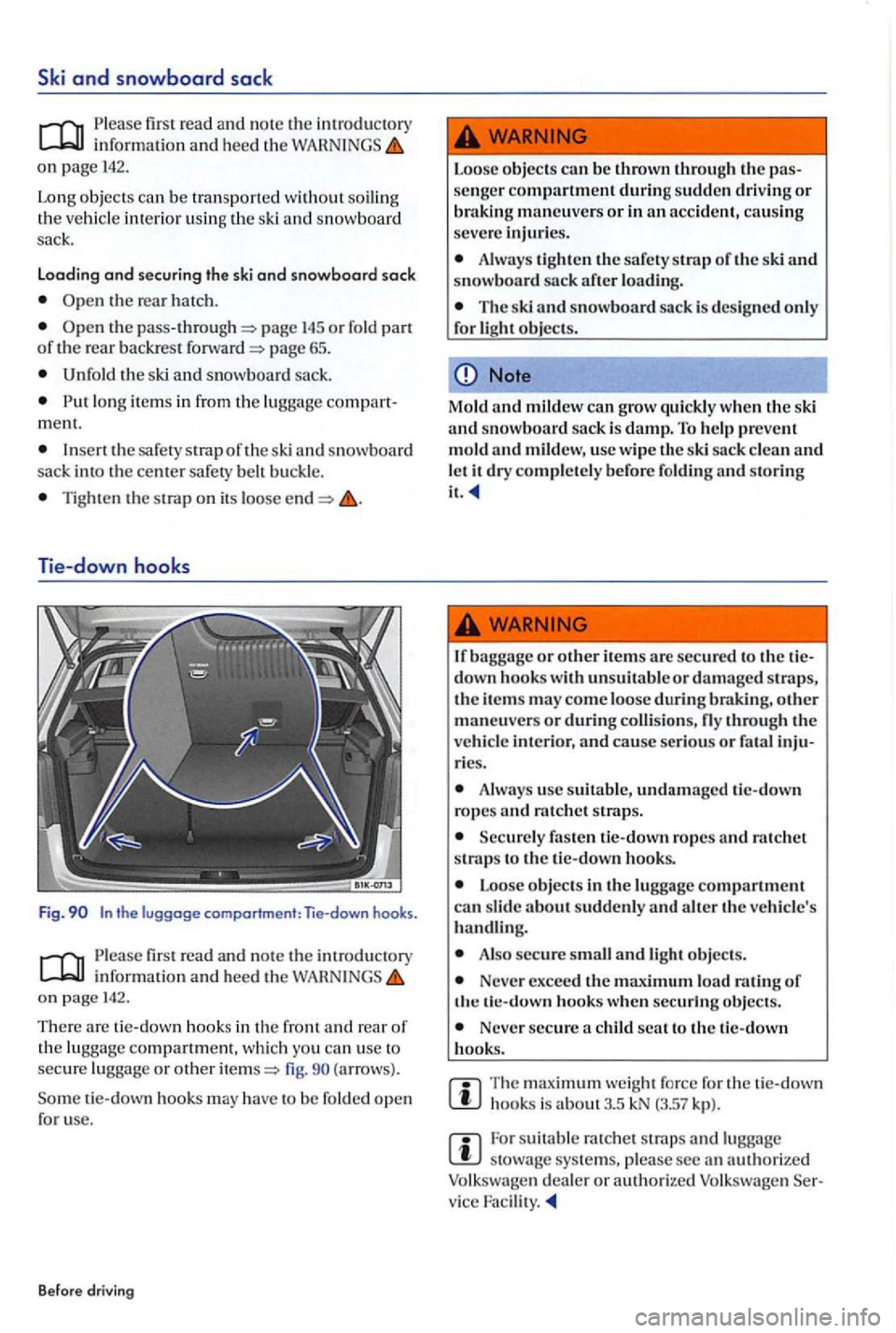
Fig. the luggage comportment: Tie-down hooks.
Please first rea d and note th e in trodu ctory informat io n and heed the on pag e 142.
There are tie-d o w n h ook s in the front and rear o f
the l u ggage compartm ent , wh ic h you can use to se cure lu gga ge or other fig. (arrows).
S
ome tie-d own hook s m ay have to b e fold ed open
f o r u se.
Befo re driving
Loose objects be thrown through the
Always tighten the safety of th e ski and snowboard sack after loading.
The ski snowboard sack is de signed only
fori
Note
Mo ld mildew can grow quickly wh en th e ski and snowboard sack is damp. T o he lp prevent mold and mildew, use wipe th e ski sack clean and let it dry completely before fo lding and storing
it.
baggage or oth er item s arc secured to th e down hooks with unsuitabl e or damaged
ries.
Always usc s uit able , undamaged tic-dow n ropes and
Securely fas ten tic-down ropes and ratch e t
stmps to th e tic -dow n hooks.
Loo se o bjec ts in th e lug gage compartm ent
ca n slide about suddenly a nd alter the ve hicl e's
handling.
A ls o secure and lig ht obj ec ts .
Never exceed the maximum load ra tin g o f
th e
Never secure a c hild seat to th e tic-down
h ooks.
The maximum weig ht fo rce for th e tie-down hook s is about3.5 k N (3.57 kp) .
sui table rat ch e t stmp s and luggage stowage syste m s, please sec a n authorized d ealer or authori zed Volksw agen
Page 152 of 541
Securing a
first r ead and note the introdu ctory information and heed the on pag e 149.
It is no t pos sibl e secure a load unless the roof rack sys te m has bee n pro perly
Maximum permissible roof load
Th e ma ximum permi ssibl e roof load is l65lb s. (75 kg). Th e roof load is the combined weight of
the roo f ra ck and the item s bein g carri ed on th e
Transporting
Checking the mountings
Afte r the base carrier and rook rack have been in
s talled, check all bolt s and faste n ers after drivin g a
s h ort time and at regular int erva ls th ereaft er.
If the maximum permissible roof load is ex
ceeded, accidents and substantial vehicle damage may occur.
Never exceed the specified roof load, the maximum gross axle weight rating, or the gross
veh icle weight rating .
Always make sure that loads are evenly dis
tributed and that heavier it ems are, as far as pos
sible, toward the front.
Loose
or improperly secured item s can fall off the roof rack and cause accid ents and injuri es.
Always use suitabl e, undamaged tie-down
ropes and ratchet straps.
the load
151