towing VOLKSWAGEN GOLF PLUS 2012 User Guide
[x] Cancel search | Manufacturer: VOLKSWAGEN, Model Year: 2012, Model line: GOLF PLUS, Model: VOLKSWAGEN GOLF PLUS 2012Pages: 541, PDF Size: 98.86 MB
Page 159 of 541
Note
can use one of these adapte rs if required for the proper in stallation of bi cycle rack or
m ent s are m el. Wh en u sin g bicycle rack s or carri ers make sure that th e tailli ghts are n o t
bl ocke d.
Retrofitting a
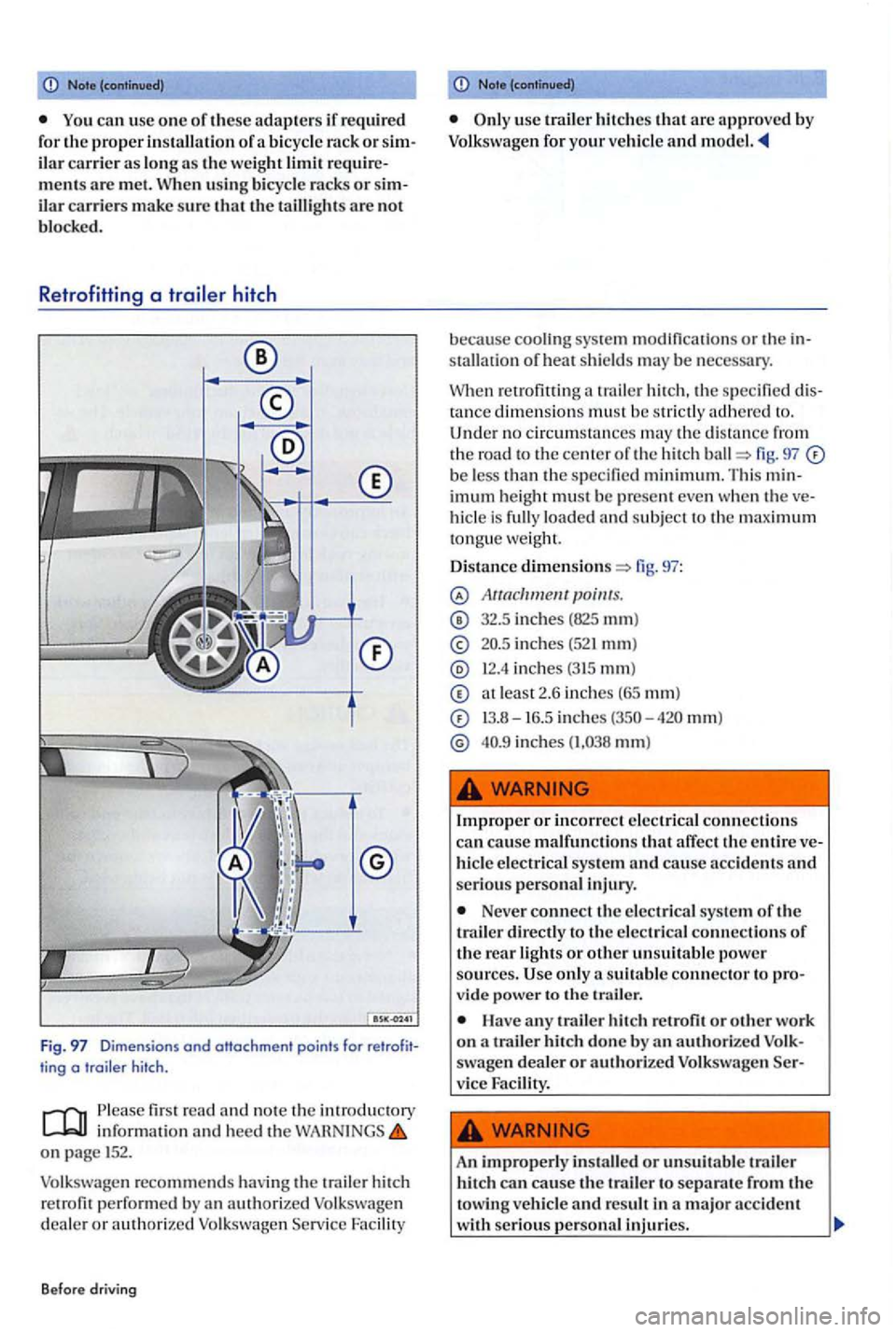
Fig. 97 Dimensions ond ottochment points for ting o hitch.
first re ad and not e th e intr oductory information and h eed th e on page 152 .
V o lk sw age n rec
ommends hav in g the trai le r hit ch
r e trofit perf o rm ed b y an Volk swag en deale r o r authorized Volk s wa gen Servic e Facility
B efore driving
Note (continued)
use hitches that a re approved by for your vehicl e and
because cooli ng sys te m m od ification s or th e sta llation of heat shield s may be necessary.
Wh en re trofi tting
traile r hi tch, th e specified ta nce dimensions must be stri ctly adhered to. Under no circums ta nces m ay the distance f ro m
th e road to the center o f the hitch fig. 97 be le ss than th e s pecifi ed min im um. Thi s imum height must be present ev e n whe n the hi cle is full y load ed and subje ct to the maximum tongue weigh
D istance fig. 97:
32.5 inch es (825 mm)
in ches ( 52 1 mm)
inc hes (315 mm )
atleast2 .6 in ches (6 5 mm)
13.8-16.5 inches mm)
in ches
Imprope r or incorrect elec tri cal connection s
ca n cause malfunction s that affect th e e ntire hicl e elec tri cal sys te m and cau se acc id e nt s and serio us perso na l injury.
Neve r connect th e e lectrical syste m of the
trailer directly to the e lec trical connectio ns of the rear light s or oth er unsuitabl e power sources . U se only v ide po w er t o th e trailer.
H ave a ny trailer hit ch r etrofit or other work on a trailer hit ch don e by an authorized swage n deal er or authorize d Volkswage n
An improperly in stalled or uns uitable trailer hitcl1 can cause th e trai le r to separate fro m the
towing vehicl e and result in major accident with serious perso nal injuries.
Page 173 of 541
In this section yo u'll fin d information on th e
ke y p ositions . . . . . . . . . . . . . . . . . . . . . . . . 17 4
Starter button . . . . . . . . . . . . . . . . . . . . . . . . . . . . . . 175
Sta rting the engine . . . . . . . . . . . . . . . . . . . . . . . . . 176
S topping th e e ngine . . . . . . . . . . . . . . . . . . . . . . . . . 177
Electro nic immobi lizer . . . . . . . . . . . . . . . . . . . . . . . . 178
Explanatory no tes in thi s chapter regard
rec t S hift Gea rbox.
Immob i
lizer display
I f a n unauthori z
ed vehicle ke y is used or the
s y s te m malf un ctions, o r Immobiliz er activ e!
m ay appear on th e in strum ent cluster. The e ng in e cannot b e s tarte d.
P ush -starting
and tow-starting
F o r t ec hni cal re as
ons, never try to pus h -s ta rt or
stead w hil e following proper a nd safe proc edures.
Mor e information:
Vehicle key pag e 34
Shifting pag e
B raking, sto pping and page
pag e
234
Fuel page 23 9
E m erge ncy clo sing and page 322
353
Towing and page 357
W hile driv ing
Switch in g off the engin e whil e th e ve hicle is
m oving can m ake the ve hicl e harder to s top and re sult in loss of ve hicl e control,lcading to sion s and seve re personal injuri es.
Brake and steerin g assis ta n ce sys tem s, the
a irbag syste m, safety belt pretensione rs, and oth er vehicle safety features onl y wor k when the
e n gi ne is runni n g.
Sw itch off theengineon lyw he n th e vehicl e is
not m ov ing.
The ris k of serious injury ca n be reduced with
the e n g in e runnin g or when startin g the en gine .
To reduce th e risk of seriou s perso nal inju ry
w hen sta rling and running the ve hicle's en gi ne,
n eve r start the e ngine or le t it run in a confined or en clo se d area. Carbon an odorl ess and colorless poisonous gas, is one co mpone nt of en gine exhaust fumes . monoxide can cause loss of conscio usn ess and d ea th.
Never leave the ve hicle unattended with the
e ngin e running. Th e ve hicl e could move denly or a n unusu al operating condition could
occ ur res ult ing in property damage or personal
i njury.
Neve r usc assi st
The ve hicle exhau st s ys tem and th e ca ta ly tic
co nve rter or diese l particula te filter ge t very ho t
and ca n cause and seriou s perso nal injury .
Never park th e veh icle where the ho t ex haust
sys te m or cataly tic co nverte r could ignit e mable materials, su ch brus h , leaves, dry grass, spilled fuel, etc.
Page 195 of 541
Braking assistance system s
fir st read and n o te the introductory information and heed the
on page
T he and EDL braking tance system s work onl y w he n th e engine is ning. These sys te m s can sig nificantl y improve
vehicle namics to help reduce the probability of skidding and loss o f vehicl e control. works only w hen the engine is running. driving situations, including w hen the veh icle is beginning to spin (yaw) out of control.
gin e power and by providing steering assistance to help hold the ve hicle on the driver's intended
course.
has limitation s.
will not always be able to help out under all tions you m ay come up against. For example, may no t a lways be able to hel p you mas te r tions w he re there is sudde n change in the
cannot perform the sa me
way it would on a dry surface. the vehicl e
cornering. ularly on winding road s, cannot always deal as
e ffectiv ely wi th diffi cult drivin g situations it can
a t lower speed s. When towin g a is not able to help you regain control as it would if yo u were not towing a trailer.
Alway s
adjust your speed bility, road, cannot overcome the laws of phys ics, increa se the available
stead, improves the possibil ity o f keeping th e
vehi cle under control and o n th e road during treme maneuvers b y using th e driver's s teerin g puts to help keep the vehicle going in the int ended direction .lf you a re tra velin g at a speed that causes yo u to run off th e road before can provide any
EDL , and XDL syste m s (sec be lo w). is switc hed on all the tim e. certain situati ons
w he n you need less traction or additional tract ion cannot be achieved, you can swit ch off by pressing page 196, fig. l28. B e
s
ure to switch ASR on again when you no longer
need less traction.
Anti-lock
brake system (ABS)
ABS helps to keep the wheels from l ocking up and helps to maintain t h e driver's ability to steer and control the vehicle . Thi s means the vehicle is less lik ely to skid, even during hard
th e brake pedal down hard
Do not the brake pedal or letup on it!
S teer the vehicl e while pushing down hard on the brake pedal.
ABS sto ps working if you re lease or let up on th e brake.
When is doing i t s job, you will notice
noise. T he stopping di stance may even be lo nger, for instance, when dri ving on
pin g distances.lfyou press the pedal very quickly, BAS detects an e m ergency situ ation.
pedal! BAS
s w itches off automaticall y as soon
reduces en gine power d irected to spinning wheels and adjus ts power to the road conditions.
Eve n under poor ro ad conditions,
Page 200 of 541
Efficient driving
Please information and heed the on page 198.
Shifting faster
As a rule, the following applies: The higher gear is
a lways the more efficient gear. The rule of thumb for most vehicles is to drive in 3rd gear at mph f km/h, 4th gear at 25 mph f km/h, and 5th gear at mph f km /h.
If
and driving conditions permit, gears when upshifting also saves fuel.
Do
not run the gears up to their limit.
mati c transmissions .
Vehicles with gear recommendation aid in fuel fic ient dri ving by indicating the optimum time to shift gears.
livery to the engine is interrupted, which lowers
fuel consumption.
T herefore, when nearing a red stop light , for s tanc e, allow the vehicle to coast without using the accelera tor. Press the clutch pedal and release it only if the v ehicle is moving too slowly or the coasting distance is too long. The engine will then continue to run at idl e.
In situati ons
where the vehicle will be stopped for
a longer period of time, such as at a train cros sing,
physically switch off the engin e.
D efens ive driving
and with traffic
Fre
quent braking and accel eration increases fuel consumption sign ific antly. Just by driving sivel y and keeping a su fficiently large distance away fro m the vehicle in front of you can make up for the speed fluctuation s caused by taking your foot off the accelerator. Active braking and ating is then not necessarily required.
system information
The power stee ring syste m i s not hydrauli c.lt is an electro-mechanical syste m. The advantage of this
s te ering system is tha t no hydra uli c hoses, draulic oil, pumps, filters or other parts are quired . Th e e lectro-m echanica l system is more fue l effi cient. A hydraulic system requires constant oil pressure in the syste m; an electro -mechanical
s teerin g sys tem, however, needs power only whil e
s teering.
Th e el
ectro-mechanical power steering
chanical power steering works only when the gin e is running.
and smooth driving
Consistency is more important than speed. The more smoothly yo u drive, the less fuel the vehicle consumes.
When driving on the highwa y or freeway, a
stantly accelerating and braking. you can r each your destinatio n just as quickly by driving at a moderate, but steady speed.
The c rui se control syste m can a ssis t in
sciou s manner.
Some dev ices can increase fuel consumption when activated (examples):
C limate control air conditioning system:
trasting temperatures, it requires a large amount of energy, which is generated by the e ngin e. T he
tr emely different from that of the outside
windows increase fuel consumption.
Switch off seat heating once it has served its
purpose.
Sw itch off the windshield and rear window
Malfunctioning engine control.
Driving in the mountains.
Towing a trailer .
page 257
Towing and page 357
Turning the steering wheel is very hard when the power steering system is not working. This makes it harder to control the vehicle.
steering works only when the engine is running.
Never let the vehicle coast with the engine switched off.
Never remove the key from the ignition
switch while the vehicle is moving or rolling to a
stop. The steering column will lock and you will be unable to control the vehicle.
Page 273 of 541
Tires and wheels
Introduction
In this section you'll find informa
tion on th e following:
Tire and . . . . . . . . . 278
New and tires . . . . . . 281
Tire
tires . 285
Tread depth and tread wear
indicators . . . . . . . . . . . . . . . . . . . . . 286
Tir e wear and damage . . . . . . . . . . 286
Spare or compact spare
....... ................. 288
Braking, stopping and parking
188
Tire Pressure Monitoring System
Exterior care and cleaning
page262
Consume r information
Wheel covers page 328
Changing a wheel page
T ir e mobili ty page 336
Tire ...................
Winter tires . . . . . . . . . . . . . . . . . . . 29 4
Snow chains . . . . . . . . . . . . . . . . . . . 295
of tire and
. . . . . . . . . . . . . . . . . . . 296
Tires and . . . . . .
Determi ning the correc t
page 137
Trailer towing page 152
Core, maintenance
New tires or tires that are old,
worn or damaged cannot provide
maximum control and braking
performance.
New tires must be broken in
because new tires do not have
full traction and braking perfor
mance. Always drive with special
care for the first
Page 285 of 541
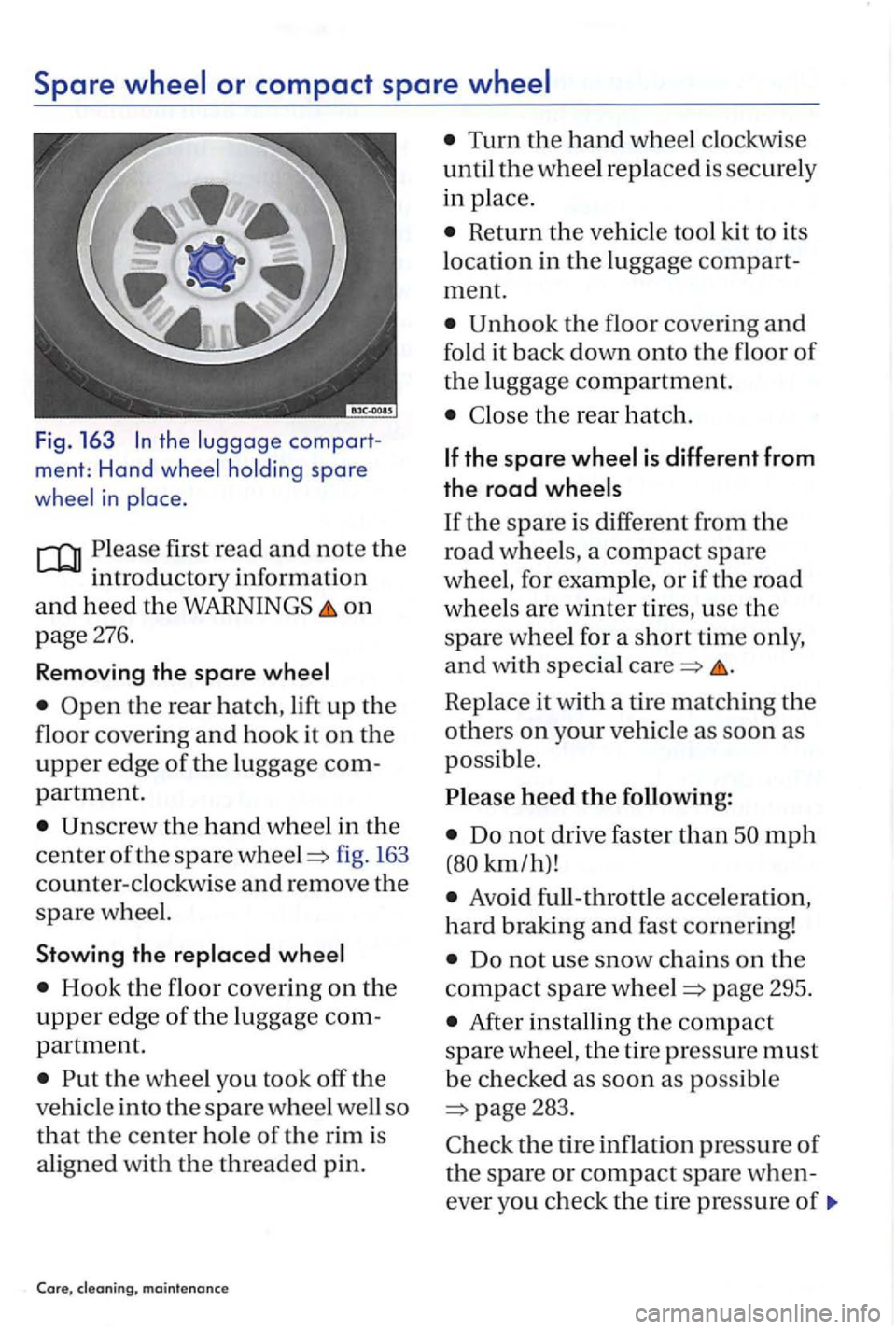
Spare
the compart
ment: Hand
Please first read and note the
introductory information
and heed the WARNINGS on
page 276.
Removing the spare
fig . 163
counter-clockwise and remove the
spare wheel.
Stowing the replaced wheel
Hook the floor cover ing on the
upper edge of the luggage com
partment.
Turn the hand wheel clockwise
until
the wheel replaced is securel y
in place .
Return the vehicle tool kit to its
location in
the luggage compart
ment.
the floor covering and
fold it back down onto the floor of
the luggage compartment.
Close the rear hatch.
Rep lace it with a tire matching the
others on your vehicle as soo n as
poss ible.
Please heed the following:
Do not drive faster than mph
km/h)!
Avoid full-throttle acceleration,
hard braking and fast cornering!
Do not use snow chains on the
compact spare whee l page 295.
After installing the compact
spare wheel, the tire pressure must
b e checked as soon as possib le
283.
Check
the tire inflation pressure of
the spare or compact spare when
ever you ch eck
the tire pressure of
Page 312 of 541
Engine
Introduction
In this sec tio n yo u'll fin d infor matio n on th e lowing:
Indicator lights . ......... , . . . . . . . . .. . . . 315
Catalytic converter ............. , . . . . . .
.......... , . . . . . . . . . . . . . 317
More informatio n:
179
234
pa ge 239
Engi ne page 247
Notice about data r eco rded by vehicle control page
Towing a nd
The vehicle exhaust sys te m and the catalyt ic
co nve rter or di ese l parti cu la te filter very hot
a n d can cause a fir e a nd serious perso na l in jury.
Neve r park where parts oft h e hot exhaust syste m and catal ytic con ver te r co uld ignite
O ammabl e m ate ri als, su c h as bru sh , lea ves, dry fu el, e tc.
Neve r appl y addition al undercoatin g o r rust
proofi ng on or near th e exhaust manifold, pipes , catalyti c converter, d ies el pa rti cu-
l a te or heat shi eld s.
Califo rni a Propo sition 65 Warnin g
E ngine exha ust, some of it s constitu ents, and ce rtain v ehi cle component s cont ain or emit ch em ica ls kno wn to th e Sta te o f California to
ca use cance r and birth defec ts and reproduc tive h arm. In additio n, cert ain flu ids contain ed in
ve hicles and ce rtain products of compone nt
wea r contain or emit ch emicals know n t o the Sta te o f Ca lifornia to cause cancer and birtJ1
firs t read and note the int rod uctory in formati on an d heed th e WARN INGS on page 315.
Light s
th orized dea le r o r a uth orized Serv ice Facility .
Diesel e ng in e preheating before eng in e 172 sta rt -up .
Page 324 of 541
Cont ents
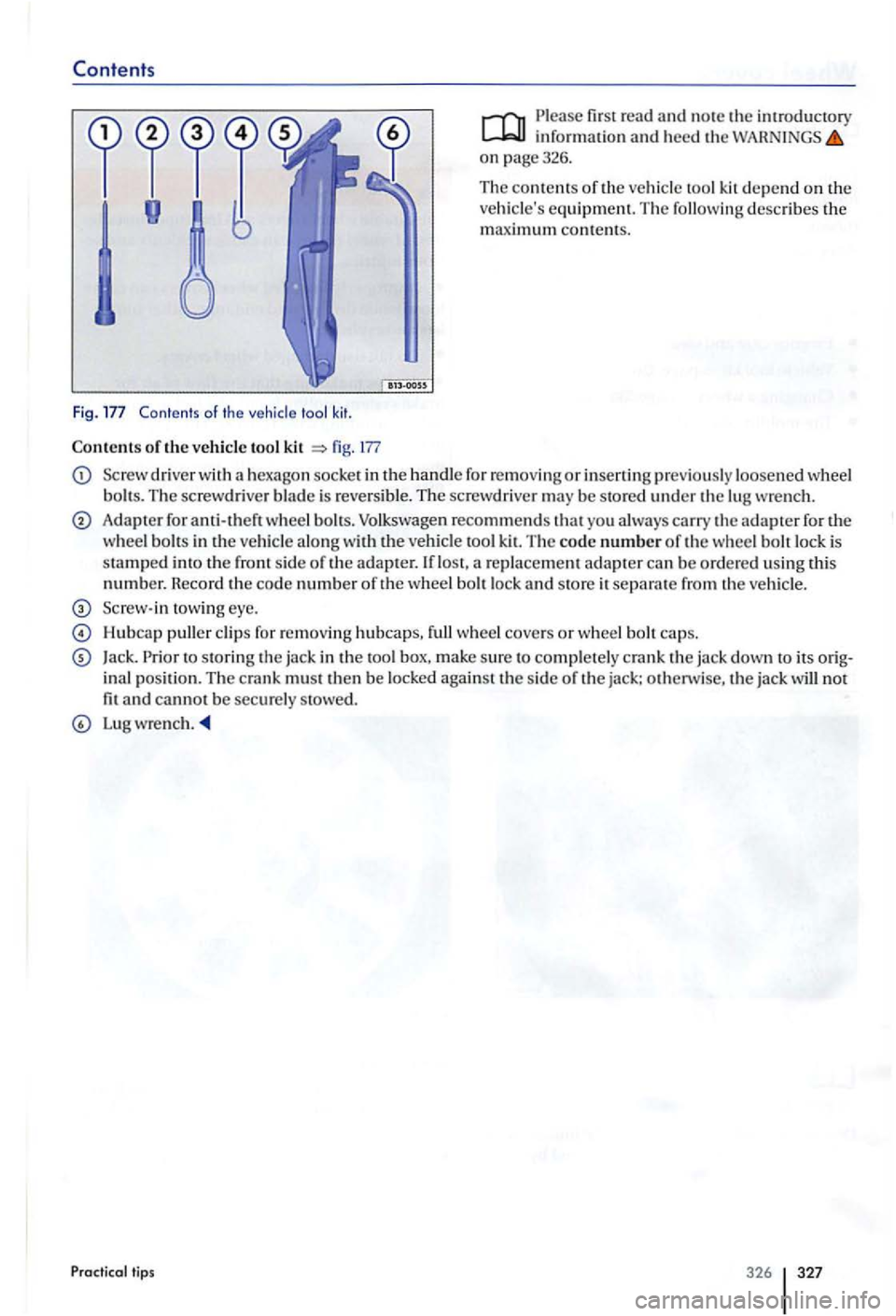
Fig . Contents of th e vehicle tool kit .
Con tents of th e vehicle tool kit fig. 177
Please first read and note the information and heed th e on page326.
T he
contents of th e ve hicl e tool kit d epend on the vehicle's equ ipment. The followin g describe s the maximum conte nt s.
Sc rewdri ver with a hexago n socke t in the handl e fo r r em ov ing or in se rting prev iou sly loosened w heel
bolt s. The screwdrive r blade is revers ible. The screw driver may be stored unde r th e lug wre nch.
Adapter for anti-theft wheel b olts. Volkswagen recom mends that yo u alw ays carry the adapte r fo r th e
w heel b olt s in the ve hicl e along w ith the veh icle tool The code number of the w heel bolt lock is
stamped th e sid e ofthe ad apter.
towing eye.
Hu bca p puller clip s for remov ing hubcaps, full wheel cover s or wheel b o lt caps.
Jack. Prior to stor in g th e jac k in the too l box, make s ure to co mpl ete ly crank the ja ck down to its ina l position. The cra nk mu st then b e locked against the sid e of the jack: oth erwise, the jack will not fit and cannot be sec urel y stowed.
Lug w rench .
Practica l tips
Page 327 of 541
Introduction
In this s ec tion lowing :
Preparation s chang ing a . . . . . . . . . . . . . 331
. . . . . . . . . . . . . . . . . . . . . . . . . . . . . . . . 332
the with the jack . . . . . . . . . . 333
Changing a
. . . . . . . . . . . . . . . . . . . . . . 335
ve hicl e design s and models are not ered with a jack and lug w re n ch . su ch cases , Volkswage n recommend s havi ng tires and wheels
changed by an authorized Volk swage n dealer or an authorized Volkswag en Servic e Facility.
Vehi cle key page 34
Tir es and wheels=>
In an page
Vehi cle tool pag e 32 6
Whee l cover s page 328
a whe el, especially on th e side of the road, can be da ngerou s. To help reduce the risk of ser ious personal injury:
Always stop the vehicle
Always make sure that all passengers , cially children, are in safe place outside the
Turn on the emergency nasher and set up another
Always make sure th at the ground is level and firm . If necessary place a sturdy board under the jack.
a whee l by yourse lf only if yo u arc
Always use proper and undamaged tools
when changing tire.
Always apply the parking brake and sh ift the transmission into Park mission ) or any gear (manual only) to help ve nt the ve hicle from moving suddenly and ping off the jack.
a w heel is lifted off the ground, having the tran smission in Park or in gea r not prevent sudden vehicl e movement.
Alwa ys blo ck
Jar object.
If you are towing trail er, alway s unhitch it
from your vehicle before star ting to change the
wh eel. Always apply th e trailer bra kes firmly and make sure the
Always use jac k that has been approved by th e m anufacturer for your vehicle . Never use other jack s, eve n if th ey have been approved for
u se on other Volk swag en models.
To reduce the risk of los ing control , crashes, and se riou s personal injurie s, neve r loosen the
sc re w s on rim s with threa ded rim rings.
Mter changin g a wheel , have the wheel bolt
tightening torque checked with an accurate
torqu e
wrench .
Page 336 of 541
Please first read and note the introdu ctory information and heed the on page 336 .
the valve core from th e tir e valve
u sin g th e valve core page 337 , fig . 187 and place it on a clean surface.
Vigorous ly shake th e tir e inflation cylinder page 337, fig. 187
Tigh tly sc rew the filling page 337, fig. 187 to the tire inflation bo ttl e ( turn
He mov e the sealing plug from th e page 337, fig. 18 7 and slid e th e open end th e way onto the tire va lve.
H old the cylinder with the bottom po inting up and the entire contents of th e tir e inflati on inder int o th e tir e.
Detach the empty tir e inflation cylinder from
th e va lve.
p age337,fig. 187 sc rew the v al ve core back into the tir e valve.
the tire
the tire inflation page 337, fig. 187 o f th e air compressor tightl y to th e tir e va lve .
whether the air release pag e 337, 187 is screwe d on tightly.
page 337, fig. 187 into a soc ket of the page
Switch th e ai r compresso r on using th e page 337, fig. 187
Le t th e air compre ssor run until 2 .5 ) bar is re ach ed
Switch off the air compressor.
an air press ure of29-36 psi 2.5 bar)
cannot b e reac hed, unscrew the tire inflation hose from the tire v alve.
tips
Dr ive about feet m ete rs) backward s o r
f o rward s so that the sealant ca n be distributed sid e th e tire .
th e tire inflat ion hose of th e air pr esso r aga in to the tir e va lve and r epeat th e
th e required tir e pressure still cannot be reached. the tir e is too badly damaged. The t ir e
canno t b e sealed us ing th e tire mobilit y set. Do not
d rive the v ehicle. Get expert
Disconnect th e air compresso r and unscrew the tire infl ation hose from the tir e va lve .
mph km/h).
page340.
The tire inflation hose and ai r compresso r ca n
get hot during inflation.
Protec t hands and skin fro m hot parts.
Do not p lace th e hot tire inflation hose or hot air compressor on flammable material.
Let th e equipment cool off almost plet ely before sto wing it.
bar), th e damage is to o great to be repaired
wi th the tire mobility set. The sealant is not able to seal the tire. Do not drive the ve hicle. Get pert assistance.
Note
Do not let the compressor run for more than 8 minutes to help prevent overheating damage.
Let the compressor cool down for a few minutes
befor e switching it on again. Let it cool down most completely before stowing it in the re p a ir
kit.
338 339