Line VOLKSWAGEN ID.4 2022 User Guide
[x] Cancel search | Manufacturer: VOLKSWAGEN, Model Year: 2022, Model line: ID.4, Model: VOLKSWAGEN ID.4 2022Pages: 417, PDF Size: 5.39 MB
Page 244 of 417
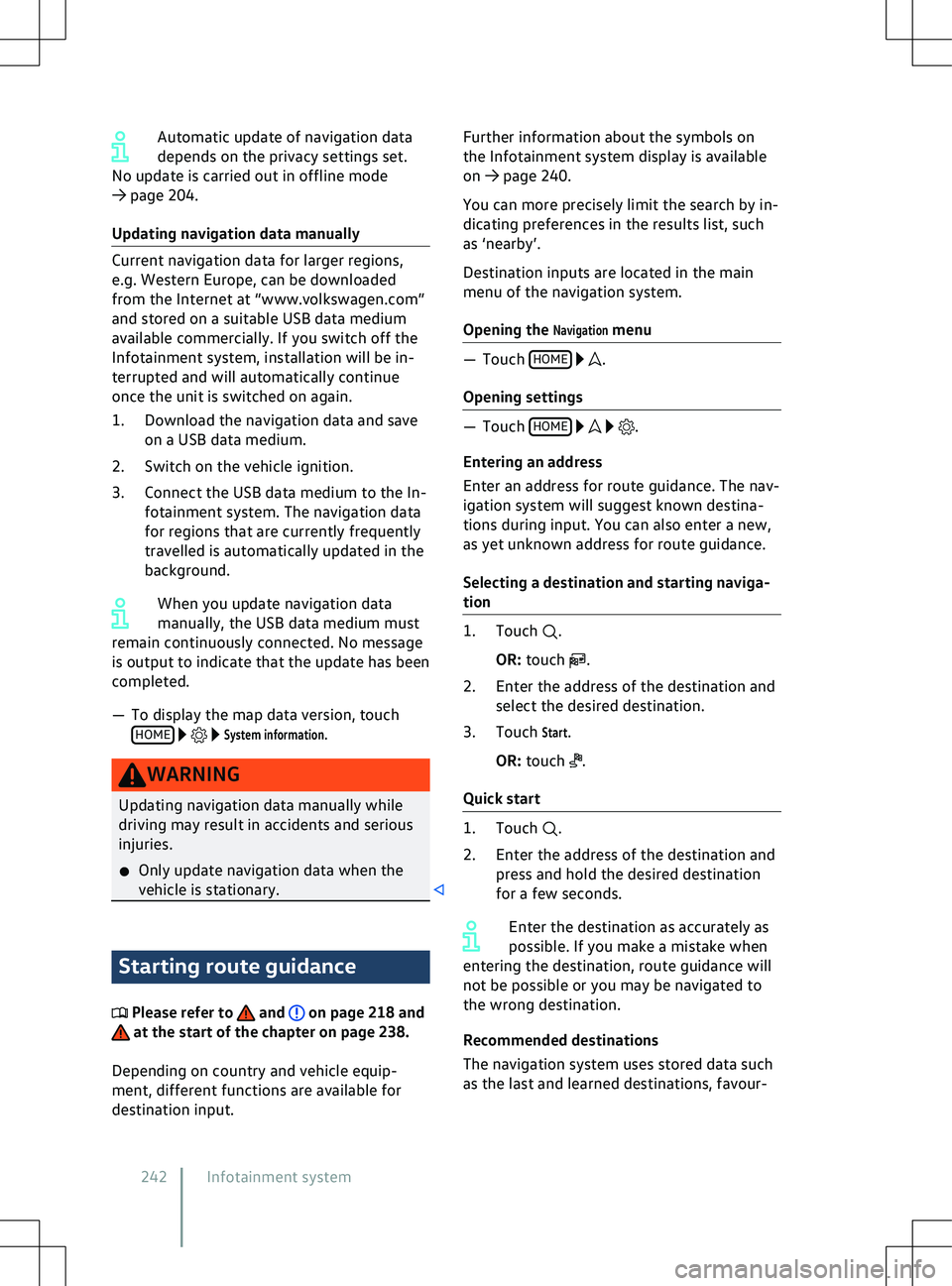
Automatic update of navigation data
depends on the priv
acy settings set.
No update is carried out in offline mode
Page 246 of 417
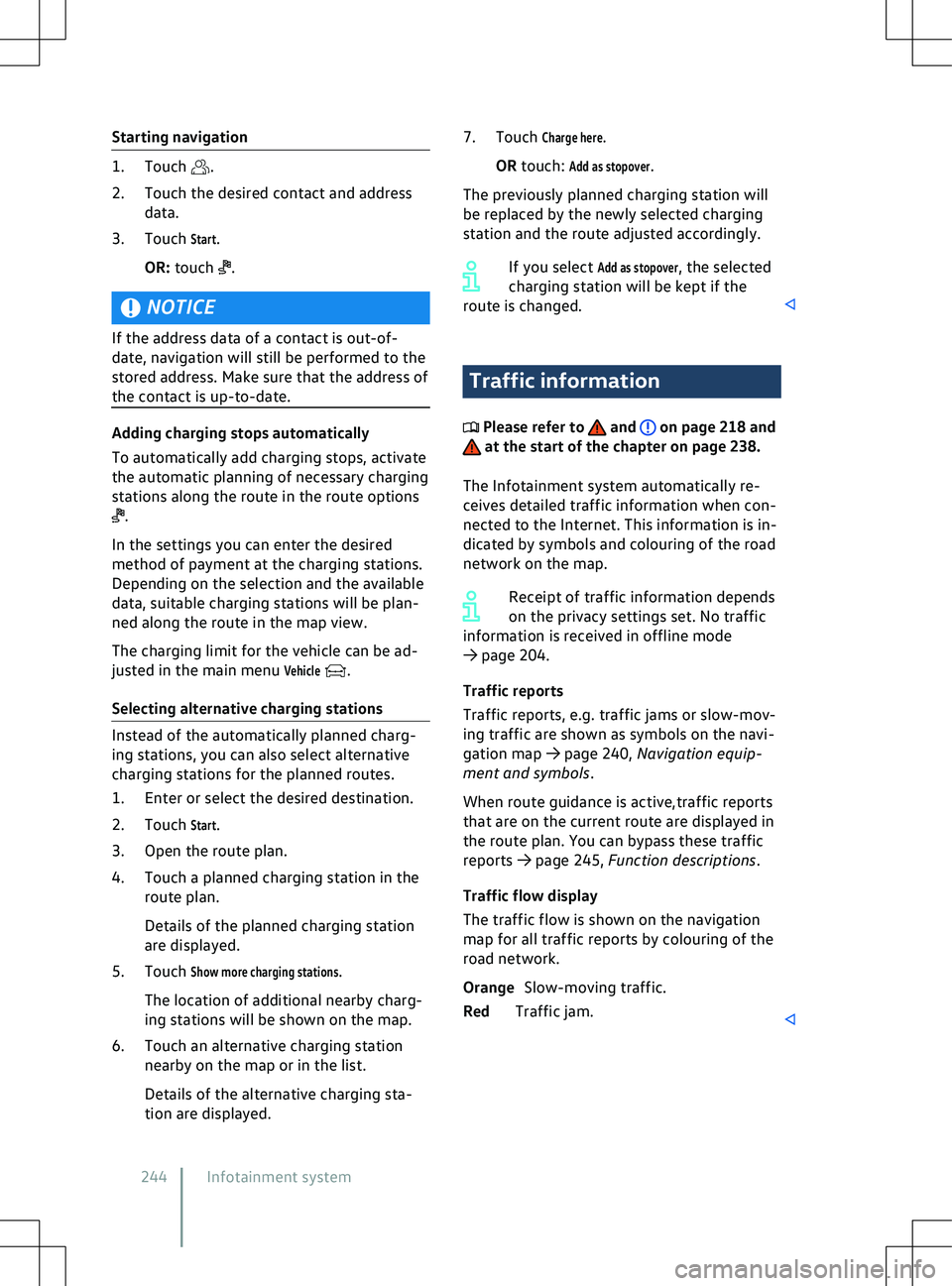
Starting navigation
.
2.
Touch the desired contact and address
data.
3. Touch
Start.
OR: touch .
NOTICE
If the address data of a contact is out-of-
date, na
vigation will still be performed to the
stored address. Make sure that the address of
the contact is up-to-date. .
In the settings you can enter the desired
method of payment at the charging stations.
Depending on the selection and the a
vailable
data, suitable charging stations will be plan-
ned along the route in the map view.
The charging limit for the vehicle can be ad-
justed in the main menu
Vehicle .
Selecting alternativ
e charging stations Traffic information
Please refer to and on page 218 and
at the start of the chapter on page 238.
The Inf
otainment system automatically re-
ceives detailed traffic information when con-
nected to the Internet. This information is in-
dicated by symbols and colouring of the road
network on the map.
Receipt of traffic information depends
on the privacy settings set. No traffic
information is received in offline mode
Page 333 of 417
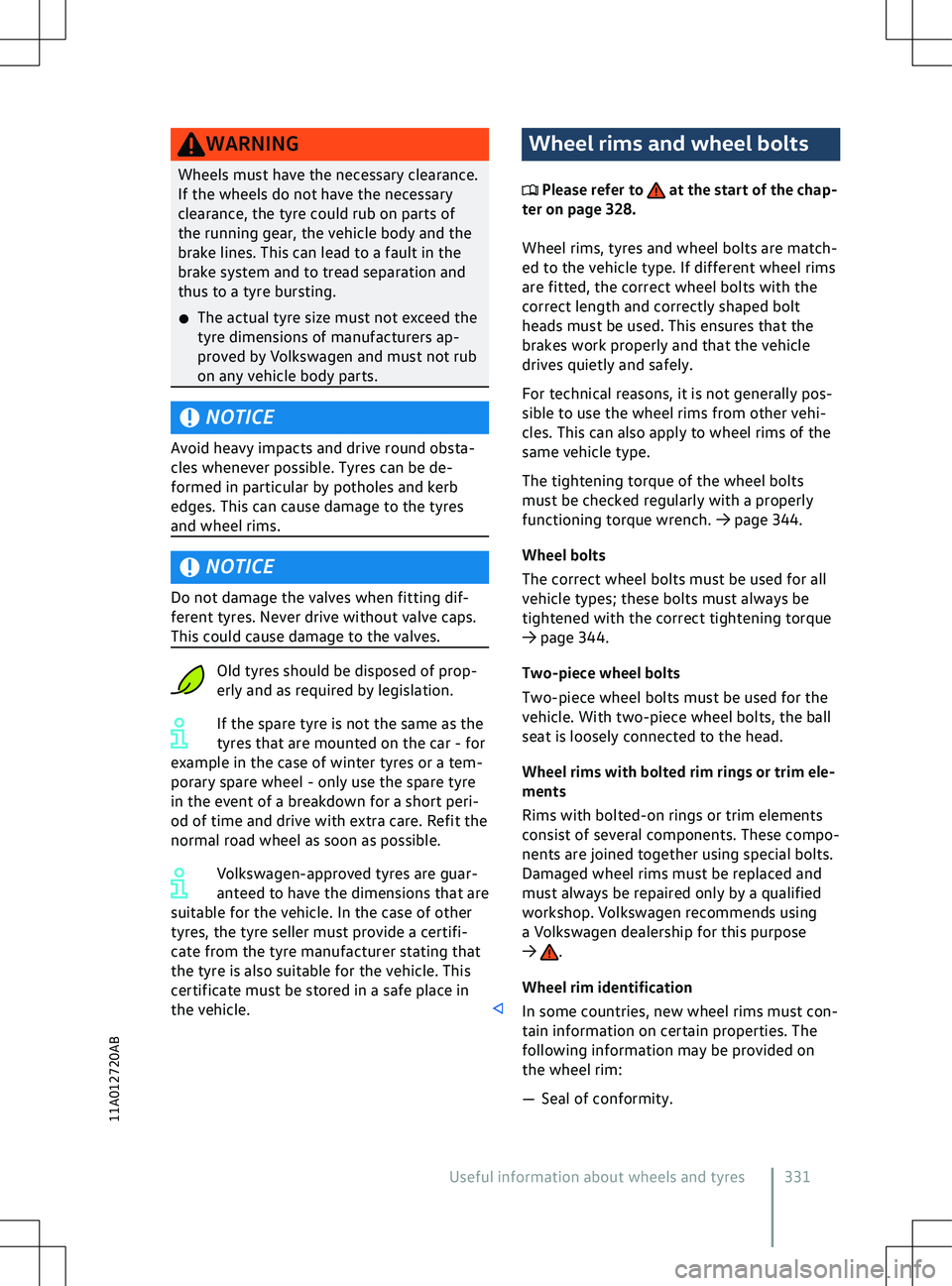
WARNING
Wheels must have the necessary clearance.
If the wheels do not ha ve the necessary
clearance, the tyre could rub on parts of
the running gear, the vehicle body and the
brake lines. This can lead to a fault in the
brake system and to tread separation and
thus to a tyre bursting.
x The actual tyre size must not exceed the
tyre dimensions of manufacturers ap-
proved by Volkswagen and must not rub
on any vehicle body parts. NOTICE
Avoid heavy impacts and drive round obsta-
cles whene
ver possible. Tyres can be de-
formed in particular by potholes and kerb
edges. This can cause damage to the tyres
and wheel rims. NOTICE
Do not damage the valves when fitting dif-
f
erent tyres. Never drive without valve caps.
This could cause damage to the valves. Old tyres should be disposed of prop-
erly and as required by legislation.
If the spare tyre is not the same as the
tyres that are mounted on the car - f
or
example in the case of winter tyres or a tem-
porary spare wheel - only use the spare tyre
in the event of a breakdown for a short peri-
od of time and drive with extra care. Refit the
normal road wheel as soon as possible.
Volkswagen-approved tyres are guar-
anteed to have the dimensions that are
suitable for the vehicle. In the case of other
tyres, the tyre seller must provide a certifi-
cate from the tyre manufacturer stating that
the tyre is also suitable for the vehicle. This
certificate must be stored in a safe place in
the vehicle. Wheel rims and wheel bolts
Please refer to at the start of the chap-
ter on page 328.
Wheel rims, tyres and wheel bolts are match-
ed to the v
ehicle type. If different wheel rims
are fitted, the correct wheel bolts with the
correct length and correctly shaped bolt
heads must be used. This ensures that the
brakes work properly and that the vehicle
drives quietly and safely.
For technical reasons, it is not generally pos-
sible to use the wheel rims from other vehi-
cles. This can also apply to wheel rims of the
same vehicle type.
The tightening torque of the wheel bolts
must be checked regularly with a properly
functioning torque wrench.
Page 365 of 417
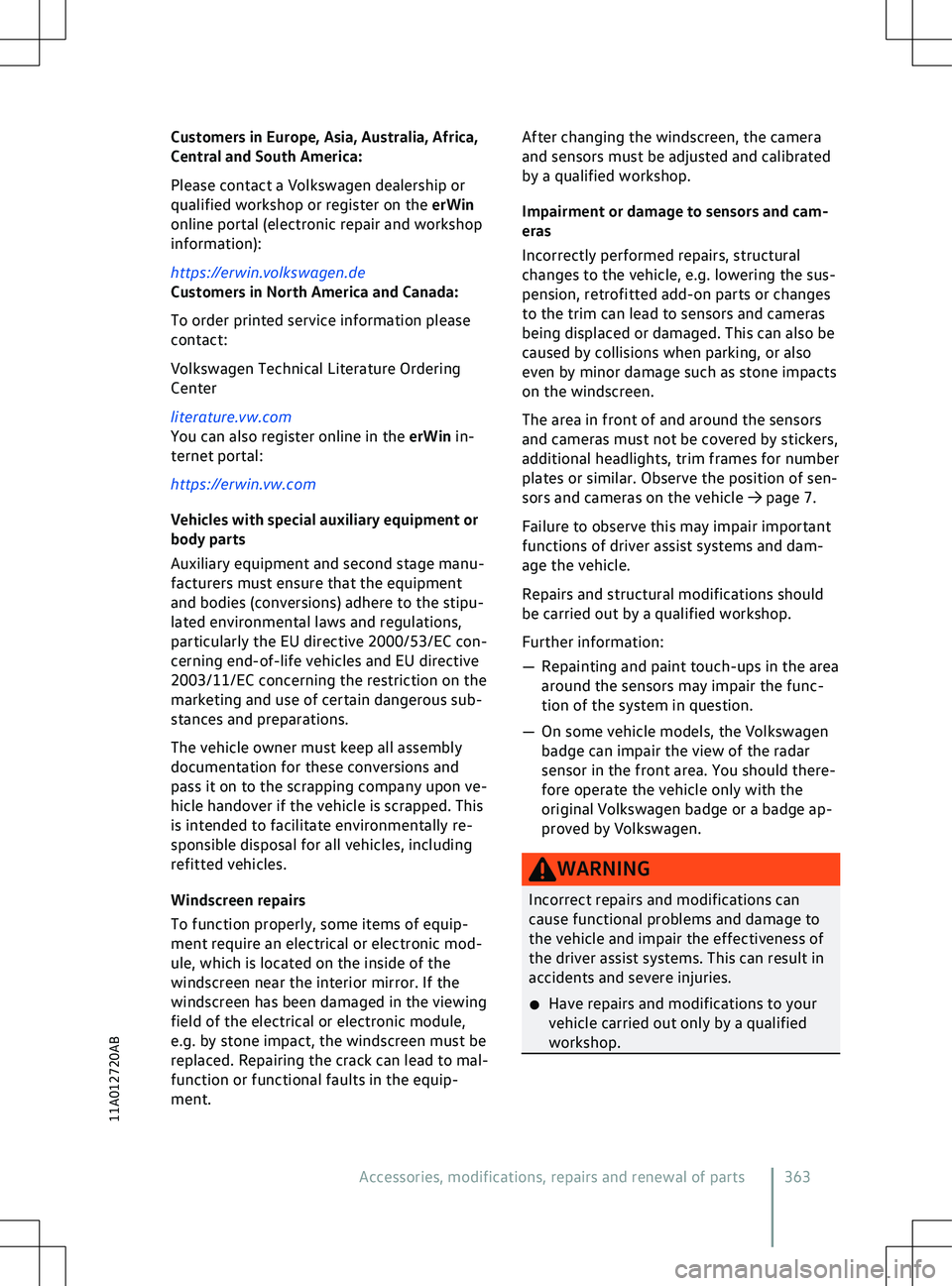
Customers in Europe, Asia, Australia, Africa,
Central and South America:
Please contact a V
olkswagen dealership or
qualified workshop or register on the erWin
online portal (electronic repair and workshop
information):
https://erwin.volkswagen.de
Customers in North America and Canada:
To order printed service information please
contact:
Volkswagen Technical Literature Ordering
Center
literature.vw.com
You can also register online in the erWin in-
ternet portal:
https://erwin.vw.com
Vehicles with special auxiliary equipment or
body parts
Auxiliary equipment and second stage manu-
facturers must ensure that the equipment
and bodies (conversions) adhere to the stipu-
lated environmental laws and regulations,
particularly the EU directive 2000/53/EC con-
cerning end-of-life vehicles and EU directive
2003/11/EC concerning the restriction on the
marketing and use of certain dangerous sub-
stances and preparations.
The vehicle owner must keep all assembly
documentation for these conversions and
pass it on to the scrapping company upon ve-
hicle handover if the vehicle is scrapped. This
is intended to facilitate environmentally re-
sponsible disposal for all vehicles, including
refitted vehicles.
Windscreen repairs
To function properly, some items of equip-
ment require an electrical or electronic mod-
ule, which is located on the inside of the
windscreen near the interior mirror. If the
windscreen has been damaged in the viewing
field of the electrical or electronic module,
e.g. by stone impact, the windscreen must be
replaced. Repairing the crack can lead to mal-
function or functional faults in the equip-
ment. After changing the windscreen, the camera
and sensors must be adjusted and calibrated
by a qualified workshop.
Impairment or damage to sensors and cam-
eras
Incorrectly perf
ormed repairs, structural
changes to the vehicle, e.g. lowering the sus-
pension, retrofitted add-on parts or changes
to the trim can lead to sensors and cameras
being displaced or damaged. This can also be
caused by collisions when parking, or also
even by minor damage such as stone impacts
on the windscreen.
The area in front of and around the sensors
and cameras must not be covered by stickers,
additional headlights, trim frames for number
plates or similar. Observe the position of sen-
sors and cameras on the vehicle
Page 371 of 417
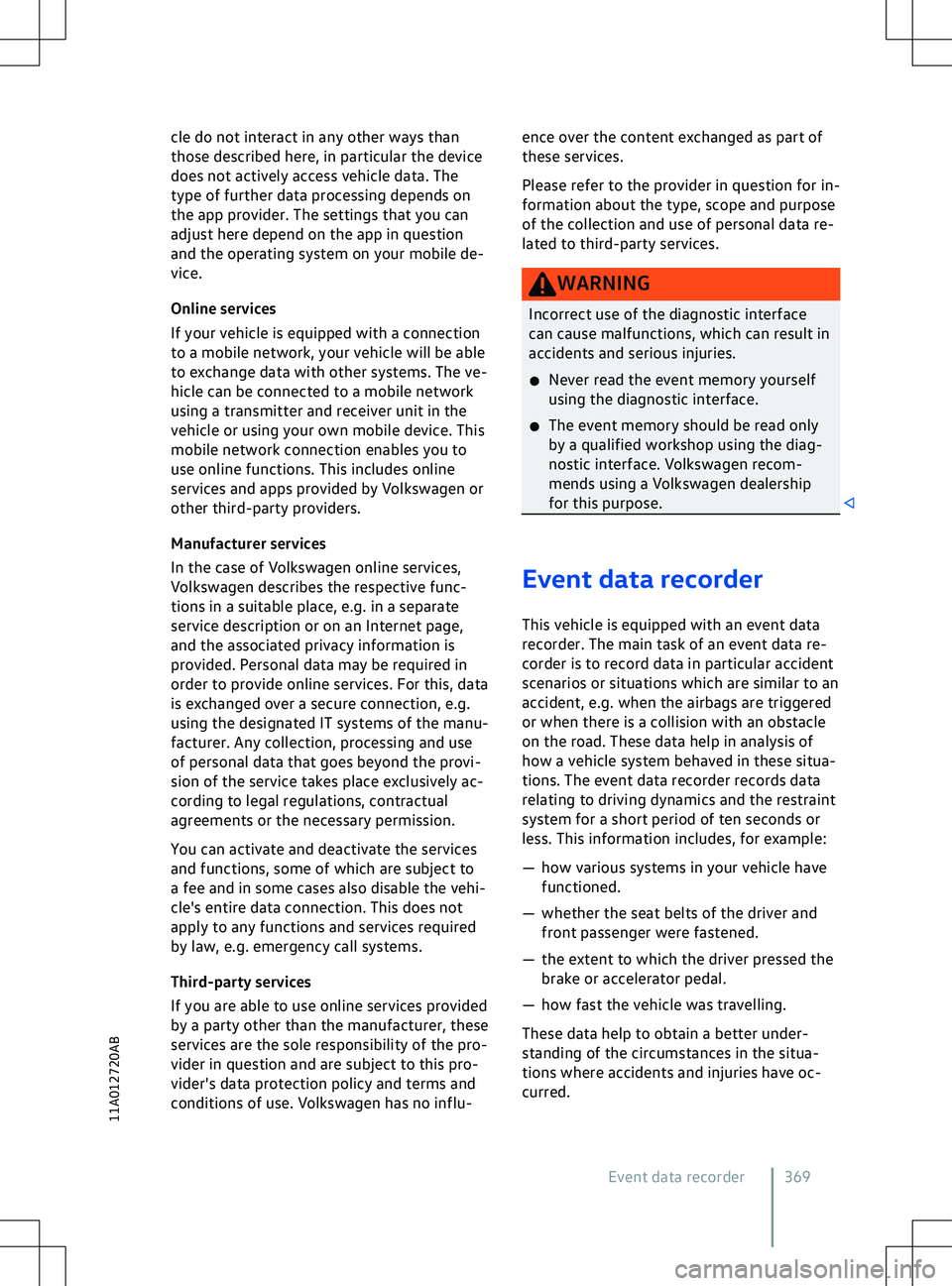
cle do not interact in any other ways than
those described here, in particular the de
vice
does not actively access vehicle data. The
type of further data processing depends on
the app provider. The settings that you can
adjust here depend on the app in question
and the operating system on your mobile de-
vice.
Online services
If your vehicle is equipped with a connection
to a mobile network, your vehicle will be able
to exchange data with other systems. The ve-
hicle can be connected to a mobile network
using a transmitter and receiver unit in the
vehicle or using your own mobile device. This
mobile network connection enables you to
use online functions. This includes online
services and apps provided by Volkswagen or
other third-party providers.
Manufacturer services
In the case of Volkswagen online services,
Volkswagen describes the respective func-
tions in a suitable place, e.g. in a separate
service description or on an Internet page,
and the associated privacy information is
provided. Personal data may be required in
order to provide online services. For this, data
is exchanged over a secure connection, e.g.
using the designated IT systems of the manu-
facturer. Any collection, processing and use
of personal data that goes beyond the provi-
sion of the service takes place exclusively ac-
cording to legal regulations, contractual
agreements or the necessary permission.
You can activate and deactivate the services
and functions, some of which are subject to
a fee and in some cases also disable the vehi-
cle
Page 374 of 417
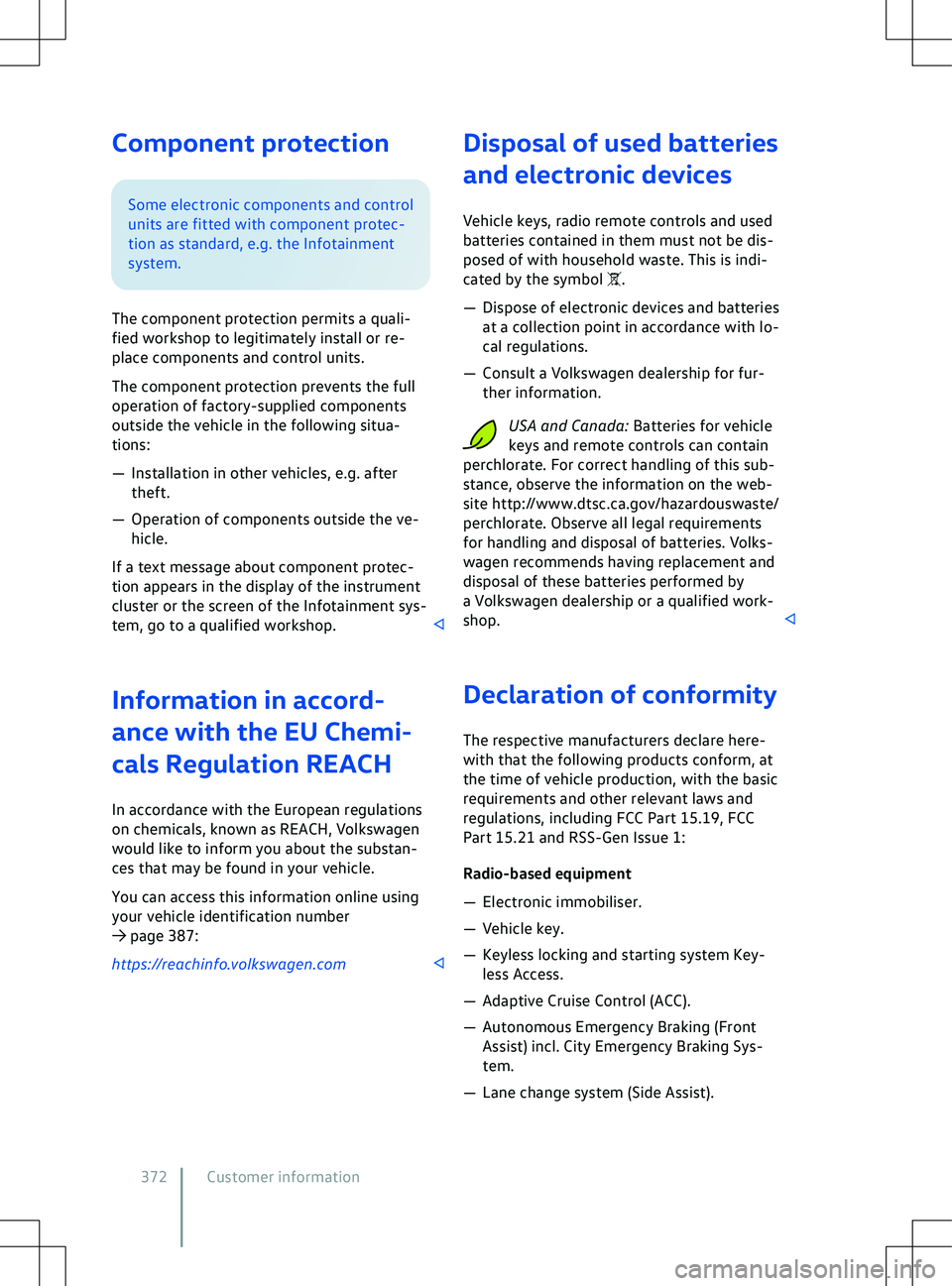
Component protection
Information in accord-
ance with the EU Chemi-
cals Regulation REACH
In accordance with the European regulations
on chemicals, known as REACH, V
olkswagen
would like to inform you about the substan-
ces that may be found in your vehicle.
You can access this information online using
your vehicle identification number
Page 401 of 417
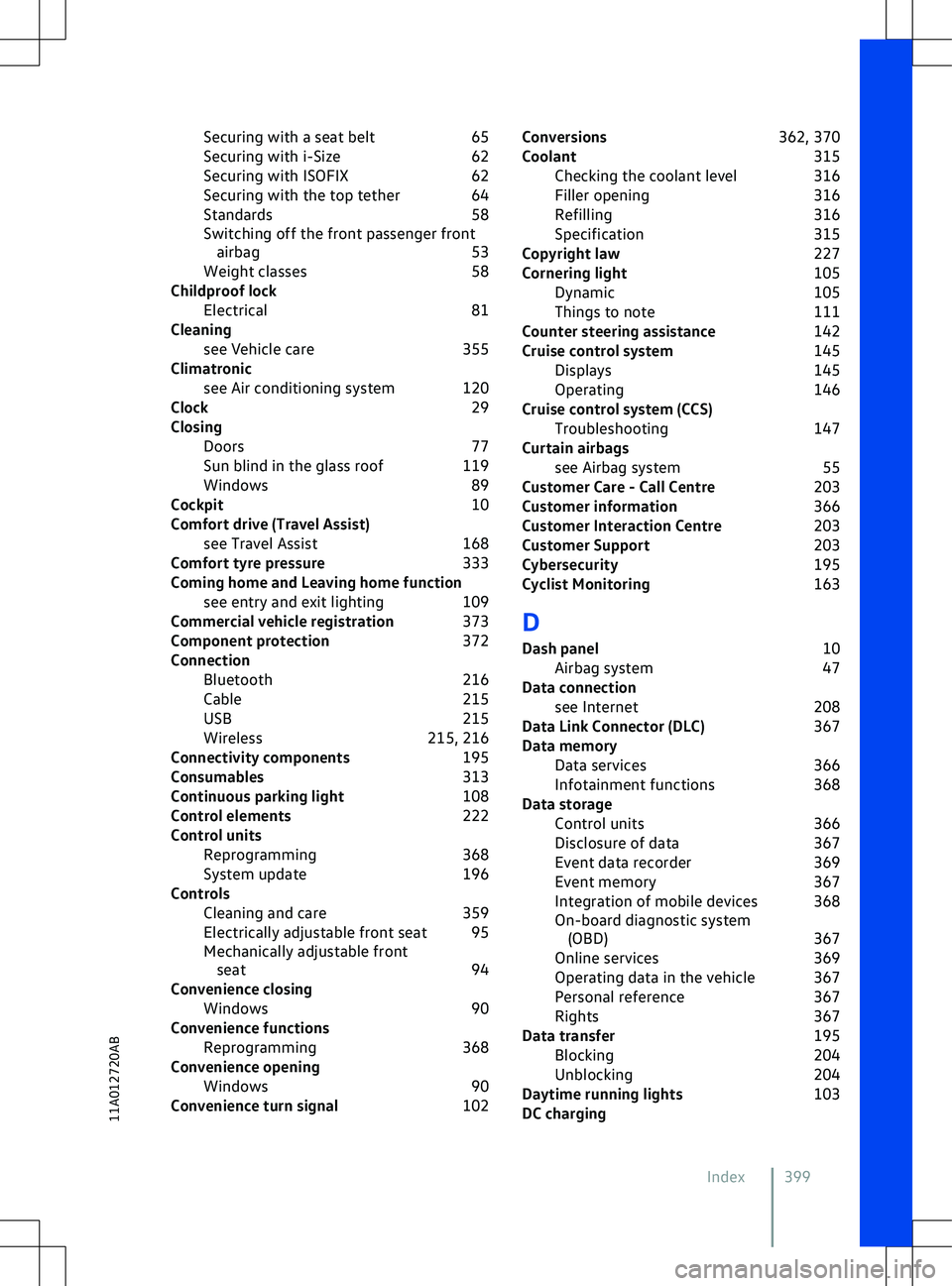
Securing with a seat belt
65
Securing with i-Size 62
Securing with ISOFIX 62
Securing with the top tether 64
Standards 58
Switching off the front passenger front airbag 53
Weight classes 58
Childproof lock Electrical 81
Cleaning see Vehicle care 355
Climatronic see Air conditioning system 120
Clock 29
Closing Doors 77
Sun blind in the glass roof 119
Windows 89
Cockpit 10
Comfort drive (Travel Assist) see Travel Assist 168
Comfort tyre pressure 333
Coming home and Leaving home function see entry and exit lighting 109
Commercial vehicle registration 373
Component protection 372
Connection Bluetooth 216
Cable 215
USB 215
Wireless 215, 216
Connectivity components 195
Consumables 313
Continuous parking light 108
Control elements 222
Control units Reprogramming 368
System update 196
Controls Cleaning and care 359
Electrically adjustable front seat 95
Mechanically adjustable front seat 94
Convenience closing Windows 90
Convenience functions Reprogramming 368
Convenience opening Windows 90
Convenience turn signal 102Conversions
362, 370
Coolant 315
Checking the coolant level 316
Filler opening 316
Refilling 316
Specification 315
Copyright law 227
Cornering light 105
Dynamic 105
Things to note 111
Counter steering assistance 142
Cruise control system 145
Displays 145
Operating 146
Cruise control system (CCS) Troubleshooting 147
Curtain airbags see Airbag system 55
Customer Care - Call Centre 203
Customer information 366
Customer Interaction Centre 203
Customer Support 203
Cybersecurity 195
Cyclist Monitoring 163
D
Dash panel 10
Airbag system 47
Data connection see Internet 208
Data Link Connector (DLC) 367
Data memory Data services 366
Infotainment functions 368
Data storage Control units 366
Disclosure of data 367
Event data recorder 369
Event memory 367
Integration of mobile devices 368
On-board diagnostic system ( OBD) 367
Online services 369
Operating data in the vehicle 367
Personal reference 367
Rights 367
Data transfer 195
Blocking 204
Unblocking 204
Daytime running lights 103
DC charging
Index 399
11A012720AB
Page 404 of 417
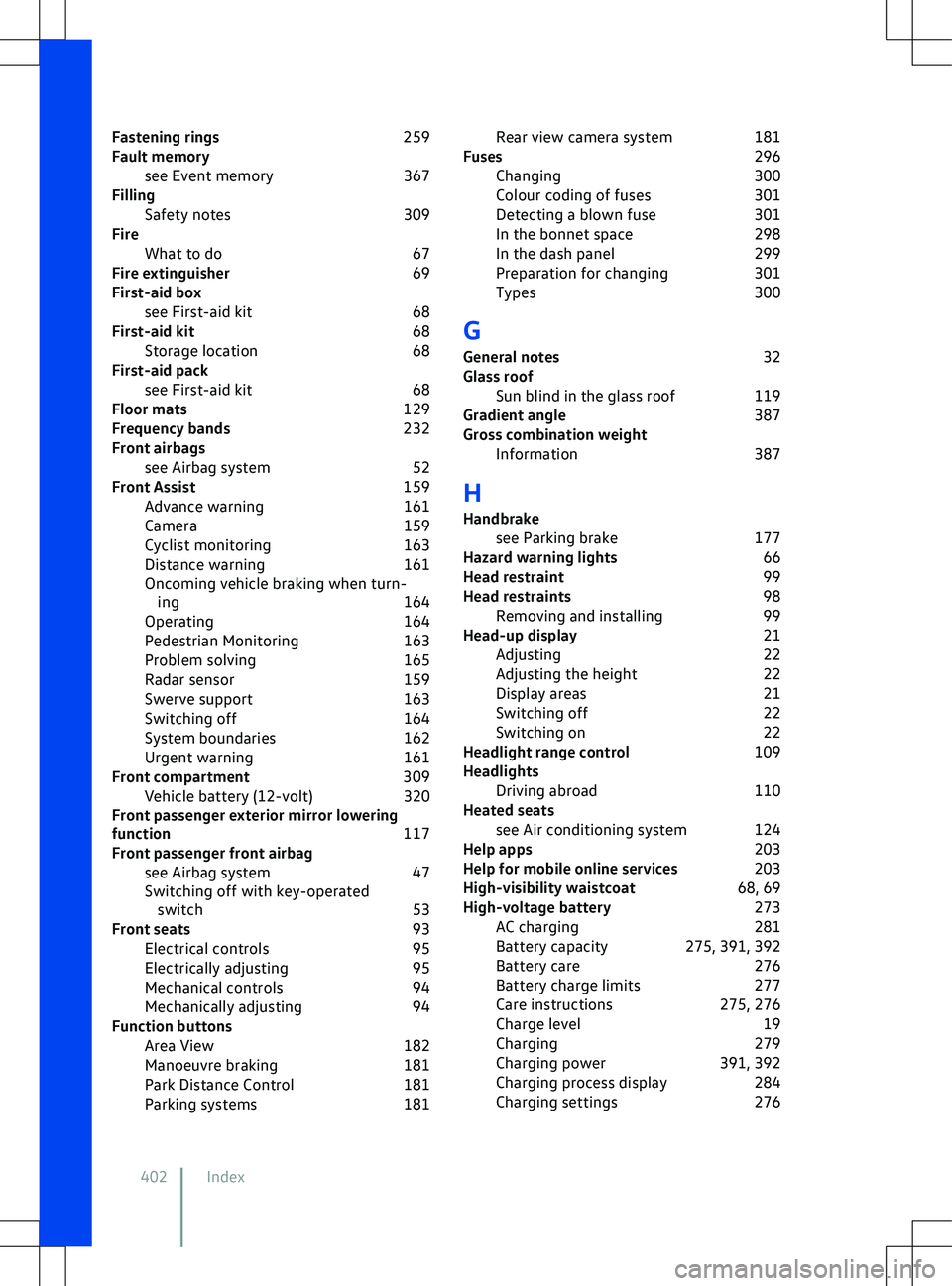
Fastening rings
259
Fault memory see Event memory 367
Filling Safety notes 309
Fire What to do 67
Fire extinguisher 69
First-aid box see First-aid kit 68
First-aid kit 68
Storage location 68
First-aid pack see First-aid kit 68
Floor mats 129
Frequency bands 232
Front airbags see Airbag system 52
Front Assist 159
Advance warning 161
Camera 159
Cyclist monitoring 163
Distance warning 161
Oncoming vehicle braking when turn- ing 164
Operating 164
Pedestrian Monitoring 163
Problem solving 165
Radar sensor 159
Swerve support 163
Switching off 164
System boundaries 162
Urgent warning 161
Front compartment 309
Vehicle battery (12-volt) 320
Front passenger exterior mirror lowering
function 117
Front passenger front airbag see Airbag system 47
Switching off with key-operated switch 53
Front seats 93
Electrical controls 95
Electrically adjusting 95
Mechanical controls 94
Mechanically adjusting 94
Function buttons Area View 182
Manoeuvre braking 181
Park Distance Control 181
Parking systems 181Rear view camera system
181
Fuses 296
Changing 300
Colour coding of fuses 301
Detecting a blown fuse 301
In the bonnet space 298
In the dash panel 299
Preparation for changing 301
Types 300
G
General notes 32
Glass roof Sun blind in the glass roof 119
Gradient angle 387
Gross combination weight Information 387
H Handbrake see Parking brake 177
Hazard warning lights 66
Head restraint 99
Head restraints 98
Removing and installing 99
Head-up display 21
Adjusting 22
Adjusting the height 22
Display areas 21
Switching off 22
Switching on 22
Headlight range control 109
Headlights Driving abroad 110
Heated seats see Air conditioning system 124
Help apps 203
Help for mobile online services 203
High-visibility waistcoat 68, 69
High-voltage battery 273
AC charging 281
Battery capacity 275, 391, 392
Battery care 276
Battery charge limits 277
Care instructions 275, 276
Charge level 19
Charging 279
Charging power 391, 392
Charging process display 284
Charging settings 276
402 Index
Page 405 of 417
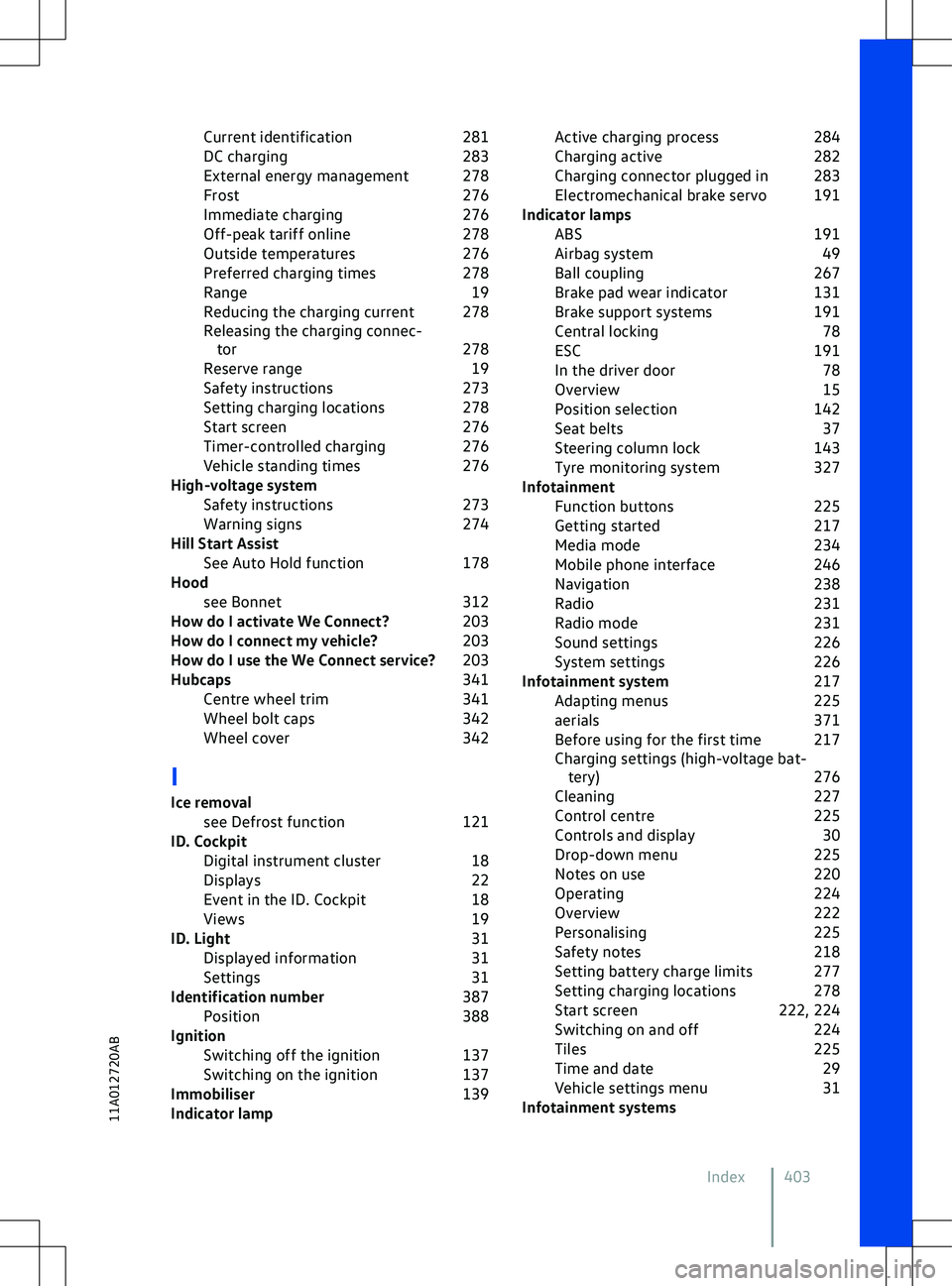
Current identification
281
DC charging 283
External energy management 278
Frost 276
Immediate charging 276
Off-peak tariff online 278
Outside temperatures 276
Preferred charging times 278
Range 19
Reducing the charging current 278
Releasing the charging connec- tor 278
Reserve range 19
Safety instructions 273
Setting charging locations 278
Start screen 276
Timer-controlled charging 276
Vehicle standing times 276
High-voltage system Safety instructions 273
Warning signs 274
Hill Start Assist See Auto Hold function 178
Hood see Bonnet 312
How do I activate We Connect? 203
How do I connect my vehicle? 203
How do I use the We Connect service? 203
Hubcaps 341
Centre wheel trim 341
Wheel bolt caps 342
Wheel cover 342
I
Ice remo val
see Defrost function 121
ID. Cockpit Digital instrument cluster 18
Displays 22
Event in the ID. Cockpit 18
Views 19
ID. Light 31
Displayed information 31
Settings 31
Identification number 387
Position 388
Ignition Switching off the ignition 137
Switching on the ignition 137
Immobiliser 139
Indicator lamp Active charging process
284
Charging active 282
Charging connector plugged in 283
Electromechanical brake servo 191
Indicator lamps ABS 191
Airbag system 49
Ball coupling 267
Brake pad wear indicator 131
Brake support systems 191
Central locking 78
ESC 191
In the driver door 78
Overview 15
Position selection 142
Seat belts 37
Steering column lock 143
Tyre monitoring system 327
Infotainment Function buttons 225
Getting started 217
Media mode 234
Mobile phone interface 246
Navigation 238
Radio 231
Radio mode 231
Sound settings 226
System settings 226
Infotainment system 217
Adapting menus 225
aerials 371
Before using for the first time 217
Charging settings (high-voltage bat- tery) 276
Cleaning 227
Control centre 225
Controls and display 30
Drop-down menu 225
Notes on use 220
Operating 224
Overview 222
Personalising 225
Safety notes 218
Setting battery charge limits 277
Setting charging locations 278
Start screen 222, 224
Switching on and off 224
Tiles 225
Time and date 29
Vehicle settings menu 31
Infotainment systems
Index 403
11A012720AB
Page 408 of 417
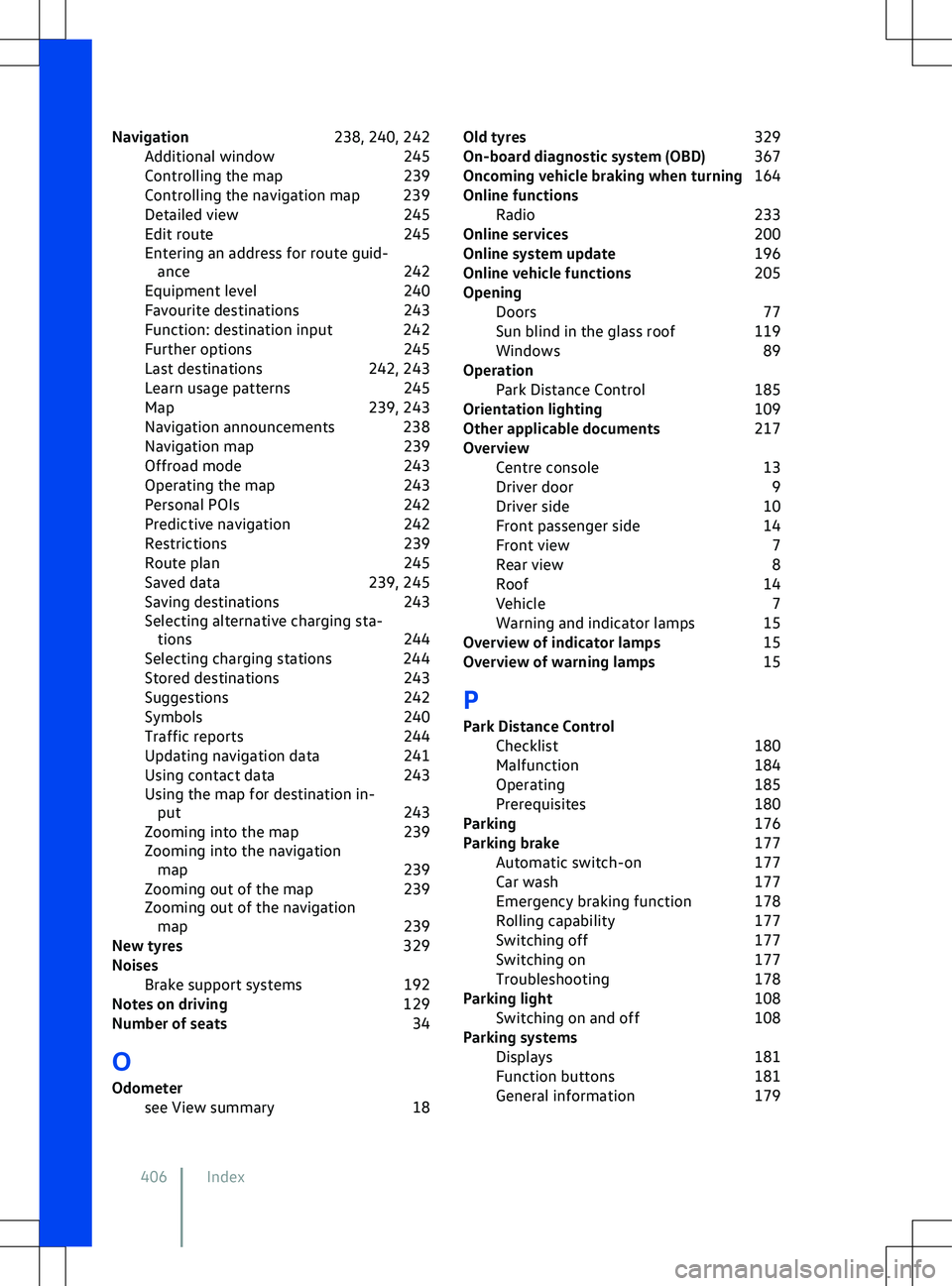
Navigation
238, 240, 242
Additional window 245
Controlling the map 239
Controlling the navigation map 239
Detailed view 245
Edit route 245
Entering an address for route guid- ance 242
Equipment level 240
Favourite destinations 243
Function: destination input 242
Further options 245
Last destinations 242, 243
Learn usage patterns 245
Map 239, 243
Navigation announcements 238
Navigation map 239
Offroad mode 243
Operating the map 243
Personal POIs 242
Predictive navigation 242
Restrictions 239
Route plan 245
Saved data 239, 245
Saving destinations 243
Selecting alternative charging sta- tions 244
Selecting charging stations 244
Stored destinations 243
Suggestions 242
Symbols 240
Traffic reports 244
Updating navigation data 241
Using contact data 243
Using the map for destination in- put 243
Zooming into the map 239
Zooming into the navigation map 239
Zooming out of the map 239
Zooming out of the navigation map 239
New tyres 329
Noises Brake support systems 192
Notes on driving 129
Number of seats 34
O
Odometer see View summary 18Old tyres
329
On-board diagnostic system (OBD) 367
Oncoming vehicle braking when turning 164
Online functions Radio 233
Online services 200
Online system update 196
Online vehicle functions 205
Opening Doors 77
Sun blind in the glass roof 119
Windows 89
Operation Park Distance Control 185
Orientation lighting 109
Other applicable documents 217
Overview Centre console 13
Driver door 9
Driver side 10
Front passenger side 14
Front view 7
Rear view 8
Roof 14
Vehicle 7
Warning and indicator lamps 15
Overview of indicator lamps 15
Overview of warning lamps 15
P P ark Distance Control Checklist 180
Malfunction 184
Operating 185
Prerequisites 180
Parking 176
Parking brake 177
Automatic switch-on 177
Car wash 177
Emergency braking function 178
Rolling capability 177
Switching off 177
Switching on 177
Troubleshooting 178
Parking light 108
Switching on and off 108
Parking systems Displays 181
Function buttons 181
General information 179
406 Index