Child VOLKSWAGEN JETTA 2007 User Guide
[x] Cancel search | Manufacturer: VOLKSWAGEN, Model Year: 2007, Model line: JETTA, Model: VOLKSWAGEN JETTA 2007Pages: 477, PDF Size: 77.6 MB
Page 136 of 477
Safety belts
General not es
Always wear safety belts!
Wearing safety b elt s correctly saves lives!
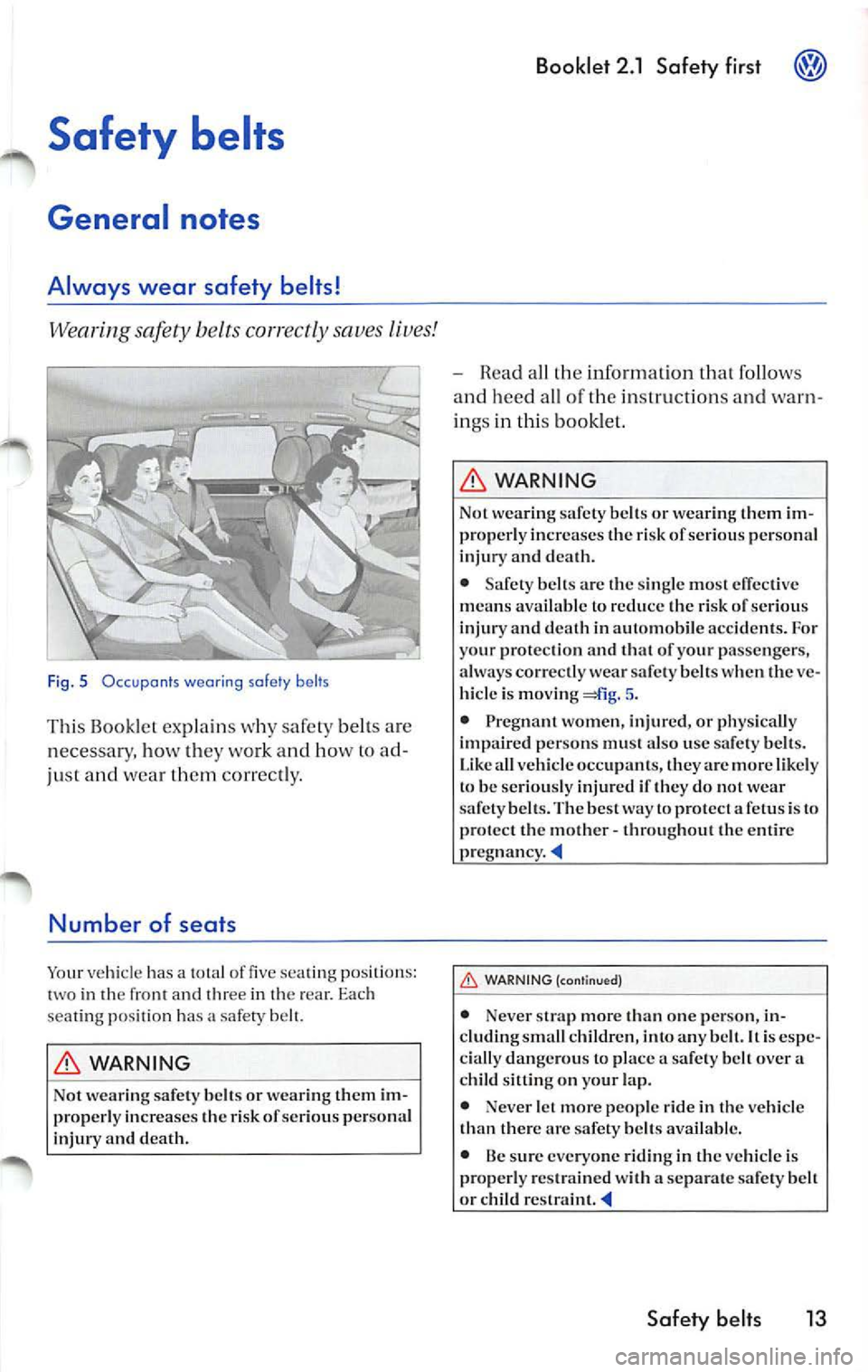
Fig . 5 Occ upan ts wear ing safety belts
This Bookl et explain s why safet y belt s are
nece ssary, ho w the y work and how to ad
ju st and wear them correc tly.
Number of seats
Yo ur vehicl e has a tota l of five se ating position s: in the fro nt and three in th e rear. Each
sea tin g p ositio n ha s a sa fety b elt.
WARNING
Not wearing safety belts or wearing them im
properly increases the risk of seriou s per sona l
injury and d eat h.
Booklet 2.1 Safety first
- Read all the information th at follows
and heed all of th e in struction s and warn
in gs in thi s booklet.
WARNING
Not wearing safety belts or wearing them im
properly increases the risk of seriou s personal
injury and death.
• Safety belts are t he sin gle mo st efTec tive
means available to reduce the risk of se rious
injur y and death in automobile accidents.
your protection and that of your passengers,
a lwa ys corre ctl y wear safety belts when the ve
hicle is moving =;fig. 5.
• Pregnant women, injured, or physically
impaired per sons mu st
use safe ty belts.
l..ik eall vehicle occupant s, they arc more likely
to be seriou sly injur ed if the y do not wear
safety bel ts. The best way to protect
fet us is to
protect the mother -throughout the entire
pregnancy.
WAR NING (con tinued)
• Never strap more than one person, in
cluding small children, into any belt. It is espe
cially dangerous to pla ce a sa fety belt over a
c hild sittin g on yo ur lap.
• Never let more people ride in the vehicle
than ther e arc safe ty belt s available.
• Be sure eve ryone riding in the vehicle is
properly res train ed with a separat e safety belt
or child restraint.
Safety belts 13
Page 141 of 477
Booklet 2.1 Safety first
WARN ING (continued)
• Neve r strap m ore than one perso n, in
cluding small ch ildr en, into belt.
• Neve r p lace a safety belt over a child sitting
o n your lap.
• Always keep fee t in the foot we ll in front of
th e scat w hile th e ve hicl e is being driven.
• Neve r let a n y perso n r ide with feet on the
instrument panel or sticking out th e window
or on th e sca t.
• Never remove a safety be lt whil e th e ve
hicle i s mo ving. Do ing so w ill increase yo ur
ri sk of being injur ed or kill ed.
• Neve r wear be lts twi sted.
• Never wear bel ts over rigid o r breakable
ob jects in or on your clothing, su ch as eye
glasses, pen s, keys, etc., as these may cause in
jur y.
• Neve r allo w sa fet y belts to become dam
aged by being caugh t in door or sea t hardware.
• Neve r wear t he s hou lder part of the be lt
und er you r ar m or otherwi se ou t of posi tion.
• Severa l layers of heavy clothing may inter
fere w ith correc t position ing of belt s and re
duce the overa ll eff ect ive ness of t he sys tem.
18 Safety belt s
WARNING (continued)
• Alwa ys keep b elt buckles free of a nyt hing
that may prevent th e buckl e from latc hing se
cure ly.
• Never use comfor t clips or dev ices that
crea te slac k in the sh ould er bel t. Howeve r,
s pecial clips may be required for the correc t
u se of some child restraint systems.
• Torn o r frayed safety belt s can tear a nd
damag ed belt hardw are can break in a colli
s ion. In spect belts reg ularl y. lf webb ing, bind
in gs, buckl es, or retractors are damaged, h ave
b elt s rep laced by an authorized Volkswage n
dealer or qualifi ed worksho p.
• Safety be lts that have been worn and
l oaded in an accident must b e re pl ace d w ith
the correct re placement safety belt by a n au
t h orized Volkswage n dea le r. Replacement
may be necessary even if damage canno t be
clea rly see n. Anchorages t hat were loaded
mu st a lso be inspecte d.
• Neve r remove, modify, disassembl e, or try
t o repa ir th e safe ty belts yourse lf.
• Always keep the belts clean. Dirty belts
m ay not work co rrectl y and can impair the
fun ction o f th e in erti a ree l
3.4 "Ti ps
an d Adv ice", c hap te r "C lea nin g and
Pro tect ion."
Page 142 of 477
Safety belts
Fastening safety belts
Sa fe ty fir st -eve rybody buckle up!
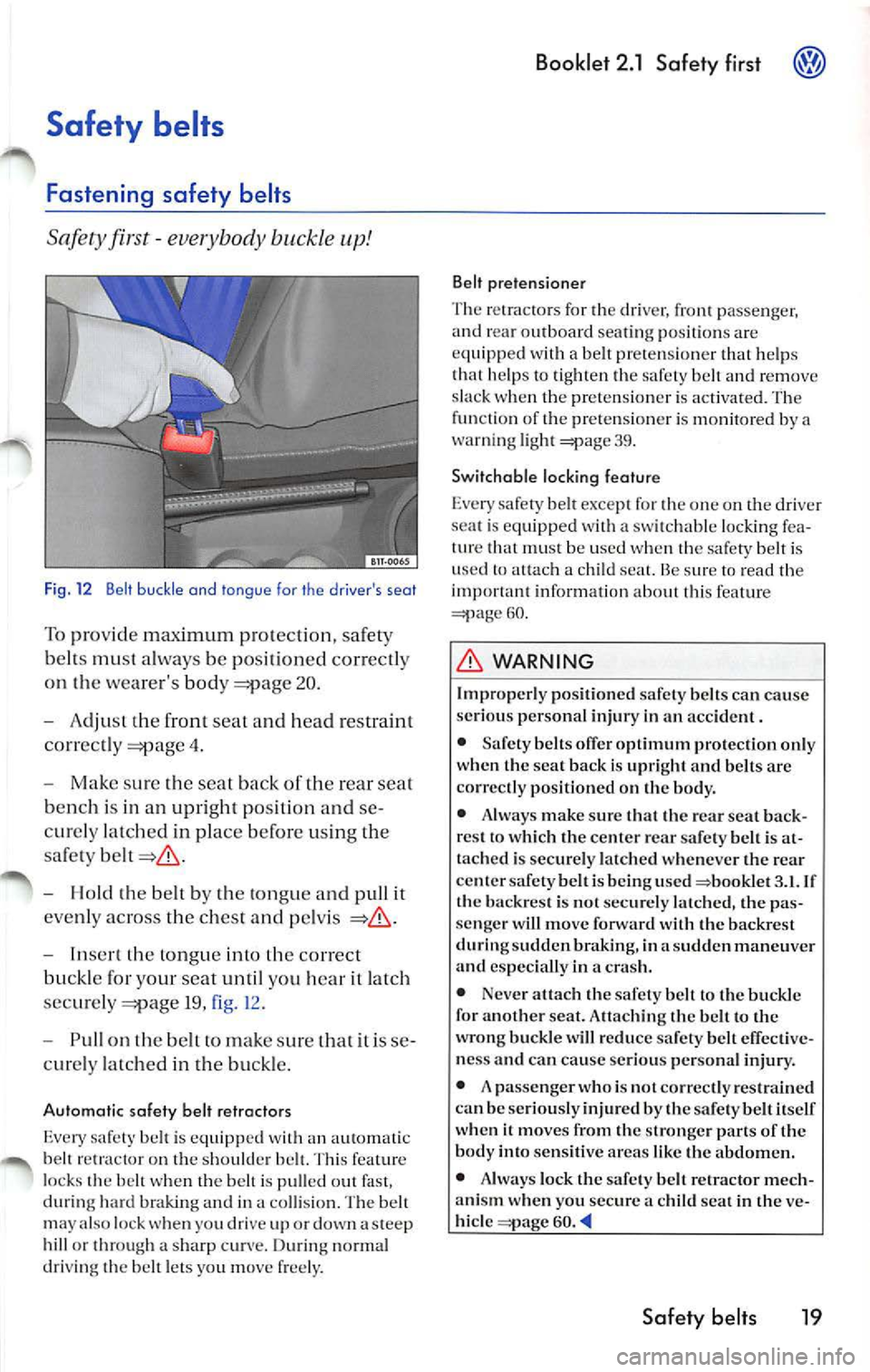
Fig. 12 Belt buck le and tongue fo r th e dr iver's seat
To pro vid e maximum prot ectio n, sa fety
b elt s
alw ays be po siti oned cor rectly
o n
weare r's bod y 20.
- Adju st
fro nt sea t and head restra int
co rrec tly
4.
- Mak e su re th e seat back of the rea r sea t
b ench i s in an upright pos ition and se
cu rely latche d in plac e before usin g th e
sa fe ty
- Hold !he be lt b y ton gu e and pull it
eve nly across the ch es t and pel vis
-th e tongue into correct
bu ckle for your seat until you h ear
latch
sec urely
19, fig. 12 .
- Pull on
belt to mak e sure that it is se
cure ly latc hed in the bu ckle.
Automatic safety belt retractors
E ve ry
b elt i s equipp ed with an aut om ati c
belt retrac tor on th e sho uld er bell. Thi s fea ture
l oc ks th e belt when the
is pu lled ou t fast ,
during hard braking and in a collision. The belt
m ay also lock
yo u d rive a stee p
hill or thro ugh a sh arp cur ve. Durin g no rma l
dri vin g th e belt le ts yo u mo ve freel y.
Booklet 2 .1 Safety first
Belt prete nsio ne r
T he re tracto rs for the drive r,
pa sse nger,
a nd rea r outboard seating po sition s are
e quipp ed wit h a belt pr ete nsio ner that h elp s
th at h elp s to t ight en th e safe ty belt and remo ve
s lac k w hen th e pr etens ioner is act iva te d. Th e
fun ction o f the pr eten sio ner is m onit ored b y a
wa rnin g light
39.
Switc hable l ocking feature
Every safety belt excep t fo r th e one on th e dr ive r
se at is eq uippe d wit h a sw itchable locking fea
tur e th at mu st be use d when the saf ety b elt is
used
1 0 att ach a child seal. Be sur e to read the
imp orta nt in formation about thi s feature
60 .
WARNING
Imp roperl y position ed safe ty belt s ca n ca use
se riou s personal injury in an accident.
• Saf ety belts offer optimum protection only
when the seat back is upright and belt s arc
c o rr ectly positioned on the body.
• Alway s m ake sure that th e re ar sea t back
res t to which th e center re ar safety belt is at
t ached is sec urely la tc h ed when ever th e rear
center safety belt i s bei ng use d
3.1. If
the b ackres t is n ot sec urely latc hed, the pa s
s enger will move fon vard wit h the backres t
during sudden braking, in a sudd en maneuver
a nd especially in a cras h.
• Never attach the safe ty belt to the bu ckl e
for another seat. Attachi ng the belt to th e
wrong buckle will reduce safety belt effective
ness and can cause se rious per sona l injury .
• A pa ssenge r w ho is not corre ctl y restrain ed
can be se riou sly injur ed by th e sa fe ty belt it self
w hen
60.
Safety belts 19
Page 145 of 477
Booklet 2.1 Safety fir st
Safety belt extender
A safety belt extende r is available if a belt is too short for the driver o r a pas
seng e,:
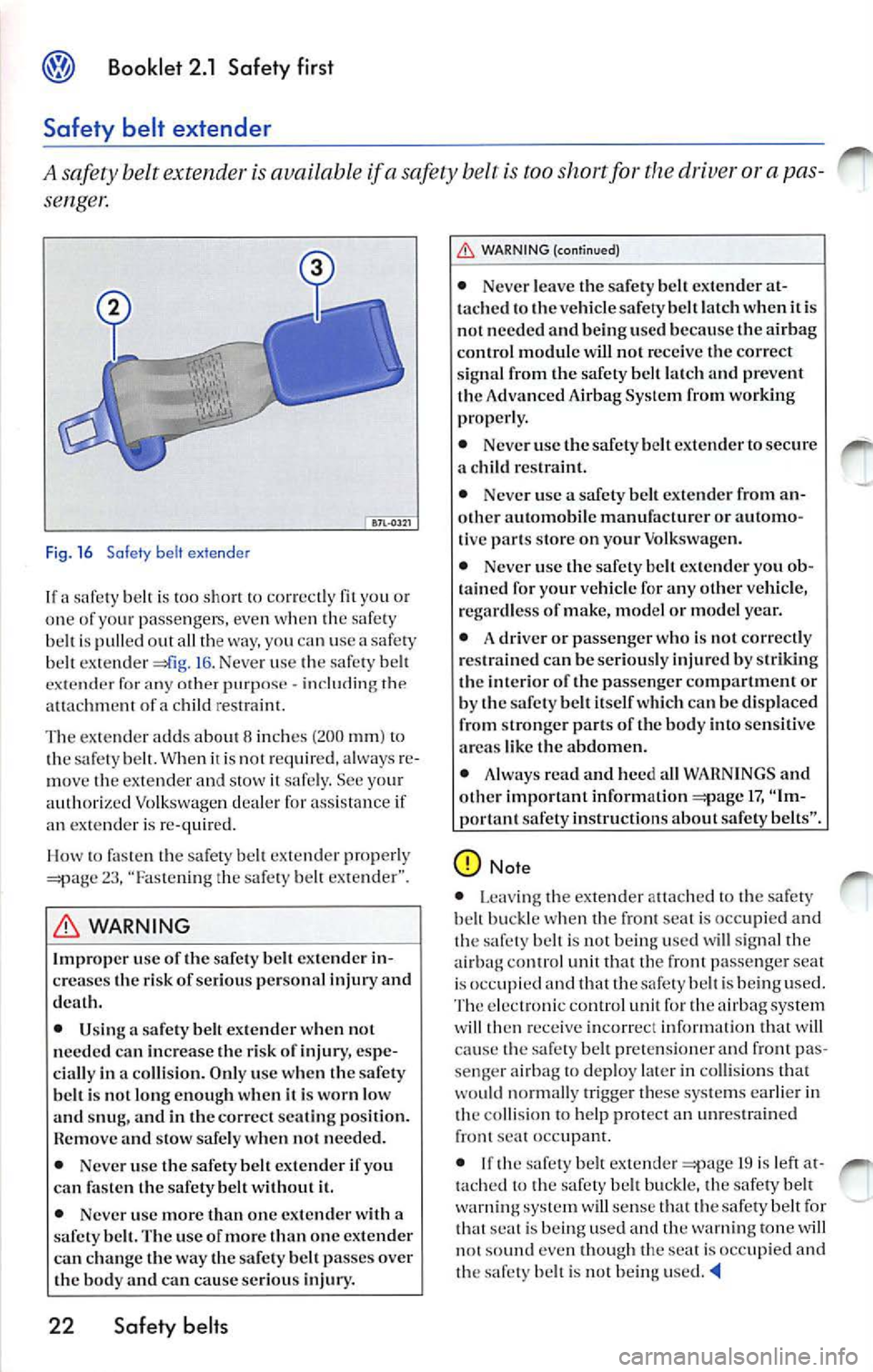
F ig . 16 Safety be lt ex tender
If a safe ty belt is too s hort t o co rrectly fit yo u or
one of your pa sse ngers , even when th e
b elt is pull ed o ut the way, you ca n use a safe ty
b elt ex te nd er 16 . Neve r use th e sa fe ty belt
ex te nd er any o ther purp ose. att ac hm ent of a child re straint.
Th e extender adds about
8 inche s (200 mm ) to
t h e sa fety belt. When is r e quired. always re
mo ve extender and stow it safe ly. See y our
a uthoriz ed Vo lksw agen d ealer for assista nce if
a n ex te nder i s re- qui re d.
How to faste n the s afet y be lt extender properly
23 , "Fa steni ng th e saf ety belt ex te nd er".
WARNING
Im proper use o f the safety belt ex te nder in
c reas es th e risk of serious perso nal injur y and
d eat h.
• U sing a sa fe ty belt ex te n der w hen n ot
n eede d can increase the r isk of inju ry, es pe
cia lly in a co llision . On ly use whe n th e safe ty
b e lt i s not lo ng eno ugh when it is wo rn low
a n d sn u g, and in the cor rect sea ting po sition .
R em ove a nd stow safely w hen not needed.
• Never use t he safe ty belt exte nder if you
can faste n th e safe ty belt w ith out it.
• Never use mo re t han one ex tende r w ith a
safe ty b elt . Th e use of more t han o ne ex ten der
ca n ch ange th e way the sa fe ty be lt passes ove r
th e body and ca n ca use ser ious injury.
22 Safety belts
WARN ING (continued)
• Neve r leave t he safety belt ex te n der at
t ac hed to t he ve hi cle safety belt latc h when it is
n ot needed and bei ng use d because t he a irb ag
con tro l m odul e will n ot r ec eive th e correct
s ig n al from the safety belt la tc h and preve nt
t h e Adva nce d Airbag Syste m fro m wo rk ing
proper ly .
• Neve r use the safety belt extende r to secure
a c hild restr ain t.
• Neve r use a safety belt exte nder from an
o the r au tomo bile manufact ure r or au to m o
t ive par ts sto re on yo ur Volk swagen.
• Never use the safety be lt ex tende r you ob
t a in ed fo r yo ur vehicl e for a ny o ther ve hicl e,
r egard less o f mak e, mo del o r m odel year.
• A drive r or passe nger who is no t correc tly
r es tra ined ca n be ser ious ly inj ured by striking
th e i nterior o f the passenger compartmen t o r
by t he safe ty belt itse lf w hich can be disp laced
f ro m stronge r pa rts of t he bo dy in to se nsit ive
areas like the abdom en.
• Always rea d and h eed all WARN INGS a nd
ot her im portant inform ation
17, " Im
por tan t safety instructio ns about safe ty belt s".
N ote
• Leav ing the extender
10 the safety
b elt bu ckle when the front scat is occ upied a nd
the saf ety belt is not b eing use d
will sig n al the
ai rba g co ntrol unit that the front passe nge r seat
i s occ up ie d and that the sa fe ty b elt is b eing use d.
Th e elec troni c control unit fo r th e airbag system
w ill th en r ece ive incorr ect informat io n that will
ca use the saf ety belt pr ete n sione r a nd fro nt pa s
s enger air bag to dep loy later in co llision s that
wou ld n orm ally trigge r th ese syste m s ea rlier in
th e colli sion
h elp prot ect an unr estrained
fr ont sea t occ up ant.
• If th e safe ty belt ex te nd er
19 is lef t tached to the sa fe ty belt buck le, th e safe ty be lt
warn ing sys te m will se nse th at the safety belt for
that scat is bei ng use d and the warn ing tone will
not soun d eve n thou gh th e sea t is occup ied and
the safe ty belt i s not be in g
Page 150 of 477
Booklet 2.1 Safety first @
Airbag system
Important things to know
Importance of wearing safety belts and sitting properly .
Airbags are only supplemental res traint s. For airbags to do th eir job , occupant s
m ust
prope rly wea r th eir saf ety b elts and be in a proper seating position.
Fo r yo ur safet y an d the safet y of your pa s
s en gers, before d riv ing alwa ys:
Ad just dr iv er 's seat and stee rin g
wh eel properl y
4.
Adj ust fr on t passe nge r seal p rop erl y
5.
We ar sa fe ty belt s properly 13 .
A lways properl y use th e co rr ec t child
r es tra int lo protect childr en
5 1.
In a co llisio n a irba gs mu st infl ate within th e
blink of an eye and w ith con sid erabl e fo rc e. The
s uppl em ental airb ags c an cause injuri es if th e
dri ver or th e front seat pa sse nge r is not seate d
prop erl y. Ther efor e in order to help the airba g to
do its jo b , it is im porta nt, both as a driver and
a passe nger to sit pro perly at all times.
keepin g ro om betwe en yo ur body and the
s te erin g and th e fr ont of t he passenger
co mpa rtm ent , the a irbag can i nflate f ull y a nd
co mpl etel y and p rovid e suppl em ent al p rotec
t io n in certa in fro ntal co llision s
deta ils
o n th e opera tio n of the se at adju stm ent contro ls
" F ro nt seat s".
I t 's especia lly im port ant th at child ren b e prop
e rl y res train ed
5 1, "C hild safe ty".
Th ere is a lo t t hat th e drive r and the passe ngers
ca n and mu st d o to he lp th e in divi du al safe ty
f e atur es insta lled in yo ur Vo lks wa gen
to
get he r as sys te m .
Pro per seati ng posi tio n is i mp ort ant sn th a t th e
fron t airb ag o n th e dr ive r sid e ca n do its jo b . If
y ou ha ve
phys ica l imp airm ent or cond iti on
t h at p rev ent s yo u from sittin g prop erly on t he
dri ver
with the sa fe ty belt prop erl y
and r eachin g th e pe dals , s p ecia l m odific ation s
t o yo ur vehicl e ma y be necessary .
Co nta ct you r auth ori7.e d Vo lk sw agen dea le r, or
c all t he V olk swage n Custo m er
Ce nter at 1-800 -822 -8987 .
When the airba g sys te m deploy s, a ga s gen erator
w ill fill the airb ags , b re ak op en th e padd ed
cov ers, and inflate be twee n the ste erin g wheel
and th e dri ver and b etwee n the in strum ent
p an el and the fro nt p asse nge r. Th e a irbag s
w ill defl ate imm edi ate ly af ter dep loy ment so that
t he front o ccupan ts ca n see th ro ugh th e wind
s h ie ld a gain with out int errupt io n .
A ll of thi s takes place in the blink ofan ey e, so
fa st that many peopl e do n't eve n rea lize t hat th e
a irbags have dep lo ye d.
airbags a lso inflat e
wit h a grea t dea l of fo rc e and noth in g sh ould be
in their w ay w hen th ey depl oy .
airb ags in
com binati on with pr op erl y wo rn safe ty belt s
s lo w
an d limi t th e occ upant 's for wa rd
m ove ment. T ogether th ey help t o preve nt the
dri ver a nd fro nt sc at passe nge r fr om hillin g
pa rts of the in side th e ve hicle
redu cing th e
fo rces actin g o n th e occu pant duri ng the cras h.
In this way they help to red uce the risk of inju ry
t o th e hea d an d upp er bod y in the c rash . A irb ags
d o no t p rot ect t he arm s or the low er p art s o f th e
b ody.
B o th fron t a irb ags w ill no t i nfl ate in all fro ntal
colli sio n s. Fro nt airba gs w ill no t infla te in all
front al colli sio ns .. The tri gge ring o f the a irbag
sys te m depe nds on the ve hicle dec ele rat io n ra te
ca use d by th e co llisio n and regis te re d b y th e
e lec tron ic control uni t. I f thi s ra te is
th e
r efe re n ce v alu e prog ramm ed in to the c ont rol
u nit , th e air bags
n o t b e trig gere d , eve n
th ou gh th e car may be badl y dam aged as a res ult
o f the colli sio n . Ve hicle dama ge, re pai r co sts o r
eve n th e la ck of v ehi cle
is not n eces-
Airbag system 27
Page 152 of 477
Booklet 2.1 Safety first
Child restraints on the front seat some important things to know
- Be sure lo read the import ant informa
tion and hea d th e WARNINGS for impor
tant detai ls abou t ch ildr en and Advanced
Airbags
5 1.
Ev en though your ve hicl e is equipp ed wi th an
Ad vanced A irbag S yste m , mak e certain all
chi ldren, e spec iall y thos e 12 years and youn ger,
a lwa ys ride in the back se at prop erly restrain ed
fo r th eir age a nd size. The airbag on the pa s
s e nger side mak es th e front sea t a pote ntially
dangerou s pla ce fo r a ch ild to ride. Th e front sea t
i s not the safest pla ce for
chil d in forward
faci ng c hild sea t. It can be very dangerou s
p la c e fo r an in fa nt or a child in a re a rward -facing
s ea t.
Th e Ad vanc ed Airbag System in yo ur vehi cle ha s
b ee n ce rtified
com ply wi th th e Requi re m en ts
of United Fed era l Moto r Ve hicl e Sta nd ard 208 as applica ble at the time your ve
hicl e was manufactured .
Th e S tandard req uires th e fro nt airbag on the
pa ssenge r sid e
be turn ed off ("s upp re ss e d" ) if
a ch ild up to about one year of ag e restra ined in
on e of th e re ar-fa cin g or forward -faci ng infa nt
r es tra int s liste d in Federal Motor Ve hicle Safety
Sta nda rd 208 with whi ch th e Advan ced Ai rbag
S ys te m in your vehi cle wa s certifi ed has bee n in
stalled o n the front pass en ger se at. For a lis ting
o f th e child res traint s th at were u sed to ce rt ify
c omp lia nce w ith th e US Saf ety S tanda rd
53 .
Th e PASS ENGER AIR BAG OFF li ght in th e in
st rum ent panel tells you when th e fro nt Ad
v a nce d Airbag on the passen ger sid e has been
turned off by the ele ctro nic cont rol
The PA SSENGER AIR BAG OFF light:
• will stay on if th e fro nt p ass eng er seat i s not
oc cupied,
• will stay on if t here is a small child or ch ild re
s tra int on th e front passe ng er sea t,
• go off if th e front passe nge r is occ u
pied by an ad ult as re g is te red by th e w eigh t
s e n sing mat
39, "Mon itor ing the Ad
va nce d Airbag S yste m ".
The PASSENGER AIR BAG OFF li ght comes on
wh en th e con trol unit detec ts a tota l wei gh t on the
pa
ssen ger sea t th at requ ires th e front
a ir bag to be turned off.
I f the tota l w eig ht on the fron t pa sse nger seat is
mor e th an
of a typical I year- old chil d le ss than the weight of a sma ll ad ult , th e front
a ir bag on the passenger side ca n dep loy (th e
PASSENGER AIR BAG OFF light do es not co me
o n ). If t he PA SSENGER AIR BAG OFF light does
no t come o n, t he fron t airb ag o n the pas se nger
s id e has not bee n tu rn ed off by the e lectro nic
c ont ro l u ni t and can dep loy if th e co ntro l u nit
s ens es an impact th at meet s th e cond ition s
sto re d in its m em ory.
For exampl e, the air b ag may dep loy if:
• a small ch ild that i s heavie r
a ryp ic al I
y ea r-old c hild is o n th e front passenger seat (r e
gard less of wh eth er th e child is in on e of the
c hild seats liste d
53), or
• a chil d who ha s outgrown c hild res tra int s is
on the front pa ssenger sea t.
I f th e fro nt pa ssenger airbag i s turn ed off,
PA SSENGER AIR BAG OFF l ig ht s up in the in
s tru ment clu ste r and stays on.
Th e fr on t a irbag on the pass e nger sid e will de
plo y if th e PAS SENGER AIR BAG OFF li ght does
co me o n an d stay o n even if a small ad ult or
te enager, o r a pa sse nger w ho is s itt in g up
right with th ei r back against a no n-re clin ed
back res t w ith th eir fe et on the ve hicle floor in
fr ont of t he se at is on the front passeng er se at
4 , " Proper occupant sea tin g pos itio ns" .
If th e front p assenger air bag deplo ys , th e Fe dera l
Standard r equir es th e airb ag to m eet th e "low
deplo ym en t cri te ri a to re duc e th e ris k of in
ju ry throu gh int era ction with the airbag .
risk" dep loy men t oc cu rs in t hos e tak e place lower d ecelerat ion s as defined in
the e le ctron ic c ontro l uni t 39, "PAS
SENG ER BAG OFF l ight".
Alway s re m ember ,
child seat or infant carr ie r
i nsta lle d on front se at may be struck and
kn ocke d o ut of position b y the rapid ly inflat ing
pa sseng er's airbag in a frontal co llis ion. The
a irb ag co uld g re a tly red uce the eff ect ive ness of
th e c hild res traint a nd even se ri ou sly inj ur e th e
ch ild dur ing in flat ion. .,_
Airbag system 29
Page 153 of 477
Booklet 2.1 Safety first
Fo r thi s reaso n, a n d becaus e th e ba ck sea t is the
sa fest place for childr en -whe n properl y re
s train ed accordi ng to thei r age and size - we
s trongl y re comm end that childr en always sit in
th e ba ck seat
51, "C hild safety" .
WARNING
A child in a rca nvar d-fa cin g child scat in
s talled o n front passeng er sca t w ill be seri
ous ly injured and can be kil le d if th e front
airbag inflat es -even w ith a n Advanced A irbag
Syste m.
• The inflating a irbag w ill hit the c hild sc at
or infant carrie r wit h grea t for ce and
will smash the c hild sea t a nd chil d aga inst the
backre st, ce nter arm rest, doo r or roo f.
• A lways insta ll rear-faci ng c hild scats on the
rea r sc at.
• If yo u mu st insta ll a rea rwa rd facin g child
se at on the front passenger scat because of ex
cep tional circum stan ces an d the PASS ENGER
AIR BA G OFF light docs not come on and sta y
o n , imm ediate ly in sta ll th e rea r-fa cing child
sca t in a rear seating pos ition and have the
a irb ag sys te m in spe cte d by yo ur Volkswage n
d ea le r.
WARNING
A n imp roperly in sta lled chi ld re straint can in
t er fer e wi th th e airbag as it deplo ys an d ser i
o usly injur e or eve n kill the child -even with
an Advanced Airb ag Syste m . If , in excep tio nal
ci rc um sta nces, you mu st in sta ll a fo nvar d
faci ng ch ild restrain t on th e front p assenge r's
sca t:
• Forward -facing child scats in stalled o n the
fr ont pa ssenger's scat may interfe re w ith the
de ploy men t o f th e a irbag an d ca use se rious
per so nal inju ry to th e child.
• Always mak e sure the fon vard -faci ng sca t
h as been d esig ned an d
by its manu
facture r fo r u se on front scat w ith a pa s
senge r fr ont and side ai rbag.
• Alwa ys care fully fo llo w the manufact ure r's
in stru ctions provid ed w ith th e chil d se at or
ca rri er.
30 Airbag syste m
WARN ING (cont inued)
• Never put the forward -facin g child re
s tra int up against or very near th e in strum ent
p anel.
• Always move the pass enger scat int o its re
ar mos t pos it ion in th e sea t's fore a nd aft ad
ju stm en t ra nge, as far away from the airbag as
po ssible before installin g th e fon va rd -facing
c h ild restraint. The backrest must b e ad juste d
t o an upright pos ition.
• Always make sur e tha t nothin g pr even ts
th e front passe nge r's sca t from being mo ved
to
r ear most pos ition in its fore a nd ad
ju stm ent ran ge.
• Neve r place a dditional items on th e sca t
that can in crease th e to tal weigh t regis tere d by
the weig ht-se nsing mat and can ca use inju ry
in a cras h.
• Make sure th at the PASSENGER AIR BAG
OFF ligh t co mes on and stay s on all th e tim e
w henever the ignitio n is sw itch ed on.
• If th e PASS ENGER AIR BAG OFF light doe s
n ot co me on and stay on, imm edi atel y in sta ll
th e for ward- facing child seat in a rea r se ating
po sition a nd have the airb ag syste m insp ec ted
b y you r Vo lkswagen dea ler.
WARNING
To re du ce the ri sk of serious inju ry, mak e sure
th at the PASS ENGE R AIR BAG OFF light is on
w heneve r a c hild res tra int is in stalled on th e
fro nt pass enger seat and the ig ni tio n i s
s witc hed on.
• If th e PASS ENGER AIR BAG OFF lig ht docs
not sta y on, p erform th e ch ec ks desc ribed
39, "Mo nitor ing th e Adv anced A irbag
Sys tem".
• Ta ke the child re stra int off the front pas
s e n ger sea t and in stall it pro perl y at on e of the
rear seat po siti ons if th e PA SSE NG ER AIR BAG
OFF lig ht d ocs no t stay o n.
•
th e airbag system inspe cted by yo ur
Vo lkswage n dealer imme diately
• J\lways carefu lly fo llow i nstru cti ons from
c hild restraint manufactur ers w hen insta llin g
ch ild
Page 154 of 477
Booklet 2.1 Safety first
Front airbag system -the basics
Description of front airbags
The airbag system can provide supplemental protection to properly restrained
front seat
Fig. 21 L ocotion of d rive r airbag: in steer ing whee l
Your is fru 11L
"A dva nced Airbag in co mplian ce United Stales Fede ral Moto r Veh icle Safery dard (FMVSS ) 208 as applicab le a l time your
ve hicle was manufac tu re d . Yo ur vehicle is also
e quipped
side airbags fo r driver and seal passe nge r. Your vehicl e ma y also be wit h op tional sid e ai rb ags for re ar board T he belt s for front and
r ea r ou tboa rd seats equipped with opti onal side
a irbags have "pretensioner s" that help to take
s lack
of th e belt sys tem. The pret en sio ners
ar e also activa te d by the ele ctroni c control
for airbag syste m.
The front a nd outb oard r ea r seats
belts
al so hav e loa d limit ers to help reduce force s
appli ed to body in a crash.
Th e airbag for
driver is in steering whee l
h ub 2 1 an d airb ag for th e fr o nt pas
se nger is in in strum ent panel 22. Th e location of airba gs is marked
There is a yo u n eed to know airb ags
in your vehicle. \V e urge you rea d detail ed
in forma tion airbags, safety and child
safety in this and th e oth er bookl ets th at mak e
Fig. 22 Location of front passenger's airbag: in the
instrume nt pa nel
up 1he ow ner 's literawre. Please be s ure to h eed WARNI NGS -th ey arc ext remely for your safet y and the sa fety of yo ur pass enger s,
especially infants and sm all childr en.
WARNING
Ne ver re ly o n air bags alone for protection.
• Even w hen th ey deplo y, airbags provide
on ly s uppl em en tal prot ection.
• Airbag work mo st effectivel y when used
w ith prop erly wo rn safety belts.
• Th erefore, always wear your safety belts
and make sur e
everybody in your vehicle
is properly re strained.
WARNING
A person on front pa ssenger seat , espe
ci ally infants and sma ll childr en, w ill rec eive
se riou s injuri es and can even be killed by
being too close to lhe airbag when
it inflat es.
• Although
Advanced Airbag Syste m in
yo ur vehicl e is designed to turn off the
passenger airbag an infant or a small child in
o ne of the child restraints used to cer tify
Adva nced A irbag Sys te m i s on pas-
Airbag system 31
Page 155 of 477
Booklet 2.1 Safety first
,0. WARNING (continued)
se nger seat, nobody can absolutely guarantee
th at d eplo yme nt und er these specia l co ndi
tion s is i mpo ssible in all co nce iva ble situa
tion s that may happ en durin g the use ful li fe of
yo ur vehicl e.
• The Adva nced Airbag Sys tem
w ill dep loy in
acco rdance with th e "low risk" optio n under
th e U.S. Federal Stan dar d ifa child that is
h eav ier than the t ypical one-yea r old child i s
to vehicles: wilh odvanced front oirbog system
Advanced front airbag system
Your veh icle is eq uip ped with a front Advanced
Airbag Syste m in co mplian ce with Unit ed Sta tes
Federa l Motor Vehicle Safety Standard 208 asap
pli cable at the time your ve hicle was manufac
tur ed .
Th e front Advanced Ai rbag Syste m su pple ment s
the safety belt s
provide ad dition al p rotect ion
for the dri ver's and fron t pa sse nger's hea ds and
up per bodie s in frontal crashes. The airbags in
fla te only in fron ta l impa cts when th e vehicle
d ecele ratio n is hi gh e noug h.
T he fro nt Advanced Airbag System for th e fron t
sea t occupants is not a sub stit ute for you r sa fety
belts. Rat her,
is part of the overall occ upant re
s traint system in yo ur vehicl e. Always remem ber
t h at the airb ag sys tem can onl y help to prot ect
you, if yo u ar e sittin g up rig h t, wearing
safet y bel t an d wear ing it properly. This is w hy
yo u and yo ur passenger s mu st always be prop
erly res train ed ,
ju st bec ause the req uires
yo u be.
Th e Adva nce d Airbag System in your vehicle has
bee n ce rtifi ed
me et the "low risk " "re quir e
m ent s fo r 3 an d 6 year-o ld childr en on pas
s eng er side and very s mall adults on the drive r
side. " Low risk " d eployme nt occ urs in th ose
c rashe s th at tak e pla ce at lower dece lerat io ns as
d efine d in the elec tron ic con tro l u nit
39 .
The low risk depl oy men t criteria are intend ed to
h elp reduce th e risk of injury through intera c
tion wit h th e front airb ag that ca n occur , for ex
ample, by bein g
th e s teer ing whee l
a nd in strum ent pane l wh en the airbag infl ates.
Fo r "low risk " deplo ym ent to occur, the
PA SSENGER AIR BAG OFF li ght mu st be off.
32 Airbag system
,0. WARN ING (conti nued)
on the front passenge r sea t and the other con
dition s for a irbag deploym ent arc met.
• Acci dent stati sti cs have s hown th at chil
dre n arc genera lly s afer in th e rea r sc at area
th an in th e front seating po sition.
• For their own safety, a ll children, especially
1 2 years a nd youn ger, s hould always ride in
th e back properly res train ed for their age and
s ize.
-4
39 "Moni to rin g th e Advanced Ai rbag
Sys tem ."
When a perso n is detected on
fron t pa s
se nger seat, we ig hi ng more than t he total weight
of a c hild that i s abo ut I year old res trai ned in
one of the rea r-faci ng or fo rward-facing infant
re strain ts ( listed in F ed era l Mot or Veh icle Sa fety
Standard 208 wit h wh ic h the Advanced Airbag
S ys tem in you r ve hicle was cert ifie d), the
P ASS ENGER AIR B AG OFF light sh oul d not come
o n and sh ould stay off .. When the PAS SENGER
AIR BAG OFF light is off, the fron t airba g on the
passenger side may or may no t dep loy de
pending on the natur e of the co llisio n as regis
tered by the electronic co ntrol unit.
For example , th e airb ag may deploy in the " low
risk " mode if:
• a sm all c hild that is heav ier than a ty pical I
yea r-o ld child in on e of the c hild re stra ints wit h
wh ic h the Advan ced A irbag Syste m was ce rtifi ed
53 is on the front passenger sea t
• a child who has out grown chil d r estrai nts is
o n th e fron t pa ssenger seat.
• a sma ll adult or teenage r is o n the front pa s
se nger seat
• a pas senger who is no t sitt ing upr igh t wi th
their back aga in st a non- reclined back rest w it h
t h ei r fee t on the vehicle floo r in front of the seat
i s on the front passe nger seat
5
In addition , the sy stem has been certifi ed to
co mpl y wit h the "sup press ion" req uireme nts of
th e Safe ty S tandard,
to turn off the fron t airbag
fo r infan ts 12 m ont hs old and younger who are
r es trai ned on th e front passenge r sea t in chil d
Page 156 of 477
res tr a int s th at liste d in th e Sta nd ard 53. "C hild restra int s an d Adva nce d Air
bag s."
"S uppr essio n " req uir es the front a irb ag o n the
p ass eng er side to be tu rn ed off if:
• a child up
o n th e fro nt pa ss e n ger se at in one of th e
r ea r-f acing o r forward -facing infant r estra int s
li sted in F ed era l M otor Vehicl e Sa fe ty Stan dard
20 8 w ith whi ch th e Ad van ce d Air b ag Sys te m in
yo ur v eh icl e
ce rtifi ed. Fo r a l is ti ng o f th e
c h ild r estrai nts th at we re use d yo ur ve
hi cle's complian ce the US Sta n dard
• weight le ss th an a t hres ho ld leve l sto re d in
t h e co nt rol uni t is detec ted on th e fro nt pas
se nge r
Th e PASS ENGER AIR B AG OFF li ght co mes on
w hen th e el ec tro nic co ntro l un it de tec ts a
w ei ght on th e fron t p asse nge r se at th at r eq uires
th e front a irbag b e tu rn ed off. If th e PAS-
S EN G BAG OFF lig ht do es not co me o n
a nd stay o n, th e air bag o n the passe nge r
s id e has b een turn ed ofTb y th e con trol u nit depl oy if th e con tro l un it se nses an im
pa ct m ee ts th e co nditi ons st ored in i ts
m emor y.=> page 45 39 "Mo nitoring th e
A dva nce d Airb ag Sys te m ."
Al ways re m emb er: E ve n t hou gh your veh ic le is
eq uip ped
Adv an ce d Air b ags. the safes t
p la c e fo r chil dren i s prop erl y res tra in ed on th e
b ack
Ple a se be sur e re a d th e infor matio n in th e sections fo llow a nd b e
s u re to a ll of th e WARN INGS .
WARNIN G
To re du ce the ri sk of inj ury w hen an airb ag in
flate s, always we ar safet y belt s pro perl y.
• If yo u ar e un res tra ine d, lea nin g forw ard,
s itlin g sid eway s or o ut of pos ition in any way,
y our risk of injur y is mu ch hi ghe r.
• You will als o rece iv e se ri o us injuri es and
co uld eve n be kill ed if yo u arc up again st th e
a ir bag o r too clo se to it when it infl ate s
e ve n
w ith an Adva nced Airb ag 27 .
WARNING
A chil d in a rear ward -fa ci ng c hild sea t in
s talled on th e front p assenge r sea t w ill b e se ri
ou sly in jur ed and can be killed if th e front
Booklet 2.1 Safety first
WARNI NG (conti nued)
a irba g infl ates eve n with an Ad van ced Airb ag
Sys te m .
• Alth ou gh th e Adva nced A irbag Sys te m in
y our vehicl e is de sig ned to turn ofT the front
a irb ag w hen a rea nva rd-fa cing c hild res trai nt
ha s bee n in stalled on th e front pa ssenger sca t,
n ob od y ca n ab solut ely g uarant ee that d epl oy
m ent is im poss ible in all co ncei va ble s itu a
ti on s th at ma y ha pp en du rin g th e use ful life of
yo ur ve hicl e.
• Th e infl ating airb ag will hit the c hild seal
or in fant carri er w ith grea t for ce an d w ill
s m as h th e c hild seat and child aga inst th e
ba ckres t, ce nter arm r est, door , or r oof .
• Al ways insta ll rea rw ard -facin g child r e
s traint s in th e back scat.
• If yo u m ust insta ll a rea rwa rd fa cin g c hild
sca t on the front passe nger sea t bec aus e of ex
ce pti ona l cir cum sta n ces and the "PAS
SENGE R A IR B AG O FF" light doc s not come on
a nd stay on, imm edi atel y in stall the re ar
f aci ng c hild scat in a re ar se atin g position and
hav e th e a irbag s ys te m in sp ect ed b y your
V ol kswage n dea le r.
WARNING
A n im prop erl y in sta lled child restr ain t can in
t e rf ere w ith the a irbag as it d epl oy s and se ri
o usly injur e or eve n kill the c hild -eve n with
an Ad van ced Airba g Sy stem . If , in exc epti onal
cir cum stan ce s, y ou mu st in sta ll a fo rwar d
facin g child r estraint on the front p asse nger' s
s ea t:
• Fo rward- facin g child scat s i nstall ed on th e
fr ont p asse nge r's s cat ma y inter fere w ith the
d epl oy ment of the a irbag and cause ser iou s
p erso nal inju ry to the child.
• Alw ays m ake sur e th e forwar d-fa cing se a t
h as bee n d esig ned and certified by its
fa ctur er for u se o n a front se a t with a pas
s e n ge r front and sid e air bag .
• Alw ay s car efull y follo w the m anu fac turer' s
i n stru ctio ns prov ided with th e child seat or
ca rri er.
• Neve r put th e fon var d-facin g child re
s traint up against or ve ry ne ar the in strum ent
p an el.
• Always move the passe nge r scat in to its re
a rm ost pos ition in th e sea t's for e and
Airbag system 33