airbag VOLKSWAGEN JETTA 2007 User Guide
[x] Cancel search | Manufacturer: VOLKSWAGEN, Model Year: 2007, Model line: JETTA, Model: VOLKSWAGEN JETTA 2007Pages: 477, PDF Size: 77.6 MB
Page 38 of 477
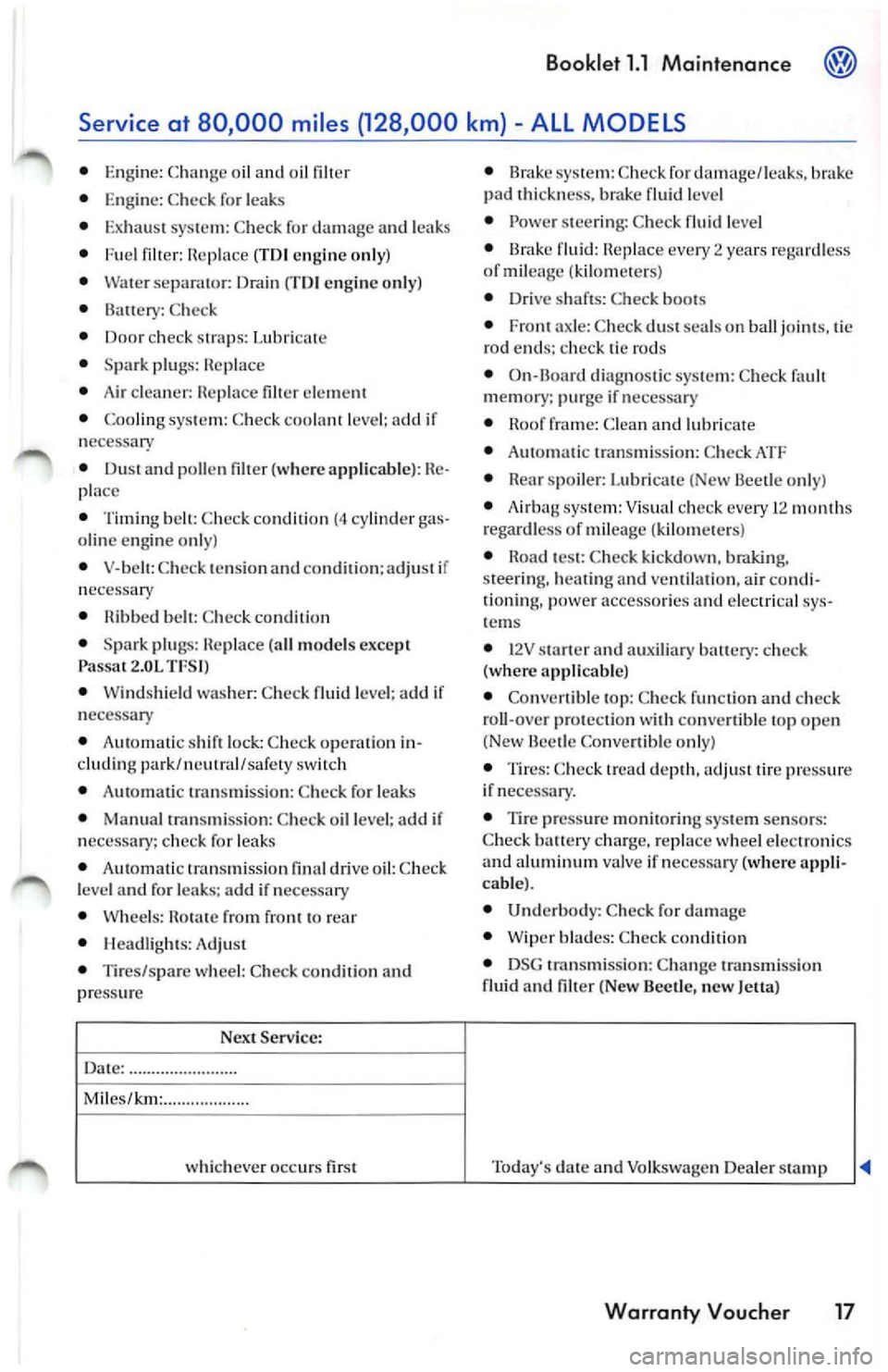
Bookl et 1.1 Ma in tenanc e
• Engin e: C heck fo r leaks
• Exhau st sys te m: Check fo r damage and leaks
• Fuel filter: Rep lace (T OI engine onl y)
• Wa te r se para to r: Drain (TO I eng in e only )
• Banery: C hec k
• Doo r ch eck strap s:
• Spark p lug s: Re place
• Air cleane r:
fi lter c le m ent
• Coo ling sys te m : C heck coo lant level: add if
n ecess ary
• Dus t an d po llen filt er (w here appli cable):
pla ce
• Timin g belt : C heck co ndit io n (4 cy lind er gas
ol ine e ngine only )
• V-be lt: C heck te n sion and cond itio n: adju st if
ne cessary
•
b elt : C heck co ndi tio n
• Spa rk plu gs: Heplac e (a ll mod els exce pt
Pa ssat 2.0L TFS I)
• Wind shi eld wash er: C heck fluid le vel; a cid i f
nece ssary
• Auto matic s hift lock: Check operation in
clud in g park/neutra l/s afet y sw itch
• Automat ic tran sm ission: Chec k for le ak s
• Man ual tran smi ssion: Chec k oil leve l; add if
n ecessary ; c h ec k for l eaks
• Auto mati c tran smi ssion fina l drive oil:
leve l a nd for le aks; acid if necess ary
• Wh eels: Rota te from front to r ear
• Hea dlig ht s: Ad just
• Tires/s pare w hee l: Check conditi on and
pr ess ure
Nex t Se rvice:
Date: ...................... ..
Mil es/km: ........ .......... .
w hi ch eve r occ urs fir st •
Bra ke sys te m : C hec k fo r d am age/ le ak s.
pad thi ckn ess, brake fluid leve l
• Powe r stee ring: Chec k fluid leve l
• Brak e flu id: Rep lace eve ry 2 y ears regard less
of mil eage (kilom eters)
• Drive shaft s: Check boo ts
• Front a xle: C hec k du st se als on ball jo int s, tie
rod end s: c hec k tie rod s
• On-Boar d diagnost ic sys te m : C hec k
mem ory; purg e if necessary
• Roof frame: Clea n and lubri cate
• Automa tic trans missio n : C heckA TF
• Rear spoiler: Lubricate (Ne w Bee tle o nly)
• Airbag syste m: Vis ua l ch eck every 12 mun th s
r ega rdless of mile age (kilom ete rs)
• Roa d tes t: C hec k ki ckdow n, braking ,
s teer ing. hea tin g and venti lati on , a ir con di
tion in g, po we r accesso ries and elec tr ica l sys
tem s
• 12V starte r and a uxiliar y batt ery: check
(where applica ble)
• Conver tible to p: C hec k fun ction and ch ec k
roll-over pro tec tion wit h co nve rtibl e top open
(New Beetle Conve rtible onl y)
• Tires: C heck tre ad depth, adjust ti re press ure
i f necessary.
• Tire press ure monitorin g syste m senso rs:
C heck banery ch arge, replace wheel e lec tro nics
a n d alum inum valve if n ecess ary (w here appli
cab le) .
• Unclerbody : Chec k for dam age
• Wiper blad es: C hec k co ndit io n
• DSG trans mission: Chang e tra nsm issio n
fluid and filt er (Ne w B eetle, new Jelta)
To day's elate and Vo lk sw age n Dealer stamp
Wa rranty Vouch er 17
Page 40 of 477
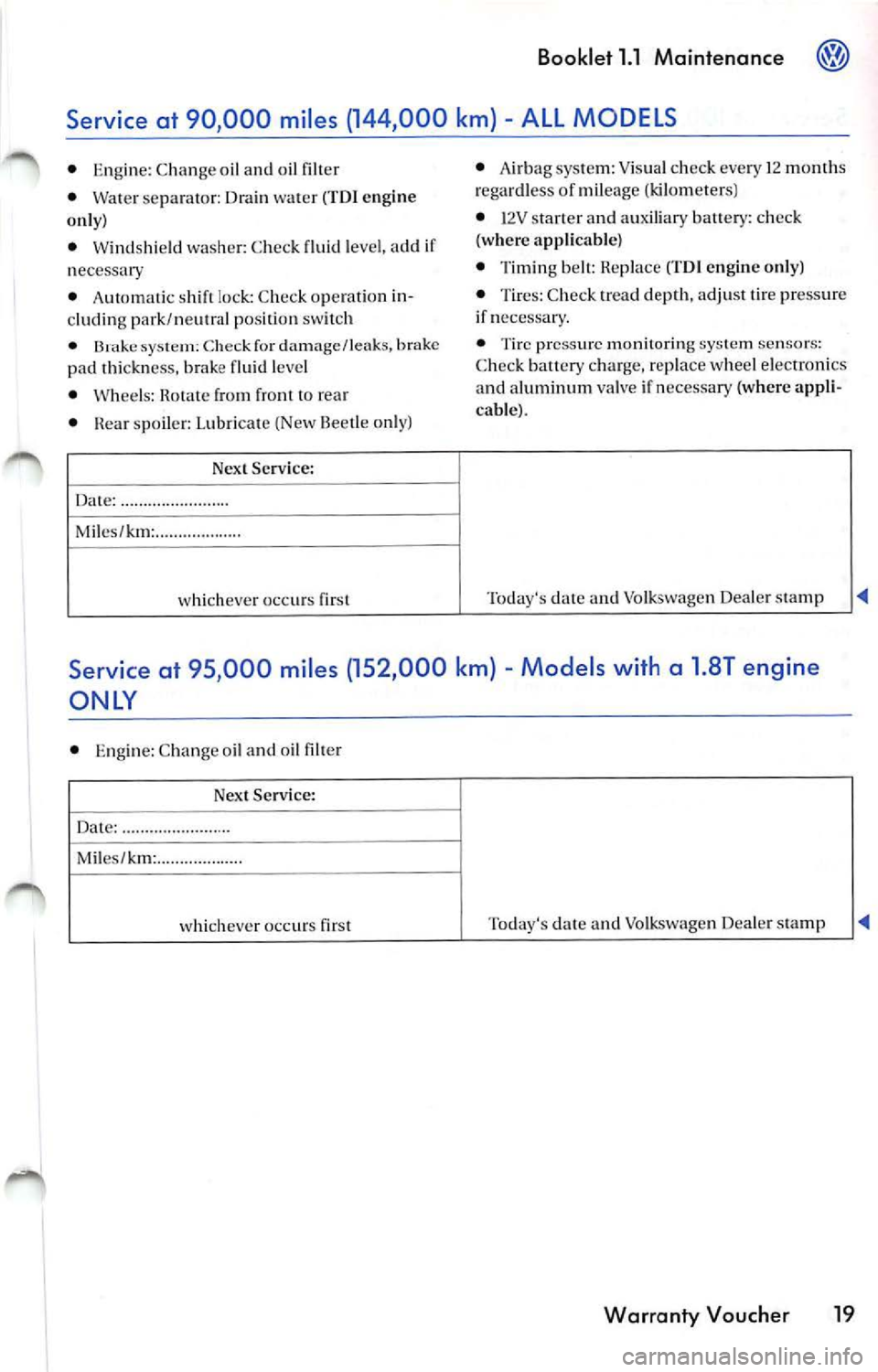
Booklet 1.1 Maintenance
pad thickn ess. brake fluid leve l
• Whee ls : Rotate from f ront to rea r
• Rea r spoile r: Lubri cate (New Beetle o nly)
Nex t Service :
Da te: ..... ... ...... ......... .
Mi les/ km: ....... ........... .
occ urs firs t •
Airbag syste m: Vis ual c h ec k every 12 m on th s
r eg ard less of mil eage (kil ome te rs)
• 1 2V starter and auxili ary ba ttery: ch eck
(wh ere app licable)
• Timing belt: Rep lace ( TDI engine o nly)
• Tire s: C heck tread depth , adju st tir e pr ess ure
i f n ecessary .
• Tire pre ssure monit oring sys te m senso rs : C hec k b attery c harge, rep lace w hee l elec tronics
a nd alum inum valve if necessary (where appli
ca ble).
T oday' s dat e an d Vo lk swage n Dea le r stamp
Service at 95 ,000 miles (152,000 km) -Models with a 1.8T engine
ONLY
• Engin e: Change oil and o il
Next Servi ce:
................ ...... ..
M iles/ km: ................ .. .
w hichever occurs fir st To
day 's dat e and Volkswage n Dea le r sta m p
Warranty Voucher 19
Page 124 of 477
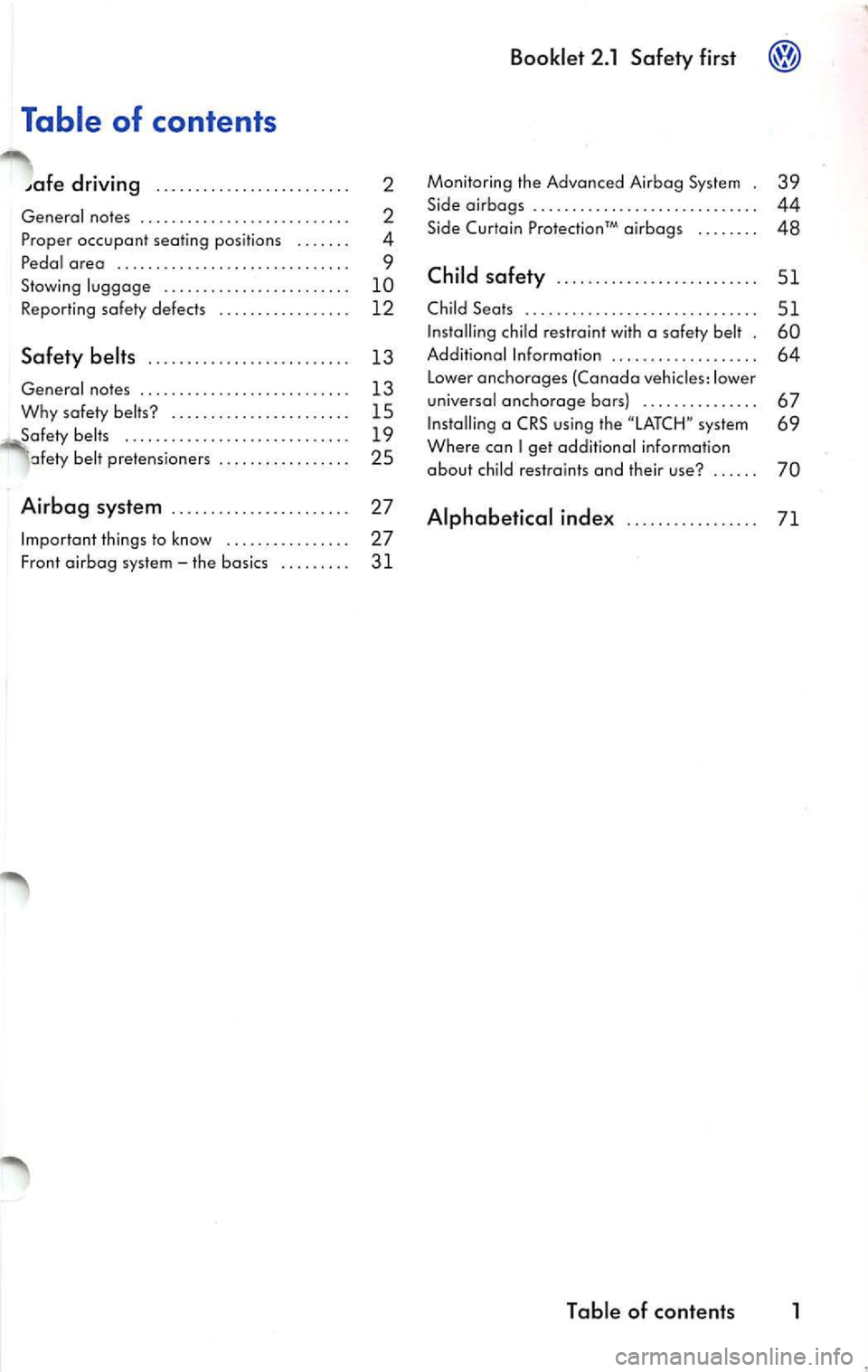
Table of contents
driving . . . . . . . . . . . . . . . . . . . . . . . . . 2
General notes . . . . . . . . . . . . . . . . . . . . . . . . . . . 2
Pr oper occupant seating positions . . . . . . . 4
P eda l area . . . . . . . . . . . . . . . . . . . . . . . . . . . . . . 9
S tow ing luggag e . . . . . . . . . . . . . . . . . . . . . . . . 10
R eporti ng safety defects . . . . . . . . . . . . . . . . . 12
Safety belts . . . . . . . . . . . . . . . . . . . . . . . . . . 13
General no te s . . . . . . . . . . . . . . . . . . . . . . . . . . . 13
Why safe ty belts? . . . . . . . . . . . . . . . . • . . . . . . 15
Safety bel ts . . . . . . . . . . . . . . . . . . . . . . . . . . . . . 19
ofe ty belt prelensioners . . . . . . . . . . • . . . . . . 25
Airbag system . . . . . . . . . . . . . . . . . . . . . . . 27
I m port ant thing s to know . . . . . . . . . . . . . . . . 27
Fr ont airbag system - the basics . . . . . . . . . 31
Booklet 2.1 Safety first
Monitoring th e Advanced Airbag Sys te m . 39
Side airbag s . . . . . . . . . . . . . . . . . . . . . . . . . . . . . 44
Side Cur tain Prot ect ion™ airbags . . . . . . . . 48
Child safety . . . . . . . . . . . . . . . . . . . . . . . . . . 51
Chi ld Se als . . . . . . . . . . . . . . . . . . . . . . . . . . . . . . 51
I ns talling child res tra int with a safety belt 60
A dd itional I nfo rmati on . . . . . . . . . . . . . . . . . . . 64
L ow er anchorages (Canada veh icl es: lower
universa l anchorage bars} . . . . . . . . . . . . . . . 6 7
In stalling a CRS using th e "LATCH " system 69
Where con I g el additional informa tion
about chi ld restraints and their use? 70
Alphabetical index . . . . . . . . . . . . . . . . . 71
Table of contents
Page 125 of 477
Booklet 2.1 Safety first
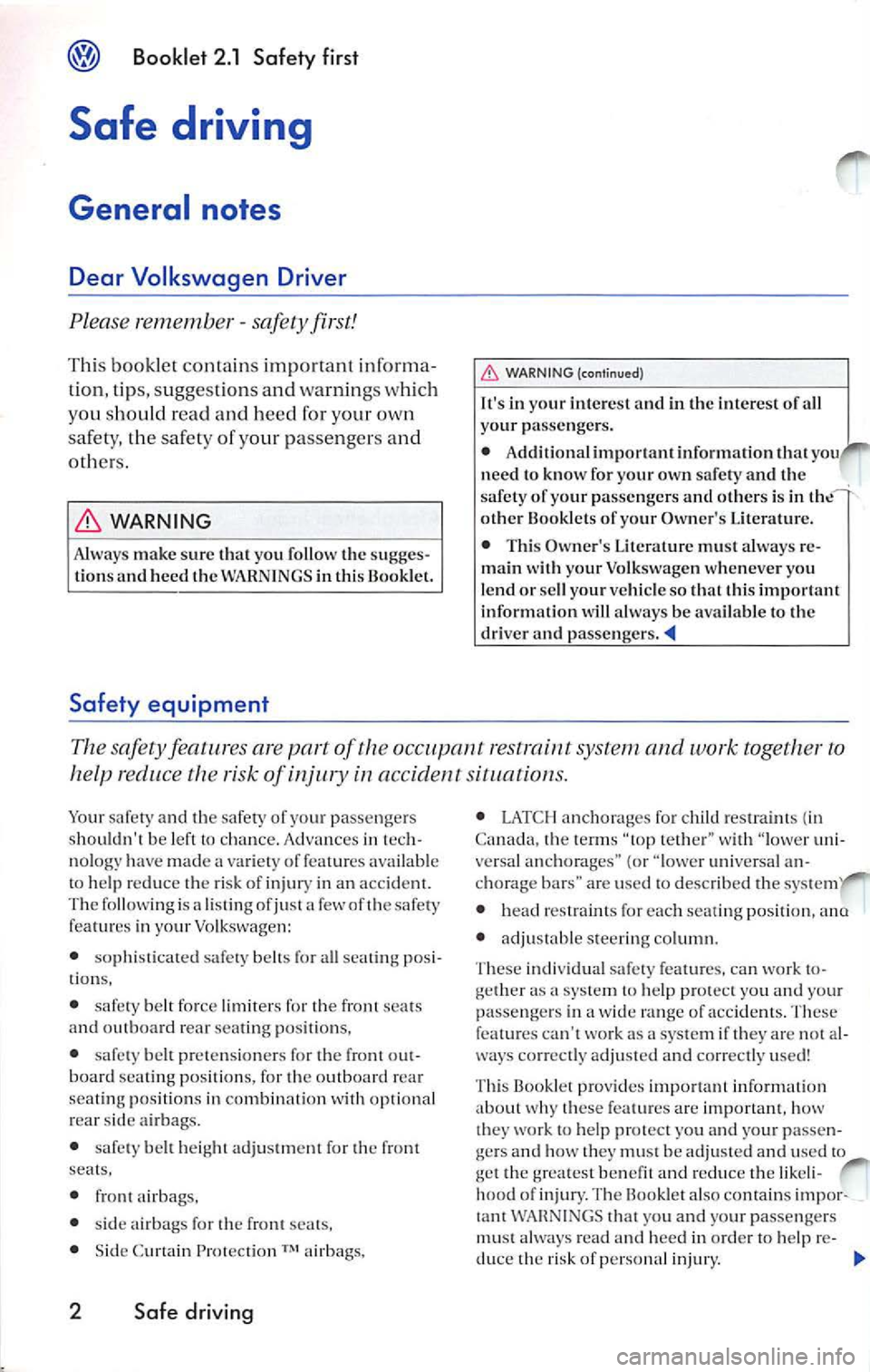
Safe driving
Gene ral notes
Dear Vo lkswagen Driver
Plea se remembe r -safety first!
This booklet conta in s impo rtan t informa
tio n, tip s, suggest ions and wa rnings wh ic h
you sh ou ld r ead an d heed fo r your own
safety, the safety of your passen ge rs and
o th ers .
WARNING
Alwa ys make sure th at yo u follow the sugges
ti ons and heed the WARN INGS in thi s Boo klet.
Safety equipmen t
WARNING (continued)
It 's in your interes t an d in th e int erest of a ll
yo ur p ass enge rs.
• Addit io nal imp orta nt information that
need to know fo r yo ur own safety a nd the
safe ty of yo ur passengers and oth ers is in
other Booklet s of your Owner' s Lit erature .
• Thi s Owne r's Lit erature must alw ays re
m ain with your Volkswagen w hen eve r you
l e nd or se ll your vehicl e so that thi s imp ortan t
informa tion will always be ava ilable to the
driver and
The safe ty feat ures are part of the occu.pan t rest raint system and work togeth er to
help re duce the risk of injury in accident
Yo ur safe ty and the sa fety of your pa ssenge rs
s hou ldn 't b e left to ch ance. Adva nce s in t ech
n o logy have ma de a va riety of fea tur es ava ilable
to h elp reduc e the risk of injur y in a n acc id ent.
The follow ing is a listin g of ju st a few of the safe ty
fea tures in your Volk swage n:
• sophi sti cate d safe ty be lts for a ll sea ting posi
tion s,
• saf ety be lt fo rce lim iters for t he front scats
a nd out boa rd rear seating pos itio ns.
• safe ty belt pre te nsion ers for the fro nt o ut
board seati n g posi tions, for th e outboard re ar
sea tin g pos itio ns in com binatio n with optio nal
r ea r sid e air ba gs.
• safe ty belt heig h t adju stm ent for th e front
sea ts,
• fron t airbags.
• sid e airbags for th e fro nt sea ts,
• Sid e Curt ain
airbag s.
2 Safe driving
• LATCH a nchora ges fo r child r estra in ts (in
Ca nada , the t erm s "to p tet her" w ith "lowe r uni
versal a nch orage s'' (or ''lowe r uni versal a n
c h orage bars" are use d
to desc ribed th e sys te m
• head restraints for eac h se ating position , ano
• adju stab le s teer ing co lumn .
T hese indi vidual safety fea tur es, can work to
ge ther as
sys tem to help protec t yo u and your
pa sse nge rs in a w ide ra nge of accid ent s. T hese
feature s ca n't wo rk as a syste m i f th ey are not a l
ways co rrec tly adjusted a nd correc tly use d!
Th is Booklet pro vid es imp ortant inform atio n
about
t h ese fe atur es are important, h ow
t h ey work to help prot ect yo u and your pa sse n
ge rs and how they mu st b e ad justed and use d to
ge t th e grea test ben efit and red uce th e lik eli
hoo d of inj ur y. T he Book le t a lso co nta in s im po r
WA HN INGS that you and your passengers
mus t a lw ays rea d and h eed in orde r to help re-
du ce the risk of per sona l injur y.
Page 127 of 477
Booklet 2.1 Safety first
Proper occupant seating positions
Proper seating position for the driver
The proper driver seating position is important for safe, relaxed driving.
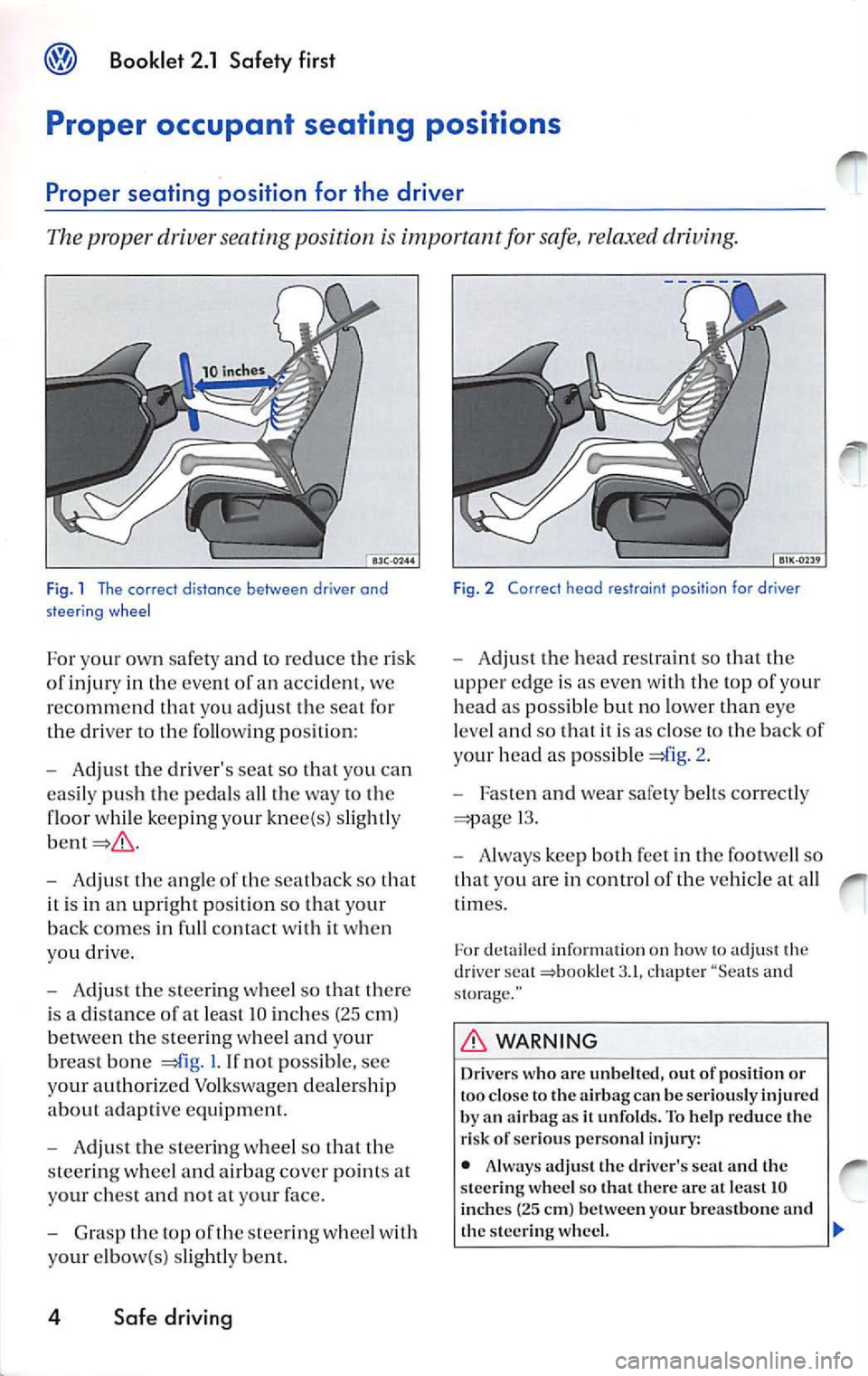
Fi g. 1 The correct distance between driver and
steering wheel
For yo ur own safety and Lo reduce the risk
of injur y in th e eve nt of a n accid ent, we
recommend that y ou adju st th e se al
the dri ver to the fo llowi ng po sition:
- A djust th e dri ver's se at so that you can
eas ily push the pedal s all th e way
10 th e
floor while k eeping you r kn ec(s) s light ly
- Adj ust the a ngl e of the sea t b ac k so that
it i s in an upri ght p osition so that your
back comes in full contact with it when
yo u dri ve.
- Adjust th e stee rin g w hee l so that there
i s a di sta nce of at le a st 10 in ch es (25 cm)
b etween the s tee rin g w hee l and your
breast bone
1. I f n ot possib le, see
yo ur authori zed Volkswagen dealership
about adapti ve equipm ent.
- Adju st th e steerin g w hee l so that the
s tee ring whee l a nd airbag cove r point s at
y our ch es t and not at your fa ce.
- Grasp the top of the ste erin g wheel with
yo ur clbow(s) sli ghtl y be nt.
4 Safe driving
Fig. 2 Correct head restraint position for driver
- Adjust t he hea d r estra int so that the
upper edge is as eve n with the to p of your
h ea d as possibl e but n o lower than eye
l eve l and so that it i s as close
to th e ba ck of
yo ur head as possible
2.
- Faste n and wear safe ty belt s co rrectl y
13 .
- Always keep both feet in the footwe ll so
that you are in control of th e ve hicle at all
tim es.
For detail ed in format io n on h ow 10 adj ust drive r 3.1, c hap te r "Sea ts an d
s torage ."
WARNING
Drivers who arc unb elted , o ut of position or
too clo se to the airbag can be seriously injured
b y an airbag as
it unfold s. To help reduc e th e
ri sk of serious p ers onal injury:
• Always adju st
driv er's scat and the
s te ering whe el so that there are al least 10
inches (25 cm) between your brea stbone and
the steer ing wheel.
Page 139 of 477
Booklet 2.1 Safety first
What happens to occupants not wearing safety belts?
In crashes unbelted occupant s cannot stop themselve s from flying forward and
being injured or killed. Always wear your safety belts.
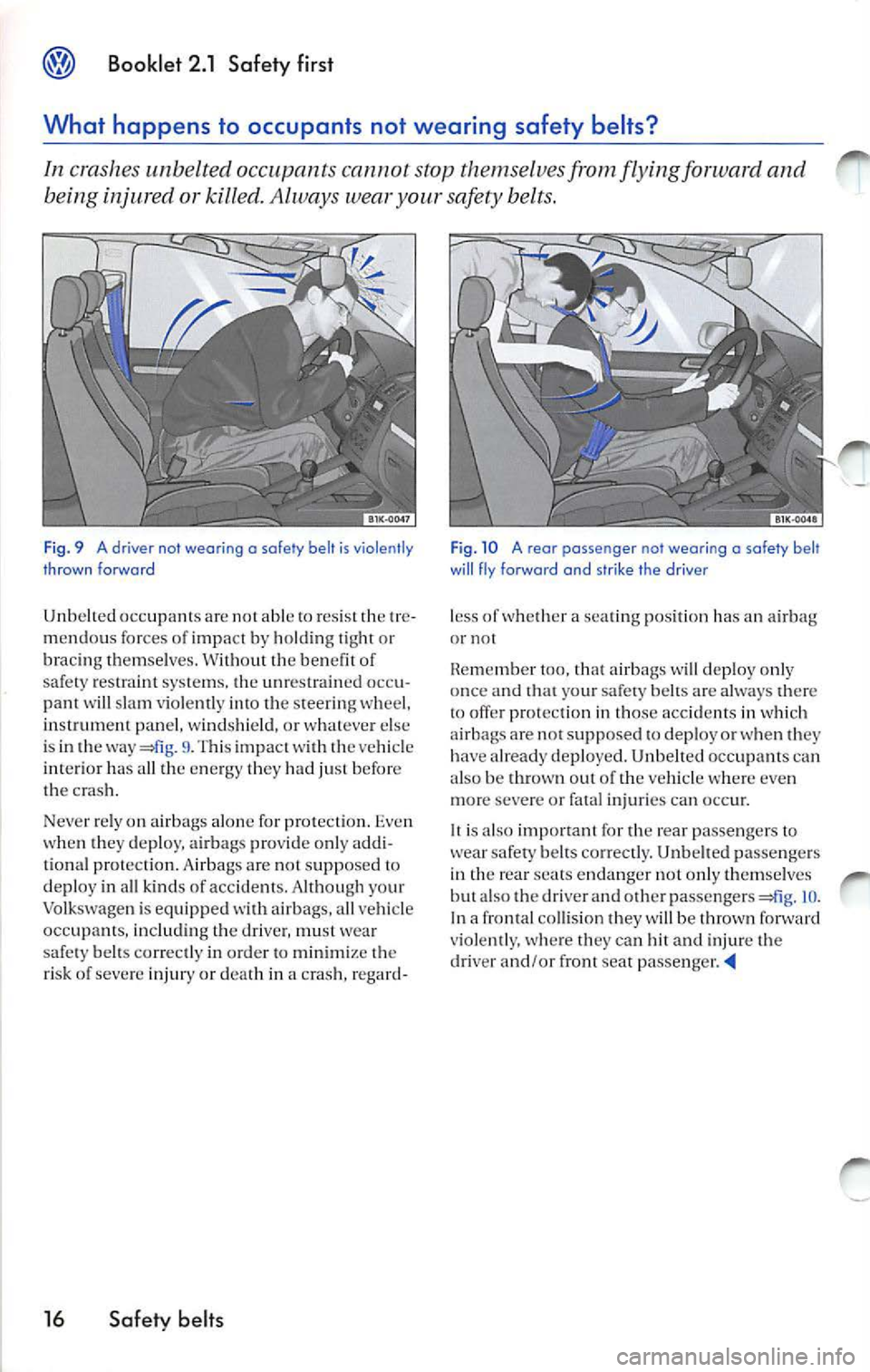
Fig. 9 A driver not wearing o safety belt is violently
thrown forward
Un belted occ upants ar e not abl e to res ist the tre
m endo us fo rces o f imp act by holdin g tig ht or
bra cing themse lves . W ith ou t th e ben efit of
s af etv res traint systems. th e unr estrai ned o ccu
slam vio le ntl y into t he steering wheel,
in strnm ent panel, win dshi eld , o r w hate ve r else
is in the way
9. T his impac t w ith the ve hicle
inte rior has a ll th e e nergy the y had just before
the cras h.
Neve r re ly on airb ags alone for pro tec tion. Eve n
wh en th ey deplo y, air ba gs provide onl y a ddi
t io n al prot ection. Airb ags are not su pposed
depl oy in all kin ds of a cci den ts. Alt hough your
Volk swag en i s eq uipped with airbags, all vehicl e
occ upant s, inclu ding th e dr ive r, mu st wear
sa fety belt s co rrectl y in order to min imize th e
ri sk of seve re injur y or d eath in a cras h, regard-
16 Safety belts
Fig . 10 A rear passenger not wearing o sa fety belt
will fly forward and strike the drive r
less of wheth er a se atin g pos ition has a n or no t
R em emb er too, that ai rbags w ill dep loy o nly
once a nd t hat your sa fery be lts are always there
to offe r pro tec tion in th ose acci dent s in whi ch
a irba gs are not supp osed to dep loy o r w hen they
h ave already deployed. Unbelt ed occ upan ts can
a lso be thro wn out of th e ve hicle w here e ven
more severe or fa ta l in jur ies can occur.
I t i s a lso important for the rear passe ngers to
wea r sa fety belts correct ly. Unb elt ed pas se nge rs
in th e re ar sea ts endanger no t on ly th emse lves
b u t a ls o th e driver an d oth er pa ssenge rs
JO .
In a fron tal collisio n th ey w ill be thrown forward
v io len tly, whe re they ca n hi t a nd injure the
driver and /or front seat
Page 140 of 477
Booklet 2.1 Safety first
it 's po ssibl e to use the to brace the body a ,ninor collision.
It 's simp ly not
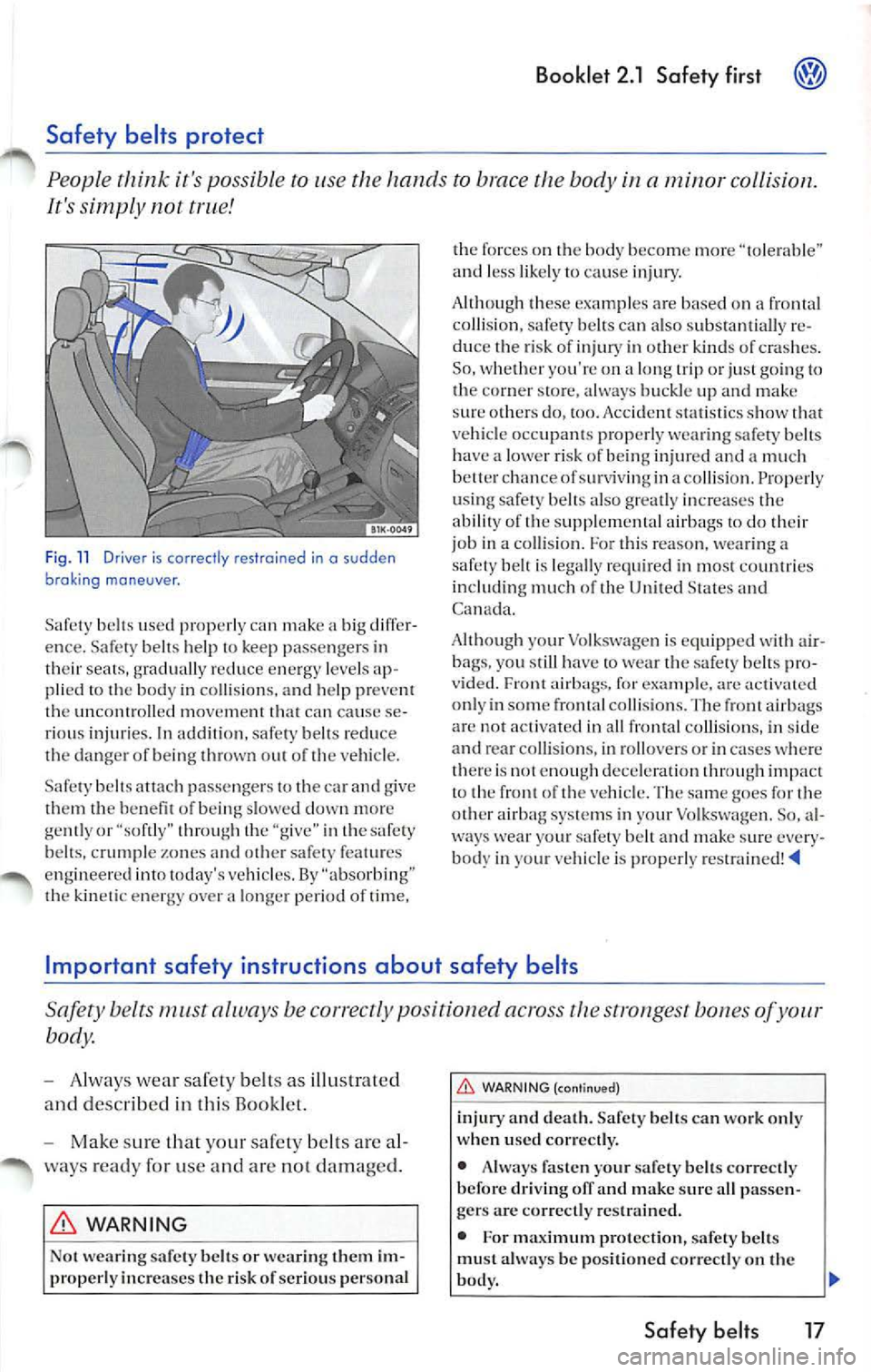
Fi g. 11 Driver is co rrectly re strained in o s udden
broki ng ma neuver .
Safely belt s used prop erl y can make a big diff er
ence. Safet y belts help to keep passe ngers in
the ir sea ls , gra dually r edu ce e nergy levels ap
pli ed
to the body in co llision s. and help preve nt
th e unc ontroll ed mo veme nl tha t can cause se
riou s injur ies. In ad di1i on, safe ty belt s redu ce
th e clang er of being thro wn ou1 o f th e ve hicl e.
Safe ty belt s atta ch passengers 10 the car and giv e
th em t he ben efi t of b eing
down more
ge nll yor "sof tly" through lhe "g ive" in the saf ety
b e lts, cru mp le zo ne s
other saf ely fea1 ures
e n gin ee re d into toda y's vehicl es. By "ab sorb ing"
t h e kinet ic ener gy ov er
longe r per iod of lime , th
e fo rces o n 1h e body be come more "tolerable "
and less likely to c ause injur y.
A lthoug h 1hese exa mples are ba sed on a frontal
co llision,
belt s can also sub sla nt ially re
duc e the risk of inju ry in 01h er kin ds of crash es.
So . w heth er yo u're on a long 1rip or ju sl go ing to
lh e c orner stor e, always buckle up and make
s ur e oth ers do, too. Acci denl statist ics sh ow 1h at
ve hicle occ upan 1s prop erl y wea ring sa fe ty
ha ve lower risk of bein g in jur ed and a much
b elie r ch an ce of in collis io n. Properl y
u sin g safe ty bell s also great ly in cre a ses the
abili 1y of 1 he s uppl em ent al a irbags 10 do their
job in a collisio n . Fo r thi s rea son, wea ring a
safe ty belt is lega lly re quir ed in mo sl cou ntries
includin g mu ch of th e Un ited
and
Canada .
A lth ough your Volk swage n i s eq uipped wilh a ir
ba gs. yo u still have to we ar th e safe ly be lts pro
v id ed. Fro nt a irba gs, for examp le,
a cti va ted
on ly in some frontal collisio ns. Th e front airb ags
a re no t acli vated in all fron ta l co lli sio ns, in sid e
and rea r co llisio ns. in rollo vers o r in cas es wh ere
is no t e nou gh de celeration through impac t
to the front of the vehicle. Th e sa me go es for the
01 hcr airbag sys1ems in yo ur Volk sw agen. So, al
w ays
you r saf ety belt and mak e sure ev ery
bo dy in ve hicle is prop erly
Impo rtant safety instructions about safety belts
Safety bel ts must alway s be cor rect ly pos i ri on ed across the strongest bones of you r
body.
- Always wea r saf ety bells as ill ustra ted
and descr ibed in thi s Bookl et.
- Make su re th at yo ur sa fet y be lts a rc a l
ways rea dy fo r u se and arc no t da ma ged.
WARNING
Not wea ring sa fe ty belt s or wearing t hem im
prop erl y inc re as es the ri sk of se rious per sona l
WAR NING (continued)
injury and death. Safety belts ca n w ork onl y
w hen u sed correct ly.
• Always fas te n yo ur safety belt s cor rect ly
before dri vin g o ff and make sure all pa sse n
ge rs are cor rec tly res tra in ed.
•
m ax imum protection, sa fel y belt s
mu st be po sitione d cor rectly on th e
body.
Safety belts 17
Page 145 of 477
Booklet 2.1 Safety fir st
Safety belt extender
A safety belt extende r is available if a belt is too short for the driver o r a pas
seng e,:
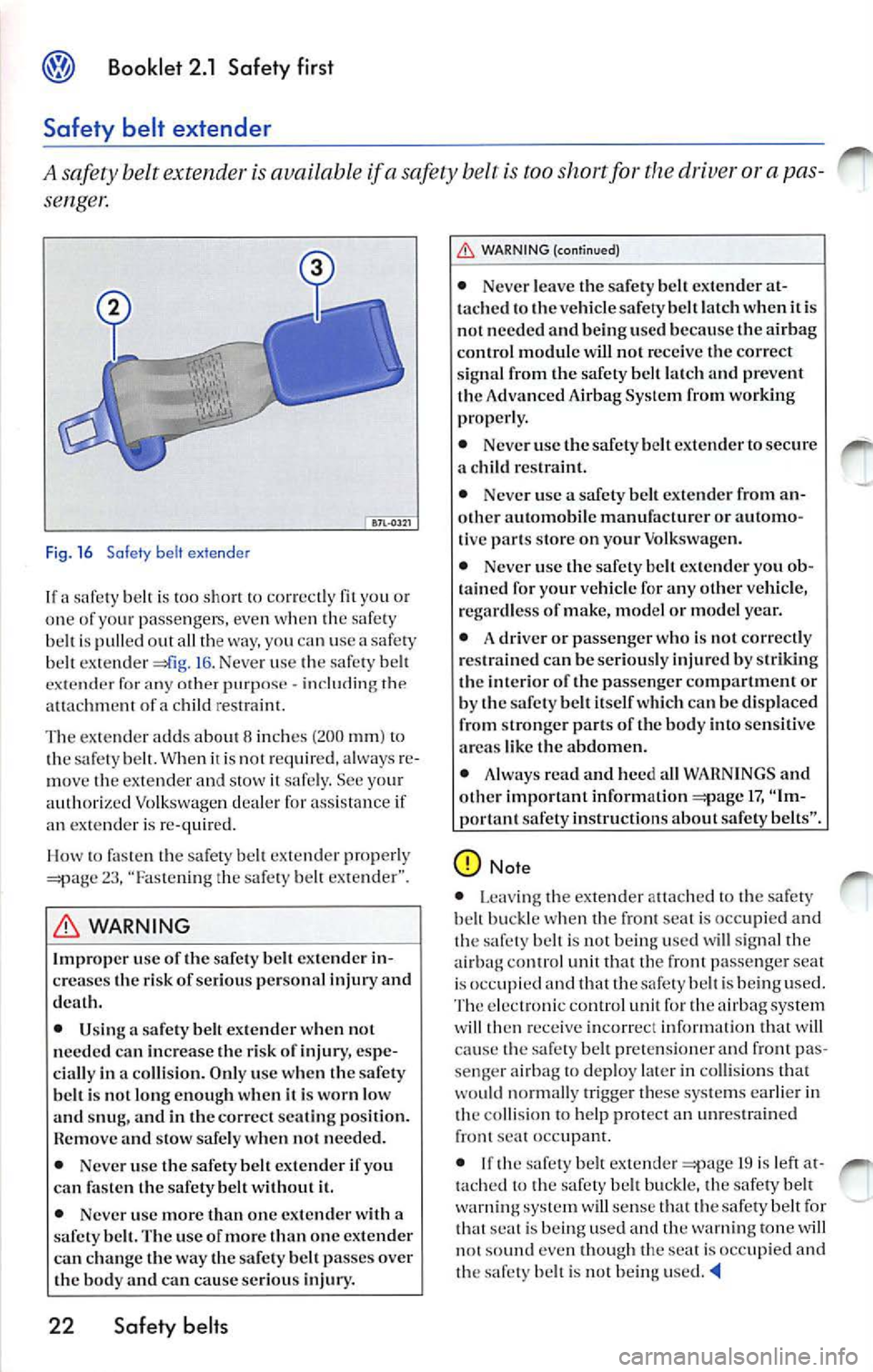
F ig . 16 Safety be lt ex tender
If a safe ty belt is too s hort t o co rrectly fit yo u or
one of your pa sse ngers , even when th e
b elt is pull ed o ut the way, you ca n use a safe ty
b elt ex te nd er 16 . Neve r use th e sa fe ty belt
ex te nd er any o ther purp ose. att ac hm ent of a child re straint.
Th e extender adds about
8 inche s (200 mm ) to
t h e sa fety belt. When is r e quired. always re
mo ve extender and stow it safe ly. See y our
a uthoriz ed Vo lksw agen d ealer for assista nce if
a n ex te nder i s re- qui re d.
How to faste n the s afet y be lt extender properly
23 , "Fa steni ng th e saf ety belt ex te nd er".
WARNING
Im proper use o f the safety belt ex te nder in
c reas es th e risk of serious perso nal injur y and
d eat h.
• U sing a sa fe ty belt ex te n der w hen n ot
n eede d can increase the r isk of inju ry, es pe
cia lly in a co llision . On ly use whe n th e safe ty
b e lt i s not lo ng eno ugh when it is wo rn low
a n d sn u g, and in the cor rect sea ting po sition .
R em ove a nd stow safely w hen not needed.
• Never use t he safe ty belt exte nder if you
can faste n th e safe ty belt w ith out it.
• Never use mo re t han one ex tende r w ith a
safe ty b elt . Th e use of more t han o ne ex ten der
ca n ch ange th e way the sa fe ty be lt passes ove r
th e body and ca n ca use ser ious injury.
22 Safety belts
WARN ING (continued)
• Neve r leave t he safety belt ex te n der at
t ac hed to t he ve hi cle safety belt latc h when it is
n ot needed and bei ng use d because t he a irb ag
con tro l m odul e will n ot r ec eive th e correct
s ig n al from the safety belt la tc h and preve nt
t h e Adva nce d Airbag Syste m fro m wo rk ing
proper ly .
• Neve r use the safety belt extende r to secure
a c hild restr ain t.
• Neve r use a safety belt exte nder from an
o the r au tomo bile manufact ure r or au to m o
t ive par ts sto re on yo ur Volk swagen.
• Never use the safety be lt ex tende r you ob
t a in ed fo r yo ur vehicl e for a ny o ther ve hicl e,
r egard less o f mak e, mo del o r m odel year.
• A drive r or passe nger who is no t correc tly
r es tra ined ca n be ser ious ly inj ured by striking
th e i nterior o f the passenger compartmen t o r
by t he safe ty belt itse lf w hich can be disp laced
f ro m stronge r pa rts of t he bo dy in to se nsit ive
areas like the abdom en.
• Always rea d and h eed all WARN INGS a nd
ot her im portant inform ation
17, " Im
por tan t safety instructio ns about safe ty belt s".
N ote
• Leav ing the extender
10 the safety
b elt bu ckle when the front scat is occ upied a nd
the saf ety belt is not b eing use d
will sig n al the
ai rba g co ntrol unit that the front passe nge r seat
i s occ up ie d and that the sa fe ty b elt is b eing use d.
Th e elec troni c control unit fo r th e airbag system
w ill th en r ece ive incorr ect informat io n that will
ca use the saf ety belt pr ete n sione r a nd fro nt pa s
s enger air bag to dep loy later in co llision s that
wou ld n orm ally trigge r th ese syste m s ea rlier in
th e colli sion
h elp prot ect an unr estrained
fr ont sea t occ up ant.
• If th e safe ty belt ex te nd er
19 is lef t tached to the sa fe ty belt buck le, th e safe ty be lt
warn ing sys te m will se nse th at the safety belt for
that scat is bei ng use d and the warn ing tone will
not soun d eve n thou gh th e sea t is occup ied and
the safe ty belt i s not be in g
Page 148 of 477
Booklet 2.1 Safety first
Improperly worn safety belts
Inco rrec tly position ed safety bel ts can cause severe injuries.
Wearing safe ty belts impro perl y can cause
se rious injury or death. Saf ety bel ts ca n
only work when they a re co rrect ly po si
tio ned on the body. Improper seating posi
t ions redu ce th e e ffec tive ne ss o f safe ty
a nd will eve n incr ease the risk of in
j ury and dea th by mo ving the safety belt t o
c riti ca l area s of the body. Improper seating
p osition s also inc rease the risk of serious
i njury and dea th when a n airbag dep loys
a nd str ik es an occ upant who is no r in the
cor rect seating position.
dri ver is re
spo nsibl e for the safety o f all vehicl e occ u
pants and espec iall y for ch ild ren. Ther e
fore:
Safety belt pretensioners
-permit anyone to assume an in
correct sittin g posi tion in the ve hicle w hile
WARNING
I mproperly worn belt s in crease the risk
of seriou s per sonal injury and d eath whenever
a ve hicl e is being use d.
• Always make sure that all vehicle occu
pants are co rrec tly res trai ned and sta y in a
corr ect sea ting position whenever the vehicl e
i s bein g use d.
• Always read and heed all WARN INGS and
other import ant inform ation
1 7 .
How safety belt pretensioners work
In a frontal collision, the safety belts for the front and rea r outboard* seating po
s itions are tightened up automatically.
The retractor s for the driver and fron t pas seng er
po sition s (r ear o utboar d seat ing positions only
i n co mb ination
op tional sid e air ba gs for
th e ou tboa rd rear sea tin g po sit ions ) are
eq uipped with b elt pre1 ensioner s. S en sors ac ti
v at e th e belt pre te n sion ers in frontal colli sion s
whe n dec ele ra ti on is high enough. Th is tig ht ens
t h e belt and ta kes up belt sla ck.
up s lack help s to re duce forwa rd o ccup a111 mov e
m ent durin g a co llis ion .
The belt p re te n sioncr can onl y be activ at ed
o n ce.
Th e belt pr ete nsion er can be
in a frontal, s ide or rea rcn cl colli sion. It will n ot acti
va te in a ro llo ve r in which side airb ags do not
d eplo y.
Note
Neve r le t th e belt re main ov er a re a r seat back
that has been fo lded forward . T he re ar belt p re - t
en sio ne r• c an be a cti vated unn ec es sar ily in a
co llision and will then have to be rep laced .
Tips
• When the s afety b elt pre ten sion cr is acti
v at ed, a fin e du st is re lea sed . Thi s is no rm al and
i s
c ause d by fire in th e ve hicl e.
• Applicab le s afet y req uirem en ts mu st be ob
s e rved when th e veh icle or comp onents of the
sy ste m are scrapp ed .
A qualified dealers hip i s fa
mi liar w ith th es e re g ul atio ns and w ill be pl ease d IO pa ss o n informat ion to yo u.
• B e sur e
to obse rv e all saf ety , e nvironm e111al
an d other r eg ul ation s if t he v eh icl e or ind iv idual
pan s of the sys tem, particu lar ly th e s afety b elt or
a irba g. are to be dispo sed. We re co mmen d yo u
h av e yo ur auth orized Vo lkswagen pe rform thi s
s ervi ce for yo u.
Safety belts 25
Page 150 of 477
Booklet 2.1 Safety first @
Airbag system
Important things to know
Importance of wearing safety belts and sitting properly .
Airbags are only supplemental res traint s. For airbags to do th eir job , occupant s
m ust
prope rly wea r th eir saf ety b elts and be in a proper seating position.
Fo r yo ur safet y an d the safet y of your pa s
s en gers, before d riv ing alwa ys:
Ad just dr iv er 's seat and stee rin g
wh eel properl y
4.
Adj ust fr on t passe nge r seal p rop erl y
5.
We ar sa fe ty belt s properly 13 .
A lways properl y use th e co rr ec t child
r es tra int lo protect childr en
5 1.
In a co llisio n a irba gs mu st infl ate within th e
blink of an eye and w ith con sid erabl e fo rc e. The
s uppl em ental airb ags c an cause injuri es if th e
dri ver or th e front seat pa sse nge r is not seate d
prop erl y. Ther efor e in order to help the airba g to
do its jo b , it is im porta nt, both as a driver and
a passe nger to sit pro perly at all times.
keepin g ro om betwe en yo ur body and the
s te erin g and th e fr ont of t he passenger
co mpa rtm ent , the a irbag can i nflate f ull y a nd
co mpl etel y and p rovid e suppl em ent al p rotec
t io n in certa in fro ntal co llision s
deta ils
o n th e opera tio n of the se at adju stm ent contro ls
" F ro nt seat s".
I t 's especia lly im port ant th at child ren b e prop
e rl y res train ed
5 1, "C hild safe ty".
Th ere is a lo t t hat th e drive r and the passe ngers
ca n and mu st d o to he lp th e in divi du al safe ty
f e atur es insta lled in yo ur Vo lks wa gen
to
get he r as sys te m .
Pro per seati ng posi tio n is i mp ort ant sn th a t th e
fron t airb ag o n th e dr ive r sid e ca n do its jo b . If
y ou ha ve
phys ica l imp airm ent or cond iti on
t h at p rev ent s yo u from sittin g prop erly on t he
dri ver
with the sa fe ty belt prop erl y
and r eachin g th e pe dals , s p ecia l m odific ation s
t o yo ur vehicl e ma y be necessary .
Co nta ct you r auth ori7.e d Vo lk sw agen dea le r, or
c all t he V olk swage n Custo m er
Ce nter at 1-800 -822 -8987 .
When the airba g sys te m deploy s, a ga s gen erator
w ill fill the airb ags , b re ak op en th e padd ed
cov ers, and inflate be twee n the ste erin g wheel
and th e dri ver and b etwee n the in strum ent
p an el and the fro nt p asse nge r. Th e a irbag s
w ill defl ate imm edi ate ly af ter dep loy ment so that
t he front o ccupan ts ca n see th ro ugh th e wind
s h ie ld a gain with out int errupt io n .
A ll of thi s takes place in the blink ofan ey e, so
fa st that many peopl e do n't eve n rea lize t hat th e
a irbags have dep lo ye d.
airbags a lso inflat e
wit h a grea t dea l of fo rc e and noth in g sh ould be
in their w ay w hen th ey depl oy .
airb ags in
com binati on with pr op erl y wo rn safe ty belt s
s lo w
an d limi t th e occ upant 's for wa rd
m ove ment. T ogether th ey help t o preve nt the
dri ver a nd fro nt sc at passe nge r fr om hillin g
pa rts of the in side th e ve hicle
redu cing th e
fo rces actin g o n th e occu pant duri ng the cras h.
In this way they help to red uce the risk of inju ry
t o th e hea d an d upp er bod y in the c rash . A irb ags
d o no t p rot ect t he arm s or the low er p art s o f th e
b ody.
B o th fron t a irb ags w ill no t i nfl ate in all fro ntal
colli sio n s. Fro nt airba gs w ill no t infla te in all
front al colli sio ns .. The tri gge ring o f the a irbag
sys te m depe nds on the ve hicle dec ele rat io n ra te
ca use d by th e co llisio n and regis te re d b y th e
e lec tron ic control uni t. I f thi s ra te is
th e
r efe re n ce v alu e prog ramm ed in to the c ont rol
u nit , th e air bags
n o t b e trig gere d , eve n
th ou gh th e car may be badl y dam aged as a res ult
o f the colli sio n . Ve hicle dama ge, re pai r co sts o r
eve n th e la ck of v ehi cle
is not n eces-
Airbag system 27