flat tire VOLKSWAGEN JETTA 2007 User Guide
[x] Cancel search | Manufacturer: VOLKSWAGEN, Model Year: 2007, Model line: JETTA, Model: VOLKSWAGEN JETTA 2007Pages: 477, PDF Size: 77.6 MB
Page 379 of 477
Booklet 3.2 Tips and Advi ce
des with tire press ure m onito rin g sys te m To preven t thi s, always make that
fac to ry i nsta ll ed va lve s te m caps on a ll whee ls
are securely mount ed on th e valve .
Tires and vehicle load limits
There ar e limits to th e amo unt of load or we ig ht
t hat any vehicl e and any tire ca n carry. A ve hicle
t h at is over loaded will not handle well an d is
mor e difficult t o sto p. Overloadi ng ca n not only
l ead to loss of veh icle contro l, but can also
damage important parts of the vehicle and can
l ead to sudden tire failure, including a blowout
an d sudd en deflat ion that can ca use th e ve hicle
to crash.
Your safety and that of yo ur passengers also de
pe nds on making sure tha t load limit s are not ex
cee ded . Veh icle load includ es everybody and ev
e ry thing in and on the ve hicle. T hese load limits
are technica lly referred to as the vehicle"s Gro ss
Ve hicl e We ig ht Hating
The in cl udes the of the basic ve
h icle , a ll in sta lled accessor ies, full tank
of fuel, oil, coolan t and o ther flui ds p lu s max
imum load . Th e m aximum load includ es the
number of passe ngers that the ve hicle is in
te nded to carry ("seatin g capacity") with an as
su med weight of 150 lbs (68 Kg) fo r each pas
se nge r at a des ig n ati on sea ting pos ition and the
to ta l weight of any lu ggage in the ve hicle. If you
tow a traile r, th e weig ht of th e tra iler hitch and
th e tong ue weig ht of the lo ad ed tra iler mu st b e
included as part of the ve hicle lo ad .
T he Gross Axle We ig ht Hatin g
is th e
maximum load that ca n be appl ied a t eac h of t h e
ve hicl e's two ax les.
The Gross Ve hicl e We ight
and th e Gross
Ax le We ig h t are liste d on the sa fe ty com
pliance sticke r la b el o n th e driv er's door latch
pi llar Your Je tt a ha s 5 seat ing posit io ns, 2 in the
front and 3 in the rea r fo r to tal seating capacity of
5. Ea ch sea ting posi tio n ha s a safe ty belt
= book le t 2. 1 "Safety firs t."
58 Checking and Filling
For th e sake of env ironm ent
Yo ur car w ill ha ve a highe r consumpt io n
a nd unn ecessa ry ex hau st em iss ions with und er
inflated tires .
that there is an upper limit to your ve
hicl e' Gross Vehicle We ig ht Hati ng mean s that
th e
weight of whatever is be ing ca rri ed in
th e veh icle (including the we ight o f trailer
hit ch and the tongu e we igh t of the loaded
t railer) is limit ed. The more pa ssenge rs in the
vehicl e or passe ngers arc heav ier th an the
s tandard weigh ts assumed mean th at less
we igh t
be carr ied as luggage.
tir e pressure label on your Vo lkswagen also
lists the maximum combin ed weight of all of the
occupants and luggage or other cargo that th e
ve hicle can carry. For the locatio n of the label
54. fig. 13 .
WA RNING
Over loadin g a vehicle can cau se loss o f ve hicl e
co ntr ol, cras h or ot her accide nt, se rious per
s o nal injur y, and eve n death.
• Car rying more weig ht th an yo ur vehicle
des ig ned to ca rry will prevent the ve hicle
from handlin g proper ly and in crease the risk
o f th e loss of ve hicl e co ntrol.
• Th e brake s o n a ve hicl e th at has bee n over
l oa ded may not be ab le to stop th e vehicle
wit hin a
dista nce.
• Tir es on a veh icle that ha s be en over loaded
ca n
su dd enl y, includin g a blowout a nd
s udd en deflation, causin g los s of co ntrol and a
c ra sh .
• Alway s make sur e th at the total l oad bein g
tran sp ort ed - inclu din g th e we ig h t of a tra ile r
hi tch and the to ngue we ig ht of a lo aded trail er
- docs not make the vehicl e heav ie r than the
v eh icle 's Gros s Ve hicl e We ig ht H atin g
Page 384 of 477
Maximum Perm issib le Inflatio n Press ure
T his nu mb er is th e g re at est a mount of
pres
s ur e tha t sh oul d ever be put in the tire und er
norma l driv ing cond itio n s.
R ep lac in g tires or rims on vehicles equipp ed
wit h
The air va lve o n all four tires (no t on the spare
ti re) is equip ped with a senso r, w hic h co nsta ntly
m on itors
a ir pr ess ure in side the tire, a nd
the n this Lu If
yo u ar e going to re pl ace the wheel rim s o n yo ur
ve hicl e, make sure the rim s also have these
se nso rs. The se nsor s mu st be co mp atib le w ith
TPM S sys tem o n yo ur vehicle .
I f yo u install rim s. w hich do not have th e se n
sors, o r ha ve sensors w hich are not comp ati ble,
th e TP MS will not wor k pro perl y. In case, theTPM S would n ot b e ab le to m oni tor pr ess ure or wa rn you if is necessa ry.
• Wheneve r you c hange se nso rs, yo u ha ve to
i n sta ll
valves.
•
dri ve the valve ste m cap s se
c ur ely m ou nted. We reco mmen d usi ng fac to ry
i n sta lle d va lve stem caps. As k your auth ori zed
Volkswage n dea le r if yo u los t va lve
caps.
T he in sta llat io n of re pla ceme111 tires
c ord hody plies in the tire si dewa ll m ay ca use
ma lfu nction tir e pre ssure monitorin g
sys te m (TPM S), and i s not recommended (cord
mat eri al informatio n is m olded on
ti re s ide
wa ll).
ch ec k yo ur TPM S indi cator af te r r eone or more tires o n yo ur vehicl e. If t he
TP MS indi cator is on. your TPMS is m alfu nc
ti o nin g. Your
tire m ig ht be incom
patibl e yourTP MS system, or some co mp o
n en t of the TP MS may be dam aged .
WARNING
• Usin g in cor rect or unmatched tires and
I or wheels or improper tire and whee l co mbi
nation s can le ad to loss of con tro l, co llisio n
and serio us perso nal injury.
• Always use tires, rims and whee l bo lts th at
me et th e specification s of ori ginal fa ctory- in
s talled tire s or other combination s th at h av e
b een sp eci fica lly app roved by the vehicle
manufa ctur er.
Booklet 3.2 Tips and Advice
WARN ING (continued)
• Tire s age even if they arc not being use d
and can fail su ddenl y, es peci ally at high
s peeds. Tire s th at are more than 6 yea rs old
can only be use d in an em ergenc y and then
w ith specia l care and at lower speeds.
• Never mount use d tir es on your vehicle if
yo u are not sur e o f th eir "previou s hi story."
Old used tir es ma y ha ve bee n damag ed even
th ou gh th e dam age ca nnot be seen that ca n
l ead to sudd en tir e fa ilur e and lo ss of vehicl e
control.
• All four whe els must be fitted with radi al
tir es of the s am e type, size (ro lling cir cumf er
ence) and th e sa me tread p attern. Dri ving
w ith diff erent tire s reduces ve hicle han dling
a nd can l ead to a loss of control.
• If the spare tire is not th e same a s th e tir es
that are mount ed on the vehicle - for examp le
with winter tir es - only u se the sp are tir e for a
s h ort period of tim e and drive w ith extra care.
Refi t th e no rma l road w hee l as soo n as safe ly
possib le.
• Neve r dri ve
than th e spe ed for wh ic h th e tires on you r ve hicle are
rat ed because tires that arc driven fas te r than
their rated sp eed ca n
sudd enly .
• Overloadin g tir es cause h eat build -up ,
s ud den tire failur e, includin g a blowout and
sudden defl ation and loss of co ntrol.
• Temperat ure grades apply lo tir es that are
properl y inflat ed and not over o r underin
flated .
• For tec hni cal reaso ns it i s not always pos
s ibl e to use whee ls from oth er ve hicles-in
s om e cases not eve n whee ls from the sa me ve
hicle model.
• If you insta ll w hee l trim d iscs on th e ve
hicle whee ls, make sur e that th e air flow to the
brakes is not blo ck ed. R edu ced airflo w to the
brakes can th em to ove rheat , in cre asin g sto p
ping distances and causin g a colli sion .
Checking and Filling 63
Page 385 of 477
Booklet 3.2 Tips and Advice
• If the spar e tire is differe nt from the tires that
yo u have mounted on your ve hicl e ( for example
tir es or wide profil e tir es), then use the
spare tire for a sh ort period of on ly and
driv e w ith extra care . R ep lace the flat tir e wi th
th e tir e ma tc hin g th e o ther s on yo ur vehicle as
soo n as pos sibl e.
Uniform tire quality grading
Qualit y can b e found w here appli cable on
th e tire side be twee n tread sh ou ld e r and
m axi mum sec tion w idth 61. fig . 16 .
For exampl e: T rea d wear 20 0, T ra ctio n /Ill, Te mII.
1111 pa sse nger car ti res must conform to Federa l
Safe ty Hcquirem ents in additi on t o grade s.
Tr ead wea r
The
specifi ed gov
ernme nt test course .
F or examp le ,
tir e g raded 150 wou ld wea r on e
and one half (11 /2) tim es well on govern
me nt course as a tire graded IOO.
T he re lat ive perfor mance of tires depend s up on
th e act ual co nditions of the ir use, however. and
m ay depa rt sig nifi cantl y from th e no rm du e to
va riat io ns in dri vin g ha bits, se rvice practic es
a nd diff ere n ces in road chara cte ri sti cs and cli
grade s, from hig hes t to lowes t. are
AA . and C. Those grade s re pr ese nt the tir e's
a bilit y to stop on pav ement as m easure d
under controlled condit io ns on spec ified gov
e rnment
surfa ces of asp halt and concret e. A
ti re m ark ed C ma y ha ve poor tracti o n perfo r
64 Checking and Filling
• in sta llin g new tires, be c are ful no t t o
dam age the va lves o r sensor s.
• Never drive witho ut the va lve ste m cap. Th e
va lves a nd senso rs
get dama ged.
• I f
sensors must be rep la ce d, th e
va lve must likew ise be re pla ced sa m e
tim e.
c£> Fo r the sak e of environment
Di sp ose o f o ld tires in accordan ce wit h th e loca l
r e qu ire m ent s.
The 1e111pem111re grades are A (the hi ghes t), B. an d C. represen ting th e tir e's to the
gene ration of heat and its abi lity 10 di ss ipat e tes te d und er contro lled co ndi tions
on a spcci f'ied indoo r lab oratory te st w heel.
Sus tained hig h tempera ture ca n cause
mate
r ial of the lir e to deg enerat e and re du ce lire life,
and excess ive te mperature can lea d to sudd en
tir e
The C co rresponds to a leve l of perfor
m an ce whi ch all pa sseng er car tires mu st m eet
un der the
Motor V ehi cle Sa fe ty Standard
No. G rad es and A re pres ent higher lev els
of pe rfo rm ance on the laboratory w heel
th an minimu m re quir ed by law.
WA RNING
The trac t ion gra de ass igned to thi s tire is base d
on stra ig ht-ah ead brak ing tra ctio n t ests, and
d ocs not i nclude acceleration, corn erin g, hy
d ropla ning or peak tracti on cha racter is ti cs.
WARNING
Th e te m pera ture gra de fo r thi s tire is es ta b
li sh ed for tir e th at is proper ly in fl ated and
not overloaded. Excess ive spee d, und crinfl a
tion , or excess ive load ing, eith er separate ly or
in com binati on, ca n ca use hea t bu ildup and
po ssible tir e fa ilur e.
Page 386 of 477
Booklet 3.2 Tips and Advice @
Winter tires
Winter rires can improve vehicle handling on snow and ice. At temperatures
below 45 ° F (7 ° C)
recommend changing to winter tires.
In som e hea vy s now areas, loca l go vernment s
m ay re quir e tru e or "snow" tires, those
wit h very deepl y cut trea d. The se ti res sh ould
on ly be use d in pair s and be in sta lled on all four
w hee ls. Make sur e yo u purcha se snow tire s that
ar e th e s am e size and const ruction ry p e as the
othe r tir es on your vehicl e.
S umm er tire s prov ide less grip on ice and sno w.
Winter tires (s now tires) must be
on a ll
four whe els .
If you wa nt to us e th e tir e pre ssure monitoring
sys tem
compat ibl e se nso rs mu st b e
in sta lle d on all four wint er tire s 63.
Ask your authori zed Volkswage n deal er or qual
ified work shop for permitt ed winter tire sizes.
U se on ly rad ia l w int er tir es.
Wi nter tires lose their effectiveness w hen the
tr ead is worn dow n
to a depth of 4 111111 (0.1 57
inch ).
Onl y driv e wit h wint er ti res und er w int er co ndi
tion s. S umm er tir es hand le bett er w hen there is
no snow or ic e on the ro ads a nd th e temp erature
is above 45 ° F (7 ° C).
If yo u ha ve a flat tir e, see notes on spar e w heel
"New tires and replaci ng tire s an d
wh eels".
Pl eas e always re m emb er that winter tir es ma y
ha ve a lower spe ed
than th e tire s origi
nall y insta lled on your vehicl e at the time it was
manufactur ed. Pl ease see
53, "Spee d
rating (letter cod e)" for a listing of the spe ed
rating l ett er co de s and
maximum speed ar
w hi ch the tires c an b e driv en.
The sp eed rating letter code
53) is on the
s id e w all of th e tire fi g . 16 .
WARNING
Winter tires have maximum speed lim its that
may be lowe r than your vehicl e's maximum
speed. Always know the maximum speed b e
fore driving
Neve r drive fa ster than the
speed permitted your speci fic wi nter tires.
This cause damage to the tire s leading to
an accident and serious personal injury to you
and your passengers.
WARNING
Driving faster than the maximum speed for
which the winter tires on your vehicle are
veloped can cause sudden tire failure, loss o f
contro l and seriot• .s personal injury.
• Winter tire s have maximum sp ee d rating
that may be lower than your ve hicle's max
imum speed.
• Neve r drive fa ster than the sp eed for which
the wint er or other tires installed on you r
hicle are rated.
WARNING
Always a djust your driving to the road and
traffic condition s. Never let the good accelera
tion of the winter tir es and all -wheel drive
tempt you into taking extra risks. Alway s
member:
• When braking, an all-w hee l drive ve hicle
h andles in the same way as a front drive
hicle.
• Drive carefu lly a nd reduce yo ur speed on
ic y and slippery roads, eve n winter tire s
cannot help un der black ice conditio ns.
Fo r the sake of environment
U se s umm er tire s wh en weat her condition s
permit. The y are qui ete r, do not wear as qui ckl y
and redu ce fuel consumpti on
Where applicabl e (TP MS = Tir e pre ssure mo nitoring system)
Checking and Filling 65
Page 391 of 477
Booklet 3.2 Tips and Advice
Applies lo vehicles: wi th spore whee l
Removing the spare wheel
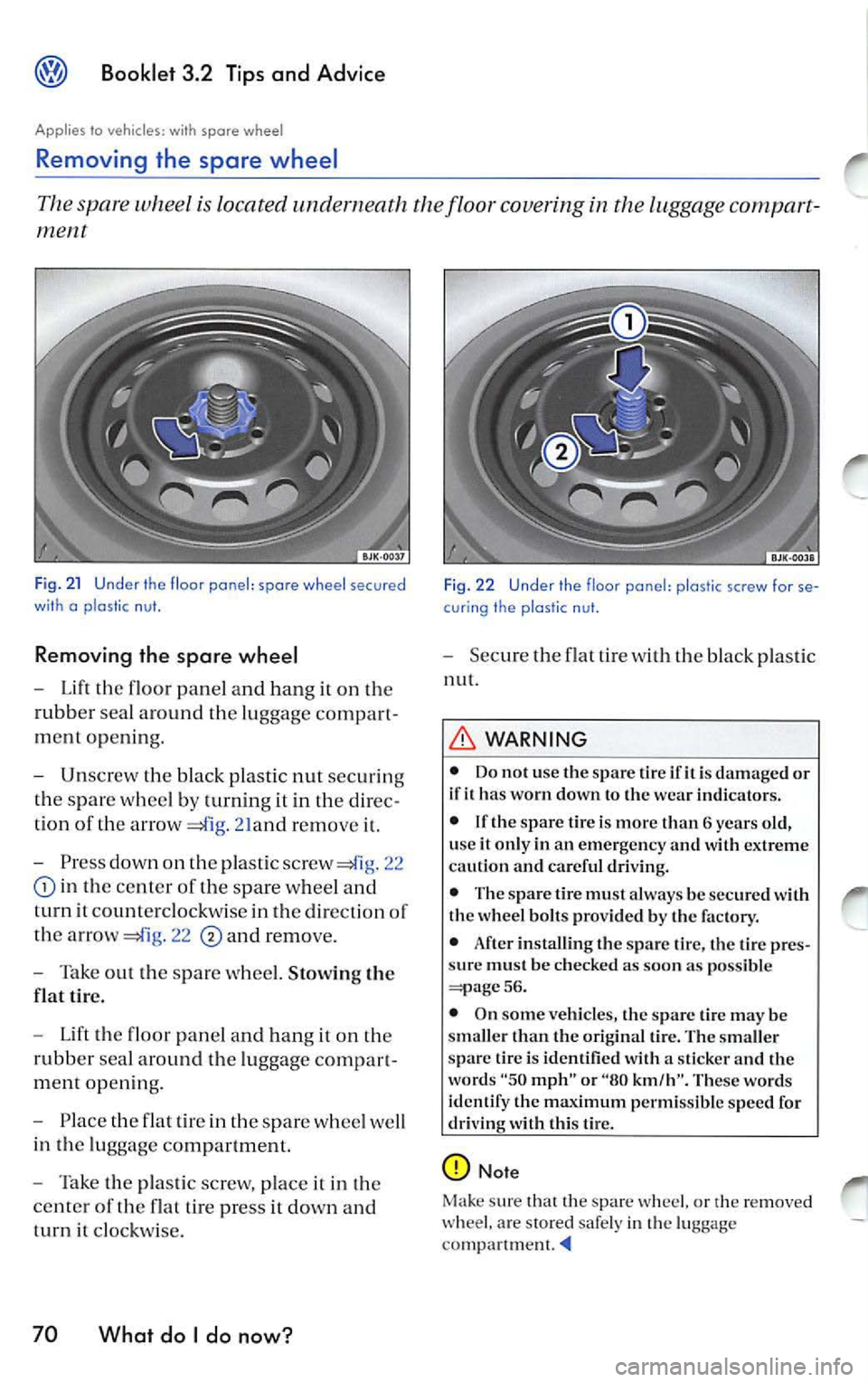
The spar e wheel is located und ern eath the floor covering in the luggag e compart
Fig. 21 Under th e floor ponel: spore wheel secured
wi th o p las tic nut.
Removing the spare wheel
-Lift floor panel and hang on
rubb er sea l aro und the luggage compart
ment openin g.
- Unscrew the black plastic nut securin g
th e s par e whee l by turning it in
direc
tion of th e arrow
21and remo ve
-Press dow n on pla stic screw 22
in the ce nter of the spare wheel and
turn it co unt erclo ckw ise in th e direction of
the arro w
22 and remove.
- Tak e out the s pare whee l. Stowing the
flat tir e.
- Lift the fl oor pan el a nd h ang i t on the
rubb er sea l around the luggage compart
m en t open ing.
- Pla ce the flat tir e in the spar e whee l we ll
in the lu ggage co mpartment.
- Take the pla stic scr ew, place it in the
c ente r of th e flat tire pre ss
dow n and
t urn
clockw ise.
70 What do I do now?
Fi g. 2 2 Under th e floor pone!: plo stic screw for se
cur ing the plostic n ut.
- Secu re the flat tire w ith bla ck pl astic
nut.
WARNING
• Do not use the spar e tir e ifit i s damaged or
if it ha s worn down to the wear indicators.
• If th e s pare lire i s more than 6 years old,
u se
it only in an em ergen cy and with extreme
cau tion and careful dri vin g.
• The spare tire mu st alwa ys be se cur ed w ith
the wheel bolt s provided b y the factory.
• After installin g the spare tire, the tire pr es
s ur e must be c hecked as soon as p ossible
56.
• On some ve hicles, the spare tire ma y be
sma ller th an th e original tire. The smaller
spar e tir e is identified with a sticker and th e
word s
"50 mph" or "80 km/h". These words
identify the max imum permissible sp ee d for
driving with this tire.
Not e
Mak e sure that the spare w heel. or
re mo ved ar e stored safe ly i n luggag e
Page 394 of 477
WARNING {continu ed)
• Never let anyone place any part of their
body underneath the vehicle when support ed
by the jack.
• Never support your vehicl e on cinder
blocks, bricks or other obje cts . These may not
Changing a wheel
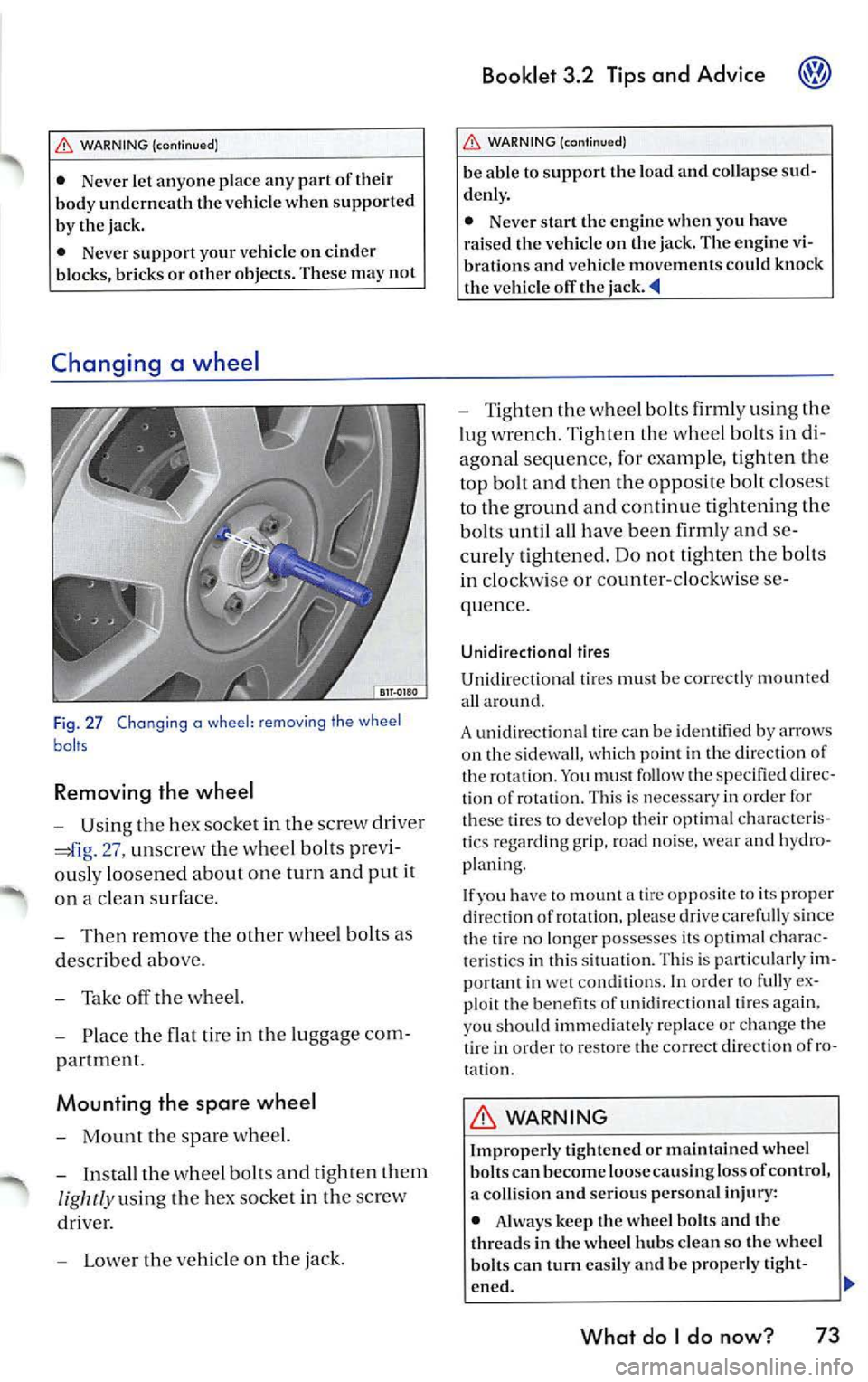
F ig . 27 Chang ing a wheel : removing the wheel
baits
Removing the wheel
-Usin g the h ex socket in th e sc rew dri ver
27, un screw t he w heel bo lts pre vi
o usly loo sen ed about on e turn and put it
o n a cl ean su rface .
- Then re mo ve the oth er whee l bolt s as
d esc ribed abo ve.
- Tak e off th e w he el.
- Place the flat ti re in the lu gg ag e co m-
p artmen t.
Mounting the spare wheel
-Mount the sp a re wh eel.
- Insta ll th e w hee l bolt s and tight en th em
lig htly u sin g th e hex so cke t in th e sc rew
dri ver.
- L ower th e ve hicle on the jack .
Booklet 3.2 Tips and Advice
WARNING {cont inu ed )
be able to support the load and collap se sud
denl y.
• Nev er start the engine when you have
raised the vehicl e on the jack. The engine vi
bration s and v ehicle movements could knock
the v ehicl e off the
- T ig ht en the wheel bolts firml y using the
lu g w re n ch. Ti gh te n th e whee l b olts in di
a gonal s equ ence , for e xampl e, tig h te n th e
top bolt and then th e oppo sit e bolt clo se st
to th e ground and continu e tight enin g the
bolt s until all have bee n firml y and se
c ur ely tight en ed. Do not tight en th e bolts
in clock wise or c ounter-cl oc kw ise se
quen ce.
Unidirectional tires
Unidir ectional tir es mu st be co rrec tly m ount ed
a ll arou nd.
A un idir ection al tir e ca n b e id en tified b y arrows
o n th e s idewa ll, w hi ch p oin t in the di rec tion of
t h e ro tation . Yo u mu st fo llow the speci fied dir ec
ti on of ro ta ti on. Thi s is necessary in orde r for
the se tires to deve lop t heir optim al cha racte ris
ti cs regar ding grip, road noise, wea r and hydro
p la ni ng .
I f y ou have
to moun t a tire opp osite to i ts pro per
dir ection of rot atio n. p lease drive caref ull y sin ce
th e tir e no lo nge r poss esses its o ptimal chara c
t e ri stic s in thi s s itu atio n. Thi s is parti cul arl y im
po rta nt in we t con ditions. In orde r to f ully ex
pl oi t th e benefi ts of unidir ectio nal tire s ag ain ,
yo u sh ou ld imm edi ate ly re place or change the
tir e in or der to resto re th e co rrect d irec tion of ro
t a ti on .
WARNING
Improp erl y tight en ed or maintain ed wheel
b olt s can b ecome loose cau sin g lo ss of control ,
a colli sio n and seriou s per son al inju ry:
• Alw ay s keep th e wheel bolt s and th e
thread s in the wh eel hub s clean so the whee l
bolt s can turn easily and be p roperl y tight-
en ed .
What do I do now? 73
Page 414 of 477
Cleani ng
A llo y whee ls
2 1 A ut omati c car was h 17
Bump er
18
chassis 22 C lo th sea t cove rs 23
E n gin e co mpartm ent 22
Ex ter ior 1 7
trim 23
In stru ment panel 23
L ea th er 23 Out side mir rors 19
P las tic 23
bel ls 26
W ashin g the ve hic le 1 7
W ind ows 19
Wind sh ie ld 19 W ind shie ld wip er blad es 20
W ooden trim
23
Cle an ing and pro tec tio n 16
C lot h sea t cove rs
C le an ing
23
Code number
Fo r
whee l bolt s 67
Cold tire inflation pressure 54
Coo la nt 43 Le ve l 44
Loss 44
Cra sh recorder s 6
D
Deter minin g corre ct load limil 59
D iese l e ngine
Ad din g en gi ne oil 41
C hang ing engin e oil 41
En gin e oil 4 1 Engin e oi l 37
Die se l fu el 33 Wi nte r operat io n 33
D iffe re nti al loc k 4
Drive r Stee ring Recomme ndati on 3
Dr iv in g eco nomi cally 14
Driv ing ou1 sid e o f !h e U.S. A. or Canada
P rec au1io ns
9 1
Driv ing wit h respec t for th e en vironme nt 14
Booklet 3.2 Tip s and Advice
ing in sid e 1h e e ng in e c om pa rtm en t 34
Wo rkin g in th e engin e com partmen t 34
Engin e coola nt 43
Add iti ves 43
Can I acid p la in wate r the engi ne
coo lan t?
44 Coola n! losses 45
Eng ine hoo d 36
How do I unlock !he en gin e hoo d? 36
Eng ine oil 37
Add ing 40
Addit ives 40
C he ck in g leve l 39
Consu mplion 38
Die sel e n gine 4 1
Dips!i ck 39 H ow do I kn ow how much oil m y eng in e is
co nsum ing?
38
Oi l cha nge 42
Specifica tions 37 Spec ifi ca tions Diese l eng in e 37 , 4 1
Spec ifica !io ns gaso li n e e ngi ne 37 W hal kind of e n gin e oi l s h o uld I p u ! in my
v eh icl e?
37
W hen sh o ul d I ch eck !he e ngin e oi l
l eve l? 38 W here is th e oil dip stick 3 9
E nvironm en t
Avo iding polluti on 31
C le anin g th e e ngine compa rtment 22 Driving economically 14
V ehi cle care produ cts 16
ES P 5
Eve nt Dat a Reco rde r 6
Ex terna l ae rial 29
Alphabetical index 93