temperature VOLKSWAGEN JETTA 2007 User Guide
[x] Cancel search | Manufacturer: VOLKSWAGEN, Model Year: 2007, Model line: JETTA, Model: VOLKSWAGEN JETTA 2007Pages: 477, PDF Size: 77.6 MB
Page 308 of 477
Booklet 3.1 Controls and Equipment
Parking
The parking brake can be us ed to pr eve nt the vehicle from moving uninten tion
ally.
A lways apply th e parking brake fully when
yo u leave y our vehicl e a nd when you p ark
yo ur vehicl e.
- Use the foo t brake to stop the veh icle.
- Appl y th e parking brake full y.
- On a ma nual tran smi ssion engage
gea r. On a n aut omatic tra nsmi ssion move
the selector lever to P.
- Switch off the engine and r emo ve the
key from the ignition lock. Turn th e
s tee rin g w he el s li ghtl y to en gage the
stee ring loc k.
- Always take you ve hicle keys w ith you
whe n yo u leave the
When parking on slopes
Before turnin g off the engin e, turn the steer ing
w hee l so if th e vehicle sta rt s to ro ll, it will roll
i nt o th e c urb:
• If th e ve hicle is faci ng
turn the whee ls so that they poilll toward the cur b.
• If th e vehicle is faci ng
turn the front
w heels so t hat they poi nt away from the curb .
• As a lways, appl y th e pa rking
full y and
m ove the se lector lever to P.
WARNING
Improp er parking procedures can lead to se
ri ous perso nal injury for you or your passen
gers.
• Never remove the key from steering lock
whil e th e ve hicle is movin g or rollin g to a stop .
The steer ing wheel
will lock up and you will not be able to stee r or control the vehicle.
WARNING
• Never park where the hot exha ust sys te m
co uld ignit e flammabl e material s, such as
bru sh, l eave s, dry grass, sp illed fuel etc.
• Alw ays apply the parking brak e fuJly wh en
parking your vehicle.
• Never leave anyone in your vehicl e to pre
ven t the ve hicle from moving if the parking
br ake is r elease d or selector lever is moved.
• Alwa ys tak e the key w ith you when you
l e ave the vehicle. The engine can be started
and vehicl e sy stems su ch as the power win
d ows can be operated leading to seriou s per
s onal injury .
• Never leave children , disabl ed p erson s or
anyone who cannot help th emselves in the ve
hicl e. The doors can b e lock ed u sing th e re
mot e co ntrol trappin g passenger s in the ve
hicle in an emergenc y. Depending on the time
of year, people tr app ed in
vehicle can be
expose d to v ery high or very low temperatures.
Note
• Please exercise care when yo u pa rk your ve
hicl e in parkin g are as w ith p arkin g barri ers or
cu rb s. Parking barriers and curb s vary in heig ht
an d co uld damage yo ur bump er and re la te d
compo nents as th e fron t of yo ur vehicl e moves
over
b arri er or curb that is too high . as you park
or as you back out of parking spot. In order to
be sur e th at no su ch d ama ge ca n occ ur, yo u m ay
wish to s top sh or t o f h av ing th e front tires o f yo ur
ca r touc h parking barri er o r curb.
• Please a lso exe rcise exce ptiona l ca re when
yo u drive up or d own steep ramp s or drive over
cu rbs or oth er obsta cles, fo r w hi ch lhe ve hicle is
not d esign ed , b ec au se compone nts of th e ve
hicl e close lo th e groun d su ch as bump er cove rs,
s poil ers , suspensio n and exhaust syste m com
ponent s, m ay beco me
Driving 105
Page 351 of 477
Booklet 3 .2 Tips and Advice
Checking and Filling
Filling the tank
fuel filler flap opens from inside the vehicle. The fuel tank holds 14 .5 gallons
(55 Liters).
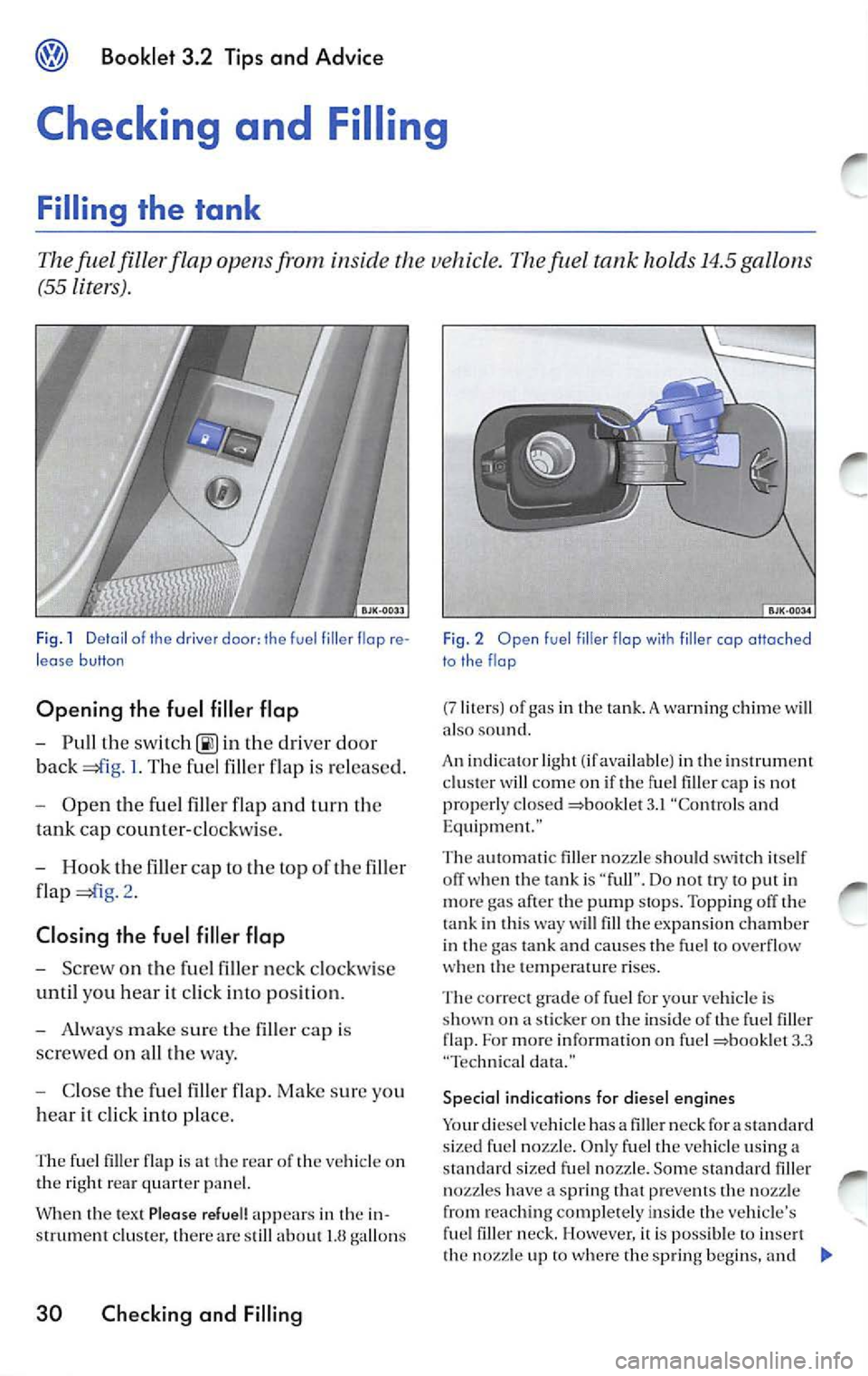
Fig . 1 Detail of the driver door: the fuel fil ler flop re
lease button
Opening the fuel filler flap
- Pull the switc h 00) in th e drive r doo r
back
I. T he fu el fill er flap i s re leased .
- Open the fuel filler flap and turn th e
tank cap counte r-cloc kw ise.
- Hook t he fill er cap to the top of the filler
flap
2 .
Clo sing the fuel filler flap
- Screw o n the fuel fi lle r ne ck clockwise
until you hea r it cl ick into position.
- Alway s m ake s ure the fi ller cap i s
screwe d on a ll way.
- Close the fuel fi ller flap. Make sure you
h ear it cli ck into place.
The fue l filler flap is at the re ar of the vehicle on
th e right re ar qua rter pan el.
Whe n the tex t Pleas e refuel! appears in the in
s trum ent clu ste r, th ere a re still abo ut
gallons
30 Checking and Filling
Fig. 2 Open fuel filler flap with f iller cap attached
to the flop
(7 liter s) of gas in the tank. A warning chi me w ill
a lso so und.
An indi cator lig ht (if availab le) in the in st rum ent
cluster w ill come on if the fu el fi ller cap is not
properly clos ed
3.1 "C ontrol s and
Eq uipment."
T he automat ic filler nozzle s hould switc h itself
when the tank is " full ". Do not try to put in
mor e gas after the pump stops. To ppin g off the
ta nk in this
will fill the expa nsion chamb er
i n th e gas tank and causes th e fuel to ove rflow
w hen the temperature ri ses.
The correct grade of fuel for your vehicle is
s h own o n
sti cker on the insid e of the fuel filler
flap. For mor e informatio n on fu el 3.3
" T ec hnical da ta ."
Specia l indications far diesel engines
Your diesel vehi cle ha s a filler neck for a sta ndard
s ized fuel noz zle. Onl y fuel the v ehicl e usin g a
s tan dard sized fuel nozz le. Some s tandard filler
no zzles have a sprin g that preve nts the nozzle
from reaching complete ly ins ide t he ve hicl e's
fille r neck. However, it is poss ible to t h e nozzl e up to wh ere the spring beg ins, an d
Page 364 of 477
Booklet 3.2 Tips and Advice
Coolant
Coolant specifications
Coolant is a of water at least 40% coolant additive.
The cooling s yst em must b e filled with a mixtur e
of a nd at le ast 40 % of Vol kswag en additi ve G 12 or an additi ve with the sp ec ifica
ti o n F (purpl e in colo r).
T hi s mi xtur e gives the necess ary fro st p rotec tion
do wn to -1 3° F (-2 5° C) and p rot ec ts th e all oy
part s of the cooling sy stem again st co rros ion.
It also pr ev ent s from scalding and raises the
boilin g po int of th e cool ant.
Th e co nce ntrati on of coo la nt mu st
b e at
l e a st 40 % eve n if fr os t p rotec tion i s not r e
quir ed .
If gre at er frost protection is nee ded in very co ld
climat es. th e proportion of th e antifree ze
tive G 12 c an b e in cre ase d. H ow ev er, th e per
ce ntag e o f coo la nt addit ives must n ot exceed
GO% , as this
re du ce the f rost p rotec tio n. It also re du ce the coo lin g e ffec t. mi xture
w ith coo lant additi ve will give frost ti on 10 about C) .
WARNING
Coola nt is poi sonous!
• Always keep the coo la nt in its origin al con
t a in er stored in a safe place.
• To reduce the risk of poi sonin g, neve r use
em pty food or bev erage co ntainers that might
mislead someone into d rinkin g from th em.
WARNING (continued)
• Always keep drain ed coo lant out th e
r eac h of ch ildren.
• The coolant additive
G 12 must be added in
s uffici ent quantiti es to give enough anti
fr eeze protection at the co ldest temperatur es
that can be expecte d where the vehicle will be
u sed.
• At ex treme ly cold temperat ures, the
coolant could fr eeze, caus ing the vehicl e to
br eak dow n. The heater wou ld also not work
and vehicl e occupants could be without pro
tection at sub-free zin g temperatures!
Note
• Oth er additi ves ma y give co nsid erabl y inf e
ri or co rros io n prot ection. The res ulting corro
s io n in th e coo ling syste m can lead to a lo ss of
c o ol ant , cau sing seri ous
to the en gine.
• The coo lant additiv e G 12 ( purpl e) can be
mi xed w it h th e ad diti ve G 12 (p ink ) o r w ith the
ad ditive
11. G 12 c an be recog nize d in the pans io n t ank b ecau se it is purpl e. T he coo lant
G L2 h as bee n with di ffe re nt coolant to
th e o nes nam ed ab ove if th e fluid in th e
sion ta nk brown! The coolant must b e
chang ed as soo n as pos sib le if th is is the ca se ! Se
ri ous fun cti onal pr oble m s
en gin e co uld be caused
Checking and Filling 43
Page 370 of 477
Booklet 3.2 Tips and Advice
Vehicl e batt ery
Location of battery
The battery is mai nte nance-free is c h ecked during the inspection serv ice.
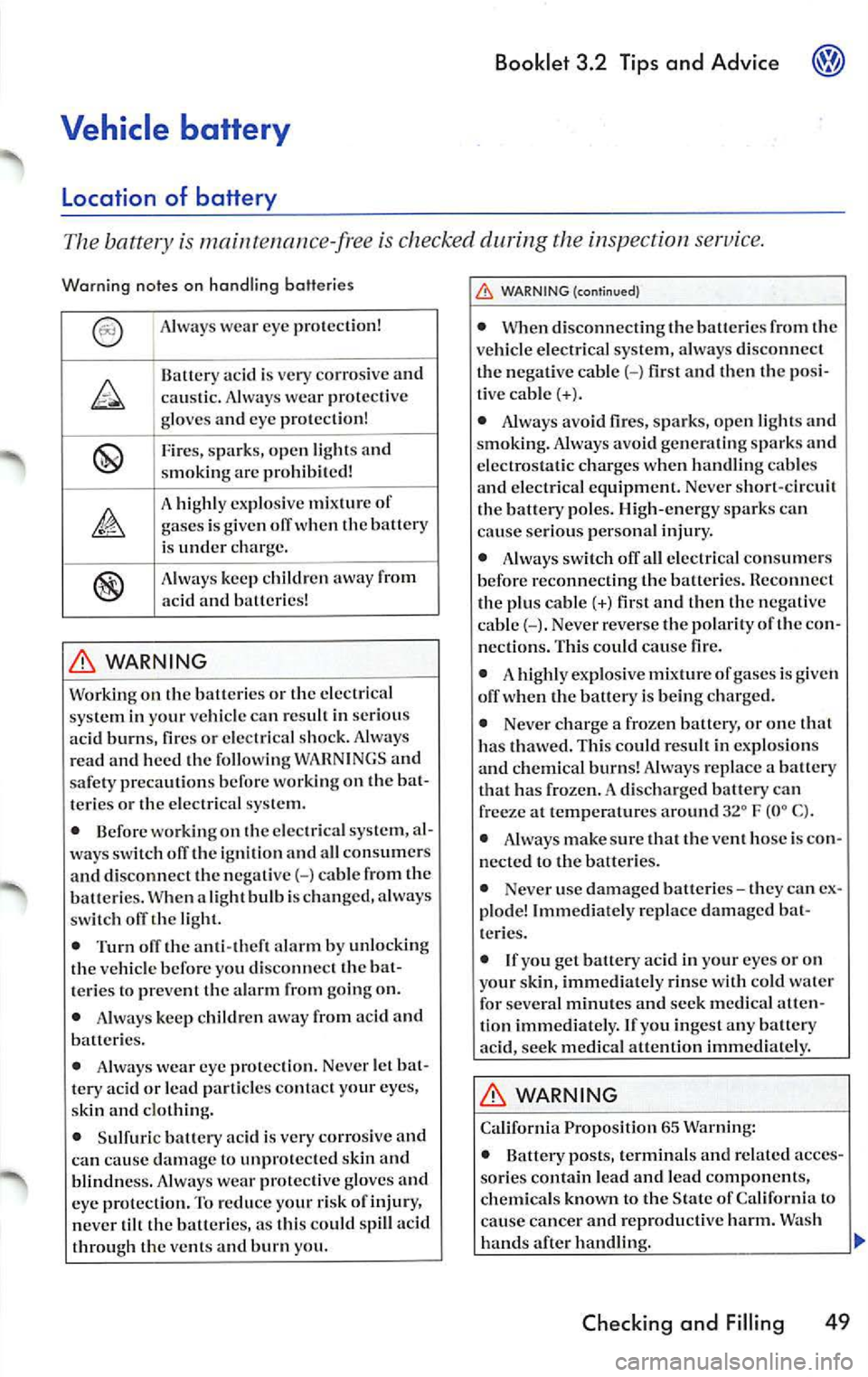
Warning note s on handling batterie s
Battery acid is very co rrosive a nd
ca usti c. Always we ar protective
g loves and eye prot ection !
Fires, s park s, open ligh ts and
s moking arc pro hibit ed!
Always kee p childr en away acid and batt eries!
WARNING
Wo rki ng on the batt eri es or the electr ical
syste m in yo ur vehicl e can result in ser ious
acid burns,
th e
batt eri es . Whe n a light bulb is c han ged, always
sw itch o!Tt he light.
• Turn o!Tt he an ti- th ert alarm by unl ockin g
the vehicl e befor e yo u disco nnect th e bat
terie s to pre vent th e ala rm rrom goin g on.
• Always kee p childr en a way
acid an d
batterie s.
• Alw ays wear eye prot ectio n. Nev er let bat
t ery acid or lead particl es contact your eyes,
and clothin g.
•
batter y acid is ve ry co rrosive and
can cause damag e to unprote cted ski n and
blindn ess. A lways wear protectiv e gloves a nd
eye protec tion. To re du ce yo ur risk o r injur y,
n eve r tilt the batt eri es, as thi s co uld spill acid
throu gh th e ve nts and burn you.
WARN ING
• Wh en disconn ecting the batt eri es from the
ve hicl e elec tr ic al sys tem , a lways disco nnect
the negative cable(- ) fir st a nd th en th e po si
ti ve ca ble(+ ).
• Alwa ys avo id fires, spark s, op en li ght s a nd
s moking. Alw ays avoid generatin g sparks a nd
e lectro static charges whe n handlin g cables
a nd elect rica l equipment. Never short-cir cuit
the battery pole s. Hi gh -energy sparks can
c au se se rious per sonal injury.
• Always swi tc h off all electrica l con sumer s
before recon nectin g the batteries. Heconncct
th e plu s ca ble( +) first and then the negative
cab le(-). Neve rrever se the polarity or the con
ne ctions. This could cause fire.
• A hi ghl y exp losive mixtur e or gases is give n
off when th e batter y is bein g ch arged.
• Never cha rge a frozen batt ery, or one that
ha s th awe d. Thi s could res ult in explos io ns
and chemical burns! A lways re pla ce
batte ry
t h at h as frozen. A discharged battery can
rr eeze a t temperatures around 32° F (0 ° CJ.
• Alwa ys make sure that t he ven t hose is co n
n ec ted to the batt eries.
• Never use dama ged batter ie s- they can ex
p lode ! Im med iately repl ace dam aged bat
terie s.
•
yo u ge t b att ery acid in yo ur eyes or on
y our imm edi ate ly rin se with co ld water
fo r sev eral minut es and see k m edi ca l att en
tion imm ed ia te ly.
yo u in ges t a ny batt ery
aci d, seek medi cal aue ntion imm ediatel y.
WARNING
California Propositi on 65 Warnin g:
• Battery posts, te rm in al s and re la te d acces
so ries contain l ead and lead compon ent s,
c hemicals kno wn to the
of Ca lifornia lo
ca use cance r and reproducti ve harm . Wash
h ands
h and ling.
Ch ecking and Filling 49
Page 374 of 477
Maximum (permissible) inflation pressure means the maximum cold inflation pressure to
which a tire may be inflated. Also called "max imum inflation pressure."
Normal occupant weight
means
150 lbs. (68 kilograms) times the number
of occupants seated in the vehicle up to the total seating capacity of your vehicle.
Outer diameter
means the overall diameter of an inflated new
tire.
Overall width means the linear distance between the exteriors
of the sidewalls of an inflated tire, including ele
vations due to labeling, decorations, or protec tive bands or ribs.
Ply
means a layer of rubber-coated parallel cords.
Radial ply tire
means a pneumatic tire in which the ply cords
that extend to the beads are laid at substantially
90 degrees to the centerline of the tread.
Recommended inflation pressure
see
52, "Cold tire inflation pressure".
Rim
means a metal support for a tire or a tire and
tube assembly upon which the tire beads are
seated.
Rim diameter
means nominal diameter of the bead seat . If you
change your wheel size, you will have to pur
chase new tires to match the new rim diameter.
Rim size designation
means rim diameter and width.
Rim width
means nominal distance between rim flanges.
Sidewall
means that portion of a tire between the tread
and bead.
Booklet 3.2 Tips and Advice
Speed rating (letter code) means the speed at which a tire is designed to be
driven for extended periods of time. The ratings range from 93 mph (150 km/h) to 186 mph
(298 km/h). These ratings are listed in the table
below 62. You may not find this informa
tion on all tires because it is not required by law.
The speed rating letter code, where applicable, is molded on the tire sidewall and indicates the
maximum permissible road speeds.
Tire pressure monitoring system
1 )
means a system that detects when one or more
of a vehicle's tires are underinflated and illumi nates a low tire pressure warning telltale.
Tread means that portion of a tire that comes into con
tact with the road.
Tread separation means pulling away of the tread from the tire
carcass.
Tread wear indicators (TWI) means the projections within the principal
grooves designed to give a visual indication of
the degrees of wear of the tread. See
59, "Tread Wear Indicator (TWI)" for more informa
tion on measuring tire wear.
Uniform Tire Quality Grading
is a tire information system developed by the United States National Highway Traffic Safety
Administration (NHTSA) that is designed to help buyers make relative comparisons among tires.
The UTQG is not a safety rating and not a guar antee that a tire
will last for a prescribed number
of miles or perform in a certain way. It simply
gives tire buyers additional information to com bine with other considerations, such as price,
brand loyalty and dealer recommendations .
Under UTQG, tires are graded by the tire manu
facturers in three areas: tread wear, traction and temperature resistance. The UTQG information
on the tires, molded into the sidewalls.
U.S. DOT Tire Identification Number (TIN)
This is the tire's "serial number."
It begins with
the letters "DOT" and indicates that the tire
meets all federal standards. The next two num-
Tire pressure monitoring system)
Checking and Filling 53
Page 386 of 477
Booklet 3.2 Tips and Advice @
Winter tires
Winter rires can improve vehicle handling on snow and ice. At temperatures
below 45 ° F (7 ° C)
recommend changing to winter tires.
In som e hea vy s now areas, loca l go vernment s
m ay re quir e tru e or "snow" tires, those
wit h very deepl y cut trea d. The se ti res sh ould
on ly be use d in pair s and be in sta lled on all four
w hee ls. Make sur e yo u purcha se snow tire s that
ar e th e s am e size and const ruction ry p e as the
othe r tir es on your vehicl e.
S umm er tire s prov ide less grip on ice and sno w.
Winter tires (s now tires) must be
on a ll
four whe els .
If you wa nt to us e th e tir e pre ssure monitoring
sys tem
compat ibl e se nso rs mu st b e
in sta lle d on all four wint er tire s 63.
Ask your authori zed Volkswage n deal er or qual
ified work shop for permitt ed winter tire sizes.
U se on ly rad ia l w int er tir es.
Wi nter tires lose their effectiveness w hen the
tr ead is worn dow n
to a depth of 4 111111 (0.1 57
inch ).
Onl y driv e wit h wint er ti res und er w int er co ndi
tion s. S umm er tir es hand le bett er w hen there is
no snow or ic e on the ro ads a nd th e temp erature
is above 45 ° F (7 ° C).
If yo u ha ve a flat tir e, see notes on spar e w heel
"New tires and replaci ng tire s an d
wh eels".
Pl eas e always re m emb er that winter tir es ma y
ha ve a lower spe ed
than th e tire s origi
nall y insta lled on your vehicl e at the time it was
manufactur ed. Pl ease see
53, "Spee d
rating (letter cod e)" for a listing of the spe ed
rating l ett er co de s and
maximum speed ar
w hi ch the tires c an b e driv en.
The sp eed rating letter code
53) is on the
s id e w all of th e tire fi g . 16 .
WARNING
Winter tires have maximum speed lim its that
may be lowe r than your vehicl e's maximum
speed. Always know the maximum speed b e
fore driving
Neve r drive fa ster than the
speed permitted your speci fic wi nter tires.
This cause damage to the tire s leading to
an accident and serious personal injury to you
and your passengers.
WARNING
Driving faster than the maximum speed for
which the winter tires on your vehicle are
veloped can cause sudden tire failure, loss o f
contro l and seriot• .s personal injury.
• Winter tire s have maximum sp ee d rating
that may be lower than your ve hicle's max
imum speed.
• Neve r drive fa ster than the sp eed for which
the wint er or other tires installed on you r
hicle are rated.
WARNING
Always a djust your driving to the road and
traffic condition s. Never let the good accelera
tion of the winter tir es and all -wheel drive
tempt you into taking extra risks. Alway s
member:
• When braking, an all-w hee l drive ve hicle
h andles in the same way as a front drive
hicle.
• Drive carefu lly a nd reduce yo ur speed on
ic y and slippery roads, eve n winter tire s
cannot help un der black ice conditio ns.
Fo r the sake of environment
U se s umm er tire s wh en weat her condition s
permit. The y are qui ete r, do not wear as qui ckl y
and redu ce fuel consumpti on
Where applicabl e (TP MS = Tir e pre ssure mo nitoring system)
Checking and Filling 65