Fluid VOLKSWAGEN JETTA 2007 Owner's Manual
[x] Cancel search | Manufacturer: VOLKSWAGEN, Model Year: 2007, Model line: JETTA, Model: VOLKSWAGEN JETTA 2007Pages: 477, PDF Size: 77.6 MB
Page 229 of 477
Booklet 3.1 Controls and Equipment
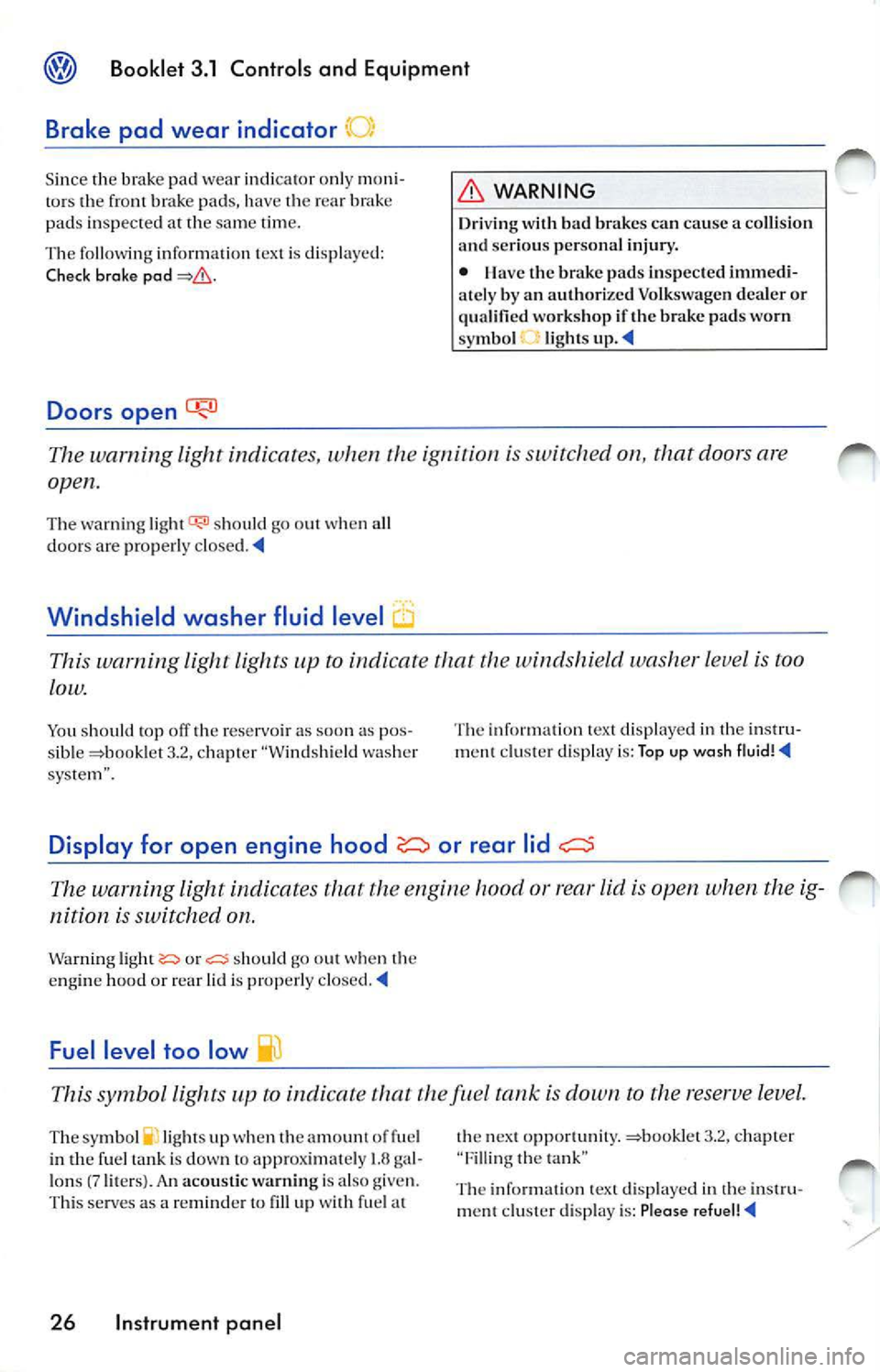
Brake pad wear indicator"
Since the brake pad wear indica tor onl y m on i
to rs th e front brak e pad s, h ave the rea r brak e
pad s in spected at che same tim e.
T he fo llowi ng information tex t is dis pla yed:
Check brake pad
Doors
WARNING
Driving with bad brak es can ca use a co llision
a nd ser io us pers onal injur y.
• I -l av e the br ake pad s inspe cted immedi
a te ly by an authori zed Volk swagen d eal er or
qu alifi ed wo rksh op if th e brake pads wo rn
s ymbo l lights
The warning indicates , when th e ign ition is switch ed on , that door s are
op en.
Th e warning sh ou ld go out whe n all
door s are pro perl y closed. •
Windshield washer fluid level
This warnin g light li ghts to indicate windshield washer leve l too
Low.
Yo u sh ou ld to p off th e reservo ir as soo n as pos
s ibl e 3.2 , c h apt er "W indshi eld was her
sys tem". T
he in forma tion text displ aye d in th e in stru
m ent clu ste r di splay is : Top up wash
Display for open engine hood or rear lid
The warning Light indicates that the engine or rea r lid is open when the ig
nition i s switc hed on.
Warn ing sh ould go o ut when th e
e n g in e hood or r ear lid is properly closed. •
Fuel level too low
This symbol li ght s to indicate that Ju.el tank i s down to the rese rve le vel.
The symb ol light s up when th e am oun t of fu el
in ch e fu el t an k is do wn to approx imate ly 1.8 ga l
l o n s (7 licers). A n aco ust ic warnin g is a lso g ive n.
Th is se rves as a remind er
to up with fue l a t
26 Inst rument panel
th e nex t oppor tunity . =boo klet 3 .2, ch ap ter
"F illin g th e tank "
inform atio n tex t d isp layed in th e in stru
m ent clu ster dis p lay is: Please
Page 230 of 477
Booklet 3.1 Controls and Equipment
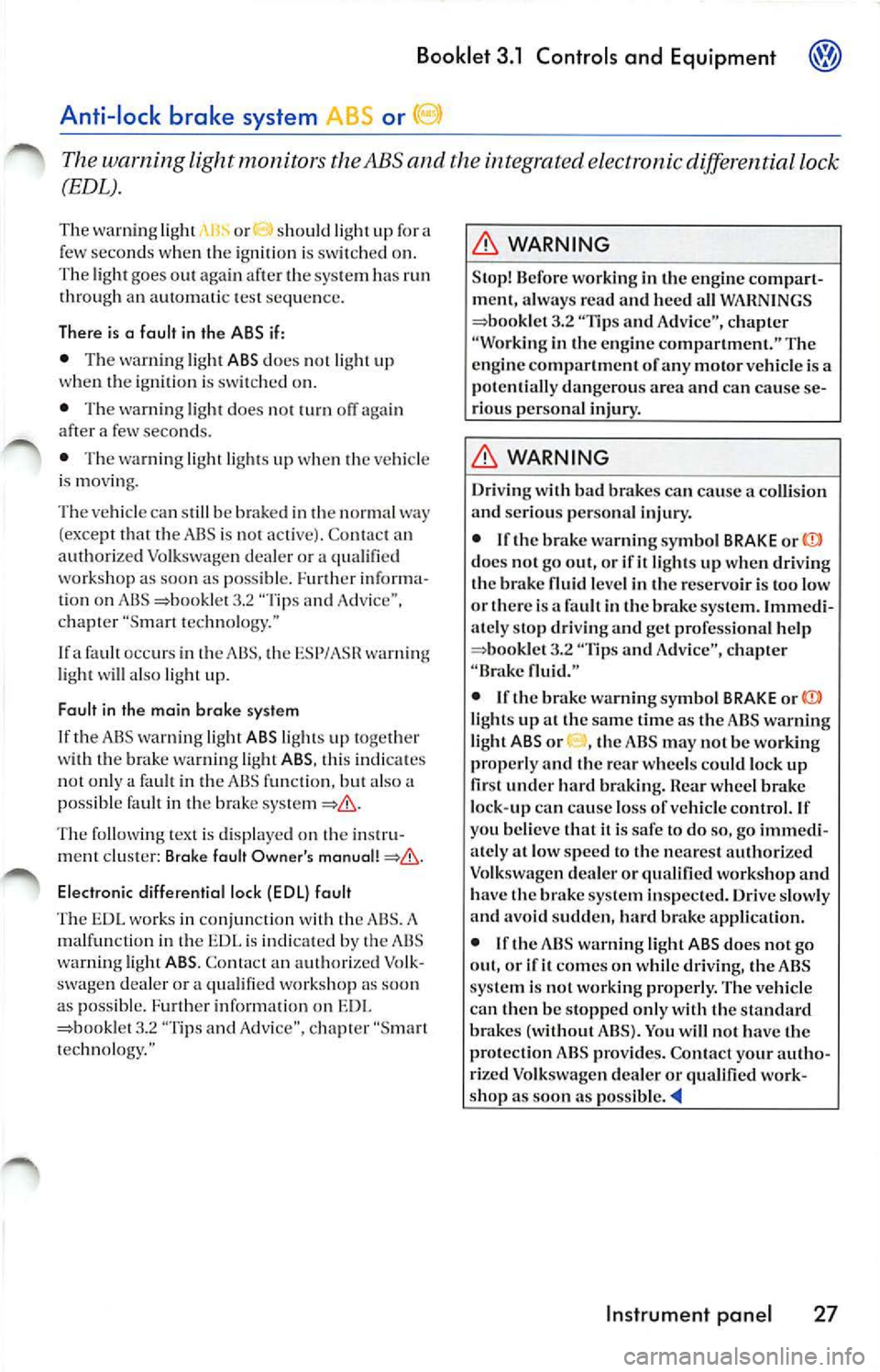
Anti-lock brake system
The warning light monitors th e ABS and the integrated electronic differential lock
(EDL).
The warn ing light or sh ould li ght up for a
few seco nds whe n th e ign ition is swi tc h ed on .
T he lig ht goes out again after the sys te m has run
th roug h an auto matic test sequ en ce.
Ther e is a fault in the ABS if:
• The wa rning light ABS d oes not lig ht up
whe n th e igniti on is swi tc h ed on.
• The warn ing li ght does not t urn off agai n
af te r a few seconds.
• The warn ing lig ht light s up when the ve hicle
i s moving .
The vehicle ca n st ill b e braked in the normal
(exce pt that the ABS is not ac tive). Con tact an
author ized Vo lkswagen dealer or a qualified
wo rksh op as soo n as possib le. Fu rth er infor ma
ti on on ABS =book let 3.2 'Tips and Advice",
c hapt er ··smart tec hnolog y."
)fa fault occu rs in the ABS . th e ES P/ASH warning
lig ht w ill also light up.
Fault in the main brake system
I f the ABS warn ing lig ht A BS lights up together
w ith the bra ke warning light ABS, thi s ind icates
n ot o nly a fault in the
func tion, but a lso a
possible fault in the brake
The fo llow ing text is disp layed on th e in stru
ment cluster: Brake fault Own er' s
El ectronic differential lock (EDL) fault
Th e ED L wor ks in con junct ion w ith th e ABS. A
ma lfun cti o n in th e ED L is indi cate d by the ABS
wa rnin g lig ht ABS. Conta ct a n authorized Vo lk
swage n dealer or a qualified works hop as soon
as poss ible. Fur ther info rma tion on EDL
3.2 "Tips a nd Adv ice", ch apter "S m art
t ec hnolo gy."
WARNING
S top! Befo re working in the e ngin e compart
m ent, alwa ys read and hee d all WARN INGS
3 .2 "Tip s and Advice", c hapter
"Wo rking in the e ngin e co mpa rtm ent." The
eng ine co mpartment of any motor vehicle i s a
p ote ntia lly dange rou s ar ea and can ca use se
riou s persona l injury.
WARNING
Dri ving wit h bad brakes can cause a co llisio n
and serio us per sonal injury.
• If th e brake wa rning symbol BRAKE or(D)
d ocs no t g o out , o r if it li ght s up when driving
t h e brak e fluid le vel in the reservo ir is to o lo w
o r the re is a fau lt in the brake system . Imm edi
at ely s top dri vin g and get profess iona l help
= bookl et 3.2 " Tips and Advice", c hapt er
"B rake fluid. "
• If the brake warning sy mbol BRAKE or
lig ht s up a t th e sa me time as the ABS warning
li g ht ABS or , the ABS may not be workin g
prop erly and the rea r w hee ls co uld lo ck up
first under hard brak ing. Hear wheel bra ke
lo ck- up can ca use loss of vehicle control. I f
yo u b elieve that it is sa fe to do so , go immedi
a tel y
low s pee d to the nearest au thorized
Volk swagen dea ler or qu alifi ed wo rksh op and
h ave the
sy stem ins pec ted . Dri ve slow ly
and avoid sudd en, hard brake application.
• If th e AB S warning light ABS docs not go
o ut , o r if il comes o n while dri vin g, the A BS
syste m is not work ing pro perly. The vehicl e
ca n then be s topp ed onl y with the standard
brake s (with out ABS). You will not have the
protection AB S pro vid es. Contact your autho
ri ze d Vo lk swa gen deal er or
work
s h op a s soo n as possib le.
Instrument panel 27
Page 231 of 477
@ Booklet 3.1 Controls and Equipment
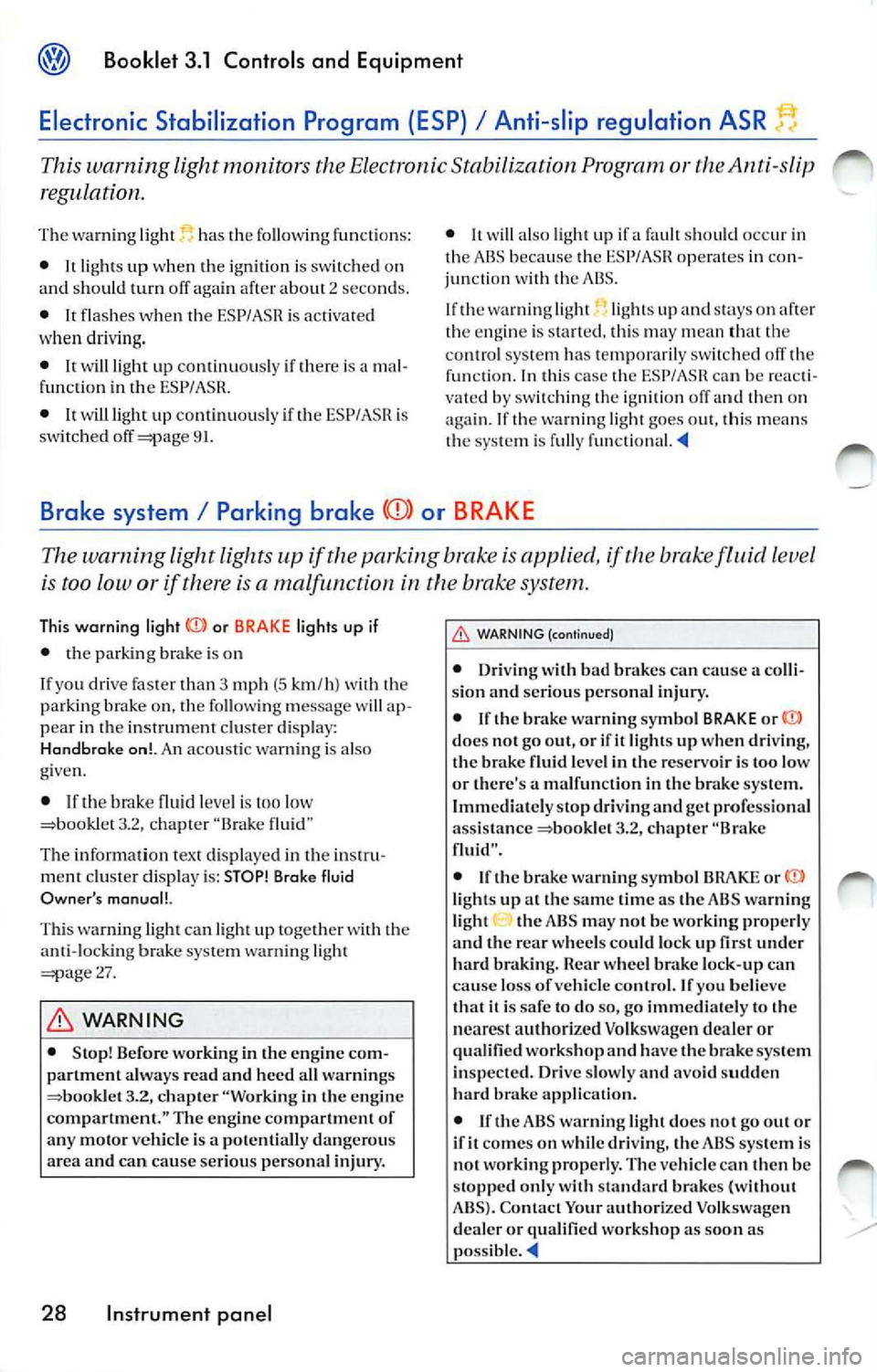
Electronic Stabilization Program {ESP) I Anti-slip regulation ASR
This warning light monitors the Elect ronic Stabil iza tion or th e Anti-slip
regulation.
The warnin g light has the follow ing functi ons:
• It light s up when the ignition i s switched on
and sh ou ld turn off aga in afte r about 2 seconds.
• It flashes whe n the ESP/ASR is activa ted
w hen dri ving.
• It will li gh t up cont inuou sly if th ere is a ma l
f un ction in th e ESP/ASR.
• It
will ligh t up continuou sly if th e ESP/ASR is
sw itch ed off =:pag e 91. •
It w ill also light up if a fa ult sh o uld occur in
the ABS because th e ESP/AS R operates in con
jun cti on w ith the AJ3S.
If th e warning ligh t light s up and stays on a fter
th e e ngin e is
thi s may mean that th e
c ontro l sys tem has tem porarily switch ed o ff the
fu ncti on . In thi s case the ESP/ASH ca n be reac ti
vated by sw itchin g th e ig niti on off and then on
again. If the wa rnin g lig ht goes out, thi s m ea ns
t he sys tem is fully functiona l.
Brake system I Parking brake or BRAKE
The warnin g light lights up if the parking brake is applied, if the brake level
is too low or if there is a malfunction in the brake system .
This warning light or BRAK E lights up if
• the park ing brake is o n
If yo u dri ve faster than 3 mph (5 km /h } w ith the
parking brake on, the follo win g m essage will ap
pear in the in strum ent cluster di spl ay :
Handbrake on!. An ac oustic wa rnin g is a lso
give n.
• If th e brake flu id leve l is too
3.2, chap te r "J3rake fluid"
The infor matio n text disp layed in the instru
m ent cluste r di sp lay is : STOP! Brake fluid
Owner's manual!.
This warn ing light can l ight up t ogether with the
ant i- locki ng bra ke system warni ng lig ht
27 .
WARNING
• Stop! Before workin g in the en gine com
partment always r ead and heed all warnings
3.2, chapter "Working in the engin e
compa rtment." The en gi ne compa rtment of
any motor vehicl e is a pot enti all y dangerou s
area and can cause serious personal injury.
28 Instrument panel
ir1 WARN ING (co ntin ued)
• Drivin g with bad brake s can cause a colli
s ion and seriou s per sona l injury.
• If the brak e warning symb ol BRAKE or
docs not go out, or if it l ights up when drivin g,
the brak e fluid leve l in the r eservoir i s too low
o r th ere's a malfun ction in the brake system.
Imm ediat ely stop driving and get profe ssional
assista nce
3.2, chapter "13 rake
fluid ".
• If the brak e warn ing sy mbol BRAK E or
ligh ts up at the same time as the ABS warning
light the ABS may not be working prope rly
a nd the rear whee ls cou ld lock up
und er
hard braking . R ea r whee l brak e lock-up can
ca use loss o f vehicl e control. If you beli eve
that it i s safe to do so , go imm ediat ely to the
near est auth orized Volkswagen dealer or
qualified works hop a nd h ave the brak e syste m
in spe cted. Dri ve slow ly and avoid sudden
h ard brake application .
• If the ABS warn ing light does not go out o r
if it come s on whil e driving , th e AB S sys te m i s
not working properly. The vehicle can then be
s topped onl y with stand ard brake s (w ithout
A BS ). Co ntact Your authorized Volkswage n
or qualified workshop as soo n as
po ssible ...
Page 298 of 477
Booklet 3.1 Controls and Equ ipment
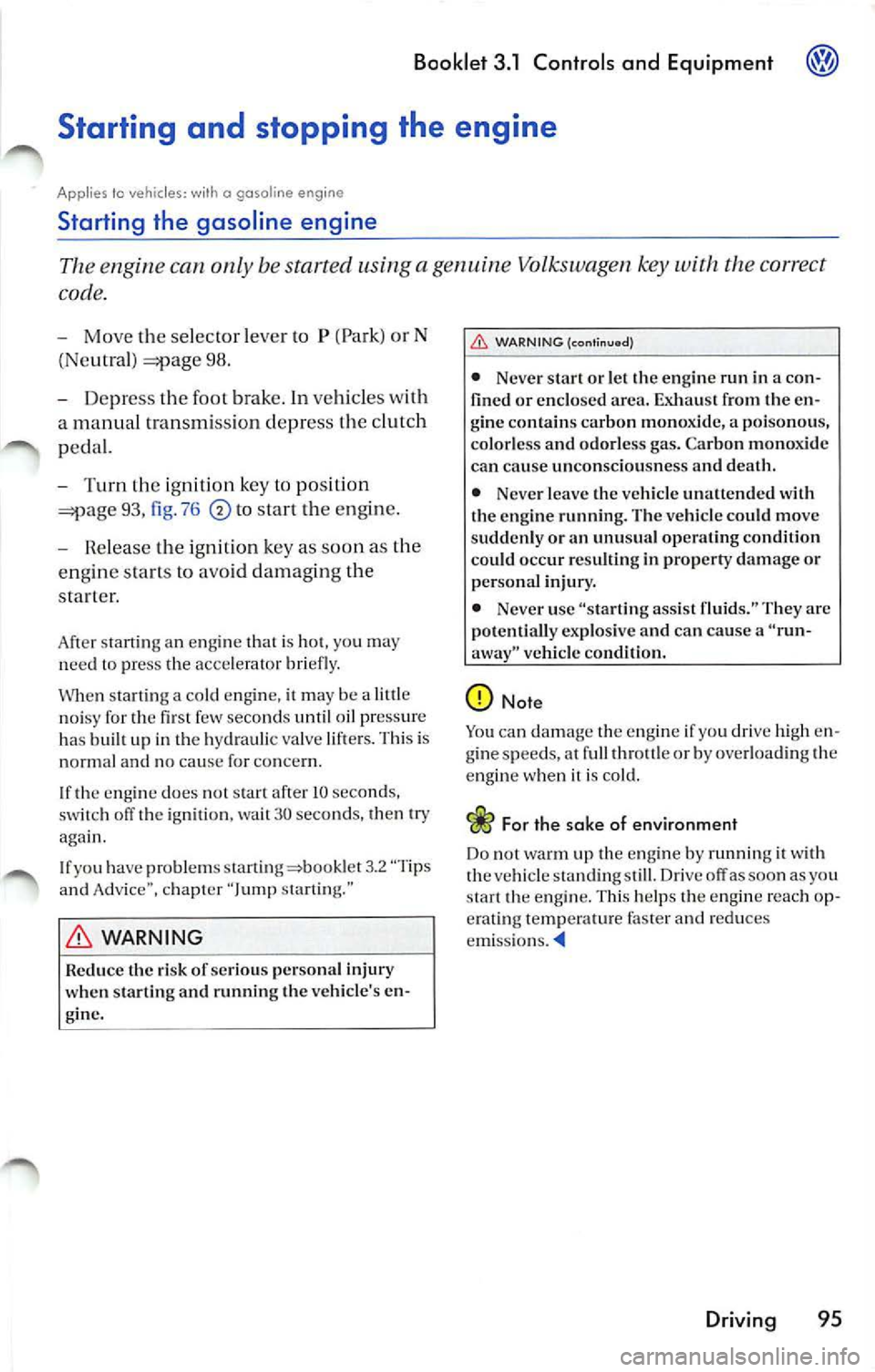
Starting and stopping the engine
Applies to vehic les : a gasoline engine
Starting the gasoline engine
Th e e ngi ne c an only be s tarted a g en uine Volkswagen key with th e corr ect
cod e.
M ove the s elec to r l eve r to P (Pa rk ) o r N
( N eutral )
98.
Depress the fo ot brak e. In vehicl es wi th
a m anual transmi ssion d epr ess the clut ch
p ed al.
Turn the ig niti on ke y to position
93 , 76 to start the engin e.
R elea se the ig nition k ey as soo n as the
e n gin e start s to avoid damagin g th e
s tart er.
Af ter s ta rtin g an en g in e th at is hot, yo u m ay
n ee d t o p ress the acce le rat or b riefl y.
W hen sta rtin g a co ld en gin e, it m ay be a
noisy fo r th e few seco nds oil pr ess ure
h as b uilt up i n th e hyd rau lic va lve li ft ers . Thi s is
n o rma l a nd n o cause for co nce rn.
I f th e en gin e does no t sta rt after
JO sec ond s,
sw itch off the ig n it io n, wait 30 seconds, then try
a g ain .
I f yo u have pro blem ssta rting=bookle t 3.2 "Tips
a nd
chapt er sta rtin g."
WARNING
Reduce the risk of ser iou s perso nal i nju ry
when st arting and run ning the vehicle' s en
g ine.
WARNING
• Nev er start or let the engine run in a co nor en clos ed are a. Exhau st from the en
g in e contain s carbo n mono xide, a poi sonous ,
c o lor le ss and odo rless ga s. C arbon monoxide
can c au se unconsciousne ss an d deat h.
• Never leave the ve hicle unattended with
the engine running. The vehicle could move
sudden ly or
unu sual operat ing cond ition
cou ld occur res ulting in property damage or
per sona l in ju ry.
• Never use "start ing assist fluids." Th ey are
potent ia ll y e xplo sive and can cause a "run
away" ve hicle condition.
Note
Y ou ca n da mage the e ngin e if yo u dri ve high en
g in e spee ds, a t full throttle or by ove rload ing th e
e n gin e w hen it i s c old.
ci> For th e sake of environmen t
Do n ot warm up th e engi ne by runnin g it w ith
th e ve hicl e sta ndin gstill. Drive off as soon as you
s ta rt th e eng ine. Thi s help s th e engin e reac h op
era tin g te mp era tu re fas te r a nd red uces
Driving 95
Page 299 of 477
Booklet 3.1 Controls and Equipment
Ap plies to ve hicles : with a di esel engine
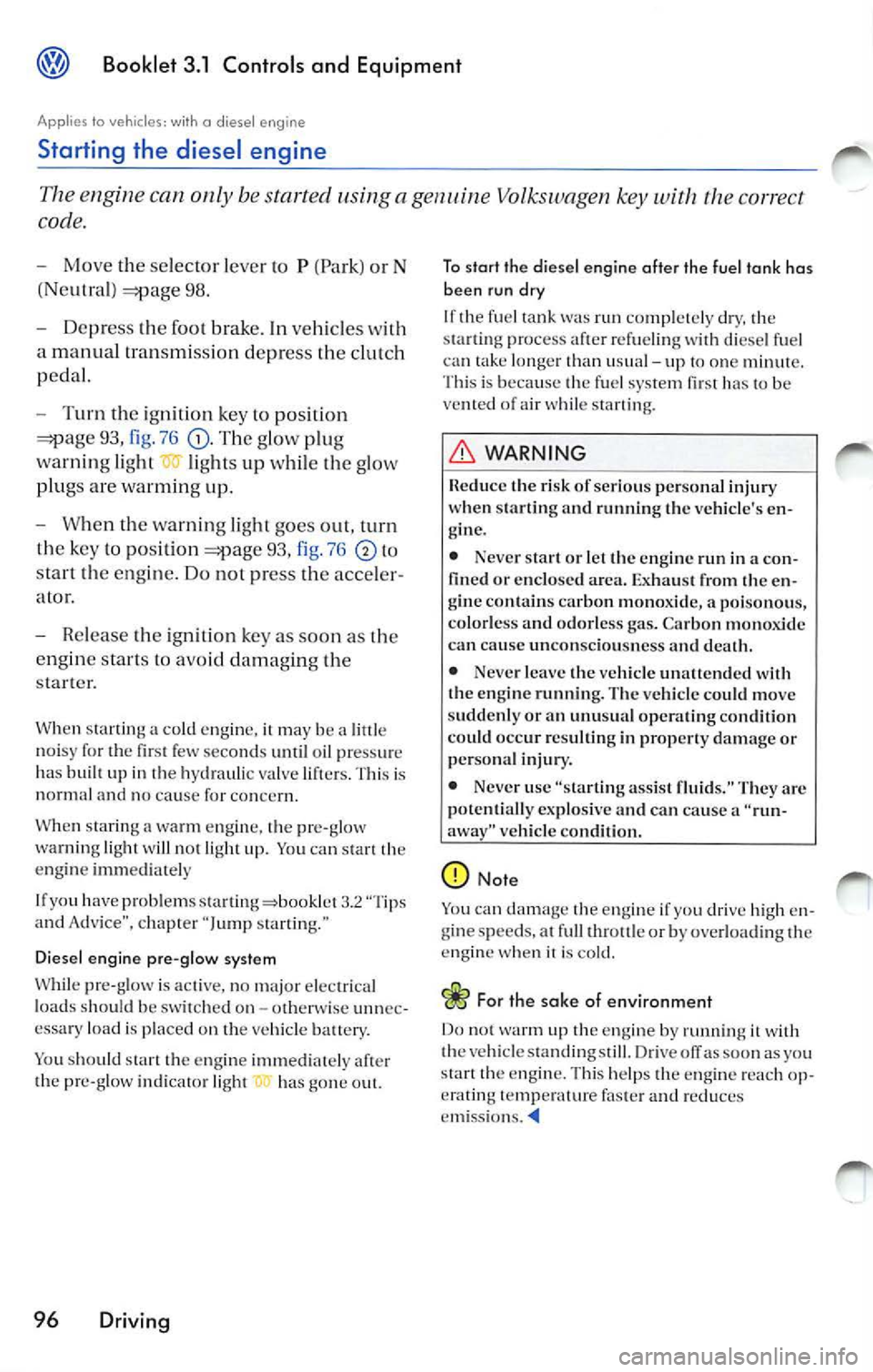
Starting the diesel engine
The engine can only be started a genuine Volkswagen key the correct
code.
- Move the se lector lever to P (Park) or N
(Ne utral )
98.
- Dep ress the foot brake. In vehicles with
manual transm iss ion d epress th e clutch
pedal.
- Turn the igni tion key to position
93, 76 The g low plug
warni ng light light s up while the glow
plug s are warm ing up.
- When the warning light goes out, turn
the key to pos ition
93, fig. 76
sta rt the engine. Do not press the acc eler
ator.
- Release the ign itio n key as soon as the
e ngin e starts to avoid damaging the
start er.
When start ing a cold eng ine, it may be a litt le
nois y for the fir st few se conds until oil pre ssur e
h as bui lt up in the hydrauli c
valve lift ers . This is
normal and no cause for conce rn.
When staring a warm engine, the pre -glow
warning light will no t li ght up. You can sta rt the
e n gi ne immed iate ly
If yo u ha ve problems sta rtin g
3.2 "Tip s
and Advice", chapt er "J ump startin g."
Di ese l e ngin e pre-glow system
Wh ile pre- glow is acti ve , n o major elec trical
lo ad s s hou ld be switched on -oth erwise unnec
ess ary load is pla ce d on the vehicle battery.
You should start the engine immediate ly after
th e pr e-g low indica tor lig ht has gone out.
96 Driving
To start the diesel engine after the fuel tank has
been run dry
If the fuel tank was run comp lete ly dr y, the
s tartin g proc ess after refueling with die sel fuel
can take long er th an usual -up t o one minute.
Th is is be cause th e fu el sys tem fir st ha s to be
vented of a ir wh ile starting.
WARNING
H edu ce the risk of ser ious per sonal injur y
when startin g and running the vehicl e's en
g in e.
• Never start or le t the engine run in a con
fined or enclosed are a. Exha ust from the en
gi ne contain s carbon mono xide , a poisonous,
co lor less and odo rless gas. Carbo n monoxide
ca n cause unconsci ousness and death .
• Neve r leave the vehicle unatt ended with
the eng ine runnin g. The vehicle could mo ve
s udd enly or an unusual operating condition
co uld occur res ultin g in prop erty damage or
personal injury.
• Neve r use "sta rting ass is t fluid s." They arc
po tentia lly exp los ive and can ca use a " run
away" vehicl e co ndition .
Note
You can
the eng ine if you drive hi gh en
g ine speeds, at full th rottle or by overloading the
en gin e whe n it i s cold.
For the sake of environment
Do not warm up the engine by running it with
th e ve hicl cstandin gstill. Drive off as soo n as yo u
s tart the e ngin e. T hi s help s th e e ngin e
o p
e ra tin g temperature fa ster and r edu ces
emissions .
--4
Page 312 of 477
Booklet 3.1 Controls and Equipment
Alphabetical index
A
ABS Wa rnin g light 27
See also Ant i-lock brake syste m
A co ustic wa rning 93
Add itional storage co mpartment 73
Adj ustin g the compass variance zone 19
Ai r co ndit io nin g
Co ndensation 89
Impo rtant notes
88
Malfunct io ns 88
Unp leasa nt od or 89
A ir conditioni ng sys tem 81
C lim atro nic
84
Air r ecircul ation mode
2C -Cl imatroni c 83, 88
Alarm syste m 36
Sw itch ing off 36
A lt ern ator
See Genera to r
A nti -lo ck brake system
ligh t 27
An ti-Slip Re gula tion 92
A nti -th eft alar m sys tem 36
Sw itchin g off 36
Arm res t
F ro nt ce nte r arm res t 66
S tora ge compartmen t 70
AS R 92
A ut omat ic mod e
C lim atroni c 85
A ut om atic sw itch-off of elec tri cal
co mp onen ts 93
A utom atic tra nsm iss io n
Dir ect shift gearbox 98
Sa fe ty int erlo ck for ign ition key 94
Se lec tor leve r loc k 99
Tiptroni c 98
A utomati c tra nsm iss ion with Tiptronic LO I
A ve rage fu el con sumpti on 9
Average sp ee d 9
B
Ba ckground lightin g 51 Brake
fluid
Wa rnin g ligh t 11
Brak e pad
W arn ing m essage II
Brak e pad wea r indi ca to r
Warn ing ligh t 26
Bra ke sys te m
Wa rnin g lig ht 28
Bulb defe cti ve
Warn ing lig ht 24
Bumpe r cov er
Ca ution when pa rki ng nea r a parkin g ba r
ri er or cu rb LO S
Bu zze r 50 , 93
C
Ca librat ing th e co mpass 18
Ce ntral loc king
I ndi vid ual unl ocking 34
Ce ntral locki ng butt on 34
Ce ntr al locki ng sys tem 34
C han ging unit s 16
C hild safe ty lo cks 35
C lea nin g
E lec troni c park ing a ssis ta nc e se nsors 106
C lim ati c 81
Ma lfun cti ons 88
C lim atroni c
I mpor tant not es 88
Ma lfu ncti ons 8 8
C loc k 5
C lo sin g
R ea r li d 38
C lot hes hook 7 1
Co rning home fu n ctio n 47
Co mp ass 18
Adjusting 19
Ca librat ing 18
Compa ss fun ctio n 12
Co ndensa tion 89
Contro ls
P owe r w ind ows 39
Conven ience closing 41, 43
Co nve nien ce men u 17
Alphabetical index 109
Page 322 of 477
Table of contents
Smart technology ........... ... .. .. .
Brakes .............. .. .. ..... .. .. .• .....
Po we r stee ring ....... .. ..... ... .. ...... .
Notice about data recorded b y vehicle
contro l modu les ....... ........ .... ..... .
Driving and protecting the
environment ..... ... .... ..... ...... ..
Break-in Pe riod ... ... ........ ......... . ..
Catalytic converter ....... .. .. .. ....... ..
T ra ile r t owi ng . . . . . . . . ... ............ .. .
D riv ing economically o nd respecti ng the
environmen t ... .... ..... ............. ... .
Cleaning and protection ........ . .
General notes .... .... ... ....... .. ...... .
Car e of veh icle exte rior ....... ..• ...... ..
C ore of the vehicle interior ... ..... ..•. ..
Accessories, new parts, repairs
and modifications .......... ...... ..
Accesso ries and pa rts .......... .... .... .
R epa irs and technica l modifications ..... .
Cellu lar phones a nd CB radi os ........ . .
2
2
6
6
7
7
10
10
14
16
16
17
23
27
27
28
29
Booklet 3 .2 Tip s and Advice
Checking and Filling 30
Fill ing the tank . . . . . . . . . .. .. . . .. . . .. . • . . . . 30
Fu el supp ly . .. . . .. . . . . . . . . . . . . . . . . . . . . . . . 32
Working in the eng ine compa rtment . . . . . 34
Engine oil . . . . . . . . . . .. . . .. .. . . . .. .. . . .. . . 37
Coo lant ....... .... .... ...... ... ......... 43
Wos he r fluid and wind shie ld wiper blade s 45
Brok e fluid . . . . . . .. . .. . . . . . . . . . . . .. . . . . . . 47
Vehicle battery . . . . . . . . . .. . .. .. .. . .. . . .. . 49
T ir es and wheels . . . . . . . . . . . . • . . . . . . . . . . . . 51
What do I do now? . .. .. . . .. . . . . .. . 67
Vehicle tools and spore whee l . . . . . . • . . . . . 67
Changing a whe el . . . . . . . . . . . . . .. .. • . . . . . 68
Em erg ency closing or opening . . . • . . . . . . . 7 5
F use s . . . . . . . .. .. . .. .. . . . .. . . . . . . .. . . .. . . . 77
Cha nging a light bulb . .. .. . . . .. .. . • .. . . . 81
Jump start ing . . . . . . . . . . . . . . . . • . . . . . . . . . . . 84
To wing .... ... . . .. . .. .... ....... ... . . .•. . 86
Lifting th e ve hicle .. . .. . . . . . . . . . . . . . .. . . . . 89
C onsumer Info rmat ion . . . . . • . . . . . . 90
Alphabetical index . . . . . . . . . 92
Table of contents
Page 327 of 477
Booklet 3.2 T ips a nd Advice
Power steering
011 vehicles with pow er stee ring , th e of power ass ista nee is regu lated e lec
t roni call y acco rdi ng to vehicle speed, stee rin g wheel torque and stee rin g w hee l
angle.
Th e power assis tance prov ided in the power
s te erin g sys te m is not hydrau lic, but m e
c h ani ca l usin g an elec tric mot or. The adva n
t a ge s of this steer ing system includ e th e fact th at
n o hydra ulic co mponents such as hoses, o il co n
t a in ers ,
o r fl uid s are re quired.
Fu rth ermo re , t his is co nsiderable de crease in
e n ergy req uir e d . T he e lec trome chani ca l s tee rin g
sys te m . in contras t to th e hydrau lic sys te m
(w hich re qu ires a co nstant flo w of fluid ), only
co nsume s energy when th e ve hicle is actua lly
be ing stee re d.
T he fu el consump tio n i s re du ced as a res ult.
If th e electro mec han ica l p owe r stee ring sys te m
fa ils, the pow er a ssis ted stee ring system
w ill still
work. If th e engin e is sw itch ed off, the pow er s
teer ing does no t fun ctio n and th e steer ing
wh eel is ve ry hard t o tu m .
WAR NING
Turning th e s teer ing whe el is very w hen t he power s tee rin g sys tem is n ot
work ing and it is harder to co ntrol the veh icl e.
• Neve r le t t he veh icle coast with th e engine
swit ch ed off.
Do no t kee p th e steer ing wheel turned all the 10 left or righ t fo r m ore than 15 seco nds
w hen th e e ngin e is runnin g. Doin g so co uld
damag e th e powe r steer ing
Data
H eco rder (EDH ), in sta lled by so me manufa c
tur ers
the exp ress purpo se of ca pturing data
fo r retr ieva l aft er an acci den t or cra sh eve nt.
are so metimes called "cras h recorders".
So me s tat e laws res tr ict t he re tri eva l or down
loadin g of da ta sto re d by ED
that were in
s ta lled in a vehicle for the exp ress p urpose of re
tr iev ing dat a af te r an acc ident or crash event
wit hou t th e Owner's conse nt.
your vehicl e is not equipped with an it is equipp ed with number of e lec tro nic
contro l modu les for variou s vehicle sys te m s
s u ch as, fo r ex am ple . e ngine function, em iss io n
6 Smart t echno logy
co ntrol, as we ll as fo r th e airbags and safe ty
be lts.
The se elec tronic con trol mod ules also
ve
hi cle-re late d dat a dur in g nor mal ve hicle ope ra
ti on for diag nos tic and re pair purp oses. The re
cordi ng capaci ty of the e lec tron ic co ntro l mod
ul es is limit ed to data (n o so und is record ed ) a nd
on ly a small amo unt of data is ac tually reco rde d
ove r a very limited p eriod of tim e and stor ed
a sys te m fau lt or o th er co ndition is se nse d by co ntro l un it. So me of dat a th en sto red
m ay re late to ve hicle sp ee d, direc tion, braking as
well a s res traint system use and performan ce in
th e eve nt of a cra sh or o th er conditi on. S to red
c an only be rea d and downloade d wit h spe
cia l
Page 329 of 477
Booklet 3.2 Tips and Advice
Braking power and braking distance
Braking power and braking distance are influenced by driving situations and
road
Worn brake pads will not provide good braking.
The amount of wear and tear on the brake pads
depends to a great extent on the cond itions
und er which the vehicle is opera ted and the way
the vehicle is dr iven. If you do a lot of city
driv ing, drive short distances or have a sporty
driving style, we reco mm end th at you have the
thickness of your brake pad s checked by an au
thor ized Volkswagen dea ler more frequently
than r ecommend ed in the service schedule.
I f you dr ive witJ1 wet brakes , for example after a
dri ving through water,
heavy rainfall or
after washing the vehicle, brakin g power will be
reduced and sto pping distances w ill be longer
because the brake d iscs will be wet or in winter
ma ybe even frozen
the brakes must be dried
with severa l ca reful brake applications.
Brake fluid absorbs water and must be c hanged
every two years. Heavy use of the brakes can
cause vapor lock if the brake fl uid is too old.
Va por lock reduces braking power, increases
stopp ing distances and can even cause total
brake failure.
WARNING
• New tires and new brake pads do not pro
v id e maximum grip, control or braking abilit y.
• To reduce the risk of losing control, a colli
s ion and se rious persona l injuries, drive with
special ca re for the first
350 mil es (560 km).
• New brake pads do not have the best stop
ping power for the first
150 mil es (240 km) and
must be broken in. You can com pensate for
the slightly reduced braking ability by drivin g
w ith care and applying more pressure on the
brak e pedal.
• Never fo llow other vehicle s too close ly or
put yourse lf into other situ ations that might
r equ ire s udden , hard brakin g especially when
th e brake pads have not been broken in.
WARNING
Wet brake s or brak es coa ted ice or road
sa lt react slower and need longer stopping dis
tanc es.
• Carefully apply brakes for a lest.
• Alwa ys dry brake s and clean olT ice coa t
ings and salt coa tings with a few cautiou s
brake app lica tions.
• Always read and hee d all
in "Break ing in tir es and brake pads" on
page 7.
WARNING
Overheated brakes will reduce the vehicle's
s topping power and increase stoppin g di s
tances.
• Always avoid over hea tin g the brakes!
• When driving downhill, the brakes have to
work hard and hea t up quickly .
• Before driving clown a long, steep hill, al
ways red uce spee d and downshift to a lower
gea r. This will let th e ve hicle use engine
braking and reduce the load on the brakes.
• Always c han ge the brake fluid at least
every two years. Hard braking with old brake
fluid may cause a va por lock. Vapor lock re
duces brakin g power, increases s topping dis
tan ces and can even ca use to tal brake failure.
• A damaged front spoiler or new non stan
dard spoile r ca n reduce the airflo w to the
brake s and cause them to overheat.
• Always sec an au thorized Vo lkswage n
dealer or qualil1ed workshop if yo u think th at
you may have damaged the front spoiler.
• Be sure to read and heed all WARNINGS
and the information =-page 27, "Accessories
and part s" before buying accessorie s.
8 Driving and protecting the environment
Page 330 of 477
Operate your vehicle safely
For drivin g safely, alwa ys follow t he speci fied
maint enance interva ls in your maint enan ce
bo okle t =boo klet
I.I "M aint en an ce" -es peci ally
fo r chan ging brake fluid. H ard use , pri marily
s top and go dr iv in g, o perat io n in very dusty
areas, t ra ile r towi ng as we ll as other con dition s
m ay make
neces sary maint enance
im erva ls -see your authorize d Vo lksw agen
d ea ler.
Your vehicle 's condition is dir ect ly relot ed to
driving safety
Th erefo re, always be sur e
ob serve fol
l ow ing points before yo u dr ive off:
• Check l ig ht s an d turn sig nals.
• Check f uel l eve l.
• Make sure
a ll ligh ts a nd all wi ndows are
clea n.
• Adjust
mirr ors .
• Make s ure
air intak e slo ts betwee n en gin e hood a nd wind shi eld are free of
l eaves, sn ow a nd ice.
• Check warning a nd indicato r light s when
s tarli ng the en g in e.
Your personal d riving style and attitude have a
lot to do with safety ..
T here fore , for you r ow n sa fe ty:
• Wear your safety bells a nd wear
pro p
er ly , ev en if you ar e just driv in g in city o r lo
th e co rner =book le t 2 .1 "Sa fe ty first",
c h apt er "Safet y
• Make sur e th at all passe ngers wear their
sa fe ty belt s proper ly. even those in rea r 2.1 "Sa fe ty chapter "Safety
belt s." Pa sse ngers wea ring en
danger not onl y th em selves in cra sh, but al so dri ver and oth er passengers .
• Make su re th at children a lwa ys
on rear
sea t prop erl y res tra in ed by a res traint system a p
propri ate for th eir size and age.
• Never tra nsp ort a child in a rear
c hild
or infant seat on the front passe nger seat
= bo oklet 2.1 "Safety
• Adju st yo ur sea t so that yo u ca n eas ily reac h
a ll co ntrol s whil e yo u are as from
Booklet 3.2 Tips and Advice
airb ag as pos sible but close r th an 10 inches
(25 cm ) = book let 2. 1 an d 3.1.
• The sea ting positi on is ve ry important for the
a irb ag perfo rm ance
2.l "S afety first",
cha pter "Air bag syste m.''
• Always a djust th e hea d res traints to
cor
r ec t h eig ht . For maximum pro tec tion , ad just the
h ead res trai nt so that the upp er edge is as eve n
w ith the top of yo ur hea d as possi ble,
no
l owe r than eye le v el a nd so that is as close to
th e ba ck of your head as possib le = bo okle t 2. 1
"Safe ty
• Alw ays make s ure that the mov ement of peda ls is no t res tri cte d in an y way 3. 1,
c h ap te r " Peda ls ."
• Store luggage an d light it em s prop erl y in
luggage compartme nt and on roo f
=book let 3. 1, c hap ter" Luggage compa rtment "
an d
3.1, cha pter rack."
If you drink, do not drive !
T he use of a lco hol, dru gs a nd certain medi ca
ti ons w ill seriously impa ir percept io n , reac tions
a nd dri vin g a bility ,
increa sin g th e
ri sk of an acci dent, cras h an d pe rso nal injury.
Do not drive if you are tired.
Make frequ ent rest stops , at le ast aft er every two
hours of dri ving.
Al ways adapt vehicle speed to traffic, road and
weather conditions.
H em ember , th at
o n sm ooth, slipp ery
roa ds, ve hicle han dling and br aking dep end a
d ea l on tire ad hes ion. On wet roa ds, the
front whee ls c an h ydrop lane, especi ally at
h ig her sp ee ds. If thi s hap pe ns, yo u will then no
l o nge r b e ab le to ste er or brak e prop erl y.
WARNING
• Alw ays observe the po sted spe ed Ii mils and
common sense. Your good judgment can
mean
diff ere n ce between arr iving safely at
your destination and being ser iously injur ed
in
crash or other kind of accide nt.
• Alway s rea d and hee d all WARNI NGS and
a dditi on al inform ation rega rding safety
= bookl et 2.1 "Safe ty
Driving and protecting the environment 9