wheel VOLKSWAGEN JETTA 2007 Owner's Manual
[x] Cancel search | Manufacturer: VOLKSWAGEN, Model Year: 2007, Model line: JETTA, Model: VOLKSWAGEN JETTA 2007Pages: 477, PDF Size: 77.6 MB
Page 308 of 477
Booklet 3.1 Controls and Equipment
Parking
The parking brake can be us ed to pr eve nt the vehicle from moving uninten tion
ally.
A lways apply th e parking brake fully when
yo u leave y our vehicl e a nd when you p ark
yo ur vehicl e.
- Use the foo t brake to stop the veh icle.
- Appl y th e parking brake full y.
- On a ma nual tran smi ssion engage
gea r. On a n aut omatic tra nsmi ssion move
the selector lever to P.
- Switch off the engine and r emo ve the
key from the ignition lock. Turn th e
s tee rin g w he el s li ghtl y to en gage the
stee ring loc k.
- Always take you ve hicle keys w ith you
whe n yo u leave the
When parking on slopes
Before turnin g off the engin e, turn the steer ing
w hee l so if th e vehicle sta rt s to ro ll, it will roll
i nt o th e c urb:
• If th e ve hicle is faci ng
turn the whee ls so that they poilll toward the cur b.
• If th e vehicle is faci ng
turn the front
w heels so t hat they poi nt away from the curb .
• As a lways, appl y th e pa rking
full y and
m ove the se lector lever to P.
WARNING
Improp er parking procedures can lead to se
ri ous perso nal injury for you or your passen
gers.
• Never remove the key from steering lock
whil e th e ve hicle is movin g or rollin g to a stop .
The steer ing wheel
will lock up and you will not be able to stee r or control the vehicle.
WARNING
• Never park where the hot exha ust sys te m
co uld ignit e flammabl e material s, such as
bru sh, l eave s, dry grass, sp illed fuel etc.
• Alw ays apply the parking brak e fuJly wh en
parking your vehicle.
• Never leave anyone in your vehicl e to pre
ven t the ve hicle from moving if the parking
br ake is r elease d or selector lever is moved.
• Alwa ys tak e the key w ith you when you
l e ave the vehicle. The engine can be started
and vehicl e sy stems su ch as the power win
d ows can be operated leading to seriou s per
s onal injury .
• Never leave children , disabl ed p erson s or
anyone who cannot help th emselves in the ve
hicl e. The doors can b e lock ed u sing th e re
mot e co ntrol trappin g passenger s in the ve
hicle in an emergenc y. Depending on the time
of year, people tr app ed in
vehicle can be
expose d to v ery high or very low temperatures.
Note
• Please exercise care when yo u pa rk your ve
hicl e in parkin g are as w ith p arkin g barri ers or
cu rb s. Parking barriers and curb s vary in heig ht
an d co uld damage yo ur bump er and re la te d
compo nents as th e fron t of yo ur vehicl e moves
over
b arri er or curb that is too high . as you park
or as you back out of parking spot. In order to
be sur e th at no su ch d ama ge ca n occ ur, yo u m ay
wish to s top sh or t o f h av ing th e front tires o f yo ur
ca r touc h parking barri er o r curb.
• Please a lso exe rcise exce ptiona l ca re when
yo u drive up or d own steep ramp s or drive over
cu rbs or oth er obsta cles, fo r w hi ch lhe ve hicle is
not d esign ed , b ec au se compone nts of th e ve
hicl e close lo th e groun d su ch as bump er cove rs,
s poil ers , suspensio n and exhaust syste m com
ponent s, m ay beco me
Driving 105
Page 311 of 477
Booklet 3.1 Controls and Equ ipment
Accelerating
- Pull th e lever upward in direction
to th e+ position to increase the
s peed by about 0.5 mph
(I km/h ).
Decelerating
- Pull the lever downward in direction of
a rrow © to the - positio n to lowe r the
s peed b y 0.5 mph (about I km/h).
Switching off
-Push the leve r in the direction of arrow
all the way to the OFF position whil e
d rivi ng. The CHU ISE or
symbo l goes off .
- Sw itch th e ignit ion off when the v ehicle
i s standing still.
WARNING
Using the crui se cont ro l whe n it i s not possib le
to dri ve sa fely at a constant speed is dangerous
in "Desc ription".
Tip s
• If th e cruise con trol is switc hed on th e
( or ·t-i sy mbol in the in stru ment cluster
li g ht s up .
• If th e c ruise co ntrol i s
the or symb ol goes o ut. The syste m is
swi tc h ed off compl etely when the selec tor leve r
is in P, Nor
• If yo u increase vehicl e speed with th e accel
erato r pedal, the prev ious ly programmed sp eed
will be re sum ed when the acce le rator p edal is re
leased . T hi s w ill not be the case. however, ifche
vehicle s peed is mo re than 6 mph (10 km/h)
hi gh er than the s tored speed fo r long er
5
minut es. The speed will then have to be store d
again .
• The set speed can be sw itche d off te mpo
rarily if you p ress the brake peda l or the clutch
pedal. Pull th e lever briefly towa rd th e steering
whee l to the point where you can start to fee l re
s is tance
107, fig. 85 to r esum e the
speed again. "'4
App lies to vehic les: with independent lever for Cruise cont·ol
Turning off control temporarily
You can turn off the control temporar ily as
follow s:
- Depress the brake pedal,
- Dep re ss th e clutch pedal, or
- Pu sh the l ever briefly to the point where
yo u can star t to feel r esis tanc e in the dir ec
t ion of a rrow
10 7, 85
Th e set sp ee d re mains in th e mem ory , but it is
not maintain ed. To res um e the spee d previo usly
se lected, re lease the brak e pedal and pull th e
l e ver bri efly coward the stee ring wheel to the
108 Driving
point whe re yo u ca n start to f eel resi stan ce 107, fig. 85
If you drive faster than about 1 10 mph (180 km/h)
the cru ise co ntrol is sw itch ed off automati cally
a nd you cann ot ac tivate the cruise contro l. To
ac tivate the cru ise control again, drive s lower
than about 110 mph (180 km/ h).
WARNING
Us ing the cruise contro l when it is not possib le
to drive safely at a constant spee d is dangerous
in "Descrip tion" on page 107. "'4
Page 322 of 477
Table of contents
Smart technology ........... ... .. .. .
Brakes .............. .. .. ..... .. .. .• .....
Po we r stee ring ....... .. ..... ... .. ...... .
Notice about data recorded b y vehicle
contro l modu les ....... ........ .... ..... .
Driving and protecting the
environment ..... ... .... ..... ...... ..
Break-in Pe riod ... ... ........ ......... . ..
Catalytic converter ....... .. .. .. ....... ..
T ra ile r t owi ng . . . . . . . . ... ............ .. .
D riv ing economically o nd respecti ng the
environmen t ... .... ..... ............. ... .
Cleaning and protection ........ . .
General notes .... .... ... ....... .. ...... .
Car e of veh icle exte rior ....... ..• ...... ..
C ore of the vehicle interior ... ..... ..•. ..
Accessories, new parts, repairs
and modifications .......... ...... ..
Accesso ries and pa rts .......... .... .... .
R epa irs and technica l modifications ..... .
Cellu lar phones a nd CB radi os ........ . .
2
2
6
6
7
7
10
10
14
16
16
17
23
27
27
28
29
Booklet 3 .2 Tip s and Advice
Checking and Filling 30
Fill ing the tank . . . . . . . . . .. .. . . .. . . .. . • . . . . 30
Fu el supp ly . .. . . .. . . . . . . . . . . . . . . . . . . . . . . . 32
Working in the eng ine compa rtment . . . . . 34
Engine oil . . . . . . . . . . .. . . .. .. . . . .. .. . . .. . . 37
Coo lant ....... .... .... ...... ... ......... 43
Wos he r fluid and wind shie ld wiper blade s 45
Brok e fluid . . . . . . .. . .. . . . . . . . . . . . .. . . . . . . 47
Vehicle battery . . . . . . . . . .. . .. .. .. . .. . . .. . 49
T ir es and wheels . . . . . . . . . . . . • . . . . . . . . . . . . 51
What do I do now? . .. .. . . .. . . . . .. . 67
Vehicle tools and spore whee l . . . . . . • . . . . . 67
Changing a whe el . . . . . . . . . . . . . .. .. • . . . . . 68
Em erg ency closing or opening . . . • . . . . . . . 7 5
F use s . . . . . . . .. .. . .. .. . . . .. . . . . . . .. . . .. . . . 77
Cha nging a light bulb . .. .. . . . .. .. . • .. . . . 81
Jump start ing . . . . . . . . . . . . . . . . • . . . . . . . . . . . 84
To wing .... ... . . .. . .. .... ....... ... . . .•. . 86
Lifting th e ve hicle .. . .. . . . . . . . . . . . . . .. . . . . 89
C onsumer Info rmat ion . . . . . • . . . . . . 90
Alphabetical index . . . . . . . . . 92
Table of contents
Page 324 of 477
WARNING (continued)
systems work and reduce their
effect iveness.
Applies to vehicles: with Driver Steering Recommenda tion
Booklet 3 .2 Tips and Advice
Driver Steering Recommendation helps to the vehicle in certain sit
uations
The Driver Stee ring R ecomm endation i s a com
pl em entar y function of the ESP. This fea ture al
low s th e driv er
stabilize ve hicl e in certain
critical situati ons. Fo r example in certai n road
s ur face conditi ons ii is necessary to brake hard.
The vehicl e will then te nd to brak e awa y to the
r ig ht or t o 1h e lef t. Th e ESP reco gnizes this situ a
tion and supp ort s the drive r to steer to the oppo-
Anti -Lock Brake System {ABS)
sit e dire cti on by in crea sing th e stee rin g
s tr ength.
WARNING
The DSH only supports the driver in cri tical
dri vin g co ndition s. The ve hicl e will not s teer
by itse lf. The dr ive r is res pon sible fo r steering
the vehicle .
The Anti-Lock Brake System prevent s th e wheels from locking when the brakes are
applied.
Th e ABS is an important part of the vehicle 's ac
ti ve safety system. The Anti-Lo ck Brake Syste m
work s onl y when the en gine is run ning.
How the ABS works
If one w he el begi ns tu t urn too s low ly in r elat io n
t o ve hicl e speed an d le n ds to lock up, t he ABS
a utom ati ca ll y
brak e pres sur e lO preve nt
that whee l fr om locking. When ABS is do ing it s
job you will notice a sli ght vibrati on throu gh the
brake pedal and hea r a noise to l et yo u know tha t
yo ur speed must be adjuste d to road, traffic and
wea ther condi tion s. T his is a warn ing 1hat on e or
mor e of the whee ls is about to lock up and that
th e AB S co ntr ol function has inter vened . In thi s
s ituati on
is important to keep the brak e peda l
fully depr essed so the ABS can help to re gul ate
th e brake applica tion. Do not "pump " th e
peda l -ABS can not do its jo b if you do.
A BS helps you 10 kee p th e ve hicl e und er control
be cause i t prev ent s th e w hee ls from locking
w hen th e brak es arc ap plied. Th is m ean s th e ve
hicl e ca n still be s teer ed and is less likely
on
g rav el o r on fresh sno w cover in g a slipp ery sur
If AB S is not functioning properl y, a wa rnin g
li ght will co me on 3.1 "Co n1rol s and
E quipm ent. "
WARNING
Always ad just yo ur dri vin g to the road, traffic
and weather conditio ns. Neve r le t th e ex tra
s afe ty that ABS can provide te mpt you into
taking extra risks.
• Always drive safely .
• ABS canno t ch ange the
of ph ysics.
S lipp ery and wet roads are dangerou s ev en
wi th ABS!
• ABS ca nnot reduce th e risk of accide nts,
f or examp le if yo u drive too
for the co ndi
ti ons or if you do not keep your distance from
th e vehicle in front of you.
Smart technology 3
Page 325 of 477
Booklet 3.2 Tips and Advice
8 WARNING
• Alw ays remembe r that vehicle alterations
or modifi cation s can affec t the function of the
ABS, BAS, EDL and ESP syste ms. Exampl es of
t h ese a ltera ti ons or modifications include a
diff ere nt wheel/tire combination and brake or
c h ass is modification s =q1age 28, "Repairs and
t ec hni cal modifications".
Electronic differential lock {EDL)
WARNING (continued)
• Changing the vehicl e suspension or usin g
unapp roved tire I rim combination can
c h ange the way the ABS, BAS, EDL and ESP
sys tems work and re duc e th eir elJect iveness.
• The eff ec tiveness of ABS is a ls o d etermined
b y th e tir es on your vehicle
51, "Tires
and wheels"
The elect roni c differential lock helps red uce th e los s of traction if a wheel starts
s pinnin g.
T he E DL help s th e ve hicle mov ing, accel
era te and climb a gradient when t he going ge ts
s li pp ery where m ov ing ahea d ma y otherw ise be
diffi cult or eve n im possibl e. EOL u ses the AB S
se nso rs to monito r th e spe ed of t he w hee ls.
EDL works on ly when the eng ine is runnin g.
EDL can help to ba la nce out differen ces in the
rotat io n of the w hee ls of a ppro ximat ely
JOO rpm
ca use d by sli ppery gro und surface on side of the vehicl e. It do es thi s by braking th e whee l
t h a t h as los t tracti on and d is tributing more
d riv ing fo rce to the oth er d riven wheel v ia th e
diff ere nt ia l
E DL is ac tive at sp ee ds up to a bout
50 m ph (80 km /h).
E DL autom atically shut s
to pr event th e di sc
brak e of th e w hee l from over heating
under excess ive loa ds. Th e ve hicle re main s op
era tional the
way as ve hicl e without EDL.
For this reas on. the dri ver is not in form ed tha t
t h e EDL has been shu t
ED L w ill auto matica lly sw itch on again when th e
br ake ha s coo le d down.
4 Smart technology
8 WARNING
Always adjus t your driving to the road, and weather condition s. Never le t th e ex tra
sa fe ty that EDL can prov ide te mpt you into
takin g extra ri sks.
• When accelerating on a slippery surfa ce,
for example on ice a nd snow , pr ess the acce l
e rator care full y. De spite ED L, th e w hee ls may
s ta rt to spin lead ing to a loss of vehicle control.
8 WARNING
• Always remember that vehicl e alt erations
o r modifi cation s can affect the fun ction of the
AB S, BAS, EDL and ESP sys tems . Exa mple s of
th ese alt era tion s or modifications include a
di!Tcrenl wheel/tire combination and brake or
chass is modifications =q1age 28, "Repair s and
t ec hni cal m odi fication s".
• Changin g t he vehicle su spen sio n or using
u napprove d tire
I rim comb ination ca n
c hang e the way the ABS , BAS, EDL and ESP
systems work and reduce their
effective ness
Page 326 of 477
Booklet 3.2 Tips and Advice
help s th e ve hicl e to sta rt mov ing.
a cc ele rat e a nd climb a grad ient in slipp ery con
di tio ns w her e thi s m ay other wise be diffi cult or
ev en impo ssibl e.
WARNING
Alway s adj ust you r driving to the road, traffic
a nd weather condition s. Do not l et the extra
WARNING (cont inu ed)
safety that ESP and can provid e tempt
yo u into taking extra risks.
• Always drive safely .
• ESP and ASH can not defy the laws of
physics. Slipp ery and wet roads are dange rous
even with ESP!
• ESP and AS H cannot reduce the risk of ac
cident, for examp le if you drive too fast for
condi tions or if yo u do not keep your distance
from the vehicle in front of yo u.
WARNING
• Alway s remember that vehicle alterations
or modifi cations ca n the function of the
ABS, BAS, EDL and ESP sys tems. Examp les of
these altera tio ns or modifications include a
different wheel/tire combination and brake or
c h ass is modifications
28, "Repa irs and
technical modifications".
• Chan ging the vehicle suspension or usi ng
un approve d tire
I rim comb ination can
change the way the ABS, BAS, E DL and ESP
sys te ms work and red uce their effective ness.
• The elJec tivencss of ESP is also determined
b y the tires fitted
51, "Tires and
wheels ".
d iu s o f th e tir es ca n c ause the syste m to re du ce
e n gin e po we r - eve n w hen thi s is not th e bes t
thing
to d o und er th e ci rc um stan ces . '4
Smart technology 5
Page 327 of 477
Booklet 3.2 T ips a nd Advice
Power steering
011 vehicles with pow er stee ring , th e of power ass ista nee is regu lated e lec
t roni call y acco rdi ng to vehicle speed, stee rin g wheel torque and stee rin g w hee l
angle.
Th e power assis tance prov ided in the power
s te erin g sys te m is not hydrau lic, but m e
c h ani ca l usin g an elec tric mot or. The adva n
t a ge s of this steer ing system includ e th e fact th at
n o hydra ulic co mponents such as hoses, o il co n
t a in ers ,
o r fl uid s are re quired.
Fu rth ermo re , t his is co nsiderable de crease in
e n ergy req uir e d . T he e lec trome chani ca l s tee rin g
sys te m . in contras t to th e hydrau lic sys te m
(w hich re qu ires a co nstant flo w of fluid ), only
co nsume s energy when th e ve hicle is actua lly
be ing stee re d.
T he fu el consump tio n i s re du ced as a res ult.
If th e electro mec han ica l p owe r stee ring sys te m
fa ils, the pow er a ssis ted stee ring system
w ill still
work. If th e engin e is sw itch ed off, the pow er s
teer ing does no t fun ctio n and th e steer ing
wh eel is ve ry hard t o tu m .
WAR NING
Turning th e s teer ing whe el is very w hen t he power s tee rin g sys tem is n ot
work ing and it is harder to co ntrol the veh icl e.
• Neve r le t t he veh icle coast with th e engine
swit ch ed off.
Do no t kee p th e steer ing wheel turned all the 10 left or righ t fo r m ore than 15 seco nds
w hen th e e ngin e is runnin g. Doin g so co uld
damag e th e powe r steer ing
Data
H eco rder (EDH ), in sta lled by so me manufa c
tur ers
the exp ress purpo se of ca pturing data
fo r retr ieva l aft er an acci den t or cra sh eve nt.
are so metimes called "cras h recorders".
So me s tat e laws res tr ict t he re tri eva l or down
loadin g of da ta sto re d by ED
that were in
s ta lled in a vehicle for the exp ress p urpose of re
tr iev ing dat a af te r an acc ident or crash event
wit hou t th e Owner's conse nt.
your vehicl e is not equipped with an it is equipp ed with number of e lec tro nic
contro l modu les for variou s vehicle sys te m s
s u ch as, fo r ex am ple . e ngine function, em iss io n
6 Smart t echno logy
co ntrol, as we ll as fo r th e airbags and safe ty
be lts.
The se elec tronic con trol mod ules also
ve
hi cle-re late d dat a dur in g nor mal ve hicle ope ra
ti on for diag nos tic and re pair purp oses. The re
cordi ng capaci ty of the e lec tron ic co ntro l mod
ul es is limit ed to data (n o so und is record ed ) a nd
on ly a small amo unt of data is ac tually reco rde d
ove r a very limited p eriod of tim e and stor ed
a sys te m fau lt or o th er co ndition is se nse d by co ntro l un it. So me of dat a th en sto red
m ay re late to ve hicle sp ee d, direc tion, braking as
well a s res traint system use and performan ce in
th e eve nt of a cra sh or o th er conditi on. S to red
c an only be rea d and downloade d wit h spe
cia l
Page 342 of 477
Locks
Lock cylinders can freeze in winter.
To d e-ic e th e lo ck cylin ders use a sp ecial lo ck
cy lind er de- ice r spra y wit h lubri cating anti ·
corrosive
Cleaning chrome parts
- Cle an chrom e part s wi th a damp cloth.
- Po lish chrome part s with a so ft, dry
cloth .
You can als o u se s pecial chrome cleaner.
C hrome cleaners will help re mov e surfa ce grime
a nd stain s from chrom e surf aces.
Cleaning alloy wheels
Every two weeks
- Was h sa lt and brake du st off alloy
w heel s.
- Use an ac id free dete rgen t to clean the
w hee ls .
Every three months
- Appl y a har d wax compound to the
w hee ls .
Li ght alloy whee ls req uire reg ular car e re mo ve
road sa il a nd brak e by reg ularl y wa shi ng w hee ls, other wise fini sh will du ll and they
wi ll be hard lo clean.
Alwa ys use a n ac id-fr ee dete rge nt for alloy
w heel s.
Do not u se vehicle polis h or oth er abra sive
u cts . I f prot ective coat ing is damag ed , fo r amp le by s tone impact, th e dama ged area
s h ould be re pair ed imm edi ate ly.
Booklet 3.2 Tips and Advice
Note
To pre vent scra tc hin g chrom e surfaces:
• Do not use an abra sive care pro duct on
c hr om e.
• Do
clean or polish chr ome are or dusty or clean or p olish in sand y
o r dusty
WARNING
I mp roper use of power washers ca n ca use rious, invis ible and permanent tire damage
l ead ing to tire failure and lo ss of ve hicle
trol.
• Neve r was h tires with a jet that sprays the
water out in a direct stream eve n from a
tance or for a very short time.
WARNING
Wet brak es or brake s coated wi th ice or road
sa lt react slower and need longer sto pping
tan ces.
• Carefu lly appl y brak es for a
• Always dry brake s and clea n off ice ings and salt coating s with a few cauti ous
brake applications.
• Alw ays read and h eed all WAR NIN GS
8, " Brakin g pow er and braking
Cleaning and protection 21
Page 372 of 477
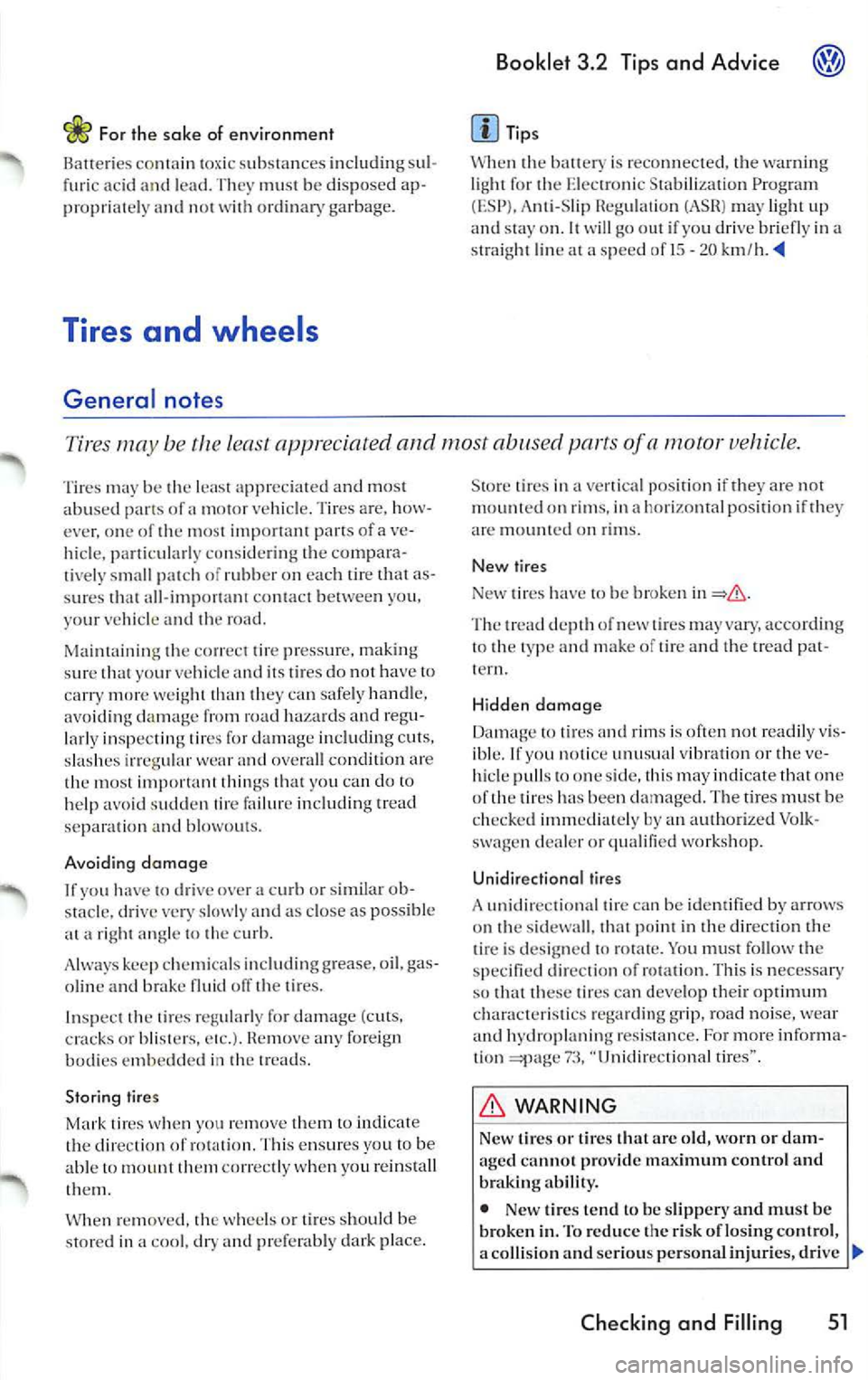
c£> For the sa ke of e nvironment
Batte ries
1ox ic s ubstan ces includin g sul
furi c acid and le ad . Th ey mus! be dis posed ap
p ro pria lc ly an d 110 1
ord inary garbage.
Tires and wheels
Genera l notes
Booklet 3.2 Tips and Advice
Tips
Wh en !h e ba ttery is reconne c1e d .
warning
li gh l for 1he S1abi lization Program
(ES P). (AS RJ ma y lig ht up
a nd sla y on. go out if yo u dri ve briefly in a line al a sp eed of 15 20 km /h .
Tires may le n st appr eciated and most abus ed parts of motor vehicle.
Tire s ma y be 1h e appr eciale d and mo st
ab use d pans of rn o!O r ve hicl e. Tire s are,
ever . o ne mo s! pans ofa ve
h icl e. p arli cula rly co nsid erin g comp arasmall o f rubb er on eac h tir e th al as
s ure s all-imponanl b etwee n yo u,
your vehicl e
road.
Mainl ainin g 1h e c orr cc1 lire pressure , ma kin g
s ur e
vehicl e an d i1s 1ir es do 1101 have to
ca rry mor e !hey can safe ly hand le ,
a vo iding dam age from haz ards and regu
larl y in spec lin g !ir es fo r d am age including
slas hes ir reg ular wear and co ndi tion are
th e mos! impor lan 11hin gs you ca n do lo
h elp avoid sudd en lire f ailur e includ ing tread
se para lion and hlo wo u1s.
Avoiding damage If yo u ha ve
dri ve ove r a cu rb or sim ilar ob
s tacl e, dri ve ve ry s lowly a nd as cl ose as po ssib le
a l a rig h1 angl e 10
curb.
ke e p ch emi ca ls including g rease. o il. gas
o lin e an d brak e fluid off 1 he 1ires .
ln spe cl
1ir es regul arly fo r damag e (c ut s.
c ra cks or c1c.J. any foreign
bo dies em bed de d in ! r e ad s.
Storing tires
Mark lires when yo u r em ove th em
to indi cale dire cti on T hi s ens ures y ou 10 be hie 10 m ou nl when yo u rein sta ll
!h em .
W hen
1h e whee ls or 1ires s hou ld be
s tor ed in a cool, dry and preferab ly dark place. S
!o re tir es in
a ven ica l po sil ion if th ey are 1101
m ount ed on rim s, in a horizo ntal pos i1 ion if1h ey
are mou n1ed on rim s.
New tires
!ir es have to be broke n
The !r ea d ofn ew lir es may vary, accor ding
10 1h e 1y pe and mak e of li re an d 1h e tre ad pat
l e rn.
Hidd en damag e
!ir es rim s is 11 01 r ead ily vis
ibl e. you n olice unu sual vibral ion or !he vepull s 10 one side, !his may indi cale th al o n e or 1h e 1ires be en dama ged. The tir es mu st b e
c h ec ke d imm ediale ly by an auth ori zed Vo lk
s wag en dea ler or qua lifi ed wo rk sh op.
U nidirectiona l tires
A unidir ec1ional lir e can b e id e111 ifi ed by arro ws
o n 1h e sid ew all , 1h a1
in 1he dir ection 1h e
l ire is designe d 10 ro la!C. Yo u must fo llow 1h e
s p ecifie d direc1 io n of ro 1a 1ion. This is necessa ry
so
1h es e 1ires de velo p !heir rega rding grip , road noi se, we ar
an d hydro plan ing For m ore info rm a
lion " Unidi re c tional 1ir es".
WARNING
tir es or !ires th al arc o ld, worn or dam
aged cannol provide max imum control and
brak ing abilil y.
• New tir es len d to be s lippery a nd mu st be
broken in.
re duce !he r is k of losin g conlrol ,
a co llisio n and serious pe rso nal injur ies, dri ve
Checking and Filling 51
Page 373 of 477
Booklet 3.2 Tips and Advice
WARNING (continued)
with special care for the fir st 35 0 mile s
( 560km ).
• Driving with worn or dam aged tires can
l ead to los s of co ntrol, sud den tire failure, in
clud ing a blowout and sudden deflation,
cras hes and se riou s perso nal injurie s. H ave
worn or damaged tires rep laced immediat ely.
• Tires age even if th ey arc not bein g used
a n d can fail sudd enl y, es pecia lly
at high
s p ee ds. Tire s th at ar c mor e than 6 yea rs old
WARNIN G (contin ued)
ca n onl y be use d in an em erge ncy and then
w ith specia l ca re and at lo w er sp eeds.
• Neve r m ount u sed t ires on yo ur vehicl e if
you arc not s ure of th eir "pre vio us hi story."
Old use d tir es ma y have been dama ged eve n
t h ough th e damage cann ot b e see n that can
l ea d to sudd en tir e fa ilur e and loss of vehicle
contro l.
• If yo u notice unu sual vibrat ion or if th e ve
hicle pull s to one sid e wh en drivin g, a lways
stop as soo n as it is safe to do so and check the
wheels and tires for dam age.
Glossary of tire and loading terminology
Accessor y weight
m ea ns th e comb ined weigh t (in excess of those
s tand ard item s wh ic h may b e re p laced ) of auto
matic tran sm iss ion, powe r stee ring . power
brake s, pow er wind ows, powe r se ats. radio, a nd
heat er, to th e ex tent that th ese item s are ava il
ab le as factory- in st all ed eq ui pment (w heth er in
s talled or not).
Aspect ratio m ea ns th e ra tio of th e heig h t
th e wid th of th e
ti re in perce nt. Numbers of70 or lowe r ind icat e
a sh ort sid ewa ll for imp roved steering r espons e
a nd be tter ove rall hand ling d ry pa vement.
B ead
m ea ns th e pan oft he tire that is m ade of stee l
w ires, wrapp ed or reinfor ced by ply cords and
t h at is s hape d to
th e rim .
B ead separation
mean s a breakdow n of th e bo nd b etwee n com
p on ent s in the bea d.
Cord mea ns th e s trands for ming the plies in t he tire .
Cold lir e inflation pressure
m ea ns th e tire press ure reco mmend ed by the
ve hicl e m anu factur er f or a tire of a des ig nate d
s ize th a t ha s not b ee n d rive n for th an a co up le of
m iles ( kilomete rs) at low sp eeds in th e thr ee
h our peri od befo re th e tire press ure is m eas ured
or ad juste d.
52 Checking and Filling
Curb weig ht
mea ns th e weig ht of
a moto r ve hicle sta n
dard equipm ent in cluding th e maxi mum ca
paci ty o f fuel. oil. a nd coolant, air co ndition ing
and additional weight of o ptional equipme nt.
Gr oss Axle Weight Roting
m ea ns th e load -ca rryi ng ca pacity of a sin gle axle
sys tem, measured at th e tire-gro und in te rface s.
Gro ss Vehicl e W eight Roling
means th e max imum t otal load ed weig ht of the
ve hicl e.
Groo ve
m ea ns th e spa ce betw een
ad jacent tread
r ib s.
L o ad rotin g (cod e)
m eans the maximum load that
tir e is ra ted to
carry for a given inflation press ure. You may not
this o n all tir es bec ause it is not
required by law.
Ma ximum load roting
m ean s th e load rating for
tire at th e perm iss ible inflatio n pressu re for that t ir e .
Ma ximum load ed ve hicle weig ht
mean s th e
of:
(a) C urb weig ht,
( b ) Accesso ry weight,
( c ) Vehicle capa city weigh t, a nd
(cl ) Pro duction o ptions we ig h t.