high VOLKSWAGEN JETTA 2007 Service Manual
[x] Cancel search | Manufacturer: VOLKSWAGEN, Model Year: 2007, Model line: JETTA, Model: VOLKSWAGEN JETTA 2007Pages: 477, PDF Size: 77.6 MB
Page 369 of 477
Booklet 3.2 Tips and Advice
Changing the brake fluid
The brake must b e chang ed e very ye ars
We r ecomm end th at yo u have the br ake fl uid
c h a nged by a n au th ori zed Volksw age n dea le r.
S to p! B efo re openin g th e eng in e hoo d, a lways
rea d and hee d all WA RN INGS
34. is jo b No . I w hen work ing in e n gine com
p a rtm ent ".
B rak e fluid absorbs mois tu re. Ove r tim e. it w ill
a bsor b wat er fr om th e air . If
co n1en 1 in
th e brak e fluid is too high, brake co uld co rro de. Too much wa te r in brake fl uid
co nsid erabl y re du ces th e boilin g of brak e fluid. Very heavy use of 1h e bra kes old
b ra ke fluid may ca use va por loc k. Va po r l oc k re
du ces brakin g powe r. in creases s!Opp in g di s
tan ces and can ev en cau se to tal br ake failur e.
Fo r thi s re a so n th e brak e fluid m ust be r epla ced
ev ery
y e ars.
Only use brak e fluid
th e US
standard FM VSS 116 D OT 4. Th e fluid mu st
b e new.
WARNING
Stop! Before working in the engine co mpart
m en t, a lways re ad and heed all
34. Th e eng in e co mpartm en t of motor vehicle is a po tent ially dangerou s area
and can ca use s eriou s per sona l injury.
WARNING
Brake failur e ca n r esult from old o r incorr ec t
brake fluid.
48 Ch ecking and Filling
,0. W ARN ING (c on tinue d)
• U se onl y brake fluid that meets SAE speci
fi ca tion J 1703 and conforms to Federa l Mo tor
Veh icle Safety Sta ndard 116.
• Alwa ys check wit h your a uthor ized Vo lk
s wagen dea le r to make su re that yo u arc usin g
the correc t
fluid.
• The correc t brake fluid is al so listed on the
l abe l o n the brake fluid reservo ir .
WARNING
Brake fluid is poison ous.
• Alway s store brake fluid in the closed or ig
inal contain ers in a safe place.
• To reduce the risk of po iso nin g, ne ver u se
em pty food or beverage co ntain ers that might
mislead someo ne into drinkin g from th em.
• Always keep brak e fluid out of the reac h of
c hildr en.
• Always c hange the brake fluids as required
in the m aint enan ce boo klet. Heavy braking
w ith old brak e fluid m ay cause a va por lock
th at reduces braking power , in crea ses stop
pi ng di sta nce s an d can eve n ca use tota l brake
Note
Llrake fluid ca n d am age t he pa int. Wipe
a n y
b ra ke fluid from th e pa int imm edi ately.
flu id mu st be dr ained and di sp ose d of in
t h e prope r ma nne r observ in g environme ntal
reg ulatio ns.
Page 371 of 477
Booklet 3.2 Tips and Advice
The electrolyte level be checked reg ularly in high-mileage vehicles, in hot
cou ntri es and in older batteries.
- Open the engine hood and open the
batt ery cover at the front.
- C heck th e co lor display in the round
w ind ow at the top of the battery.
- If there are air bubb les in the window,
tap the w indow gent ly un til they disp erse .
Th e positio n of th e battery is sh ow n in th e corre
spo ndin g engine compart ment diagram
3.3. Th
e ro und window ("magic eye '') on th e to p of
t h e batt ery chang es color, d epending on the
c harg e le vel and ele ctrolyt e le vel of the ba ttery.
I f th e c olor in the w indow i s co lor less or bri gh t
ye llow . the elec trol yte le vel of the battery is to o
I la ve the ba tte1y ch ec ked by a q ualifi ed
d eal ers hip ..
The col ors g ree n and b la ck ar c use d b y the work
s h op t o diagno se the battery.
Charging and replacing vehicle batteries
All work with the vehicle battery req uir es specia l know ledge.
Have th e batteries checked by auth orized
Vo lkswagen deale r o r qua lified workshop be
t ween regular ma inten an ce i nt erva ls if you of te n
driv e short distance s or i f th e vehicle is not
driven for lo ng peri ods.
I f the bat te ry has discharged and you have prob
l ems starting th e ve hicle, the battery might be
damaged . If thi s happens, we re comme nd you
h ave the ve hicle batte ry c hecked by an autho
ri ze d Vol kswag en dealer
it w ill he erly recha rged o r re pla ced.
C har ging vehicle batteries
T he c har ging of the vehicl e batt eri es s hould be
l ef t to an aut horized Vo lkswage n deale r o r qual
ifi ed workshop, b ecau se your ve hicle is
equipp ed w ith specia l batteri es th at mu st b e
charg ed in a contro lled e nvironm ent.
50 Checking and Filling
Rep lacing a battery
T he batt eries have been specia lly deve lo ped for
th eir lo cat io ns and they have specia l sa fe ty fea
Genui ne Volkswage n batte ries me et th e m aint e
nan ce, and safety sp ecificat io ns
fo r you r ve hicl e.
WARNING
• u se on ly maint en an ce -fr ee or
cycle -free, leak-proof batteries with the same
s pecification s and dimen sions as the ori ginal
e quipm ent batt ery. S pecifi cation s are liste d
on the batt ery hous ing.
• Before sta rtin g
work on th e batteries,
a lways rea d and heed a ll in
"Loca tion of battery" on page 49.
Page 373 of 477
Booklet 3.2 Tips and Advice
WARNING (continued)
with special care for the fir st 35 0 mile s
( 560km ).
• Driving with worn or dam aged tires can
l ead to los s of co ntrol, sud den tire failure, in
clud ing a blowout and sudden deflation,
cras hes and se riou s perso nal injurie s. H ave
worn or damaged tires rep laced immediat ely.
• Tires age even if th ey arc not bein g used
a n d can fail sudd enl y, es pecia lly
at high
s p ee ds. Tire s th at ar c mor e than 6 yea rs old
WARNIN G (contin ued)
ca n onl y be use d in an em erge ncy and then
w ith specia l ca re and at lo w er sp eeds.
• Neve r m ount u sed t ires on yo ur vehicl e if
you arc not s ure of th eir "pre vio us hi story."
Old use d tir es ma y have been dama ged eve n
t h ough th e damage cann ot b e see n that can
l ea d to sudd en tir e fa ilur e and loss of vehicle
contro l.
• If yo u notice unu sual vibrat ion or if th e ve
hicle pull s to one sid e wh en drivin g, a lways
stop as soo n as it is safe to do so and check the
wheels and tires for dam age.
Glossary of tire and loading terminology
Accessor y weight
m ea ns th e comb ined weigh t (in excess of those
s tand ard item s wh ic h may b e re p laced ) of auto
matic tran sm iss ion, powe r stee ring . power
brake s, pow er wind ows, powe r se ats. radio, a nd
heat er, to th e ex tent that th ese item s are ava il
ab le as factory- in st all ed eq ui pment (w heth er in
s talled or not).
Aspect ratio m ea ns th e ra tio of th e heig h t
th e wid th of th e
ti re in perce nt. Numbers of70 or lowe r ind icat e
a sh ort sid ewa ll for imp roved steering r espons e
a nd be tter ove rall hand ling d ry pa vement.
B ead
m ea ns th e pan oft he tire that is m ade of stee l
w ires, wrapp ed or reinfor ced by ply cords and
t h at is s hape d to
th e rim .
B ead separation
mean s a breakdow n of th e bo nd b etwee n com
p on ent s in the bea d.
Cord mea ns th e s trands for ming the plies in t he tire .
Cold lir e inflation pressure
m ea ns th e tire press ure reco mmend ed by the
ve hicl e m anu factur er f or a tire of a des ig nate d
s ize th a t ha s not b ee n d rive n for th an a co up le of
m iles ( kilomete rs) at low sp eeds in th e thr ee
h our peri od befo re th e tire press ure is m eas ured
or ad juste d.
52 Checking and Filling
Curb weig ht
mea ns th e weig ht of
a moto r ve hicle sta n
dard equipm ent in cluding th e maxi mum ca
paci ty o f fuel. oil. a nd coolant, air co ndition ing
and additional weight of o ptional equipme nt.
Gr oss Axle Weight Roting
m ea ns th e load -ca rryi ng ca pacity of a sin gle axle
sys tem, measured at th e tire-gro und in te rface s.
Gro ss Vehicl e W eight Roling
means th e max imum t otal load ed weig ht of the
ve hicl e.
Groo ve
m ea ns th e spa ce betw een
ad jacent tread
r ib s.
L o ad rotin g (cod e)
m eans the maximum load that
tir e is ra ted to
carry for a given inflation press ure. You may not
this o n all tir es bec ause it is not
required by law.
Ma ximum load roting
m ean s th e load rating for
tire at th e perm iss ible inflatio n pressu re for that t ir e .
Ma ximum load ed ve hicle weig ht
mean s th e
of:
(a) C urb weig ht,
( b ) Accesso ry weight,
( c ) Vehicle capa city weigh t, a nd
(cl ) Pro duction o ptions we ig h t.
Page 374 of 477
Maximum (permissible) inflation pressure means the maximum cold inflation pressure to
which a tire may be inflated. Also called "max imum inflation pressure."
Normal occupant weight
means
150 lbs. (68 kilograms) times the number
of occupants seated in the vehicle up to the total seating capacity of your vehicle.
Outer diameter
means the overall diameter of an inflated new
tire.
Overall width means the linear distance between the exteriors
of the sidewalls of an inflated tire, including ele
vations due to labeling, decorations, or protec tive bands or ribs.
Ply
means a layer of rubber-coated parallel cords.
Radial ply tire
means a pneumatic tire in which the ply cords
that extend to the beads are laid at substantially
90 degrees to the centerline of the tread.
Recommended inflation pressure
see
52, "Cold tire inflation pressure".
Rim
means a metal support for a tire or a tire and
tube assembly upon which the tire beads are
seated.
Rim diameter
means nominal diameter of the bead seat . If you
change your wheel size, you will have to pur
chase new tires to match the new rim diameter.
Rim size designation
means rim diameter and width.
Rim width
means nominal distance between rim flanges.
Sidewall
means that portion of a tire between the tread
and bead.
Booklet 3.2 Tips and Advice
Speed rating (letter code) means the speed at which a tire is designed to be
driven for extended periods of time. The ratings range from 93 mph (150 km/h) to 186 mph
(298 km/h). These ratings are listed in the table
below 62. You may not find this informa
tion on all tires because it is not required by law.
The speed rating letter code, where applicable, is molded on the tire sidewall and indicates the
maximum permissible road speeds.
Tire pressure monitoring system
1 )
means a system that detects when one or more
of a vehicle's tires are underinflated and illumi nates a low tire pressure warning telltale.
Tread means that portion of a tire that comes into con
tact with the road.
Tread separation means pulling away of the tread from the tire
carcass.
Tread wear indicators (TWI) means the projections within the principal
grooves designed to give a visual indication of
the degrees of wear of the tread. See
59, "Tread Wear Indicator (TWI)" for more informa
tion on measuring tire wear.
Uniform Tire Quality Grading
is a tire information system developed by the United States National Highway Traffic Safety
Administration (NHTSA) that is designed to help buyers make relative comparisons among tires.
The UTQG is not a safety rating and not a guar antee that a tire
will last for a prescribed number
of miles or perform in a certain way. It simply
gives tire buyers additional information to com bine with other considerations, such as price,
brand loyalty and dealer recommendations .
Under UTQG, tires are graded by the tire manu
facturers in three areas: tread wear, traction and temperature resistance. The UTQG information
on the tires, molded into the sidewalls.
U.S. DOT Tire Identification Number (TIN)
This is the tire's "serial number."
It begins with
the letters "DOT" and indicates that the tire
meets all federal standards. The next two num-
Tire pressure monitoring system)
Checking and Filling 53
Page 375 of 477
Booklet 3.2 Tips and Advice
bers or w her e il manufactured, and fo ur numb ers re pre
s ent the week and year of manufa ctur e. For ex
ampl e, th e numb ers 180 1 m ean lhal
lir e produ ced in the wee k of 200 1. oth er
numb ers arc m ark e ting code s may or may
n ot b e use d by th e lir e m an ufa c tur er. T hi s info r
is use d lO cl co nsum ers if lir e dere quir es reca ll.
Vehicle capacity we ight
means cargo and luggage load pl us
1 50 lbs. (68 kilogra ms) lime s vehicle's I se
alin g capaci ty as
on label alt ached lo
t h e open ed ge of th e dri ver's door .
Vehicle maximum load on the tire
means that load on an ind iv idua l tire that is de
t erm in ed b y dis tribu ting e a ch ax le its shar e of ma ximum load ed ve hicle weig ht and di
v iding b y
Vehicle nor mal load on the tire
mean s load on an indi vidual lha l is de
termined by each axle i ls s hare of curb accessory and n ormal weighl in accordan ce below 54) and div id in g by
Occupant loading and distribution for vehic le normal load for various designated sealing capaciti es
Desig na ted sea ling capaci ty,
Vehicle norm al l oad, numbe r
Occupa nt distri bution in a
nu mber of occ upants
of occupants normally lo aded vehicle
2 th rough 4
2 2 in front.
5 3 in I in back scat.
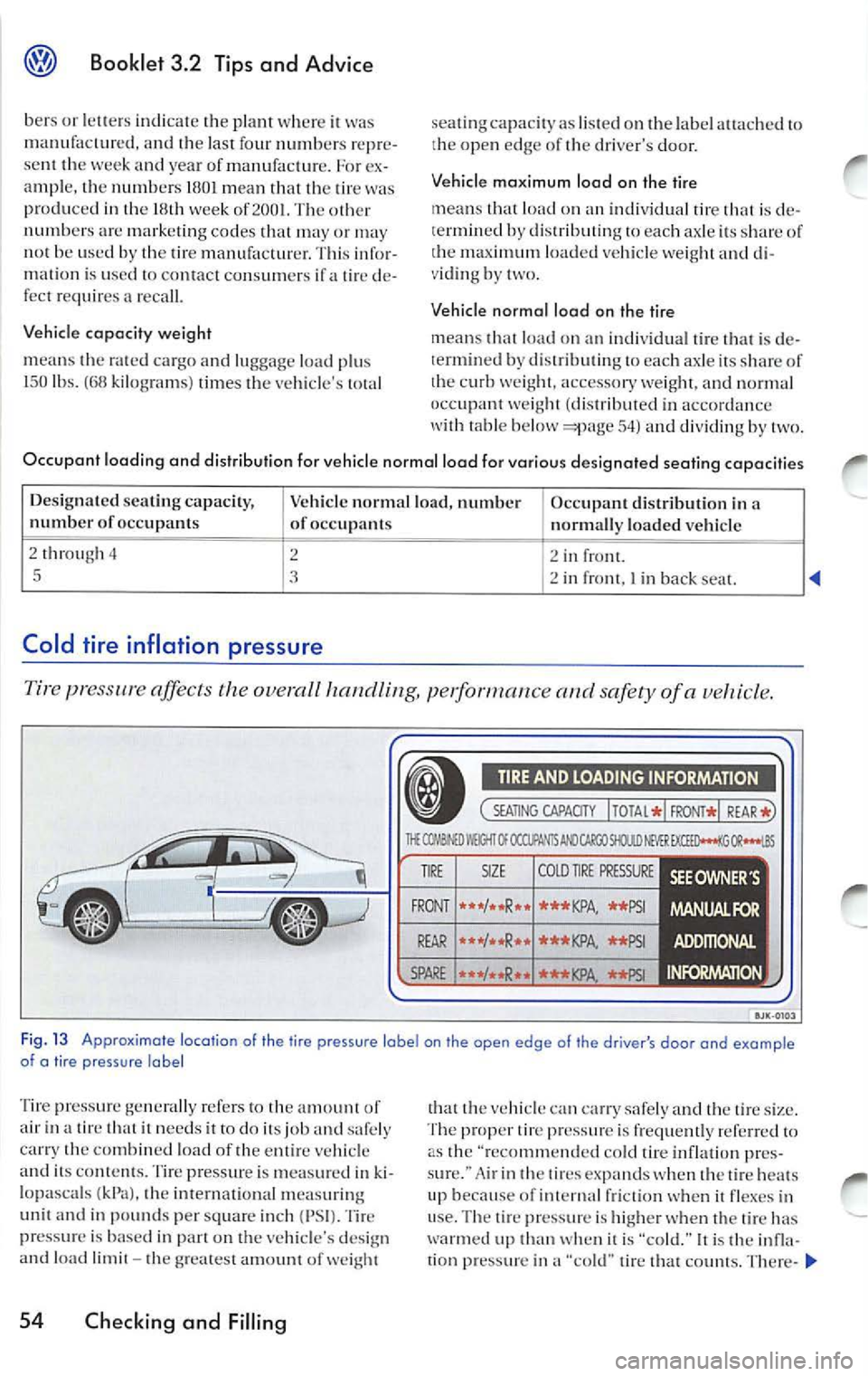
Cold tire inflation pressure
pressure aff ects the overall safety of a icle .
TIRE AND LOADING INFORMATION
( SEATING CAPAOTY
amt,l D Of
TIR E SIZE COLD TIRE PRESSURE
FRONT
SPARE
F ig . 1 3 Approximate location of fire pressure labe l on open edge of driver's door and example
of a fire pressure label
T ire p ress ur e ge nera lly refe rs to in a tire th at i l needs il t o do ils job an d sa fe ly
ca rry co mbin ed loa d of enti re vehicle
and it s content s. Tir e pre ssur e is meas ured in ki
l op ascals
imernat io nal meas urin g
unit and in poun ds per squar e in ch (P SI). Tir e
p ressure is based in pan o n th e ve hicle's des ig n
and l oad Ii mil -
greates t amount of
54 Checking and Filling
th at can car ry safe ly an d th e lir e s ize.
T he proper tir e press ure is frequ entl y to
as the "recom mend ed co ld tire inflation pr es
s ur e." Air in
!ires expa nds w hen tir e heat s
up because of fric tion when it fl exes in
u se . Th e tir e press ure is highe r w hen tire warmed up than when is "co ld.·· ll i s infla
t io n p ressure in a "co ld" lire Ther e-
Page 376 of 477
fore, you shou ld ne ver let air o ut of a warm ti re m atc h "cold tire inflation pressure" reco m
m endati ons. The tir es wo uld then be und erin
fla ted and could fail suddenl y.
Maint aining proper tire press ure is on e of the
mo st important things you ca n do
help avoi d
s udd en tir e failu re. Unde rinflated tire s are a
major cause of sudden tir e failure. Keeping t ires
a t th e righ t p ress ure is also important for saf e
and resp o nsiv e ve hicl e handl ing, tra ctio n,
and load carryi ng. Tire pre ssure s arc
part icu lar ly i mport ant when the ve hicle is
being driven at higher speeds, and then espe
cially when heavi ly lo ad ed eve n wit hin th e per
mi ssible load-carry ing capaci ties approved for
yo ur vehicle.
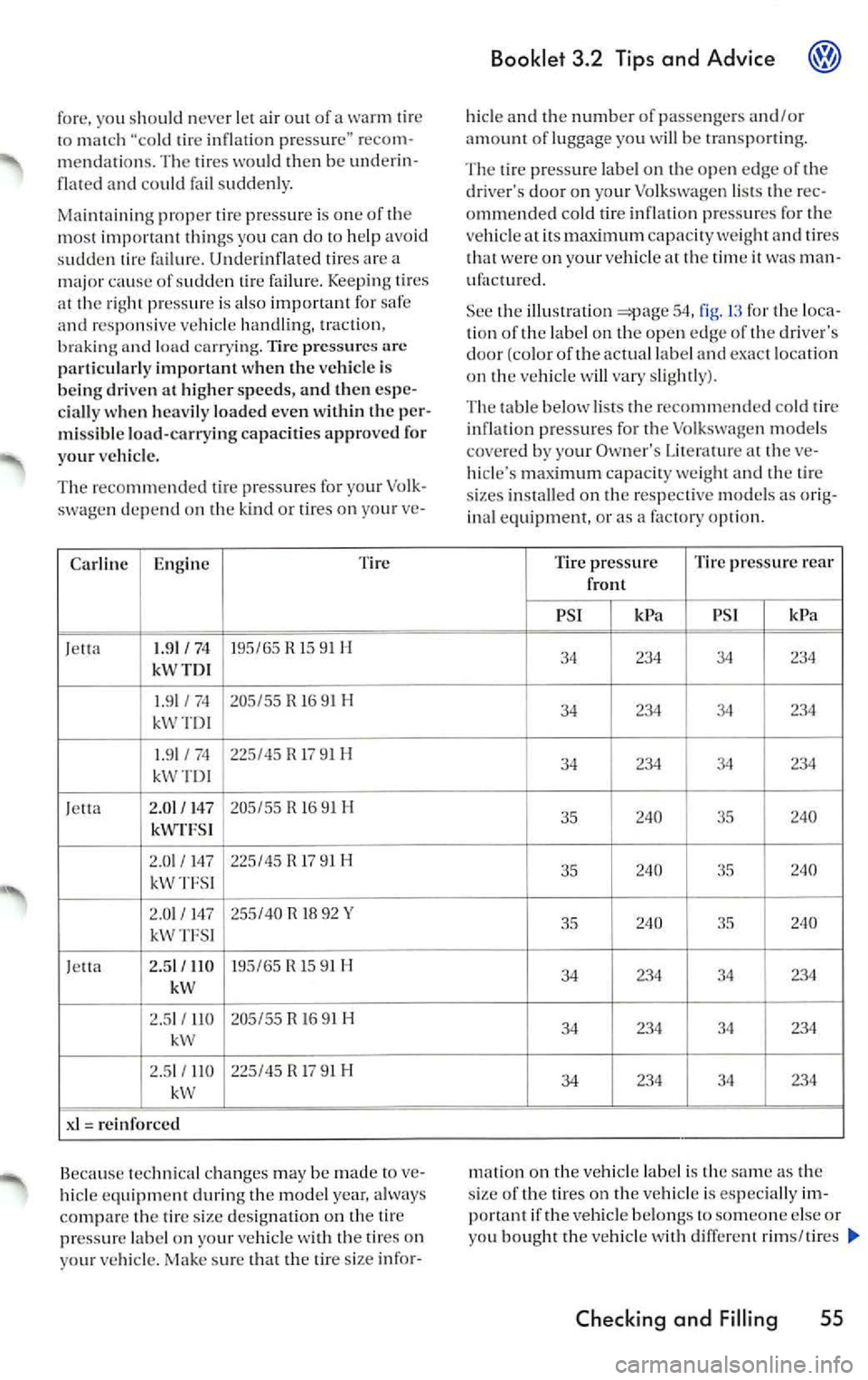
The reco mm end ed tir e pre ssure s fo r yo ur Volk
sw age n dep end on th e kind or tires on your ve-
Ca rlin e E ngin e Tire
Jet ta 1.91
/ 74 195/65
15 91 H
kWT DI
1.91/ 74 205
/55 R 16 91
kW TD I
1. 9 1 / 74 225/45
17 91 H
kW TDI
J etta 2.0
l / 147 205/55 R 16 911-1
2. 0l / 147 225/45
R 17 91 H
kWTF SI
2.0 1 / 147 255 /40
18 92 Y
kWTFSI
J e tt a 2.51/ 110 195/65
1 5 91 H
kW
2 .5 1 /
IIO 205/55 R 16 91 H
k W
2 .5 1 /
IIO 225/45 R 1791 H
kW
xi= reinfor ced
Be caus e
ch anges may be mad e to ve
hicl e equipm ent during the model year, always
c ompar e th e tire size designation on the tire
pr ess ure label on yo ur vehi cle
the tire s on
y ou r ve hicle. Make sur e that th e tir e s ize in fo r-
Booklet 3.2 Tips and Advice
hide an d th e number of passe ngers and /or
amo unt of luggage you will b e
The tire pr ess ure la b el on the op en edge of the
dri ver's doo r on your Volk swagen li sts th e rec
o mmended cold tire infla tion press ures fo r the
veh icle at its max imum capaci ty weight and tire s
th at were on your vehicle at the time it was man
ufa ctur ed.
See the illu stration
54, fig. for the loca
ti on of the label on the open edge of the drive r's
door (color of th e actual label and exact location
o n the vehicl e will vary slightl y).
table below li sts the recom mend ed co ld tire
inflation pressures for the Volk swa gen m odel s
cove red by your O wner's Lit era ture at the ve
hi cle's maximum capacit y weig ht and the tir e
s izes insta lled on th e res pec tive mode ls as ori g
in al e quipment , o r as a fa ctory opt ion .
Tire pressur e Tire pressure rear
front
PSI kPa
PS I kPa
34 234 34 234
34 234 34 234
34 234 34 234
3 5 240 35 240
35 240
35 240
35 240
240
34 234
34 234
34 2
34 3 4
234
34 234
34 234
mation o n the vehicl e lab el i s the same as th e
s ize of t he tir es on the ve hicl e is es pecially im
portan t if th e ve hicl e belo ngs to someo ne e lse or
y ou bou ght the vehicle with different rims/tires
Checking and Filling 55
Page 378 of 477
"Tires and ve hicl e lo ad limit s" for more imporinfor mati on.
Vehicles
ha ve full hub caps have valve ex
tenders ins tead of du st caps. To ch eck tire pr es
s ur e or acid air. you do not n eed to re move the
ex te nd er. 13e s ure to rein sta ll va lve dust caps
ch eck ing or adjust ing tir e pr ess ure.
A lways use an
tir e pr ess ure gaug e w hen
c h eck ing and adju stin g i nfl atio n pr essu res .
C hec k all of the
and b e sure not l o forg et th e
s par e tire. If p ress ure in an y is too high
w hen the tire is "co ld," let o ur of the tir e
s lowly with th e of the tir e ga uge and kee p
c h eck ing th e press ure until you re ac h th e pr es
s ure that is correc t for th e loa d (pa sse nge rs and
l u gg age)
ki nd of dri ving yo u plan t o do .
I f th e pr ess ure in any tire is too low , n ote the dif
f e re n ce between the press ure in the co ld
a nd
th e pr ess ure yo u need and add air yo u
n eed to reac h th e co rrect press ure for the vehicle
load (pa sse nge rs and lu ggage) for th e tire s on
yo ur vehicle as listed o n the on yo ur vehicle a nd
in thi s man ual
th e kind of driv ing y ou p lan
t o do .
Neve r excee d th e maxi mum infl ati on pre ssure
li sted on the tir e sid ewa ll for any reason.
R em emb er th at the ve hicle manufac turer, not
t h e tir e man ufa ctur er, de te rmin es th e co rrec t
t ir e pr ess ure for th e tir es o n yo ur vehicle
I t i s imp ortant
ch ec k th e tir e pr ess ure when
the tires are cold.
Vehicle witho ut
• the re quir ed tire pressure from the tir e
pressu re lab el on the ope n edge of th e dri ver's
door .
• Place the a ir press ure gauge on the dust cap s
- th ere is no need
re m ove them.
• The tir e press ures s ho uld onl y be checked
tire s cold. The sli ghtl y pres
s ur es ofwann tires no t b e reduced.
•
th e tire press ure to the load you are
ca rrying.
Vehicle with
• the req uir ed tir e pr ess ure from the tir e
pressure label o n th e ope n edge of the dr ive r's
do or.
Booklet 3.2 Tips and Advice
• Turn th e va lve s tem cap counter-clockw ise to
r emove it from the tire valve.
•
th e ai r press ure on the valv e.
• The tir e pressures sh o uld onl y be ch ecke d
w hen th e tir es are cold. T he slig htly rai sed pres
s ur es of
tires not be redu ced.
• Adju st th e tir e pr ess ure to the load you are
carry ing.
• Reins tall the valv e ste m cap on the valve.
When should I ch eck the tire pressure?
Th e co rrec t tir e pr ess ure is especia lly import ant
a t hi gh speeds . Th e pre ssur e s ho uld th erefo re be
c h ecked at leas t once a month and alwa ys befo re
s ta rt in g a jo urn ey. D o not forget to ch eck the tire
pr ess ure on th e spare whee l
When shou ld
I adjust the tire press ures?
Ad just th e tire press ure to the loa d you are car
ry ing. After changin g
wheel or repl acing
w hee ls yo u have tu adj ust th e tir e press ures on
a ll whee ls. In ad ditio n on ve hicles wit h TPMS,
yo u sh oul d s pecify new tire pressures
=boo klet
WARNING
In co rrec t tire press ure ca n result in sudd en
ti re failur e Jo ss of co ntrol, collision , seriou s
perso nal injur y an d eve n dea th .
•
tire s to the re co mm end ed and
co rrec t tir e pre ssure before drivin g off.
• Driving with und erinfl atcd tires bend
m or e, le ttin g th em get too hot res ulting in
tr ead separatio n, s udd en tir e fai lure ti re
fa ilur e and Jo ss of control.
• Excess ive sp ee d and /or ove rload ing ca n
ca use hea t build -u p, su dden tire failure in
cludin g a bl owo ut an d su dden deflati on and
Jo ss o f co ntrol.
• If th e tire pr essure is to o low or too high,
th e tir es will wear prema turely and the ve hicl e
wi ll not handl e we ll.
Not e
Dr iv in g w ith out valve s te m caps ca n cau se
applicab le Tire pressure monitoring system)
Checking and Filling 57
Page 379 of 477
Booklet 3.2 Tips and Advi ce
des with tire press ure m onito rin g sys te m To preven t thi s, always make that
fac to ry i nsta ll ed va lve s te m caps on a ll whee ls
are securely mount ed on th e valve .
Tires and vehicle load limits
There ar e limits to th e amo unt of load or we ig ht
t hat any vehicl e and any tire ca n carry. A ve hicle
t h at is over loaded will not handle well an d is
mor e difficult t o sto p. Overloadi ng ca n not only
l ead to loss of veh icle contro l, but can also
damage important parts of the vehicle and can
l ead to sudden tire failure, including a blowout
an d sudd en deflat ion that can ca use th e ve hicle
to crash.
Your safety and that of yo ur passengers also de
pe nds on making sure tha t load limit s are not ex
cee ded . Veh icle load includ es everybody and ev
e ry thing in and on the ve hicle. T hese load limits
are technica lly referred to as the vehicle"s Gro ss
Ve hicl e We ig ht Hating
The in cl udes the of the basic ve
h icle , a ll in sta lled accessor ies, full tank
of fuel, oil, coolan t and o ther flui ds p lu s max
imum load . Th e m aximum load includ es the
number of passe ngers that the ve hicle is in
te nded to carry ("seatin g capacity") with an as
su med weight of 150 lbs (68 Kg) fo r each pas
se nge r at a des ig n ati on sea ting pos ition and the
to ta l weight of any lu ggage in the ve hicle. If you
tow a traile r, th e weig ht of th e tra iler hitch and
th e tong ue weig ht of the lo ad ed tra iler mu st b e
included as part of the ve hicle lo ad .
T he Gross Axle We ig ht Hatin g
is th e
maximum load that ca n be appl ied a t eac h of t h e
ve hicl e's two ax les.
The Gross Ve hicl e We ight
and th e Gross
Ax le We ig h t are liste d on the sa fe ty com
pliance sticke r la b el o n th e driv er's door latch
pi llar Your Je tt a ha s 5 seat ing posit io ns, 2 in the
front and 3 in the rea r fo r to tal seating capacity of
5. Ea ch sea ting posi tio n ha s a safe ty belt
= book le t 2. 1 "Safety firs t."
58 Checking and Filling
For th e sake of env ironm ent
Yo ur car w ill ha ve a highe r consumpt io n
a nd unn ecessa ry ex hau st em iss ions with und er
inflated tires .
that there is an upper limit to your ve
hicl e' Gross Vehicle We ig ht Hati ng mean s that
th e
weight of whatever is be ing ca rri ed in
th e veh icle (including the we ight o f trailer
hit ch and the tongu e we igh t of the loaded
t railer) is limit ed. The more pa ssenge rs in the
vehicl e or passe ngers arc heav ier th an the
s tandard weigh ts assumed mean th at less
we igh t
be carr ied as luggage.
tir e pressure label on your Vo lkswagen also
lists the maximum combin ed weight of all of the
occupants and luggage or other cargo that th e
ve hicle can carry. For the locatio n of the label
54. fig. 13 .
WA RNING
Over loadin g a vehicle can cau se loss o f ve hicl e
co ntr ol, cras h or ot her accide nt, se rious per
s o nal injur y, and eve n death.
• Car rying more weig ht th an yo ur vehicle
des ig ned to ca rry will prevent the ve hicle
from handlin g proper ly and in crease the risk
o f th e loss of ve hicl e co ntrol.
• Th e brake s o n a ve hicl e th at has bee n over
l oa ded may not be ab le to stop th e vehicle
wit hin a
dista nce.
• Tir es on a veh icle that ha s be en over loaded
ca n
su dd enl y, includin g a blowout a nd
s udd en deflation, causin g los s of co ntrol and a
c ra sh .
• Alway s make sur e th at the total l oad bein g
tran sp ort ed - inclu din g th e we ig h t of a tra ile r
hi tch and the to ngue we ig ht of a lo aded trail er
- docs not make the vehicl e heav ie r than the
v eh icle 's Gros s Ve hicl e We ig ht H atin g
Page 381 of 477
Booklet 3.2 Tips and Advice
will be s ix 10 eight of them evenly pla ced aroun d tire. Marks on the tire s idewa ll (fo r ex amp le o r oth er symbols) indicate the p ositions
of the tread w ear in dica tor s. Wo rn tires mu st be
rep laced . Different figu res may apply in oth er
Tir e pressure
In co rrec t lir e pr ess ure cause s pr ematur e wear
and can cause s udden tire blow -out. F or thi s
r easo n, tir e pressure must be c hec ke d at leas t
o nce a m ont h
56.
Driving style
Drivin g fast around cu rves, heavy acce lera tio n
and hard braking increase t ir e w ear.
Rotating tir es for more even wear
I f th e front tires are worn consid era bly m ore
than t he re ar ones, rotate th em as sh own
59, fig. 15 . All the tir es will then last for
about sa me of tim e.
A ll
tir es s hou ld have th e sam e am ount of
wear. All four w heels must have the sa me ro lling
ci rc umf ere nce.
Wheel balancing
Th e wh eels on ne w ve hicl es are balan ced. H ow
eve r. various situations during every d ay driv ing
can cause them
b ecom e unbalan ced, r e
s ultin g in vib rat io ns y ou can usuall y fe el throug h
th e steering wheel.
Unbalan ced w hee ls mu st be reb alan ced to avoid
e x cessive wear on stee ring, suspen sion and
60 Checking and Filling
tire s. A wheel also be rebalan ced w hen a
new lire i s in stalled .
In correct whee l alignment
Incorr ect whee l alignment can cause exc ess ive
ti re wea r, impa ir in g
safe ty of the ve hicle. If
t ir es s how excess ive wear, have wheel align
m en t ch ecke d by an authori zed Vol ksw age n
d ea le r or qualifi ed work sh op.
WARNING
Sud den tir e fa ilur e ca n le ad to lo ss of con trol ,
a cra sh and serious persona l injury!
• Neve r drive a vehicle wh en th e trea d on
any tire is wo rn dow n to the wea r indicator s.
• Worn tires a rc a sa fety hazar d, the y do not
gr ip we ll on wet roads and increase y our risk
of "h yd ropl anin g" and lo ss of contro l.
• Always kee p ch emi cals that can ca use tir e
d amage, s uch as g rease, oil , gaso line and
brak e fluid away from tire s.
• Tire s age even if th ey a rc not b ein g use d
and can fail sudd enl y, es pecially al high
s pe eds . Tir es that a re more than 6 year s old
can onl y be use d in an emergen cy and th en
w ith sp ecia l care a nd at lowe r sp eeds.
• Neve r mount u sed tire s on your vehicl e if
you a rc not sur e of their "pr ev iou s hi stor y."
Old use d tir es ma y ha ve been d amaged eve n
th ough the d am age ca nnot b e seen that can
lead t o sudd en tir e failure and loss of vehicle
Page 384 of 477
Maximum Perm issib le Inflatio n Press ure
T his nu mb er is th e g re at est a mount of
pres
s ur e tha t sh oul d ever be put in the tire und er
norma l driv ing cond itio n s.
R ep lac in g tires or rims on vehicles equipp ed
wit h
The air va lve o n all four tires (no t on the spare
ti re) is equip ped with a senso r, w hic h co nsta ntly
m on itors
a ir pr ess ure in side the tire, a nd
the n this Lu If
yo u ar e going to re pl ace the wheel rim s o n yo ur
ve hicl e, make sure the rim s also have these
se nso rs. The se nsor s mu st be co mp atib le w ith
TPM S sys tem o n yo ur vehicle .
I f yo u install rim s. w hich do not have th e se n
sors, o r ha ve sensors w hich are not comp ati ble,
th e TP MS will not wor k pro perl y. In case, theTPM S would n ot b e ab le to m oni tor pr ess ure or wa rn you if is necessa ry.
• Wheneve r you c hange se nso rs, yo u ha ve to
i n sta ll
valves.
•
dri ve the valve ste m cap s se
c ur ely m ou nted. We reco mmen d usi ng fac to ry
i n sta lle d va lve stem caps. As k your auth ori zed
Volkswage n dea le r if yo u los t va lve
caps.
T he in sta llat io n of re pla ceme111 tires
c ord hody plies in the tire si dewa ll m ay ca use
ma lfu nction tir e pre ssure monitorin g
sys te m (TPM S), and i s not recommended (cord
mat eri al informatio n is m olded on
ti re s ide
wa ll).
ch ec k yo ur TPM S indi cator af te r r eone or more tires o n yo ur vehicl e. If t he
TP MS indi cator is on. your TPMS is m alfu nc
ti o nin g. Your
tire m ig ht be incom
patibl e yourTP MS system, or some co mp o
n en t of the TP MS may be dam aged .
WARNING
• Usin g in cor rect or unmatched tires and
I or wheels or improper tire and whee l co mbi
nation s can le ad to loss of con tro l, co llisio n
and serio us perso nal injury.
• Always use tires, rims and whee l bo lts th at
me et th e specification s of ori ginal fa ctory- in
s talled tire s or other combination s th at h av e
b een sp eci fica lly app roved by the vehicle
manufa ctur er.
Booklet 3.2 Tips and Advice
WARN ING (continued)
• Tire s age even if they arc not being use d
and can fail su ddenl y, es peci ally at high
s peeds. Tire s th at are more than 6 yea rs old
can only be use d in an em ergenc y and then
w ith specia l care and at lower speeds.
• Never mount use d tir es on your vehicle if
yo u are not sur e o f th eir "previou s hi story."
Old used tir es ma y ha ve bee n damag ed even
th ou gh th e dam age ca nnot be seen that ca n
l ead to sudd en tir e fa ilur e and lo ss of vehicl e
control.
• All four whe els must be fitted with radi al
tir es of the s am e type, size (ro lling cir cumf er
ence) and th e sa me tread p attern. Dri ving
w ith diff erent tire s reduces ve hicle han dling
a nd can l ead to a loss of control.
• If the spare tire is not th e same a s th e tir es
that are mount ed on the vehicle - for examp le
with winter tir es - only u se the sp are tir e for a
s h ort period of tim e and drive w ith extra care.
Refi t th e no rma l road w hee l as soo n as safe ly
possib le.
• Neve r dri ve
than th e spe ed for wh ic h th e tires on you r ve hicle are
rat ed because tires that arc driven fas te r than
their rated sp eed ca n
sudd enly .
• Overloadin g tir es cause h eat build -up ,
s ud den tire failur e, includin g a blowout and
sudden defl ation and loss of co ntrol.
• Temperat ure grades apply lo tir es that are
properl y inflat ed and not over o r underin
flated .
• For tec hni cal reaso ns it i s not always pos
s ibl e to use whee ls from oth er ve hicles-in
s om e cases not eve n whee ls from the sa me ve
hicle model.
• If you insta ll w hee l trim d iscs on th e ve
hicle whee ls, make sur e that th e air flow to the
brakes is not blo ck ed. R edu ced airflo w to the
brakes can th em to ove rheat , in cre asin g sto p
ping distances and causin g a colli sion .
Checking and Filling 63