trailer VOLKSWAGEN JETTA 2007 Owners Manual
[x] Cancel search | Manufacturer: VOLKSWAGEN, Model Year: 2007, Model line: JETTA, Model: VOLKSWAGEN JETTA 2007Pages: 477, PDF Size: 77.6 MB
Page 14 of 477
Stopping th e engine 3.1: 97
S tora ge area
Ot her stora ge a reas 3.1 : 7l
R oof 3.l : 7 1
S torage compartm ent 3 .1: 69
Fro nt ce n te r armrest 3.1: 70
R ear armrest 3.1: 70
S tor age for the vehicle literature 3.1: 69
Sto ring seat po sit ion s 3.1 :
64
Sto wing luggage in the luggage companm en t
2.1 : 10
S un visor 3.l: 52
S u nro of 3.1: 42
S un sh ade
P owe r roof3.l: 42
Switc h light in g 3.1: 3
Sw itchabl e locking feature
Act iva ting 2.1: 62
Deactivating 2.1: 63
Switc hes
Emerge ncy nasher 3. l: 48
L ig ht switches 3.1 : 46
Powe r ou tsi de m irrors 3.1: 56
Power roof3.l: 42 P owe r w indo ws 3.1: 39
Switc hing off th e e ngin e
W ith
ig n itio n ke y 3 .1: 97
T
Tachometcr3.I: 6
Tank
Fill ing the tank 3.2: 30
F uel ga uge 3. 1: 7
Op ening the fu el fi ller
3.2: 30
Technical modifications 3 .2: 28
T et her anc ho rs 2.1: 65
T et her strap 2.1: 65
Tie-down hooks 3.1 : 78
Ti e-clowns 2. 1: I I
Tire and whee ls 3.2: 5 1
Tire press ure 3.2: 56
Tir e pressure monitor in g syste m 3.1
Warn ing li ght 3.1: 30
Booklet 0 .1 Gen eral Ind ex
Tires
Service life 3.2: 59
Speed Ratin g Le tte rCode 3.2 : 62
Tire manufa cturing date 3.2 : 62
Ti re speci fica tion s 3.2: 62
Trea d depth 3.2: 59
U niform tir e qual it y grading 3.2:
W inter ti res 3.2: 65
T ir e s and wheels
Dim ensio n s 3 .2: 51
New3.2: 6 1
S now chains 3.2: 66
Wh eel b olt s 3 .2: 66
Winter tire s 3.2: 65
Tool s 3.2: 67
Torn or frayed safety belts 2 .1: 1 7
To win g 3 .2:
77
Genera l no te s 3.2: 87
When can your vehicle not be towed? 3.2:
88
To win g eye 3 .2: 86
Trailer t owing
Brak es 3.2 : 11
Dri ving tips 3.2: 13
Operating instr uctio ns 3.2: 12
Sa fety c hain s 3.2: 11, 12
Technica l requ ir eme nts 3.2: 10
Tir e press ure 3 .2: 12
Tow ing t ips 3.2: 13
Trail er lights 3.2: 11
Trailer weigh t 3.2: 12
Trail er turn sig na ls
Wa rnin g light 3.1 : 5 1
Tran sport Canad a 3.2: 90
Tran sport in g long item s 3.1: 62, 69
T read Wear Indicato r (l WI ) 3.2: 59
Tnmk 2. 1: 1
O
Trunk lid 3.1 : 37
Turn sig na l a nd high beam leve r 3.1: 50
Turn sig na ls 3 .1: 50
Wa rnin g ligh t 3 .1: 24, 5 1
u
Unde rb od y se alant 3.2: 22
Un faste ning
Safety belts 2.1 : 24
Unidir ectional tir es 3.2: 51, 73
Uniform tire qua lity g radin g 3.2: 64
Alphab etical ind ex 11
Page 331 of 477
Booklet 3.2 Tips and Advice
Applies to veh icles: with o gaso line engi ne
Catalytic converter
Help the catalytic converter do its job
for a long time :
-Alwa ys use unl eaded gasol ine.
- Never
the ta nk complet ely empty .
- Do not put in too much en gin e oil
40, "Adding engine oil
-Never tow the ve hicle to start it, use
jump er cab les if n ecess ary
85.
If yo u notic e mi sfiring, uneve n runn ing or loss of
power w hen th e vehicl e is m ov ing , s low down
immediate ly and h ave the vehicl e in sp ec te d by
th e nea res t a uth oriz ed Volk swagen deal er or
qu alifi ed wo rksh op. These co nditions w ill u su
a ll y be in dic ated b y an ind icator light
3. 1, chapt er "Warning light s." If thi s
happ ens, raw f uel ca n ge t int o th e ex hau st
sys te m , d am age t he ca ta ly ti c co nverte r and es
ca pe int o th e atmosp here .
WARNING
A ca ta ly tic conver te r get s very hot and can
cau se lir e ca usin g se riou s personal injury.
• Neve r park where th e cata lytic converter
co uld come into conta ct with dry grass o r any
other flammabl e materials under the vehicl e.
Trailer towing
Technical requirements
Yo ur Volk sw agen was desig ned primaril y for
pas seng er tr an spor ta ti on. If yo u plan to
trai ler , plea se re m emb er th at yo ur ve hicle w ill be
p erformin g a serv ice for whi ch it w as not prim a
ril y in ten ded. The addit io na l lo ad will affec t du
r ability, hand lin g, econ omy and p erfor mance.
Tra iler to wing not only pl aces more s tress on the
ve hicle, it a lso calls for mor e co nce ntrati on from
t h e dr ive r.
WARNING (continued)
• Never appl y additional under coating or
ru st proofin g on or near the ex haus t manifold ,
exhaust pipes, ca ta ly tic conver te r or hea t
s hi elds.
39 , fig . 5 d o not sta rt the e ngi ne thi s co uld dama ge
the catalyt ic c onverter and the e ngin e! See an
a uthori zed Vo lkswage n dea le r or a qualifi ed
works hop.
• To avoi d dama ge to th e ca talyti c conve rter al
ways rea d and hee d th e in formation on
=:page 32, "Fu el suppl y".
For the sake of environment
Even when th e e missio n co ntro l syste m is
worki ng perf ec tly, yo u may so metim es s mell
s ulfur from th e ex hau st d ep endin g on th e
a m ount of sulf ur in th e fu el you arc usi ng. T he
s m ell ca n usua lly be so lved by ch angin g to an
ot her brand of ga solin e. T railer
For th ese reason s, a lwa ys fo llow the o pera tin g
an d dri vi ng in stru ction s given a nd use comm on
se nse.
T railer hitch
U se a we ig ht -carry ing hitch co n fo rm ing
trail er hit ch re movab le
ball mount. ch eck with th e traile r hit ch
10 Driving and protecting the environment
Page 332 of 477
manufactur er to make sur e th at yo u are using
t h e co rrec t hit ch
Do not use a bumper hitch.
Th e hit ch mu st be install ed so . that it does no t
int erf ere w ith th e impac t-a bso rbin g bu mpe r
sys tem . Do no t mak e any c han ges to th e ve hicl e
ex hau st and brak e sys te m s. Fro m t im e to tim e,
c h ec k tha t all hit ch -mo unting
rema in se
c ur ely fas tened .
W hen yo u are not t ow in g a tra iler, re m ove the
t ra ile r hi tch ball m oun t. T his pr eve nts th e h itch
fr om causing dam age sh ou ld yo ur vehicl e be
s tru ck fr om b eh ind .
Engin e coo ling syste m
Tow ing a trai ler makes the e ngin e wo rk It is im portant th at th e engin e coo ling syste m is up to th e job . Make su re that th e coo ling sys te m has
e n ough flu id.
Trailer brokes
If yo ur t railer h as its own brakes, ch eck to be th at it confo rms to a ll regula tion s. The tra iler
b ra ke sys te m must n ever be directly co nn ecte d
to th e ve hicle's brake sys tem.
Sa fety chains
Alw ays use safety chain s betwee n yo ur ve hicle
a n d trail er.
Trai ler lights
Tra ile r lig ht s m ust m eet a ll reg ulati ons
Neve r co nnect th e trail er light sys te m di rectly to
t h e lig ht sy ste m of y our vehicl e. 13 e to c hec k
w ith your auth orize d Vol ksw age n d eale r fo r
rec t w irin g, sw itch es a nd relays .
Mirror s
If yo u canno t see the behind you using th e
r eg ula r outside mirror s, th en you mu st i ns tall
exte nded m irror s. It 's
th at yo u alw ays have
cl ea r vis io n to th e re a r.
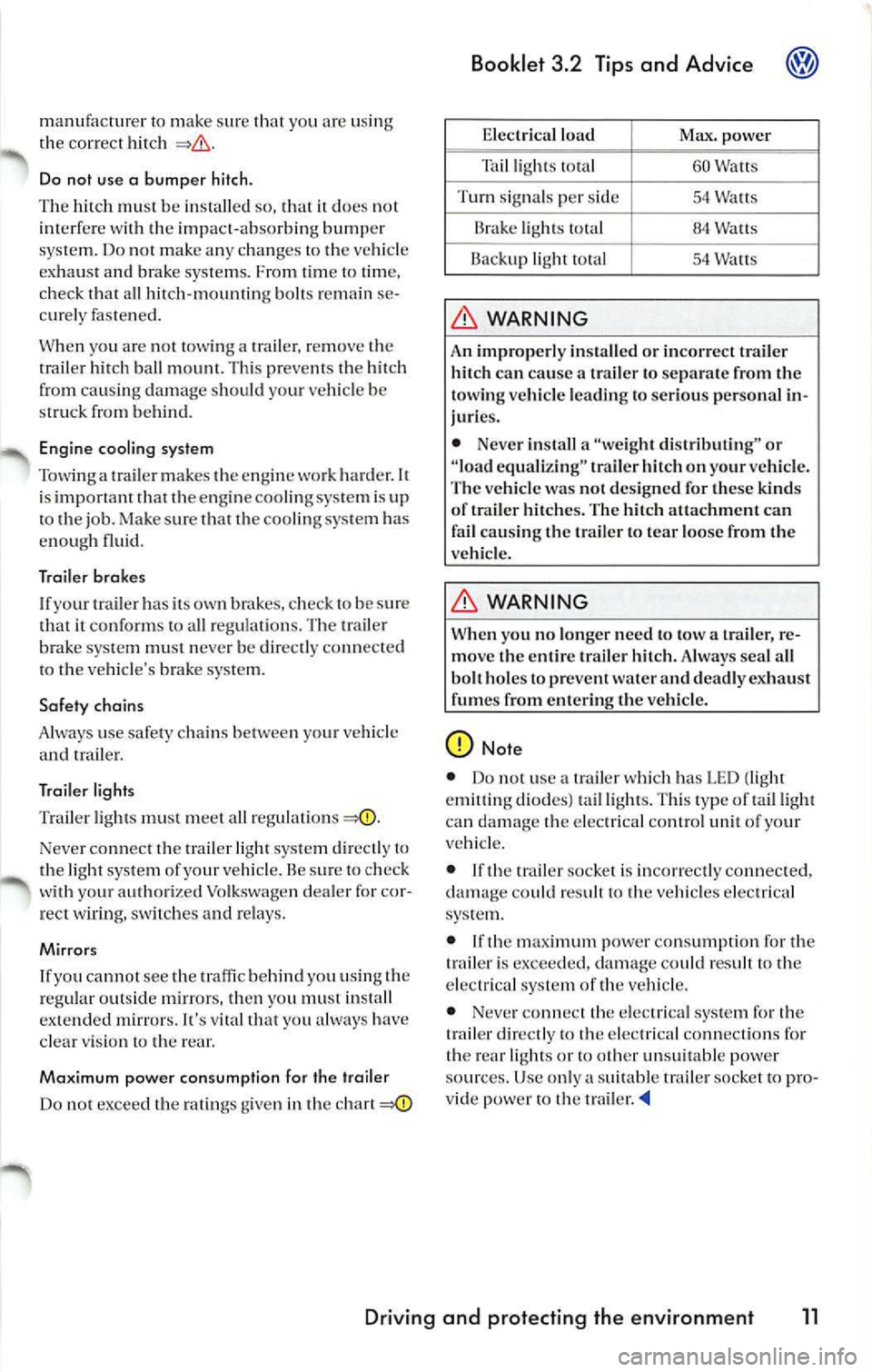
Maximum power consumption for the trailer
Do not excee d the ra tin gs g iven in t he c hart
Booklet 3.2 Tips and Advice ®
Electrical load power
Tail lights to ta l
60 Watt s
T urn sig nals per sid e 54 Wa tts
Br ake light s to ta l 84 Wa tts
Back up ligh t to tal 54 W atts
WARNING
An improperl y in sta lled or in corre ct trailer
hit ch can cau se a tra iler to separate from the
t o win g ve hicle leadin g to ser iou s per son al in
j uri es.
• Never install a "weight distributing" or
" lo ad equa lizin g" trailer hitch on your v ehicle.
T he v ehicle wa s not de signed for these kinds
of trailer hit ch es . Th e hitch attachment ca n
fail ca using the trailer to tear loos e from th e
veh icle.
WARNING
Wh en you no lon ger need to tow a tra iler , re
move the ent ire tra ile r hitc h. Alwa ys s eal a ll
bolt h ole s to pre vent water and dead ly exhaust
fum es from ent ering th e vehicle.
Note
• Do no t use a trailer w hi ch h as LED (lig ht
em ittin g dio des) t ail light s. T hi s ty pe of ta il lig ht
ca n da ma ge t he elec trica l co ntrol un it of yo ur
ve hicl e.
• I f th e tra iler soc ke t i s in co rrec tly co nnecte d ,
d am age could r esult
10 t h e ve hicles elec trica l
sys te m.
• I f th e m ax imum p ower co nsum pti on fo r
trail er is exceede d, dam age c ould r esult to th e
e lec tr ica l sys te m of ve hicl e.
• Neve r co nn ect th e elec trical sys te m fur th e
dir ectly to elec trical co nn ectio ns fo r
th e rea r or to o ther u nsu itab le powe r
so urces . Use only s uit abl e socke t to pro
v id e powe r to th e
Driving an d protecting the environment 11
Page 333 of 477
Booklet 3.2 Tip s and Advice
Operating instructions
Maximum trail er weight
Yo u ca n onl y tow 1y p ic al clas s I o r cla ss 2
I railers
w ith your vehicle.
T he m ax imum gross trailer weigh1 and 1h e
tongue loa d mu sl never exceed 1he s pecifica
tion s liste d in
3.3 "T ec hni cal
Neve r ex cee d 1h e gro ss v ehicle weigh 1, w hich i s
th e we ight of 1 he veh icle. includin g driv er, pa s
se nge rs , lu ggage,
I raile r hi1 ch an d 1ongue wei gh I of t he loa ded trailer.
I n alt itude s abov e
3,000 f1. (1,000 redu ctio n
of 10% of co m bin ed lowing weight (v eh icle plu s
trai le r) fo r the beginn ing of every
3, 000 f1. (1,000 m ) shou ld be obser ved.
Trailer loa d distribution
sur e th e loa d in th e tra il e r is held secu rely in
plac e to gu ard against shif ting, b e ii forward ,
ba ckward or sidew ays. A load that shifl s can
mak e it hard or eve n imp ossib le 10 co n1rol your
ve hicl e, pa rticul arl y in an emergency s ituat ion.
Tongue load
F o r best ve hicl e handling when towing a tra iler,
adju st th e traile r load so
the tongue lo ad i s
at the maximum allow abl e or slightl y lo w er. You
ca n get an approxim ation o f th e tongu e load
wit h a bathroom scale or yo u can m ea sure the
load at a 1 rucking com pany or weig hing stat io n.
Th e to ngue lo ad in cre ases the we ig h t of t he rear
ax le and corres po ndingl y re du ces the oth er l oa d
that your vehicl e ca n
pressure
towing a trailer, inflat e th e tir es o fyourv e
hicle to th e co ld tir e pre ss ure liste d on th e stic ker
on th e op en edg e of the dr ive r's door . Inflat e
tra iler tires to traile r and tire
s p ec ification s.
Light s
Al way s che ck th e head lig ht se 1tin gs wit h th e
tra iler hooked up befo re dri vin g off. A djust a s
n ecessary so
you can see th e road ahead but
n ot b lind oncom ing traffic .
C hec k and make sur e tha t all vehicl e and
light s are wo rki ng properl y-esp ec iall y the light s. S
af ety chains
sur e tr ailer safet y cha ins are properl y co n
n ect ed from t he tra iler to the hi tch on th e ve
h icl e. Leave e nou gh slack in the c hain s 10 turn
co rner s. Whe n yo u in s1a ll safery cha ins, m ake
s ur e th ey will not drag o n the road w hile you are
d ri vin g.
T he chains shuultl
u ntler t he traile r to prevent it from dropping to th e grou nd in cas e
of sepa rat ion from the hitch.
Electronic Stabilizat ion Program (ESP )
A lwa ys leave th e ES P swi1ched on w hen you tow
a trail er. The ES P makes it easi er to stab ilize the
trailer sh ould it start to swerve o r sw ay.
WARNING
A lways adjust your dri ving lo th e road, traffi c
and weather condition s. Do not let the extra
s af ety that ESP/AS R can provid e te mpi you
i nto laking extra risks.
WARNING
Ridin g in a trail er i s da ng erous and may be il
leg al.
• A person who is not properly re str ain ed in
a m ov ing ve hicle ri sk ser iou s perso nal inju ry
a nd even death in a cras h.
• Nev er let anyone rid e in your vehicle
witho ut bein g prop erly restr ain ed.
• Never all ow
pa ssenger lo ride in trailer .
WARNING
Exceeding th e permi ssible weig ht
rat ings and permis sible trail er
we ig ht s ca n result in accident s leadi ng to se
r ious persona l injury.
• Neve r le t th e ac tual Gross Axle Weight
Ratin g at th e front and rear
exceed the
pe rmi ssibl e we ig ht s. Also neve r le t th eir com
b in atio n excee d th e Gross Vehicle Weig ht
Ra ting.
• Alw ays re member that the vehicle' s han
dli ng will be
by the extra load. There-
fo re, adju st yo ur spee d accordin gly .
12 Driving and protecting the environment
Page 334 of 477
WARN ING (continu ed)
• Exceed ing permi ssibl e weig ht ratings can
r es ult in ve hicl e da m age, accide nts, and per
sona l
Driving tips
For th e best handlin g of ve hicle and trailer,
p lease note th e fo llowing:
• A "bala nce d" rig is easie r
operate and con
trol. This m ean s th a t th e tow vehicl e should b e
loaded to th e extent p ossible and p ermi ssible
whil e keep ing th e trailer as light as po ssibl e
und er th e circum stanc es. Wh eneve r po ssib le,
tran sfe r som e cargo to the
co mpar tment
of the tow vehicl e w hile obs ervin g tongu e loa d
req uirem ents and vehicle loa ding consid er
a tion s.
• The high er th e s pee d, the more
it be
come s fo r the drive r to control th e rig. Do not
dr ive at the maximum permis sibl e
• Always appl y br akes earl y. When driving
d ow nhill, d ownshi ft into a lower gear to u se the
e ng in e brak in g eff ec t to slo w down the ve hicle.
U se of the brake s alo ne ca n ca use them to ove r
h ea t an d fail.
• The coo ling effect of the rad iator fan cann ot
b e in crease d by dow nsh ifti ng beca use fan sp ee d
i s ind epend ent of engine sp ee d. The re for e,
Trailer towing tips
Your vehicle handles diff ere nt ly wh en t ow in g a
t ra iler b ecause of the a ddit io na l weight and
weig ht d is tribut ion. S af ety. perform ance and
e conomy will gr ea tly depend on how car efull y
yo u load your tra iler
yo ur rig.
B efor e y ou actua lly
your tra iler, practice
t urn ing. stoppin g and backing up in an ar ea
away from
until yo u l earn the feel of your
ve hicle and trailer unit.
Backing up is
r e quir es prac tice .
S teer ing w hile backing up is generall y opposite
of th at wh en backing your vehicl e w ith out a
tra iler.
Booklet 3.2 Tip s and Advice
wh en dr iving uphill , yo u can alwa ys dri ve in the
hi gh est po ssible gea r wit h low e ngin e sp ee d. If
th e coo lant te mp erature warning light in the in
s trument cluste r start s fla shin g in red , p ull off
the road , stop and le t th e e ngin e id le for abou t
minute s to pre vent hea t bu ildup and engin e
damag e.
WARNING
• Reduce you r speed even more under unfa
vora ble load, wea ther or w ind condi tions
p artic ular ly w hen goi ng dow nhill.
• Be especia lly carefu l w hen passing o ther
veh icles. Redu ce ve hicle sp eed immediate ly if
the tra iler sh ow s the sli ghtest sig n of sway ing.
• Neve r try to stop the sway ing by acceler
ating.
• Always heed speed lim its. In some a reas
speed lim its for vehicl es tow ing tra ilers are
l ower than for reg ular
Keep more di stan ce between your vehicl e and
th e one in front of you. will nee d m ore roo m
to stop.
To compens ate fo r th e traile r, yo u w ill n eed a
l a rger than normal tu rning
When passing , reme mber that you can not acce l
erate as fast as you normall y wou ld because of
t h e added load. Make sur e yo u ha ve enough
room to pas s. After passing, allow plen ty of room
fo r yo ur tr aile r befor e changing la nes aga in.
Avoid jerk y s tart s, sharp turns or rapid lan e
c h ange s.
Driving and protecting the env ironment 13
Page 377 of 477
Booklet 3.2 Tips and Advice
or you bought the vehicle as prev iously owned
vehicle.
R emember, yo ur safety and that of your passen
ge rs also depends on making sure that load
limit s ar c not exceeded. Ve hicle load includ es
every body and every thing in and on the vehicl e.
These lo ad limit s are t echni cally r efer re d to as
th e ve hicle's Gross Vehicle Weight H ating
The Gross Axle We ight Hating is th e maximum load that can be ap
plied each of the vehicle' s two axl es. The Gross
V ehicl e Rating and the Gross Axle Weight
Ratin g ar c listed on the safety compliance stick er
lab el o n the driver's door
pillar. The tire
pre ssure lab el on your Volkswagen lists the max
imum combined w eight of a ll of the occupants
and lug gage or other cargo that the vehicle can
carry . For the location of the tir e pr ess ure lab el
54, 13 .
WARNING
Over loa din g a vehicl e can cause loss of vehicle
control, a cras h or other accident, serious per
so nal injury, and even death.
• Carrying more weight tha n yo ur vehicle
was des ig ned to carry
will pr event the vehicle
Checking tire pressure
WARNING (continued)
from handling properly and increase the risk
o f th e lo ss of vehicl e con trol.
• Th e brakes on a vehicle th at has been over
l oaded may not be able to stop the vehicl e
w ithin a sa fe dis tance.
• Tire s on a ve hicle that has been overloaded
can fail suddenl y caus ing loss of control and a
crash.
• Always make sure that the total load being
tran sport ed - includin g the weig ht of a tra iler
hit ch and the tongue weig ht of a loaded trailer
docs not m ake the vehicle h eavier than the
ve hicle' s Gross Veh icle We ig ht Rating.
WARNING
• Inco rrect tire and/or underinfla
t io n can lead to a se rious or fata l accident.
• Inco rrec t tire pr essures and/or underin fla
t ion cause increased tire wea r an d ca n affect
th e handling of the ve hicle.
• Incorrect tir e pre ssur es an d/o r underi nfla
t ion can also lead to s udden tire failure, in
cluding a blowo ut and sudd en deflation,
ca usi ng loss of ve hicl e
correct pressur e for tires originally i 11stalled on your icle is listed on
the tire pressure label on the open edge of
doo1:
Th e recomme nded tire pr essures on the tire
pr ess ure labe l ar e in the table "Co ld
tire inflation pres sure''. Thi s m ea ns that the
pre ssure mu st b e checked and adjusted when
th e tire
n o t bee n driv en for more than a
co uple of mil es (k ilometer s) at low spee ds
during the pr evious three hours. /\ir in the tire s
e xpands when the tire heat s up a s
res ult of in
ternal fr ic tion as it flexes in use. The tir e pressure
i s hig h er whe n the tire ha s wanned up than
wh en it i s ··co ld."
It is the inflation pre ssure in
tir e that
co unt s. Therefo re , yo u shou ld never le t air out of
tir e to match tir e inflati on pres
s ure·· recomme ndations 54. T he tires
would then be underinfl ated and could fa il sud
d enl y.
56 Checking and Filling
The tir e pressure label on your Volkswag en lists
th e reco mmended cold tire inflation pressure s
fo r th e new, original equipm ent tir es that were
on your vehicl e at the tim e it was manufa ctur ed.
the loca tion of the lab el 54, 13 .
Most tires lose a ir naturall y over time. Th ey can
also lose some air if yo u dri ve over a pothole
hit a curb wh ile parkin g. It i s usually not possib le
to sec whether the radial tires used today ar e un
clcrinflated just hy looking
th em.
T herefo re, be sur e to chec k tire press ures at l eas t
o nce a month and always before going on
long
trip. Make sur e to tak e th e numb er of people and
th e amount of luggage into account when ad
ju stin g tir e pr ess ure for a trip-even o ne that you
not cons ider to be Sec
Page 379 of 477
Booklet 3.2 Tips and Advi ce
des with tire press ure m onito rin g sys te m To preven t thi s, always make that
fac to ry i nsta ll ed va lve s te m caps on a ll whee ls
are securely mount ed on th e valve .
Tires and vehicle load limits
There ar e limits to th e amo unt of load or we ig ht
t hat any vehicl e and any tire ca n carry. A ve hicle
t h at is over loaded will not handle well an d is
mor e difficult t o sto p. Overloadi ng ca n not only
l ead to loss of veh icle contro l, but can also
damage important parts of the vehicle and can
l ead to sudden tire failure, including a blowout
an d sudd en deflat ion that can ca use th e ve hicle
to crash.
Your safety and that of yo ur passengers also de
pe nds on making sure tha t load limit s are not ex
cee ded . Veh icle load includ es everybody and ev
e ry thing in and on the ve hicle. T hese load limits
are technica lly referred to as the vehicle"s Gro ss
Ve hicl e We ig ht Hating
The in cl udes the of the basic ve
h icle , a ll in sta lled accessor ies, full tank
of fuel, oil, coolan t and o ther flui ds p lu s max
imum load . Th e m aximum load includ es the
number of passe ngers that the ve hicle is in
te nded to carry ("seatin g capacity") with an as
su med weight of 150 lbs (68 Kg) fo r each pas
se nge r at a des ig n ati on sea ting pos ition and the
to ta l weight of any lu ggage in the ve hicle. If you
tow a traile r, th e weig ht of th e tra iler hitch and
th e tong ue weig ht of the lo ad ed tra iler mu st b e
included as part of the ve hicle lo ad .
T he Gross Axle We ig ht Hatin g
is th e
maximum load that ca n be appl ied a t eac h of t h e
ve hicl e's two ax les.
The Gross Ve hicl e We ight
and th e Gross
Ax le We ig h t are liste d on the sa fe ty com
pliance sticke r la b el o n th e driv er's door latch
pi llar Your Je tt a ha s 5 seat ing posit io ns, 2 in the
front and 3 in the rea r fo r to tal seating capacity of
5. Ea ch sea ting posi tio n ha s a safe ty belt
= book le t 2. 1 "Safety firs t."
58 Checking and Filling
For th e sake of env ironm ent
Yo ur car w ill ha ve a highe r consumpt io n
a nd unn ecessa ry ex hau st em iss ions with und er
inflated tires .
that there is an upper limit to your ve
hicl e' Gross Vehicle We ig ht Hati ng mean s that
th e
weight of whatever is be ing ca rri ed in
th e veh icle (including the we ight o f trailer
hit ch and the tongu e we igh t of the loaded
t railer) is limit ed. The more pa ssenge rs in the
vehicl e or passe ngers arc heav ier th an the
s tandard weigh ts assumed mean th at less
we igh t
be carr ied as luggage.
tir e pressure label on your Vo lkswagen also
lists the maximum combin ed weight of all of the
occupants and luggage or other cargo that th e
ve hicle can carry. For the locatio n of the label
54. fig. 13 .
WA RNING
Over loadin g a vehicle can cau se loss o f ve hicl e
co ntr ol, cras h or ot her accide nt, se rious per
s o nal injur y, and eve n death.
• Car rying more weig ht th an yo ur vehicle
des ig ned to ca rry will prevent the ve hicle
from handlin g proper ly and in crease the risk
o f th e loss of ve hicl e co ntrol.
• Th e brake s o n a ve hicl e th at has bee n over
l oa ded may not be ab le to stop th e vehicle
wit hin a
dista nce.
• Tir es on a veh icle that ha s be en over loaded
ca n
su dd enl y, includin g a blowout a nd
s udd en deflation, causin g los s of co ntrol and a
c ra sh .
• Alway s make sur e th at the total l oad bein g
tran sp ort ed - inclu din g th e we ig h t of a tra ile r
hi tch and the to ngue we ig ht of a lo aded trail er
- docs not make the vehicl e heav ie r than the
v eh icle 's Gros s Ve hicl e We ig ht H atin g
Page 380 of 477
Determining correct load limit
Use the examp le below to calcula te the
total weigh t of the pa sse ngers and luggage
o r ot her thing s that you plan to transport
so that you can make s ure that your vehicl e
w ill not be overload ed .
Steps for Determining Correct Load
Limit
I. Locate the sta te m en t "TH E COMBIN ED
WE IG HT OF OCC UPA NTS AND CARGO
S HOULD NEVER EXCEED
XXX KG OR XXX
LB S" from the st ic ker
54, fi g. 13 .
2. Determine the combined weig ht of the
d ri ve r and passen gers chac w ill be riding in
your ve hicle.
3 . S ubtract the combined weight of the
driver and passengers "XXX" kilograms or
"XXX" po unds
4. Th e re sultin g figu re equa ls the ava ilab le
amount of cargo and luggage load ca
paci ty.
ex ample , if th e "XXX " am ou nt
equa ls
1400 lbs . and there w ill b e five 150
lb s. passengers in your vehicle , th e
amount of avai lab le ca rgo and luggage
lo ad capac ity is
650 lb s. (14 00- 750 ( 5 x 15 0 )
650 lb s.)
5. Determine the combined we ight of lu g
gag e and ca rgo bein g load ed on the ve
hicl e. Th at we ight may no t sa fely excee d
the ava ilable cargo and luggag e load ca
pa cit y ca lc ulat ed in Step
4.
6. your ve hicle will be towing a trailer,
load from your trailer will be transferred to
yo ur vehicle. Consult thi s manual to d eter
mine ho w this re d uces the ava ilable carg o
a n d luggage load capacit y of your vehicle.
- C heck the ti re sid ew all
fig. 16 ) to de te rmin e the de signated load
ratin g for a spec ific tire.
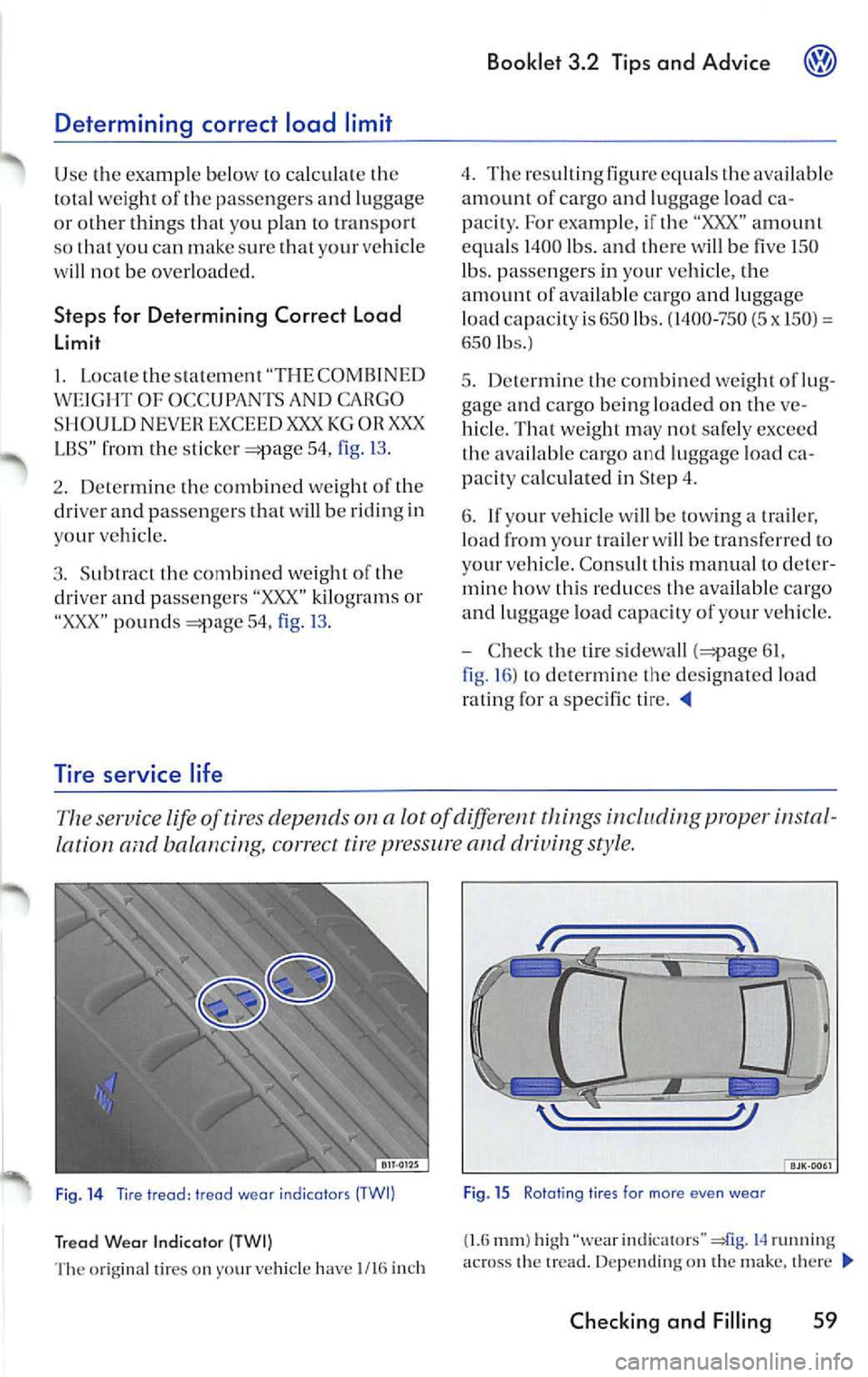
se rvice lif e of tires depend s on a lot of diffe rent inc/11di11g proper instal
balanc ing, correc t tir e pressu re and driv ing style .
Fig. 14 Tire tread: tr ead wear ind icators (TW I)
Tread Wear Indicator {TWI)
Th e ori gina l ti re s on yo ur veh icle have I /16 in ch
Fi g. 15 Rotating t ires for more even we ar
(1. 6 mm ) hi gh indi cator s" 14 runn in g
a cro ss the Depending on th e m ak e, th ere
Checking and Filling 59
Page 409 of 477
Booklet 3.2 Tips and Ad vic e
Attach the tow-rope or the tow-bar only to th e
tow ing eyes provid ed .
D riv in g s ty le
T ow ing require s some exper ie nc e, es pecia lly
when using a tow -rope. Both driv ers should be
familiar w it h th e tec hn iqu es required for tow ing.
In ex perienced drivers should not try to tow an
o th er ve hicle.
Do not pu ll to o hard w ith th e towing vehicle and
a vo id j erking the tow- rope . When tow in g on an
unpa ved road, there i s alway s
risk of over
l oad ing and damaging the an ch orage points .
T he ignition oft he ve hicle be in g towed must be
s witched on to prevent the stee ring whee l fro111
lo ck ing. Also ensur e that the turn signals, horn,
windshield wipers and wash ers work properl y.
Keep in mind that the brake b ooste r d oes not
work when th e e ngine is not running. You will
hav e to apply considerably more pressure to th e
brak e pedal than you wou ld nor111a lly.
A lso the pow er stee rin g do es not work when the
e n g in e is not running. You will n eed m ore for ce
to stee r than you would norma lly.
Tow in g ve hicl es w it h an aut om atic tran smi ssio n
• Move the se lec tor leve r to N. •
Do not drive fa ster than 30 mph (50 km/h)
wh en towing a ve hicl e.
• Do not tow further t han
3 0 111iles (50 km ).
• lfa tow tru ck i s use d, th e ve hicle must be
tow ed with a ll w heels off the ground .
WARNING
Towing a vehicle c hange s th e way yo ur vehi cle
h an dles a nd br akes. To help re du ce t he risk of
an acci den t lead ing to se rious persona l injury,
no te th e fo llow ing:
• T he dr ive r of t he ve hicle t hat is be ing
towe d:
- Will h ave to p ress th e bra ke peda l con
s id era bly harder than no rm al beca use th e
b ra ke boos te r i s not a cti ve. Always be alert
no t to rear-end the tow ing ve hicle .
- Will h ave to use cons idera bly more fo rce
t o t urn th e steerin g w hee l, b eca use th e
power steer ing is not active.
• The driver o f the ve hicle that is tow ing:
- Must accelera te grad ually a nd ge ntle,
avo id je rkin g m oveme nts.
- Must b ra ke ear lier a nd more gentle t han
yo u wo uld norm ally
When can your vehicle not be towed?
Yo ur ve hicle m ay no t be towe d un der the fo l
l ow ing con ditions:
• If th e tran sm iss ion mal fun cti o ns and there is
no tran smis sion flui d.
• I f th e veh icle e lectr ical sys tem is not func
ti o nin g beca use the s tee ring will lock up.
• If yo u ha ve to driv e fu rth er th an 30 mile s (5 0
• If the front or rea r axl e is off th e ground
because you dama ge th e gea r.
In the se cases the vehicl e mu st be transport ed
o n a car c arrie r or trailer.
WARNING
If you still tow your ve hicle un der these co ndi
tio ns, you could ca use an acci dent or ca use
d am age to th e ve hicle. Thi s w ill n ot b e covere d
by your Limit ed New Ve hicle Warra nty .
88 Wha t do I do no w?
Do no t tow your ve hicl e beh ind a re cre a tional
vehicle . The Automatic transmi ssio n can be se
ve re ly damaged. This can happ en even if these
l ec to r lever is in th e N (Ne utral) pos ition.
• If th ere is no oil in th e tra nsmi ssio n because
o f dama ge to yo ur vehicle , th e veh icl e s hould b e
mo ved with a ca r carrier .
• If th e front or rear axle is lift ed off th e grou nd,
thi s will serio us dama ge the dr ive gea r.
• If th e veh icl e ha s to be towe d more than 30
mi les (5 0
all whee ls must be rai sed to tow
t he vehicle. The vehicle should be m oved with a
car carrier .
• If vehicle has no e lec trica l po we r, th e
s te erin g will be locked. The ve hicle must
Page 416 of 477
Parts 27
Plastic parts 19
Clean ing 23
Power steering 6
Power wa sh er 18
Prem ium Gaso line 32
R
Rai sing th e veh icle wit h th e jac k 72
Hear lid
Escape handle 76
wind ow heat ing
Heatin g element wires 20
Refue ling 30
H eg ular Gaso line 32
Repair s 28
Hep lacin g
Whee l rim s 63
Rep lacing tires and wheels 6 1
He por ting safety de fects
Ca nada 90
Unit ed States 90
Rims Replacing 63
gas kets 20
s
Safery belt s
Cleaning 26
S now chains 66
Spa res 27
Speed Hating Letter Code 62
Sta rtin g w ith jum per ca bles 84
Ste ps fo r dete rmining correc t load lim it 59
T
Tank
Fillin g
tank 30
Openi ng the fu el filler
30
Tec hnical m od ifica tions 28
T ire pressu re 56
T ir e pressure monitoring system
Se nso rs 63
Tir es and whee ls 63
Va lves 63
Booklet 3.2 Tips and Advice @
Tire service life 59
T ir es
Rep la cing 63
Se rv ice life 59
Speed Hating Leller Code 62
Ti re manufa cturing dale 62
Ti re specificat ions 62
Tread depth 59
Uni form tire qua lity gradi ng 64
Win te r tires 65
Tir es and vehicle load limit s 58
Tir es and whe els 5 1
C hec king tir e press ure 56
Co ld tire innation pre ssure 54
D imens ions 6 1
General notes 51
Glo ssary of
and loadin g
t e rm inology 52
New tires and whee ls 61
Rep lacing 6 1
Snow cha ins 66
T ire pressu re mon ito rin g sys tem 63
Tir es and vehicle load limit s 58
Whee l bolts 66
W int er tire s 65
Tools 67
Towing 86
Four-wheel dr ive 86
General notes 87
When can yo ur vehicl e not be towed? 88
Towing eye 86
Tra iler tow ing
Brak es ll
Dr iv in g tips 13
Operating instru ction s 12
Safety chain s 11, 12
Tec hnical requir ements IO
Tire press ure 12
T ow ing tips 13
Trailer lights 11
Tra iler weigh t 12
Tra nspo rt Ca nada 90
Tread Wea r Ind ica to r (TWI) 59
u
Underbody sea lant 22
Unidir ectiona l tires 51, 73
Uniform lir e qu alit y g rading 64
Alphabetical index 95