air VOLKSWAGEN JETTA 2008 Owners Manual
[x] Cancel search | Manufacturer: VOLKSWAGEN, Model Year: 2008, Model line: JETTA, Model: VOLKSWAGEN JETTA 2008Pages: 477, PDF Size: 77.6 MB
Page 293 of 477
Booklet 3.1 Controls and Equipment
Driving
Steering
Applies lo vehicles: with manually adju stab le steering column
Adjusting the steering wheel position manually
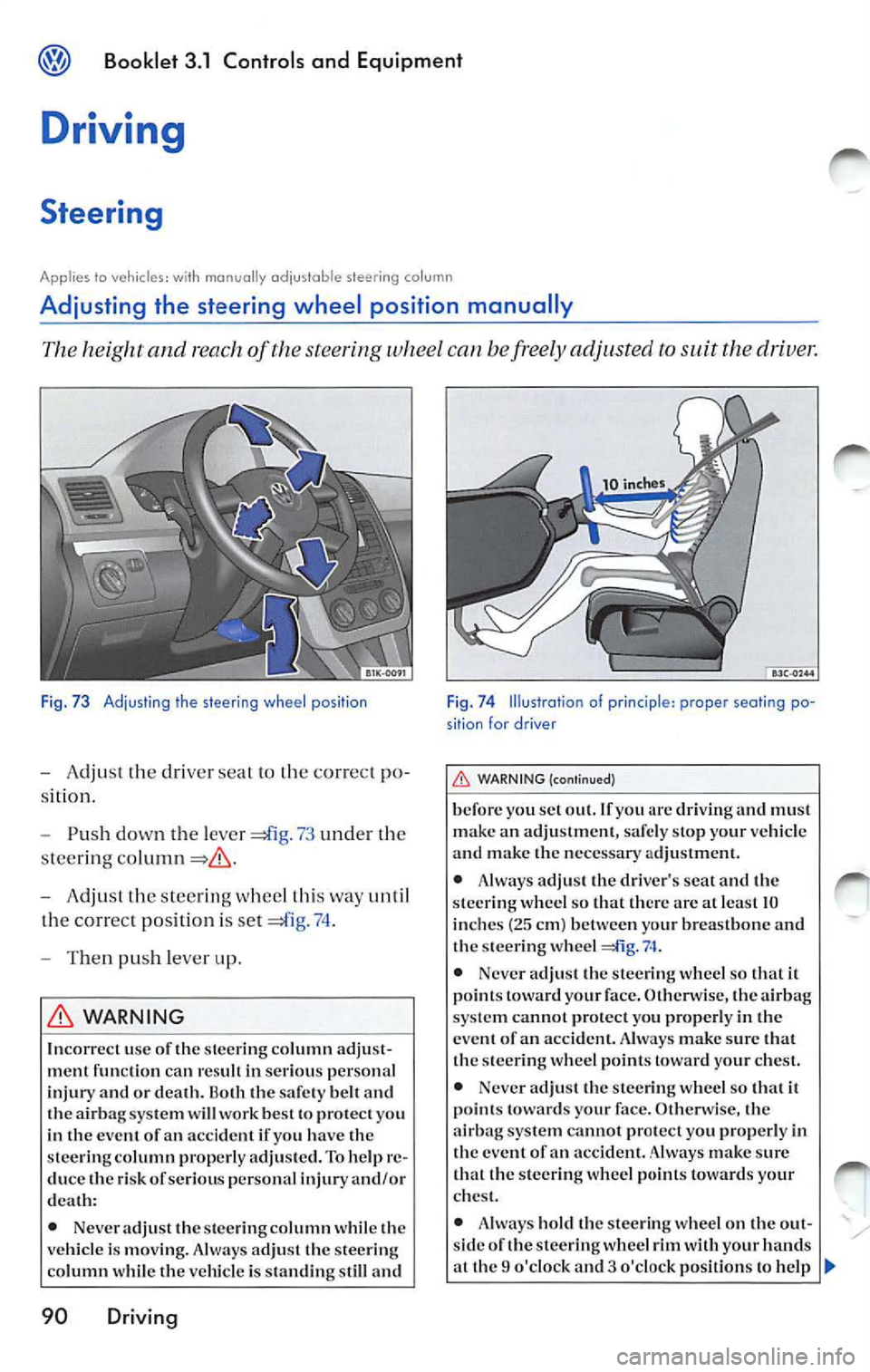
The and reach of the steering whe el can be freely adjusted to suit the driver.
Fi g. 73 Adjusting the stee ring wheel position
- Adj ust the d river sea t to th e cor rect po
s it ion.
- Push dow n the leve r
73 und er th e
s tee rin g
- Adju st th e s teerin g w hee l thi s way until
the corre ct po siti on is se t
74 .
- Then push le ver up .
WARNING
Incorrect use of the steer ing co lumn adjust
ment function can in seriou s per sonal
in ju ry and or death. the sa fety bell and sys tem w ill work best to protec t yo u
in the event of an accident if yo u have the
s teering column properly adjusted. To help re
duce
ri sk of seriou s perso nal injury and /or
death:
• Neve r adjust
steering column whil e vehicle i s moving. Always ad just steering
co lumn whil e the vehicle is standing still and
90 Driving
Fig. 74 Illustratio n of prin ciple: proper seating po
sition for d river
WARN ING (continu ed)
b efore you se t out . If yo u are driving and must
ma ke an adju stment, safely slop your vehicl e
and make
necessary adjustment.
• Always adjust the dri ver 's s cat and the
s teer ing wheel so that there are at leas t 10
in che s (2 5 cm) between your brea stb one and
ste ering whee l
• Neve r adjust the stee ring wheel so Iha! ii points toward your face. Otherw ise, the a irb ag
syste m cann ot prote ct yo u proper ly in
eve nt of an accident. A lway s make sure that steer ing wh eel point s toward your chest .
• Neve r ad just the stee ring whee l so
points towards your face. O then vise, airbag system canno t p ro tect you properl y in eve nt of an accid ent . Always make sure
that the steerin g whe el po int s toward s your
c h es t.
• Alw ays hold
stee ring w heel on out
s id e of steering wheel rim with your hands
a t th e 9 o 'clock 3 o'clock posit ions to help
Page 296 of 477
Booklet 3.1 Controls and Equipment
i0, WARNING (continued)
different wheel/lire combination and brake or
c ha ssis modifications 3.2 "Tips and
Advic e", chapt er "lle pair s and technical mod
ifications."
• Changing the vehicle suspens ion or using
unappro ved tire
I rim combination can
c h ange the way the ABS, BAS, EDL and ASH
sys tems work and redu ce their elTective ne ss.
• Th e effectivene ss of
is also determined
b y th e tir es 3.2 and Ad
v ic e", chapter "Wheels."
Ignition lock
Position of the ignition key
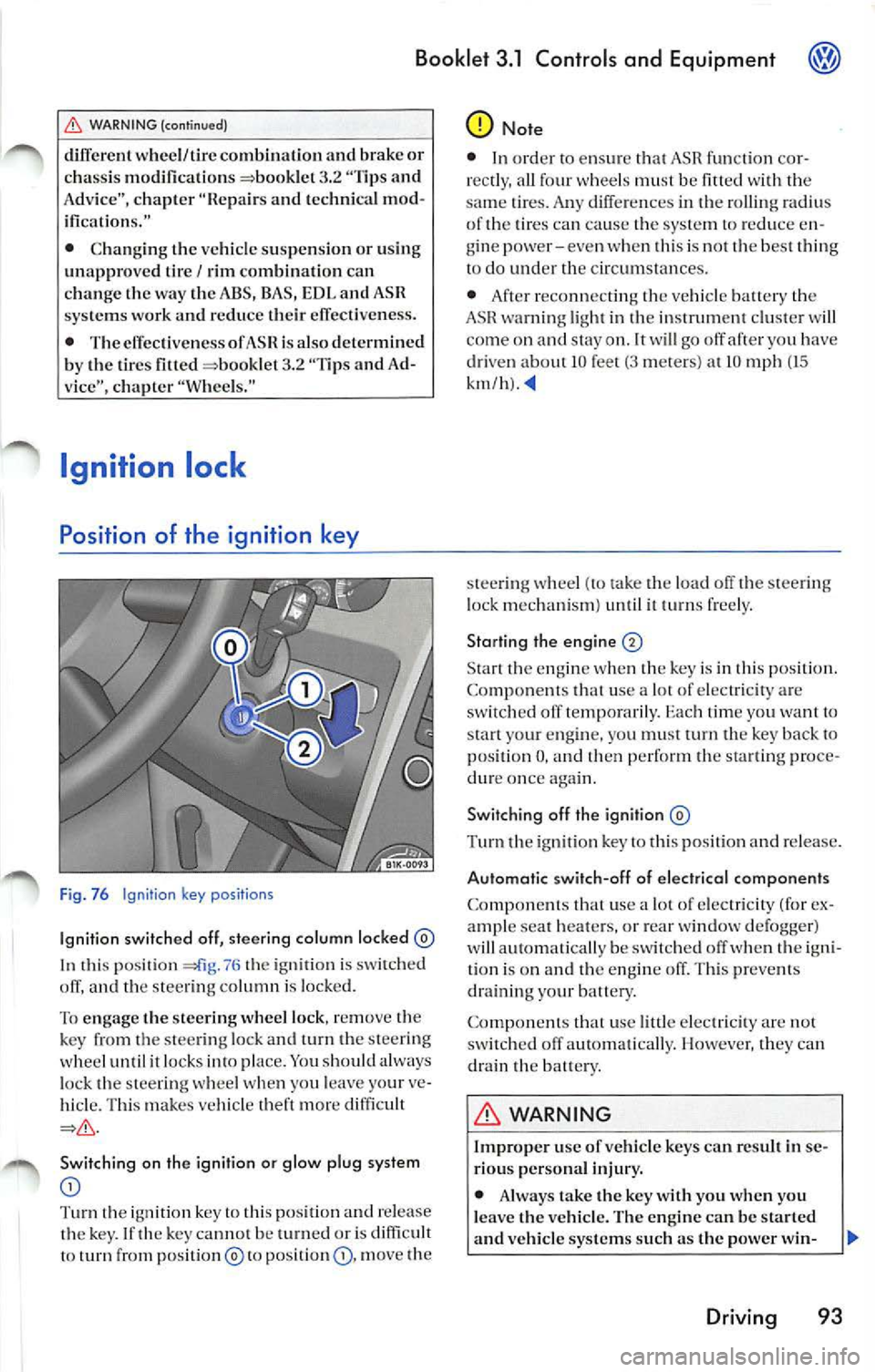
F ig . 76 lgnilion key posit io ns
Ignition switched off, steering column
In thi s po siti on the ig niti on is sw itched
off, and th e steering co lumn i s locked.
T o engage the stee ring wheel lock, re m ove the
key from the steering lo ck and turn the stee ring
w hee l un til it locks into place. You should always
l oc k the steer ing whee l w hen yo u le ave your ve
hicl e. This make s vehi cle th eft m ore difficult
Switching on the ignition or glow plug system
Turn the ig niti on key to this pos ition and re lease
th e key. If the key can not b e tu rned or is difficult
turn from pos ition ® to posi tion m ove the
go off afte r you have
d riven about IO fee t (3 meter s) at 10 mph (15 km/ h).
s tee ring wheel (to take the load off the stee ring
l ock mec han ism) until it turn s free ly.
Starting the engine
Start the en gin e when the key is in this posit io n.
Co mp onent s th at u se a lot of electricity are
sw itch ed olT te mp orar ily. Each time you want to
s tart your engine, you must turn the ke y back to
position
0, and then perform the starting proce
dure once aga in.
Switching off the ignition
Turn the ignition ke y this position and re lease.
Automatic switch-off of ele ctrical components
Comp on en ts that use a lo t of e lectricity (for ex
a mpl e se at heat ers, or rear win dow defogge r)
wi ll aut om aticall y be switc hed off wh en th e ign i
ti on is o n and th e eng ine off. This prevents
draining your b all ery.
Com po nent s th at us e littl e elec lricit y are not
sw itch ed off automatica lly. H oweve r, th ey ca n
drain the batt ery.
WARNING
Improp er u se of vehicl e ke ys can resu lt in se
rious personal injur y.
• Always take the key wit h yo u when you
le ave the vehicl e. The engine can be star ted
and vehicle systems s uch as the power win-
»,,
Driving 93
Page 300 of 477
Booklet 3.1 Controls and Equipment
Switching off the engine
- Let the vehicle come to a complete stop.
- Turn the ignition key to position
93, 76
WARNING
Never switch off the engine before the vehicle
ha s come to a com plete stop. You can lose co n
of the vehicle, crash and be ser iously in
jured.
Manual transmission
Applies to vehicles: with monuol
WARNING (continued]
• The airbags and safety belt pretensioners will not wo rk when the ignition is switch ed off.
• The brake booster docs not work when the
engine is turned off. A lot more
pedal
pressure will be necessary to stop the vehicle.
• The power steer ing system docs not work
w hen the engine is turned off and you will
ne ed mor e force to stee r the vehicle.
• When the key is removed, lhc steering
whee l co lumn will lock up and you will not be
ab le to steer the veh icle.
engin e could ov erh eat w hen it is
s wi tc h ed off . To r edu ce the ri sk of en gine
dama ge, be sur e
to le t th e engine id le for ab out 2
minut es before yo u sw it c h it off._.
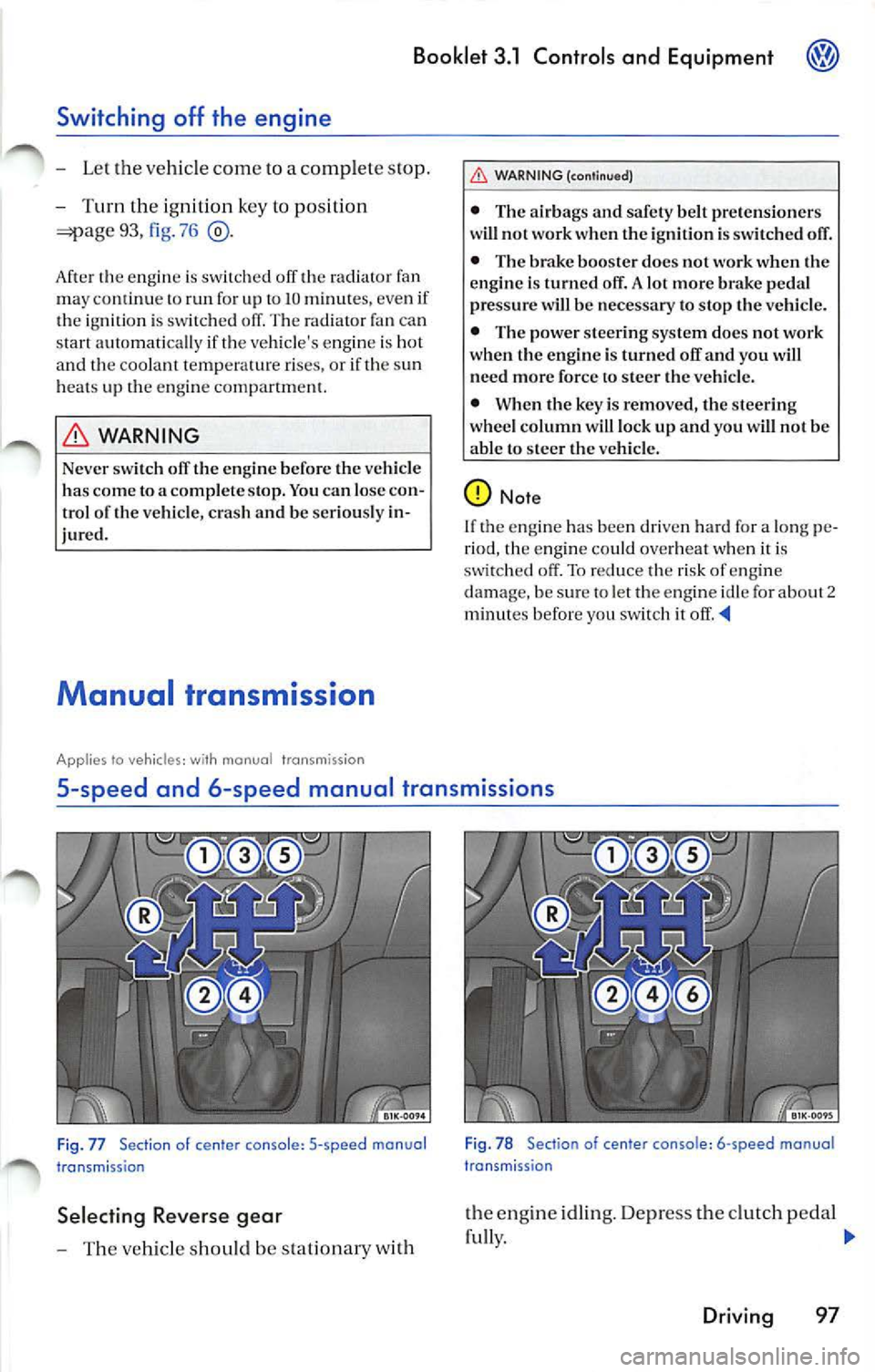
5-speed and 6-speed manual transmissions
Fig. 77 Section of center console : 5- speed manual
transm ission
Selecting Reverse gear
- The ve hicl e shou ld be stat ionary w ith
Fig. 78 Section of center console : 6 -speed manual
t ransm issio n
the eng in e idli ng. Depr ess the clutch p edal
fully. ._
Driving 97
Page 303 of 477
Booklet 3.1 Controls and Equipment
Stopping on an incline
- You should always hold the veh icle in
posit ion with th e footbrake to sto p it from
"ro lling backward".
- Do not try to stop th e veh ic le from
"ro lling backward" by increasing the revs
w hen a gear is
Moving away on an incline
- With a gear en gaged, rake your foot
from th e brake and depress t he accele r
a tor.
The steepe r the gradient, the lowe r the ge ar you
will need . This increases the brakin g effect of the
e n gin e. For exampl e, yo u should drive clown a
very steep s lo p e in 3rd gear. If the engin e brak e
effect is not suffi cient , th e ve hicle wi ll gain
speed. Th e auto matic transmi ssion
I direct shi ft
ge arbox automaticall y upshift s to prev ent the
e n gine from overr eving. U se the foot b rake to re
duce speed a nd chang e into 3rd gear using "T ip
tronic
Your veh icle has an A utomat ic Shift Lock (ASL )
t h at lo cks the sel ector lever in P or N when th e
ignition is o n. You mu st depr ess th e brake pedal
t o mov e the selec tor le ve r out of P or N. Thi s pre
ven ts the selector le ve r from b ein g unintention
a lly mov ed in to
driv ing pos ition resulting in
unwanted vehicl e movement.
A lway s hold the ve hicle
the foot if you
s top while driv ing up hill to preve nt from
rolling backward.
T he ignition ke y cannot be re m ov ed unl ess the
se lector le ver is in P.
WARNING
Unintended ca n ca use rious persona l inju ry .
• Neve r get out of the driver's seat when the
eng ine is runnin g, espe cially w hen it is in ge ar.
If yo u mu st lea ve yo ur vehicle w ith th e engine
runnin g, alwa ys se t the parki ng brake firml y
and m ove the se lec tor lever to P (Par k).
• When the en gine is runnin g wit h th ese
l ec tor lever in a driving po sition (D (Dr ive), S
(S port ) or R (Revers e) always de press and ho ld
100 Driving
WARN ING (continued)
the brake pedal lo keep the vehicl e from
mo vin g. Power is transmitted to th e wh eels
when a driving position is se lec ted a nd th e ve
hicl e m ay "creep" even a t idle spe ed.
• Neve r depr ess the acce lerato r w hen
mo vin g th e se lec tor leve r.
• Neve r move the selecto r leve r to R (Re
verse) or P (Park) when th e ve hicle i s moving.
WARNING
Neve r sw itch off the e ngi ne be fore the vehicle
ha s co me to a co mplete sto p. Y ou ca n lose co n
trol of the vehicle, crash and be se riou sly in
jured .
• Th e airbags and safe ty belt pr ete n sio ners
w ill not work when the ig niti on is sw itched
• Th e brak e booster does no t wor k w hen th e
e n gin e is turn ed oil A lot m ore brak e peda l
press ure w ill b e necessary to stop th e ve hicl e.
• The power steering system does not work
when t he eng ine is turn ed
and you w ill
ne ed more force to steer the vehicle.
• When th e key is removed, the s teer ing
w hee l co lumn will lock up and you w ill not be
able to stee r th e ve hicl e.
• Never co as t do wn a slo pe with the t rans
mi ssion in Neu tral.
Not e
• If you stop the ve hicl e on gradi ent, d o not
attempt to stop it rollin g by depres sin g th e
a cce le rat or wh en a gear has be en sel ec te d. Th e
a u tomatic tra nsmi ssio n
I direc t sh ift gearb ox
co uld ove rheat an d be damag ed . Pu ll th e
parking brake on fully or depr ess the brak e pedal
t o pr eve nt th e v ehicl e from
• :-lever let th e vehicle roll down a hill with the
s electo r lev er i n N and the engine swi tched off .
Thi s w ill dam age th e a utomati c tran smi ssion
I d ir ec t shift gearb ox.
Tip s
• If th e sele ctor l ev er is un intentiona lly mo ved
int o N whil e dr ivi ng, tak e your foot off the acce l
erato r peda l and wait unt il the eng ine s peed has
dropp ed to id le s peed b efo re se lectin g a drivi ng
po sition.
Page 306 of 477
Booklet 3.1 Controls and Equipment
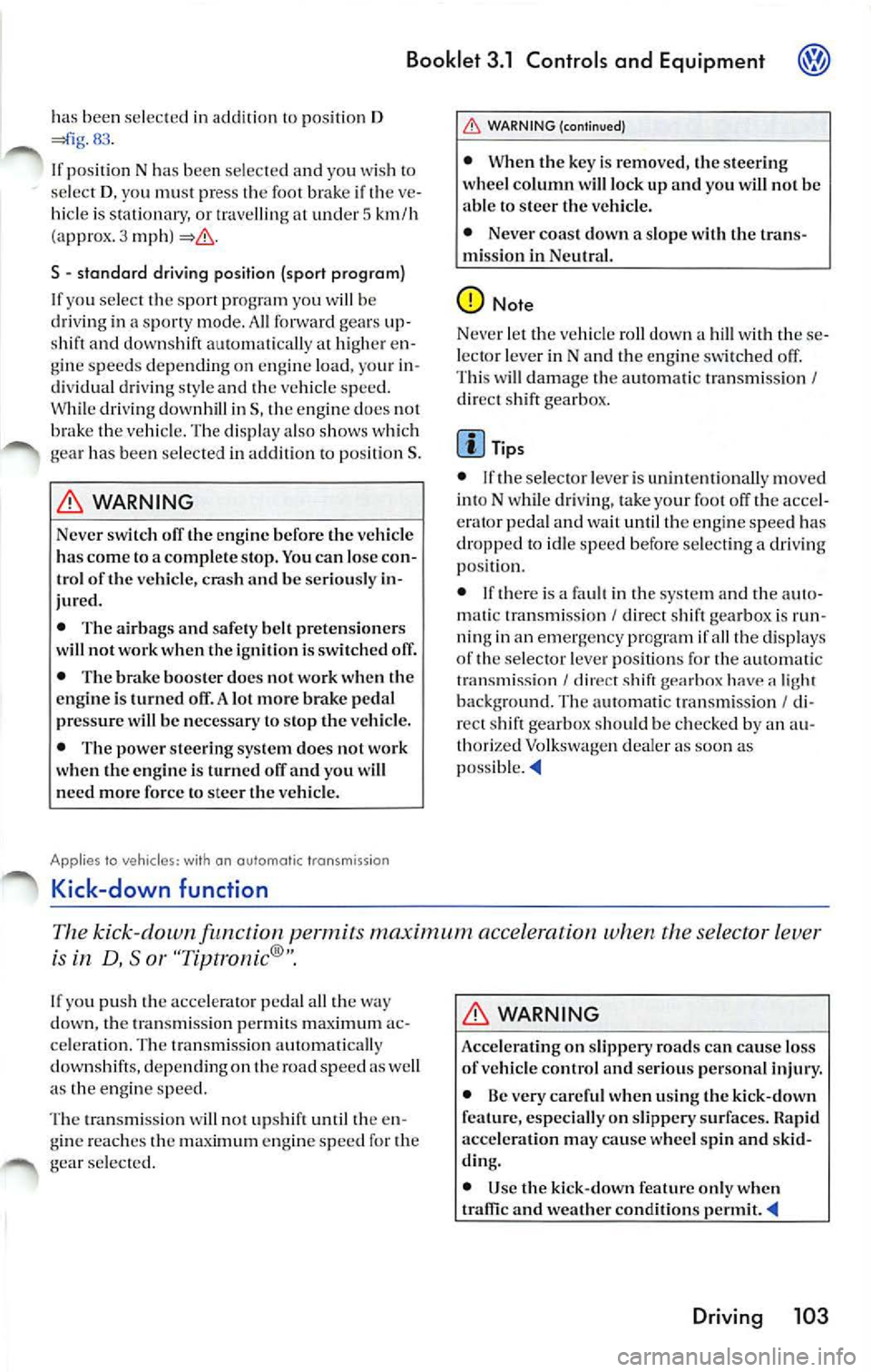
has bee n se lec te d in ad dition to po siti on D 83 .
If po sit io n N h as been selec te d and you wi sh to
se le ct D , yo u mu st pre ss the foot brake if th e ve
hi cle is stat io nary, or travellin g at under 5 km/h
( approx. 3 mph )
S - standard dri ving posit ion {sport program)
If y ou s ele ct t he sport pro gra m yo u will be
dri ving in a sport y mode . A ll forward gear s
shift and down shift automat ically at high er en
g in e s pee ds dep ending on en gin e load , you r in
di vid ual d rivin g sty le and th e ve hicle sp ee d.
W hile dr iv ing downh ill in S, the engin e docs not
the veh icle. Th e displa y al so sh ow s wh ic h
ge ar ha s be en se lec te d in addit io n t o po siti on S .
WARNING
Neve r switch off the engine before the ve hicle
ha s come lo a complete stop. You can lose co n
trol of the vehicl e, crash and be ser iously in
jured.
• The airb ags a nd safe ty bell pretensioners
w ill n ot work when the igniti on i s swi tched off.
• The br ake boo ster do es no t work when the
eng ine i s turn ed off. A lot mor e brak e pedal
pressure will be necessary to stop th e vehicle.
• The power steer ing system does not work
w hen the engine is turn ed off and you will
n eed more force to steer th e ve hicl e.
Applies to vehicles: with on a utoma tic trans missio n
Kick-down function
WARNI NG (continued)
• When the key is removed, th e steer ing
w hee l co lumn will lo ck up and you will not be
able to stee r th e ve hicle.
• Never coast down a slop e w ith th e trans
mi ssio n in Ne utral.
Tips
• If th e selec to r lev er i s un inte nti onal ly mo ved
int o N wh ile dri ving , take your fo ot off t he acc el
era to r p eda l a n d wa it until th e engi ne spee d has
dropp ed to idl e sp ee d before sele c tin g a dri vin g
po sition .
• If th ere is
fa ult in th e sys te m and th e auto
mati c tra nsmi ssion I dir ect shift gearbox is run
n in g in an emergen cy program if all the displays
of the s elector leve r position s for the au tomat ic
tr ansmi ss ion
I di rec t s hi ft g ea rb ox have light
ba ckg ro un d. The a utoma tic tran smi ssio n I di
r ec t shift gearbo x shou ld be c hec ked b y an au
thori zed Vo lkswage n dea ler as soon as
po ssibl e._.
Th e kick -down permits maximum a ccele ration the se lector lev er
is
D, So r
down, th e tran smi ssion p ermi ts a c
c e le ratio n. The tran smi ssio n aut om atica lly
down shift s, de pending on the road spe ed as we ll
a s th e eng ine sp ee d.
Th e tra nsmi ssion
not up sh ift until the en
g in e reac hes the engin e s pee d for th e
g ear sele ct ed .
WARNING
Accelerating on slippe ry road s can cause lo ss
of ve hicle control and serious per sonal injury.
• Be very careful when u sin g th e kick -do wn
especi all y o n sli ppery sur faces. Rapid
accelera tion may ca use w hee l spin and sk id
d in g.
• Use the kick-down fea tur e o nly w hen
and weather conditions permit
Driving 103
Page 312 of 477
Booklet 3.1 Controls and Equipment
Alphabetical index
A
ABS Wa rnin g light 27
See also Ant i-lock brake syste m
A co ustic wa rning 93
Add itional storage co mpartment 73
Adj ustin g the compass variance zone 19
Ai r co ndit io nin g
Co ndensation 89
Impo rtant notes
88
Malfunct io ns 88
Unp leasa nt od or 89
A ir conditioni ng sys tem 81
C lim atro nic
84
Air r ecircul ation mode
2C -Cl imatroni c 83, 88
Alarm syste m 36
Sw itch ing off 36
A lt ern ator
See Genera to r
A nti -lo ck brake system
ligh t 27
An ti-Slip Re gula tion 92
A nti -th eft alar m sys tem 36
Sw itchin g off 36
Arm res t
F ro nt ce nte r arm res t 66
S tora ge compartmen t 70
AS R 92
A ut omat ic mod e
C lim atroni c 85
A ut om atic sw itch-off of elec tri cal
co mp onen ts 93
A utom atic tra nsm iss io n
Dir ect shift gearbox 98
Sa fe ty int erlo ck for ign ition key 94
Se lec tor leve r loc k 99
Tiptroni c 98
A utomati c tra nsm iss ion with Tiptronic LO I
A ve rage fu el con sumpti on 9
Average sp ee d 9
B
Ba ckground lightin g 51 Brake
fluid
Wa rnin g ligh t 11
Brak e pad
W arn ing m essage II
Brak e pad wea r indi ca to r
Warn ing ligh t 26
Bra ke sys te m
Wa rnin g lig ht 28
Bulb defe cti ve
Warn ing lig ht 24
Bumpe r cov er
Ca ution when pa rki ng nea r a parkin g ba r
ri er or cu rb LO S
Bu zze r 50 , 93
C
Ca librat ing th e co mpass 18
Ce ntral loc king
I ndi vid ual unl ocking 34
Ce ntral locki ng butt on 34
Ce ntr al locki ng sys tem 34
C han ging unit s 16
C hild safe ty lo cks 35
C lea nin g
E lec troni c park ing a ssis ta nc e se nsors 106
C lim ati c 81
Ma lfun cti ons 88
C lim atroni c
I mpor tant not es 88
Ma lfu ncti ons 8 8
C loc k 5
C lo sin g
R ea r li d 38
C lot hes hook 7 1
Co rning home fu n ctio n 47
Co mp ass 18
Adjusting 19
Ca librat ing 18
Compa ss fun ctio n 12
Co ndensa tion 89
Contro ls
P owe r w ind ows 39
Conven ience closing 41, 43
Co nve nien ce men u 17
Alphabetical index 109
Page 322 of 477
Table of contents
Smart technology ........... ... .. .. .
Brakes .............. .. .. ..... .. .. .• .....
Po we r stee ring ....... .. ..... ... .. ...... .
Notice about data recorded b y vehicle
contro l modu les ....... ........ .... ..... .
Driving and protecting the
environment ..... ... .... ..... ...... ..
Break-in Pe riod ... ... ........ ......... . ..
Catalytic converter ....... .. .. .. ....... ..
T ra ile r t owi ng . . . . . . . . ... ............ .. .
D riv ing economically o nd respecti ng the
environmen t ... .... ..... ............. ... .
Cleaning and protection ........ . .
General notes .... .... ... ....... .. ...... .
Car e of veh icle exte rior ....... ..• ...... ..
C ore of the vehicle interior ... ..... ..•. ..
Accessories, new parts, repairs
and modifications .......... ...... ..
Accesso ries and pa rts .......... .... .... .
R epa irs and technica l modifications ..... .
Cellu lar phones a nd CB radi os ........ . .
2
2
6
6
7
7
10
10
14
16
16
17
23
27
27
28
29
Booklet 3 .2 Tip s and Advice
Checking and Filling 30
Fill ing the tank . . . . . . . . . .. .. . . .. . . .. . • . . . . 30
Fu el supp ly . .. . . .. . . . . . . . . . . . . . . . . . . . . . . . 32
Working in the eng ine compa rtment . . . . . 34
Engine oil . . . . . . . . . . .. . . .. .. . . . .. .. . . .. . . 37
Coo lant ....... .... .... ...... ... ......... 43
Wos he r fluid and wind shie ld wiper blade s 45
Brok e fluid . . . . . . .. . .. . . . . . . . . . . . .. . . . . . . 47
Vehicle battery . . . . . . . . . .. . .. .. .. . .. . . .. . 49
T ir es and wheels . . . . . . . . . . . . • . . . . . . . . . . . . 51
What do I do now? . .. .. . . .. . . . . .. . 67
Vehicle tools and spore whee l . . . . . . • . . . . . 67
Changing a whe el . . . . . . . . . . . . . .. .. • . . . . . 68
Em erg ency closing or opening . . . • . . . . . . . 7 5
F use s . . . . . . . .. .. . .. .. . . . .. . . . . . . .. . . .. . . . 77
Cha nging a light bulb . .. .. . . . .. .. . • .. . . . 81
Jump start ing . . . . . . . . . . . . . . . . • . . . . . . . . . . . 84
To wing .... ... . . .. . .. .... ....... ... . . .•. . 86
Lifting th e ve hicle .. . .. . . . . . . . . . . . . . .. . . . . 89
C onsumer Info rmat ion . . . . . • . . . . . . 90
Alphabetical index . . . . . . . . . 92
Table of contents
Page 325 of 477
Booklet 3.2 Tips and Advice
8 WARNING
• Alw ays remembe r that vehicle alterations
or modifi cation s can affec t the function of the
ABS, BAS, EDL and ESP syste ms. Exampl es of
t h ese a ltera ti ons or modifications include a
diff ere nt wheel/tire combination and brake or
c h ass is modification s =q1age 28, "Repairs and
t ec hni cal modifications".
Electronic differential lock {EDL)
WARNING (continued)
• Changing the vehicl e suspension or usin g
unapp roved tire I rim combination can
c h ange the way the ABS, BAS, EDL and ESP
sys tems work and re duc e th eir elJect iveness.
• The eff ec tiveness of ABS is a ls o d etermined
b y th e tir es on your vehicle
51, "Tires
and wheels"
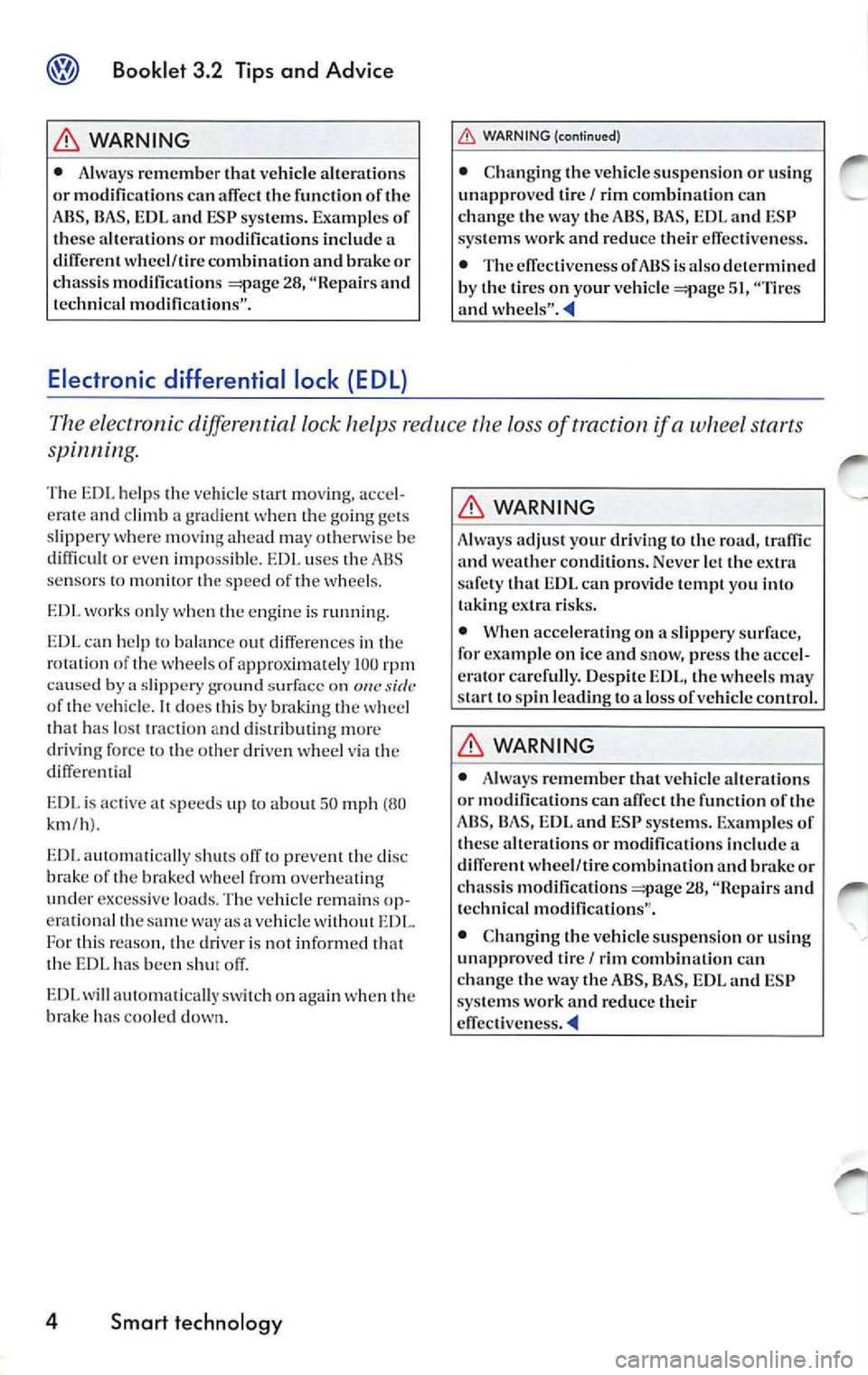
The elect roni c differential lock helps red uce th e los s of traction if a wheel starts
s pinnin g.
T he E DL help s th e ve hicle mov ing, accel
era te and climb a gradient when t he going ge ts
s li pp ery where m ov ing ahea d ma y otherw ise be
diffi cult or eve n im possibl e. EOL u ses the AB S
se nso rs to monito r th e spe ed of t he w hee ls.
EDL works on ly when the eng ine is runnin g.
EDL can help to ba la nce out differen ces in the
rotat io n of the w hee ls of a ppro ximat ely
JOO rpm
ca use d by sli ppery gro und surface on side of the vehicl e. It do es thi s by braking th e whee l
t h a t h as los t tracti on and d is tributing more
d riv ing fo rce to the oth er d riven wheel v ia th e
diff ere nt ia l
E DL is ac tive at sp ee ds up to a bout
50 m ph (80 km /h).
E DL autom atically shut s
to pr event th e di sc
brak e of th e w hee l from over heating
under excess ive loa ds. Th e ve hicle re main s op
era tional the
way as ve hicl e without EDL.
For this reas on. the dri ver is not in form ed tha t
t h e EDL has been shu t
ED L w ill auto matica lly sw itch on again when th e
br ake ha s coo le d down.
4 Smart technology
8 WARNING
Always adjus t your driving to the road, and weather condition s. Never le t th e ex tra
sa fe ty that EDL can prov ide te mpt you into
takin g extra ri sks.
• When accelerating on a slippery surfa ce,
for example on ice a nd snow , pr ess the acce l
e rator care full y. De spite ED L, th e w hee ls may
s ta rt to spin lead ing to a loss of vehicle control.
8 WARNING
• Always remember that vehicl e alt erations
o r modifi cation s can affect the fun ction of the
AB S, BAS, EDL and ESP sys tems . Exa mple s of
th ese alt era tion s or modifications include a
di!Tcrenl wheel/tire combination and brake or
chass is modifications =q1age 28, "Repair s and
t ec hni cal m odi fication s".
• Changin g t he vehicle su spen sio n or using
u napprove d tire
I rim comb ination ca n
c hang e the way the ABS , BAS, EDL and ESP
systems work and reduce their
effective ness
Page 327 of 477
Booklet 3.2 T ips a nd Advice
Power steering
011 vehicles with pow er stee ring , th e of power ass ista nee is regu lated e lec
t roni call y acco rdi ng to vehicle speed, stee rin g wheel torque and stee rin g w hee l
angle.
Th e power assis tance prov ided in the power
s te erin g sys te m is not hydrau lic, but m e
c h ani ca l usin g an elec tric mot or. The adva n
t a ge s of this steer ing system includ e th e fact th at
n o hydra ulic co mponents such as hoses, o il co n
t a in ers ,
o r fl uid s are re quired.
Fu rth ermo re , t his is co nsiderable de crease in
e n ergy req uir e d . T he e lec trome chani ca l s tee rin g
sys te m . in contras t to th e hydrau lic sys te m
(w hich re qu ires a co nstant flo w of fluid ), only
co nsume s energy when th e ve hicle is actua lly
be ing stee re d.
T he fu el consump tio n i s re du ced as a res ult.
If th e electro mec han ica l p owe r stee ring sys te m
fa ils, the pow er a ssis ted stee ring system
w ill still
work. If th e engin e is sw itch ed off, the pow er s
teer ing does no t fun ctio n and th e steer ing
wh eel is ve ry hard t o tu m .
WAR NING
Turning th e s teer ing whe el is very w hen t he power s tee rin g sys tem is n ot
work ing and it is harder to co ntrol the veh icl e.
• Neve r le t t he veh icle coast with th e engine
swit ch ed off.
Do no t kee p th e steer ing wheel turned all the 10 left or righ t fo r m ore than 15 seco nds
w hen th e e ngin e is runnin g. Doin g so co uld
damag e th e powe r steer ing
Data
H eco rder (EDH ), in sta lled by so me manufa c
tur ers
the exp ress purpo se of ca pturing data
fo r retr ieva l aft er an acci den t or cra sh eve nt.
are so metimes called "cras h recorders".
So me s tat e laws res tr ict t he re tri eva l or down
loadin g of da ta sto re d by ED
that were in
s ta lled in a vehicle for the exp ress p urpose of re
tr iev ing dat a af te r an acc ident or crash event
wit hou t th e Owner's conse nt.
your vehicl e is not equipped with an it is equipp ed with number of e lec tro nic
contro l modu les for variou s vehicle sys te m s
s u ch as, fo r ex am ple . e ngine function, em iss io n
6 Smart t echno logy
co ntrol, as we ll as fo r th e airbags and safe ty
be lts.
The se elec tronic con trol mod ules also
ve
hi cle-re late d dat a dur in g nor mal ve hicle ope ra
ti on for diag nos tic and re pair purp oses. The re
cordi ng capaci ty of the e lec tron ic co ntro l mod
ul es is limit ed to data (n o so und is record ed ) a nd
on ly a small amo unt of data is ac tually reco rde d
ove r a very limited p eriod of tim e and stor ed
a sys te m fau lt or o th er co ndition is se nse d by co ntro l un it. So me of dat a th en sto red
m ay re late to ve hicle sp ee d, direc tion, braking as
well a s res traint system use and performan ce in
th e eve nt of a cra sh or o th er conditi on. S to red
c an only be rea d and downloade d wit h spe
cia l
Page 329 of 477
Booklet 3.2 Tips and Advice
Braking power and braking distance
Braking power and braking distance are influenced by driving situations and
road
Worn brake pads will not provide good braking.
The amount of wear and tear on the brake pads
depends to a great extent on the cond itions
und er which the vehicle is opera ted and the way
the vehicle is dr iven. If you do a lot of city
driv ing, drive short distances or have a sporty
driving style, we reco mm end th at you have the
thickness of your brake pad s checked by an au
thor ized Volkswagen dea ler more frequently
than r ecommend ed in the service schedule.
I f you dr ive witJ1 wet brakes , for example after a
dri ving through water,
heavy rainfall or
after washing the vehicle, brakin g power will be
reduced and sto pping distances w ill be longer
because the brake d iscs will be wet or in winter
ma ybe even frozen
the brakes must be dried
with severa l ca reful brake applications.
Brake fluid absorbs water and must be c hanged
every two years. Heavy use of the brakes can
cause vapor lock if the brake fl uid is too old.
Va por lock reduces braking power, increases
stopp ing distances and can even cause total
brake failure.
WARNING
• New tires and new brake pads do not pro
v id e maximum grip, control or braking abilit y.
• To reduce the risk of losing control, a colli
s ion and se rious persona l injuries, drive with
special ca re for the first
350 mil es (560 km).
• New brake pads do not have the best stop
ping power for the first
150 mil es (240 km) and
must be broken in. You can com pensate for
the slightly reduced braking ability by drivin g
w ith care and applying more pressure on the
brak e pedal.
• Never fo llow other vehicle s too close ly or
put yourse lf into other situ ations that might
r equ ire s udden , hard brakin g especially when
th e brake pads have not been broken in.
WARNING
Wet brake s or brak es coa ted ice or road
sa lt react slower and need longer stopping dis
tanc es.
• Carefully apply brakes for a lest.
• Alwa ys dry brake s and clean olT ice coa t
ings and salt coa tings with a few cautiou s
brake app lica tions.
• Always read and hee d all
in "Break ing in tir es and brake pads" on
page 7.
WARNING
Overheated brakes will reduce the vehicle's
s topping power and increase stoppin g di s
tances.
• Always avoid over hea tin g the brakes!
• When driving downhill, the brakes have to
work hard and hea t up quickly .
• Before driving clown a long, steep hill, al
ways red uce spee d and downshift to a lower
gea r. This will let th e ve hicle use engine
braking and reduce the load on the brakes.
• Always c han ge the brake fluid at least
every two years. Hard braking with old brake
fluid may cause a va por lock. Vapor lock re
duces brakin g power, increases s topping dis
tan ces and can even ca use to tal brake failure.
• A damaged front spoiler or new non stan
dard spoile r ca n reduce the airflo w to the
brake s and cause them to overheat.
• Always sec an au thorized Vo lkswage n
dealer or qualil1ed workshop if yo u think th at
you may have damaged the front spoiler.
• Be sure to read and heed all WARNINGS
and the information =-page 27, "Accessories
and part s" before buying accessorie s.
8 Driving and protecting the environment