engine oil VOLKSWAGEN JETTA 2008 Owner's Manual
[x] Cancel search | Manufacturer: VOLKSWAGEN, Model Year: 2008, Model line: JETTA, Model: VOLKSWAGEN JETTA 2008Pages: 477, PDF Size: 77.6 MB
Page 298 of 477
Booklet 3.1 Controls and Equ ipment
Starting and stopping the engine
Applies to vehic les : a gasoline engine
Starting the gasoline engine
Th e e ngi ne c an only be s tarted a g en uine Volkswagen key with th e corr ect
cod e.
M ove the s elec to r l eve r to P (Pa rk ) o r N
( N eutral )
98.
Depress the fo ot brak e. In vehicl es wi th
a m anual transmi ssion d epr ess the clut ch
p ed al.
Turn the ig niti on ke y to position
93 , 76 to start the engin e.
R elea se the ig nition k ey as soo n as the
e n gin e start s to avoid damagin g th e
s tart er.
Af ter s ta rtin g an en g in e th at is hot, yo u m ay
n ee d t o p ress the acce le rat or b riefl y.
W hen sta rtin g a co ld en gin e, it m ay be a
noisy fo r th e few seco nds oil pr ess ure
h as b uilt up i n th e hyd rau lic va lve li ft ers . Thi s is
n o rma l a nd n o cause for co nce rn.
I f th e en gin e does no t sta rt after
JO sec ond s,
sw itch off the ig n it io n, wait 30 seconds, then try
a g ain .
I f yo u have pro blem ssta rting=bookle t 3.2 "Tips
a nd
chapt er sta rtin g."
WARNING
Reduce the risk of ser iou s perso nal i nju ry
when st arting and run ning the vehicle' s en
g ine.
WARNING
• Nev er start or let the engine run in a co nor en clos ed are a. Exhau st from the en
g in e contain s carbo n mono xide, a poi sonous ,
c o lor le ss and odo rless ga s. C arbon monoxide
can c au se unconsciousne ss an d deat h.
• Never leave the ve hicle unattended with
the engine running. The vehicle could move
sudden ly or
unu sual operat ing cond ition
cou ld occur res ulting in property damage or
per sona l in ju ry.
• Never use "start ing assist fluids." Th ey are
potent ia ll y e xplo sive and can cause a "run
away" ve hicle condition.
Note
Y ou ca n da mage the e ngin e if yo u dri ve high en
g in e spee ds, a t full throttle or by ove rload ing th e
e n gin e w hen it i s c old.
ci> For th e sake of environmen t
Do n ot warm up th e engi ne by runnin g it w ith
th e ve hicl e sta ndin gstill. Drive off as soon as you
s ta rt th e eng ine. Thi s help s th e engin e reac h op
era tin g te mp era tu re fas te r a nd red uces
Driving 95
Page 299 of 477
Booklet 3.1 Controls and Equipment
Ap plies to ve hicles : with a di esel engine
Starting the diesel engine
The engine can only be started a genuine Volkswagen key the correct
code.
- Move the se lector lever to P (Park) or N
(Ne utral )
98.
- Dep ress the foot brake. In vehicles with
manual transm iss ion d epress th e clutch
pedal.
- Turn the igni tion key to position
93, 76 The g low plug
warni ng light light s up while the glow
plug s are warm ing up.
- When the warning light goes out, turn
the key to pos ition
93, fig. 76
sta rt the engine. Do not press the acc eler
ator.
- Release the ign itio n key as soon as the
e ngin e starts to avoid damaging the
start er.
When start ing a cold eng ine, it may be a litt le
nois y for the fir st few se conds until oil pre ssur e
h as bui lt up in the hydrauli c
valve lift ers . This is
normal and no cause for conce rn.
When staring a warm engine, the pre -glow
warning light will no t li ght up. You can sta rt the
e n gi ne immed iate ly
If yo u ha ve problems sta rtin g
3.2 "Tip s
and Advice", chapt er "J ump startin g."
Di ese l e ngin e pre-glow system
Wh ile pre- glow is acti ve , n o major elec trical
lo ad s s hou ld be switched on -oth erwise unnec
ess ary load is pla ce d on the vehicle battery.
You should start the engine immediate ly after
th e pr e-g low indica tor lig ht has gone out.
96 Driving
To start the diesel engine after the fuel tank has
been run dry
If the fuel tank was run comp lete ly dr y, the
s tartin g proc ess after refueling with die sel fuel
can take long er th an usual -up t o one minute.
Th is is be cause th e fu el sys tem fir st ha s to be
vented of a ir wh ile starting.
WARNING
H edu ce the risk of ser ious per sonal injur y
when startin g and running the vehicl e's en
g in e.
• Never start or le t the engine run in a con
fined or enclosed are a. Exha ust from the en
gi ne contain s carbon mono xide , a poisonous,
co lor less and odo rless gas. Carbo n monoxide
ca n cause unconsci ousness and death .
• Neve r leave the vehicle unatt ended with
the eng ine runnin g. The vehicle could mo ve
s udd enly or an unusual operating condition
co uld occur res ultin g in prop erty damage or
personal injury.
• Neve r use "sta rting ass is t fluid s." They arc
po tentia lly exp los ive and can ca use a " run
away" vehicl e co ndition .
Note
You can
the eng ine if you drive hi gh en
g ine speeds, at full th rottle or by overloading the
en gin e whe n it i s cold.
For the sake of environment
Do not warm up the engine by running it with
th e ve hicl cstandin gstill. Drive off as soo n as yo u
s tart the e ngin e. T hi s help s th e e ngin e
o p
e ra tin g temperature fa ster and r edu ces
emissions .
--4
Page 303 of 477
Booklet 3.1 Controls and Equipment
Stopping on an incline
- You should always hold the veh icle in
posit ion with th e footbrake to sto p it from
"ro lling backward".
- Do not try to stop th e veh ic le from
"ro lling backward" by increasing the revs
w hen a gear is
Moving away on an incline
- With a gear en gaged, rake your foot
from th e brake and depress t he accele r
a tor.
The steepe r the gradient, the lowe r the ge ar you
will need . This increases the brakin g effect of the
e n gin e. For exampl e, yo u should drive clown a
very steep s lo p e in 3rd gear. If the engin e brak e
effect is not suffi cient , th e ve hicle wi ll gain
speed. Th e auto matic transmi ssion
I direct shi ft
ge arbox automaticall y upshift s to prev ent the
e n gine from overr eving. U se the foot b rake to re
duce speed a nd chang e into 3rd gear using "T ip
tronic
Your veh icle has an A utomat ic Shift Lock (ASL )
t h at lo cks the sel ector lever in P or N when th e
ignition is o n. You mu st depr ess th e brake pedal
t o mov e the selec tor le ve r out of P or N. Thi s pre
ven ts the selector le ve r from b ein g unintention
a lly mov ed in to
driv ing pos ition resulting in
unwanted vehicl e movement.
A lway s hold the ve hicle
the foot if you
s top while driv ing up hill to preve nt from
rolling backward.
T he ignition ke y cannot be re m ov ed unl ess the
se lector le ver is in P.
WARNING
Unintended ca n ca use rious persona l inju ry .
• Neve r get out of the driver's seat when the
eng ine is runnin g, espe cially w hen it is in ge ar.
If yo u mu st lea ve yo ur vehicle w ith th e engine
runnin g, alwa ys se t the parki ng brake firml y
and m ove the se lec tor lever to P (Par k).
• When the en gine is runnin g wit h th ese
l ec tor lever in a driving po sition (D (Dr ive), S
(S port ) or R (Revers e) always de press and ho ld
100 Driving
WARN ING (continued)
the brake pedal lo keep the vehicl e from
mo vin g. Power is transmitted to th e wh eels
when a driving position is se lec ted a nd th e ve
hicl e m ay "creep" even a t idle spe ed.
• Neve r depr ess the acce lerato r w hen
mo vin g th e se lec tor leve r.
• Neve r move the selecto r leve r to R (Re
verse) or P (Park) when th e ve hicle i s moving.
WARNING
Neve r sw itch off the e ngi ne be fore the vehicle
ha s co me to a co mplete sto p. Y ou ca n lose co n
trol of the vehicle, crash and be se riou sly in
jured .
• Th e airbags and safe ty belt pr ete n sio ners
w ill not work when the ig niti on is sw itched
• Th e brak e booster does no t wor k w hen th e
e n gin e is turn ed oil A lot m ore brak e peda l
press ure w ill b e necessary to stop th e ve hicl e.
• The power steering system does not work
when t he eng ine is turn ed
and you w ill
ne ed more force to steer the vehicle.
• When th e key is removed, the s teer ing
w hee l co lumn will lock up and you w ill not be
able to stee r th e ve hicl e.
• Never co as t do wn a slo pe with the t rans
mi ssion in Neu tral.
Not e
• If you stop the ve hicl e on gradi ent, d o not
attempt to stop it rollin g by depres sin g th e
a cce le rat or wh en a gear has be en sel ec te d. Th e
a u tomatic tra nsmi ssio n
I direc t sh ift gearb ox
co uld ove rheat an d be damag ed . Pu ll th e
parking brake on fully or depr ess the brak e pedal
t o pr eve nt th e v ehicl e from
• :-lever let th e vehicle roll down a hill with the
s electo r lev er i n N and the engine swi tched off .
Thi s w ill dam age th e a utomati c tran smi ssion
I d ir ec t shift gearb ox.
Tip s
• If th e sele ctor l ev er is un intentiona lly mo ved
int o N whil e dr ivi ng, tak e your foot off the acce l
erato r peda l and wait unt il the eng ine s peed has
dropp ed to id le s peed b efo re se lectin g a drivi ng
po sition.
Page 308 of 477
Booklet 3.1 Controls and Equipment
Parking
The parking brake can be us ed to pr eve nt the vehicle from moving uninten tion
ally.
A lways apply th e parking brake fully when
yo u leave y our vehicl e a nd when you p ark
yo ur vehicl e.
- Use the foo t brake to stop the veh icle.
- Appl y th e parking brake full y.
- On a ma nual tran smi ssion engage
gea r. On a n aut omatic tra nsmi ssion move
the selector lever to P.
- Switch off the engine and r emo ve the
key from the ignition lock. Turn th e
s tee rin g w he el s li ghtl y to en gage the
stee ring loc k.
- Always take you ve hicle keys w ith you
whe n yo u leave the
When parking on slopes
Before turnin g off the engin e, turn the steer ing
w hee l so if th e vehicle sta rt s to ro ll, it will roll
i nt o th e c urb:
• If th e ve hicle is faci ng
turn the whee ls so that they poilll toward the cur b.
• If th e vehicle is faci ng
turn the front
w heels so t hat they poi nt away from the curb .
• As a lways, appl y th e pa rking
full y and
m ove the se lector lever to P.
WARNING
Improp er parking procedures can lead to se
ri ous perso nal injury for you or your passen
gers.
• Never remove the key from steering lock
whil e th e ve hicle is movin g or rollin g to a stop .
The steer ing wheel
will lock up and you will not be able to stee r or control the vehicle.
WARNING
• Never park where the hot exha ust sys te m
co uld ignit e flammabl e material s, such as
bru sh, l eave s, dry grass, sp illed fuel etc.
• Alw ays apply the parking brak e fuJly wh en
parking your vehicle.
• Never leave anyone in your vehicl e to pre
ven t the ve hicle from moving if the parking
br ake is r elease d or selector lever is moved.
• Alwa ys tak e the key w ith you when you
l e ave the vehicle. The engine can be started
and vehicl e sy stems su ch as the power win
d ows can be operated leading to seriou s per
s onal injury .
• Never leave children , disabl ed p erson s or
anyone who cannot help th emselves in the ve
hicl e. The doors can b e lock ed u sing th e re
mot e co ntrol trappin g passenger s in the ve
hicle in an emergenc y. Depending on the time
of year, people tr app ed in
vehicle can be
expose d to v ery high or very low temperatures.
Note
• Please exercise care when yo u pa rk your ve
hicl e in parkin g are as w ith p arkin g barri ers or
cu rb s. Parking barriers and curb s vary in heig ht
an d co uld damage yo ur bump er and re la te d
compo nents as th e fron t of yo ur vehicl e moves
over
b arri er or curb that is too high . as you park
or as you back out of parking spot. In order to
be sur e th at no su ch d ama ge ca n occ ur, yo u m ay
wish to s top sh or t o f h av ing th e front tires o f yo ur
ca r touc h parking barri er o r curb.
• Please a lso exe rcise exce ptiona l ca re when
yo u drive up or d own steep ramp s or drive over
cu rbs or oth er obsta cles, fo r w hi ch lhe ve hicle is
not d esign ed , b ec au se compone nts of th e ve
hicl e close lo th e groun d su ch as bump er cove rs,
s poil ers , suspensio n and exhaust syste m com
ponent s, m ay beco me
Driving 105
Page 322 of 477
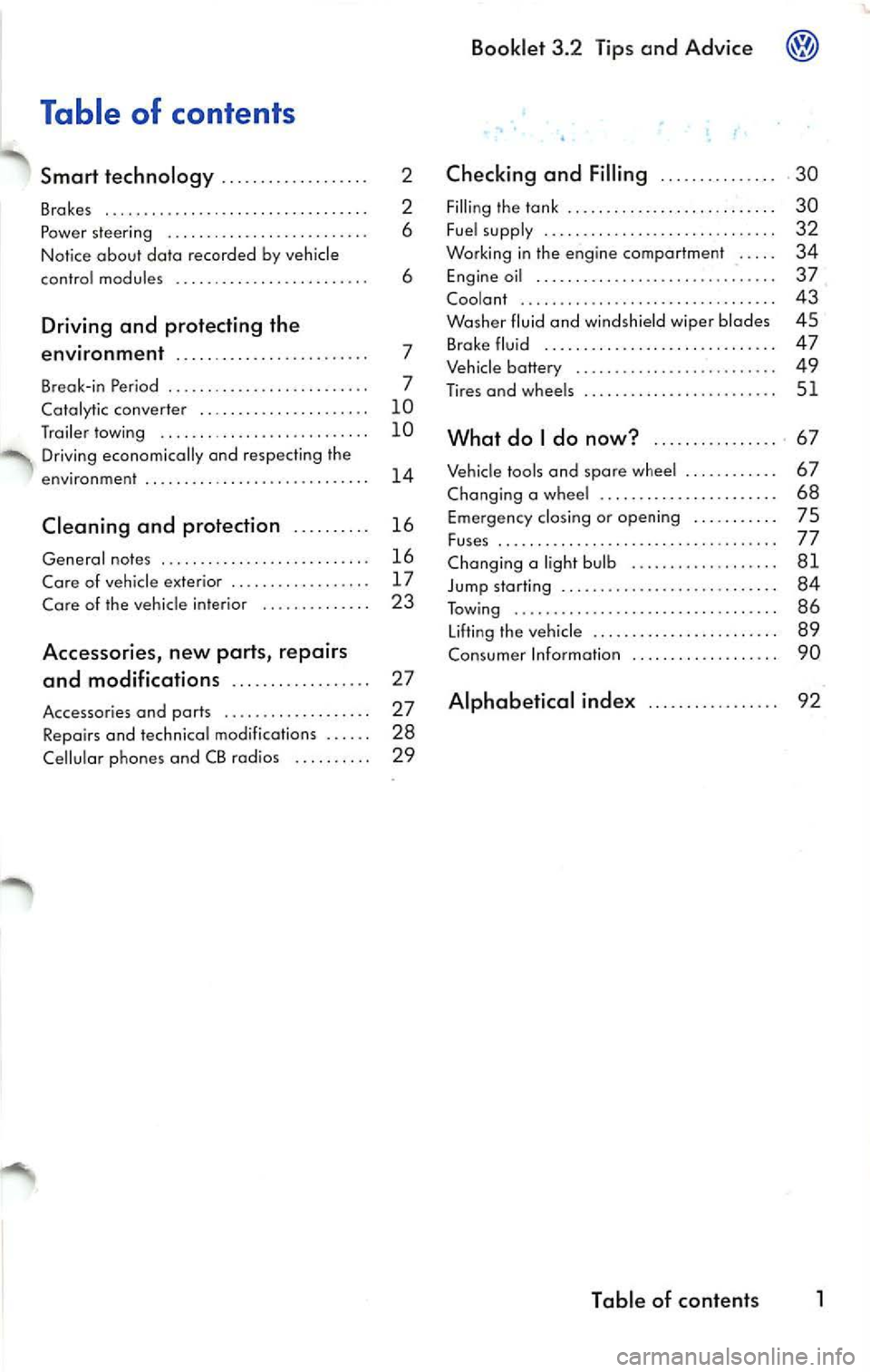
Table of contents
Smart technology ........... ... .. .. .
Brakes .............. .. .. ..... .. .. .• .....
Po we r stee ring ....... .. ..... ... .. ...... .
Notice about data recorded b y vehicle
contro l modu les ....... ........ .... ..... .
Driving and protecting the
environment ..... ... .... ..... ...... ..
Break-in Pe riod ... ... ........ ......... . ..
Catalytic converter ....... .. .. .. ....... ..
T ra ile r t owi ng . . . . . . . . ... ............ .. .
D riv ing economically o nd respecti ng the
environmen t ... .... ..... ............. ... .
Cleaning and protection ........ . .
General notes .... .... ... ....... .. ...... .
Car e of veh icle exte rior ....... ..• ...... ..
C ore of the vehicle interior ... ..... ..•. ..
Accessories, new parts, repairs
and modifications .......... ...... ..
Accesso ries and pa rts .......... .... .... .
R epa irs and technica l modifications ..... .
Cellu lar phones a nd CB radi os ........ . .
2
2
6
6
7
7
10
10
14
16
16
17
23
27
27
28
29
Booklet 3 .2 Tip s and Advice
Checking and Filling 30
Fill ing the tank . . . . . . . . . .. .. . . .. . . .. . • . . . . 30
Fu el supp ly . .. . . .. . . . . . . . . . . . . . . . . . . . . . . . 32
Working in the eng ine compa rtment . . . . . 34
Engine oil . . . . . . . . . . .. . . .. .. . . . .. .. . . .. . . 37
Coo lant ....... .... .... ...... ... ......... 43
Wos he r fluid and wind shie ld wiper blade s 45
Brok e fluid . . . . . . .. . .. . . . . . . . . . . . .. . . . . . . 47
Vehicle battery . . . . . . . . . .. . .. .. .. . .. . . .. . 49
T ir es and wheels . . . . . . . . . . . . • . . . . . . . . . . . . 51
What do I do now? . .. .. . . .. . . . . .. . 67
Vehicle tools and spore whee l . . . . . . • . . . . . 67
Changing a whe el . . . . . . . . . . . . . .. .. • . . . . . 68
Em erg ency closing or opening . . . • . . . . . . . 7 5
F use s . . . . . . . .. .. . .. .. . . . .. . . . . . . .. . . .. . . . 77
Cha nging a light bulb . .. .. . . . .. .. . • .. . . . 81
Jump start ing . . . . . . . . . . . . . . . . • . . . . . . . . . . . 84
To wing .... ... . . .. . .. .... ....... ... . . .•. . 86
Lifting th e ve hicle .. . .. . . . . . . . . . . . . . .. . . . . 89
C onsumer Info rmat ion . . . . . • . . . . . . 90
Alphabetical index . . . . . . . . . 92
Table of contents
Page 328 of 477
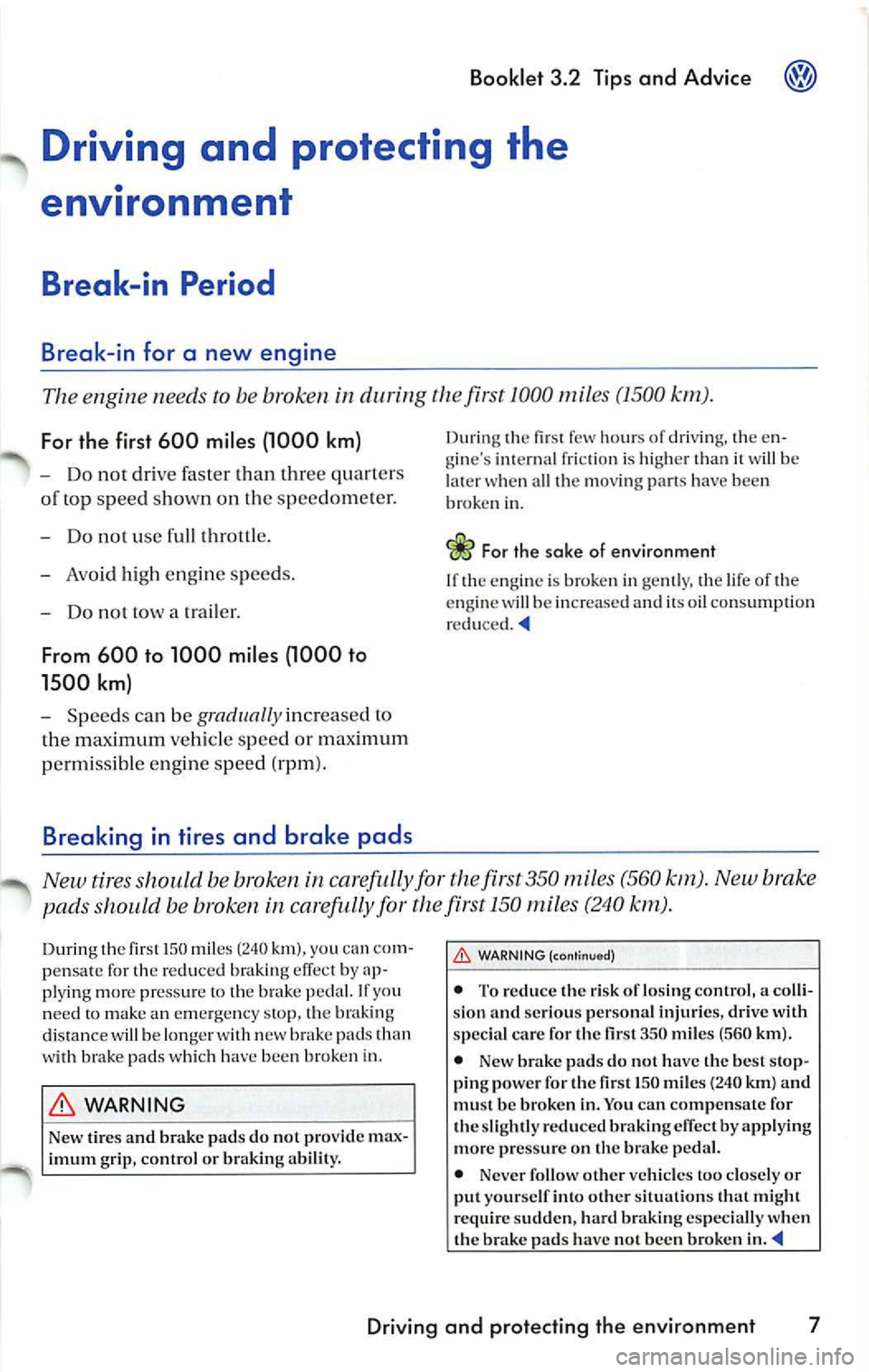
Booklet 3.2 Tips and Advice
Driving and protecting the
environment
Break-in Period
B reak-in for a new engine
The en gine needs to be broken i n during the first 1000 miles (1500 km ).
For the first 600 miles (1000 km)
- Do n ot dri ve faste r than three q uarters
or top speed shown on th e speedo mete r.
- Do not u se full th rott le .
- Avo id high eng ine speeds.
- Do not tow a tra iler.
From 600 to 1000 miles (1000 to
1500 km)
- Speeds ca n be grad ually increased to
the maximu m vehic le speed or max imum
perm iss ibl e en gine spee d (rpm ).
Breaking in tires and brake pads
Durin g first few hou rs of driv in g, the e n
g ine 's in te rn al fri cti on is hi gh er than it will be
all th e m ov in g pan s ha ve bee n
broken in.
For the sake of en vironment
lfth c engine is brok en i n ge ntl y, the life of the
e ngin e w ill b e in crease d and it s oil cons umptio n
New tires s hou ld be b roken in ca refu lly fo r the first 350 mi les (560 km). New b rake
pads s houl d be broken in ca refu lly fo r
first 150 miles (240
WARNING
Ne w tir es and brak e pad s do no t pro vid e m ax
imum grip , co ntrol or b rakin g abilit y.
W ARNING ( continue d)
• T o reduce th e ris k of los ing co ntrol, a colli
s io n and serious perso nal injuri es, drive w ith
s p ecial car e for the fir st 35 0 mil es (560 km ).
• New brake pads do not have th e be st stop
pin g powe r for the fir st 1 50 mil es (24 0 km) and
mu st b e bro ken in. You ca n comp en sa te for
th e sli ghtl y re du ced brakin g
by apply in g
mor e pr ess ure o n th e bra ke p ed al.
• Never fo llow other vehicle s to o clo sely or
put your se lf into oth er situ ation s th at mi ght
re quir e sudd en, hard br akin g es peci all y w hen
th e b rak e pads have not b ee n brok en
Driving and protecting the environment 7
Page 329 of 477
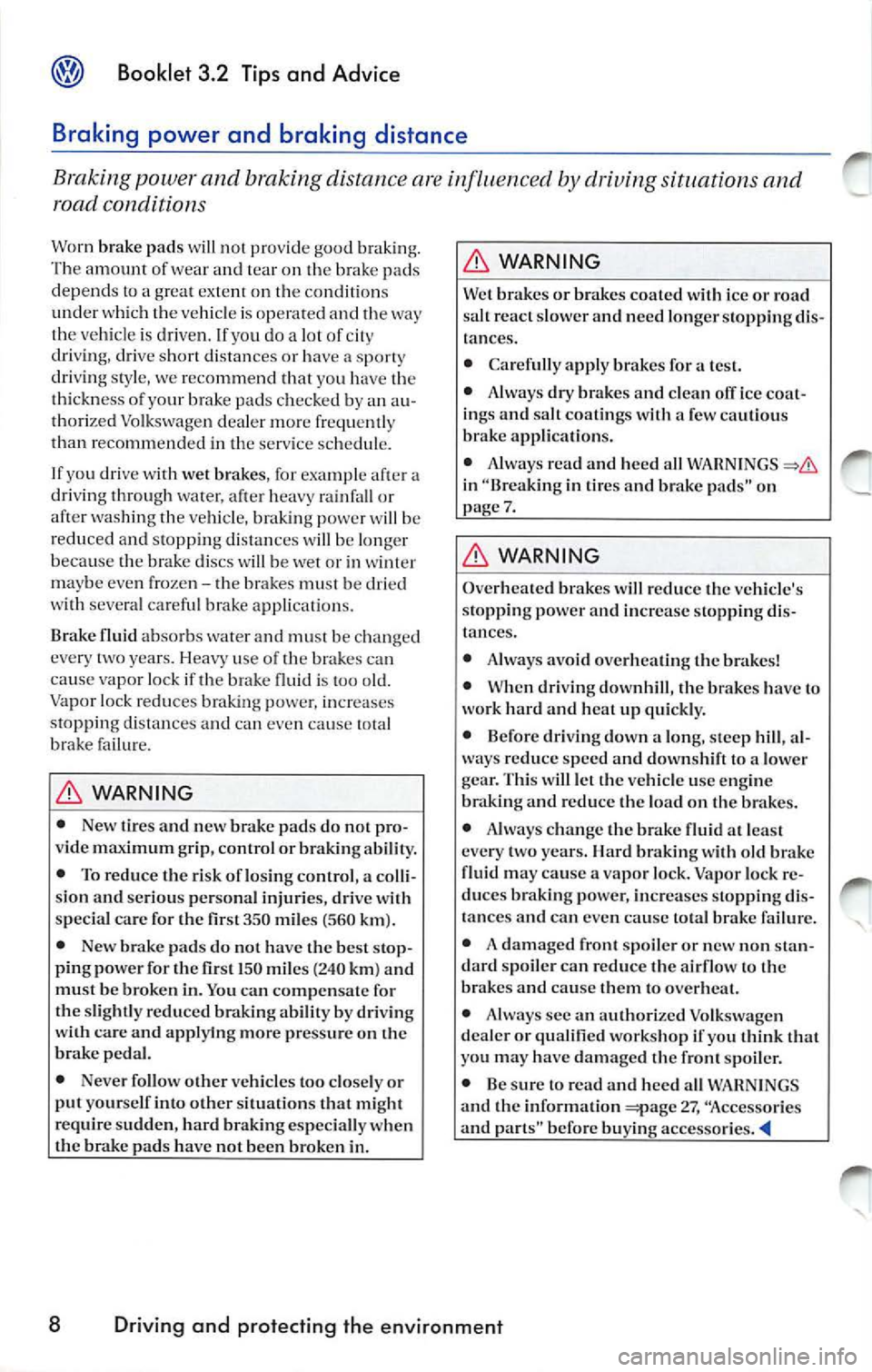
Booklet 3.2 Tips and Advice
Braking power and braking distance
Braking power and braking distance are influenced by driving situations and
road
Worn brake pads will not provide good braking.
The amount of wear and tear on the brake pads
depends to a great extent on the cond itions
und er which the vehicle is opera ted and the way
the vehicle is dr iven. If you do a lot of city
driv ing, drive short distances or have a sporty
driving style, we reco mm end th at you have the
thickness of your brake pad s checked by an au
thor ized Volkswagen dea ler more frequently
than r ecommend ed in the service schedule.
I f you dr ive witJ1 wet brakes , for example after a
dri ving through water,
heavy rainfall or
after washing the vehicle, brakin g power will be
reduced and sto pping distances w ill be longer
because the brake d iscs will be wet or in winter
ma ybe even frozen
the brakes must be dried
with severa l ca reful brake applications.
Brake fluid absorbs water and must be c hanged
every two years. Heavy use of the brakes can
cause vapor lock if the brake fl uid is too old.
Va por lock reduces braking power, increases
stopp ing distances and can even cause total
brake failure.
WARNING
• New tires and new brake pads do not pro
v id e maximum grip, control or braking abilit y.
• To reduce the risk of losing control, a colli
s ion and se rious persona l injuries, drive with
special ca re for the first
350 mil es (560 km).
• New brake pads do not have the best stop
ping power for the first
150 mil es (240 km) and
must be broken in. You can com pensate for
the slightly reduced braking ability by drivin g
w ith care and applying more pressure on the
brak e pedal.
• Never fo llow other vehicle s too close ly or
put yourse lf into other situ ations that might
r equ ire s udden , hard brakin g especially when
th e brake pads have not been broken in.
WARNING
Wet brake s or brak es coa ted ice or road
sa lt react slower and need longer stopping dis
tanc es.
• Carefully apply brakes for a lest.
• Alwa ys dry brake s and clean olT ice coa t
ings and salt coa tings with a few cautiou s
brake app lica tions.
• Always read and hee d all
in "Break ing in tir es and brake pads" on
page 7.
WARNING
Overheated brakes will reduce the vehicle's
s topping power and increase stoppin g di s
tances.
• Always avoid over hea tin g the brakes!
• When driving downhill, the brakes have to
work hard and hea t up quickly .
• Before driving clown a long, steep hill, al
ways red uce spee d and downshift to a lower
gea r. This will let th e ve hicle use engine
braking and reduce the load on the brakes.
• Always c han ge the brake fluid at least
every two years. Hard braking with old brake
fluid may cause a va por lock. Vapor lock re
duces brakin g power, increases s topping dis
tan ces and can even ca use to tal brake failure.
• A damaged front spoiler or new non stan
dard spoile r ca n reduce the airflo w to the
brake s and cause them to overheat.
• Always sec an au thorized Vo lkswage n
dealer or qualil1ed workshop if yo u think th at
you may have damaged the front spoiler.
• Be sure to read and heed all WARNINGS
and the information =-page 27, "Accessories
and part s" before buying accessorie s.
8 Driving and protecting the environment
Page 331 of 477
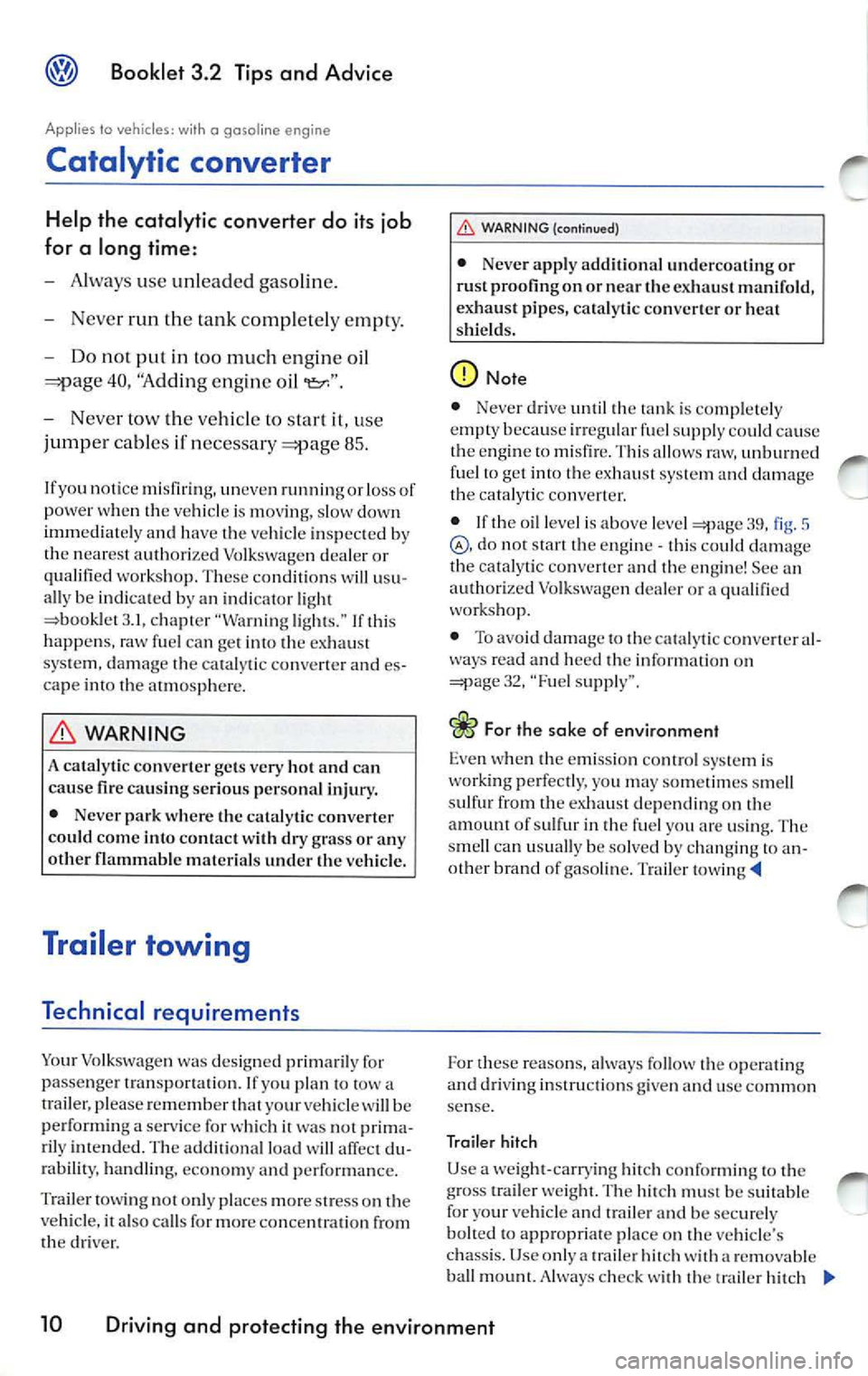
Booklet 3.2 Tips and Advice
Applies to veh icles: with o gaso line engi ne
Catalytic converter
Help the catalytic converter do its job
for a long time :
-Alwa ys use unl eaded gasol ine.
- Never
the ta nk complet ely empty .
- Do not put in too much en gin e oil
40, "Adding engine oil
-Never tow the ve hicle to start it, use
jump er cab les if n ecess ary
85.
If yo u notic e mi sfiring, uneve n runn ing or loss of
power w hen th e vehicl e is m ov ing , s low down
immediate ly and h ave the vehicl e in sp ec te d by
th e nea res t a uth oriz ed Volk swagen deal er or
qu alifi ed wo rksh op. These co nditions w ill u su
a ll y be in dic ated b y an ind icator light
3. 1, chapt er "Warning light s." If thi s
happ ens, raw f uel ca n ge t int o th e ex hau st
sys te m , d am age t he ca ta ly ti c co nverte r and es
ca pe int o th e atmosp here .
WARNING
A ca ta ly tic conver te r get s very hot and can
cau se lir e ca usin g se riou s personal injury.
• Neve r park where th e cata lytic converter
co uld come into conta ct with dry grass o r any
other flammabl e materials under the vehicl e.
Trailer towing
Technical requirements
Yo ur Volk sw agen was desig ned primaril y for
pas seng er tr an spor ta ti on. If yo u plan to
trai ler , plea se re m emb er th at yo ur ve hicle w ill be
p erformin g a serv ice for whi ch it w as not prim a
ril y in ten ded. The addit io na l lo ad will affec t du
r ability, hand lin g, econ omy and p erfor mance.
Tra iler to wing not only pl aces more s tress on the
ve hicle, it a lso calls for mor e co nce ntrati on from
t h e dr ive r.
WARNING (continued)
• Never appl y additional under coating or
ru st proofin g on or near the ex haus t manifold ,
exhaust pipes, ca ta ly tic conver te r or hea t
s hi elds.
39 , fig . 5 d o not sta rt the e ngi ne thi s co uld dama ge
the catalyt ic c onverter and the e ngin e! See an
a uthori zed Vo lkswage n dea le r or a qualifi ed
works hop.
• To avoi d dama ge to th e ca talyti c conve rter al
ways rea d and hee d th e in formation on
=:page 32, "Fu el suppl y".
For the sake of environment
Even when th e e missio n co ntro l syste m is
worki ng perf ec tly, yo u may so metim es s mell
s ulfur from th e ex hau st d ep endin g on th e
a m ount of sulf ur in th e fu el you arc usi ng. T he
s m ell ca n usua lly be so lved by ch angin g to an
ot her brand of ga solin e. T railer
For th ese reason s, a lwa ys fo llow the o pera tin g
an d dri vi ng in stru ction s given a nd use comm on
se nse.
T railer hitch
U se a we ig ht -carry ing hitch co n fo rm ing
trail er hit ch re movab le
ball mount. ch eck with th e traile r hit ch
10 Driving and protecting the environment
Page 336 of 477
Regular servicing
By hav ing ve hicl e serviced reg ularly by an
aut horiz ed Volksw age n dea le r yo u ca n es tab lish
th e bas is for a good fuel eco nomy even
before yo u start driving. A we ll maint ain ed an d se rv ic ed
e n gi ne g ives you t he be nefit of bett er fu el effi
cie ncy as well as maximum re liabi liry and a
g rea ter res ale val ue.
Short distances
T he engi ne and catal ytic conve rter mu st reach
the ir o ptim al o p eratin g te m pe ratur e befo re y ou
se e a sig n ifi ca nt reduc tio n in exhaus t emi ssions.
A cold engin e will use m ore fuel until it rea ch es
it 's ope ra ting t emp eratur e at whic h po int th e
Warranty coverages
Yo ur Volkswagen is covered by th e follow in g
warra nties:
• Li mited New Ve hicle Warranty
• L imited Powertrain Warra nty
• Li mited Warra nty Aga in st Co rrosion Perfora
t io n
• Emi ssio ns Cont rol Sys tem Warranry
Booklet 3.2 Tip s and Advice @
An eng in e th at is no t p rop erl y ma intained can
use up to 10 % more fuel than ne cessary.
Check the oil l eve l eve ry tim e you ge t gas
39. Oil co nsumpti on d ep end s la rge ly on
t h e engine load a nd eng in e
fuel consump tion will impro ve. A lso imp ortant
i s the out sid e tempera ture. Th e co ld er the out
s id e te m peratur e, the g rea te r th e fu el
• Emi ssio ns Perfor mance Wa rranty
• Califo rnia Emi ssions Co ntrol Warranty (U SA
ve hicl es only)
• California E missio ns Perfo rmanc e Warranty
( U SA veh icles only)
Det ail ed informa tion regarding your wa rranties
ca n b e found in your Wa rra nty
Driving and prot ecti ng the envi ronm ent 15
Page 343 of 477
Booklet 3.2 Tips and Advice
Chassis
The unde rbody of the v eh icle is coated to help p rotect it from corrosion and
damage.
The und ercoat in g co uld be damag ed d uring
n ormal use. We recommend 1h a1 1h e und er
coali ng on th e ve hicl e and 1h e prot ec1ive c oat
in gs o n 1he s usp ension be inspec 1e d . a nd re
pa ired if necessary, befo re and afte r 1h c wint er
seaso n.
R ep a ir wor k and ad
V o lk swagen d ealer or qualified workshop.
Cleaning the engine compartment
WARNING
The exhaust sys le m ge ts very hot w hen th e ve
hi cle is dri ven and can ca use fire res ultin g in
se riou s perso nal inju ry.
• Never a pply additi onal und ercoa ting or
ru st proo fing o n or near the ex haust m ani fold,
ex haust pip es, cata ly ti c co nverter o r lhe hea t
Be especia lly ca refu l when cleaning the engine compartm ent!
Anti -c o rrosion tr eatment
The e ngin e compar1m en 1 i s 1r ea 1e d at the fa c
tor y to help preve nl corro sio n 34.
Good corro sion prole clion i s pa rlicula rly imp or
lant in 1he win ie r whe re roa d salt is use d. To pre
ve nt salt dama ge, th e entir e en gin e co mpa rt
m ent sh oul d be th oro ugh ly cleaned before and
after the sa lting p eriod.
Y our auth oriz e d Vol kswagen dea ler h as the
ri gh t cl eaners and pr eserv a tives a nd th e neces
sary e quipm en t to apply 1h cm correc 1ly. \Ve rec
o m mend havi ng
wor k perfo rmed b y an au
t h o riz ed Vo lkswage n dea le r.
Co rros io n pro tec tio n is usuall y remove d when
t h e e ngi ne co mpar1m cn 1 is cl ea ned with grease
s o lve nts . W hen eve r
engin e is clean ed , mak e
s u re that corros ion pro1 ec1io n is app lied 10 all
s urface s, sea ms, jo inl s an d co mponents in 1h e
e n g in e compa r1m en1.
22 Cl eaning and prot ection
WARNING
T he eng ine c omp artm ent of a ny mo tor ve hicle
i s a po te nti ally dangero us area a nd ca n ca use
se rious perso nal inju ry.
• Always read and h eed a ll WA RN IN GS
34 be fore wor king in th e e ngin e co m
pa rlm ent .
c£> For the sake of en v ir o nm ent
Fuel. grease an d oil d epo sit s can run off
th e e ngin e is wash ed. Th e po llu1 ed was te mu st pass throu gh an oil sepa rator befo re di s
po sal. H ave th e e ng in e clean ed only by an au
t h ori ze d V olk sw agen de aler or other qua li fied
wo rksh op that has the nec ess ary e qui pmen1 10
prot ect th e