weight VOLKSWAGEN JETTA 2009 User Guide
[x] Cancel search | Manufacturer: VOLKSWAGEN, Model Year: 2009, Model line: JETTA, Model: VOLKSWAGEN JETTA 2009Pages: 477, PDF Size: 77.6 MB
Page 176 of 477
Booklet 2.1 Safety first
Advanced Airbags and the weight -sensing mat in the front seat
The A dva nced Airba g Sys te m in yo ur vehicl e de
t e cts the presence of an infant or ch ild in a child
r estrai nt on th e fron t passe nger sea t usin g th e
weig ht-sensin g mat in the sea t cushi on and the
se nso r below the safe ty belt lat ch on the front
p assenger seat th at m eas ures the te nsion on th e
belt.
The weigh t-se nsi ng m at m eas ures
we ig ht
o f th e c hild and the child seat and a child bla nk et
on the front pa sse nge r sea t. The weight on th e
front passe nger seat is re la ted to th e de sig n of
the child restrai nt and its "foo tprint ", the s ize
an d sh ap e of the b ou om of the c hild res traint a s
it sits on the se at. The we ig ht of
ch ild res traint
an d it s "foot print " vary for differe nt kind s of
child re straint s and for th e diffe re nt m odels of
t h e sam e kin d o f child r estraint offere d b y child
re straint manufa ctu rers.
Th e weig ht ranges for the indi vidual ty p es,
makes and m odels of c hild res trai nts th at th e
N HT SA has sp ecified in th e Safe ty Standa rd to· ge
ther w ith th e weight ra nges of typi ca l in fants
and ty pic al I ye ar-old child have bee n sto re d in
t h e co ntrol un it o f the Advanced Airb ag Sys te m.
Whe n a c hild res traint is bei ng use d on th e fro nt
passe nge r sea t w ith a ty p ica l
1 ye ar- old child , th e
A dvanc ed Ai rbag System compares the weight
mea sur ed b y th e we ig h t-se nsi ng ma t w ith the
informa tion stored in the elec tro nic con trol unit.
T he elec troni c control u nit al so reg is te rs th e ten
s ion on th e front passeng er sa fe ty be lt. T he te n
s ion on th e sa fety belt for the front pa ssenger
sea t
be different for ad ult is prop erl y
u sin g th e s afety belt as compar ed to the te n sio n
o n th e be lt
it is use d to att ach a child r e
s traint to th e seat. Th e senso r be low the la tc h fo r
th e safe ty belt for t he front seat passe nger mea
s ur es the tensio n on th e be lt. The input from thi s
se nso r is th en use d wit h the weig ht t o "d ec ide ",
w hethe r th ere is a chil d res tra int with a typica l
1 year-old ch ild on the front passe nger seat and
w he th er or not th e airb ag mu st b e turn ed
Child restraints and Advanced Airbags
Hegar dlcss of the ch il d re stra in t that you use,
mak e sur e th at it has been ce rtifi ed me et
United States Fe dera l Motor Vehicl e Saf ety S tan
dard s and has been ce rtified by its m anufa ctu re r
for use w ith a n airb ag. /\!ways be sur e that the
c hild r estrai nt i s pro perly
at o ne of t he
r ear sea ting pos itio ns. I f in exce ptional circu m
s ta nces you m ust u se it o n the fro nt pa ssenge r
sea t, car efull y read all of th e in for matio n on
c hild safety and Adva nced Airbags and hee d all
of th e a pplicabl e
IN GS . Mak e ce rtain that
t h e c hild res traint is cor rec tly reco gnized by th e
we ig ht- sensin g mat in side the front passe nge r
sea t, th at th e front p assenge r air b ag is turn ed off
and th at the a irb ag stat us is always correc tly s ig
n aled by th e PASSENGER AIR BAG OFF light.
Many ty p es an d m odels of ch ild res 1rai111 s have
b ee n avai lab le ov er th e years ,
models are
introdu ced r egularl y in cor poratin g new and im
proved des ign s and old er m odels are take n out
of produ cti on. Chil d res train ts are no t sta ndard
i zed. C hild restra ints o f the sam e ty p e typi ca ll y h
ave diff ere nt weight s and sizes and differ en t
'foot prin ts ,' t he s ize and sh ape of th e bott om of
th e c hild res train t th at s its on the seat, whe n
th ey are installed on a vehi cle seat. Th ese differ
e nces mak e it virt uall y impos sib le to cert ify
co mplian ce with th e re quireme nts fo r adva nce d
a ir bag s wit h ea ch and every child res traint that
h as eve r bee n so ld in the pa st or will be sold ove r
th e co urse of the use ful life of yo ur vehicle.
For thi s reaso n, th e Uni te d Sta tes N ati ona l
Hi gh way Tra ffic Sa fe ty A dmini strat io n has pub
li sh ed
li st of sp ecifi c type, makes and mode ls
of child restr ai nt s that must b e use d t o ce rti fy
co mpliance of the Advan ced Air bag Syste m in
y our vehicl e w it h th e s uppre ssio n r equir em en ts
of Fe d era l Moto r Ve hicle Safety S tandard 208.
Th ese c hild restra ints are:
A. Car beds, manufactur ed an or after De·
cember 1, 1999:
• Cos co Dre am Rid e 02-7 19
Child safety 53
Page 182 of 477
Booklet 2.1 Safety first
help protect children who weigh more 40 lbs.
(18 kg) wh o are less than 4 ft. 9
(57 inches, I.Sm) tall in a colli sion.
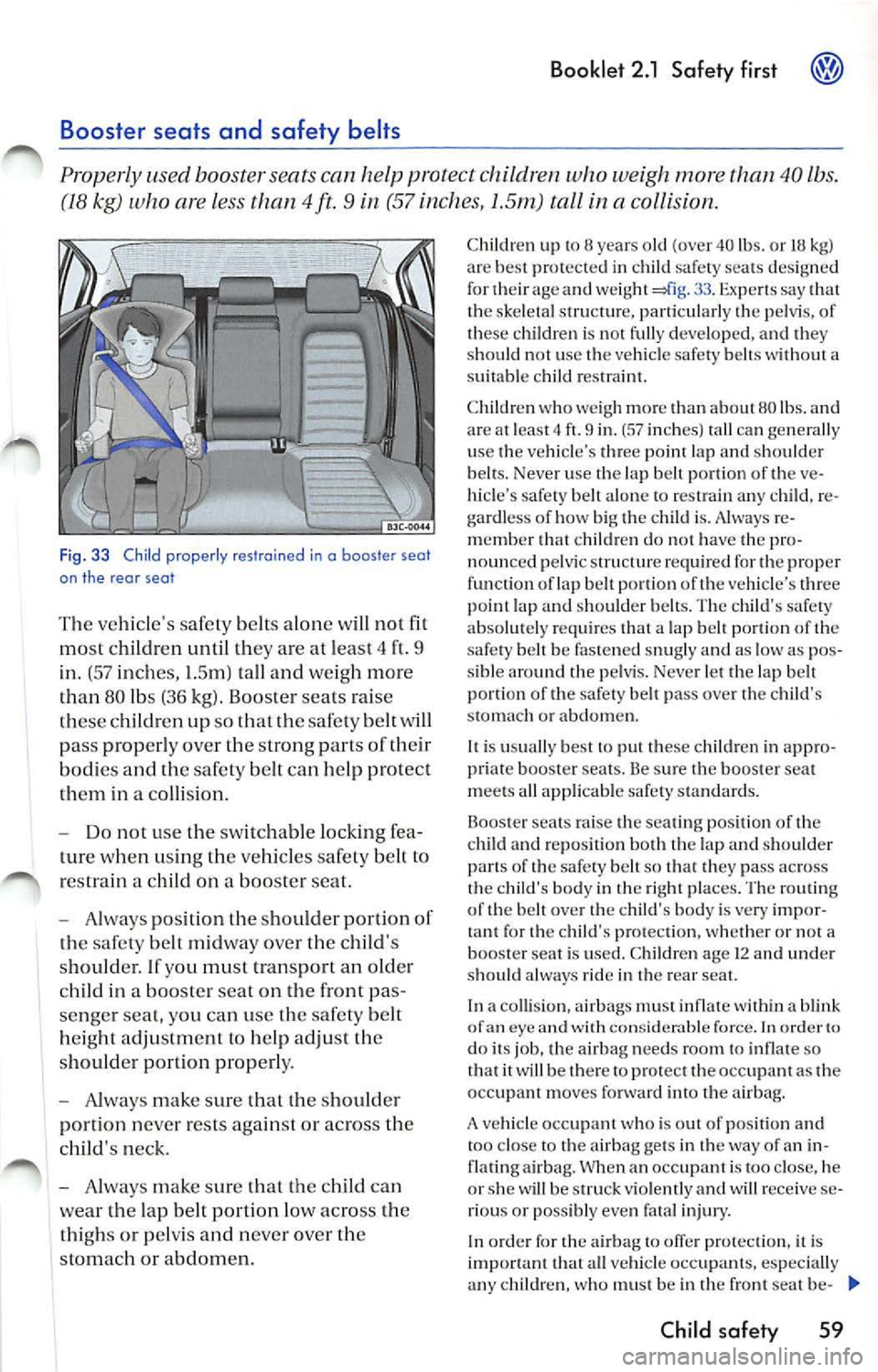
Fig . 3 3 Chi ld properly restroined in o booster seot
on the reor seot
The vehicle 's safe ty belts a lone will not fit
mo st children until th ey are at least 4
f t. 9
in. (57 inch es, 1.5m l tall and weig h m ore
th an 80 lb s (36 kg). Booster seats rai se
th ese children up so that th e safety belt w ill
p ass prop erly ove r the strong parts of their
bodies and the safety belt ca n h elp prot ect
th em in a co llis ion .
- Do not us e the switc habl e lo ck ing fea
tur e w hen using th e ve hicles safety belt to
r es train a child on a boos te r se at.
- Always positio n the sh ould er po rtio n of
the safery be lt m idway over th e child 's
s h oulder. If you mu st tran sport an olde r
c hild in a booster seal on the front pas
se nger seat, you can use th e safety belt
h eig h t adju stm ent to h elp ad ju st th e
s h ou lder po rti on prope rly.
- Alwa ys make sure that th e should er
porti on neve r rests aga inst or across the
ch ild' s neck .
- Always make sur e th at the child can
wea r the la p belt porti on low across the
thi gh s or pelvis and neve r over the
s to m ac h or abd om en .
C hil dren up to 8 yea rs old (ove r 40 lbs. or 18 kg)
are best protecte d in child safe ty seats desig ned
fo r their age and weight
33 . Expert s say that
th e s ke le ta l st ru ctur e, parti cul arl y the pelvi s, of
the se c hildren is not full y developed, a nd they
s h ou ld no t u se the ve hicle safety belts w ithout a
s uitable chil d res train t.
Ch ild re n who we igh mor e th an about 80 lbs . a nd
are at le a st 4 ft. 9 in. (57 inch es)
can ge nerally
u se t he ve hicle's t hree point lap and sh ou lder
belts . Never use th e la p b elt p ortio n of the ve
hicl e's safe ty be lt alone to res tra in an y c hild, r e
gardle ss of how big the chil d is. A lways re
membe r that children do not have t he pro
n oun ced pe lvic stru ctur e req uired for the prope r
func tion of lap belt po rtion of the ve hicle 's three
po int lap and sh oulder b elts. T he ch ild's safety
absolutely re qu ires that a lap be lt portion of the
sa fe ry belt be fastened sn ugly and as low as pos
s ibl e arou nd the pelvi s. Never let the lap belt
porti on of r he safety belt pass over the child 's
s tomac h or abd om en .
It is usuall y best to put th ese childr en in appro
p ri ate boo ster sea ts. Be sur e th e bo oster seat
me ets a ll app lica ble safety standa rds.
Boos te r seats raise the sea tin g pos ition of the
c hild and rep osition both the lap and shoulder
parts o f the safety belt so that they pass across
th e c hild 's bod y in th e right pla ces. The ro uting
of the belt over the child 's body is very impor
tant for the chil d's pro tec tion, w heth er o r not a
boo ste r seat i s used. Chil dren age 12 a nd und er
s hou ld always ride in the rear seat.
I n a co llision, a irbags must inflate within
blink
of a n eye and with force. In orde r to
do its job, the a irbag needs roo m to infl ate so
that it wi ll b e th ere to protec t the occupa nt as the
occ upant moves forward into the airbag.
A ve hicle occup ant who is ou t of pos ition and
t oo close to the a irbag gets in th e way of an in
fl atin g airbag . W hen an occupan t is too close, he
or she will be struck viole ntly a nd will r eceive se
r io us or possi bly even fatal injur y.
In orde r fo r th e airbag to offer pro tec tion, it is
imp ortant th at all ve hicle occ upant s, especia lly
any childr en , w ho must be in the fron t sea t
Child safety 59
Page 185 of 477
Booklet 2.1 Safety first
WARNING (continu ed)
• Forward-facin g child seats installed on the
fr ont passe nger's sea t may interfer e with the
d e plo ym ent of
airba g an d cause seriou s
per sonal injury to the ch ild.
• Always make sur e th e fo rwa rd-fa cing sca t
h as bee n de sig n ed and certifi ed by its manu
facturer for use on a front seat with a pas
se nge r front and sid e ai rbag.
• Always carefully foll ow the manufa ctur er's
in structi ons pro vided with th e c hild seal or
ca rri er.
• Never put the fon vard -facing child r e
stra int up against or very near the instrum ent
panel.
• Always move the passenge r sea t int o its re
armost pos ition in the sea t's fore and aft ad
ju stment range, as far away from the airba g as
p ossible before installing the for ward-faci ng
WARN ING (cont inued)
child restraint. The backrest must be adjusted
t o an upr ig ht position .
• Always make sure that nothin g preve nts
t h e front passenger's sea t from bei ng m oved
to th e rearmos t position in it s fore and aft ad
ju stm ent rang e.
• Never place additional items on th e seat
that can in crease the total weight reg is tere d by
the weig ht-se nsin g mat and can ca use inju ry
in a cras h.
• Make s ure that the
PASSENGER AIR BAG OFF light comes on an d sta ys on all th e tim e
w hen ever the ig nition i s switch ed on.
• If th e PASSENGER
BAG OFF light doc s
n o t come on and stay on , imm ediately insta ll
t he forward -faci ng ch ild sea t in a rear seating
po sition and have the air bag sys tem inspected
b y yo ur Volkswagen dealer.
Activating the switchable locking feature
Us e the switchable Locking feature to properly secure a child restraint
Always ca refully fo llow t he c hild sear man
u fac turer's instruct io n s w hen insta lling a
c hild res tra int in yo ur vehicle .
To activat e
th e sw itch able lock ing fe a ture:
- Pla ce the ch ild res train t on a sea t, pref
erab ly o n the rear
- Route the safe ty belt around or th rough
the child restra int usi ng the proper path
for the sa fety be lt as speci fied by the child
re stra int manu facturer
- In se rt the belt tongu e into the buckle
fo r that seat ing po siti on.
- Make su re th at the red re lease button is
faci ng away from th e child restra int so that
it ca n be unbuckled quickly .
- Push the c hild sca t do wn w it h your full
we ig ht t o get the sa fety belt rea lly tight
- S low ly pull the belt all the way out.
62 Child safety
-Guide th e safety be lt b ack int o the re
t ractor un til the be lt lies fla t and snu g on
the ch ild se at. You sho uld hea r a "c lick ing"
n o ise as t he be lt wi nds back into th e in
ert ia reel of t he safety belt re tr actor. Tes t
the switch able locking featu re by pulli ng
on th e bc l
l. You should n o longer be ab le to
pull the b elt o ut of t he re tra ctor. The swit
c habl e lock ing feature is now act ive.
-
s trap or teth er is being used to tie
th e ch ild sea t to th e front passe nger seat,
mak e sur e th at it is not so tight that it
cau ses the weig h t-s en sin g ma t to m eas ure
m ore we ig h t than is actua lly on th e sea t.
- Pull on the safety belt to make sure th at
it is prope rly fastened and tight.
- Chec k th e c hild seat for prope r install a
ti on by pu llin g on the c hild seat. The child
sea t sh ou ld no t mo ve forward or sid eways
b y m ore than one in ch (2.5 cm) .
Page 188 of 477
Booklet 2.1 Safety first
Tether anchors
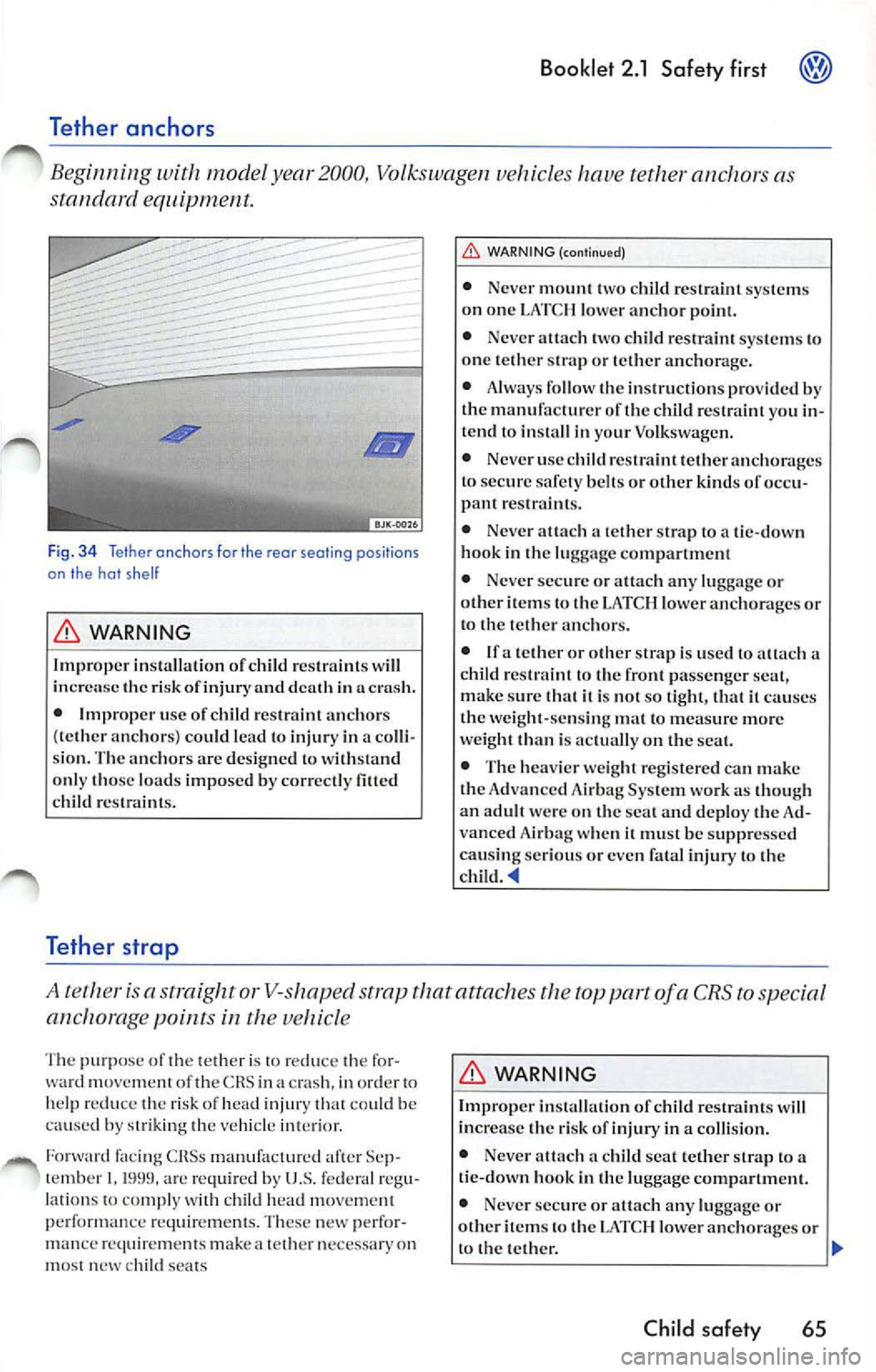
Beginning with model year 2000, Volkswagen vehicles have tether anchors as
standard equipment.
Fi g. 3 4 Tether on ch for the rear seating positions
on the hot shelf
WARNING
Improp er in slallalion of c hild r eslrainl s will increa se !h e risk of injury and clculh crash.
• Improp er u se of ch ild reslrainl anchor s
(l elhcr anchors) could le ad 10 injury in
colli·
sion. The ancho rs are desig ned lo wi1h s1and
onl y !ho se load s imp osed by correct ly
ch ild res lrainl s.
Tether strop
WARNING (continued)
• Neve r m ounl l wo ch ild restra int systems
on on e LA T CI I lower a nch or poinl.
• Never attac h lwo c hild re straint syste ms lo
o ne te th er slrap o r lelher a nchor age.
• Always follow lhe in stru ctions provid ed by
the
of lhe c hild restrain! you in
l e nd l o in sta ll in your Volkswage n.
• Neve r use child re strain I t ether a nchora ges
to sec ure safel y bell s or other kind s of occu
pant restra in ts .
• Never attach a
str ap to a tie- down
h oo k in the lu ggage compar lmenl
• Nev er sec ure o r attach an y lu ggage or
ot her ilcm s lo lhe LATC H l ower anc horages or
to lhe t eth er anc ho rs.
• If a le t h er or
strap is used to att ac h a
c hild r estraint lo th e front pa ssenger sca t,
ma ke s ure thal ii is not so tight , thal ii cau ses
th e we ig ht -sensi ng mat to measur e more
weight than is
o n the seal.
• The hea vier weig ht registered can make
lh e Advanced Airbag Syste m wo rk as !hough
an adull were on the seat and d eploy the Ad
va nced Airbag w hen ii must be supp ressed
ca using serio us or eve n
inju ry 10
A tethe r is a straight or V-shaped strap that attaches the lop pa rt of a CRS to special
anchorage points in the vehicle
The purpo se of 1e1h er is lO r e du ce for
ward movem enl of the CRS in a crash, in orde r lo
h elp reduce
risk of head injur y 1h a1 cou ld be
caused by str iking the ve hicle interior.
Forward
C HSs manufactur ed after Sep
te mber I. 1999, required by U.S. fed eral rcgu
l alions 10 w ith child head moveme nt
p er forman ce re quirement s. Th ese perfo r
man ce re quiremems make a tet her ne cessa ry on
m ost new c hild seals
WARNING
Improp er inslallation of child restrain ls w ill
in crease lhc risk of inju ry in a colli sio n.
• Never allach a child seat teth er strap l o
tie-down hook in the lu ggage compartmenl.
• Never secure or att ach any luggage or
ot her ilcm s lo the LATC H l owe r anchorage s or
to the !ether.
Child safety 65
Page 189 of 477
Booklet 2.1 Safety first
WARNING (continued)
• If a or oth er strap is used lo attac h a
c hild restra int to th e f ro nt p assenger sca t,
make sure that it i s not so tight ,
weight -sensin g lo mea sur e m ore
weig ht than is act ually on th e seat.
Using tethers on rear-facing CRSs
few rear-fa cin g CRSs come wit h a
t e th er. P le a se read and heed the CRS manufa c
t ur er' s in stru ction s carefully
det ermin e how
t o properly ins tall the te th er.
WARNING
A ch ild in a reanva rd-faci ng ch ild seal s tall ed on front passenger seat w ill be ous ly injur ed and can be kill ed if front
a ir ba g in flates· even with a n Advanced Air b ag
Sys te m .
• The
airbag will ch ild seal
or infant carri er w ith g rea t force and will
smas h the child seal and chi ld again st th e
b ac krest, ce nter ar m rest, or door.
• A
tether or other str ap o n a rearward
faci ng c hild re straint attached lo front senge r sca t can put t oo mu ch pr essure on
WARNING (continu ed)
• Th e heavier we ig h t regis tered can make
th e sys te m work as though an adult were on
th e sea l and d epl oy
Adva nce d Air bag w hen ii m ust be s uppressed causing serious or even
fat al inju ry to child .
WARNING (continued)
weig ht -mat in the scat an d register a heav ier
we ig ht in A dvan ced Airba g Syste m. The
h eav ie r we ig ht reg is tere d ca n make
vance d Airba g Sys te m wo rk as thou gh an
a dult were on the seat and dep loy the
va nced A irbag w hen ii must be suppr essed
ca usin g se rious or eve n fatal injury to the
c hild .
• If you mu st in stall a rea rward facing child
sea l o n th e front pas senge r sca t beca use of
cep tional circumstan ces and the PA SSENGER
AIR BAG OFF li ght docs not come on and stay
on, imm edia te ly in sta ll th e rear-facing child
se at in a rear seating po sition and have
airbag system insp ec ted b y your Vo lkswag en
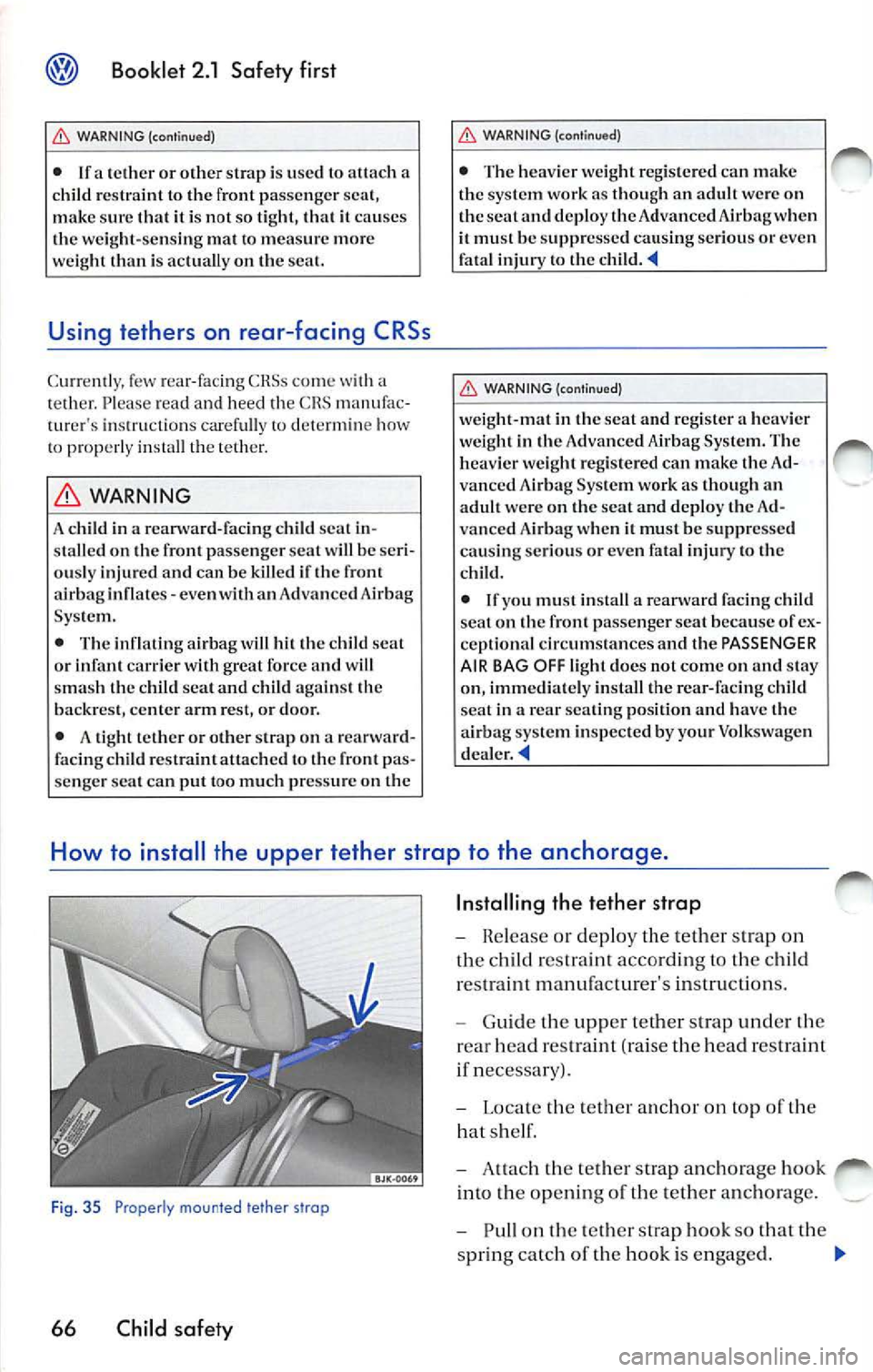
How to install the upper tether strap to the anchorage .
Fig. 35 Prope rly moun ted le ther slrop
66 Child safety In
sta lling the t ether strap
- Release or dep loy the tether str ap on
th e ch ild res train t accor ding to th e ch ild
re stra int manufa ctu rer's in structions.
- Gui de th e upper tether strap und er th e
r e ar head res traint (ra ise th e head res tra int
if necessa ry) .
- Loca te th e te ther anchor on top or th e
h at s h elf.
- Atta ch th e te ther strap anchorag e hook
int o th e op ening
th e tet he r an ch orage.
- Pull on th e te the r strap hook so th at th e
s prin g ca tc h of the h ook is en gag ed .
Page 278 of 477
Booklet 3.1 Controls and Equipment
WARNING
Heavy load s will influ ence the way your ve
hicle handl es and heavy loads t hat are not
properly stowe d or sec ured can cause loss of
contro l a nd se rious injury.
• Always keep in
when transporting
h eav y ob ject s, that a chan ge in th e center of
gravity can also cause c hanges in vehicle han
dling:
-Always distribute the load as evenly as
po ssib le.
- Secur e heavy object s properly as far for
ward in the lug gage compar tment as pos
sible.
- Alwa ys s ecure heavy items securely
using the tie-downs provided wit h suitable
s trap s.
• Never excee d the Gross Axle Weight
or the Gross Ve hicle Wei ght Hating on the
s afe ty compliance sticker o n th e left d oor
jamb. Exceedi ng permi ssible weig ht can ca use
the vehicle to slide and handle difTerently.
• Always read and heed a ddition al imp or
in forma tion on driving 2.1
" Safety first."
WARNING
To help p rev en t poisonou s exhaust gas from
being drawn into the vehicle , a lways ke ep the
rear lid clo sed w hile driving.
• Never transport objects larger than those
fitting completely into the luggage area be
cause t he rear lid cannot be full y closed.
• If you abso lut ely must drive with the rear
li d open, observe the following notes to reduce
th e risk of poisoning:
WARNING (continued)
-Close all wind ows,
- Close the power roof,
- Open all air outlets in the in strumen t
panel,
- Switch off the air recirculation,
- Set the fresh air fan to the highest speed.
WARNING
Always make sur e that the doors and rear lid
are secure ly clo sed and locke d to redu ce the
risk of injury when the vehicle is not being
u sed.
• Afte r clo sing the rear lid , a lways mak e sur e
that it is p roper ly closed and locked.
• Never leave yo ur vehicle unattended espe
cially with th e rear lid left open. A child could
craw l into the vehicle through the luggage
compartment a nd pull the re ar lid or window
s hut becoming trapped and unab le to get ou t.
Being trapped in a ve hicle can lead to serious
p ersona l inju ry.
• Never le t ch ildr en play in or around the ve
hicle.
• Never let passe ngers ride in the luggag e
com par tmenl. Vehicl e occupants must always
be properl y re strained in one of the veh icle's
s eat ing po siti on s.
Note
o bj ec ts o n th e hat sh elf co uld d am age the
w ires of the re a r w ind ow d efogg er.
Tips
D o no t co ve r th e ve ntilatio n slo ts in front of th e
r e ar sid e w ind ows beca use this ca n pr event sta le
a ir fr om esca ping the vehi cle.
Seats and storage 75
Page 280 of 477
Booklet 3.1 Controls and Equipment @)
Securing the load
Loads transported on the roof rack must be securely attached. The vehicle's han
dling is affected when transporting loads.
Always secure th e in the
WARNING
Items that arc not properly secured to a roof
rack can fall off causing a collision and per
sona l injury.
• Always make sure that all bolts and fas
teners arc properly installed and properly
ti ghten ed befor e every trip at each stop during
a long trip.
• Always properly install special fixtures for
it em s s uch as bicycles, skis, surfboard s, etc.
• Never use s traps or other things that are
damag ed, not strong enough or not suitabl e to
attac h items to a roof rack.
WARNING
Transporting heavy bulky loads o n the roof
will change the way the vehicl e handl es by
shifting the vehicle's center of gravity,
changing its aerodynamics and the way it re
acts to side winds.
WARNING (cont inued)
• Cargo th at is l arge , heavy, bulky, long or
flat will have a more negative influence on the
ve hicle 's aerodynamics, center of gravity and
overa ll handlin g.
• Always adapt your driving and speed to
what you ar e carry ing on the roof as
as to
road, traffic , weather and wind condition s.
• Always avoid sudd en braking or driving
maneuvers.
• Always make sure that loads arc properly
distributed and that heavier items arc in th e
front.
• Never exceed the maximum roof load for
th e vehicle 165 lb s. (75 kg) , maximum axle
loads or the maximum gross vehicle weight
3.3 "Techn ica l D ata."
sys
t e m s is no t cov ered by the warra nty.
• The height of yo ur vehicle is chan ged by th e
in sta llation of the roof rack and the loa d sec ured
on it. Bear this in mind when driving throu gh ga
door s or low und erp asses to avo id damag e
to the vehicle.
For the sake of environment
D rivi ng w ith the roof
incre ases fu el con
s umpti on. If yo u do not nee d do not u se it.
Page 332 of 477
manufactur er to make sur e th at yo u are using
t h e co rrec t hit ch
Do not use a bumper hitch.
Th e hit ch mu st be install ed so . that it does no t
int erf ere w ith th e impac t-a bso rbin g bu mpe r
sys tem . Do no t mak e any c han ges to th e ve hicl e
ex hau st and brak e sys te m s. Fro m t im e to tim e,
c h ec k tha t all hit ch -mo unting
rema in se
c ur ely fas tened .
W hen yo u are not t ow in g a tra iler, re m ove the
t ra ile r hi tch ball m oun t. T his pr eve nts th e h itch
fr om causing dam age sh ou ld yo ur vehicl e be
s tru ck fr om b eh ind .
Engin e coo ling syste m
Tow ing a trai ler makes the e ngin e wo rk It is im portant th at th e engin e coo ling syste m is up to th e job . Make su re that th e coo ling sys te m has
e n ough flu id.
Trailer brokes
If yo ur t railer h as its own brakes, ch eck to be th at it confo rms to a ll regula tion s. The tra iler
b ra ke sys te m must n ever be directly co nn ecte d
to th e ve hicle's brake sys tem.
Sa fety chains
Alw ays use safety chain s betwee n yo ur ve hicle
a n d trail er.
Trai ler lights
Tra ile r lig ht s m ust m eet a ll reg ulati ons
Neve r co nnect th e trail er light sys te m di rectly to
t h e lig ht sy ste m of y our vehicl e. 13 e to c hec k
w ith your auth orize d Vol ksw age n d eale r fo r
rec t w irin g, sw itch es a nd relays .
Mirror s
If yo u canno t see the behind you using th e
r eg ula r outside mirror s, th en you mu st i ns tall
exte nded m irror s. It 's
th at yo u alw ays have
cl ea r vis io n to th e re a r.
Maximum power consumption for the trailer
Do not excee d the ra tin gs g iven in t he c hart
Booklet 3.2 Tips and Advice ®
Electrical load power
Tail lights to ta l
60 Watt s
T urn sig nals per sid e 54 Wa tts
Br ake light s to ta l 84 Wa tts
Back up ligh t to tal 54 W atts
WARNING
An improperl y in sta lled or in corre ct trailer
hit ch can cau se a tra iler to separate from the
t o win g ve hicle leadin g to ser iou s per son al in
j uri es.
• Never install a "weight distributing" or
" lo ad equa lizin g" trailer hitch on your v ehicle.
T he v ehicle wa s not de signed for these kinds
of trailer hit ch es . Th e hitch attachment ca n
fail ca using the trailer to tear loos e from th e
veh icle.
WARNING
Wh en you no lon ger need to tow a tra iler , re
move the ent ire tra ile r hitc h. Alwa ys s eal a ll
bolt h ole s to pre vent water and dead ly exhaust
fum es from ent ering th e vehicle.
Note
• Do no t use a trailer w hi ch h as LED (lig ht
em ittin g dio des) t ail light s. T hi s ty pe of ta il lig ht
ca n da ma ge t he elec trica l co ntrol un it of yo ur
ve hicl e.
• I f th e tra iler soc ke t i s in co rrec tly co nnecte d ,
d am age could r esult
10 t h e ve hicles elec trica l
sys te m.
• I f th e m ax imum p ower co nsum pti on fo r
trail er is exceede d, dam age c ould r esult to th e
e lec tr ica l sys te m of ve hicl e.
• Neve r co nn ect th e elec trical sys te m fur th e
dir ectly to elec trical co nn ectio ns fo r
th e rea r or to o ther u nsu itab le powe r
so urces . Use only s uit abl e socke t to pro
v id e powe r to th e
Driving an d protecting the environment 11
Page 333 of 477
Booklet 3.2 Tip s and Advice
Operating instructions
Maximum trail er weight
Yo u ca n onl y tow 1y p ic al clas s I o r cla ss 2
I railers
w ith your vehicle.
T he m ax imum gross trailer weigh1 and 1h e
tongue loa d mu sl never exceed 1he s pecifica
tion s liste d in
3.3 "T ec hni cal
Neve r ex cee d 1h e gro ss v ehicle weigh 1, w hich i s
th e we ight of 1 he veh icle. includin g driv er, pa s
se nge rs , lu ggage,
I raile r hi1 ch an d 1ongue wei gh I of t he loa ded trailer.
I n alt itude s abov e
3,000 f1. (1,000 redu ctio n
of 10% of co m bin ed lowing weight (v eh icle plu s
trai le r) fo r the beginn ing of every
3, 000 f1. (1,000 m ) shou ld be obser ved.
Trailer loa d distribution
sur e th e loa d in th e tra il e r is held secu rely in
plac e to gu ard against shif ting, b e ii forward ,
ba ckward or sidew ays. A load that shifl s can
mak e it hard or eve n imp ossib le 10 co n1rol your
ve hicl e, pa rticul arl y in an emergency s ituat ion.
Tongue load
F o r best ve hicl e handling when towing a tra iler,
adju st th e traile r load so
the tongue lo ad i s
at the maximum allow abl e or slightl y lo w er. You
ca n get an approxim ation o f th e tongu e load
wit h a bathroom scale or yo u can m ea sure the
load at a 1 rucking com pany or weig hing stat io n.
Th e to ngue lo ad in cre ases the we ig h t of t he rear
ax le and corres po ndingl y re du ces the oth er l oa d
that your vehicl e ca n
pressure
towing a trailer, inflat e th e tir es o fyourv e
hicle to th e co ld tir e pre ss ure liste d on th e stic ker
on th e op en edg e of the dr ive r's door . Inflat e
tra iler tires to traile r and tire
s p ec ification s.
Light s
Al way s che ck th e head lig ht se 1tin gs wit h th e
tra iler hooked up befo re dri vin g off. A djust a s
n ecessary so
you can see th e road ahead but
n ot b lind oncom ing traffic .
C hec k and make sur e tha t all vehicl e and
light s are wo rki ng properl y-esp ec iall y the light s. S
af ety chains
sur e tr ailer safet y cha ins are properl y co n
n ect ed from t he tra iler to the hi tch on th e ve
h icl e. Leave e nou gh slack in the c hain s 10 turn
co rner s. Whe n yo u in s1a ll safery cha ins, m ake
s ur e th ey will not drag o n the road w hile you are
d ri vin g.
T he chains shuultl
u ntler t he traile r to prevent it from dropping to th e grou nd in cas e
of sepa rat ion from the hitch.
Electronic Stabilizat ion Program (ESP )
A lwa ys leave th e ES P swi1ched on w hen you tow
a trail er. The ES P makes it easi er to stab ilize the
trailer sh ould it start to swerve o r sw ay.
WARNING
A lways adjust your dri ving lo th e road, traffi c
and weather condition s. Do not let the extra
s af ety that ESP/AS R can provid e te mpi you
i nto laking extra risks.
WARNING
Ridin g in a trail er i s da ng erous and may be il
leg al.
• A person who is not properly re str ain ed in
a m ov ing ve hicle ri sk ser iou s perso nal inju ry
a nd even death in a cras h.
• Nev er let anyone rid e in your vehicle
witho ut bein g prop erly restr ain ed.
• Never all ow
pa ssenger lo ride in trailer .
WARNING
Exceeding th e permi ssible weig ht
rat ings and permis sible trail er
we ig ht s ca n result in accident s leadi ng to se
r ious persona l injury.
• Neve r le t th e ac tual Gross Axle Weight
Ratin g at th e front and rear
exceed the
pe rmi ssibl e we ig ht s. Also neve r le t th eir com
b in atio n excee d th e Gross Vehicle Weig ht
Ra ting.
• Alw ays re member that the vehicle' s han
dli ng will be
by the extra load. There-
fo re, adju st yo ur spee d accordin gly .
12 Driving and protecting the environment
Page 334 of 477
WARN ING (continu ed)
• Exceed ing permi ssibl e weig ht ratings can
r es ult in ve hicl e da m age, accide nts, and per
sona l
Driving tips
For th e best handlin g of ve hicle and trailer,
p lease note th e fo llowing:
• A "bala nce d" rig is easie r
operate and con
trol. This m ean s th a t th e tow vehicl e should b e
loaded to th e extent p ossible and p ermi ssible
whil e keep ing th e trailer as light as po ssibl e
und er th e circum stanc es. Wh eneve r po ssib le,
tran sfe r som e cargo to the
co mpar tment
of the tow vehicl e w hile obs ervin g tongu e loa d
req uirem ents and vehicle loa ding consid er
a tion s.
• The high er th e s pee d, the more
it be
come s fo r the drive r to control th e rig. Do not
dr ive at the maximum permis sibl e
• Always appl y br akes earl y. When driving
d ow nhill, d ownshi ft into a lower gear to u se the
e ng in e brak in g eff ec t to slo w down the ve hicle.
U se of the brake s alo ne ca n ca use them to ove r
h ea t an d fail.
• The coo ling effect of the rad iator fan cann ot
b e in crease d by dow nsh ifti ng beca use fan sp ee d
i s ind epend ent of engine sp ee d. The re for e,
Trailer towing tips
Your vehicle handles diff ere nt ly wh en t ow in g a
t ra iler b ecause of the a ddit io na l weight and
weig ht d is tribut ion. S af ety. perform ance and
e conomy will gr ea tly depend on how car efull y
yo u load your tra iler
yo ur rig.
B efor e y ou actua lly
your tra iler, practice
t urn ing. stoppin g and backing up in an ar ea
away from
until yo u l earn the feel of your
ve hicle and trailer unit.
Backing up is
r e quir es prac tice .
S teer ing w hile backing up is generall y opposite
of th at wh en backing your vehicl e w ith out a
tra iler.
Booklet 3.2 Tip s and Advice
wh en dr iving uphill , yo u can alwa ys dri ve in the
hi gh est po ssible gea r wit h low e ngin e sp ee d. If
th e coo lant te mp erature warning light in the in
s trument cluste r start s fla shin g in red , p ull off
the road , stop and le t th e e ngin e id le for abou t
minute s to pre vent hea t bu ildup and engin e
damag e.
WARNING
• Reduce you r speed even more under unfa
vora ble load, wea ther or w ind condi tions
p artic ular ly w hen goi ng dow nhill.
• Be especia lly carefu l w hen passing o ther
veh icles. Redu ce ve hicle sp eed immediate ly if
the tra iler sh ow s the sli ghtest sig n of sway ing.
• Neve r try to stop the sway ing by acceler
ating.
• Always heed speed lim its. In some a reas
speed lim its for vehicl es tow ing tra ilers are
l ower than for reg ular
Keep more di stan ce between your vehicl e and
th e one in front of you. will nee d m ore roo m
to stop.
To compens ate fo r th e traile r, yo u w ill n eed a
l a rger than normal tu rning
When passing , reme mber that you can not acce l
erate as fast as you normall y wou ld because of
t h e added load. Make sur e yo u ha ve enough
room to pas s. After passing, allow plen ty of room
fo r yo ur tr aile r befor e changing la nes aga in.
Avoid jerk y s tart s, sharp turns or rapid lan e
c h ange s.
Driving and protecting the env ironment 13