ESP VOLKSWAGEN JETTA 2009 Owner's Manual
[x] Cancel search | Manufacturer: VOLKSWAGEN, Model Year: 2009, Model line: JETTA, Model: VOLKSWAGEN JETTA 2009Pages: 477, PDF Size: 77.6 MB
Page 155 of 477
Booklet 2.1 Safety first
,0. WARNING (continued)
se nger seat, nobody can absolutely guarantee
th at d eplo yme nt und er these specia l co ndi
tion s is i mpo ssible in all co nce iva ble situa
tion s that may happ en durin g the use ful li fe of
yo ur vehicl e.
• The Adva nced Airbag Sys tem
w ill dep loy in
acco rdance with th e "low risk" optio n under
th e U.S. Federal Stan dar d ifa child that is
h eav ier than the t ypical one-yea r old child i s
to vehicles: wilh odvanced front oirbog system
Advanced front airbag system
Your veh icle is eq uip ped with a front Advanced
Airbag Syste m in co mplian ce with Unit ed Sta tes
Federa l Motor Vehicle Safety Standard 208 asap
pli cable at the time your ve hicle was manufac
tur ed .
Th e front Advanced Ai rbag Syste m su pple ment s
the safety belt s
provide ad dition al p rotect ion
for the dri ver's and fron t pa sse nger's hea ds and
up per bodie s in frontal crashes. The airbags in
fla te only in fron ta l impa cts when th e vehicle
d ecele ratio n is hi gh e noug h.
T he fro nt Advanced Airbag System for th e fron t
sea t occupants is not a sub stit ute for you r sa fety
belts. Rat her,
is part of the overall occ upant re
s traint system in yo ur vehicl e. Always remem ber
t h at the airb ag sys tem can onl y help to prot ect
you, if yo u ar e sittin g up rig h t, wearing
safet y bel t an d wear ing it properly. This is w hy
yo u and yo ur passenger s mu st always be prop
erly res train ed ,
ju st bec ause the req uires
yo u be.
Th e Adva nce d Airbag System in your vehicle has
bee n ce rtifi ed
me et the "low risk " "re quir e
m ent s fo r 3 an d 6 year-o ld childr en on pas
s eng er side and very s mall adults on the drive r
side. " Low risk " d eployme nt occ urs in th ose
c rashe s th at tak e pla ce at lower dece lerat io ns as
d efine d in the elec tron ic con tro l u nit
39 .
The low risk depl oy men t criteria are intend ed to
h elp reduce th e risk of injury through intera c
tion wit h th e front airb ag that ca n occur , for ex
ample, by bein g
th e s teer ing whee l
a nd in strum ent pane l wh en the airbag infl ates.
Fo r "low risk " deplo ym ent to occur, the
PA SSENGER AIR BAG OFF li ght mu st be off.
32 Airbag system
,0. WARN ING (conti nued)
on the front passenge r sea t and the other con
dition s for a irbag deploym ent arc met.
• Acci dent stati sti cs have s hown th at chil
dre n arc genera lly s afer in th e rea r sc at area
th an in th e front seating po sition.
• For their own safety, a ll children, especially
1 2 years a nd youn ger, s hould always ride in
th e back properly res train ed for their age and
s ize.
-4
39 "Moni to rin g th e Advanced Ai rbag
Sys tem ."
When a perso n is detected on
fron t pa s
se nger seat, we ig hi ng more than t he total weight
of a c hild that i s abo ut I year old res trai ned in
one of the rea r-faci ng or fo rward-facing infant
re strain ts ( listed in F ed era l Mot or Veh icle Sa fety
Standard 208 wit h wh ic h the Advanced Airbag
S ys tem in you r ve hicle was cert ifie d), the
P ASS ENGER AIR B AG OFF light sh oul d not come
o n and sh ould stay off .. When the PAS SENGER
AIR BAG OFF light is off, the fron t airba g on the
passenger side may or may no t dep loy de
pending on the natur e of the co llisio n as regis
tered by the electronic co ntrol unit.
For example , th e airb ag may deploy in the " low
risk " mode if:
• a sm all c hild that is heav ier than a ty pical I
yea r-o ld child in on e of the c hild re stra ints wit h
wh ic h the Advan ced A irbag Syste m was ce rtifi ed
53 is on the front passenger sea t
• a child who has out grown chil d r estrai nts is
o n th e fron t pa ssenger seat.
• a sma ll adult or teenage r is o n the front pa s
se nger seat
• a pas senger who is no t sitt ing upr igh t wi th
their back aga in st a non- reclined back rest w it h
t h ei r fee t on the vehicle floo r in front of the seat
i s on the front passe nger seat
5
In addition , the sy stem has been certifi ed to
co mpl y wit h the "sup press ion" req uireme nts of
th e Safe ty S tandard,
to turn off the fron t airbag
fo r infan ts 12 m ont hs old and younger who are
r es trai ned on th e front passenge r sea t in chil d
Page 169 of 477
Booklet 2.1 Safety first
Applies to vehicles: with side airbags
How supplemental side airbags work
Ai rbags inflate in the of an eye and can help reduce the risk of upper torso
injuries fo r occupants who are properly rest rained.
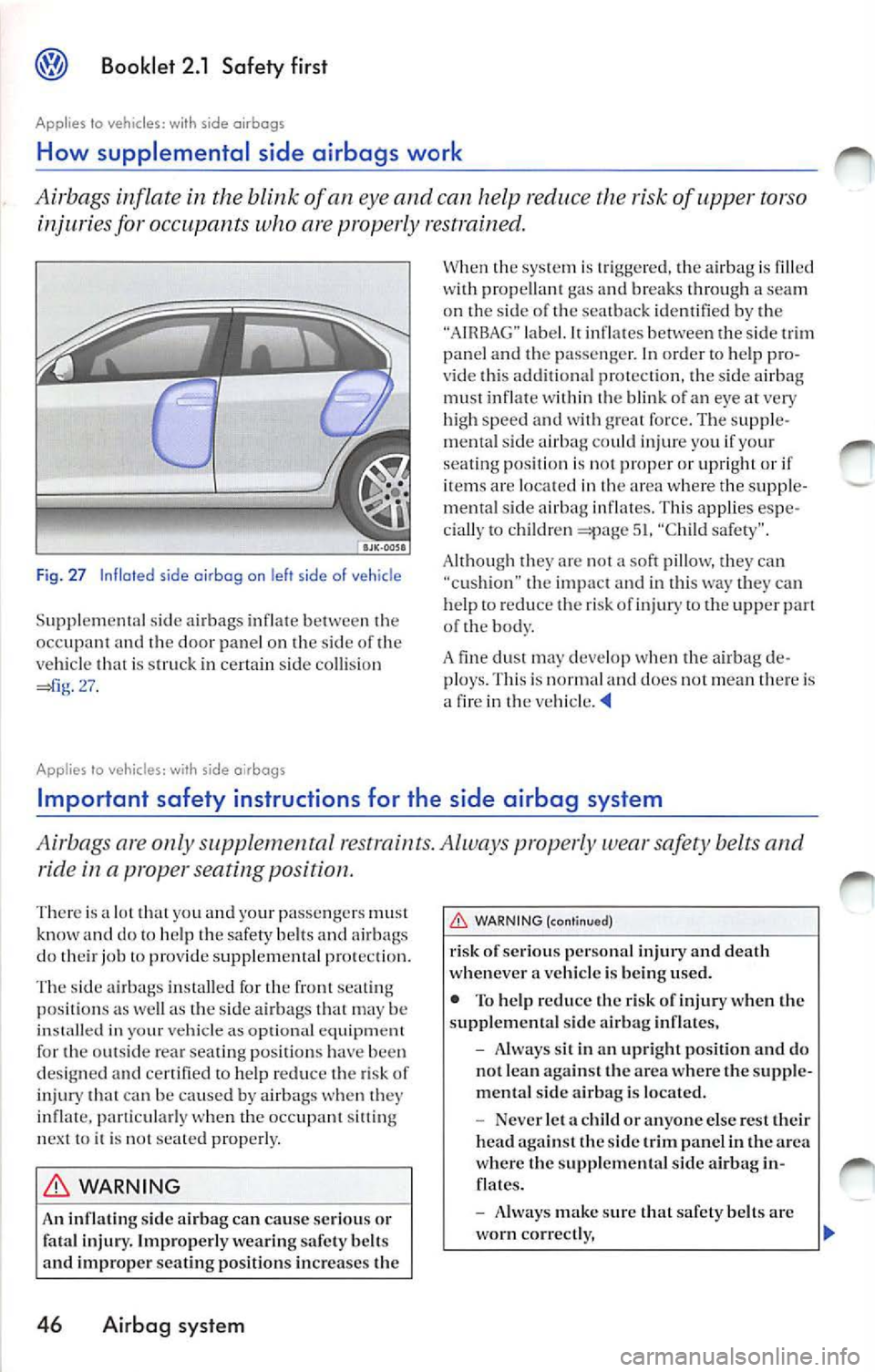
F ig . 2 7 Inflate d side air bag an left side of vehicle
Suppl em ent al sid e airbag s infl ate be tw ee n th e and !h e doo r pan el o n sid e of ve hicl e is s tru ck in certain sid e co llisio n 27 .
Applies to vehicles: with side airbags
When the syste m is tri gger ed, th e airbag is fill ed
with prop ellan t ga s and br eak s throu gh a se am
o n the s ide o f th e sea t b ack id entifi ed by th e
" A IH BA G" lab el. It
betw een the side p anel and th e passe nge r. In ord er t o help pro
v id e thi s add itional protec tion, sid e a irba g
mu st infl ate within th e blink of an eye at very
hi gh sp ee d and with grea t fo rce . Th e suppl e
m ental sid e airba g could i njur e you if your
seating po sit io n is
11 0 1 prop er or upr ight or if
i t e m s are lo cat ed in ar ea wh ere t he sup ple-m ent al sid e airba g inflat es. Th is applie s espe-
cially to children 5 1, "C hild safe ty".
A lth ough th ey arc no t
so ft pill ow, th ey ca n
"c ushi on " th e im pact and in thi s way they c an
h elp t o re du ce the risk of inju ry to th e upp er p an
o f th e bod y.
fin e du st ma y when th e airba g de
p loys. This is no rmal and doe s not mean th ere is
a fir e in the v eh icl e.
Important safety instructions for the side airbag system
Airbag s are only supplem ental res traint s. Always prop erl y wear safety belts and
ride in a proper seating posit ion.
Th ere is a lo t thal you and your pa ssengers mu st
know and do help th e safety belts and a irbag s
do their job lO provid e supp lem ental protec tion.
Th e sid e airbag s insta lled for th e front sealin g
p os itions as w ell as th e s ide airba gs that ma y be
in stall ed in your vehicl e as op tio nal equipm ent
fo r th e outsid e re ar se a tin g po siti ons hav e bee n
d es ig n ed and certifi ed t o help r edu ce the r is k of
injur y th at ca n b e caused by airba gs when th ey
inflat e,
wh en the oc cup ant siuin g
n ex t to it i s no t seat ed prop erly .
WARNING
An in flatin g s ide a irbag ca n cau se serious or in jury. Improper ly wear ing safety belts
an d i mproper seating pos itions i ncreases the
46 A irbag system
WARN ING (continued)
ris k of se riou s perso nal inju ry and d eath
w heneve r a ve hicle is bein g use d.
• To help re duce the risk
inju ry w hen th e
su ppl em ent al sid e airb ag infl ates,
-
s it in an u prig ht pos ition and do
n ot lea n aga inst th e a rea w here th e s up ple
me nta l side airbag is located.
- Never let a ch ild or an yo ne e lse res t th eir
h ead aga ins t th e side t rim p anel in th e area
w here th e s up pl eme ntal s id e a irbag in
fla tes .
- Always make su re that safe ty belt s arc
wo rn correc tly,
Page 174 of 477
Booklet 2.1 Safety first
happ en s w hen
yo ur vehicle is in a cras h appl y also to chi ldren
15 , sa fety belt s?". But unlik e adult s
a nd t eenagers, the ir mu scles and bones are not
f ull y deve lo ped. In man y res pe cts child ren are a t
greater risk of serious inju ry in cras hes than
adult s.
13ecausc childr en' s bodi es are not full y deve l
oped, they re quir e re straint syste m s es peciall y
d esig ned for their size, weight, and
struc
tu re. Many co untries and all sta tes of the Unit ed
S ta tes a nd pro vin ces of Ca nad a hav e la ws re
qui ring the use of ap proved child restra int sys
tem s fo r infan ts and sm all childr en.
In a fron tal cras h at a s peed of20-35 mph (30-56
km /h ) th e forces actin g on a 13-pou nd (6 kg) in
fant w ill be m ore
20 tim es the we igh t of the
child. This m eans th e we ig ht of t he c hild would
s udd enl y be mor e th an 2 60 pound s (120 kg).
Under these co nditions, o nly a n appropr iat e
child res traint properl y use d can re du ce the risk
of serious injur y. Child rest rain ts , lik e adu lt
belt s, mu st b e used properl y to be effec
t ive . U sed im pro per ly, they ca n increase the risk
of serious injur y in an
Consu lt the chil d sca t manuf ac!Ur er's instru c
tion s to b e sure th e seat is right for your chil d's
s ize
54 , " Imp ort ant safety inst ructi ons fo r
u sin g child seats". Please be sure to rea d and
h ee d all of th e im porta nt inform atio n and
WAHN INGS
c hild safety, Advanced Air
bags , the in sta lla tion of child r estraint s in
thi s
is lot you need to kn ow about the Ad
van ced in your vehicl e and how th ey
wo rk when infants c h ild re n in child re
strai nts arc o n the front passenge r sea t.13eca use
of the la rge amo unt of im portant inform ati on .
we cann ot re p eat it all here . We urge you to re ad
th e deta iled inf orm ati on in thi s booklet abo ut a
irba gs and the i\dva nced A irbag Sys te m in yo ur
veh icle an d th e very import ant inform ati on
abo ut transport ing c hildren on th e front pas
se ng er sea t. Pl ease be sure to heed the WARN
I NGS -th ey are ex trem ely imp ort ant for yo ur
sa fe ty and th e safety of yo ur pa sse ngers , espe
ciall y in fants and sm all childr en .
WARNING
• Accident statistics have shown that chil
dr en are genera lly sa fer in th e rear seat area
t h an in the front seating po sition. Always re
s train any ch ild age 12 and und er in th e re ar.
• AU vehicle occ upant s and especially chil
dr en mu st be r estrain ed properl y w hen ever
riding in a vehicle. An unr estrain ed or im
properly res trained ch ild could be injured by
striking the interior or by being ejec ted from
the vehicle during
sudden maneuver or im
pact. An unrestrain ed or improperly re
stra ined ch ild is also at greater r is k of injury or
death through contact with an inflating
airbag.
• A sui table chil d re straint properly in stalled
a nd u sed at on e of th e rear seati ng positio ns
pro vid es t he hi gh est degre e of protection for
infants and small children in mo st accident
s ituation s.
WARNING
Childr en on the front s cat of any car even with
i\dvanced can be seriously injured or
eve n kill ed when an ai rbag inflat es.
• A ch ild in
re arward -facing child seat in
s ta lled on the front p assenger seat will be seri
o usly injur ed and can b e killed if the front
a irbag inflate s.
• The inflati ng airbag
hit th e ch ild seat
or infant carrier with great fo rce a nd will II>-
Child safety 51
Page 177 of 477
Booklet 2.1 Safety first
8. Rear facing child restraint systems, manufac
tured on or alter December l, 1999.
( W hen the res tra in t sys te m comes e quipp ed
w ith a re mo vable ba se, co mpli ance ha s to be
ce rtified with or wit hout the ba se).
• Britax Hand le wit h Care
191
• Centur y Ass ura 4553
• Centu ry Sm art Fit 4 543
• Cosco Arriva 02727
• Eve nflo Disc overy A dju st 212
• Evenflo Fir st Ch oice
204
• Gra co Infant 8 11 57
C. For war d-facing convertible child res trai nt
systems, manufactured on or after Dece mber l ,
1999:
• Brit ax Rou ndabou t
161
• Brit ax Expressway J SOFIX
• Centur y Enco re
• Century 1000
• Cosco Ol ymp ia n 0280 3
• Cosco Touriv a 02519
• Even flo Horizon V 425
• Evenfl o Meda llion 25 4
• Saf ety 1s t Co mfort Ride 22-400
D. Forward-fac ing toddler /be lt po sitioning
booster systems, manufactur ed on or after D e
cember l, 1999 :
• Brita x Roadster
9004
• Century Next Step 4920
• Cosco High Back Booste r
• Eve nfl o Hig ht Fit 2 45
L'.0, WARNING
To redu ce the ri sk of serio us inju ry, mak e sur e
that the PASSENGER AIR BAG OFF li ght comes
on and sta ys on when eve r a child restraint is
in stall ed on the front pa ssenger sea t and the
ignition is switched on.
• Take the child res traint
the front pa s
s enger seat a nd install it properl y at one of the
rear seat position s if th e PASSENGER AIR BAG
OFF light does not sta y o n.
• Have the airbag system insp ec ted by yo ur
aut hori zed Volkswag en dealer immediately.
Important safety instructions for using child seats
Correct use of chil d seat s substant ially reduce s the risk of injury in an ac cident!
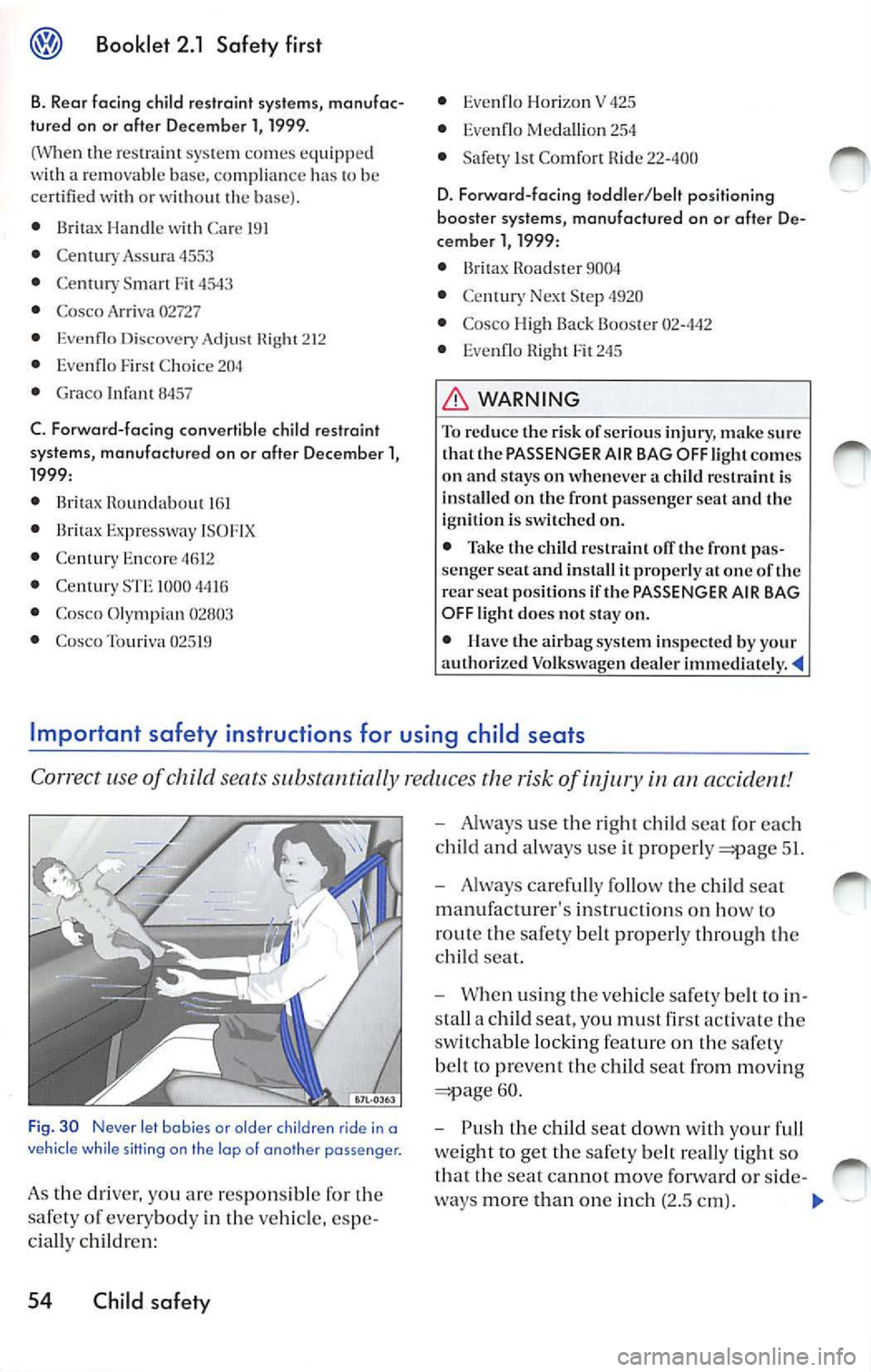
Fi g. 3 0 Neve r le t babi es or older c hildren rid e in a
v ehicl e wh ile s itting on th e lop o f a no th er passenge r.
As the driver, yo u ar e res pon sible for th e
s a fety of eve ry bod y in th e ve hicle , espe
ci all y chil dren:
54 Child safety
-Alway s use the right child seat for each
c hi ld and alwa ys use it prop erly
51.
- Alw ays caref ully foll ow the child seat
m anu fac turer 's in stru ction s on how to
rou te the sa fe ty bel t pr oper ly throu gh
child seat.
- When usin g th e ve h icle safety belt
10 in
s ta ll a child seat, you must fir st a ctivat e
sw itchab le lock ing fea tur e on th e safe ty
b elt
p reven t th e child seal from mov ing
60.
- Push th e c hild sea t d ow n with yo ur full
weig ht to get the sa fe ty belt re all y light so
th at the seat cannot mov e for ward or side -
w ays more th an one inch (2.5 cm ).
»,,
Page 178 of 477
-If a strap or te ther is being use d to tie
th e ch ild sea t to th e front passenge r seat,
ma ke s ure that it is
no t so tight that it
ca uses the we ight -sensin g mat to meas ure
more weig ht th an is actuall y on the se at.
Always remember: Even though yo ur vehicle is
e quip ped w ith an Advanced Airbag sys te m. all
c hildr en, especia lly those 12 years a nd youn ger,
s h ould always ride in the ba ck sea t p roper ly re
s train ed for th eir age and size.
WARNING
Not using a child sc a t, u si ng th e wrong child
s eat or improp erly insta llin g a c hild r estraint
in creases the risk of se riou s personal injury
and dea th.
• All ve hicle occupants and especia lly chil
dr en must alway s be res train ed properl y
whenever riding in a ve hicl e.
-
unr estrain ed or improperl y re
s trained child can be injur ed or kill ed by
b ein g thrown against the insid e of th e ve
hicle or by being ejected from it during a
s udd en man euver or imp act.
-
unrest rained or improperly re
stra ined ch ild is at much greater risk of in
jur y or death by being stru ck b y an in
fl atin g ai rbag.
• Comm ercia lly ava ilabl e child seats are re
quir ed t o co mply with U.S. Federal Motor Ve
hicle Safe ty Sta ndard (FMVSS) 2 13 (in Canada
CMVSS2 13).
- Wh en buying a child re straint , selec t one
that
y our child and the vehicle.
- Onl y use child restraint syste m s that
full y contact the flat portion of
seat
cushion. The child restraint must not tip or
lean t o either side. Volkswag en do cs not
r eco mmend using child scats that r es t on
l egs o r tube -lik e fram es. They do not pro
vide adequate co ntact with the scat.
- Always hee d all legal r equirem ent s per
t a inin g to the in stallati on an d u se of ch ild
sc ats and care fully follo w the in structions
pro vided by the manufacturer of the seat
yo u arc usin g.
• Neve r allow childr en und er 4 ft 9 in (57
in che s, 1.5 met ers) to wear a normal safety
belt. They must always be restr ained b y a
Booklet 2.1 Safety first
WARN ING (continu ed)
proper child re straint system. Oth erw ise, they
c ould susta in injurie s to the abdomen and
ne ck ar eas during sudden braking maneuvers
or accidents.
• Never let more than one child oc cupy a
child scat.
• Neve r let babi es or older chil dre n ride in a
ve hicle while sittin g on the lap of anoth er pas
se nge r.
- Holding a child in your arms is neve r a
sub stitute for a child restraint system.
- The strongest person could not hold the
c hild with the forces that exis t in an acci
dent. The child will strik e th e int eri orof the
ve hicl e and can al so be s tru ck by the pa s
senger.
- The child and th e passenge r ca n also in
jur e each another in an accident.
• Ne ver install rear-faci ng child seat s or in
fant carriers on the front passe nge r sea t.
w ill b e se riou sly injur ed and can be
killed when the passenger airbag inflates
even with Advanced Airbag System.
• The i nflating airb ag w ill hit th e child scat
o r infant carrier w ith great force and will
s mash th e child scat a nd child against the
backr est, ce nter arm res t, d oo r or roof.
• Alwa ys insta ll rear-facing child scats or in
fant carri ers on the r ear seat.
• Forward-facing child seats insta lled on th e
front pa ssenger 's sca t can interfer e with th e
a irb ag w hen it inflate s an d cau se se riou s in
ju ry to th e child . Always install forward-facing
c hild scats on the rear seat.
• I f exce ptional circumstance s requir e th e
u se of a forward-facing child res traint on the
front pa ssenger's scat, th e c hild 's safet y and
we ll-be ing require that the following sp ecia l
pr ecaut ions be taken:
- Make sur e the fonvard-facing seat ha s
been des ig n ed and
by its manu
factur er for use on a front scat with a pas
se nger front and side airba g.
- Always carefully follow the manufac
tur er's instru ction s pro vid ed w ith th e child
sea t or carrier.
- Always move the front pa ssenger seal
into th e rearmo st position
pass enger
Child safety 55
Page 182 of 477
Booklet 2.1 Safety first
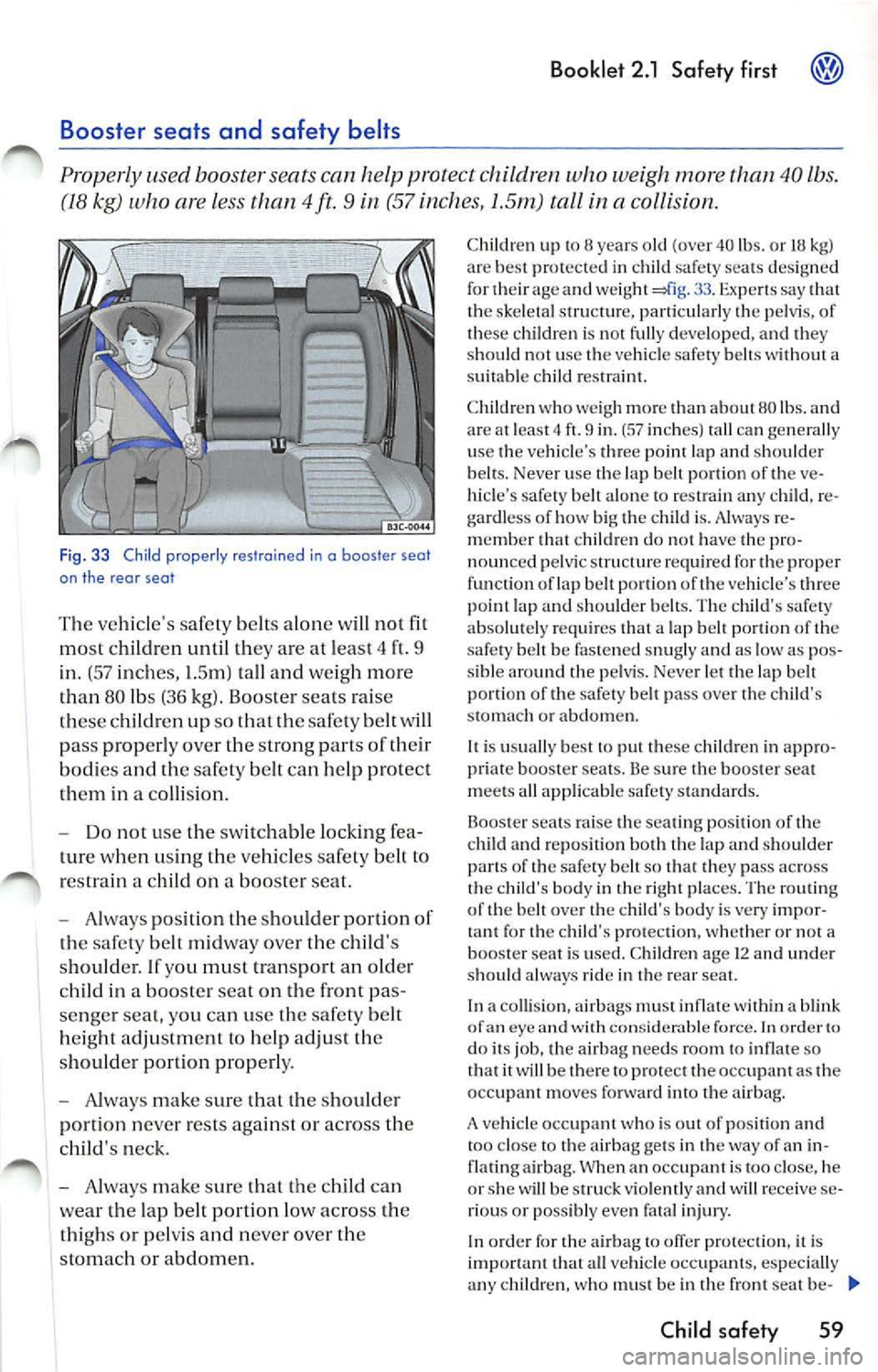
help protect children who weigh more 40 lbs.
(18 kg) wh o are less than 4 ft. 9
(57 inches, I.Sm) tall in a colli sion.
Fig . 3 3 Chi ld properly restroined in o booster seot
on the reor seot
The vehicle 's safe ty belts a lone will not fit
mo st children until th ey are at least 4
f t. 9
in. (57 inch es, 1.5m l tall and weig h m ore
th an 80 lb s (36 kg). Booster seats rai se
th ese children up so that th e safety belt w ill
p ass prop erly ove r the strong parts of their
bodies and the safety belt ca n h elp prot ect
th em in a co llis ion .
- Do not us e the switc habl e lo ck ing fea
tur e w hen using th e ve hicles safety belt to
r es train a child on a boos te r se at.
- Always positio n the sh ould er po rtio n of
the safery be lt m idway over th e child 's
s h oulder. If you mu st tran sport an olde r
c hild in a booster seal on the front pas
se nger seat, you can use th e safety belt
h eig h t adju stm ent to h elp ad ju st th e
s h ou lder po rti on prope rly.
- Alwa ys make sure that th e should er
porti on neve r rests aga inst or across the
ch ild' s neck .
- Always make sur e th at the child can
wea r the la p belt porti on low across the
thi gh s or pelvis and neve r over the
s to m ac h or abd om en .
C hil dren up to 8 yea rs old (ove r 40 lbs. or 18 kg)
are best protecte d in child safe ty seats desig ned
fo r their age and weight
33 . Expert s say that
th e s ke le ta l st ru ctur e, parti cul arl y the pelvi s, of
the se c hildren is not full y developed, a nd they
s h ou ld no t u se the ve hicle safety belts w ithout a
s uitable chil d res train t.
Ch ild re n who we igh mor e th an about 80 lbs . a nd
are at le a st 4 ft. 9 in. (57 inch es)
can ge nerally
u se t he ve hicle's t hree point lap and sh ou lder
belts . Never use th e la p b elt p ortio n of the ve
hicl e's safe ty be lt alone to res tra in an y c hild, r e
gardle ss of how big the chil d is. A lways re
membe r that children do not have t he pro
n oun ced pe lvic stru ctur e req uired for the prope r
func tion of lap belt po rtion of the ve hicle 's three
po int lap and sh oulder b elts. T he ch ild's safety
absolutely re qu ires that a lap be lt portion of the
sa fe ry belt be fastened sn ugly and as low as pos
s ibl e arou nd the pelvi s. Never let the lap belt
porti on of r he safety belt pass over the child 's
s tomac h or abd om en .
It is usuall y best to put th ese childr en in appro
p ri ate boo ster sea ts. Be sur e th e bo oster seat
me ets a ll app lica ble safety standa rds.
Boos te r seats raise the sea tin g pos ition of the
c hild and rep osition both the lap and shoulder
parts o f the safety belt so that they pass across
th e c hild 's bod y in th e right pla ces. The ro uting
of the belt over the child 's body is very impor
tant for the chil d's pro tec tion, w heth er o r not a
boo ste r seat i s used. Chil dren age 12 a nd und er
s hou ld always ride in the rear seat.
I n a co llision, a irbags must inflate within
blink
of a n eye and with force. In orde r to
do its job, the a irbag needs roo m to infl ate so
that it wi ll b e th ere to protec t the occupa nt as the
occ upant moves forward into the airbag.
A ve hicle occup ant who is ou t of pos ition and
t oo close to the a irbag gets in th e way of an in
fl atin g airbag . W hen an occupan t is too close, he
or she will be struck viole ntly a nd will r eceive se
r io us or possi bly even fatal injur y.
In orde r fo r th e airbag to offer pro tec tion, it is
imp ortant th at all ve hicle occ upant s, especia lly
any childr en , w ho must be in the fron t sea t
Child safety 59
Page 184 of 477
examp le. so 1ha 1 ii ca n'! lip 10 s ide when the
ve hicle goes aro und a comer.
A lways re m emb er: Eve n thoug h yo ur vehicle is
e quipp ed wit h an Advan ced Airbag system, all
c hildren, especia lly
12 years and young er,
s h oul d always ri de in the ba ck seat prop erl y re
fo r th eir ag e and size
WARNING
Improp erl y in stall ed child seats in crease risk of ser io us persona l injury and death in a
co llisio n.
• Always make sur e !hat the safety be lt re
t racto r is locked whe n installing a chil d sea t.
An unlocked safe ly belt retractor cannot hold
ch ild seal in place durin g nor mal driv ing
o r in a cr ash .
• Alw ays buckl e !h e c hild seal firml y in place
eve n if a child is not sitlin g in it. A loos e ch ild
sea l ca n fly aro und during a sudd en slop or in
collision
• Always make sure !ha! the rear seal back
10 w hich th e cen te r rear safely belt is at is securely la tc h ed whenever the rear
ce nter safety belt is being used to secu re a
c hild r estra in!
3.1, c hapt er "R ea r
sea l b en ch. "
• If
back res! i s not securely la tc h ed , child and th e child r estraint will be for
ward 1ogeth er w i1h !he backrest and will str ike
of the vehicl e inter ior. T he child can be
se rious ly in jured or killed.
• Never insta ll r ear-f acing c hild seals or in
f a n! carr iers on
passenger scat. A
ch ild will be serious ly injured and ca n be
killed when the pa ssenger air b ag
• The i nflatin g airbag will hit child seal
or infant carrier great forc e and will
s m ash !h e child seal and child against th e
backre st, ce nt er ar m
do or or roof.
• Always install r ear-faci ng child seals or in
carriers on !he rear seat.
• Forwa rd-faci ng c hild seal s or infant car
ri ers insta lled on !he front passe nger' s sea t
m ay interf ere
th e dep lo ym ent of !h e
a ir bag and cause ser ious inju ry to th e c hild.
• fl is safer lo install a forward-facing child
sea l on rea r seal .
• Alway s read a nd heed a ll WAR NINGS
w hene ver using a child r estrained i n a vehicle
Booklet 2.1 Safety fir st
,6 WARN ING (co ntinu ed)
is being use d 51. Specia l pr eca ution s
a pply when in sta llin g a c hild seat on !he front
passenger seat
29, "Child res traint s on sea l -s om e important t hings k n ow".
WARNING
Rearwa rd-facing ch ild restrain l s:
• A child in a rearw ard -faci ng c hild seal in
s ta ll ed on
pas senger seal w ill be ser i
ous ly inj ured and can be kill ed if !h e front
a ir bag in flates - even wi th an Adva nced Ai rbag
Sys tem.
• The inflatin g airbag will hit th e chil d seal
or infant carrier
grea t for ce and will
s m as h the chi ld sea l an d child against the
ba ckres t, ce nter arm r est, d oo r or roo f.
• Alwa ys be especia lly ca re ful if yo u mu st in
a reanvard faci ng child seal o n fronl
pa sse nge r seal in excep tiona l cir cumstan ces.
• A tight tether
on a rea rward-facing
c hild restrain! auached lo t he front p assenge r
seal can put t oo mu ch pres sur e on
wc ig hl
m al in the seal and regis ter a heavie r weigh ! in
th e Adva nced A irbag Sys te m . T he heav ier
we ight registe red ca n m ake
syste m work
as though an ad ult were on the sea t a nd de
plo y
Advanced A irbag when
the child.
• Make s ure !h a!
PASSENGER A IR BAG
O FF light comes on and stays o n all !h e lime
whenever
i gnit ion is s wit ch ed on.
• lflh e PASSENGER AIR BAG OFF
do es
n o ! co me on and stay on, immediatel y ins ta ll
rear-faci ng chi ld sea t in a rear seat ing po
s ition and have a.i rbag sys te m insp ec ted by
you r dea le r.
WARNING
sea l:
Child safety 61
Page 190 of 477
- Tighten the te ther strap firm ly fo l
lowin g th e ch ild re straint manufact urer's
in struction s
Releasing the tether strap
-Loo sen the tension fo llowing the ch ild
r estrain t manufactur er's instru ctions.
- Depress t he s prin g catc h on the hook
a nd r elease it
th e anchorage ..
Booklet 2 .1 Safety first
Ad justi ng head re straint s 3.1, chapter
"S eals and
Note
If you le ave t he c hild restra in! wilh 1he !et her firml y in stall ed for several day s, !hi s co uld
l eav e mark on !he upholst ery o n th e sea t
c u sh ion and in th e ar ea wher e !h e
1e1h er strap was insta lled . Th e uphol stery would
a lso be permane111 lys 1re1 ched aro und 1he teth er
T hi s appl ies especially 10 lea ther
vehicle at the factory.
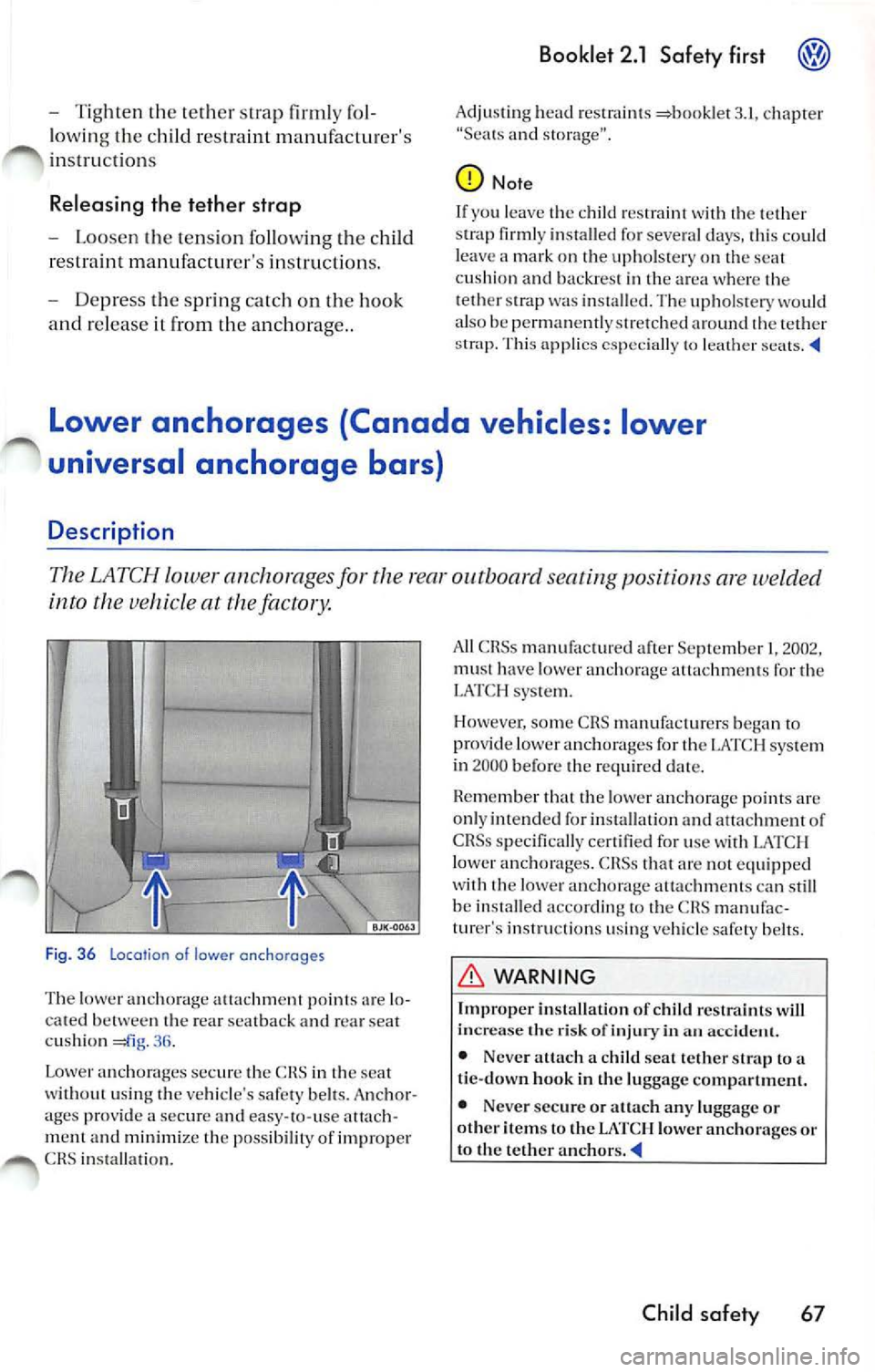
Fig. 36 Location of lower anchorages
The lowe r anc horage allachm enl poinl s are lo
caled between 1he re ar scatba ck and re ar sea t
cushio n
36.
Lower
s ec ure !h e in 1he se at using veh icle 's safety belts. Ancho r
ag es prov ide a sec ure and ea sy- lo-use allach
menl and minimiz e th e poss ibil ity of im proper
C RS in stallati on. All
cnss manufac tur ed after Septemb er I , 2002.
mu s! have lowe r
attac hment s for th e
LATCH syste m .
How ever, som e ens manufa ctur ers beg an
pro vide low er a nchorages for the LATC H in 2000 befor e th e requ ired
R em ember that the lower a nch orag e poi nts ar e
only intend ed fo r in stalla tion an d attachment of
specifi cally ce rtifi ed for use with LATC H
low er anchorages . cnss that are not equ ipped
w ilh 1he lowe r ancho rage atta chm ent s c an slill
be install ed a cco rdin g to t he
m anufac
tur er's using vehicle safety belt s.
WARNING
Impr oper insla llation of child restraints will
in crease the risk o f injur y in an accid e111.
• Neve r attach a child seat tether s trap to a
ti e-dow n hook in the luggage compartm ent.
• Neve r sec ure or attac h an y lugga ge or
other item s to the LAT CH lower anchorages or
to th e tet her
Child safety 67
Page 203 of 477
About this booklet
This booklet conta ins important information ,
t ip s, su ggest ions, and WARN INGS on using your
vehicle. The other booklet s in th e Owner's Liter
ature contain further information that you
should be aware of for your own safety and for
the safety of your passengers.
Make sure that you always keep the comp lete
Owner's Literature in the vehicle. This i s espe
cially important when you len d or sell th e ve
hicle .
Thi s manual describe s the vehicle equipment at
the time of publication. Som e of the equipment
described will not be available until a later date,
or is only available for certain markets.
Illustration s may slight ly vary from your vehicle.
F or thi s rea son you should regard illu stration s as
a general guide.
At the beg inning of this bookl et, you will find a
t a ble of contents showing all the items de
sc ribed in this manual in the order they appear.
An alphabetical index
at the end o f the
booklet.
Dir ections a nd positions (for examp le right, left.
front, rear) are always relative
to the dire ction of
trav el of the ve hicle unl ess s tated otherwise.
Some sect ions of this booklet do not apply to all
ve hicles. If this i s the case, a text at the beginning
of th e sect ion indicates which vehicles it applies
to , for example "Applies to vehicles with Die sel
engine ".
® Regi ster ed trademark s are marked®. How
ever, the absence of this symbo l doe s not
co nstitute a wa iver of the right s concern ing
any term.
The sectio n is con tinued on t he next pa ge.
Indicates the e nd of a section.
Cro ss-refe rence to a "WARN ING" within
or outside of a section.
Cross-reference to a "Note" wit hin or out
s ide of a section.
Texts with this symbo l contain important ' formation on safety and how to reduce the risk
of personal injury or death.
Tips
Texts with this symbo l contain special tips and
other informat ion about gelling th e most out of
yo ur vehicle and its features.
Page 206 of 477
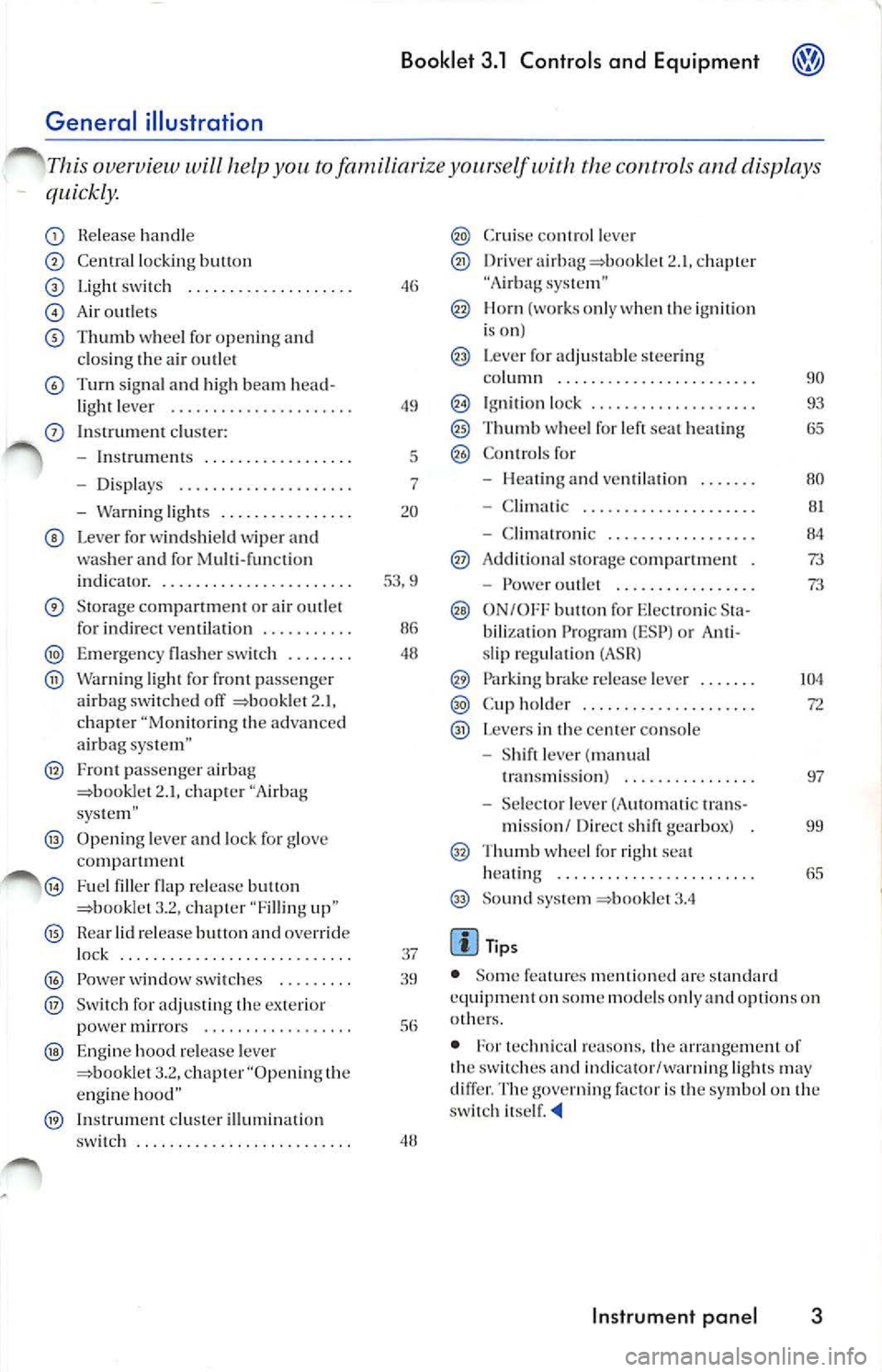
Booklet 3.1 Controls and Equipment
help you t o fami liarize yo urself the control s and displays
quickly.
Re lease hand le
Central locking button
Light switc h ............ •... ..•.
A ir out le ts
Th um b whee l for ope nin g and
cl osing th e air outl et
T urn sig n al a nd high beam head-
li ght lever ..................... .
In strum ent clu ste r:
Inst rum ents ...... ........... .
Display s .... .... ........ .... .
Warn ing lights ............... .
Lever for win dshi eld wipe r and
was her an d for Mu lti-fun ctio n
indicator. ............ ......... . .
Sto rage compartm ent or ai r outlet
fo r in di rec t ve ntilation .......... .
Emerge ncy flas her sw itch ... ... . .
Warni ng light fo r fro nt passe nger
a irbag switched off 2.1 ,
c h ap te r "Mo nitoring th e advan ced
a irb ag sys te m "
Fron t passe nge r a irb ag 2.1, c hap te r "Airbag
sys tem"
Openi ng leve r and lock for glove
co mp artm ent
Fuel fi ller flap release b utton
= bo okle t 3.2, cha pter "F illing
Hea r lid releas e butt on and overr ide
lock .... .. .... ....... ....... ... .
Power w indow switch es ..... ... .
Sw it c h for adj ust ing the pow er mir rors ................. .
Engine hood re lease leve r 3.2. cha pte r "Op ening the
e ngi ne
In strument cluster illumin atio n
49
5
7
20
53 .9
48
37
sw itch . . . . . . . . . . . . . . . . . . . . . . . . . .
C rui se contr ol leve r
Driv era irha g 2.1 , cha pter
"A irb ag
I lorn {wo rks onl y whe n the ig ni tio n
is on)
L eve r for adjustable steering
co lumn ...... ................. .
Ig niti on lock ................... .
Thumb w hee l fo r l eft se at heati ng
Co ntr ols for
Hea tin g and ve ntilat ion . ..... .
Clima tic ........ ..... ....... .
Clima troni c ................. .
Ad ditional storage comp artme nt
Powe r outl et . ............ ... .
ON/OFF b utton fo r Elec tronic Sta
b ili za tion Pr ogram {ESP) or Ant i
sli p regu latio n (ASH)
Park ing brak e re lease leve r ...... .
Cup hold er ... .... .... .........•
Levers in the center conso le
Sh ift le ver (ma nual
t ra nsmi ssio n) ....... .... .
Se lec tor le ve r (A utomatic tran s-
111i ssio n / Dir ect shi ft gearbox)
Thu111b whee l for r ight seat
heat ing .. .... ..... .... ........ .
So un d sys te111 =book le t
Tips
90
93
80
8 1
84
73
73
104
• Some feature s m en tion ed arc s ta nd ard
e quip111en t o n so me m od els on ly and opti ons on
o th ers.
• For tec hn ica l reasons, t he
of
t h e sw itches and indica tor/warn ing lig h ts ma y
di ffer. T he
factor is t he sy mbol o n th e
sw itch its elf.
Instrument panel 3