brake light VOLKSWAGEN JETTA 2009 Owner's Manual
[x] Cancel search | Manufacturer: VOLKSWAGEN, Model Year: 2009, Model line: JETTA, Model: VOLKSWAGEN JETTA 2009Pages: 477, PDF Size: 77.6 MB
Page 322 of 477
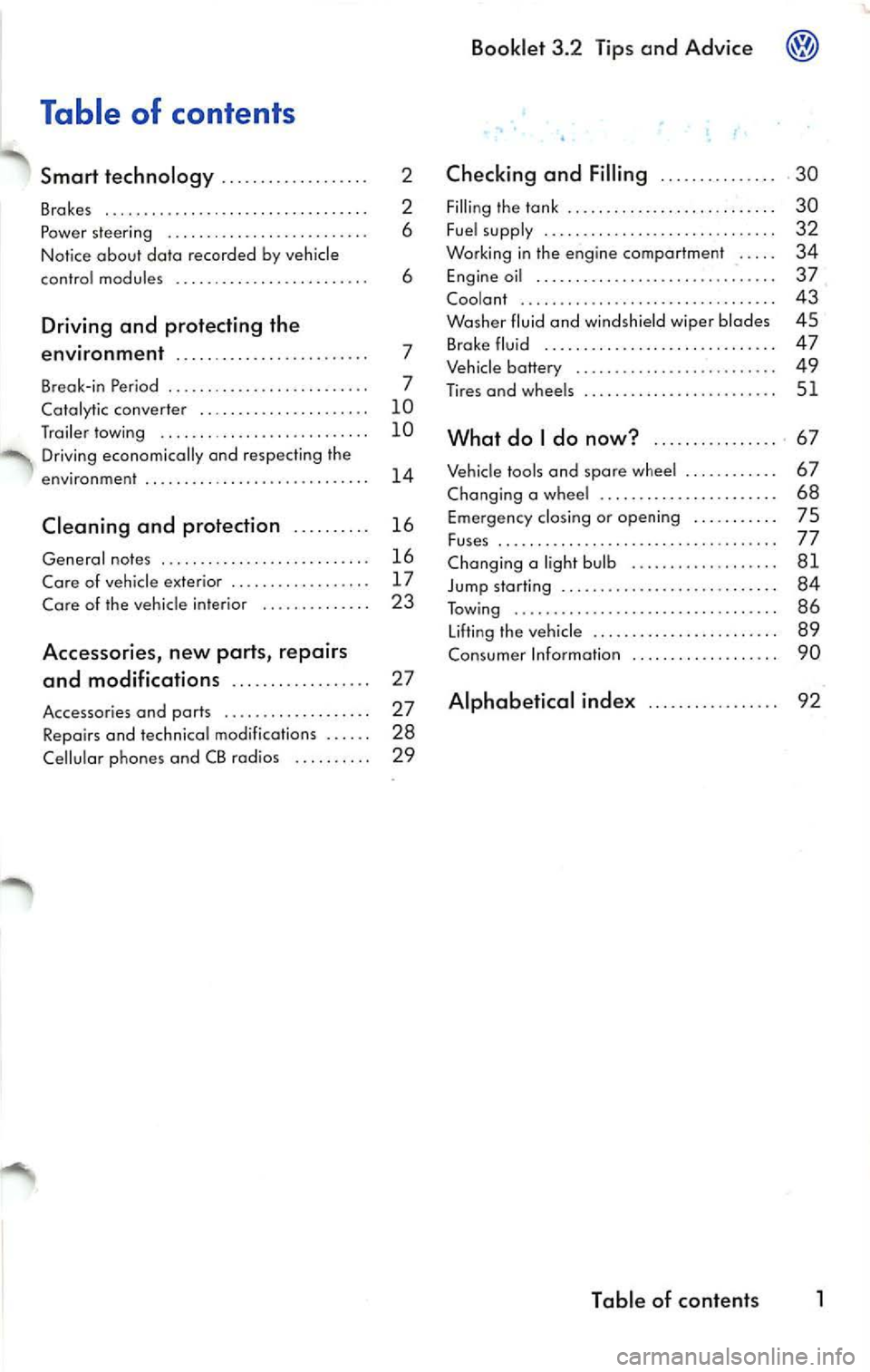
Table of contents
Smart technology ........... ... .. .. .
Brakes .............. .. .. ..... .. .. .• .....
Po we r stee ring ....... .. ..... ... .. ...... .
Notice about data recorded b y vehicle
contro l modu les ....... ........ .... ..... .
Driving and protecting the
environment ..... ... .... ..... ...... ..
Break-in Pe riod ... ... ........ ......... . ..
Catalytic converter ....... .. .. .. ....... ..
T ra ile r t owi ng . . . . . . . . ... ............ .. .
D riv ing economically o nd respecti ng the
environmen t ... .... ..... ............. ... .
Cleaning and protection ........ . .
General notes .... .... ... ....... .. ...... .
Car e of veh icle exte rior ....... ..• ...... ..
C ore of the vehicle interior ... ..... ..•. ..
Accessories, new parts, repairs
and modifications .......... ...... ..
Accesso ries and pa rts .......... .... .... .
R epa irs and technica l modifications ..... .
Cellu lar phones a nd CB radi os ........ . .
2
2
6
6
7
7
10
10
14
16
16
17
23
27
27
28
29
Booklet 3 .2 Tip s and Advice
Checking and Filling 30
Fill ing the tank . . . . . . . . . .. .. . . .. . . .. . • . . . . 30
Fu el supp ly . .. . . .. . . . . . . . . . . . . . . . . . . . . . . . 32
Working in the eng ine compa rtment . . . . . 34
Engine oil . . . . . . . . . . .. . . .. .. . . . .. .. . . .. . . 37
Coo lant ....... .... .... ...... ... ......... 43
Wos he r fluid and wind shie ld wiper blade s 45
Brok e fluid . . . . . . .. . .. . . . . . . . . . . . .. . . . . . . 47
Vehicle battery . . . . . . . . . .. . .. .. .. . .. . . .. . 49
T ir es and wheels . . . . . . . . . . . . • . . . . . . . . . . . . 51
What do I do now? . .. .. . . .. . . . . .. . 67
Vehicle tools and spore whee l . . . . . . • . . . . . 67
Changing a whe el . . . . . . . . . . . . . .. .. • . . . . . 68
Em erg ency closing or opening . . . • . . . . . . . 7 5
F use s . . . . . . . .. .. . .. .. . . . .. . . . . . . .. . . .. . . . 77
Cha nging a light bulb . .. .. . . . .. .. . • .. . . . 81
Jump start ing . . . . . . . . . . . . . . . . • . . . . . . . . . . . 84
To wing .... ... . . .. . .. .... ....... ... . . .•. . 86
Lifting th e ve hicle .. . .. . . . . . . . . . . . . . .. . . . . 89
C onsumer Info rmat ion . . . . . • . . . . . . 90
Alphabetical index . . . . . . . . . 92
Table of contents
Page 329 of 477
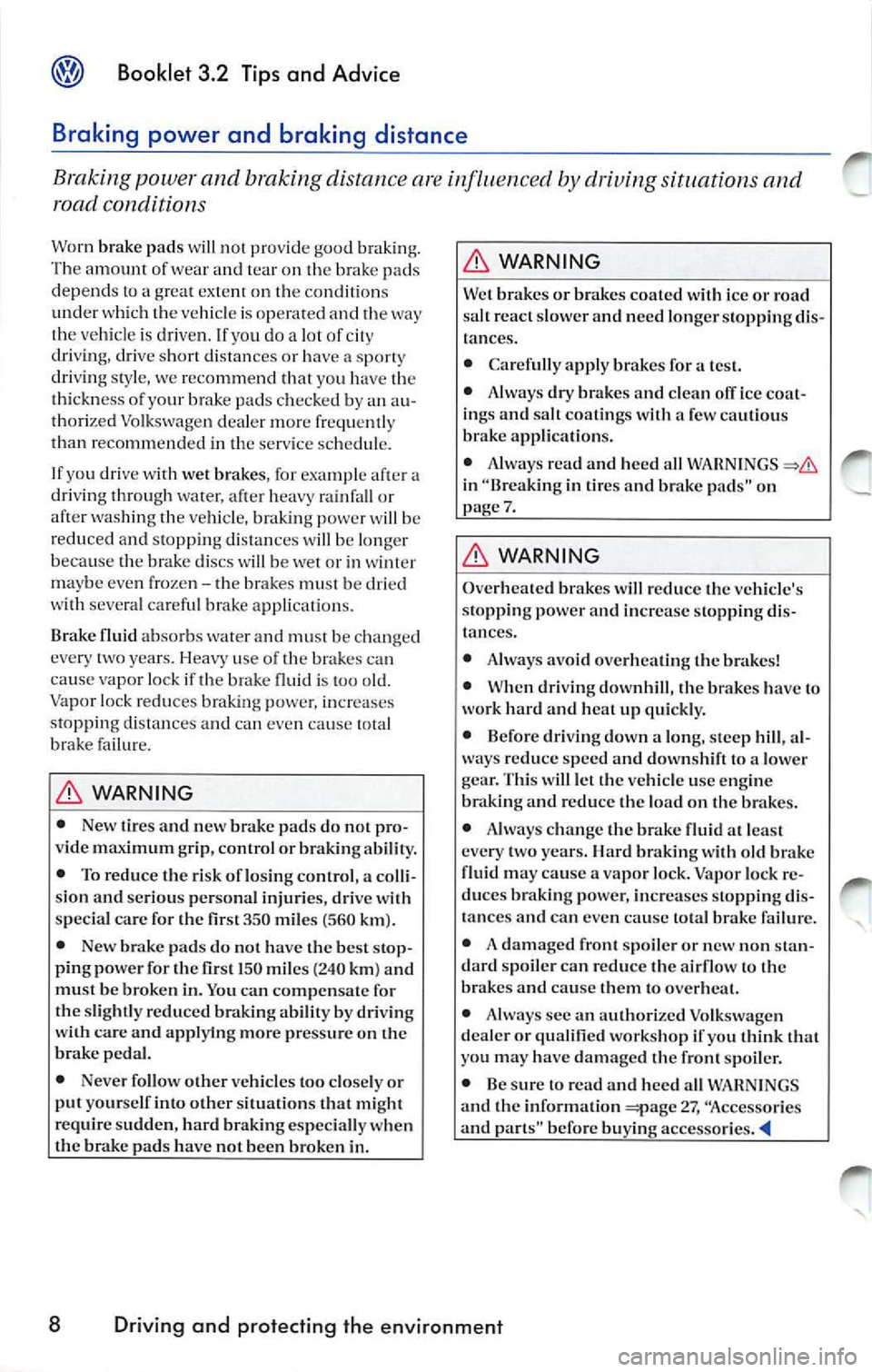
Booklet 3.2 Tips and Advice
Braking power and braking distance
Braking power and braking distance are influenced by driving situations and
road
Worn brake pads will not provide good braking.
The amount of wear and tear on the brake pads
depends to a great extent on the cond itions
und er which the vehicle is opera ted and the way
the vehicle is dr iven. If you do a lot of city
driv ing, drive short distances or have a sporty
driving style, we reco mm end th at you have the
thickness of your brake pad s checked by an au
thor ized Volkswagen dea ler more frequently
than r ecommend ed in the service schedule.
I f you dr ive witJ1 wet brakes , for example after a
dri ving through water,
heavy rainfall or
after washing the vehicle, brakin g power will be
reduced and sto pping distances w ill be longer
because the brake d iscs will be wet or in winter
ma ybe even frozen
the brakes must be dried
with severa l ca reful brake applications.
Brake fluid absorbs water and must be c hanged
every two years. Heavy use of the brakes can
cause vapor lock if the brake fl uid is too old.
Va por lock reduces braking power, increases
stopp ing distances and can even cause total
brake failure.
WARNING
• New tires and new brake pads do not pro
v id e maximum grip, control or braking abilit y.
• To reduce the risk of losing control, a colli
s ion and se rious persona l injuries, drive with
special ca re for the first
350 mil es (560 km).
• New brake pads do not have the best stop
ping power for the first
150 mil es (240 km) and
must be broken in. You can com pensate for
the slightly reduced braking ability by drivin g
w ith care and applying more pressure on the
brak e pedal.
• Never fo llow other vehicle s too close ly or
put yourse lf into other situ ations that might
r equ ire s udden , hard brakin g especially when
th e brake pads have not been broken in.
WARNING
Wet brake s or brak es coa ted ice or road
sa lt react slower and need longer stopping dis
tanc es.
• Carefully apply brakes for a lest.
• Alwa ys dry brake s and clean olT ice coa t
ings and salt coa tings with a few cautiou s
brake app lica tions.
• Always read and hee d all
in "Break ing in tir es and brake pads" on
page 7.
WARNING
Overheated brakes will reduce the vehicle's
s topping power and increase stoppin g di s
tances.
• Always avoid over hea tin g the brakes!
• When driving downhill, the brakes have to
work hard and hea t up quickly .
• Before driving clown a long, steep hill, al
ways red uce spee d and downshift to a lower
gea r. This will let th e ve hicle use engine
braking and reduce the load on the brakes.
• Always c han ge the brake fluid at least
every two years. Hard braking with old brake
fluid may cause a va por lock. Vapor lock re
duces brakin g power, increases s topping dis
tan ces and can even ca use to tal brake failure.
• A damaged front spoiler or new non stan
dard spoile r ca n reduce the airflo w to the
brake s and cause them to overheat.
• Always sec an au thorized Vo lkswage n
dealer or qualil1ed workshop if yo u think th at
you may have damaged the front spoiler.
• Be sure to read and heed all WARNINGS
and the information =-page 27, "Accessories
and part s" before buying accessorie s.
8 Driving and protecting the environment
Page 330 of 477
Operate your vehicle safely
For drivin g safely, alwa ys follow t he speci fied
maint enance interva ls in your maint enan ce
bo okle t =boo klet
I.I "M aint en an ce" -es peci ally
fo r chan ging brake fluid. H ard use , pri marily
s top and go dr iv in g, o perat io n in very dusty
areas, t ra ile r towi ng as we ll as other con dition s
m ay make
neces sary maint enance
im erva ls -see your authorize d Vo lksw agen
d ea ler.
Your vehicle 's condition is dir ect ly relot ed to
driving safety
Th erefo re, always be sur e
ob serve fol
l ow ing points before yo u dr ive off:
• Check l ig ht s an d turn sig nals.
• Check f uel l eve l.
• Make sure
a ll ligh ts a nd all wi ndows are
clea n.
• Adjust
mirr ors .
• Make s ure
air intak e slo ts betwee n en gin e hood a nd wind shi eld are free of
l eaves, sn ow a nd ice.
• Check warning a nd indicato r light s when
s tarli ng the en g in e.
Your personal d riving style and attitude have a
lot to do with safety ..
T here fore , for you r ow n sa fe ty:
• Wear your safety bells a nd wear
pro p
er ly , ev en if you ar e just driv in g in city o r lo
th e co rner =book le t 2 .1 "Sa fe ty first",
c h apt er "Safet y
• Make sur e th at all passe ngers wear their
sa fe ty belt s proper ly. even those in rea r 2.1 "Sa fe ty chapter "Safety
belt s." Pa sse ngers wea ring en
danger not onl y th em selves in cra sh, but al so dri ver and oth er passengers .
• Make su re th at children a lwa ys
on rear
sea t prop erl y res tra in ed by a res traint system a p
propri ate for th eir size and age.
• Never tra nsp ort a child in a rear
c hild
or infant seat on the front passe nger seat
= bo oklet 2.1 "Safety
• Adju st yo ur sea t so that yo u ca n eas ily reac h
a ll co ntrol s whil e yo u are as from
Booklet 3.2 Tips and Advice
airb ag as pos sible but close r th an 10 inches
(25 cm ) = book let 2. 1 an d 3.1.
• The sea ting positi on is ve ry important for the
a irb ag perfo rm ance
2.l "S afety first",
cha pter "Air bag syste m.''
• Always a djust th e hea d res traints to
cor
r ec t h eig ht . For maximum pro tec tion , ad just the
h ead res trai nt so that the upp er edge is as eve n
w ith the top of yo ur hea d as possi ble,
no
l owe r than eye le v el a nd so that is as close to
th e ba ck of your head as possib le = bo okle t 2. 1
"Safe ty
• Alw ays make s ure that the mov ement of peda ls is no t res tri cte d in an y way 3. 1,
c h ap te r " Peda ls ."
• Store luggage an d light it em s prop erl y in
luggage compartme nt and on roo f
=book let 3. 1, c hap ter" Luggage compa rtment "
an d
3.1, cha pter rack."
If you drink, do not drive !
T he use of a lco hol, dru gs a nd certain medi ca
ti ons w ill seriously impa ir percept io n , reac tions
a nd dri vin g a bility ,
increa sin g th e
ri sk of an acci dent, cras h an d pe rso nal injury.
Do not drive if you are tired.
Make frequ ent rest stops , at le ast aft er every two
hours of dri ving.
Al ways adapt vehicle speed to traffic, road and
weather conditions.
H em ember , th at
o n sm ooth, slipp ery
roa ds, ve hicle han dling and br aking dep end a
d ea l on tire ad hes ion. On wet roa ds, the
front whee ls c an h ydrop lane, especi ally at
h ig her sp ee ds. If thi s hap pe ns, yo u will then no
l o nge r b e ab le to ste er or brak e prop erl y.
WARNING
• Alw ays observe the po sted spe ed Ii mils and
common sense. Your good judgment can
mean
diff ere n ce between arr iving safely at
your destination and being ser iously injur ed
in
crash or other kind of accide nt.
• Alway s rea d and hee d all WARNI NGS and
a dditi on al inform ation rega rding safety
= bookl et 2.1 "Safe ty
Driving and protecting the environment 9
Page 332 of 477
manufactur er to make sur e th at yo u are using
t h e co rrec t hit ch
Do not use a bumper hitch.
Th e hit ch mu st be install ed so . that it does no t
int erf ere w ith th e impac t-a bso rbin g bu mpe r
sys tem . Do no t mak e any c han ges to th e ve hicl e
ex hau st and brak e sys te m s. Fro m t im e to tim e,
c h ec k tha t all hit ch -mo unting
rema in se
c ur ely fas tened .
W hen yo u are not t ow in g a tra iler, re m ove the
t ra ile r hi tch ball m oun t. T his pr eve nts th e h itch
fr om causing dam age sh ou ld yo ur vehicl e be
s tru ck fr om b eh ind .
Engin e coo ling syste m
Tow ing a trai ler makes the e ngin e wo rk It is im portant th at th e engin e coo ling syste m is up to th e job . Make su re that th e coo ling sys te m has
e n ough flu id.
Trailer brokes
If yo ur t railer h as its own brakes, ch eck to be th at it confo rms to a ll regula tion s. The tra iler
b ra ke sys te m must n ever be directly co nn ecte d
to th e ve hicle's brake sys tem.
Sa fety chains
Alw ays use safety chain s betwee n yo ur ve hicle
a n d trail er.
Trai ler lights
Tra ile r lig ht s m ust m eet a ll reg ulati ons
Neve r co nnect th e trail er light sys te m di rectly to
t h e lig ht sy ste m of y our vehicl e. 13 e to c hec k
w ith your auth orize d Vol ksw age n d eale r fo r
rec t w irin g, sw itch es a nd relays .
Mirror s
If yo u canno t see the behind you using th e
r eg ula r outside mirror s, th en you mu st i ns tall
exte nded m irror s. It 's
th at yo u alw ays have
cl ea r vis io n to th e re a r.
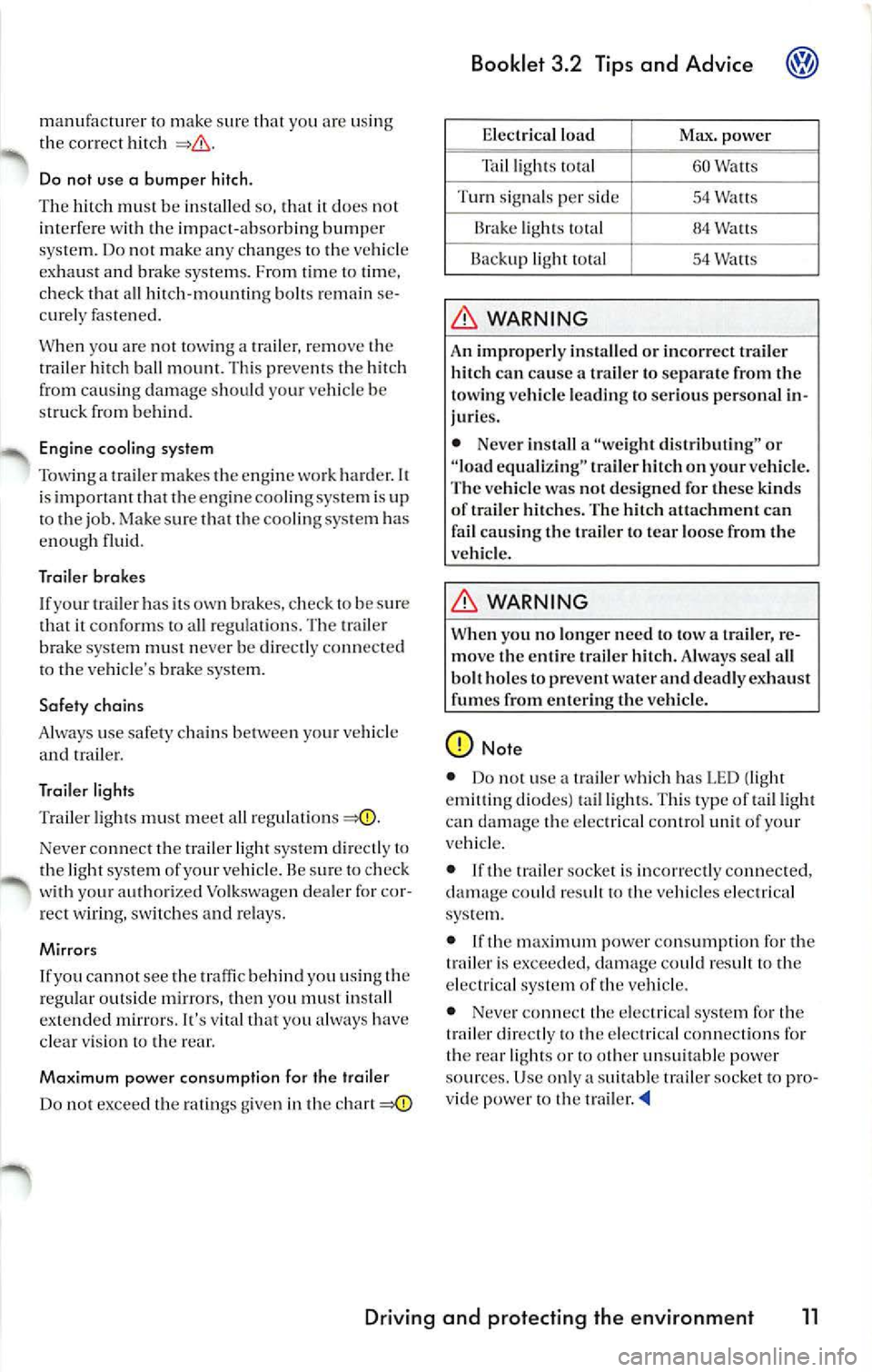
Maximum power consumption for the trailer
Do not excee d the ra tin gs g iven in t he c hart
Booklet 3.2 Tips and Advice ®
Electrical load power
Tail lights to ta l
60 Watt s
T urn sig nals per sid e 54 Wa tts
Br ake light s to ta l 84 Wa tts
Back up ligh t to tal 54 W atts
WARNING
An improperl y in sta lled or in corre ct trailer
hit ch can cau se a tra iler to separate from the
t o win g ve hicle leadin g to ser iou s per son al in
j uri es.
• Never install a "weight distributing" or
" lo ad equa lizin g" trailer hitch on your v ehicle.
T he v ehicle wa s not de signed for these kinds
of trailer hit ch es . Th e hitch attachment ca n
fail ca using the trailer to tear loos e from th e
veh icle.
WARNING
Wh en you no lon ger need to tow a tra iler , re
move the ent ire tra ile r hitc h. Alwa ys s eal a ll
bolt h ole s to pre vent water and dead ly exhaust
fum es from ent ering th e vehicle.
Note
• Do no t use a trailer w hi ch h as LED (lig ht
em ittin g dio des) t ail light s. T hi s ty pe of ta il lig ht
ca n da ma ge t he elec trica l co ntrol un it of yo ur
ve hicl e.
• I f th e tra iler soc ke t i s in co rrec tly co nnecte d ,
d am age could r esult
10 t h e ve hicles elec trica l
sys te m.
• I f th e m ax imum p ower co nsum pti on fo r
trail er is exceede d, dam age c ould r esult to th e
e lec tr ica l sys te m of ve hicl e.
• Neve r co nn ect th e elec trical sys te m fur th e
dir ectly to elec trical co nn ectio ns fo r
th e rea r or to o ther u nsu itab le powe r
so urces . Use only s uit abl e socke t to pro
v id e powe r to th e
Driving an d protecting the environment 11
Page 334 of 477
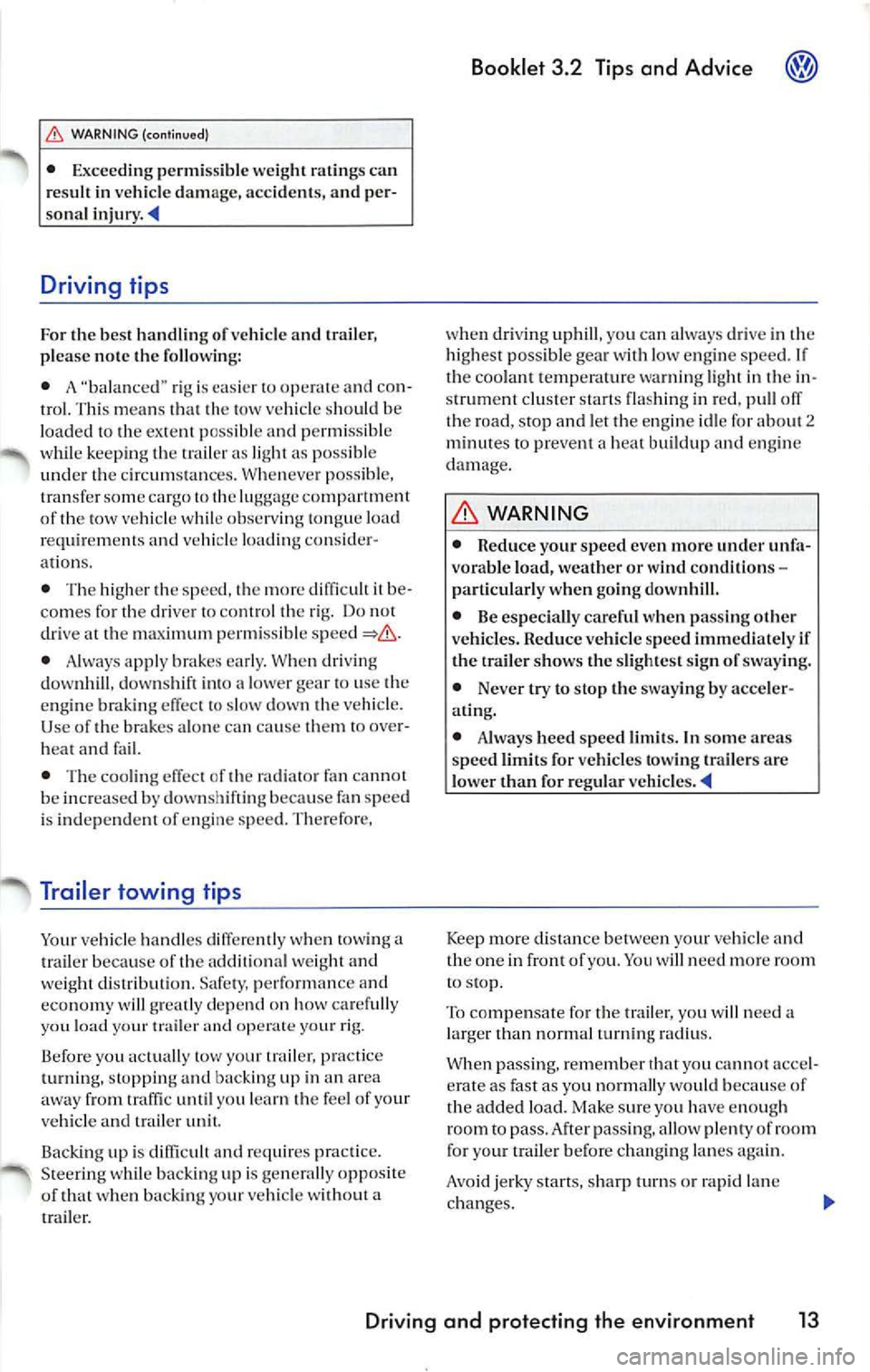
WARN ING (continu ed)
• Exceed ing permi ssibl e weig ht ratings can
r es ult in ve hicl e da m age, accide nts, and per
sona l
Driving tips
For th e best handlin g of ve hicle and trailer,
p lease note th e fo llowing:
• A "bala nce d" rig is easie r
operate and con
trol. This m ean s th a t th e tow vehicl e should b e
loaded to th e extent p ossible and p ermi ssible
whil e keep ing th e trailer as light as po ssibl e
und er th e circum stanc es. Wh eneve r po ssib le,
tran sfe r som e cargo to the
co mpar tment
of the tow vehicl e w hile obs ervin g tongu e loa d
req uirem ents and vehicle loa ding consid er
a tion s.
• The high er th e s pee d, the more
it be
come s fo r the drive r to control th e rig. Do not
dr ive at the maximum permis sibl e
• Always appl y br akes earl y. When driving
d ow nhill, d ownshi ft into a lower gear to u se the
e ng in e brak in g eff ec t to slo w down the ve hicle.
U se of the brake s alo ne ca n ca use them to ove r
h ea t an d fail.
• The coo ling effect of the rad iator fan cann ot
b e in crease d by dow nsh ifti ng beca use fan sp ee d
i s ind epend ent of engine sp ee d. The re for e,
Trailer towing tips
Your vehicle handles diff ere nt ly wh en t ow in g a
t ra iler b ecause of the a ddit io na l weight and
weig ht d is tribut ion. S af ety. perform ance and
e conomy will gr ea tly depend on how car efull y
yo u load your tra iler
yo ur rig.
B efor e y ou actua lly
your tra iler, practice
t urn ing. stoppin g and backing up in an ar ea
away from
until yo u l earn the feel of your
ve hicle and trailer unit.
Backing up is
r e quir es prac tice .
S teer ing w hile backing up is generall y opposite
of th at wh en backing your vehicl e w ith out a
tra iler.
Booklet 3.2 Tip s and Advice
wh en dr iving uphill , yo u can alwa ys dri ve in the
hi gh est po ssible gea r wit h low e ngin e sp ee d. If
th e coo lant te mp erature warning light in the in
s trument cluste r start s fla shin g in red , p ull off
the road , stop and le t th e e ngin e id le for abou t
minute s to pre vent hea t bu ildup and engin e
damag e.
WARNING
• Reduce you r speed even more under unfa
vora ble load, wea ther or w ind condi tions
p artic ular ly w hen goi ng dow nhill.
• Be especia lly carefu l w hen passing o ther
veh icles. Redu ce ve hicle sp eed immediate ly if
the tra iler sh ow s the sli ghtest sig n of sway ing.
• Neve r try to stop the sway ing by acceler
ating.
• Always heed speed lim its. In some a reas
speed lim its for vehicl es tow ing tra ilers are
l ower than for reg ular
Keep more di stan ce between your vehicl e and
th e one in front of you. will nee d m ore roo m
to stop.
To compens ate fo r th e traile r, yo u w ill n eed a
l a rger than normal tu rning
When passing , reme mber that you can not acce l
erate as fast as you normall y wou ld because of
t h e added load. Make sur e yo u ha ve enough
room to pas s. After passing, allow plen ty of room
fo r yo ur tr aile r befor e changing la nes aga in.
Avoid jerk y s tart s, sharp turns or rapid lan e
c h ange s.
Driving and protecting the env ironment 13
Page 337 of 477
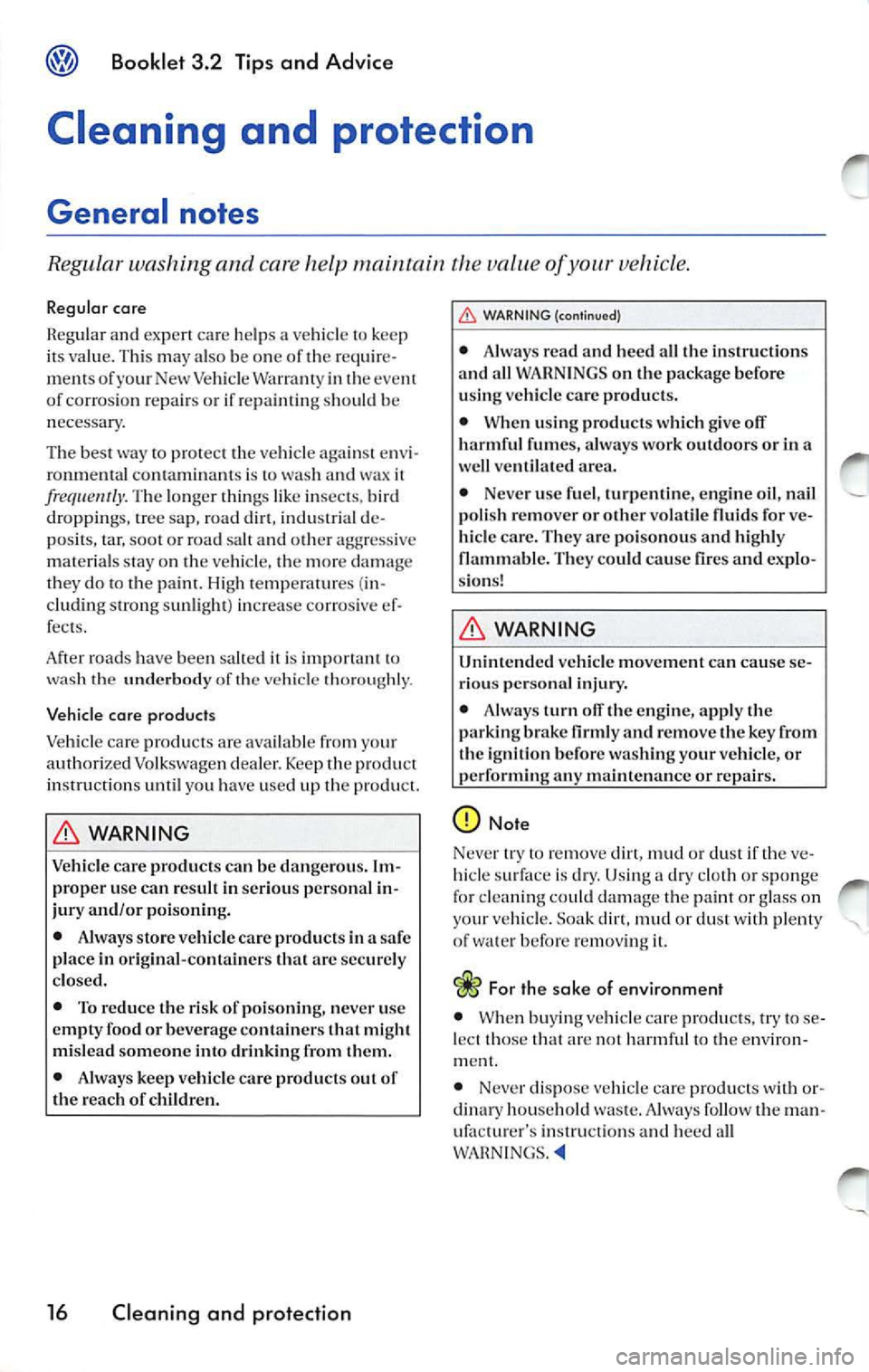
® Booklet 3.2 Tips and Advice
Cleaning and protection
General notes
Regular washing and care help maintain value of your vehicle.
Regular care
Reg ular and expert ca re help s a ve hicl e to kee p
it s va lu e. Th is ma y als o be o ne of th e re qu ire
m ent s of
New Ve hicle Warrant y in the eve nt
of corro sio n r ep air s or if re painting should be
n ec essary.
Th e bes t way to pr otec t the ve hicl e aga inst en vi
ronm ental contamin ant s is
to w as h and wax it freq11 e111/ y. The long er thin gs lik e in sec ts. bird
droppin gs, tree sap , road dirt , indu stri al d e
p os its, ta r, s oo t or ro ad salt and oth er a ggress ive
m ate rial s stay on the ve hicle, the mor e dama ge
the y do to th e pa int. Hi gh t emp eratur es (in
clud ing s tron g sunlight ) in cre a se corro sive ef
fec ts .
A ft er roa ds have bee n salt ed it i s imp ortant
to w ash th e und erbody of th e ve hicle th orou ghl y.
Vehicle care products
Veh icle care product s are ava ilable from your
authori zed Volk swagen d eale r. K eep the produ ct
in struc tion s until you hav e use d up th e produ ct.
WARNING
Ve hicle care products can be dangerou s. Im
proper use can result in seriou s personal in
ju ry and /or poisoning.
• Always store vehicle care produ cts in a sa fe
place in original-containers that are securely
closed .
• To reduce the risk of poisoning, never use
empty food or beverage container s that might
mi slead so meone into drinking from them.
• Alwa ys keep vehicl e care products out of
the r eac h of c hildren .
16 Cleaning and protection
WARNING ( continu ed)
• Always read and heed all the instru ction s
a nd a ll WARN IN GS on the package before
u sing veh icle ca re products.
• When using product s w hi ch g ive off
ha rmfu l fume s, always work outdoor s or in a
we ll ventilated area.
• Neve r use fuel , turpentine, en gine oil,
poli sh remover or other vo latile nuid s for ve
hicl e care. They arc poisonou s and highly
flammable. They could cause
and exp lo
s ion s!
WARNING
Unintended vehicle mo vement can cause se
rious per so n al inju ry.
• Alway s turn ofTthe eng ine, apply th e
parking brake
and remov e th e ke y from
the ignition b efore wa shin g your veh icle, or
pe rform ing any maint enance or repair s.
Note
Neve r try
10 re mo ve dirt, mud or du st if th e ve
hicl e surface is dr y. Usin g dry cl oth or spon ge
fo r cl ea ning cou ld dama ge th e paint or glas s o n
yo ur vehicl e. So ak d irt, mud or du st w ith plent y
wat er befor e re m ovin g it.
For th e sake of environment
• Wh en bu yin g v eh icle car e produ cts , try to se
l ec t tho se that are not harmfu l to the environ
m ent.
• Never di spo se vehicl e ca re pro duct s with or
d ina ry house hold was te . A lw ays follo w the man
ufa ctu re r's instru ctio n s and hee d all
Page 368 of 477
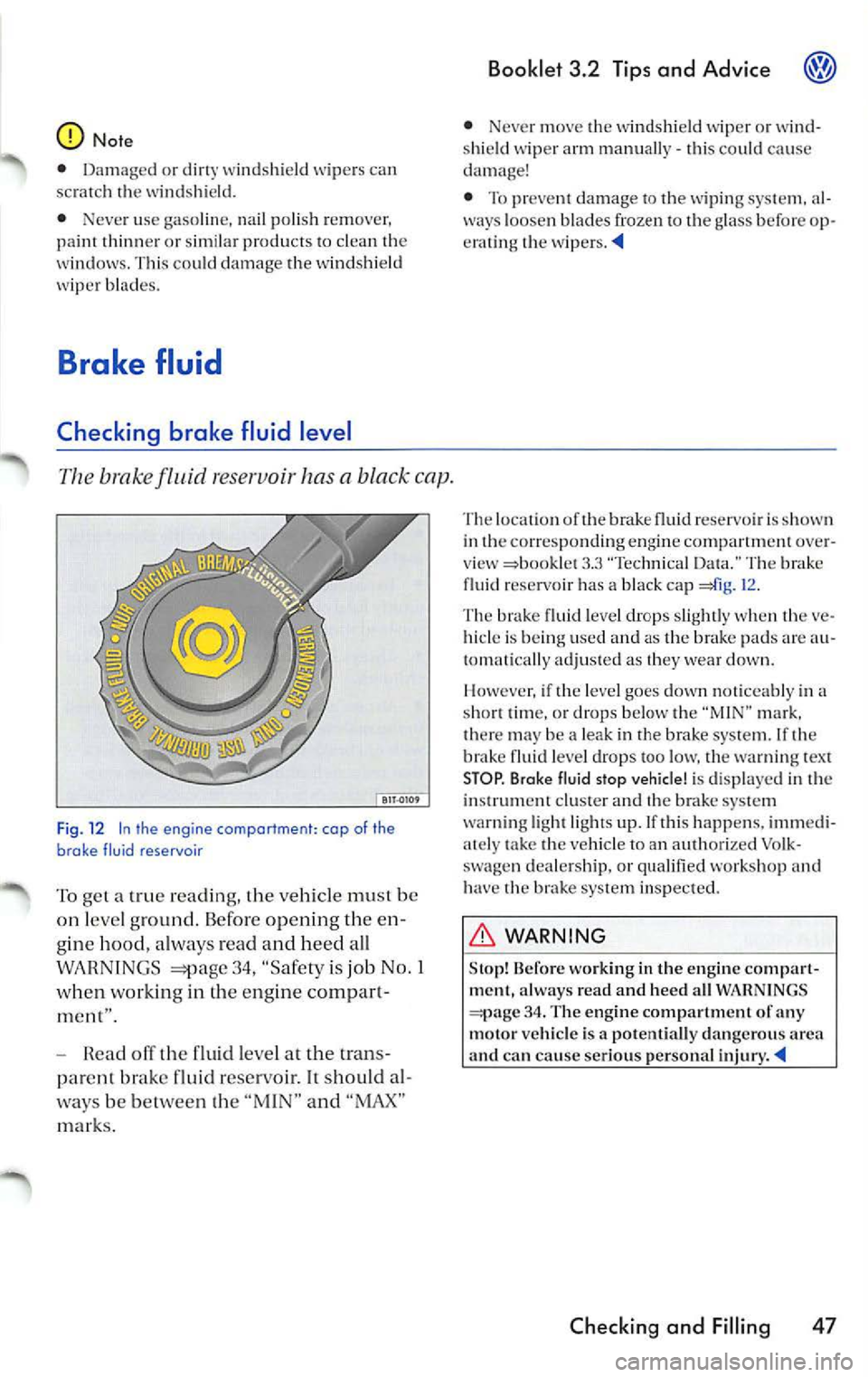
fluid reservoir has a black cap.
Fig. 12 I n the engine compartm ent : c ap of the
brake fluid reservoi r
To get a read in g, the ve hicl e be
on leve l g round . Before opening th e
g in e hood, always rea d and hee d all
WA RN INGS
34, "Sa fety is job No. 1
w hen wo rkin g in the eng ine com par t·
m ent' '.
H ead off fluid leve l a t the tran s
par ent brak e fluid reservo ir. IL sho uld
ways be be twee n th e "M IN" and "MAX"
m arks .
Bookl et 3.2 Tips and Advic e @
• Never move the w indshi eld wiper o r sh ield wiper arm manu ally· this co uld cause
damage!
• To prevent damage to the wiping sys te m,
ways loose n blades froze n to th e g lass befor e ting th e wi pers
Th e loca tion of the brak e flu id reservo ir is show n
in the correspo nding engin e co mpartm ent over·
v iew
3 .3 "Tec hnical Data. " T he brake
fluid reservoir has a black cap 12 .
Th e fluid leve l drops slightly w hen th e hide is bein g use d and as the pads are to mat ically a dju ste d as they wea r dow n.
Howe ver, if the leve l goes
no ticeab ly i n a time, o r drops below th e "MIN " mark,
ther e ma y be a lea k in the brake syste m. If th e
brak e fluid leve l drops too low, the wa rnin g tex t
STOP . Brake fluid stop vehicle! i s disp layed i n the
instrumem cluste r an d the brake system
warning lig ht light s up . If this hap pens, imm edi ·
ate ly take the ve hicle to an auth orized Vo lk
s wa gen d ealer ship, or qua lified workshop a nd
have the brak e sys te m insp ecte d.
WARNING
Stop! Before wo rk in g in the en gin e compart
ment , a lways read and h eed all WARN IN GS
34 . Th e engine compar tme nt of any
motor vehicle is a pot entia lly dan gerou s area
and can ca use ser io us perso nal injur y
Checking and Filling 47
Page 417 of 477
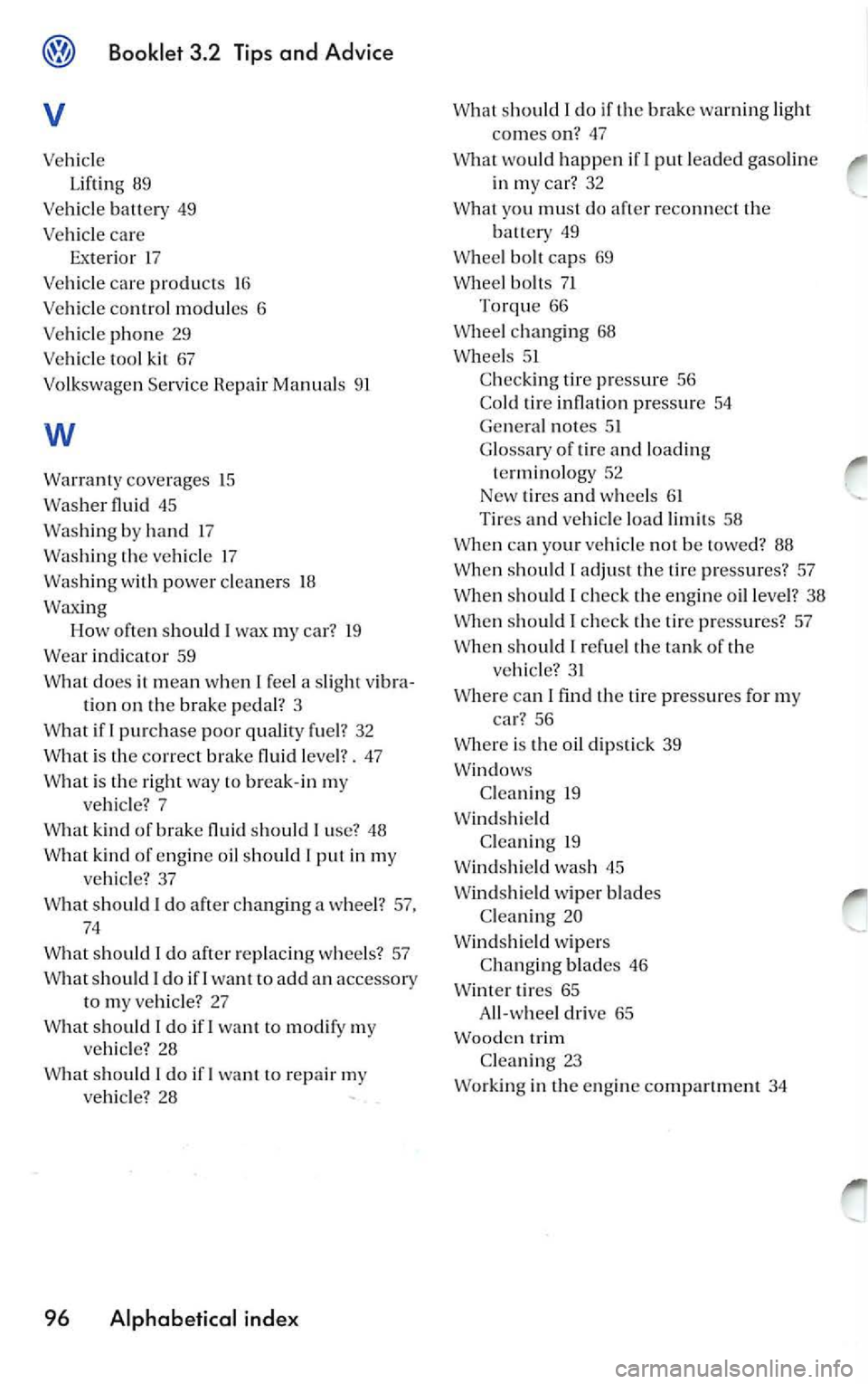
Booklet 3.2 Tip s and Ad vice
V
Ve hicl e
Li ftin g 89
Ve hicl e batt ery
49
Ve hicle care
Exte rior 17
Ve hicle care prod ucts 16
Ve hicl e co ntrol m odul es
6
Vehicle phone 29
Veh icle too l kit
67
Vo lksw agen Se rv ice Repa ir Manua ls 9 1
w
Warranty covera ges L5
W as her 45
Was hing by ha nd 17
W as hin g th e veh icl e 17
Was hin g with power cl eaners
18
Wax ing
Ho w ofte n shou ld
I wax my ca r? 19
W ear indicato r 59
What do es it mea n wh en I fee l a sli ght vibra-
tio n on th e brak e peda l?
3
What if I pur ch ase poor quali ty fu el? 32
W hat is th e co rrect brak e
leve l?. 47
W hat is the right way to break- in my
ve hicl e?
7
W hat kind of brak e should 1 u se? 48
W hat kind of e ngin e oil sh ould 1 p ut in my
ve hicl e?
37
W hat sho uld 1 do afte r ch an ging a w hee l? 57,
74
What sh oul d 1 do after re p laci ng wh eels? 57
Wha t s h ould
I do if I want to add an accesso,y
to m y ve hicle ?
27
What s houl d 1 do if 1 wa nt to mod ify my
veh icl e? 28
Wh at should 1 do if I wan t to re pair m y
ve hicl e? 28
96 Alphabetical index
What sh o uld I do if t he brake warnin g light
comes o n?
47
What wo uld happ en if 1 put le ad ed gasol ine
in my ca r? 32
What you must do aft er rec onn ect th e
batt ery
49
Wheel bolt caps 69
Whee l b olt s 7 1
T orq ue 66
W hee l chan gin g
68
Whee ls 5 1 C hec kin g tire press ure 56
Co ld tire infl ati o n pre ssure 5 4
G en era l not es 51
G lossary o f tir e and loading
t e rmino logy 52
New tir es and whee ls 6 1
Tir es and veh icl e load limit s 58
Whe n ca n yo ur ve hicle not be to we d? 88
Wh en sh ould I adju st the tire press ures? 57
Whe n sh ould I ch ec k th e e ngin e o il level? 38
W hen should
I c h eck the tir e pr ess ures? 57
W hen sh ould
I ref uel the tank of the
ve hicle ?
3 1
W her e ca n I find t he tire pr essures for my
ca r?
56
Wh ere is th e oil d ipsti ck 3 9
W indo ws
Clea nin g
19
Wi ndshie ld
C lean ing
19
Win dsh ie ld wash 45
W ind sh ie ld wiper blades
C lea nin g 20
Win dsh ie ld wip ers
C hanging b lade s
46
Wint er tir es 65 All-w hee l dri ve 65
Wood en trim
C le anin g 23
Wo rking in the en gin e compartme nt 34
Page 431 of 477
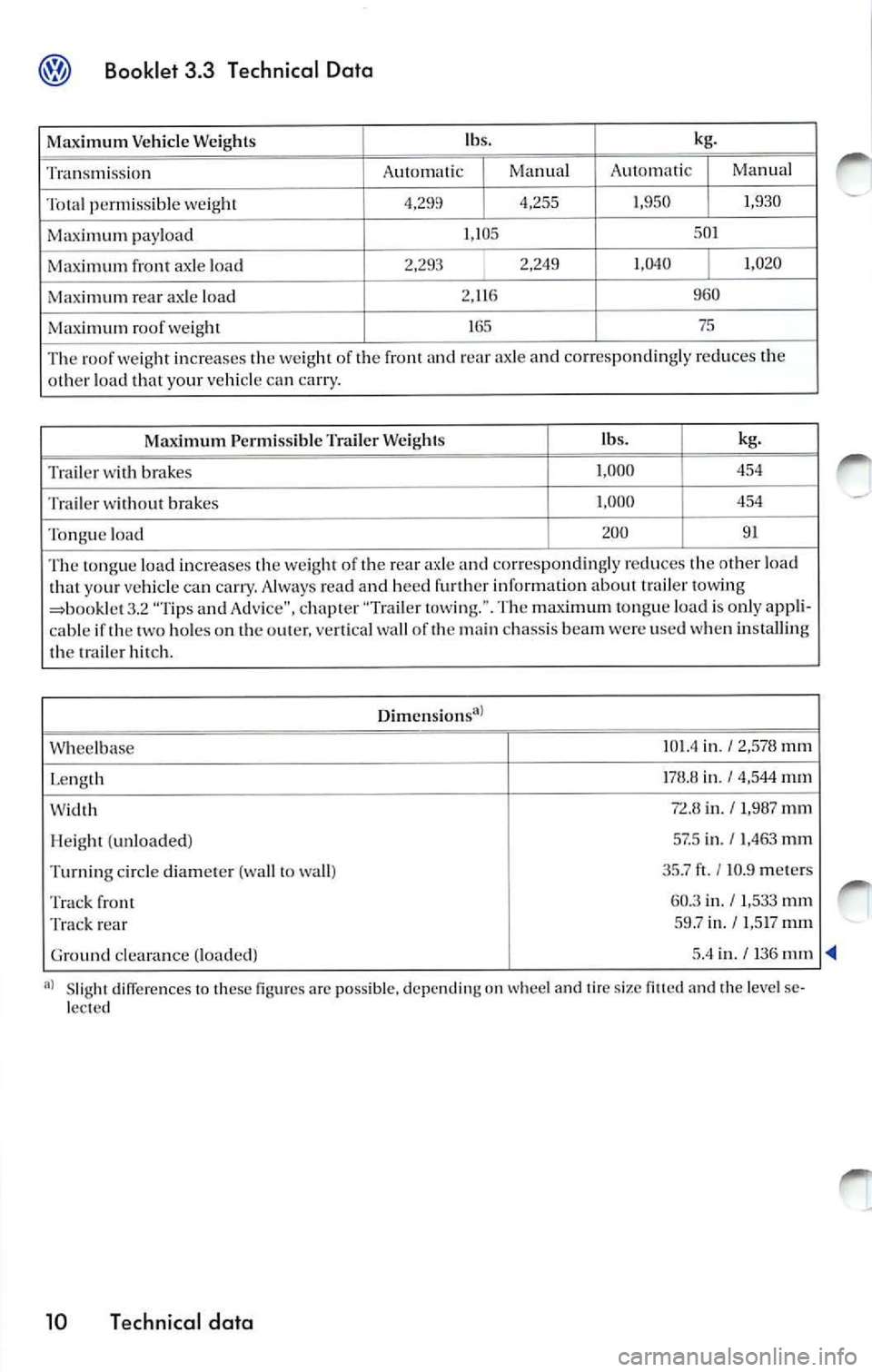
Booklet 3.3 Technical Data
Maximum Vehicl e Weight s lb
s. kg.
Tra nsm iss ion A
utomatic
I Ma nua l A
utom atic I Manua l
Tota l p ermi ssibl e weig ht
I 4,255 1
,950 I 1 ,930
Maxim um payload 1,105
50
1
Maximum front axle load 2,293
2,249
1,040
I 1,020
Maxi mum re a r ax le load 2,
116 960
Maximum roof weight 1
65 75
Th e roof weig ht in creases the we igh t of t he front and
axle and correspo ndingly red uces th e
ot her th at yo ur veh icle can car ry.
Maxim um Permissible Trailer Weig hts lb
s. kg.
Trailer with brakes 1,0
00 454
Tra iler w itho ut brakes 1.
000 454
Tongu e load 200
91
Th e tong ue load increa ses the we ight of th e rear axle and correspon dingly reduces the ot her load
th at yo ur vehicl e can carry. Always rea d and heed fu rther information about trailer towing
3.2 " Tips and Adv ice", chapter "Trai le r tow ing.". The maxi mum tongue loa d is o nly app li-
cab le if th e two holes o n th e out er, ve rtical wall of the mai n ch assis beam were use d when in sta lling
th e tra iler hi tc h.
W hee lbase 1
0 1.4 in ./ 2,578111111
Le ngt h 1
78 .8 in .
I 4,544 mm
W idth
in . / !,9 87 mm
H eig ht (unloaded ) 57.5
in.
I 1.463 mm
T urni ng ci rcle diame te r (wall to wall ) 35.7 ft.
I 10.9 me
te rs
Tra ck front 60.3
in./ I,533111111
Track re ar 59.7
in.
I 1,517 111111
Grou nd clearance (loaded) 5.4
in.
I 136 111111
Slight diff erences th ese arc possible , depending on whee l and tire size and the leve l se
lect ed
10 Technical data