tire pressure VOLKSWAGEN JETTA 2009 Owners Manual
[x] Cancel search | Manufacturer: VOLKSWAGEN, Model Year: 2009, Model line: JETTA, Model: VOLKSWAGEN JETTA 2009Pages: 477, PDF Size: 77.6 MB
Page 14 of 477
Stopping th e engine 3.1: 97
S tora ge area
Ot her stora ge a reas 3.1 : 7l
R oof 3.l : 7 1
S torage compartm ent 3 .1: 69
Fro nt ce n te r armrest 3.1: 70
R ear armrest 3.1: 70
S tor age for the vehicle literature 3.1: 69
Sto ring seat po sit ion s 3.1 :
64
Sto wing luggage in the luggage companm en t
2.1 : 10
S un visor 3.l: 52
S u nro of 3.1: 42
S un sh ade
P owe r roof3.l: 42
Switc h light in g 3.1: 3
Sw itchabl e locking feature
Act iva ting 2.1: 62
Deactivating 2.1: 63
Switc hes
Emerge ncy nasher 3. l: 48
L ig ht switches 3.1 : 46
Powe r ou tsi de m irrors 3.1: 56
Power roof3.l: 42 P owe r w indo ws 3.1: 39
Switc hing off th e e ngin e
W ith
ig n itio n ke y 3 .1: 97
T
Tachometcr3.I: 6
Tank
Fill ing the tank 3.2: 30
F uel ga uge 3. 1: 7
Op ening the fu el fi ller
3.2: 30
Technical modifications 3 .2: 28
T et her anc ho rs 2.1: 65
T et her strap 2.1: 65
Tie-down hooks 3.1 : 78
Ti e-clowns 2. 1: I I
Tire and whee ls 3.2: 5 1
Tire press ure 3.2: 56
Tir e pressure monitor in g syste m 3.1
Warn ing li ght 3.1: 30
Booklet 0 .1 Gen eral Ind ex
Tires
Service life 3.2: 59
Speed Ratin g Le tte rCode 3.2 : 62
Tire manufa cturing date 3.2 : 62
Ti re speci fica tion s 3.2: 62
Trea d depth 3.2: 59
U niform tir e qual it y grading 3.2:
W inter ti res 3.2: 65
T ir e s and wheels
Dim ensio n s 3 .2: 51
New3.2: 6 1
S now chains 3.2: 66
Wh eel b olt s 3 .2: 66
Winter tire s 3.2: 65
Tool s 3.2: 67
Torn or frayed safety belts 2 .1: 1 7
To win g 3 .2:
77
Genera l no te s 3.2: 87
When can your vehicle not be towed? 3.2:
88
To win g eye 3 .2: 86
Trailer t owing
Brak es 3.2 : 11
Dri ving tips 3.2: 13
Operating instr uctio ns 3.2: 12
Sa fety c hain s 3.2: 11, 12
Technica l requ ir eme nts 3.2: 10
Tir e press ure 3 .2: 12
Tow ing t ips 3.2: 13
Trail er lights 3.2: 11
Trailer weigh t 3.2: 12
Trail er turn sig na ls
Wa rnin g light 3.1 : 5 1
Tran sport Canad a 3.2: 90
Tran sport in g long item s 3.1: 62, 69
T read Wear Indicato r (l WI ) 3.2: 59
Tnmk 2. 1: 1
O
Trunk lid 3.1 : 37
Turn sig na l a nd high beam leve r 3.1: 50
Turn sig na ls 3 .1: 50
Wa rnin g ligh t 3 .1: 24, 5 1
u
Unde rb od y se alant 3.2: 22
Un faste ning
Safety belts 2.1 : 24
Unidir ectional tir es 3.2: 51, 73
Uniform tire qua lity g radin g 3.2: 64
Alphab etical ind ex 11
Page 15 of 477
® Booklet 0.1 General Index
Unplea sant odo r 3.1: 83
Upho ls tery
Pr ess ure marks 2.1: 67
V
Veh. sta tus 3.1: 15
Veh icle
Lift ing 3.2: 89
Ve hicle battery 3.2 : 49
Ve hicle care
Exterior 3.2: 17
Ve hicle care products 3 .2: 16
Vehicle contro l module s 3.2: 6
Ve hicl e electric syste m 3.1: 24
Ve hicle phon e 3.2: 29
Ve hicle sta tu s 3.1: 15
Ve hicle tool kit 3.2: 67
Ven tilati on slots 2.1: 11
V olk swagen Service Rep air Manuals 3.2: 91
w
Warning light
E lectro nic Power Co ntrol (EPC) 3. 1: 23
Warning li gh ts 3.1: 20
Emergency flasher 3.1 : 48
P ASS EN GER AIR BAG OFF 2. 1: 39
Sa fety bel ts 2.1: 14
Turn signals 3 .1: 49
Warn ing texts in the dis pl ay 3.1: 11
Warn ing triang le 3. 1: 74
War ranty cove rages 3.2: 15
Wa sh er fluid 3.2: 45
Wa shin g by hand 3.2 : 17
Was hing the vehicle 3.2: 1 7
Was hing wit h pow er cl eaners 3 .2 : 18
Waxing How often sh o uld I wax my car? 3.2: 19
Wear indicator 3.2: 59
What does it m ean w hen I fee l a sli ght vibra
ti on on the bra ke pedal? 3.2: 3
What hap pens if yo u do not wea r your safety
belt ? 2.1: 16
W hat happen s if you wea r yo ur safety belt too
l oose? 2.1: 20
W hat happe ns to occu pants not wear ing
sa fety
2. 1: 16
12 Alphabetical inde x
What if I p urch ase poor quality f uel? 3 .2: 32
W hat impair s driv ing safety? 2.1: 3
Wha t is LATCH? 2 .1: 64
What is the correct brake fluid leve l?. 3.2 : 47
What is the right way
to brea k-in my vehicle?
3.2:7
What kind of brake fluid sho uld I use? 3.2: 48
What kind of engine oil sh ou ld I put in my ve
hi cle? 3.2: 37
What should I do af ter ch an ging a whee l? 3.2:
57, 74
W hat s hould I do after replac ing w hee ls? 3.2 :
57
What sh ould I do if I want to add an accessory
to my ve hicl e? 3.2: 27
W hat should I do if I want to modify my vehi
cle? 3.2: 28
What sh ould I do if I want to repair my ve hi
cle? 3.2: 28
What sho uld I do if the brake warning light
comes on? 3.2: 47
Wha t types ofCRS a nchor s are availab le and
how are they related to child safety? 2. 1:
64
Wha t wo uld happ en if I put lead ed gaso line
in my ca r? 3.2: 32
What you m ust do after reconnec t th e batt ery
3.2: 49
What you should know when driving with
chi ld ren? 2.1: 51
Whee l b olt caps 3.2: 69
W hee l b olt s 3.2: 71
To rque 3.2: 66
W heel c hangin g 3.2: 68
Wheel s 3.2: 51
When can yo ur vehicl e not be towed? 3.2: 88
When must a safety belt be re pl ace d? 2.1: 17
When must the airbag system be in spected?
2 .1: 39
When parking on slopes 3.1 : 10 5
When sh ou ld I adju st the tire pressures? 3.2 :
57
W hen sho uld I ch eck the en gin e o il leve l? 3.2 :
38
W hen should I check the tire press ures? 3.2:
57
W hen sh ou ld I re fuel the tank of the ve hicle?
3 .1: 7
Page 30 of 477
Booklet 1.1 Maintenance
ALL MODELS
• Eng ine: C han ge o il and oil filter
• Water se parat or: Drain water (TDI en gin e
o nl y)
• Winds hie ld washer: Chec k flui d leve l, add if
n ecessa ry
• Automatic shift lock: Che ck opera tion in
clud in g park/neu tra l po sit ion sw itch
•
sys tem; Che ck for damag e/l eaks, pad thickness, brake fluid level
• Whee ls:
from fro nt to rea r
Next Service :
Date : ...................... ..
M iles/ km: .................. .
whichever occurs first •
Hear spoile r: Lubri cate (New Beet le on ly)
• Airbag sys tem: V is ual ch eck eve ry
m on ths
r ega rdless o f mileage (ki lomete rs)
• 12V s tarter and au xiliary battery : ch ec k
(w here ap plicab le)
• Tires: C heck tre ad depth, adjust t ire pressure
if n ecessary .
• Tire pressure mon ito rin g sys tem senso rs ;
C he ck batt ery c harge , rep la ce whee l e lec tro nics
a nd aluminum valve if necessary ( where app li
cab le) .
T oday 's date and Volkswagen Deale r sta mp
Service at 15,000 miles (24,000 km) Models with a 1.8T engine
ONLY
• Eng ine: C han ge oil and o il filter
Nex t Serv ice:
Date: ...................... ..
Miles/km: ................. ..
whic heve r occ urs first Today's
elate and Volkswag en Dea le r stam p
Warranty Voucher 9
Page 35 of 477
Booklet 1.1 Maintenance
Service at 60,000 miles (96,000 km) - ALL MODELS
• Engi ne: Change o il and oil filter
• En gin e: Chec k for le ak s
• Exhau s1 sys te m: Check for damag e and leaks
• Spark plug s: H ep lace (2 .0L TFSI only)
• Wa te r se paral or: Drain wate r (TOI engine
on ly)
• Fuel
He p lace (TOI engi ne on ly)
• Ba1t ery: Check
• Doo r check s1raps: Lubricate
• Dust and p ollen
(where applicabl e): Re
pl ace
• Coo ling syste m: Chec k coola111 leve l: add if
n ecessary
• Wind shie ld wa sh er: C heck fluid leve l; add if
n ecess ary
• Auto matic shift lo ck: Chec k op era1 io n in
clud ing
sw itch
• Automat ic tra nsmi ssio n: Check fo r le ak s
• Manual tran smi ssio n: Chec k oil leve l; add if
n ecess ary; check for le aks
• Tim ing
Check conditi on (4 cy linder gas
o lin e en gin e o nly)
• Aut omatic lrnn smi ssio n fina l dri ve: C heck
fluid l evel and for lea ks
• Whee ls : R o 1a 1e from fronl to rear
Next Service:
Dat e: ....... ... ............. .
Mil es/km: ....... .... ... .... .
w hi chever occurs first
14 Warranty Voucher
• Tires/spar e whee l: Check condition and
pressure
• Brak e sys te m: Check fo r damag e/l eak s. brake
pa d 1hickn ess and brak e fluid leve l
• Drive s haf1s: Chec k b oots
• On- Board diagnoslic
Chec k fault
m emory ; purge if necess ary
• Roo f fram e: C lean
lu bricaie
• Fron ! ax le : Check dusl se al on ba ll join
and
t ie rods: ch eck tie rods
• Head lighi s: Ad jus1
• Rea r spoil er: Lubri cate (New
onl y)
• Airbag syslem: Visual check every 12
rega rdless of mileage (kilometers )
• Road t est: Check kickdown , braking.
h ea ling and venl ilation, a ir cond i
tioning , pow er ac cessor ies and ele ctri ca l sys
t e ms
• 12V start er and auxiliary balle ry : c heck
( where app lica ble)
• Tires: C hec k !read depth, adju sl lir e pr ess ure
if necessa ry .
• Tire pr ess ure monilOring
se nsor s:
C he ck b alt ery ch arge. repla ce whee l e lec ironi cs
and a luminum va lv e if necessary (where app li
cab le).
Today' s
and Volk swagen D ealer stamp
Page 37 of 477
Booklet 1.1 M aint enanc e
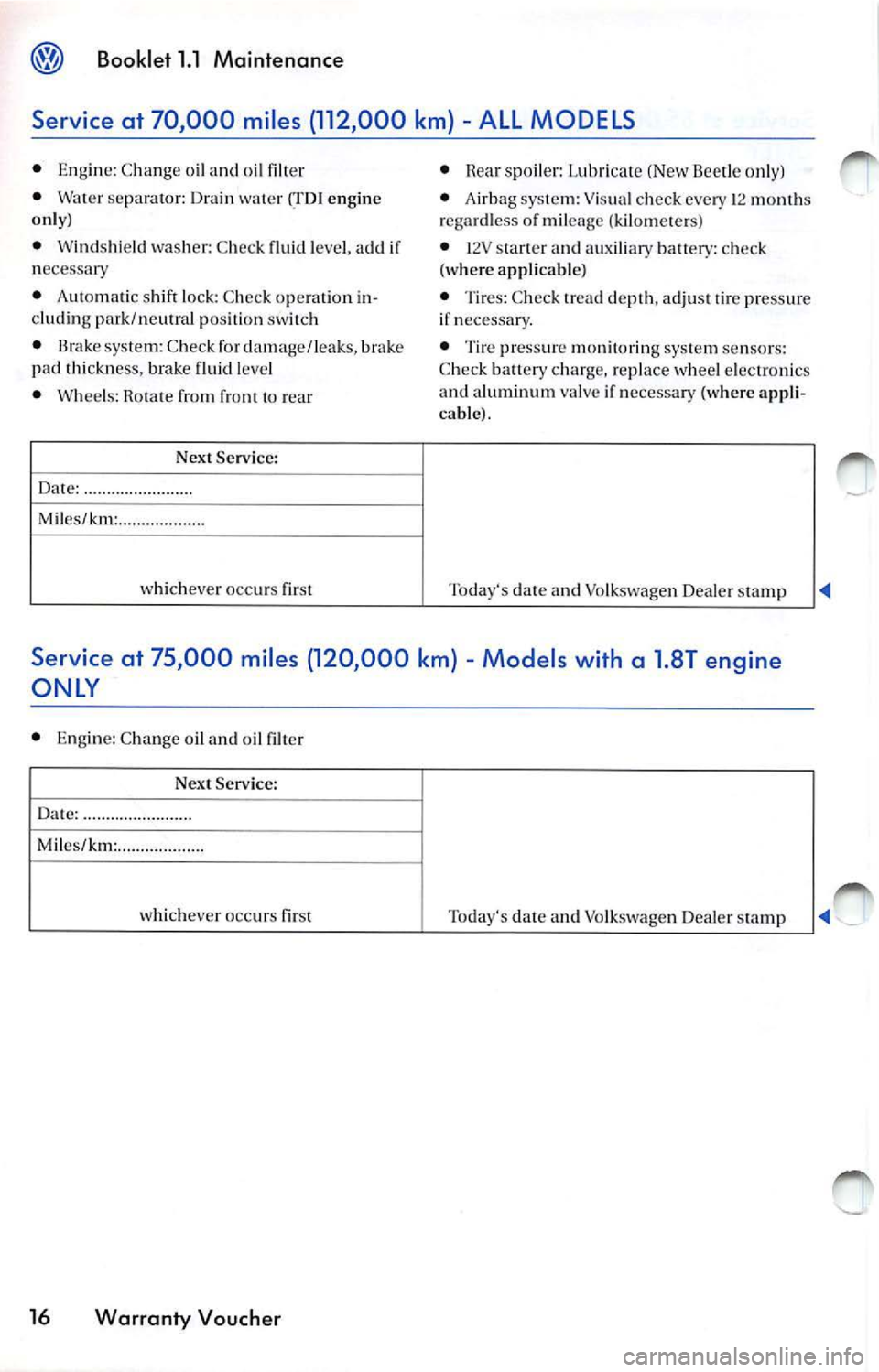
Service at 70,000 miles (112,000 km) ALL MODELS
• Engine: Change oil an d oil filter
•
separator: D ra in wate r (TO I en g in e
on ly)
• Win dshi eld was her: C hec k flu id le ve l, add if
nec essary
• Automat ic shi ft lock: Check operatio n in
cl ud ing pa rk/n eu tra l p osi tion sw itch
• Brake sys te m : C hec k fo r damage /leaks, brake
p ad thick ness, brak e fluid l eve l
• Whee ls : n ota te from fr on t t o rear
Nex t Serv ice:
Da te: .... ....................
M iles/ km: ... .... ... .. .......
wh ic h ever occ urs fir st •
s
p o iler : Lu br icate (New Beetle only)
• Airbag system: Visua l ch eck every 12 m onth s
r eg ard less of m ileag e (kilo m ete rs)
• 12V s tarter an d aux iliary ba ttery : ch ec k
(w here a ppli cable)
• Tire s: C heck tread d ep th , a dju st tire pressure
i f n ecessa ry.
• Tire pressure monitor ing sys te m senso rs:
C heck battery ch arge, re p lace w hee l e lec tro nics
a lumi num valve if ne cess ary (w here a ppli
c ab le).
T oday's date and Vo lk swage n Deal er
Service at 75,000 mile s (120,000 km) Models with a 1.8T engine
ONLY
• Eng ine: Change o il an d oil fi lter
Nex t Serv ice:
Date: ......... ............. ..
Mi les/k m: .. .... ........ .....
wh ic h ev er o ccur s fir st
Today's dat e and Volksw age n Dealer stam p
16 Warranty V oucher
Page 126 of 477
Booklet 2.1 Safety first
Safety is everybody 's res pon sibilit y! ..
Important things to do before driving
Safety is job. Vehicle and occupant safety always depends on the in
fo rm ed and
driver.
For your safety and th e sa fe ty of yo ur pas
se ng ers, before drivi ng a lways :
- Make sure that a ll lights and signals are
ope ratin g correctly.
- Mak e sur e that the tire pressure is co r
rect.
- Make s ure that all wind ows are clea n
and a fford good vis ib ili ty to the out side.
- Secu re all luggage a nd oth er items care
fully
10.
- Make sure that not hing can interf ere
w ith the peda ls .
What impairs driving safety
- Adju st fr ont sea t, head res traint and
mirror s correct ly for your heig ht.
- Instru ct pa ssengers to adjust the head
restra ints accor ding to th eir h eig ht .
- Ma ke su re to use the r ig ht chil d re
s tra int and use it cor rectl y to prot ect chil
dren
5 l.
- Sit p rope rly in you r sea t and make sur e
that your passenger s do th e sa me
4.
- Faste n yo ur safe ty belt and wear it prop
e rly. A lso i nst ruct your pa ssenge rs to
fasten their safety belts prop erl y
.-
Safe driv ing is directly re lat ed to the condition of the vehicle , the driv er as well as
the driver's
to concentrate on the road without being distracted.
The driv er i s respo nsibl e for the sa fe ty o f
th e ve hicle and a ll of its occupan ts. If yo ur
ab ilit y to dr ive is im paired, safe ty risks for
eve ry bod y in th e veh icle increase and you
a lso become a hazard to everyo ne e lse on
t he road
The refo re:
- Do not le t yo urse lf be distra cte d b y pas
se nge rs or by usi ng the sound system o r a
ce llul ar t elep hone
- Never drive when yo ur driv in g abil ity is
imp air ed (b y m edi ca tions, alco hol , drugs,
etc.) .
- Obse rve a ll traffic laws, rules of th e road
and sp eed limit s and plai n co mm on se nse . -
Alw ays ad just yo ur spee d to road , traffic
a nd wea ther condition s.
- Take frequ ent breaks on long trips.
Don't drive for more than two hou rs at a
s tr etc h.
- Do n ot dr ive w he n yo u are tir ed, und er
press ure o r w hen you a re s tressed.
WARNING
dri vin g sa fe ty increases the risk of
se riou s perso nal inju ry and dea th when ever a
ve hicle is being use d ...
Safe driving 3
Page 233 of 477
Booklet 3.1 Controls and Equipment
Applies to vehicles: with on automat ic transmission
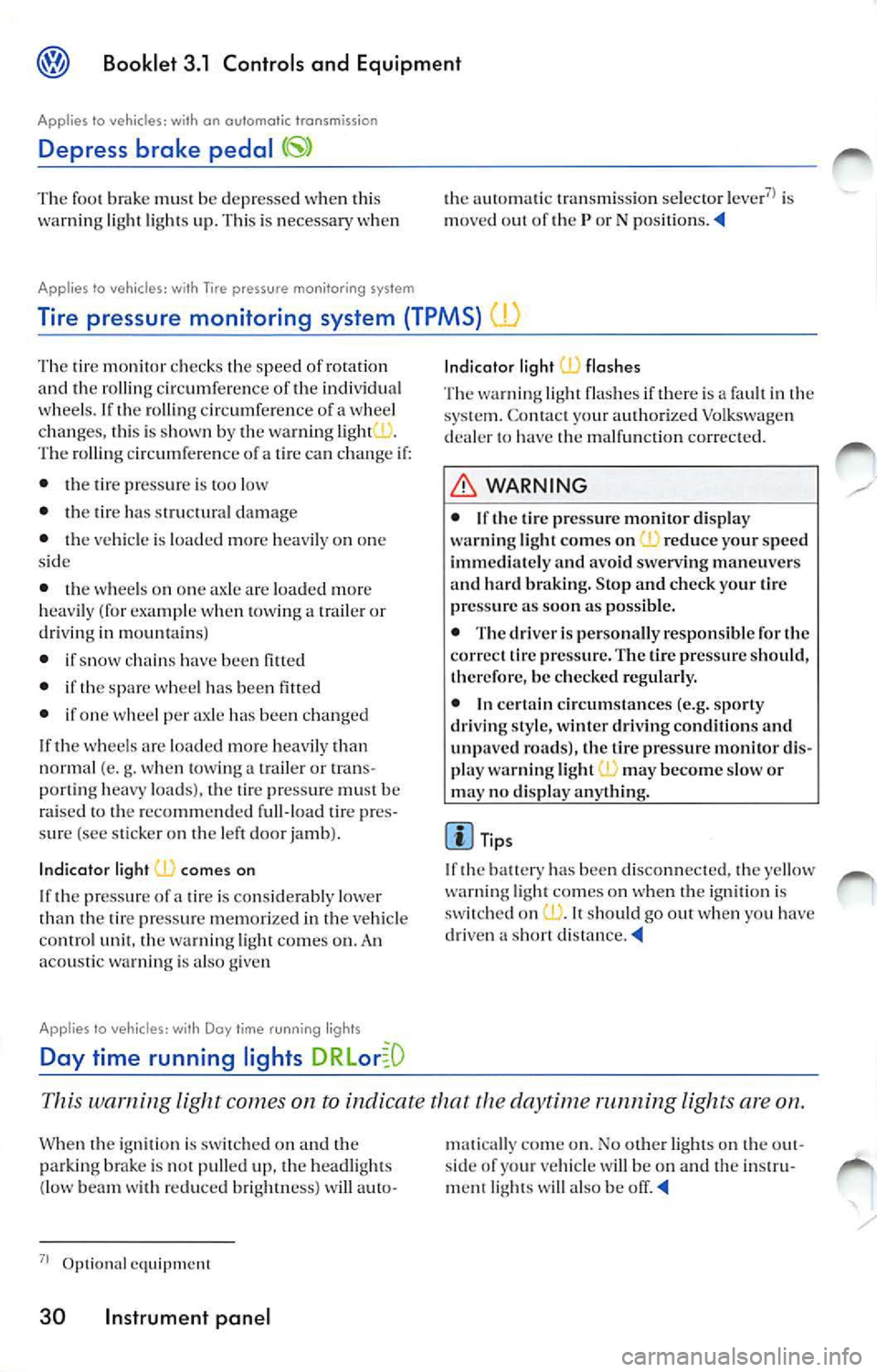
Depress brake pedal
The foot brake must be depressed w hen thi s
wa rnin g light lights up. Thi s is necessary whe n
Applies to vehicles: with Tire pressure monitoring system
the aut omati c tran smission se lec to r is
m ove d out of the P o r N pos itions.
Tire pressure monitoring system (TPMS}
Th e tir e m on itor ch ec ks th e spee d of rotation
a nd the ro llin g ci rcumfe rence of the indi vidual
w heels. If the ro llin g circumference o f a w hee l
c h an ges, this is s hown by the warn ing light
T he rolling circ umf erence of a tire can change if:
• the tire pressur e is too low
• the tire has s truc tural damage
• the ve hicle is loa ded mor e heav ily on one
side
• the whee ls on one axle a re loa ded m ore
h eavi ly (fo r examp le w hen tow ing a traile r o r
d riv in g in mounta ins)
• if s now chain s have been fitted
• if th e spar e w hee l h as bee n fitt ed
• if one whee l p er ax le ha s bee n ch an ged
If th e w heels
loaded more h eavily than
n o rma l (e.g . w hen towi ng a tra iler or trans
portin g heavy loa ds) , th e tir e pr ess ure mu st b e
raised to th e re co mmend ed full- load t ire pres
s ur e (see s ticker on th e le ft door jamb ).
Indicator light comes on
If th e pr ess ure ofa tire is co nsiderably lowe r
than th e tire press ure memo rized in the veh icle
control unit, the warn ing light comes on. A n
aco usti c warning is also give n
Applies lo vehicles: with Day time running lights
Day time runn ing lights DRLorfD
Indicator light
flashes
warnin g light flashes if th ere is a in th e
sys te m. Conta ct your authorized Volkswage n
d ea ler to ha ve the m alfunction corrected.
WARNING
• If th e tir e pre ssure monitor di spla y
wa rning light comes on re duc e your sp ee d
immediatel y and avoid swerving maneuver s
and hard braking. Stop and ch eck yo ur tire
pre ssur e as s oon as possible.
• Th e driver i s per sonally responsible for the
c orre ct tire press ure. The tire pressur e should ,
therefore, be ch ec ked regularly.
• In certain circumstances (e.g. sporty
dri vin g styl e, winter driving condition s
unpaved roads), the lire pressure monitor dis-
pla y wa rnin g light ma y become slow or
ma y no di spla y an ythin g.
Tips
If th e battery has b een di sco nnected, the ye llow
wa rnin g lig ht comes on w hen the ignitio n is
sw itch ed on .
sh o uld go out w hen you have
dr iven a short distance. -4
This wa rning light co,nes on to indicate that the daytime are on .
When th e ig nition is sw itch ed on and the
parkin g brake is not pu lled up, the h eadlig hts
(low bea m with re du ced brightne ss) will au to-
Op tiona l
30 Instrument panel
come on. No other lig ht s on th e out
s id e of yo ur vehicle w ill be o n and the in stru
m en t
wi ll also be off .
Page 329 of 477
Booklet 3.2 Tips and Advice
Braking power and braking distance
Braking power and braking distance are influenced by driving situations and
road
Worn brake pads will not provide good braking.
The amount of wear and tear on the brake pads
depends to a great extent on the cond itions
und er which the vehicle is opera ted and the way
the vehicle is dr iven. If you do a lot of city
driv ing, drive short distances or have a sporty
driving style, we reco mm end th at you have the
thickness of your brake pad s checked by an au
thor ized Volkswagen dea ler more frequently
than r ecommend ed in the service schedule.
I f you dr ive witJ1 wet brakes , for example after a
dri ving through water,
heavy rainfall or
after washing the vehicle, brakin g power will be
reduced and sto pping distances w ill be longer
because the brake d iscs will be wet or in winter
ma ybe even frozen
the brakes must be dried
with severa l ca reful brake applications.
Brake fluid absorbs water and must be c hanged
every two years. Heavy use of the brakes can
cause vapor lock if the brake fl uid is too old.
Va por lock reduces braking power, increases
stopp ing distances and can even cause total
brake failure.
WARNING
• New tires and new brake pads do not pro
v id e maximum grip, control or braking abilit y.
• To reduce the risk of losing control, a colli
s ion and se rious persona l injuries, drive with
special ca re for the first
350 mil es (560 km).
• New brake pads do not have the best stop
ping power for the first
150 mil es (240 km) and
must be broken in. You can com pensate for
the slightly reduced braking ability by drivin g
w ith care and applying more pressure on the
brak e pedal.
• Never fo llow other vehicle s too close ly or
put yourse lf into other situ ations that might
r equ ire s udden , hard brakin g especially when
th e brake pads have not been broken in.
WARNING
Wet brake s or brak es coa ted ice or road
sa lt react slower and need longer stopping dis
tanc es.
• Carefully apply brakes for a lest.
• Alwa ys dry brake s and clean olT ice coa t
ings and salt coa tings with a few cautiou s
brake app lica tions.
• Always read and hee d all
in "Break ing in tir es and brake pads" on
page 7.
WARNING
Overheated brakes will reduce the vehicle's
s topping power and increase stoppin g di s
tances.
• Always avoid over hea tin g the brakes!
• When driving downhill, the brakes have to
work hard and hea t up quickly .
• Before driving clown a long, steep hill, al
ways red uce spee d and downshift to a lower
gea r. This will let th e ve hicle use engine
braking and reduce the load on the brakes.
• Always c han ge the brake fluid at least
every two years. Hard braking with old brake
fluid may cause a va por lock. Vapor lock re
duces brakin g power, increases s topping dis
tan ces and can even ca use to tal brake failure.
• A damaged front spoiler or new non stan
dard spoile r ca n reduce the airflo w to the
brake s and cause them to overheat.
• Always sec an au thorized Vo lkswage n
dealer or qualil1ed workshop if yo u think th at
you may have damaged the front spoiler.
• Be sure to read and heed all WARNINGS
and the information =-page 27, "Accessories
and part s" before buying accessorie s.
8 Driving and protecting the environment
Page 333 of 477
Booklet 3.2 Tip s and Advice
Operating instructions
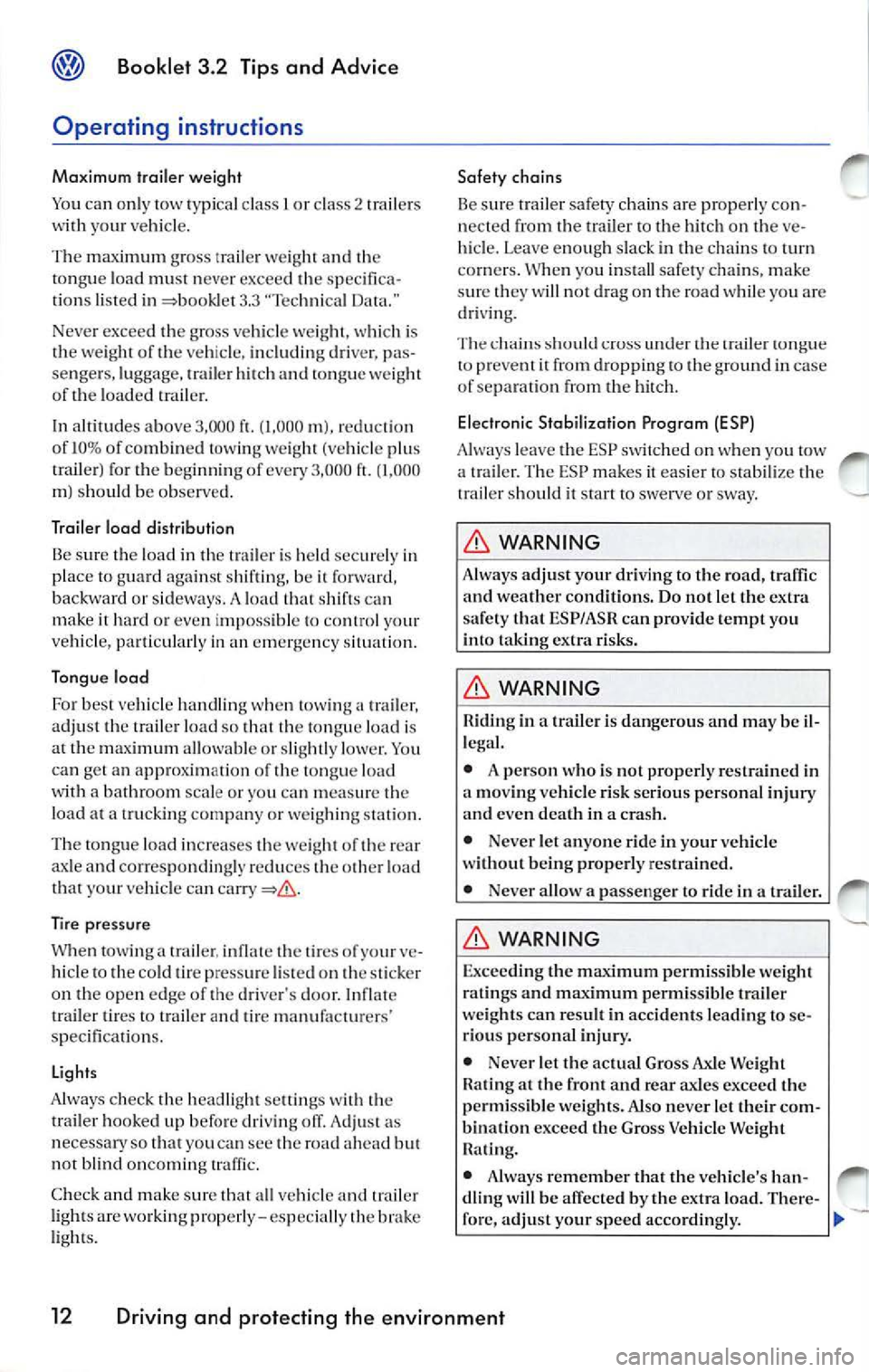
Maximum trail er weight
Yo u ca n onl y tow 1y p ic al clas s I o r cla ss 2
I railers
w ith your vehicle.
T he m ax imum gross trailer weigh1 and 1h e
tongue loa d mu sl never exceed 1he s pecifica
tion s liste d in
3.3 "T ec hni cal
Neve r ex cee d 1h e gro ss v ehicle weigh 1, w hich i s
th e we ight of 1 he veh icle. includin g driv er, pa s
se nge rs , lu ggage,
I raile r hi1 ch an d 1ongue wei gh I of t he loa ded trailer.
I n alt itude s abov e
3,000 f1. (1,000 redu ctio n
of 10% of co m bin ed lowing weight (v eh icle plu s
trai le r) fo r the beginn ing of every
3, 000 f1. (1,000 m ) shou ld be obser ved.
Trailer loa d distribution
sur e th e loa d in th e tra il e r is held secu rely in
plac e to gu ard against shif ting, b e ii forward ,
ba ckward or sidew ays. A load that shifl s can
mak e it hard or eve n imp ossib le 10 co n1rol your
ve hicl e, pa rticul arl y in an emergency s ituat ion.
Tongue load
F o r best ve hicl e handling when towing a tra iler,
adju st th e traile r load so
the tongue lo ad i s
at the maximum allow abl e or slightl y lo w er. You
ca n get an approxim ation o f th e tongu e load
wit h a bathroom scale or yo u can m ea sure the
load at a 1 rucking com pany or weig hing stat io n.
Th e to ngue lo ad in cre ases the we ig h t of t he rear
ax le and corres po ndingl y re du ces the oth er l oa d
that your vehicl e ca n
pressure
towing a trailer, inflat e th e tir es o fyourv e
hicle to th e co ld tir e pre ss ure liste d on th e stic ker
on th e op en edg e of the dr ive r's door . Inflat e
tra iler tires to traile r and tire
s p ec ification s.
Light s
Al way s che ck th e head lig ht se 1tin gs wit h th e
tra iler hooked up befo re dri vin g off. A djust a s
n ecessary so
you can see th e road ahead but
n ot b lind oncom ing traffic .
C hec k and make sur e tha t all vehicl e and
light s are wo rki ng properl y-esp ec iall y the light s. S
af ety chains
sur e tr ailer safet y cha ins are properl y co n
n ect ed from t he tra iler to the hi tch on th e ve
h icl e. Leave e nou gh slack in the c hain s 10 turn
co rner s. Whe n yo u in s1a ll safery cha ins, m ake
s ur e th ey will not drag o n the road w hile you are
d ri vin g.
T he chains shuultl
u ntler t he traile r to prevent it from dropping to th e grou nd in cas e
of sepa rat ion from the hitch.
Electronic Stabilizat ion Program (ESP )
A lwa ys leave th e ES P swi1ched on w hen you tow
a trail er. The ES P makes it easi er to stab ilize the
trailer sh ould it start to swerve o r sw ay.
WARNING
A lways adjust your dri ving lo th e road, traffi c
and weather condition s. Do not let the extra
s af ety that ESP/AS R can provid e te mpi you
i nto laking extra risks.
WARNING
Ridin g in a trail er i s da ng erous and may be il
leg al.
• A person who is not properly re str ain ed in
a m ov ing ve hicle ri sk ser iou s perso nal inju ry
a nd even death in a cras h.
• Nev er let anyone rid e in your vehicle
witho ut bein g prop erly restr ain ed.
• Never all ow
pa ssenger lo ride in trailer .
WARNING
Exceeding th e permi ssible weig ht
rat ings and permis sible trail er
we ig ht s ca n result in accident s leadi ng to se
r ious persona l injury.
• Neve r le t th e ac tual Gross Axle Weight
Ratin g at th e front and rear
exceed the
pe rmi ssibl e we ig ht s. Also neve r le t th eir com
b in atio n excee d th e Gross Vehicle Weig ht
Ra ting.
• Alw ays re member that the vehicle' s han
dli ng will be
by the extra load. There-
fo re, adju st yo ur spee d accordin gly .
12 Driving and protecting the environment
Page 372 of 477
c£> For the sa ke of e nvironment
Batte ries
1ox ic s ubstan ces includin g sul
furi c acid and le ad . Th ey mus! be dis posed ap
p ro pria lc ly an d 110 1
ord inary garbage.
Tires and wheels
Genera l notes
Booklet 3.2 Tips and Advice
Tips
Wh en !h e ba ttery is reconne c1e d .
warning
li gh l for 1he S1abi lization Program
(ES P). (AS RJ ma y lig ht up
a nd sla y on. go out if yo u dri ve briefly in a line al a sp eed of 15 20 km /h .
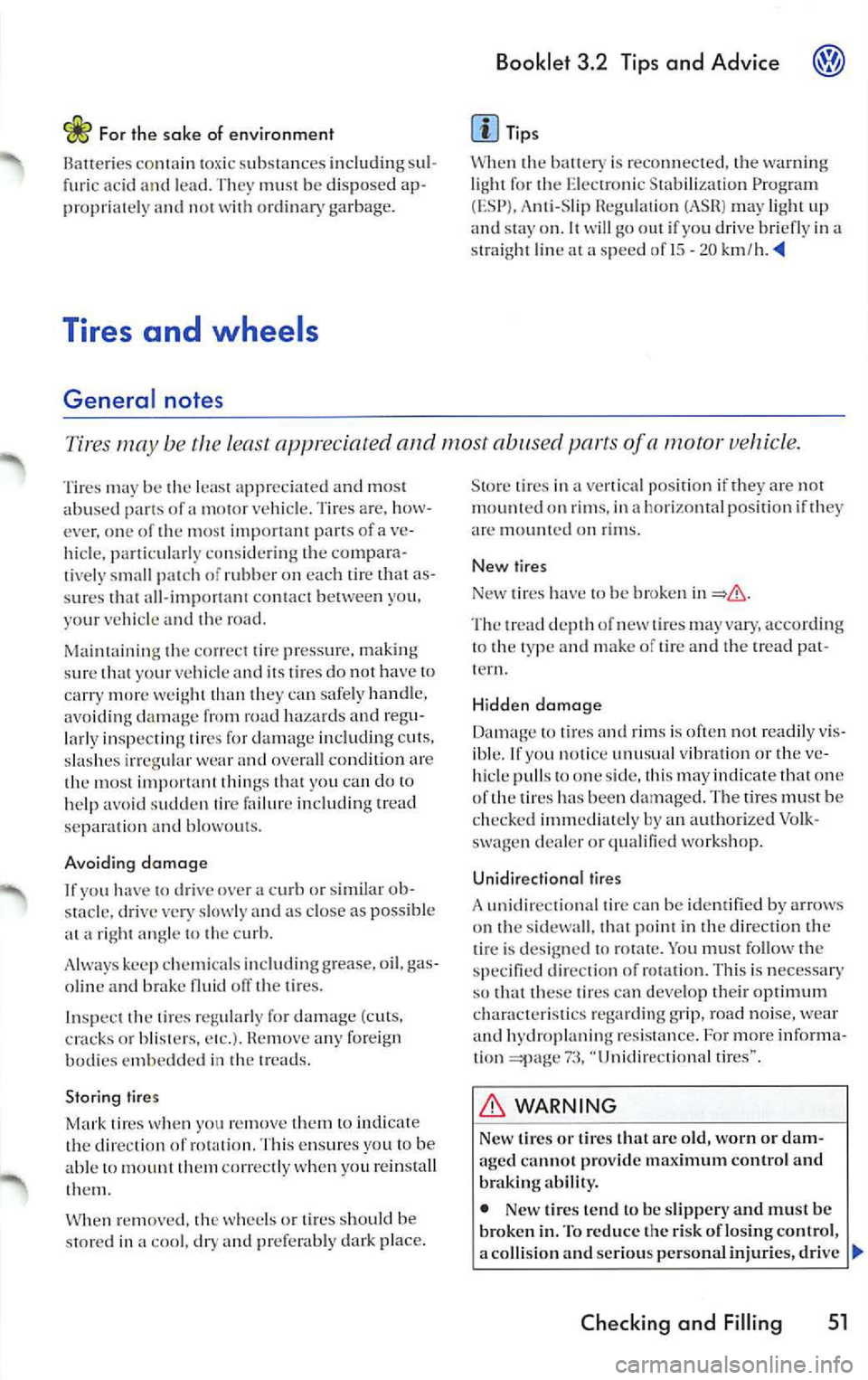
Tires may le n st appr eciated and most abus ed parts of motor vehicle.
Tire s ma y be 1h e appr eciale d and mo st
ab use d pans of rn o!O r ve hicl e. Tire s are,
ever . o ne mo s! pans ofa ve
h icl e. p arli cula rly co nsid erin g comp arasmall o f rubb er on eac h tir e th al as
s ure s all-imponanl b etwee n yo u,
your vehicl e
road.
Mainl ainin g 1h e c orr cc1 lire pressure , ma kin g
s ur e
vehicl e an d i1s 1ir es do 1101 have to
ca rry mor e !hey can safe ly hand le ,
a vo iding dam age from haz ards and regu
larl y in spec lin g !ir es fo r d am age including
slas hes ir reg ular wear and co ndi tion are
th e mos! impor lan 11hin gs you ca n do lo
h elp avoid sudd en lire f ailur e includ ing tread
se para lion and hlo wo u1s.
Avoiding damage If yo u ha ve
dri ve ove r a cu rb or sim ilar ob
s tacl e, dri ve ve ry s lowly a nd as cl ose as po ssib le
a l a rig h1 angl e 10
curb.
ke e p ch emi ca ls including g rease. o il. gas
o lin e an d brak e fluid off 1 he 1ires .
ln spe cl
1ir es regul arly fo r damag e (c ut s.
c ra cks or c1c.J. any foreign
bo dies em bed de d in ! r e ad s.
Storing tires
Mark lires when yo u r em ove th em
to indi cale dire cti on T hi s ens ures y ou 10 be hie 10 m ou nl when yo u rein sta ll
!h em .
W hen
1h e whee ls or 1ires s hou ld be
s tor ed in a cool, dry and preferab ly dark place. S
!o re tir es in
a ven ica l po sil ion if th ey are 1101
m ount ed on rim s, in a horizo ntal pos i1 ion if1h ey
are mou n1ed on rim s.
New tires
!ir es have to be broke n
The !r ea d ofn ew lir es may vary, accor ding
10 1h e 1y pe and mak e of li re an d 1h e tre ad pat
l e rn.
Hidd en damag e
!ir es rim s is 11 01 r ead ily vis
ibl e. you n olice unu sual vibral ion or !he vepull s 10 one side, !his may indi cale th al o n e or 1h e 1ires be en dama ged. The tir es mu st b e
c h ec ke d imm ediale ly by an auth ori zed Vo lk
s wag en dea ler or qua lifi ed wo rk sh op.
U nidirectiona l tires
A unidir ec1ional lir e can b e id e111 ifi ed by arro ws
o n 1h e sid ew all , 1h a1
in 1he dir ection 1h e
l ire is designe d 10 ro la!C. Yo u must fo llow 1h e
s p ecifie d direc1 io n of ro 1a 1ion. This is necessa ry
so
1h es e 1ires de velo p !heir rega rding grip , road noi se, we ar
an d hydro plan ing For m ore info rm a
lion " Unidi re c tional 1ir es".
WARNING
tir es or !ires th al arc o ld, worn or dam
aged cannol provide max imum control and
brak ing abilil y.
• New tir es len d to be s lippery a nd mu st be
broken in.
re duce !he r is k of losin g conlrol ,
a co llisio n and serious pe rso nal injur ies, dri ve
Checking and Filling 51