ECU VOLKSWAGEN JETTA 2010 User Guide
[x] Cancel search | Manufacturer: VOLKSWAGEN, Model Year: 2010, Model line: JETTA, Model: VOLKSWAGEN JETTA 2010Pages: 477, PDF Size: 77.6 MB
Page 188 of 477
Booklet 2.1 Safety first
Tether anchors
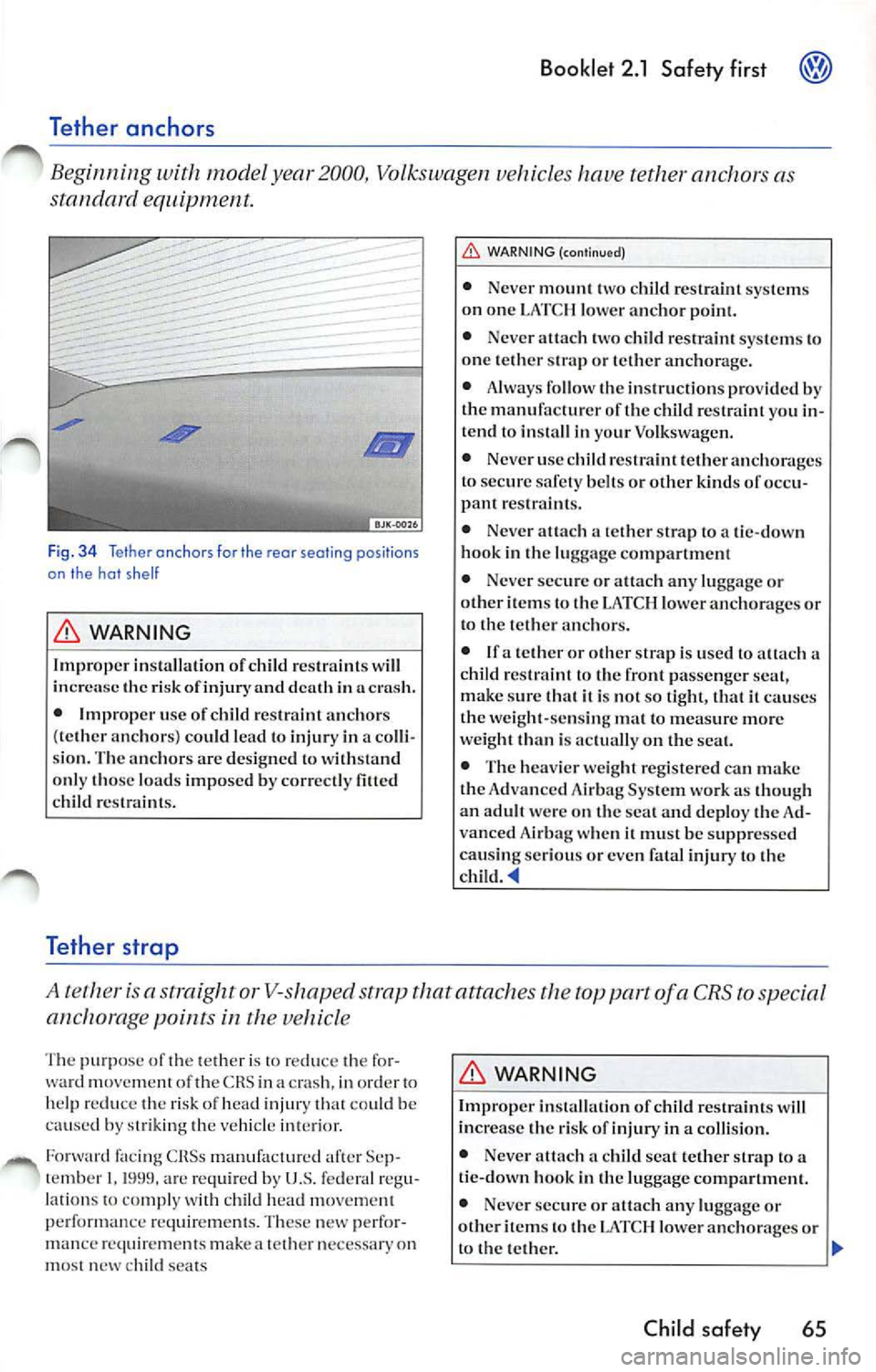
Beginning with model year 2000, Volkswagen vehicles have tether anchors as
standard equipment.
Fi g. 3 4 Tether on ch for the rear seating positions
on the hot shelf
WARNING
Improp er in slallalion of c hild r eslrainl s will increa se !h e risk of injury and clculh crash.
• Improp er u se of ch ild reslrainl anchor s
(l elhcr anchors) could le ad 10 injury in
colli·
sion. The ancho rs are desig ned lo wi1h s1and
onl y !ho se load s imp osed by correct ly
ch ild res lrainl s.
Tether strop
WARNING (continued)
• Neve r m ounl l wo ch ild restra int systems
on on e LA T CI I lower a nch or poinl.
• Never attac h lwo c hild re straint syste ms lo
o ne te th er slrap o r lelher a nchor age.
• Always follow lhe in stru ctions provid ed by
the
of lhe c hild restrain! you in
l e nd l o in sta ll in your Volkswage n.
• Neve r use child re strain I t ether a nchora ges
to sec ure safel y bell s or other kind s of occu
pant restra in ts .
• Never attach a
str ap to a tie- down
h oo k in the lu ggage compar lmenl
• Nev er sec ure o r attach an y lu ggage or
ot her ilcm s lo lhe LATC H l ower anc horages or
to lhe t eth er anc ho rs.
• If a le t h er or
strap is used to att ac h a
c hild r estraint lo th e front pa ssenger sca t,
ma ke s ure thal ii is not so tight , thal ii cau ses
th e we ig ht -sensi ng mat to measur e more
weight than is
o n the seal.
• The hea vier weig ht registered can make
lh e Advanced Airbag Syste m wo rk as !hough
an adull were on the seat and d eploy the Ad
va nced Airbag w hen ii must be supp ressed
ca using serio us or eve n
inju ry 10
A tethe r is a straight or V-shaped strap that attaches the lop pa rt of a CRS to special
anchorage points in the vehicle
The purpo se of 1e1h er is lO r e du ce for
ward movem enl of the CRS in a crash, in orde r lo
h elp reduce
risk of head injur y 1h a1 cou ld be
caused by str iking the ve hicle interior.
Forward
C HSs manufactur ed after Sep
te mber I. 1999, required by U.S. fed eral rcgu
l alions 10 w ith child head moveme nt
p er forman ce re quirement s. Th ese perfo r
man ce re quiremems make a tet her ne cessa ry on
m ost new c hild seals
WARNING
Improp er inslallation of child restrain ls w ill
in crease lhc risk of inju ry in a colli sio n.
• Never allach a child seat teth er strap l o
tie-down hook in the lu ggage compartmenl.
• Never secure or att ach any luggage or
ot her ilcm s lo the LATC H l owe r anchorage s or
to the !ether.
Child safety 65
Page 192 of 477
WARNIN G (conti nu ed)
ve hicl e safety b elt to in sta ll the child restra int
in th e center sea ting po siti on.
Booklet 2 .1 Safety first
ways re a an 1e e a
w hen ev er using a child res train ed in a vehicle
i s be in g used
13, "Sa fe ty belts", 27, "A ir b ag sys te m " and 5 1, "C hild
cur ely la tc h ed in place.
- Attac h th e co nn ector s ont o th e LATC H
l owe r an ch o ra ges.
- Ma ke sur e yo u hear
CRS cl ick
cur ely in to place .
- Release o r de ploy the c hild restrai nt
t e th er s trap.
- Gui de the up per tether strap und er the
r ear head res train t (ra ise the hea d r estrai nt
i f necess ary ).
- Attac h
te the r stra p anchorage hook
in to the ope ning of
tethe r anc horage.
- Pull on bot h sid es o f
CRS once
yo u've mounted it to make certa in it i s
cu re a nd pro perl y att ac hed.
Releasing
- Release lowe r lat ch from th e LATC H
lo we r an ch ora ge s fo llowing t he C RS ma n
u fac turer' s ins truc tions.
- Releas e th e te th er strap.
Hooks attached to adjustable straps
(hook-on connectors)
- Ma ke su re se at bac k of the rea r seal
b en ch is i n th e upr ig ht p os ition an d
cu rely la tc h ed in p lace.
- Press the hoo k-on con nect or with
spri ng c atch r elease onto th e lower
c h orage so that th e connec to r locks int o
pl ace.
- Pull on th e co nnecto r to ma ke su re th at
i t is prope rly att ac hed
th e lowe r chorage.
-Attach bot h stra ps wit h hoo k-on con
n ecto rs on the CRS sec urely to th e lower
a nch orages.
- Pull stra ps tight follow ing the CRS m an
instru ctio ns.
- Release or de ploy t he child r estra int
tether stra p.
- Gui de the upper tethe r strap under th e
r ear head restra int (rai se the head restra in t
i f n ecess ary) .
-
t h e te th er stra p anc horage hook
i n to th e ope ning of
tet her an ch orage.
- Pull on bo th o f th e ad justab le straps on
th e CRS a nd p ull also on th e te th er stra p
once yo u've moun ted the C RS to make ce r-
tai n it 's secure and prope rly a ttac hed .
Child safety 69
Page 193 of 477
Booklet 2.1 Safety first
Releasing
- Loo sen th e te nsio n on th e stra p fo l
lo wing the CRS manufacturer's in struc
ti on s
- Depre ss the spring catc h on the hook.
- Hold th e spr ing catch in th e depr ess ed
po siti on.
- Move the hook in direct io n of the
ve
hicle floor so that th ere is enough spa ce to
r e le a se th e co nnector from th e lower an
c hora ge.
- Rele a se the tether strap
WARNING
Imp roper use of the LATCH system can in
crease the risk of serious personal injury and
death in an accide nt.
WARNING (continued )
• These anchors were developed solely for
c hild seals using the "LATCH" system.
• Never allach other child seats, belts or
o th er obj ects lo these an chor s.
• Alwa ys make sure that you hear a click
when latchin g the seat in pl ace. If you do not
h ea r a cli ck th e seal is not secure and cou ld fly
forward and
the interior of the vehicle, or
be ejec ted from the vehicl e.
WARNING
Improp er installation of child restraint s will
increase the ri sk of injur y in an accident.
• Alw ays follow the
manufacturer's in
s tru ction s for prop er in stallation of the
and prop er use te ther strap s as well as the
l owe r an chorages or safe ty belts in your ve
hicl e.
• Alway s read and heed th e important infor
mation and WARNINGS about ch ild safety and
the installation of CRSs
51, "Child
s afety ".
Where can I get additional information about child
restraints and their use?
There are numb er of so urces of additiona l in
for mation ab o u1 se )ec 1ion, insta lla tion and
u se :
N HTSA advises that the bes t child safety
i s
t h e o ne fits your child and fits in your ve
hi cle, a nd that you will u se c orrectly and consis
tent ly.
Tr y before you bu y!
National Highwa y
Safe ty Adm inistration
Tel.: (888) DAS H-2 -DOT
www.nh tsa. dot.gov
P rog ra m Profess io nals
T e l.: (734) 324-7550
70 Child safety
W\vw.prog ramprofessionnls.org
N ational SAFE KIDS Campaign
Te l.: (202) 662-0600
WW\V.safek ids.o rg
Sa fet y BeltSafe U.S .A
T el. : (800 ) 745-SA FE (E nglish )
Te l.: (80 0) 74 7-SANO (Spa nish)
www .carsea t.o rg
Volk swa gen Custo m er C AHE
T e l.: (800) 822-8987
Tran sport Canada
Te l.: (8 88) 675-6863
www. tc .gc .ca
Page 262 of 477
Booklet 3.1 Contro ls and Equipment
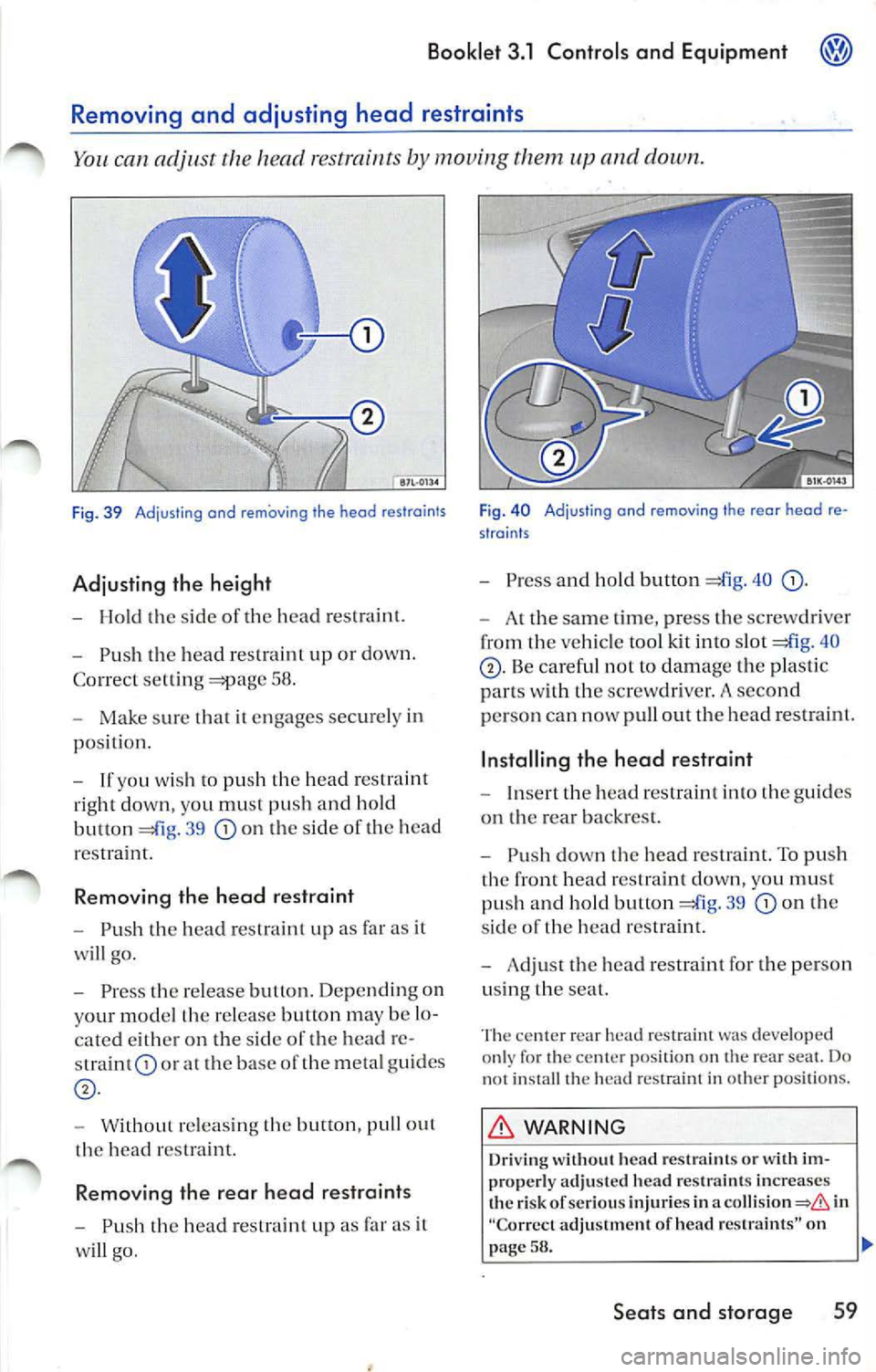
can adjust the head restraints by mouing them and down.
Fig. 39 Adjusting and removing the head restraints
Adjusting the height
- Hold the sid e o f the head restraint.
- Push the head res traint up or down.
C orr ect setting
58 .
- Make sur e that it en gages securely in
position.
- If yo u wish to push the head restraint
r ight down, you must push and hold
button =£lg.
39 on the side of the head
r e straint.
R em oving the head restraint
-Push the head restraint up as far as it
will go.
- Press the re lea se button . Depending o n
yo ur mod el th e re lease button may be lo
cated either on the sid e of the head re
straint
or the base of the meta l gu ides
- With out releasing the button, pull ou t
the head restra int.
Removing the rear head restraints
-Push the head re straint up as far as it
will go .
Fig. 40 Adjusting and removing the rear head re
straints
- Press and hold bu tton =£lg. 40
- A t the sam e time, press the screwdrive r
from the ve hicl e tool kit i nto slot =£l g. 40
pu ll out the head res traint.
Installing th e head re straint
- In se rt the head rest raint into the gu ides
on the rear backr est.
- Push down the hea d restraint. To push
the fro nt head re straint down, you must
pus h and hold butto n
39 on th e
s ide of the head rest raint.
- Ad just the hea d re straint for the person
u sing th e seat.
cen te r r ear h ead restraint was developed
on ly for the center position on the rear seat. Do
n ot install th e hea d res traint in oth er pos ition s.
WARNING
Driving w ithout h ead restraint s or w ith im
properly adjusted head restra int s in crease s
th e risk of serio us injuri es in
a in
"C orr ect adju stm ent of head res trai nts" on
58.
Seats and storage 59
Page 264 of 477
Booklet 3.1 Control s and Equipment
to vehicles: w, th foldoble front seat backrest
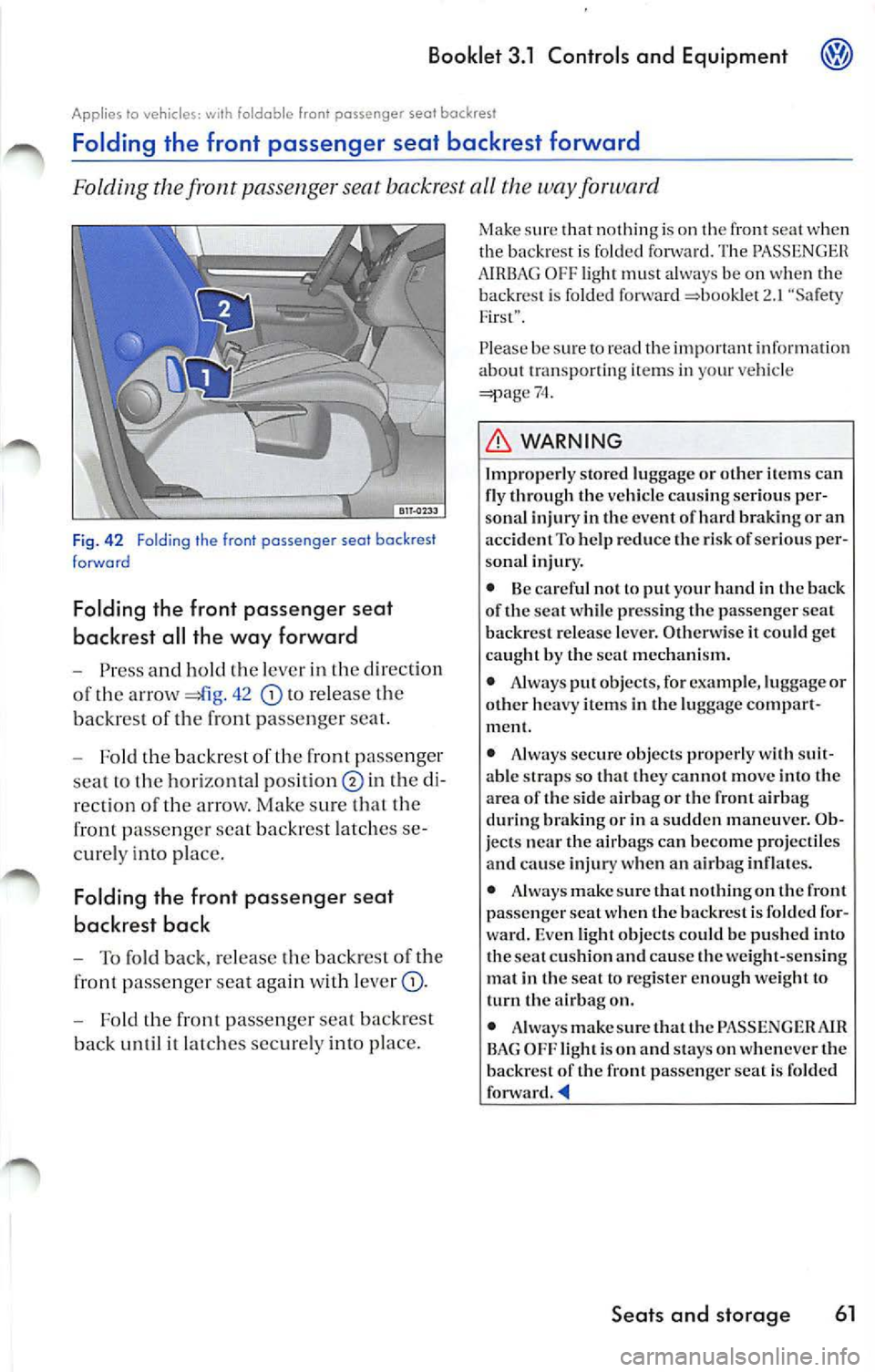
Folding the front passenger seat backrest forward
Folding the front passenger seat backrest the way forward
Fig . 4 2 Folding th e front passenger seal backrest
forward
Folding the front pa ssenger seat
backrest all the way for ward
Press and hold th e leve r in the direc tion
of the arrow
42 to re lea se the
backre st of the
pas seng er sea t.
Fold the backre st of th e fro nt pas senger
sea t to the hori zontal
in th e
rection of the arrow. Make sure that the
front pa ssenger seal backrest latches
curely into pla ce.
Folding the fr ont pas senger seat
backrest back
To fold back, release the backr est of the
front passeng er seat again with lever
Fold the front passeng er seat backrest
back until it latch es secure ly into pl ace.
Make sur e that nothin g is on th e front seat when
the back rest is fo lded The AIRBAG OFF light must always be on when the
backrest is folded forward 2.1 "'Safety
F irst".
P lease be s ure
74.
L'.D, WARNING
Im pr operl y store d lu ggage o r o th er it em s ca n
fl y thr ou gh th e vehicle ca using ser io us pe r
so nal i nj ury in th e even t of hard bra kin g or a n
ac cide nt To help red uce the risk of serious per
sona l inju ry.
• Be ca ref ul n ot lo p ut your hand in th e bac k
of the sea t wh ile press ing t he passe nge r scat
backrest re lease le ve r. O thenvise it co uld get
ca ugh t b y th e seal mech ani sm.
• Always put ob jects, for example, luggage or
o th er h eavy items in the luggage compar t
m ent.
• Always sec ure o bjec ts pro per ly wi th suit
a b le straps so th at they ca nno t m ove into the
area of t he s ide air bag or t he fron t a irbag
d u ring bra kin g or in a sud de n m an eu ver. O b
j ec ts nea r the air b ags ca n beco me pro ject iles
and cause injury when an a irbag inflates.
• Always make sure that no thin g on t he fro nt
passe nge r seal w hen th e backres t is fo lded for
war d. Eve n light ob jects co uld be push ed i nto
th e sea l c u shi on an d ca use the we ight- sens ing
mat in the seat to reg is te r en ough we ig ht to
t u rn th e airbag on.
• Always make su re that t he PAS SENG ER AJ R
BAG OFF ligh t is on and stays on whenever t he
b ac krest of the front passe nger sea t is fold ed
fo nva rd .
Page 270 of 477
Booklet 3.1 Controls and Equipment
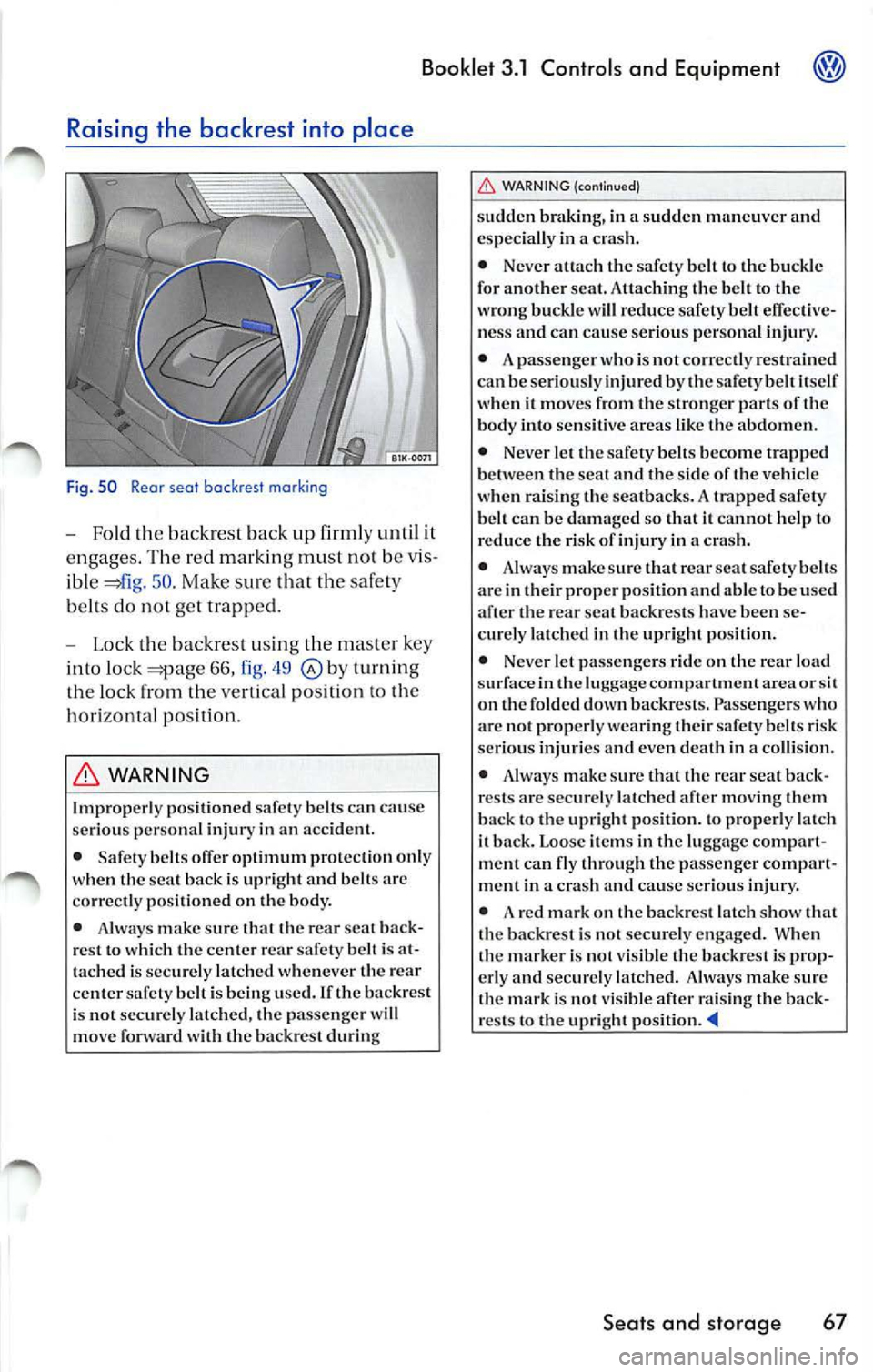
Raising the backrest into place
Fig. 5 0 Rear seat backrest marking
-Fold the backrest back up firmly until it
engages. The red marking must not be vis
ibl e
50. Make sure that the saf ety
bel ts do not get trapped.
- Lock the backrest using the master key
into lock
66, fig. 49 by turning
th e lock from the vertical position to the
horizonta l po sition.
WARNING
Improperl y positioned safety belts can ca use
serio us personal injury in an accident.
• Safety belts olTeroptimum protection only
w hen the scat back is upright and belts arc
correc tly positioned on the body.
• Always make sure that the rear scat back
rest to which the center rear safety belt is at
t ached is secure ly lat ch ed whenever the rear
center safe ty belt is being use d. If the backre st
is not secure ly lat ch ed, the passenger
will move forward with the backrest during
WARNING (continued)
sudde n braking, in a sudden maneuver and
es pecia lly in a cras h.
• Never attach the safety belt to the buckle
for another seat. Attac hing the belt to the
wrong buckle
will reduce safety belt effective
n ess and can cause serious persona l injury.
• A passen ger who is not correc tly re strain ed
can be ser ious ly injured by the safety belt itself
when it move s from the stronger parts of the
bod y into sensitiv e areas like th e abdomen.
• Never le t the safety belts become trapped
between the scat and the side of the ve hicle
when raising the scat back s. A trapped safety
belt can be damag ed so that it can not help to
r ed uce the risk of injury in a cras h.
• Alway s mak e sure that rear seal safe ty belts
arc in their proper positio n and able lo be used
after the rear scat backr ests have been se
c ur ely lat che d in the up right position.
• Neve r let passengers ride on the rear load
surface in the luggage compartment area or sit
on the folded clown backrests. Passengers who
are not properly wearing their safety belts risk
ser ious injuri es and even dea th in a co llisio n.
• Alwa ys make sure that the rear seat back
r es ts are securely latched after moving them
back to the upright positio n. to properly latch
it back. Loose items in the
compart
ment can fl y through th e passenger compart
ment in a crash and cause ser ious injury.
• A red mark on the backre st latch show that
the back rest is not secur ely engaged. When
th e marker i s not visible th e backrest is prop
erly and securely latched. Always make sur e
the mark i s not visi bl e after raising the back
re sts to the upri ght
Seats and storage 67
Page 278 of 477
Booklet 3.1 Controls and Equipment
WARNING
Heavy load s will influ ence the way your ve
hicle handl es and heavy loads t hat are not
properly stowe d or sec ured can cause loss of
contro l a nd se rious injury.
• Always keep in
when transporting
h eav y ob ject s, that a chan ge in th e center of
gravity can also cause c hanges in vehicle han
dling:
-Always distribute the load as evenly as
po ssib le.
- Secur e heavy object s properly as far for
ward in the lug gage compar tment as pos
sible.
- Alwa ys s ecure heavy items securely
using the tie-downs provided wit h suitable
s trap s.
• Never excee d the Gross Axle Weight
or the Gross Ve hicle Wei ght Hating on the
s afe ty compliance sticker o n th e left d oor
jamb. Exceedi ng permi ssible weig ht can ca use
the vehicle to slide and handle difTerently.
• Always read and heed a ddition al imp or
in forma tion on driving 2.1
" Safety first."
WARNING
To help p rev en t poisonou s exhaust gas from
being drawn into the vehicle , a lways ke ep the
rear lid clo sed w hile driving.
• Never transport objects larger than those
fitting completely into the luggage area be
cause t he rear lid cannot be full y closed.
• If you abso lut ely must drive with the rear
li d open, observe the following notes to reduce
th e risk of poisoning:
WARNING (continued)
-Close all wind ows,
- Close the power roof,
- Open all air outlets in the in strumen t
panel,
- Switch off the air recirculation,
- Set the fresh air fan to the highest speed.
WARNING
Always make sur e that the doors and rear lid
are secure ly clo sed and locke d to redu ce the
risk of injury when the vehicle is not being
u sed.
• Afte r clo sing the rear lid , a lways mak e sur e
that it is p roper ly closed and locked.
• Never leave yo ur vehicle unattended espe
cially with th e rear lid left open. A child could
craw l into the vehicle through the luggage
compartment a nd pull the re ar lid or window
s hut becoming trapped and unab le to get ou t.
Being trapped in a ve hicle can lead to serious
p ersona l inju ry.
• Never le t ch ildr en play in or around the ve
hicle.
• Never let passe ngers ride in the luggag e
com par tmenl. Vehicl e occupants must always
be properl y re strained in one of the veh icle's
s eat ing po siti on s.
Note
o bj ec ts o n th e hat sh elf co uld d am age the
w ires of the re a r w ind ow d efogg er.
Tips
D o no t co ve r th e ve ntilatio n slo ts in front of th e
r e ar sid e w ind ows beca use this ca n pr event sta le
a ir fr om esca ping the vehi cle.
Seats and storage 75
Page 280 of 477
Booklet 3.1 Controls and Equipment @)
Securing the load
Loads transported on the roof rack must be securely attached. The vehicle's han
dling is affected when transporting loads.
Always secure th e in the
WARNING
Items that arc not properly secured to a roof
rack can fall off causing a collision and per
sona l injury.
• Always make sure that all bolts and fas
teners arc properly installed and properly
ti ghten ed befor e every trip at each stop during
a long trip.
• Always properly install special fixtures for
it em s s uch as bicycles, skis, surfboard s, etc.
• Never use s traps or other things that are
damag ed, not strong enough or not suitabl e to
attac h items to a roof rack.
WARNING
Transporting heavy bulky loads o n the roof
will change the way the vehicl e handl es by
shifting the vehicle's center of gravity,
changing its aerodynamics and the way it re
acts to side winds.
WARNING (cont inued)
• Cargo th at is l arge , heavy, bulky, long or
flat will have a more negative influence on the
ve hicle 's aerodynamics, center of gravity and
overa ll handlin g.
• Always adapt your driving and speed to
what you ar e carry ing on the roof as
as to
road, traffic , weather and wind condition s.
• Always avoid sudd en braking or driving
maneuvers.
• Always make sure that loads arc properly
distributed and that heavier items arc in th e
front.
• Never exceed the maximum roof load for
th e vehicle 165 lb s. (75 kg) , maximum axle
loads or the maximum gross vehicle weight
3.3 "Techn ica l D ata."
sys
t e m s is no t cov ered by the warra nty.
• The height of yo ur vehicle is chan ged by th e
in sta llation of the roof rack and the loa d sec ured
on it. Bear this in mind when driving throu gh ga
door s or low und erp asses to avo id damag e
to the vehicle.
For the sake of environment
D rivi ng w ith the roof
incre ases fu el con
s umpti on. If yo u do not nee d do not u se it.
Page 333 of 477
Booklet 3.2 Tip s and Advice
Operating instructions
Maximum trail er weight
Yo u ca n onl y tow 1y p ic al clas s I o r cla ss 2
I railers
w ith your vehicle.
T he m ax imum gross trailer weigh1 and 1h e
tongue loa d mu sl never exceed 1he s pecifica
tion s liste d in
3.3 "T ec hni cal
Neve r ex cee d 1h e gro ss v ehicle weigh 1, w hich i s
th e we ight of 1 he veh icle. includin g driv er, pa s
se nge rs , lu ggage,
I raile r hi1 ch an d 1ongue wei gh I of t he loa ded trailer.
I n alt itude s abov e
3,000 f1. (1,000 redu ctio n
of 10% of co m bin ed lowing weight (v eh icle plu s
trai le r) fo r the beginn ing of every
3, 000 f1. (1,000 m ) shou ld be obser ved.
Trailer loa d distribution
sur e th e loa d in th e tra il e r is held secu rely in
plac e to gu ard against shif ting, b e ii forward ,
ba ckward or sidew ays. A load that shifl s can
mak e it hard or eve n imp ossib le 10 co n1rol your
ve hicl e, pa rticul arl y in an emergency s ituat ion.
Tongue load
F o r best ve hicl e handling when towing a tra iler,
adju st th e traile r load so
the tongue lo ad i s
at the maximum allow abl e or slightl y lo w er. You
ca n get an approxim ation o f th e tongu e load
wit h a bathroom scale or yo u can m ea sure the
load at a 1 rucking com pany or weig hing stat io n.
Th e to ngue lo ad in cre ases the we ig h t of t he rear
ax le and corres po ndingl y re du ces the oth er l oa d
that your vehicl e ca n
pressure
towing a trailer, inflat e th e tir es o fyourv e
hicle to th e co ld tir e pre ss ure liste d on th e stic ker
on th e op en edg e of the dr ive r's door . Inflat e
tra iler tires to traile r and tire
s p ec ification s.
Light s
Al way s che ck th e head lig ht se 1tin gs wit h th e
tra iler hooked up befo re dri vin g off. A djust a s
n ecessary so
you can see th e road ahead but
n ot b lind oncom ing traffic .
C hec k and make sur e tha t all vehicl e and
light s are wo rki ng properl y-esp ec iall y the light s. S
af ety chains
sur e tr ailer safet y cha ins are properl y co n
n ect ed from t he tra iler to the hi tch on th e ve
h icl e. Leave e nou gh slack in the c hain s 10 turn
co rner s. Whe n yo u in s1a ll safery cha ins, m ake
s ur e th ey will not drag o n the road w hile you are
d ri vin g.
T he chains shuultl
u ntler t he traile r to prevent it from dropping to th e grou nd in cas e
of sepa rat ion from the hitch.
Electronic Stabilizat ion Program (ESP )
A lwa ys leave th e ES P swi1ched on w hen you tow
a trail er. The ES P makes it easi er to stab ilize the
trailer sh ould it start to swerve o r sw ay.
WARNING
A lways adjust your dri ving lo th e road, traffi c
and weather condition s. Do not let the extra
s af ety that ESP/AS R can provid e te mpi you
i nto laking extra risks.
WARNING
Ridin g in a trail er i s da ng erous and may be il
leg al.
• A person who is not properly re str ain ed in
a m ov ing ve hicle ri sk ser iou s perso nal inju ry
a nd even death in a cras h.
• Nev er let anyone rid e in your vehicle
witho ut bein g prop erly restr ain ed.
• Never all ow
pa ssenger lo ride in trailer .
WARNING
Exceeding th e permi ssible weig ht
rat ings and permis sible trail er
we ig ht s ca n result in accident s leadi ng to se
r ious persona l injury.
• Neve r le t th e ac tual Gross Axle Weight
Ratin g at th e front and rear
exceed the
pe rmi ssibl e we ig ht s. Also neve r le t th eir com
b in atio n excee d th e Gross Vehicle Weig ht
Ra ting.
• Alw ays re member that the vehicle' s han
dli ng will be
by the extra load. There-
fo re, adju st yo ur spee d accordin gly .
12 Driving and protecting the environment
Page 337 of 477
® Booklet 3.2 Tips and Advice
Cleaning and protection
General notes
Regular washing and care help maintain value of your vehicle.
Regular care
Reg ular and expert ca re help s a ve hicl e to kee p
it s va lu e. Th is ma y als o be o ne of th e re qu ire
m ent s of
New Ve hicle Warrant y in the eve nt
of corro sio n r ep air s or if re painting should be
n ec essary.
Th e bes t way to pr otec t the ve hicl e aga inst en vi
ronm ental contamin ant s is
to w as h and wax it freq11 e111/ y. The long er thin gs lik e in sec ts. bird
droppin gs, tree sap , road dirt , indu stri al d e
p os its, ta r, s oo t or ro ad salt and oth er a ggress ive
m ate rial s stay on the ve hicle, the mor e dama ge
the y do to th e pa int. Hi gh t emp eratur es (in
clud ing s tron g sunlight ) in cre a se corro sive ef
fec ts .
A ft er roa ds have bee n salt ed it i s imp ortant
to w ash th e und erbody of th e ve hicle th orou ghl y.
Vehicle care products
Veh icle care product s are ava ilable from your
authori zed Volk swagen d eale r. K eep the produ ct
in struc tion s until you hav e use d up th e produ ct.
WARNING
Ve hicle care products can be dangerou s. Im
proper use can result in seriou s personal in
ju ry and /or poisoning.
• Always store vehicle care produ cts in a sa fe
place in original-containers that are securely
closed .
• To reduce the risk of poisoning, never use
empty food or beverage container s that might
mi slead so meone into drinking from them.
• Alwa ys keep vehicl e care products out of
the r eac h of c hildren .
16 Cleaning and protection
WARNING ( continu ed)
• Always read and heed all the instru ction s
a nd a ll WARN IN GS on the package before
u sing veh icle ca re products.
• When using product s w hi ch g ive off
ha rmfu l fume s, always work outdoor s or in a
we ll ventilated area.
• Neve r use fuel , turpentine, en gine oil,
poli sh remover or other vo latile nuid s for ve
hicl e care. They arc poisonou s and highly
flammable. They could cause
and exp lo
s ion s!
WARNING
Unintended vehicle mo vement can cause se
rious per so n al inju ry.
• Alway s turn ofTthe eng ine, apply th e
parking brake
and remov e th e ke y from
the ignition b efore wa shin g your veh icle, or
pe rform ing any maint enance or repair s.
Note
Neve r try
10 re mo ve dirt, mud or du st if th e ve
hicl e surface is dr y. Usin g dry cl oth or spon ge
fo r cl ea ning cou ld dama ge th e paint or glas s o n
yo ur vehicl e. So ak d irt, mud or du st w ith plent y
wat er befor e re m ovin g it.
For th e sake of environment
• Wh en bu yin g v eh icle car e produ cts , try to se
l ec t tho se that are not harmfu l to the environ
m ent.
• Never di spo se vehicl e ca re pro duct s with or
d ina ry house hold was te . A lw ays follo w the man
ufa ctu re r's instru ctio n s and hee d all