eye VOLKSWAGEN JETTA 2010 User Guide
[x] Cancel search | Manufacturer: VOLKSWAGEN, Model Year: 2010, Model line: JETTA, Model: VOLKSWAGEN JETTA 2010Pages: 477, PDF Size: 77.6 MB
Page 172 of 477
The Side Curtain Prot ection ™ airbag syste m ba
sica lly con sis ts of:
•
e lec tron ic co ntro l modu le and sid e impa ct se nso rs,
•
Sid e Curtain airbag s ab ove front and r ear sid e window s,
• the airbag indica to r
in in strum ent
panel.
Th e airbag
is m oniwred electroni cally to
mak e ce rtain ii is functioni ng prop erl y all
tim es. Eac h you turn on the ig niti on, airbag syste m indica tor will come on for a
fe w seconds (self diagno sti cs).
Th e Side Curtain Protection™ airbag syste m is
not acti vated:
• if the igniti on is turn ed off,
• in sid e colli sion s when the ac ce lera tion
s ur ed by se nsor is 100 low,
Applies to vehicles: with side curtain protection airbags
Booklet 2 .1 Safety first
• in fron t-end collisio ns,
• in rea r-e nd collisio ns,
• in ro llove rs .
In some types o f acc ident s th e front, Sid e
tai n and side airba gs may be tri g
ge re d to gether.
WARNING
• Safety bell s an d the airbag system will only
provide protection when occupants are in the
proper seating pos ition
4.
• If th e a irbag indicator ligh t comes w hen
th e vehicle is being used, have the system
spec te d immediately by your Volkswagen
deal er. The Sid e C urtain
m ay not work proper ly eve n when the vehicle
acce lera tion in side co llision i s hi gh en oug h
t o act iva te the airbag.
How Side Curtain Protection™ airbags wor k
S id e Curtain
airbags can work together with side airb ags to help re
d uce the risk of head and upp er to rso injuri es fo r occupants who ar e properly
st rain ed.
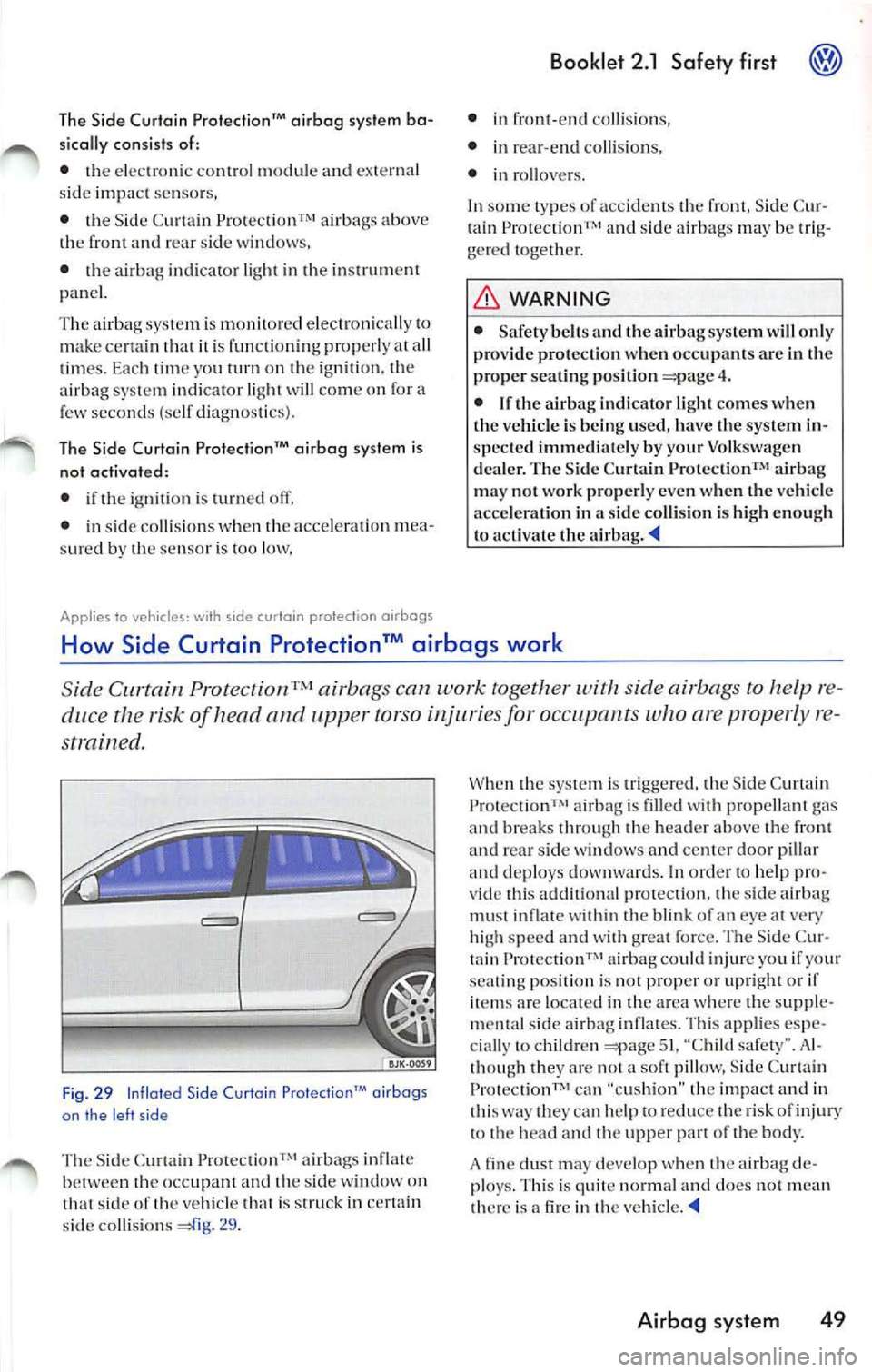
F ig . 29 Inflate d Side Curtai n airbags
on the lef t side
T he S ide Curtain airbags occupa nt and sid e windo w on side of ve hicle is in s id e collis io n s 29 . W
hen th e
is tri gger ed , th e S ide Curt ain
Prot ection
and break s through hea der above the and re ar wind ows and center doo r pi llar
and d eplo ys dow nwa rds. In ord er to help
vid e addit io nal prot ection, side airbag infl ate the blink of an eye at very
hi gh sp ee d and g rea t fo rce . The S ide Protec tion airbag could injure you if yo ur
seat ing po sit ion is 1101 prop er or up righ t or if
are in area where the suppl esid e a irba g infl ates. This app lies es pe
cia lly lO children 5 1, "C hild saf ety". thou gh are not a so ft pillow, Sid e C urtain "cu shion" the impa ct and in
thi s th ey can help t o re du ce ris k of injur y the head and upp er part of bod y.
A fine du st
d eve lo p when airbag ploys . Thi s is quit e normal and doe s not mean is a fi re in ve hicl e.
Airbag system 49
Page 182 of 477
Booklet 2.1 Safety first
help protect children who weigh more 40 lbs.
(18 kg) wh o are less than 4 ft. 9
(57 inches, I.Sm) tall in a colli sion.
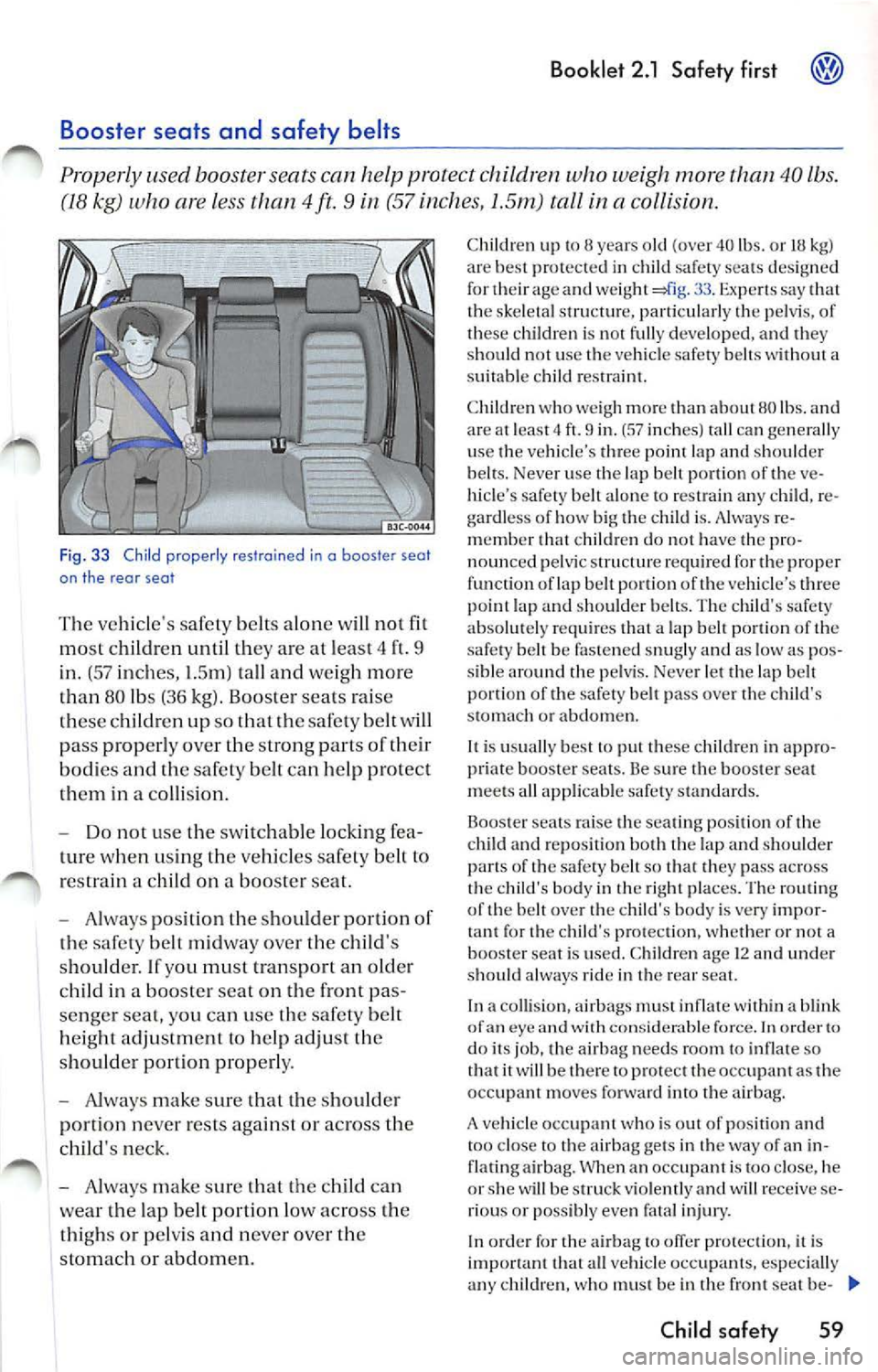
Fig . 3 3 Chi ld properly restroined in o booster seot
on the reor seot
The vehicle 's safe ty belts a lone will not fit
mo st children until th ey are at least 4
f t. 9
in. (57 inch es, 1.5m l tall and weig h m ore
th an 80 lb s (36 kg). Booster seats rai se
th ese children up so that th e safety belt w ill
p ass prop erly ove r the strong parts of their
bodies and the safety belt ca n h elp prot ect
th em in a co llis ion .
- Do not us e the switc habl e lo ck ing fea
tur e w hen using th e ve hicles safety belt to
r es train a child on a boos te r se at.
- Always positio n the sh ould er po rtio n of
the safery be lt m idway over th e child 's
s h oulder. If you mu st tran sport an olde r
c hild in a booster seal on the front pas
se nger seat, you can use th e safety belt
h eig h t adju stm ent to h elp ad ju st th e
s h ou lder po rti on prope rly.
- Alwa ys make sure that th e should er
porti on neve r rests aga inst or across the
ch ild' s neck .
- Always make sur e th at the child can
wea r the la p belt porti on low across the
thi gh s or pelvis and neve r over the
s to m ac h or abd om en .
C hil dren up to 8 yea rs old (ove r 40 lbs. or 18 kg)
are best protecte d in child safe ty seats desig ned
fo r their age and weight
33 . Expert s say that
th e s ke le ta l st ru ctur e, parti cul arl y the pelvi s, of
the se c hildren is not full y developed, a nd they
s h ou ld no t u se the ve hicle safety belts w ithout a
s uitable chil d res train t.
Ch ild re n who we igh mor e th an about 80 lbs . a nd
are at le a st 4 ft. 9 in. (57 inch es)
can ge nerally
u se t he ve hicle's t hree point lap and sh ou lder
belts . Never use th e la p b elt p ortio n of the ve
hicl e's safe ty be lt alone to res tra in an y c hild, r e
gardle ss of how big the chil d is. A lways re
membe r that children do not have t he pro
n oun ced pe lvic stru ctur e req uired for the prope r
func tion of lap belt po rtion of the ve hicle 's three
po int lap and sh oulder b elts. T he ch ild's safety
absolutely re qu ires that a lap be lt portion of the
sa fe ry belt be fastened sn ugly and as low as pos
s ibl e arou nd the pelvi s. Never let the lap belt
porti on of r he safety belt pass over the child 's
s tomac h or abd om en .
It is usuall y best to put th ese childr en in appro
p ri ate boo ster sea ts. Be sur e th e bo oster seat
me ets a ll app lica ble safety standa rds.
Boos te r seats raise the sea tin g pos ition of the
c hild and rep osition both the lap and shoulder
parts o f the safety belt so that they pass across
th e c hild 's bod y in th e right pla ces. The ro uting
of the belt over the child 's body is very impor
tant for the chil d's pro tec tion, w heth er o r not a
boo ste r seat i s used. Chil dren age 12 a nd und er
s hou ld always ride in the rear seat.
I n a co llision, a irbags must inflate within
blink
of a n eye and with force. In orde r to
do its job, the a irbag needs roo m to infl ate so
that it wi ll b e th ere to protec t the occupa nt as the
occ upant moves forward into the airbag.
A ve hicle occup ant who is ou t of pos ition and
t oo close to the a irbag gets in th e way of an in
fl atin g airbag . W hen an occupan t is too close, he
or she will be struck viole ntly a nd will r eceive se
r io us or possi bly even fatal injur y.
In orde r fo r th e airbag to offer pro tec tion, it is
imp ortant th at all ve hicle occ upant s, especia lly
any childr en , w ho must be in the fron t sea t
Child safety 59
Page 260 of 477
Booklet 3.1 Controls and Equipment
a
safety belt.
Th e dri ver sea t and front pa ssenger seat can be
adjusted in many ways to sui t the physi cal need s
of the ve hicle occupams . Seat position i s very
i mporta nt:
• fast and easy operation of all control s on th e
in strum ent panel,
• relax ed posture that does not ca use drow si
ness,
• safe driving,
• opt imum protection from the seat belts and
airbag syste m
2.1 "Safety fir st."
WARNING
Drivers or passe ngers who arc unbelted , out of
position or too close to the airbag can be seri
ously injured or killed by an airba g as it un
folds. To help reduce the risk of ser iou s per
so nal injur y:
• Alwa ys adjust the driver's seat and the
s teering wheel so that th ere a re at least 10
inches (25 cm) betwe en yo ur breastbone and
the steeri ng w heel.
• Alwa ys hold th e steer ing wheel on th e out
s id e of the s teer ing wheel rim with your hand s
at the 9 o'clock and 3 o'clock positions to help
reduce the risk of personal injury if the
driver 's airbag inflates.
• Neve r hold th e steer ing wheel at the 12
o'clock position or with your hands at other
pos ition s in sid e the steer ing w hee l rim or on
the steer ing wheel hub. Holding the ste ering
w hee l th e wrong way can cause serio us inju
ries to the h ands, ar ms and head if the driver's
airbag inflates.
• P assengers must alway s sit in an upright
po sitio n and ne ver lean against or place any ,0.
WARNING
(continued)
part of th eir body too close to the area where
the airbags arc located.
• Passengers who are unbelt ed, out of posi
tion or too close to the airbag can be seriously
injured by an
as it unfo lds with great
force in the blink of an eye.
• Always make sure th at there arc at least 10
in ch es (25 cm) between the front passeng ers
breastbone and the instrum ent panel.
• Each passenger must always sit on a sca t of
th eir ow n and properly fasten and wear the
safety belt belonging to that seat.
• Before driving, a lways adjust the front
seats an d head restra ints pr operl y.
• Neve r adjust the seats while the vehicle is
moving. Your scat may mo ve unexpectedl y
and you could lose control of the vehicle .
• Always keep your feet on the floor in front
of the scat. Neve r rest them on the seat, instru
m ent panel, out of the window, etc. The airbag
s ystem and safety belt will not be able to pro
t ect you properl y a nd can even increase the
ri sk of injur y in a crash.
• Never drive with the backrest recl ined or
tilt ed far back! The farther the backrests arc
tilt ed back, the greater the risk
due to
in cor rect positionin g of the safety belt and im
proper seating position.
• Safety belts only offer max imum protec
ti on wh en th e sea t back is sec urely latched in
th e upri ght position and the safety belts arc
proper ly positioned on the bod y. By not sitting
upright, a rear scat passenger increase s th e
r is k of per sonal injury from improperly pos i
ti oned safet y belts!
• Children must always ride in child seats.
Specia l precautions apply when insta lling a
child scat on the front pas senger sea t
2.1, ch ap ter "Chi ld
Seats and storag e 57
Page 261 of 477
Booklet 3.1 Controls and Equipm ent
Head restraints
Correct adjustment of head restraints
Properly adjusted h ead restraints are an importa 11t part of occupant protection
and can help to reduce the risk of
in accidents.
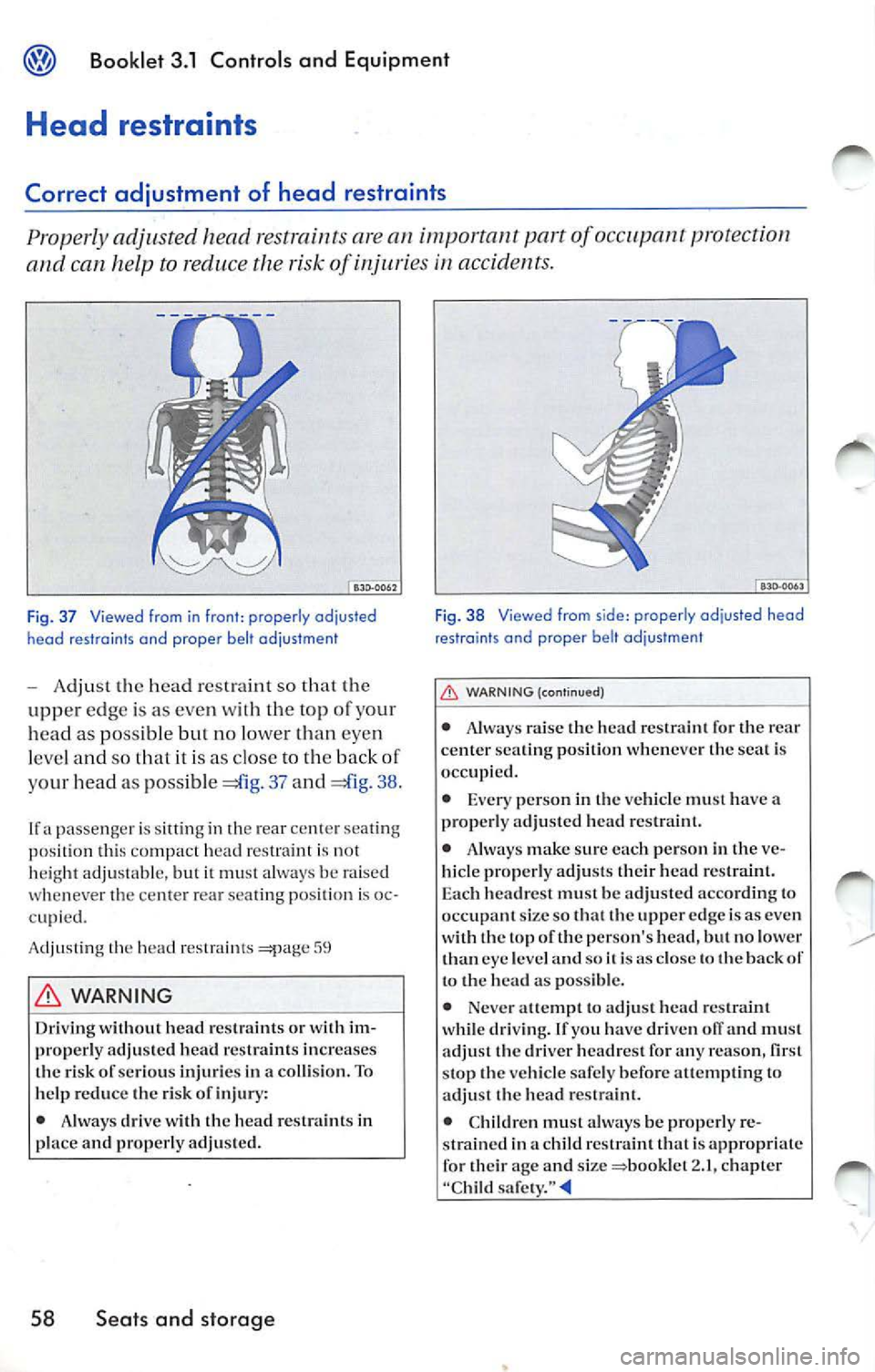
Fig. 3 7 Viewed from in front : properly odjusted
heod restraints end proper belt odjustment
- Adjust the head restraint so that the
uppe r edg e is as eve n wit h th e top o f your
head as possible
no lo wer than eyen
l eve l and so th at it is as close to th e bac k of
y our head a s possi ble
37 and 38.
If a passenger is s itting in th e rear center sea tin g
position thi s co mpact h ead r estraint is no t
h eight adju stabl e, but it must always be raised
whenever the ce nte r rear sea ting posi tion is oc
c upi ed.
A dju sting the head
WARNING
Driving without head rest raints o r wit h im
prop erly adjusted head restraints inc reases
th e risk of serious injurie s in a co llision. To
h elp reduc e th e risk of injury:
• Always drive with th e head restraints in
place a nd properly adjuste d.
58 Seats and storage
F ig . 38 Viewed from s ide: properly adjusted head
restraints and proper belt ad justment
WARNING (contin ued)
• Always raise the head restrai nt for the r ear
center seating position wheneve r the seat is
occupied.
• Ever y perso n in th e ve hicle must have a
properl y adjuste d head r estra int.
• Alway s make sur e eac h person in the ve
hicle properly adju sts their head restraint.
E ac h headres t must be adjusted a ccord ing to
occupant size s o that the upper ed ge is as eve n
wit h the to p of the person's head, but no lower
tha n eye leve l an d soi
is as clo se th e back to the head as pos sibl e.
• Neve r attempt to adj ust head r estraint
wh ile dri vin g. If yo u have driven
and mu st
adjust the driver h eadrest for any reason,
stop the ve hicle safe ly befo re atte mptin g to
ad just the head r estra int.
• Children must always be properly re
s trained in a ch ild restrain t that i s appropr iate
for their age and size
2. 1, ch apter
"Chil d safety. "
Page 330 of 477
Operate your vehicle safely
For drivin g safely, alwa ys follow t he speci fied
maint enance interva ls in your maint enan ce
bo okle t =boo klet
I.I "M aint en an ce" -es peci ally
fo r chan ging brake fluid. H ard use , pri marily
s top and go dr iv in g, o perat io n in very dusty
areas, t ra ile r towi ng as we ll as other con dition s
m ay make
neces sary maint enance
im erva ls -see your authorize d Vo lksw agen
d ea ler.
Your vehicle 's condition is dir ect ly relot ed to
driving safety
Th erefo re, always be sur e
ob serve fol
l ow ing points before yo u dr ive off:
• Check l ig ht s an d turn sig nals.
• Check f uel l eve l.
• Make sure
a ll ligh ts a nd all wi ndows are
clea n.
• Adjust
mirr ors .
• Make s ure
air intak e slo ts betwee n en gin e hood a nd wind shi eld are free of
l eaves, sn ow a nd ice.
• Check warning a nd indicato r light s when
s tarli ng the en g in e.
Your personal d riving style and attitude have a
lot to do with safety ..
T here fore , for you r ow n sa fe ty:
• Wear your safety bells a nd wear
pro p
er ly , ev en if you ar e just driv in g in city o r lo
th e co rner =book le t 2 .1 "Sa fe ty first",
c h apt er "Safet y
• Make sur e th at all passe ngers wear their
sa fe ty belt s proper ly. even those in rea r 2.1 "Sa fe ty chapter "Safety
belt s." Pa sse ngers wea ring en
danger not onl y th em selves in cra sh, but al so dri ver and oth er passengers .
• Make su re th at children a lwa ys
on rear
sea t prop erl y res tra in ed by a res traint system a p
propri ate for th eir size and age.
• Never tra nsp ort a child in a rear
c hild
or infant seat on the front passe nger seat
= bo oklet 2.1 "Safety
• Adju st yo ur sea t so that yo u ca n eas ily reac h
a ll co ntrol s whil e yo u are as from
Booklet 3.2 Tips and Advice
airb ag as pos sible but close r th an 10 inches
(25 cm ) = book let 2. 1 an d 3.1.
• The sea ting positi on is ve ry important for the
a irb ag perfo rm ance
2.l "S afety first",
cha pter "Air bag syste m.''
• Always a djust th e hea d res traints to
cor
r ec t h eig ht . For maximum pro tec tion , ad just the
h ead res trai nt so that the upp er edge is as eve n
w ith the top of yo ur hea d as possi ble,
no
l owe r than eye le v el a nd so that is as close to
th e ba ck of your head as possib le = bo okle t 2. 1
"Safe ty
• Alw ays make s ure that the mov ement of peda ls is no t res tri cte d in an y way 3. 1,
c h ap te r " Peda ls ."
• Store luggage an d light it em s prop erl y in
luggage compartme nt and on roo f
=book let 3. 1, c hap ter" Luggage compa rtment "
an d
3.1, cha pter rack."
If you drink, do not drive !
T he use of a lco hol, dru gs a nd certain medi ca
ti ons w ill seriously impa ir percept io n , reac tions
a nd dri vin g a bility ,
increa sin g th e
ri sk of an acci dent, cras h an d pe rso nal injury.
Do not drive if you are tired.
Make frequ ent rest stops , at le ast aft er every two
hours of dri ving.
Al ways adapt vehicle speed to traffic, road and
weather conditions.
H em ember , th at
o n sm ooth, slipp ery
roa ds, ve hicle han dling and br aking dep end a
d ea l on tire ad hes ion. On wet roa ds, the
front whee ls c an h ydrop lane, especi ally at
h ig her sp ee ds. If thi s hap pe ns, yo u will then no
l o nge r b e ab le to ste er or brak e prop erl y.
WARNING
• Alw ays observe the po sted spe ed Ii mils and
common sense. Your good judgment can
mean
diff ere n ce between arr iving safely at
your destination and being ser iously injur ed
in
crash or other kind of accide nt.
• Alway s rea d and hee d all WARNI NGS and
a dditi on al inform ation rega rding safety
= bookl et 2.1 "Safe ty
Driving and protecting the environment 9
Page 363 of 477
Booklet 3.2 Tip s and Advice
Changing the engine oil
The engine oil be changed at the intervals listed in the Maintenance Booklet.
The engin e oil mu st b e c han ged a ccordin g to th e
int erva ls s pecified in your Ma intenan ce book le t
I. I.
Thi s is ve ry important becau se the lubri catin g
prop erti es of oil decrea se gradually during
n o rm al v ehicl e use. If yo u ar e no t sur e w hen you
yu ur yuur Vol k
sw age n Se rv ice Ad viso r.
Und er so me c ircum sta nces the e ngin e o il
s h o uld b e changed more freq u entl y. C hange oil
mor e often
you driv e mo stl y s hor t d is tan ce s.
opera te the veh icl e in dusty areas or mostl y
und er stop-and-g o traffi c conditi ons. o r wh en
yo u u se yo ur vehicl e where te mperatur es stay
b elow freez in g po int for l ong p eri o ds.
D eterge nt additive s in th e oil will m ake fres h oil
lo ok d ark aft er t he e ngin e ha s bee n runnin g fo r a
s hort t ime. T hi s is normal
is not a r easo n to ch an ge the oil mor e often than r ecomm end ed .
WARN ING
Sto p! Before w orkin g in the en gine compan
ment , alwa ys read and h eed all WARN INGS
34 . The engine co mpartment of motor vehicl e is a potentia lly dangerou s area
and can cause se rious perso nal inju ry.
WARNING
If yo u mu st cha nge the engine oil in yo ur ve
hicle:
• A lways wear eye pro tec tion.
• To reduce the risk of burns from hot e ngine
oil le t the engin e coo l down to th e to u ch.
42 Checking and Filling
WARNING (continued )
• When removi ng the oil drai n plug with
y our fing ers, s tay as far away as poss ible. A l
ways keep your forear m
to the ground
to h elp pr even t hot oil from ru nning down
your
• Drain the oil into a con ta in er des igne d for
th is on e large en ough to hold at least
th e to tal amo unt of oil in yo ur eng ine.
• To reduce t he risk of poisoning, neve r use
em pty food or beverage containers that might
mi slea d someo ne into drinkin g from them.
• Eng ine oil is poisonous. Keep it we ll out of
the rea ch of c hildren.
• Conti nuo us co nta ct with used e ngine oil is
h armfu l to yo ur skin. Alway s pro tec t yo ur skin
by wash ing th oroug hly wi th soa p and water.
For t he sake of environm ent
• Before ch angin g t he oil, fi rs t m ake sur e yo u
k now w here yo u can prop erl y di sp ose of the old
o il.
• Always disp ose o f u se d engin e oil prop erly .
N ev er dump it on garden soil. in wood ed ar ea s,
int o stream s or cl ow n se wa ge drain s.
• Recy cle use d engin e oil
takin g it t o a u sed
e n gin e o il co llect io n fa cilit y in your area , o r co n
ta ct a se rv ice sta tion.
• Beca use of th e probl em of prop er d is po sa l,
a long with the special too ls and nec ess ary exp er
ti se req uir ed,
stro ngly reco mm end that you
h ave yo ur oil ch ang ed b y an auth oriz ed Volk
swage n deale r o r a qualifi ed wo rks hop .
Page 370 of 477
Booklet 3.2 Tips and Advice
Vehicl e batt ery
Location of battery
The battery is mai nte nance-free is c h ecked during the inspection serv ice.
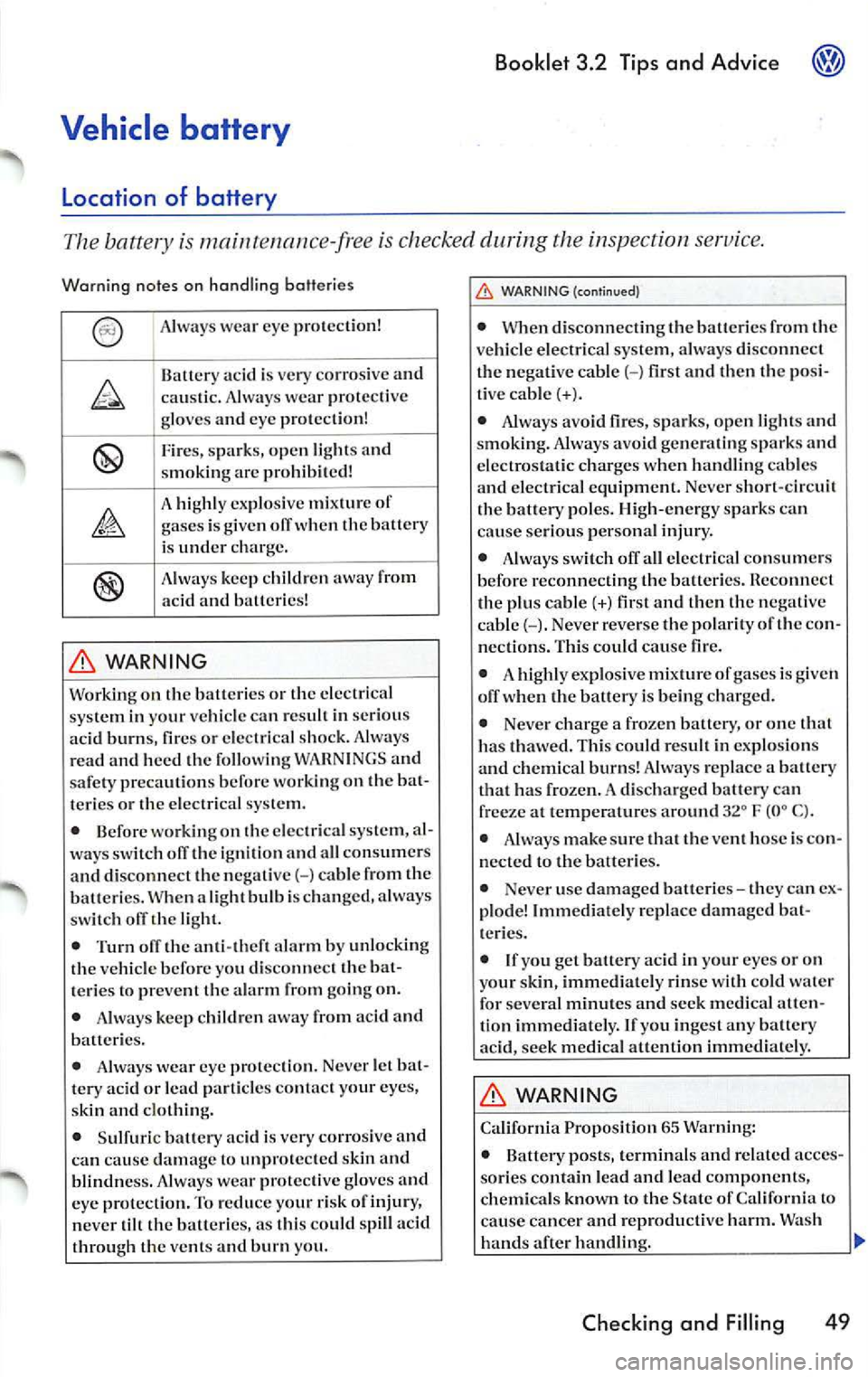
Warning note s on handling batterie s
Battery acid is very co rrosive a nd
ca usti c. Always we ar protective
g loves and eye prot ection !
Fires, s park s, open ligh ts and
s moking arc pro hibit ed!
Always kee p childr en away acid and batt eries!
WARNING
Wo rki ng on the batt eri es or the electr ical
syste m in yo ur vehicl e can result in ser ious
acid burns,
th e
batt eri es . Whe n a light bulb is c han ged, always
sw itch o!Tt he light.
• Turn o!Tt he an ti- th ert alarm by unl ockin g
the vehicl e befor e yo u disco nnect th e bat
terie s to pre vent th e ala rm rrom goin g on.
• Always kee p childr en a way
acid an d
batterie s.
• Alw ays wear eye prot ectio n. Nev er let bat
t ery acid or lead particl es contact your eyes,
and clothin g.
•
batter y acid is ve ry co rrosive and
can cause damag e to unprote cted ski n and
blindn ess. A lways wear protectiv e gloves a nd
eye protec tion. To re du ce yo ur risk o r injur y,
n eve r tilt the batt eri es, as thi s co uld spill acid
throu gh th e ve nts and burn you.
WARN ING
• Wh en disconn ecting the batt eri es from the
ve hicl e elec tr ic al sys tem , a lways disco nnect
the negative cable(- ) fir st a nd th en th e po si
ti ve ca ble(+ ).
• Alwa ys avo id fires, spark s, op en li ght s a nd
s moking. Alw ays avoid generatin g sparks a nd
e lectro static charges whe n handlin g cables
a nd elect rica l equipment. Never short-cir cuit
the battery pole s. Hi gh -energy sparks can
c au se se rious per sonal injury.
• Always swi tc h off all electrica l con sumer s
before recon nectin g the batteries. Heconncct
th e plu s ca ble( +) first and then the negative
cab le(-). Neve rrever se the polarity or the con
ne ctions. This could cause fire.
• A hi ghl y exp losive mixtur e or gases is give n
off when th e batter y is bein g ch arged.
• Never cha rge a frozen batt ery, or one that
ha s th awe d. Thi s could res ult in explos io ns
and chemical burns! A lways re pla ce
batte ry
t h at h as frozen. A discharged battery can
rr eeze a t temperatures around 32° F (0 ° CJ.
• Alwa ys make sure that t he ven t hose is co n
n ec ted to the batt eries.
• Never use dama ged batter ie s- they can ex
p lode ! Im med iately repl ace dam aged bat
terie s.
•
yo u ge t b att ery acid in yo ur eyes or on
y our imm edi ate ly rin se with co ld water
fo r sev eral minut es and see k m edi ca l att en
tion imm ed ia te ly.
yo u in ges t a ny batt ery
aci d, seek medi cal aue ntion imm ediatel y.
WARNING
California Propositi on 65 Warnin g:
• Battery posts, te rm in al s and re la te d acces
so ries contain l ead and lead compon ent s,
c hemicals kno wn to the
of Ca lifornia lo
ca use cance r and reproducti ve harm . Wash
h ands
h and ling.
Ch ecking and Filling 49
Page 371 of 477
Booklet 3.2 Tips and Advice
The electrolyte level be checked reg ularly in high-mileage vehicles, in hot
cou ntri es and in older batteries.
- Open the engine hood and open the
batt ery cover at the front.
- C heck th e co lor display in the round
w ind ow at the top of the battery.
- If there are air bubb les in the window,
tap the w indow gent ly un til they disp erse .
Th e positio n of th e battery is sh ow n in th e corre
spo ndin g engine compart ment diagram
3.3. Th
e ro und window ("magic eye '') on th e to p of
t h e batt ery chang es color, d epending on the
c harg e le vel and ele ctrolyt e le vel of the ba ttery.
I f th e c olor in the w indow i s co lor less or bri gh t
ye llow . the elec trol yte le vel of the battery is to o
I la ve the ba tte1y ch ec ked by a q ualifi ed
d eal ers hip ..
The col ors g ree n and b la ck ar c use d b y the work
s h op t o diagno se the battery.
Charging and replacing vehicle batteries
All work with the vehicle battery req uir es specia l know ledge.
Have th e batteries checked by auth orized
Vo lkswagen deale r o r qua lified workshop be
t ween regular ma inten an ce i nt erva ls if you of te n
driv e short distance s or i f th e vehicle is not
driven for lo ng peri ods.
I f the bat te ry has discharged and you have prob
l ems starting th e ve hicle, the battery might be
damaged . If thi s happens, we re comme nd you
h ave the ve hicle batte ry c hecked by an autho
ri ze d Vol kswag en dealer
it w ill he erly recha rged o r re pla ced.
C har ging vehicle batteries
T he c har ging of the vehicl e batt eri es s hould be
l ef t to an aut horized Vo lkswage n deale r o r qual
ifi ed workshop, b ecau se your ve hicle is
equipp ed w ith specia l batteri es th at mu st b e
charg ed in a contro lled e nvironm ent.
50 Checking and Filling
Rep lacing a battery
T he batt eries have been specia lly deve lo ped for
th eir lo cat io ns and they have specia l sa fe ty fea
Genui ne Volkswage n batte ries me et th e m aint e
nan ce, and safety sp ecificat io ns
fo r you r ve hicl e.
WARNING
• u se on ly maint en an ce -fr ee or
cycle -free, leak-proof batteries with the same
s pecification s and dimen sions as the ori ginal
e quipm ent batt ery. S pecifi cation s are liste d
on the batt ery hous ing.
• Before sta rtin g
work on th e batteries,
a lways rea d and heed a ll in
"Loca tion of battery" on page 49.
Page 388 of 477
Booklet 3.2 Tips and Advice
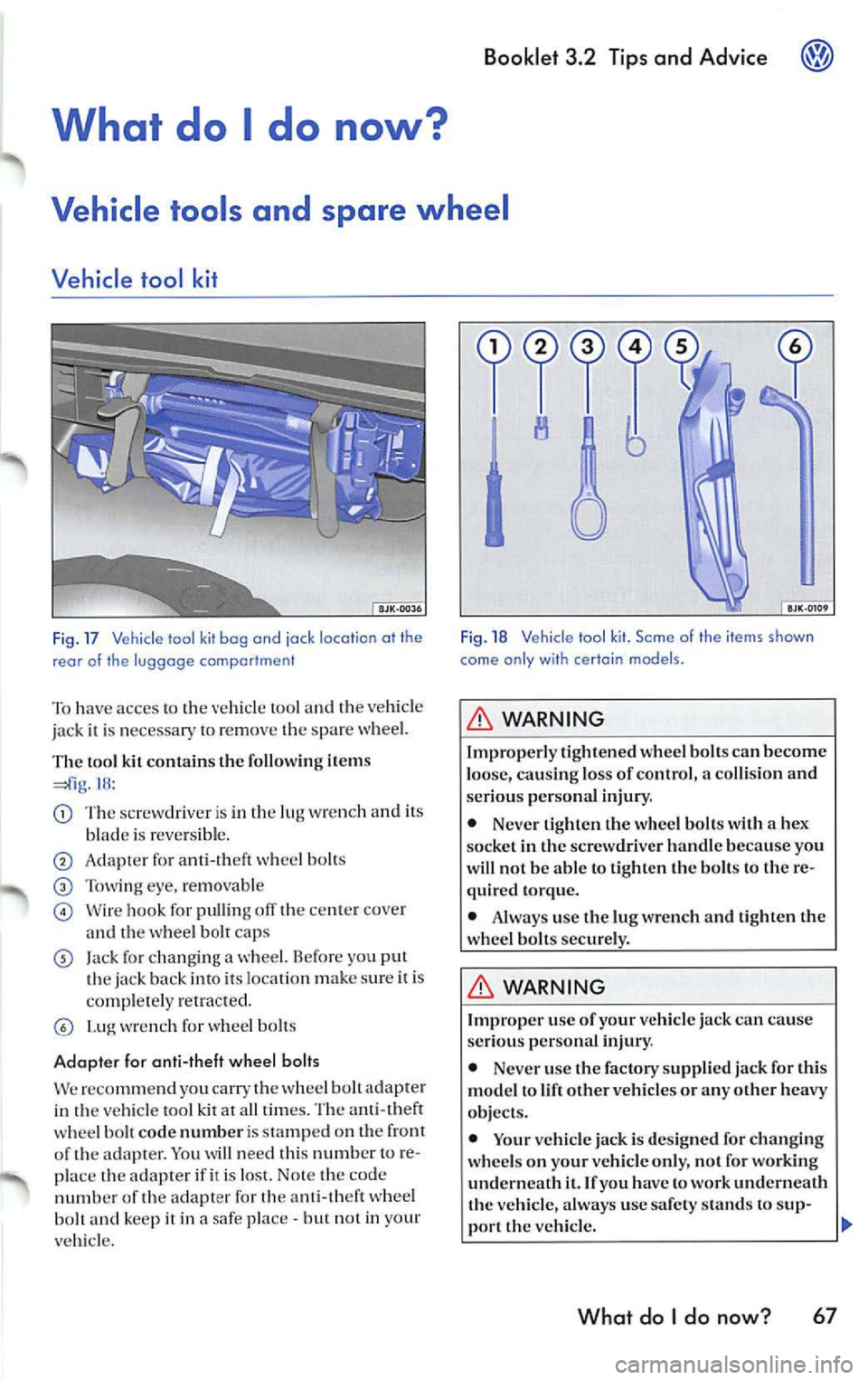
tool and th e vehicl e
jack
con tains th e follow ing items 18 :
Th e sc rew driv er is in th e lu g w re nch and its
b lad e is re ve rs ib le .
A dap ter for ant i-th eft wh eel bo lts
Tow ing eye, re movab le
W ire hook for pulling off the ce nte r co ve r
a nd th e w he el b olt cap s
Jack f or changing a wheel. B efor e yo u put
th e jack back in to i ts loca tion make sur e it is
co mp le te ly re tr a cted.
wr en ch for wheel bolts
Ad opter for anti-th eft w hee l baits
We reco mmend yo u carry t he wh eel bolt adap te r
in th e ve hicle tool kit at all times. The a nti-theft
w hee l bo lt code numbe r is sta mp ed on th e front
of th e ada pter. Yo u will need this numb er to re
p lace t he ada pter if it is lo st. No te th e c ode
numb er o f th e adapt er fo r th e an ti- th ef t whee l
b olt and kee p it in a safe pla ce
but not in your
veh icle.
Fig . 18 Vehicle too l kit. Some of th e it e m s sh own
come o nly w it h certa in models .
WARNING
Improper ly t ighte ned whee l bo lts can become
l oose, ca usi ng loss of contro l, a co llisio n an d
ser ious perso nal i nju ry.
• Neve r tig h te n th e w hee l bo lts wit h a hex
socke t in th e sc rew driver h and le because yo u
w ill n ot be ab le to tig hte n th e bo lts to t he re
qu ired torque.
• Always use t he lug wrench and tig ht en th e
wh eel bolts secure ly.
WARNING
Imp roper use of your ve hicle jack can ca use
ser io u s pe rso nal in jury .
• Never use the fac tory sup plied jac k for t his
mod el to lift othe r ve hicles o r any other heavy
ob jec ts.
• Your vehicle jac k i s des igned for ch ang in g
w hee ls on your vehicle on ly, not fo r working
un dernea th
it. If you have to wo rk un derneat h
t h e ve hicle , a lways use safe ty s ta nds to s up-
p or t th e veh icle.
What do I do now ? 67
Page 407 of 477
Booklet 3.2 Tips and Advice
WARNING (continued)
• Always make sure that the battery pro
v idin g ass istance has the same vo ltage as the
discharged battery (12V) and approximately
the same ca pacity (see battery label).
• Neve r jump start a ve hicle with
rrozen
batt ery. 1r a battery is or has been frozen, re
pla ce it.
• Batteries giv e
explosive hydrogen gas.
A lways keep sparks, open flame and
smoking materials away from batteri es.
• Never short out the battery pole s by con
necting the positive
and nega tive po les
with eac h other .
• Always follow the jumper cab les ' manufac
turer's instruct ions.
• Never co nn ect the negati ve cab le from the
other vehicle directly to the negat ive terminal
or the discharged battery. The hydrogen gas
rrom the battery is exp losive.
Towing
WARN ING (continued)
• Never attac h the negative cable from the
ve hicl e providing starting assistance to parts
of the fuel syst em or to the brake hoses o r
brake lines.
• Never a llow the non -in sula ted parts of th e
batt ery clamps to touch. Never allow the
jumpe r cab le a ttached to the positive battery
t ermina l to contac t metal parts of the vehicle.
• Alw ays route the jumper cables so that
th ey can not ge t tangled up with moving parts
in th e engi ne c ompartment.
the vehicl e's e lec
tri cal sys te m.
• Do not l et
veh icles touch eac h oth er. Oth
e rw ise curr ent could fl ow betwee n the ve hicles
a s soo n as the plu s(+) te rminal s are
co nn ect ed.
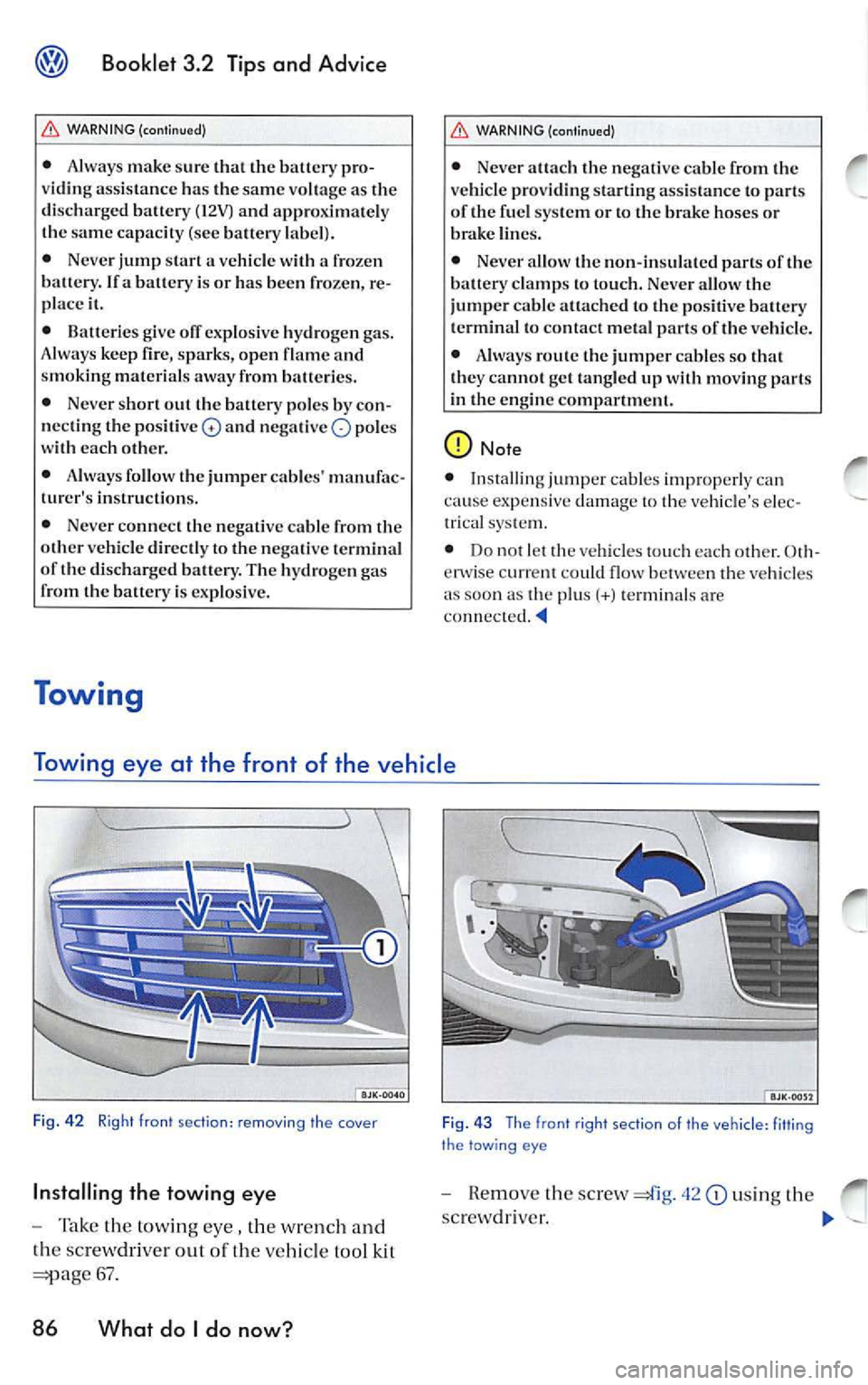
67.
86 What do I do now?
Fig. 43 The front right secti on of the vehicle: fitti ng
t he towing eye
- Rem ove the scre w 42 usin g the
sc rew dri ver.