warning light VOLKSWAGEN JETTA 2010 Repair Manual
[x] Cancel search | Manufacturer: VOLKSWAGEN, Model Year: 2010, Model line: JETTA, Model: VOLKSWAGEN JETTA 2010Pages: 477, PDF Size: 77.6 MB
Page 306 of 477
Booklet 3.1 Controls and Equipment
has bee n se lec te d in ad dition to po siti on D 83 .
If po sit io n N h as been selec te d and you wi sh to
se le ct D , yo u mu st pre ss the foot brake if th e ve
hi cle is stat io nary, or travellin g at under 5 km/h
( approx. 3 mph )
S - standard dri ving posit ion {sport program)
If y ou s ele ct t he sport pro gra m yo u will be
dri ving in a sport y mode . A ll forward gear s
shift and down shift automat ically at high er en
g in e s pee ds dep ending on en gin e load , you r in
di vid ual d rivin g sty le and th e ve hicle sp ee d.
W hile dr iv ing downh ill in S, the engin e docs not
the veh icle. Th e displa y al so sh ow s wh ic h
ge ar ha s be en se lec te d in addit io n t o po siti on S .
WARNING
Neve r switch off the engine before the ve hicle
ha s come lo a complete stop. You can lose co n
trol of the vehicl e, crash and be ser iously in
jured.
• The airb ags a nd safe ty bell pretensioners
w ill n ot work when the igniti on i s swi tched off.
• The br ake boo ster do es no t work when the
eng ine i s turn ed off. A lot mor e brak e pedal
pressure will be necessary to stop th e vehicle.
• The power steer ing system does not work
w hen the engine is turn ed off and you will
n eed more force to steer th e ve hicl e.
Applies to vehicles: with on a utoma tic trans missio n
Kick-down function
WARNI NG (continued)
• When the key is removed, th e steer ing
w hee l co lumn will lo ck up and you will not be
able to stee r th e ve hicle.
• Never coast down a slop e w ith th e trans
mi ssio n in Ne utral.
Tips
• If th e selec to r lev er i s un inte nti onal ly mo ved
int o N wh ile dri ving , take your fo ot off t he acc el
era to r p eda l a n d wa it until th e engi ne spee d has
dropp ed to idl e sp ee d before sele c tin g a dri vin g
po sition .
• If th ere is
fa ult in th e sys te m and th e auto
mati c tra nsmi ssion I dir ect shift gearbox is run
n in g in an emergen cy program if all the displays
of the s elector leve r position s for the au tomat ic
tr ansmi ss ion
I di rec t s hi ft g ea rb ox have light
ba ckg ro un d. The a utoma tic tran smi ssio n I di
r ec t shift gearbo x shou ld be c hec ked b y an au
thori zed Vo lkswage n dea ler as soon as
po ssibl e._.
Th e kick -down permits maximum a ccele ration the se lector lev er
is
D, So r
down, th e tran smi ssion p ermi ts a c
c e le ratio n. The tran smi ssio n aut om atica lly
down shift s, de pending on the road spe ed as we ll
a s th e eng ine sp ee d.
Th e tra nsmi ssion
not up sh ift until the en
g in e reac hes the engin e s pee d for th e
g ear sele ct ed .
WARNING
Accelerating on slippe ry road s can cause lo ss
of ve hicle control and serious per sonal injury.
• Be very careful when u sin g th e kick -do wn
especi all y o n sli ppery sur faces. Rapid
accelera tion may ca use w hee l spin and sk id
d in g.
• Use the kick-down fea tur e o nly w hen
and weather conditions permit
Driving 103
Page 307 of 477
@ Booklet 3.1 Controls and Equipment
Parking brake
Applying the parking brake
pa rking brake can b e use d to prevent the uehicle from moving
ally .
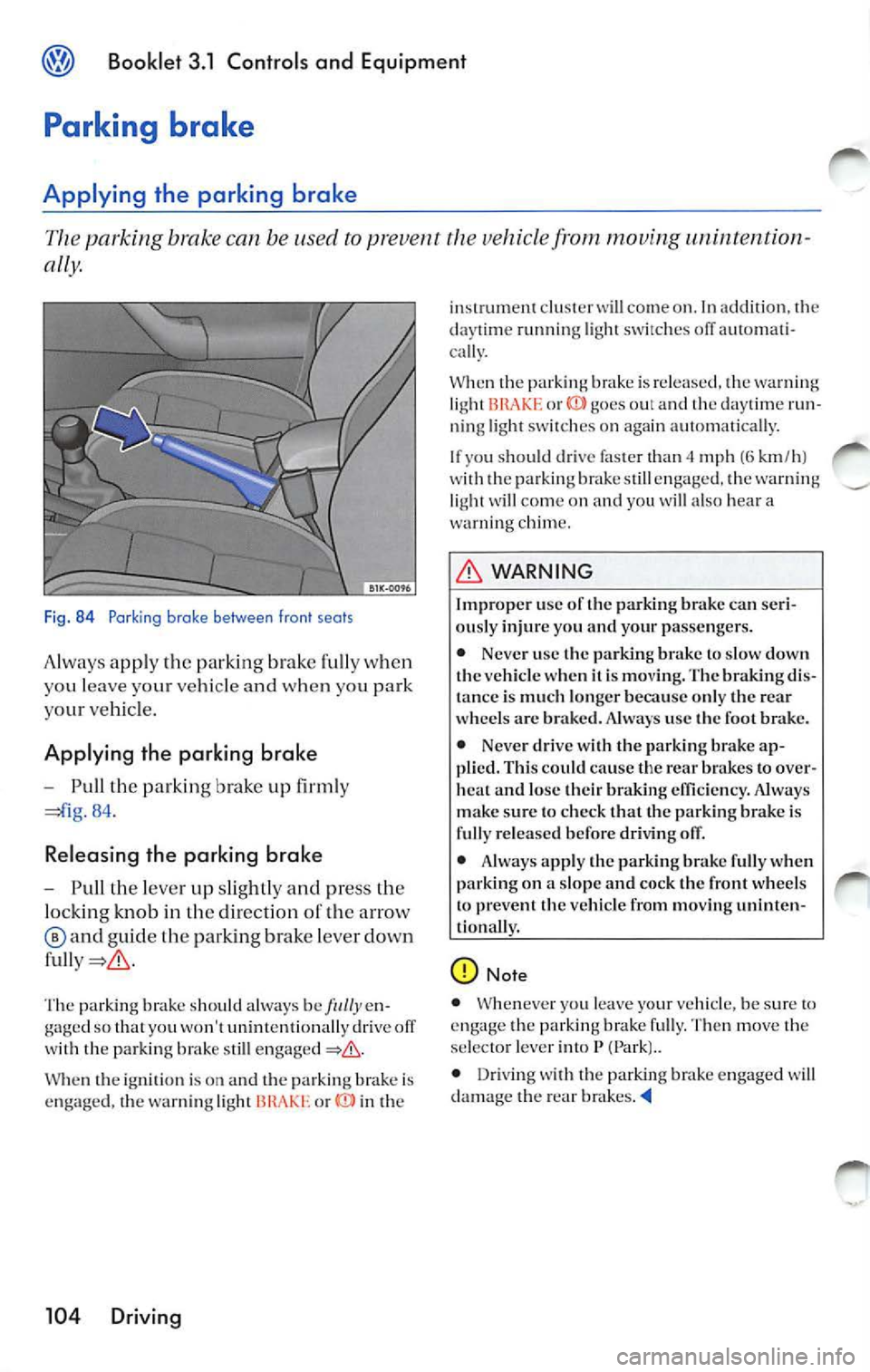
Fig . 84 Parking brake between front seats
Always app ly th e par kin g brak e fu lly w hen
you le ave your ve hicle w hen yo u pa rk
yo ur ve hicle.
Applying the parking brake
- Pull the parking brak e up firm ly
84 .
Rele a sing th e parking bra ke
-Pull the leve r up slig htly and pre ss the
lo cki ng kn ob in the dir ec tion of the arrow
a nd guide th e park ing brak e leve r down
T he park ing bra ke sh ou ld always be /111/ yen
gage d so that you won' t u ni nt enti ona lly dr ive off
wit h th e pa rk in g brake sti ll
W hen th e ignition is on t h e parking brake is
e n gaged, th e wa rnin g ligh t or in th e
104 Driving
instrum ent clust er w ill co me o n. In addit ion. the
daytime running light swi tch es olT a utomati
ca lly.
When the park ing brake is re leased, th e wa rning
li g h t
or goes o ut and the da ytim e run
ning ligh t sw itch es on again automatica lly.
If yo u shou ld dr ive faste r than 4 mph (6 k m/h )
w ith th e parkin g brak e still engaged, th e wa rning
lig ht will co me on
you w ill also hea r a
wa rnin g chim e.
WARNING
Imprope r use of the parki ng brak e ca n se ri
ou sly in jur e yo u and yo ur passe ngers.
• Never use th e parki ng brake to slow down
t h e veh icle when it is mov ing. T he braking dis
tanc e is mu ch l on ge r because on ly th e rea r
whee ls arc brak ed . A lways use the foo t brak e.
• Neve r drive with th e parki ng bra ke ap
pl ied. This cou ld cause t he rear brakes to o ver
h eat and l ose their b raking e fficie ncy . A lways
m ake sure to ch eck th at the parki ng bra ke is
f ull y re lea sed befo re dri ving olT.
• Alwa ys app ly th e par king brake f ully w hen
p arki ng o n a s lope and coc k the fron t w hee ls
to prevent t he ve hicle fro m movin g unin ten
ti onall y.
N ote
• Wheneve r yo u lea ve you r ve hicle, be sur e to
e ngage th e park in g b rake full y. Th en m ove the
lever int o P (Park ) ..
• Drivi ng wi th the parking brak e engaged will
damage the rear
Page 313 of 477
Booklet 3.1 Controls and Equipment
Conve nien ce open ing 41
Conven ie n ce operatio n (elec tric
w ind ows) 18
Coo lant
li ght 11
Coo lant leve l
Warn ing 24
Coo lant te mperature
Gauge 6
Warn ing 24
Coo ling the glo ve
69
C ru ise co111rol 107
Wa rnin g light 29
Cup ho ld ers
I n the rear armrest 72
C up holder s in the center co nso le 72
C urrent f uel cons umption 9
D
Day time runnin g lights
Warning lig ht 30
Daytime dri vin g ligh ts 46
Di gita l c loc k 5
Di sp lay 7, 12
D is plays
One-co lo r display 12
Distance trave lled 9
Door re lease hand le 3
Door s
Wa rnin g lig ht 26
Drain the bauery 52
Driving time 9
Driving
an automatic transmi ssion 99
Dust
88
E
See Electron ic D iffe rentia l Lock
EDS
Wa rnin g light 27
E lec tric seal a djustment
See Seat adj ustme nt
Ele ctrical accessories 73
Elec tro-mechanica l power steering syste m
Warning light 29
110 Alphabetical index
Electron ic Diffe re nti al Lock
Wa rnin g lig ht 27
Electronic immobilize r 94
Wa rnin g light 23
Electro nic parking assistance 106
E lectro nic Power Control (EPC)
light 23
E lec tron ic Stabi liza tion Program 28, 91
Wa rnin g lig ht 28
Emergency
48
E m erge ncy wa rning lights
light 24
Engi ne fault
Warning light 23
E ngin e hood
Warning light 26
E ngin e malfun ction
Warn in g light 23
E ngine mana gement
Warn ing lig ht 23
E ngine oil pr essure
Wa rnin g light 11 , 25
Environmental inform ation
Fuel economy 6
Environmental tip
Fue l economy 77
ESP 91
See E lectronic Stabil ization Program
Exhau st warning light
Warning lig ht 22
F
Firs t- aid kit 74
Fog lig ht s 46
Foo t brak e
Wa rning lig ht 30
cen te r a rmr est 70
Fron t passenger
backre st
Folding forward 6 1
F ront seats 60
E le ctri ca l adj ustab le 62
Manua l ad justab le 60
Fuel filler cap Wa rnin g light 29
Fue l g auge
Di splay 7
Fuel level 7
Page 316 of 477
Set up menu 1 6
Se tting the cl ock 16
Me nu 1 6
Sho ppin g bag hook 78
Socket 73 Speed wa rning 9
S tar tin g th e di ese l e ngine
W ith the ig nition key 96
Sta rtin g th e gaso lin e e ngine
W ith the ig niti on key 95
S tee rin g 90
Stee ring lock 93
S teer ing w hee l h eig h t adju stme nt 90
S toppin g th e eng in e 97
S to rag e ar ea
Oth er storage areas 7 1
Roof 71
co mpartm ent 69
Front cen te r a rm res t 70
R ear a rmr est 70
S to rage fo r th e ve hicl e lite ral ure 69
Sto rin g seat positi ons 64
Su n sha de 79
Su n viso r 52
S unr oof 4 2
S un shade
powe r roof 42
S wit ch lig h ting 3
Sw itches
E mer gency
48
Li ght sw i tch cs 46
Powe r outsid e mir rors 56
Power roof 42
Po we r w ind ows 39
Sw itchi ng off the e ngine
W it h th e ig niti on key 97
T
Ta cho mete r 6
Ta nk
F uel g au ge 7
T ic -cl ow n hook s 78
Bookl et 3.1 Control s and Equipment
Ti re press ure m on itorin g sys tem
Wa rnin g lig ht 30
Trail er tu rn sig nal s
Wa rnin g light 49
Tran sp o rtin g lo ng ite m s 61, 68
Trunk l id 37
Turn sig n al and high bea m leve r 49
T urn sig n als 49
Warnin g lig ht 24, 49
u
U np leasa nt odo r 89
V
Veh. sta tu s 15
Ve hicle e lec tric syste m 24
Ve hicl e stat us 15
w
Wa rnin g lig ht
E lec troni c Power Con trol (E PC) 23
Warn ing ligh ts 20
E m erge ncy fla sh er 48
Turn sig nals 49
Warn ing tex ts in th e disp lay ll
Wa rnin g tri angle 74
W hen parkin g on slo pes 105
W hen should I ref uel th e ta nk of th e
ve hic le ? 7
W indows 39, 40
Wind shi eld was her fl uid
Warn in g light 26
w in dsh ie ld wash er flui d
Warning message 11
Wind shi eld wip er an d was her sys tem 53
Wind shi eld wip ers 53
R ain se n so r
Service pos iti on 53
W int er ope ration 54, 55
W int er tire s
Speed wa rning 16
Alphabetical ind ex 113
Page 321 of 477
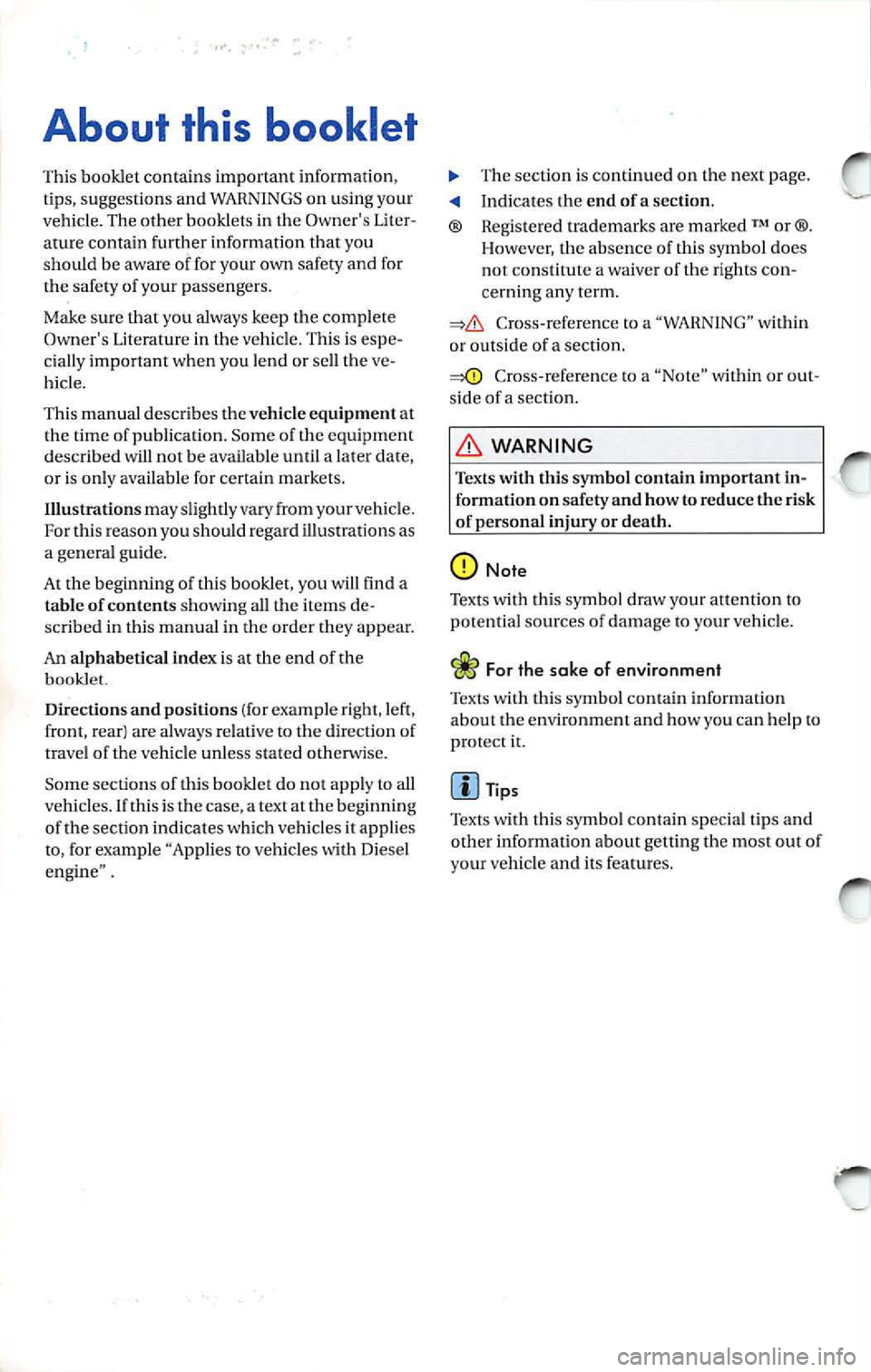
About this booklet
This booklet contains important information,
tip s, s uggest ions and WARN INGS on usin g yo ur
veh icle. The other booklets in the Owner's Liter
ature contain further information tha t you
sho uld be aware of for yo ur own safety and for
the sa fety of yo ur pa ssenge rs.
Make sure that you always keep the comp lete
Owner's Literature in the vehi cle. Th is is es pe
cia lly import ant whe n you lend or sell th e ve
hicl e.
Thi s manual describes the vehicle equipm ent at
th e time of publicatio n. Some of the equipmen t
d escribed w ill not be availab le until a late r date,
or is only available for certain markets.
Illustrations may slightly vary fro m you r veh icle.
Fo r tl1is reaso n yo u sh ou ld regard illus tratio ns as
a general g uide.
A t th e beginning of this booklet, you
find a
table of contents sho wing all the item s de
scr ibed in this manua l in the order they appear .
An alphabetica l ind ex is a t the end of the
booklet.
Dire ction s and positions (for example right, left,
front, rear ) are a lways re lat ive to the direction o f
travel of the vehicle unless sta ted otherwise.
Some sections of this book let do not app ly to a ll
ve hicl es. If this is the case, a text at the beginning
section indicates w hic h veh icles it appli es
to , for examp le "App lies to veh icles wit h Diese l
engi ne" .
The section i s con tinued on t he nex t page.
In dicates the end of a section.
® Registered trademarks are marked
or®·
However, the absence of this sym bol does
not const itute a wa iver of th e rights con
ce rnin g any te rm.
Cross-reference to a "WA RN ING" within
o r outside of a sect ion.
WARNING
Texts symbo l co ntain imp ortant in
formation on safety and how to reduce risk
of personal injury or d eath.
Note
T exts
sym bol dr aw your attention to potential sources of damage to your vehicle .
For th e sake of environment
Texts w ith this symbo l contain infor mation
a bo ut the environment and how you can he lp
to protect it.
Tips
Texts with thi s symbol contai n spec ia l tips and
othe r information abou t gett ing the most out of
your veh icle and its features.
Page 329 of 477
Booklet 3.2 Tips and Advice
Braking power and braking distance
Braking power and braking distance are influenced by driving situations and
road
Worn brake pads will not provide good braking.
The amount of wear and tear on the brake pads
depends to a great extent on the cond itions
und er which the vehicle is opera ted and the way
the vehicle is dr iven. If you do a lot of city
driv ing, drive short distances or have a sporty
driving style, we reco mm end th at you have the
thickness of your brake pad s checked by an au
thor ized Volkswagen dea ler more frequently
than r ecommend ed in the service schedule.
I f you dr ive witJ1 wet brakes , for example after a
dri ving through water,
heavy rainfall or
after washing the vehicle, brakin g power will be
reduced and sto pping distances w ill be longer
because the brake d iscs will be wet or in winter
ma ybe even frozen
the brakes must be dried
with severa l ca reful brake applications.
Brake fluid absorbs water and must be c hanged
every two years. Heavy use of the brakes can
cause vapor lock if the brake fl uid is too old.
Va por lock reduces braking power, increases
stopp ing distances and can even cause total
brake failure.
WARNING
• New tires and new brake pads do not pro
v id e maximum grip, control or braking abilit y.
• To reduce the risk of losing control, a colli
s ion and se rious persona l injuries, drive with
special ca re for the first
350 mil es (560 km).
• New brake pads do not have the best stop
ping power for the first
150 mil es (240 km) and
must be broken in. You can com pensate for
the slightly reduced braking ability by drivin g
w ith care and applying more pressure on the
brak e pedal.
• Never fo llow other vehicle s too close ly or
put yourse lf into other situ ations that might
r equ ire s udden , hard brakin g especially when
th e brake pads have not been broken in.
WARNING
Wet brake s or brak es coa ted ice or road
sa lt react slower and need longer stopping dis
tanc es.
• Carefully apply brakes for a lest.
• Alwa ys dry brake s and clean olT ice coa t
ings and salt coa tings with a few cautiou s
brake app lica tions.
• Always read and hee d all
in "Break ing in tir es and brake pads" on
page 7.
WARNING
Overheated brakes will reduce the vehicle's
s topping power and increase stoppin g di s
tances.
• Always avoid over hea tin g the brakes!
• When driving downhill, the brakes have to
work hard and hea t up quickly .
• Before driving clown a long, steep hill, al
ways red uce spee d and downshift to a lower
gea r. This will let th e ve hicle use engine
braking and reduce the load on the brakes.
• Always c han ge the brake fluid at least
every two years. Hard braking with old brake
fluid may cause a va por lock. Vapor lock re
duces brakin g power, increases s topping dis
tan ces and can even ca use to tal brake failure.
• A damaged front spoiler or new non stan
dard spoile r ca n reduce the airflo w to the
brake s and cause them to overheat.
• Always sec an au thorized Vo lkswage n
dealer or qualil1ed workshop if yo u think th at
you may have damaged the front spoiler.
• Be sure to read and heed all WARNINGS
and the information =-page 27, "Accessories
and part s" before buying accessorie s.
8 Driving and protecting the environment
Page 330 of 477
Operate your vehicle safely
For drivin g safely, alwa ys follow t he speci fied
maint enance interva ls in your maint enan ce
bo okle t =boo klet
I.I "M aint en an ce" -es peci ally
fo r chan ging brake fluid. H ard use , pri marily
s top and go dr iv in g, o perat io n in very dusty
areas, t ra ile r towi ng as we ll as other con dition s
m ay make
neces sary maint enance
im erva ls -see your authorize d Vo lksw agen
d ea ler.
Your vehicle 's condition is dir ect ly relot ed to
driving safety
Th erefo re, always be sur e
ob serve fol
l ow ing points before yo u dr ive off:
• Check l ig ht s an d turn sig nals.
• Check f uel l eve l.
• Make sure
a ll ligh ts a nd all wi ndows are
clea n.
• Adjust
mirr ors .
• Make s ure
air intak e slo ts betwee n en gin e hood a nd wind shi eld are free of
l eaves, sn ow a nd ice.
• Check warning a nd indicato r light s when
s tarli ng the en g in e.
Your personal d riving style and attitude have a
lot to do with safety ..
T here fore , for you r ow n sa fe ty:
• Wear your safety bells a nd wear
pro p
er ly , ev en if you ar e just driv in g in city o r lo
th e co rner =book le t 2 .1 "Sa fe ty first",
c h apt er "Safet y
• Make sur e th at all passe ngers wear their
sa fe ty belt s proper ly. even those in rea r 2.1 "Sa fe ty chapter "Safety
belt s." Pa sse ngers wea ring en
danger not onl y th em selves in cra sh, but al so dri ver and oth er passengers .
• Make su re th at children a lwa ys
on rear
sea t prop erl y res tra in ed by a res traint system a p
propri ate for th eir size and age.
• Never tra nsp ort a child in a rear
c hild
or infant seat on the front passe nger seat
= bo oklet 2.1 "Safety
• Adju st yo ur sea t so that yo u ca n eas ily reac h
a ll co ntrol s whil e yo u are as from
Booklet 3.2 Tips and Advice
airb ag as pos sible but close r th an 10 inches
(25 cm ) = book let 2. 1 an d 3.1.
• The sea ting positi on is ve ry important for the
a irb ag perfo rm ance
2.l "S afety first",
cha pter "Air bag syste m.''
• Always a djust th e hea d res traints to
cor
r ec t h eig ht . For maximum pro tec tion , ad just the
h ead res trai nt so that the upp er edge is as eve n
w ith the top of yo ur hea d as possi ble,
no
l owe r than eye le v el a nd so that is as close to
th e ba ck of your head as possib le = bo okle t 2. 1
"Safe ty
• Alw ays make s ure that the mov ement of peda ls is no t res tri cte d in an y way 3. 1,
c h ap te r " Peda ls ."
• Store luggage an d light it em s prop erl y in
luggage compartme nt and on roo f
=book let 3. 1, c hap ter" Luggage compa rtment "
an d
3.1, cha pter rack."
If you drink, do not drive !
T he use of a lco hol, dru gs a nd certain medi ca
ti ons w ill seriously impa ir percept io n , reac tions
a nd dri vin g a bility ,
increa sin g th e
ri sk of an acci dent, cras h an d pe rso nal injury.
Do not drive if you are tired.
Make frequ ent rest stops , at le ast aft er every two
hours of dri ving.
Al ways adapt vehicle speed to traffic, road and
weather conditions.
H em ember , th at
o n sm ooth, slipp ery
roa ds, ve hicle han dling and br aking dep end a
d ea l on tire ad hes ion. On wet roa ds, the
front whee ls c an h ydrop lane, especi ally at
h ig her sp ee ds. If thi s hap pe ns, yo u will then no
l o nge r b e ab le to ste er or brak e prop erl y.
WARNING
• Alw ays observe the po sted spe ed Ii mils and
common sense. Your good judgment can
mean
diff ere n ce between arr iving safely at
your destination and being ser iously injur ed
in
crash or other kind of accide nt.
• Alway s rea d and hee d all WARNI NGS and
a dditi on al inform ation rega rding safety
= bookl et 2.1 "Safe ty
Driving and protecting the environment 9
Page 331 of 477
Booklet 3.2 Tips and Advice
Applies to veh icles: with o gaso line engi ne
Catalytic converter
Help the catalytic converter do its job
for a long time :
-Alwa ys use unl eaded gasol ine.
- Never
the ta nk complet ely empty .
- Do not put in too much en gin e oil
40, "Adding engine oil
-Never tow the ve hicle to start it, use
jump er cab les if n ecess ary
85.
If yo u notic e mi sfiring, uneve n runn ing or loss of
power w hen th e vehicl e is m ov ing , s low down
immediate ly and h ave the vehicl e in sp ec te d by
th e nea res t a uth oriz ed Volk swagen deal er or
qu alifi ed wo rksh op. These co nditions w ill u su
a ll y be in dic ated b y an ind icator light
3. 1, chapt er "Warning light s." If thi s
happ ens, raw f uel ca n ge t int o th e ex hau st
sys te m , d am age t he ca ta ly ti c co nverte r and es
ca pe int o th e atmosp here .
WARNING
A ca ta ly tic conver te r get s very hot and can
cau se lir e ca usin g se riou s personal injury.
• Neve r park where th e cata lytic converter
co uld come into conta ct with dry grass o r any
other flammabl e materials under the vehicl e.
Trailer towing
Technical requirements
Yo ur Volk sw agen was desig ned primaril y for
pas seng er tr an spor ta ti on. If yo u plan to
trai ler , plea se re m emb er th at yo ur ve hicle w ill be
p erformin g a serv ice for whi ch it w as not prim a
ril y in ten ded. The addit io na l lo ad will affec t du
r ability, hand lin g, econ omy and p erfor mance.
Tra iler to wing not only pl aces more s tress on the
ve hicle, it a lso calls for mor e co nce ntrati on from
t h e dr ive r.
WARNING (continued)
• Never appl y additional under coating or
ru st proofin g on or near the ex haus t manifold ,
exhaust pipes, ca ta ly tic conver te r or hea t
s hi elds.
39 , fig . 5 d o not sta rt the e ngi ne thi s co uld dama ge
the catalyt ic c onverter and the e ngin e! See an
a uthori zed Vo lkswage n dea le r or a qualifi ed
works hop.
• To avoi d dama ge to th e ca talyti c conve rter al
ways rea d and hee d th e in formation on
=:page 32, "Fu el suppl y".
For the sake of environment
Even when th e e missio n co ntro l syste m is
worki ng perf ec tly, yo u may so metim es s mell
s ulfur from th e ex hau st d ep endin g on th e
a m ount of sulf ur in th e fu el you arc usi ng. T he
s m ell ca n usua lly be so lved by ch angin g to an
ot her brand of ga solin e. T railer
For th ese reason s, a lwa ys fo llow the o pera tin g
an d dri vi ng in stru ction s given a nd use comm on
se nse.
T railer hitch
U se a we ig ht -carry ing hitch co n fo rm ing
trail er hit ch re movab le
ball mount. ch eck with th e traile r hit ch
10 Driving and protecting the environment
Page 332 of 477
manufactur er to make sur e th at yo u are using
t h e co rrec t hit ch
Do not use a bumper hitch.
Th e hit ch mu st be install ed so . that it does no t
int erf ere w ith th e impac t-a bso rbin g bu mpe r
sys tem . Do no t mak e any c han ges to th e ve hicl e
ex hau st and brak e sys te m s. Fro m t im e to tim e,
c h ec k tha t all hit ch -mo unting
rema in se
c ur ely fas tened .
W hen yo u are not t ow in g a tra iler, re m ove the
t ra ile r hi tch ball m oun t. T his pr eve nts th e h itch
fr om causing dam age sh ou ld yo ur vehicl e be
s tru ck fr om b eh ind .
Engin e coo ling syste m
Tow ing a trai ler makes the e ngin e wo rk It is im portant th at th e engin e coo ling syste m is up to th e job . Make su re that th e coo ling sys te m has
e n ough flu id.
Trailer brokes
If yo ur t railer h as its own brakes, ch eck to be th at it confo rms to a ll regula tion s. The tra iler
b ra ke sys te m must n ever be directly co nn ecte d
to th e ve hicle's brake sys tem.
Sa fety chains
Alw ays use safety chain s betwee n yo ur ve hicle
a n d trail er.
Trai ler lights
Tra ile r lig ht s m ust m eet a ll reg ulati ons
Neve r co nnect th e trail er light sys te m di rectly to
t h e lig ht sy ste m of y our vehicl e. 13 e to c hec k
w ith your auth orize d Vol ksw age n d eale r fo r
rec t w irin g, sw itch es a nd relays .
Mirror s
If yo u canno t see the behind you using th e
r eg ula r outside mirror s, th en you mu st i ns tall
exte nded m irror s. It 's
th at yo u alw ays have
cl ea r vis io n to th e re a r.
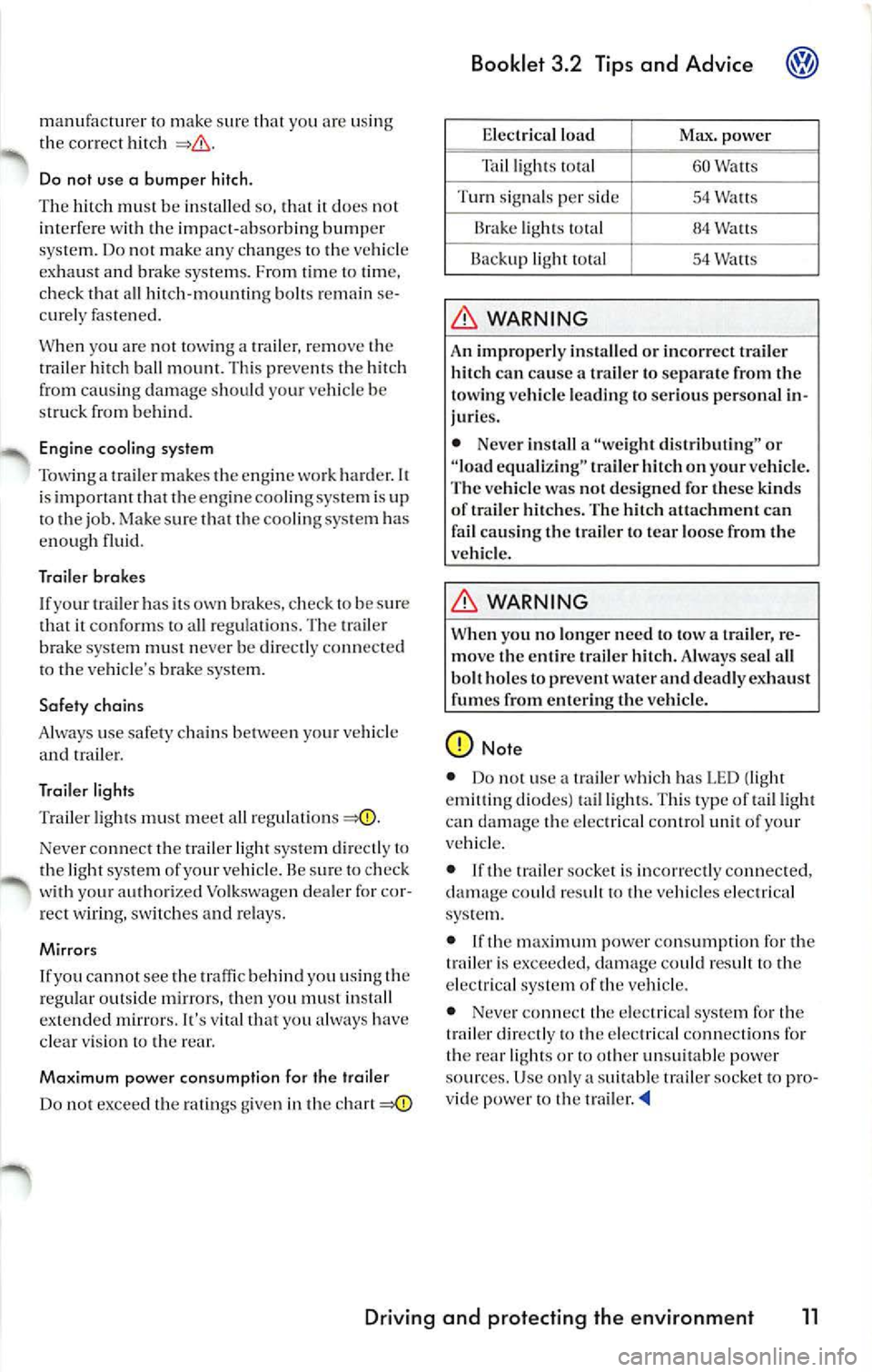
Maximum power consumption for the trailer
Do not excee d the ra tin gs g iven in t he c hart
Booklet 3.2 Tips and Advice ®
Electrical load power
Tail lights to ta l
60 Watt s
T urn sig nals per sid e 54 Wa tts
Br ake light s to ta l 84 Wa tts
Back up ligh t to tal 54 W atts
WARNING
An improperl y in sta lled or in corre ct trailer
hit ch can cau se a tra iler to separate from the
t o win g ve hicle leadin g to ser iou s per son al in
j uri es.
• Never install a "weight distributing" or
" lo ad equa lizin g" trailer hitch on your v ehicle.
T he v ehicle wa s not de signed for these kinds
of trailer hit ch es . Th e hitch attachment ca n
fail ca using the trailer to tear loos e from th e
veh icle.
WARNING
Wh en you no lon ger need to tow a tra iler , re
move the ent ire tra ile r hitc h. Alwa ys s eal a ll
bolt h ole s to pre vent water and dead ly exhaust
fum es from ent ering th e vehicle.
Note
• Do no t use a trailer w hi ch h as LED (lig ht
em ittin g dio des) t ail light s. T hi s ty pe of ta il lig ht
ca n da ma ge t he elec trica l co ntrol un it of yo ur
ve hicl e.
• I f th e tra iler soc ke t i s in co rrec tly co nnecte d ,
d am age could r esult
10 t h e ve hicles elec trica l
sys te m.
• I f th e m ax imum p ower co nsum pti on fo r
trail er is exceede d, dam age c ould r esult to th e
e lec tr ica l sys te m of ve hicl e.
• Neve r co nn ect th e elec trical sys te m fur th e
dir ectly to elec trical co nn ectio ns fo r
th e rea r or to o ther u nsu itab le powe r
so urces . Use only s uit abl e socke t to pro
v id e powe r to th e
Driving an d protecting the environment 11
Page 333 of 477
Booklet 3.2 Tip s and Advice
Operating instructions
Maximum trail er weight
Yo u ca n onl y tow 1y p ic al clas s I o r cla ss 2
I railers
w ith your vehicle.
T he m ax imum gross trailer weigh1 and 1h e
tongue loa d mu sl never exceed 1he s pecifica
tion s liste d in
3.3 "T ec hni cal
Neve r ex cee d 1h e gro ss v ehicle weigh 1, w hich i s
th e we ight of 1 he veh icle. includin g driv er, pa s
se nge rs , lu ggage,
I raile r hi1 ch an d 1ongue wei gh I of t he loa ded trailer.
I n alt itude s abov e
3,000 f1. (1,000 redu ctio n
of 10% of co m bin ed lowing weight (v eh icle plu s
trai le r) fo r the beginn ing of every
3, 000 f1. (1,000 m ) shou ld be obser ved.
Trailer loa d distribution
sur e th e loa d in th e tra il e r is held secu rely in
plac e to gu ard against shif ting, b e ii forward ,
ba ckward or sidew ays. A load that shifl s can
mak e it hard or eve n imp ossib le 10 co n1rol your
ve hicl e, pa rticul arl y in an emergency s ituat ion.
Tongue load
F o r best ve hicl e handling when towing a tra iler,
adju st th e traile r load so
the tongue lo ad i s
at the maximum allow abl e or slightl y lo w er. You
ca n get an approxim ation o f th e tongu e load
wit h a bathroom scale or yo u can m ea sure the
load at a 1 rucking com pany or weig hing stat io n.
Th e to ngue lo ad in cre ases the we ig h t of t he rear
ax le and corres po ndingl y re du ces the oth er l oa d
that your vehicl e ca n
pressure
towing a trailer, inflat e th e tir es o fyourv e
hicle to th e co ld tir e pre ss ure liste d on th e stic ker
on th e op en edg e of the dr ive r's door . Inflat e
tra iler tires to traile r and tire
s p ec ification s.
Light s
Al way s che ck th e head lig ht se 1tin gs wit h th e
tra iler hooked up befo re dri vin g off. A djust a s
n ecessary so
you can see th e road ahead but
n ot b lind oncom ing traffic .
C hec k and make sur e tha t all vehicl e and
light s are wo rki ng properl y-esp ec iall y the light s. S
af ety chains
sur e tr ailer safet y cha ins are properl y co n
n ect ed from t he tra iler to the hi tch on th e ve
h icl e. Leave e nou gh slack in the c hain s 10 turn
co rner s. Whe n yo u in s1a ll safery cha ins, m ake
s ur e th ey will not drag o n the road w hile you are
d ri vin g.
T he chains shuultl
u ntler t he traile r to prevent it from dropping to th e grou nd in cas e
of sepa rat ion from the hitch.
Electronic Stabilizat ion Program (ESP )
A lwa ys leave th e ES P swi1ched on w hen you tow
a trail er. The ES P makes it easi er to stab ilize the
trailer sh ould it start to swerve o r sw ay.
WARNING
A lways adjust your dri ving lo th e road, traffi c
and weather condition s. Do not let the extra
s af ety that ESP/AS R can provid e te mpi you
i nto laking extra risks.
WARNING
Ridin g in a trail er i s da ng erous and may be il
leg al.
• A person who is not properly re str ain ed in
a m ov ing ve hicle ri sk ser iou s perso nal inju ry
a nd even death in a cras h.
• Nev er let anyone rid e in your vehicle
witho ut bein g prop erly restr ain ed.
• Never all ow
pa ssenger lo ride in trailer .
WARNING
Exceeding th e permi ssible weig ht
rat ings and permis sible trail er
we ig ht s ca n result in accident s leadi ng to se
r ious persona l injury.
• Neve r le t th e ac tual Gross Axle Weight
Ratin g at th e front and rear
exceed the
pe rmi ssibl e we ig ht s. Also neve r le t th eir com
b in atio n excee d th e Gross Vehicle Weig ht
Ra ting.
• Alw ays re member that the vehicle' s han
dli ng will be
by the extra load. There-
fo re, adju st yo ur spee d accordin gly .
12 Driving and protecting the environment