engine VOLKSWAGEN JETTA 2013 1B / 6.G Manual PDF
[x] Cancel search | Manufacturer: VOLKSWAGEN, Model Year: 2013, Model line: JETTA, Model: VOLKSWAGEN JETTA 2013 1B / 6.GPages: 339, PDF Size: 4.83 MB
Page 261 of 339

Model Engine Tire size Tire pressure
bar psi kPa
195/65 R 15 2.2 32 220
2.0 l/115 hp (85 kW) 205/55 R 16 2.0 29 200
195/65 R 15 2.0 29 200
2.0 l/140 hp (103 kW)
TDI
225/45 R 17 2.3 33 230
205/55 R 16 2.3 33 230
195/65 R 15 2.3 33 230
The Tire Pressure Monitoring System is configured at the factory with the correct tire inflation
pressure applicable for the vehicle model, engine and factory-installed tires. The tire inflation
pressure is listed on the tire inflation pressure label on the driver door jamb ⇒fig. 140. The tire
inflation pressures for the road tires are listed on this label. The inflation pressure for the compact
spare is as specified on the tire pressure label or on a separate label for the compact spare, if there
is one. In the event of a discrepancy between the above figures and the tire pressures listed on the
tire inflation pressure label, the pressures listed on the label are the ones you should use. The listed
pressure applies to all road tires. The Tire Pressure Monitoring System must be recalibrated using
the SET button whenever you change or adjust the cold tire inflation pressures or remove and
remount or change any wheel or tire on the vehicle, even if the reinstalled or replacement wheels
and tires are identical to those that were removed and even if the tire pressure does not change .
Applicable only in Canada
Tire inflation pressure in cold tires
Page 262 of 339
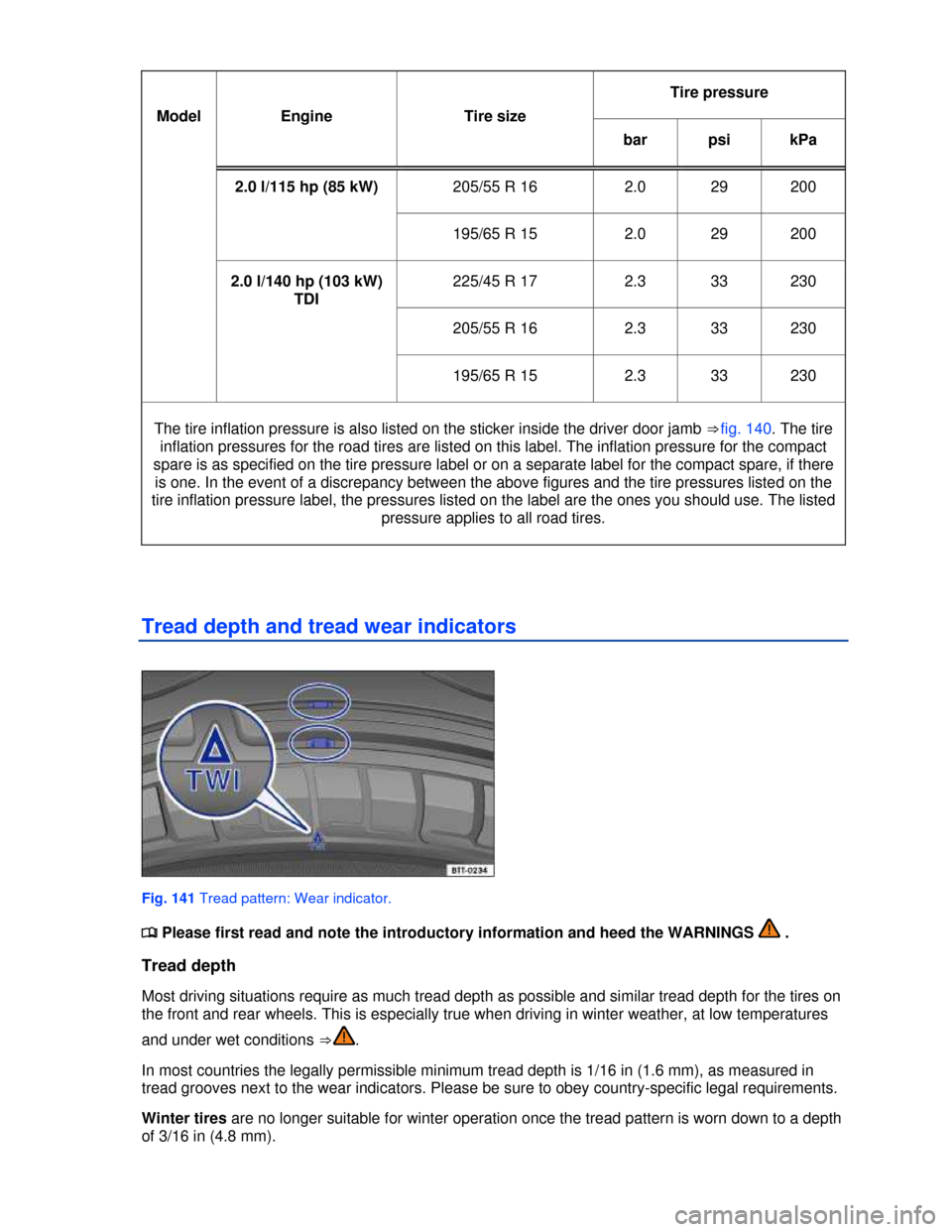
Model Engine Tire size
Tire pressure
bar psi kPa
2.0 l/115 hp (85 kW) 205/55 R 16 2.0 29 200
195/65 R 15 2.0 29 200
2.0 l/140 hp (103 kW)
TDI
225/45 R 17 2.3 33 230
205/55 R 16 2.3 33 230
195/65 R 15 2.3 33 230
The tire inflation pressure is also listed on the sticker inside the driver door jamb ⇒fig. 140. The tire
inflation pressures for the road tires are listed on this label. The inflation pressure for the compact
spare is as specified on the tire pressure label or on a separate label for the compact spare, if there
is one. In the event of a discrepancy between the above figures and the tire pressures listed on the
tire inflation pressure label, the pressures listed on the label are the ones you should use. The listed
pressure applies to all road tires.
Tread depth and tread wear indicators
Fig. 141 Tread pattern: Wear indicator.
Page 271 of 339

Winter tires improve the handling characteristics of your vehicle significantly when driving under wintry
road conditions. Summer tires have less traction on snow and ice because of their design (width,
rubber composition, tread design). Volkswagen strongly recommends that you always have winter
tires or all-season tires installed on all 4 wheels on your vehicle, especially when winter road
conditions are expected. Winter tires also improve the vehicle's braking performance and help reduce
stopping distances during winter weather. Volkswagen recommends installing winter tires once
temperatures are below +45 °F (+7 °C).
Winter tires are no longer suitable for winter driving once the tread pattern is worn down to a depth of
3/16 in (4.8 mm). In addition, winter tire performance decreases with age – independent of the tread
profile depth.
When using winter tires:
x Obey state and country-specific legal requirements.
x Install winter tires on all 4 wheels.
x Use winter tires only under wintry road conditions.
x Only use winter tires with dimensions approved for the vehicle.
x Use only winter tires of the same tire belt design, the same dimensions (tread circumference), and
the same tread design.
x Follow speed restrictions according to the winter tire's speed rating code letter ⇒.
Speed restrictions
Winter tires are certified up to a top speed identified by speed rating code letters on the side wall .
In some vehicle models it is possible to set a speed warning in the menu in the instrument cluster
display
Top speed rating and tire inflation pressure for V winter tires depend on the engine installed in your
vehicle. Be sure to ask you authorized Volkswagen dealer or authorized Volkswagen Service Facility
about the maximum permissible speed and the required tire inflation pressure for the winter tires that
you plan to use.
WARNING
Driving faster than the maximum speed for which the winter tires on your vehicle were
designed can cause sudden tire failure including a blowout and sudden deflation, loss of
control, crashes and serious personal injuries.
x Winter tires have a maximum speed rating that may be lower than your vehicle's maximum
speed.
x Never drive faster than the maximum speed for which the winter tires installed on your
vehicle are rated because tires that are driven faster than their rated speed can fail suddenly.
x Never exceed the maximum load rating for the winter tires installed on your vehicle.
Install summer tires promptly in the spring. Summer tires offer better handling characteristics for
temperatures above +45 °F (+7 °C). They are quieter, do not wear as quickly, and reduce fuel
consumption.
The Tire Pressure Monitoring System must be recalibrated using the SET button whenever you
remove and remount or change any wheel or tire on the vehicle, even if the reinstalled or replacement
Page 282 of 339
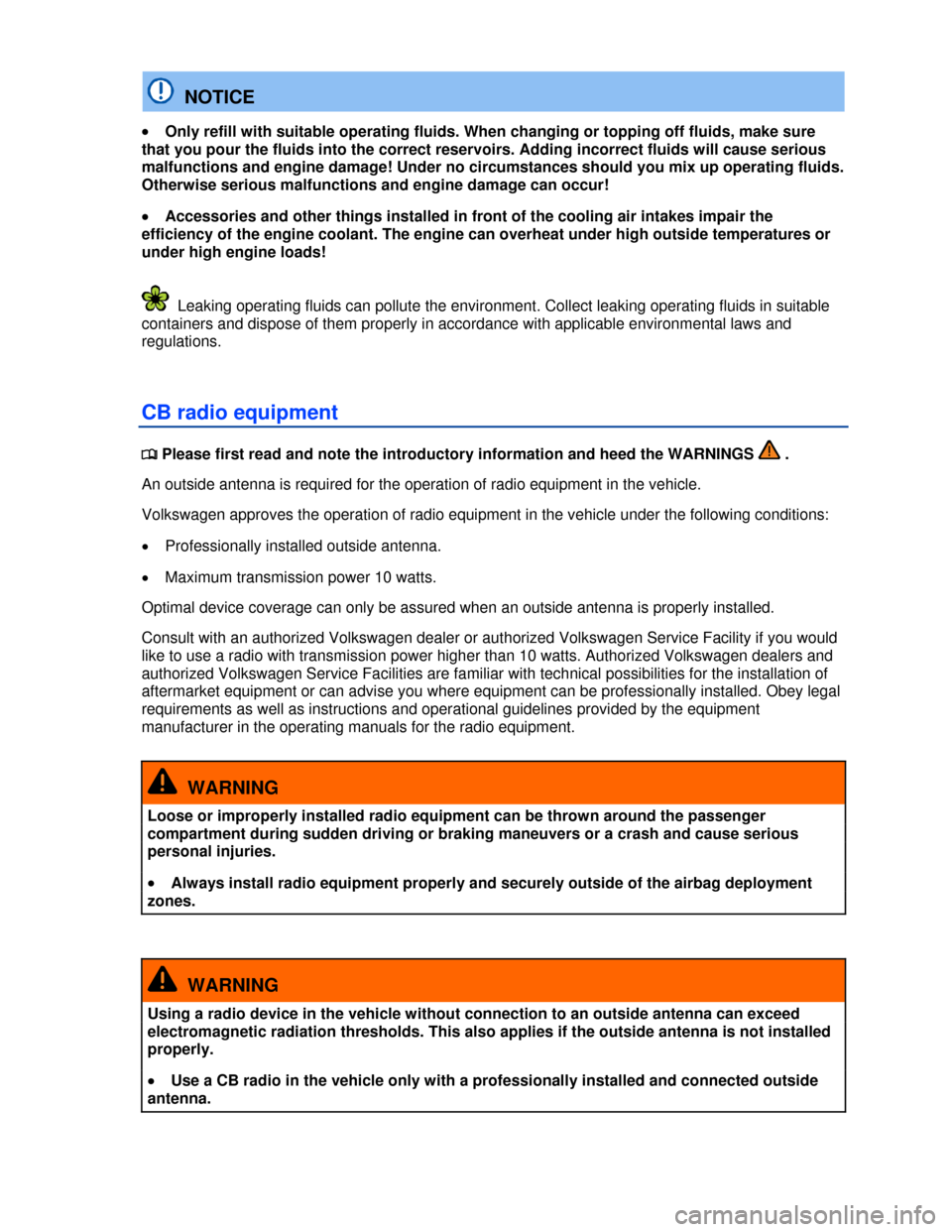
NOTICE
x Only refill with suitable operating fluids. When changing or topping off fluids, make sure
that you pour the fluids into the correct reservoirs. Adding incorrect fluids will cause serious
malfunctions and engine damage! Under no circumstances should you mix up operating fluids.
Otherwise serious malfunctions and engine damage can occur!
x Accessories and other things installed in front of the cooling air intakes impair the
efficiency of the engine coolant. The engine can overheat under high outside temperatures or
under high engine loads!
Leaking operating fluids can pollute the environment. Collect leaking operating fluids in suitable
containers and dispose of them properly in accordance with applicable environmental laws and
regulations.
CB radio equipment
Page 286 of 339
x If vehicle components bearing safety certificates, stickers, or labels are replaced, make certain that
the firm doing the work attaches new conforming certificates, stickers, or labels to the same part of the
new components.
Safety Compliance Certification Label
A safety certificate affixed to the door jamb in the driver door confirms that at time of production all
necessary safety standards and requirements of the traffic safety agency of the respective country
were met. The month and year of production as well as the vehicle identification number may be listed
as well.
Radiator fan and high voltage warning sticker
A warning sticker about the radiator fan and the high voltage of the electrical system is located in the
engine compartment next to the engine hood release. The vehicle ignition system complies with the
Canadian standard ICES-002.
Operating your vehicle outside of the United States and Canada
Page 292 of 339
Engine control and emission control system
Page 293 of 339

Lights
up Possible cause Proper response
%0# Engine control malfunction (Electronic
Power Control).
Have engine checked immediately by an
authorized Volkswagen dealer or authorized
Volkswagen Service Facility.
D Diesel engine pre-glow before engine
start-up. ⇒page 199.
B
Engine control/monitoring system
malfunction (engine Malfunction Indicator
Light - MIL)
Ease off the accelerator. Carefully drive to the
nearest authorized Volkswagen dealer or
authorized Volkswagen Service Facility. Have
engine checked.
Diesel particulate filter clogged with soot.
Drive about 15 minutes in 4th gear (manual
transmission) or in Drive (D) (automatic
transmission) and at a speed of about
45 mph (70 km/h). There may be a noticeable
smell.
Obey speed limits ⇒.
See an authorized Volkswagen dealer or
authorized Volkswagen Service Facility if the
indicator light is still on.
Flashes Possible cause Proper response
D Engine control malfunction (diesel
engine).
Have engine checked immediately by an
authorized Volkswagen dealer or authorized
Volkswagen Service Facility.
B Misfire, which can damage the catalytic
converter.
Ease off the accelerator. Carefully drive to the
nearest authorized Volkswagen dealer or
authorized Volkswagen Service Facility. Have
engine checked.
When the ignition is switched on, several warning and indicator lights come on briefly for a function
check. They go out after a few seconds.
WARNING
Obey all applicable legal requirements when cleaning the diesel particulate filter.
x Clean the diesel particulate filter as recommended only when visibility, weather, road, and
traffic conditions permit.
x Do not put others at risk.
Page 294 of 339
NOTICE
Failure to heed warning lights or text WARNINGS can result in vehicle damage.
As long as the indicator lights ÷, x or EPC are on, expect engine malfunctions, increased fuel
consumption, and loss of engine efficiency.
Catalytic converter
Page 295 of 339

Frequently asked questions
If you suspect a malfunction or vehicle damage, read and follow the following advice before contacting
an authorized Volkswagen dealer or an authorized Volkswagen Service Facility. You may also find
helpful information under “Special considerations” or “Checklist” in the index.
Description Possible causes, among
others Possible remedy
Engine does not start.
Vehicle battery dead. – Perform jump-start .
– Charge vehicle battery .
The wrong vehicle key is used. Use a valid vehicle key
Fuel level too low. Refuel .
Vehicle cannot be locked
or unlocked using vehicle
key.
– Battery in the remote control
vehicle key is dead.
– Too far away from the
vehicle (out of range).
– Buttons have been pressed
too many times.
– Replace the battery in the remote
control vehicle key
– Move closer to vehicle.
– Synchronize vehicle key
– Lock or unlock vehicle manually .
Unusual noises.
Cold engine, braking assist
systems, electronic steering
column lock.
Check the “Noises” entry in the index.
Odd driving behavior.
Assistance systems activated. Check the “Assistance systems” entry
in the index.
DSG® Direct Shift Gearbox too
hot.
Stop vehicle as soon as you can safely
do so.
Front seats cannot be
adjusted with power
controls.
Vehicle battery dead. Charge vehicle battery .
Fuse blown. Check fuse and replace if necessary .
Features do not work as
described in this manual.
Settings were adjusted in the
Volkswagen Information
System.
Check and reset to factory settings if
necessary
Headlights do not light up
the road as they should.
– Headlights incorrectly
adjusted.
– Light bulbs burned out.
– Low beams not switched on.
– Have the headlight range adjusted by
an authorized Volkswagen dealer or an
authorized Volkswagen Service
Facility.
– Change light bulbs .
– Switch on low beams .
Page 296 of 339

Frequently asked questions
If you suspect a malfunction or vehicle damage, read and follow the following advice before contacting
an authorized Volkswagen dealer or an authorized Volkswagen Service Facility. You may also find
helpful information under “Special considerations” or “Checklist” in the index.
Description Possible causes, among
others Possible remedy
Engine does not start.
Vehicle battery dead. – Perform jump-start .
– Charge vehicle battery .
The wrong vehicle key is used. Use a valid vehicle key
Fuel level too low. Refuel .
Vehicle cannot be locked
or unlocked using vehicle
key.
– Battery in the remote control
vehicle key is dead.
– Too far away from the
vehicle (out of range).
– Buttons have been pressed
too many times.
– Replace the battery in the remote
control vehicle key
– Move closer to vehicle.
– Synchronize vehicle key
– Lock or unlock vehicle manually .
Unusual noises.
Cold engine, braking assist
systems, electronic steering
column lock.
Check the “Noises” entry in the index.
Odd driving behavior.
Assistance systems activated. Check the “Assistance systems” entry
in the index.
DSG® Direct Shift Gearbox too
hot.
Stop vehicle as soon as you can safely
do so.
Front seats cannot be
adjusted with power
controls.
Vehicle battery dead. Charge vehicle battery .
Fuse blown. Check fuse and replace if necessary .
Features do not work as
described in this manual.
Settings were adjusted in the
Volkswagen Information
System.
Check and reset to factory settings if
necessary
Headlights do not light up
the road as they should.
– Headlights incorrectly
adjusted.
– Light bulbs burned out.
– Low beams not switched on.
– Have the headlight range adjusted by
an authorized Volkswagen dealer or an
authorized Volkswagen Service
Facility.
– Change light bulbs .
– Switch on low beams .