ESP VOLKSWAGEN JETTA 2016 Workshop Manual
[x] Cancel search | Manufacturer: VOLKSWAGEN, Model Year: 2016, Model line: JETTA, Model: VOLKSWAGEN JETTA 2016Pages: 412, PDF Size: 4.04 MB
Page 245 of 412

speed fluctuations caused by taking your foot off the accelerator. Active braking and accelerating is then not necessarily required.
Calm and smooth driving
Consistency is more important than speed. The more smoothly you drive, the less fuel the vehicle consumes.
When driving on the highway or freeway, a constant, moderate speed is more efficient and economical than constantly accelerating and braking. Usually you can reach your destination just as quickly by driving at a moderate, but steady speed.
The cruise control can assist in maintaining a uniform driving style.
Moderate use of extra electrical loads
Comfort inside the vehicle is nice and important, but it is important to use them in an environmentally conscious manner.
Some devices can increase fuel consumption when activated (examples):
x Climate control system (air conditioner): If the air conditioner has to produce starkly contrasting temperatures, it requires a large amount of energy, which is generated by the engine. The temperature in the vehicle should therefore not be extremely different from that of the outside temperature. It may be helpful to ventilate the vehicle before driving and then to drive a short distance with the windows open. After that, switch on the air conditioner with the windows closed. Keep the windows closed when driving at high speeds. Open windows increase fuel consumption.
x Switch off seat heating once it has served its purpose.
x Switch off the rear window defroster as soon as the windows are free of fog and ice.
Additional factors that increase fuel consumption (examples):
x Malfunctioning engine control.
x Driving in the mountains.
x Towing a trailer.
NOTICE
Never let the vehicle coast or roll down a hill in Neutral (N), especially when the engine is not running. The transmission will not be lubricated and will be damaged.
Page 255 of 412
WARNING
The Rear View Camera system technology cannot overcome the laws of physics and the limits of the system. Careless or unintentional use of the Rear View Camera system may result in accidents and severe injuries.
x Always adjust your speed and driving style to road, traffic, weather, and visibility condi-tions.
x Always keep an eye on the parking direction and the vehicle surroundings. The front of the vehicle swings out more than the rear of the vehicle.
x Never pay so much attention to the graphics shown on the screen that you fail to notice what is going on around you.
x Always watch for people, especially small children, animals, and objects, because the Rear View Camera system may not always be able to detect them.
x The system may not be able to clearly show everything behind the vehicle.
x Use the Rear View Camera system only when the luggage compartment lid is completely closed.
NOTICE
x The Rear View Camera system shows only two-dimensional images on the screen. Due to the lack of depth of field, it may be difficult or impossible to identify protruding objects or recesses in the road, for example.
x Things like thin rods, fences, posts, and trees may not be detected by the Rear View Cam-era system and could damage the vehicle.
Special considerations
Page 265 of 412
WARNING
The Blind Spot Monitor with Rear Traffic Alert technology cannot overcome the laws of phys-ics and limits of the system. Careless or unintentional use of the Blind Spot Monitor and Rear Traffic Alert may result in accidents and serious injuries.
x The Rear Traffic Alert is not a substitute for careful and attentive driving.
x Never use the system when visibility is limited or in confusing traffic situations, for exam-ple, on heavily traveled roads or when there are multiple lanes.
x Always watch for people, especially small children, bicycles, animals, and objects, be-cause the Rear Traffic Alert may not always be able to detect them. Rear Traffic Alert cannot detect people, animals, and things that are moving slowly or not at all.
x The Rear Traffic Alert does not always brake the vehicle to a complete stop.
x The harsh automatic braking will be uncomfortable for many people, and if you or your passengers have special conditions or sensitivities, particularly in the neck, you may want to switch off Rear Traffic Alert.
Using the Blind Spot Monitor with Rear Traffic Alert
Page 267 of 412
WARNING
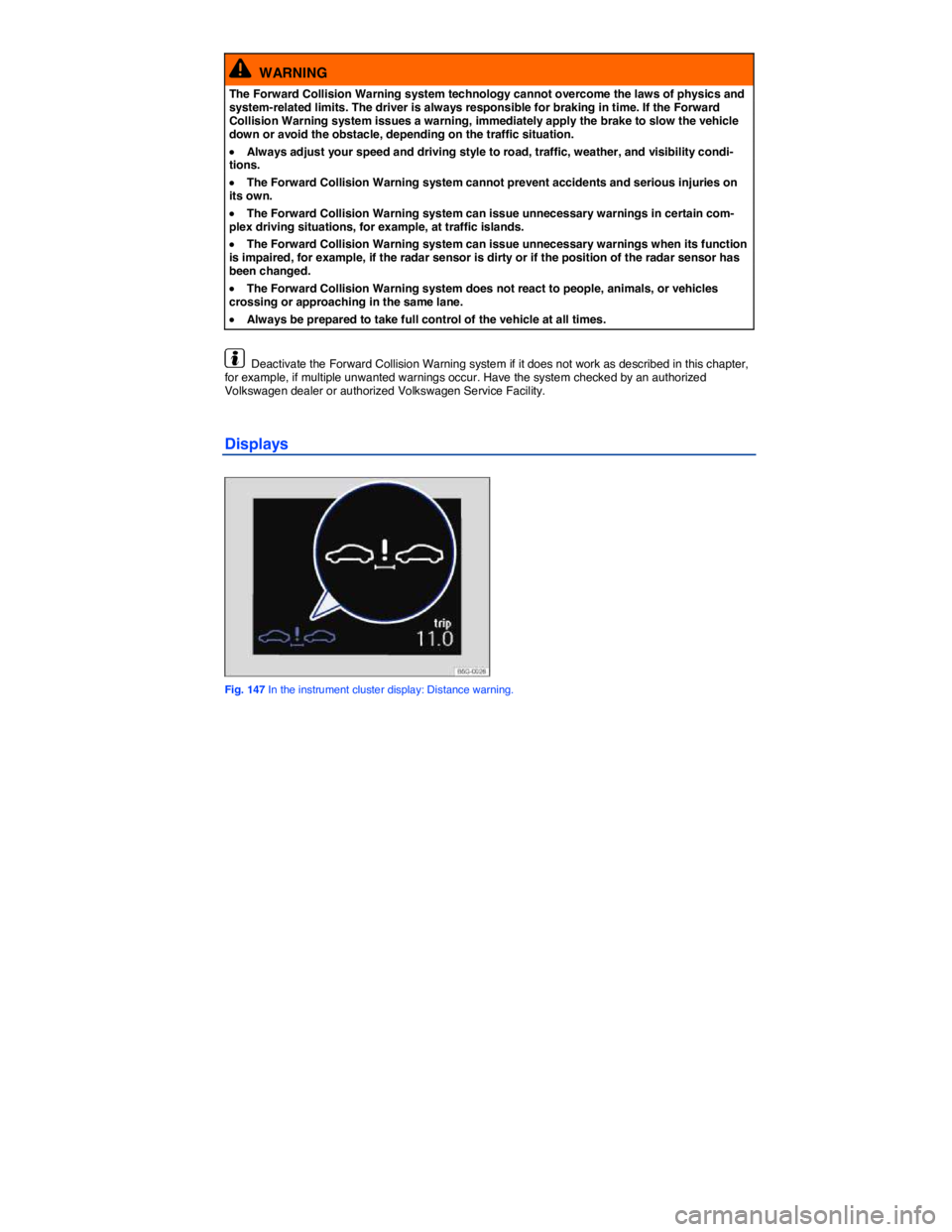
The Forward Collision Warning system technology cannot overcome the laws of physics and system-related limits. The driver is always responsible for braking in time. If the Forward Collision Warning system issues a warning, immediately apply the brake to slow the vehicle down or avoid the obstacle, depending on the traffic situation.
x Always adjust your speed and driving style to road, traffic, weather, and visibility condi-tions.
x The Forward Collision Warning system cannot prevent accidents and serious injuries on its own.
x The Forward Collision Warning system can issue unnecessary warnings in certain com-plex driving situations, for example, at traffic islands.
x The Forward Collision Warning system can issue unnecessary warnings when its function is impaired, for example, if the radar sensor is dirty or if the position of the radar sensor has been changed.
x The Forward Collision Warning system does not react to people, animals, or vehicles crossing or approaching in the same lane.
x Always be prepared to take full control of the vehicle at all times.
Deactivate the Forward Collision Warning system if it does not work as described in this chapter, for example, if multiple unwanted warnings occur. Have the system checked by an authorized Volkswagen dealer or authorized Volkswagen Service Facility.
Displays
Fig. 147 In the instrument cluster display: Distance warning.
Page 283 of 412
WARNING
Even if empty, portable fuel containers can leak and cause a fire and serious personal inju-ries, especially in a crash.
x For your safety, we strongly recommend that you do not travel with a portable fuel con-tainer in your vehicle.
x If, under exceptional circumstances, you must transport a portable fuel container, please observe the following:
– Never fill a portable fuel container while it is anywhere in or on the vehicle (for exam-ple, in the luggage compartment or on top of the luggage compartment lid). Static electric-ity can build up while filling and can ignite fuel vapors, causing a fire.
– Always place a portable fuel container on the ground before filling. Never spill fuel inside the vehicle or luggage compartment. Fuel vapors are highly flammable.
– Always keep the filler nozzle completely inside the portable container before and dur-ing filling.
– If filling a portable container made of metal, the filler nozzle must always be in contact with the container. This will help prevent static electricity from discharging and causing a fire.
– Always observe local and state or provincial laws about the use, storage, and transpor-tation of portable fuel containers.
– Make certain that the portable fuel container meets industry standards, such as AN-SI/ASTM F852-86.
NOTICE
x Remove fuel spills from the vehicle immediately to help prevent damage to the paint, tires, and wheel housings.
x Refueling with gasoline when your vehicle has a diesel engine or refueling with diesel fuel when your vehicle has a gasoline engine can cause very serious and expensive engine and fuel system damage that is not covered by any Volkswagen Limited Warranty.
x If you put any amount of incorrect fuel in the fuel tank, do not start the engine under any circumstances. Immediately contact the nearest authorized Volkswagen dealer or authorized Volkswagen Service Facility for assistance. These fuels contain substances that can severely damage the fuel system and the engine if the engine is started.
x Vehicles with diesel engines must never be refueled or driven with gasoline, kerosene, heating oil, or other non-specified fuels that have not been expressly approved for use with the diesel engine. Other kinds of fuel will cause serious damage to the fuel system and the engine that is not covered by any Volkswagen Limited Warranty.
Fuels can pollute the environment. Spilled fuel must be collected and disposed of properly, following all applicable environmental regulations.
There is no emergency release for the fuel filler flap. Contact an authorized Volkswagen dealer or an authorized Volkswagen Service Facility for assistance.
Page 285 of 412
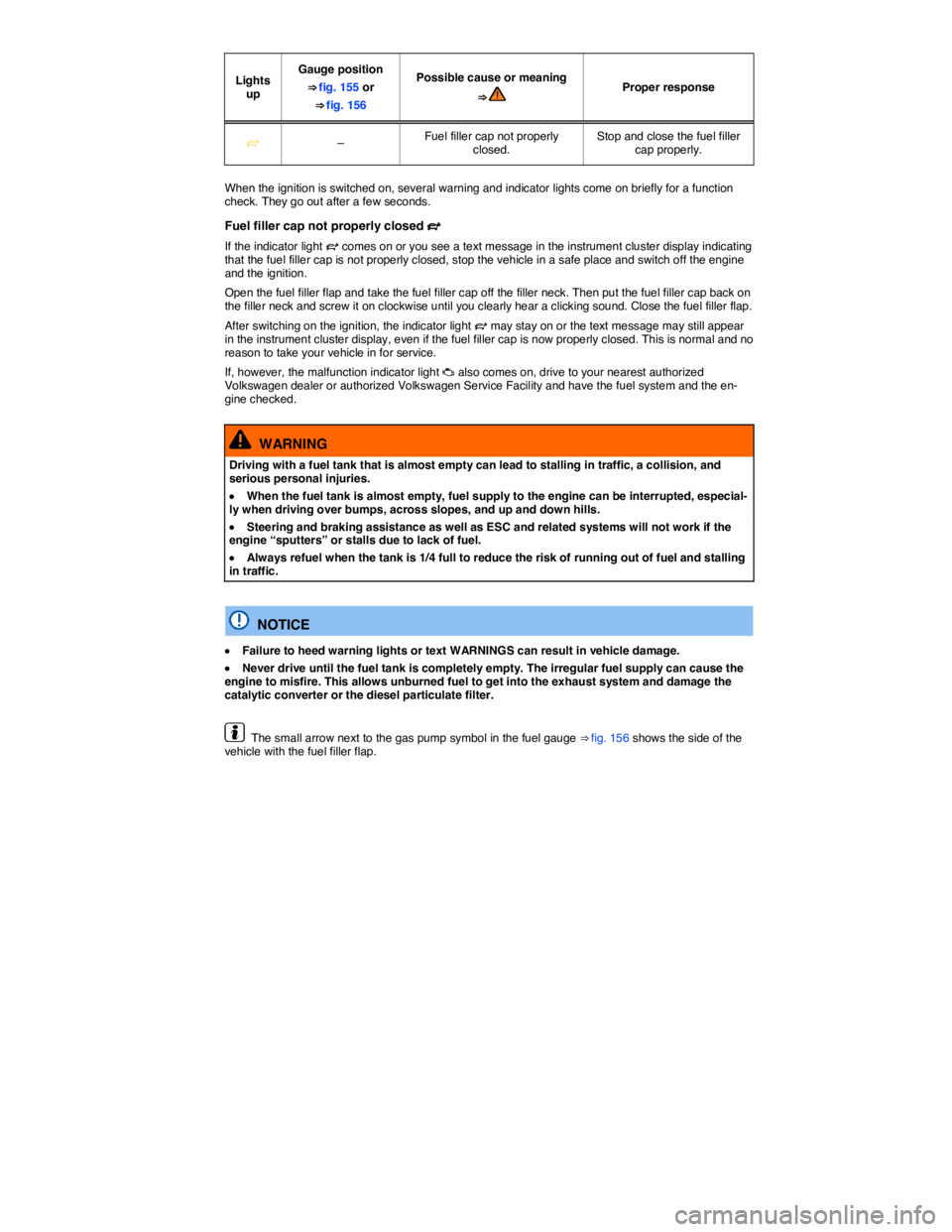
Lights up
Gauge position
⇒ fig. 155 or
⇒ fig. 156
Possible cause or meaning
⇒ Proper response
Page 288 of 412
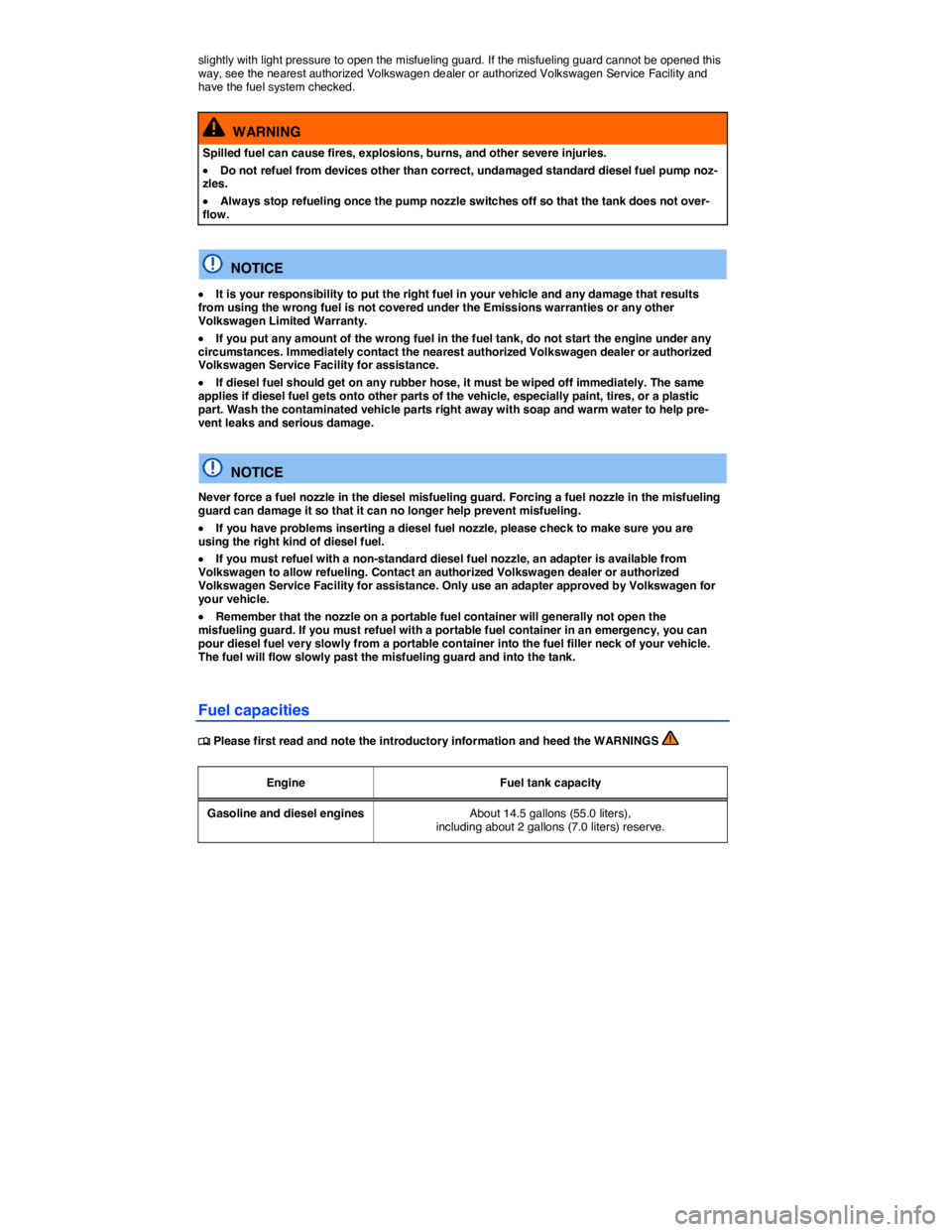
slightly with light pressure to open the misfueling guard. If the misfueling guard cannot be opened this way, see the nearest authorized Volkswagen dealer or authorized Volkswagen Service Facility and have the fuel system checked.
WARNING
Spilled fuel can cause fires, explosions, burns, and other severe injuries.
x Do not refuel from devices other than correct, undamaged standard diesel fuel pump noz-zles.
x Always stop refueling once the pump nozzle switches off so that the tank does not over-flow.
NOTICE
x It is your responsibility to put the right fuel in your vehicle and any damage that results from using the wrong fuel is not covered under the Emissions warranties or any other Volkswagen Limited Warranty.
x If you put any amount of the wrong fuel in the fuel tank, do not start the engine under any circumstances. Immediately contact the nearest authorized Volkswagen dealer or authorized Volkswagen Service Facility for assistance.
x If diesel fuel should get on any rubber hose, it must be wiped off immediately. The same applies if diesel fuel gets onto other parts of the vehicle, especially paint, tires, or a plastic part. Wash the contaminated vehicle parts right away with soap and warm water to help pre-vent leaks and serious damage.
NOTICE
Never force a fuel nozzle in the diesel misfueling guard. Forcing a fuel nozzle in the misfueling guard can damage it so that it can no longer help prevent misfueling.
x If you have problems inserting a diesel fuel nozzle, please check to make sure you are using the right kind of diesel fuel.
x If you must refuel with a non-standard diesel fuel nozzle, an adapter is available from Volkswagen to allow refueling. Contact an authorized Volkswagen dealer or authorized Volkswagen Service Facility for assistance. Only use an adapter approved by Volkswagen for your vehicle.
x Remember that the nozzle on a portable fuel container will generally not open the misfueling guard. If you must refuel with a portable fuel container in an emergency, you can pour diesel fuel very slowly from a portable container into the fuel filler neck of your vehicle. The fuel will flow slowly past the misfueling guard and into the tank.
Fuel capacities
Page 291 of 412
Octane rating
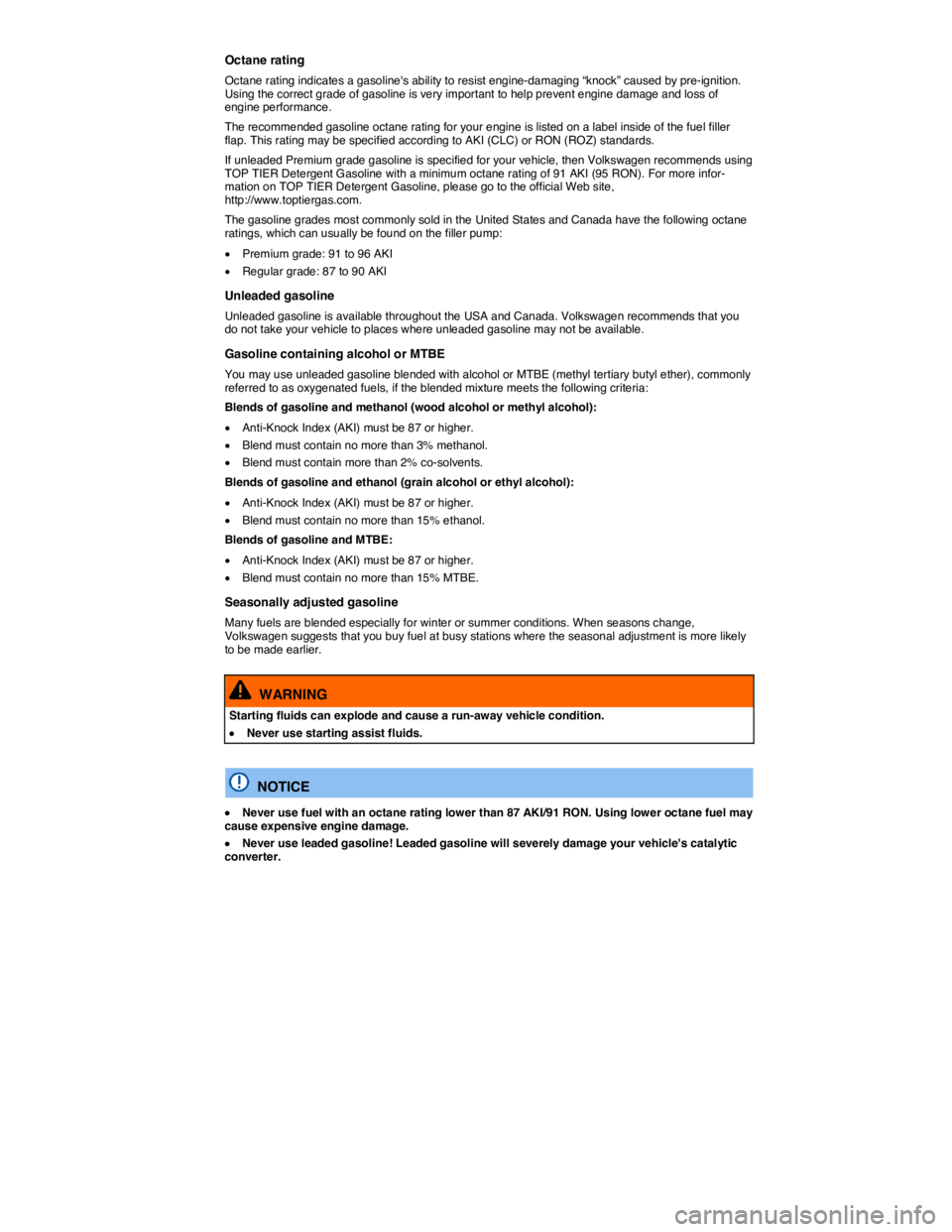
Octane rating indicates a gasoline's ability to resist engine-damaging “knock” caused by pre-ignition. Using the correct grade of gasoline is very important to help prevent engine damage and loss of engine performance.
The recommended gasoline octane rating for your engine is listed on a label inside of the fuel filler flap. This rating may be specified according to AKI (CLC) or RON (ROZ) standards.
If unleaded Premium grade gasoline is specified for your vehicle, then Volkswagen recommends using TOP TIER Detergent Gasoline with a minimum octane rating of 91 AKI (95 RON). For more infor-mation on TOP TIER Detergent Gasoline, please go to the official Web site, http://www.toptiergas.com.
The gasoline grades most commonly sold in the United States and Canada have the following octane ratings, which can usually be found on the filler pump:
x Premium grade: 91 to 96 AKI
x Regular grade: 87 to 90 AKI
Unleaded gasoline
Unleaded gasoline is available throughout the USA and Canada. Volkswagen recommends that you do not take your vehicle to places where unleaded gasoline may not be available.
Gasoline containing alcohol or MTBE
You may use unleaded gasoline blended with alcohol or MTBE (methyl tertiary butyl ether), commonly referred to as oxygenated fuels, if the blended mixture meets the following criteria:
Blends of gasoline and methanol (wood alcohol or methyl alcohol):
x Anti-Knock Index (AKI) must be 87 or higher.
x Blend must contain no more than 3% methanol.
x Blend must contain more than 2% co-solvents.
Blends of gasoline and ethanol (grain alcohol or ethyl alcohol):
x Anti-Knock Index (AKI) must be 87 or higher.
x Blend must contain no more than 15% ethanol.
Blends of gasoline and MTBE:
x Anti-Knock Index (AKI) must be 87 or higher.
x Blend must contain no more than 15% MTBE.
Seasonally adjusted gasoline
Many fuels are blended especially for winter or summer conditions. When seasons change, Volkswagen suggests that you buy fuel at busy stations where the seasonal adjustment is more likely to be made earlier.
WARNING
Starting fluids can explode and cause a run-away vehicle condition.
x Never use starting assist fluids.
NOTICE
x Never use fuel with an octane rating lower than 87 AKI/91 RON. Using lower octane fuel may cause expensive engine damage.
x Never use leaded gasoline! Leaded gasoline will severely damage your vehicle's catalytic converter.
Page 292 of 412
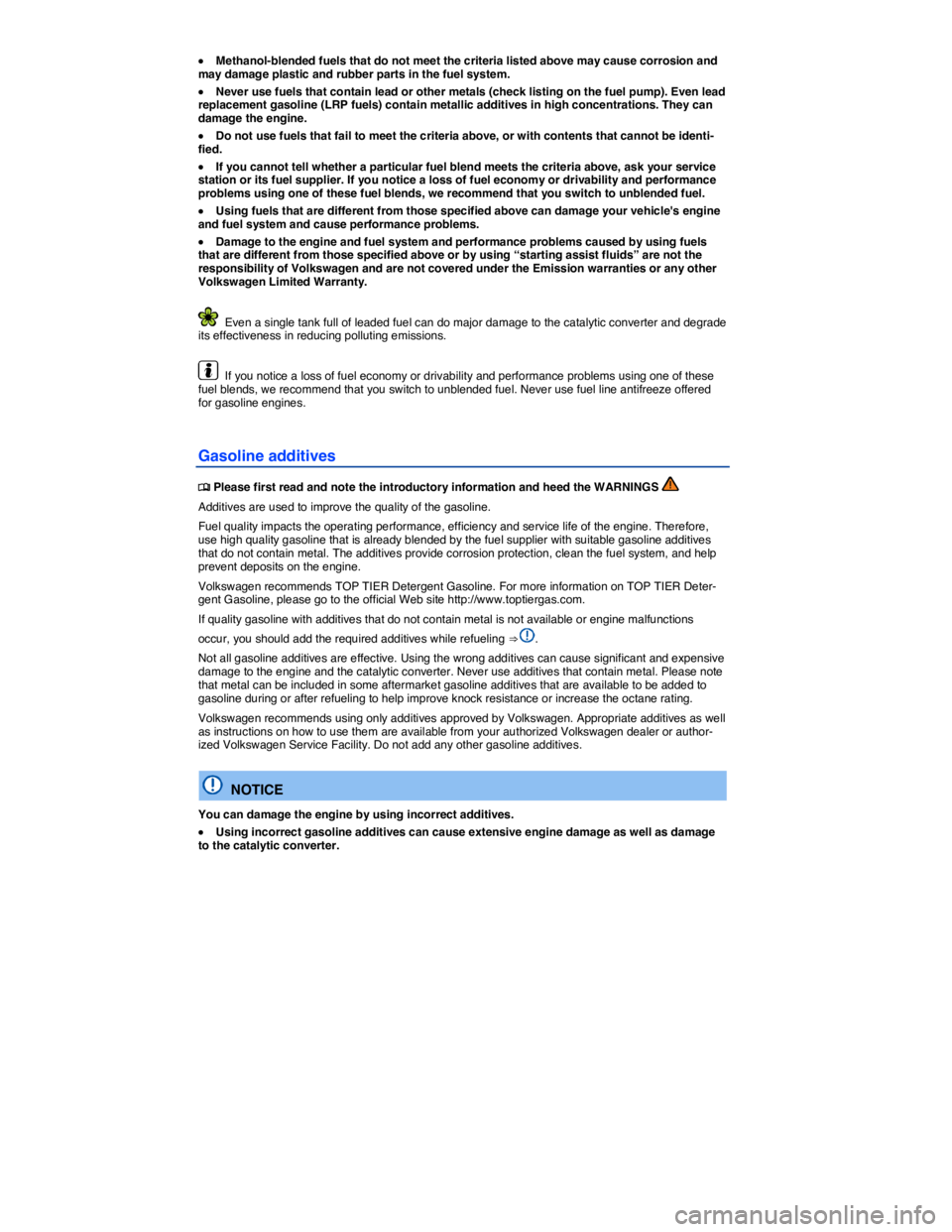
x Methanol-blended fuels that do not meet the criteria listed above may cause corrosion and may damage plastic and rubber parts in the fuel system.
x Never use fuels that contain lead or other metals (check listing on the fuel pump). Even lead replacement gasoline (LRP fuels) contain metallic additives in high concentrations. They can damage the engine.
x Do not use fuels that fail to meet the criteria above, or with contents that cannot be identi-fied.
x If you cannot tell whether a particular fuel blend meets the criteria above, ask your service station or its fuel supplier. If you notice a loss of fuel economy or drivability and performance problems using one of these fuel blends, we recommend that you switch to unblended fuel.
x Using fuels that are different from those specified above can damage your vehicle's engine and fuel system and cause performance problems.
x Damage to the engine and fuel system and performance problems caused by using fuels that are different from those specified above or by using “starting assist fluids” are not the responsibility of Volkswagen and are not covered under the Emission warranties or any other Volkswagen Limited Warranty.
Even a single tank full of leaded fuel can do major damage to the catalytic converter and degrade its effectiveness in reducing polluting emissions.
If you notice a loss of fuel economy or drivability and performance problems using one of these fuel blends, we recommend that you switch to unblended fuel. Never use fuel line antifreeze offered for gasoline engines.
Gasoline additives
Page 294 of 412
Using diesel fuel with concentrations of methyl ester biodiesel higher than 20 % (B20), such as B100 is still contrary to the terms of your Emission warranties or any other Volkswagen Limited Warranty and remains strictly prohibited.
Biodiesel blends (up to B20) may be used in your Illinois registered TDI® Clean Diesel vehicle; howev-er, please be aware that biodiesel has characteristics that are different from other kinds of fuel, espe-cially petroleum-based fuels.
Biodiesel can attract water and also deteriorate with age. Small amounts of biodiesel can get into the engine oil, but unlike petroleum diesel, it does not evaporate over time. This can cause the oil level in the engine to rise and can affect the quality of the oil.
x Routinely check the engine oil level. A good time to do this is when you refuel, especially if you regularly do a lot of short distance or stop-and-go driving. This will help you see if the engine oil level is getting higher. (A rising oil level beyond the maximum indicator means an oil change is needed due
to the dilution of the oil in the system; a potential characteristic of biodiesel use) ⇒ page 306, Engine oil.
x If you ever notice that the engine oil level has risen or is above the maximum indicator, contact your authorized Volkswagen dealer, authorized Volkswagen Service Facility or Volkswagen Customer CARE to schedule an oil change – regardless of the time or mileage that has elapsed since you last had an oil change performed.
x Continue to follow the oil change intervals found in the Warranty and Maintenance booklet that came with your vehicle, and use only engine oil that expressly complies with Volkswagen quality standard VW 507 00.
x Refuel only at trusted, commercial fueling stations that are located near main highways. These stations are more likely to have “fresh” biodiesel fuels that have not aged significantly.
x If your vehicle will be in storage (or not driven) for several weeks or months, please completely fill the fuel tank. If possible, fill the tank with Ultra Low Sulfur Diesel fuel [ASTM D-975 standard Grade No. 2-D (S15)].
If you have additional questions about your Illinois registered TDI® Clean Diesel vehicle, please call or write to us at:
Volkswagen of America, Inc.
Attn: Customer CARE
3800 Hamlin Road, Auburn Hills, MI 48326
Tel.: 1-800-444-8982
WARNING
Starting fluids can explode and cause a run-away vehicle condition.
x Never use starting assist fluids.
NOTICE
x The vehicle's diesel engine was designed solely for use with ULSD fuel. For this reason, never use gasoline, heating oil, or other fuels that have not been expressly approved for use with the diesel engine. These fuels contain substances that will severely damage the fuel sys-tem and the engine. Such damage will not be covered by any Volkswagen Limited Warranty.
x If you put any amount of the incorrect fuel in the fuel tank, do not start the engine under any circumstances. Immediately contact the nearest authorized Volkswagen dealer or authorized Volkswagen Service Facility for assistance.
x If diesel fuel should get on any rubber hose, it must be wiped off immediately. The same applies if diesel fuel gets onto other parts of the vehicle, especially paint, tires, or a plastic part. Wash the contaminated vehicle parts right away with soap and warm water to help pre-vent leaks and serious damage.