lock VOLKSWAGEN JETTA 2016 Workshop Manual
[x] Cancel search | Manufacturer: VOLKSWAGEN, Model Year: 2016, Model line: JETTA, Model: VOLKSWAGEN JETTA 2016Pages: 412, PDF Size: 4.04 MB
Page 328 of 412

Vehicles with push-button start
If the ignition will not start after reconnecting the vehicle battery, lock the vehicle from the outside and
unlock it again ⇒ Power locking system. Then try to start the ignition again. If the ignition cannot be switched on, contact an authorized Volkswagen dealer, an authorized Volkswagen Service Facility, or another qualified workshop for assistance.
Automatic electrical load deactivation
If the vehicle battery drain is high, the intelligent onboard electrical system management automatically takes steps to help prevent battery drain.
x The idle speed is increased so that the alternator provides more power.
x The power to devices that consume a lot of electricity is cut back or switched off completely.
x When the engine is started, the power supply to the 12 Volt sockets is temporarily interrupted.
The onboard electrical system management cannot always keep the battery from being drained. For example, the battery will drain if the engine is not running, but the ignition is switched on or the parking lights are left on for a long time when parked.
What drains the vehicle battery?
x Long periods when the engine is not running, especially when the ignition is on.
x Using electrical systems or devices when the engine is switched off.
x Leaving the vehicle unlocked for several days when not in use.
x The selector lever is left for a long period of time in any position other than Park (P) when the
ignition is switched off ⇒ Automatic transmission: Selector lever.
WARNING
Failure to use the proper battery with proper mounting and connections may cause short circuits, fires, and serious personal injuries.
x Always use only maintenance-free or cycle-free, leak-proof batteries with the same speci-fications and dimensions as the original equipment battery. Specifications are listed on the battery housing.
WARNING
When the vehicle battery is charged, it produces highly explosive hydrogen gas.
x Charge vehicle batteries only in well-ventilated areas.
x Never charge a frozen or thawed battery. A dead battery can freeze at temperatures around +32 °F (0 °C).
x You must replace the vehicle battery if it was frozen.
x Incorrectly connected cables can cause a short-circuit. First connect the positive cable (+) and then the negative cable (-).
NOTICE
x Never disconnect the vehicle battery or connect 2 vehicle batteries to each other when the ignition is switched on or the engine is running. Doing this may damage the electrical system or electronic components.
x Never use a vehicle battery that does not meet the specifications for the vehicle battery for your vehicle. Using the wrong battery can damage the electrical system or electronic compo-nents and cause electrical malfunctions.
Page 332 of 412
Clean the wheels and under the door sills last. Use a different sponge or wash mitt.
WARNING
After the vehicle has been washed, the wet brakes or, in winter, brake discs or pads coated with ice, react slower and need longer stopping distances.
x Always dry the brakes and clean off any ice coatings with a few careful applications of the brake. Make sure not to endanger other motorists or cyclists or disobey legal requirements.
CAUTION
Sharp edges under the vehicle can cut exposed skin.
x Always protect your hands and arms from cuts on sharp metal edges when cleaning the underbody, the inside of the wheel housings, etc.
NOTICE
x The water temperature must not be more than +140 °F (+60 °C).
x To help prevent damage to the paint, do not wash the vehicle in direct sunlight.
x Do not use insect sponges, abrasive kitchen sponges or similar things to clean the vehicle. These can damage the paint finish.
x Never clean headlights with a dry cloth or sponge. Always use a wet cloth or sponge. For best results use soapy water.
x When washing or rinsing the vehicle in cold weather, do not let water get into the lock cylinders or point the hose at gaps around the doors, hood, or luggage compartment lid. The water could freeze on the locks and seals and make it difficult to open the vehicle!
x When outside temperatures are low, wipe the rubber seals and their contact surfaces dry to help prevent freezing.
NOTICE
To help prevent vehicle damage in a car wash:
x Compare the vehicle track width with the dimensions of the guide rails in the car wash to help prevent damage to wheel rims and tires!
x Switch off the rain sensor before driving the vehicle through a car wash ⇒ Rain sensor.
x Make sure there is enough clearance for the height and width of the vehicle.
x To help prevent paint damage to the engine hood, place wiper blades against the windshield after they have dried. Do not let them snap back into place.
x Fold the outside mirrors toward the vehicle body.
x Lock the luggage compartment lid to help prevent unintentional opening in the car wash.
Washing with a power washer
Page 333 of 412

Make sure there is enough distance to soft materials such as rubber hoses or insulating material.
Never use concentrated jet nozzles or so-called dirt blasters ⇒ .
Never use a power washer to clean the engine compartment ⇒ Cleaning the engine compartment.
WARNING
Improper use of power washers can cause serious invisible permanent damage leading to tire failure and loss of vehicle control. This can cause accidents and severe personal injury.
x Keep sufficient distance between water jet and tires. Never wash tires with a nozzle that sprays the water out in a direct stream regardless of the distance to the tire and even for a very short time.
x Never use “dirt blasters” to clean tires. Even spraying from a relatively long distance for a very short time can do visible or invisible damage to tires.
WARNING
After the vehicle has been washed, the wet brakes or, in winter, brake discs or pads coated with ice, react slower and need longer stopping distances.
x Always dry the brakes and clean off any ice coatings with a few careful applications of the brake. Make sure not to endanger other motorists or cyclists or disobey legal requirements.
NOTICE
x Water temperature should not be more than +140 °F (+60 °C).
x To help prevent damage to the paint, do not wash the vehicle in direct sunlight.
x Do not clean icy or snow-covered windows with a power washer.
x When washing or rinsing the vehicle in cold weather, do not let water get into the lock cylinders or point the hose at gaps around the doors, hood, or luggage compartment lid. The water could freeze on the locks and seals and make it difficult to open the vehicle!
Cleaning windows and outside mirrors
Page 370 of 412
NOTICE
To help prevent vehicle damage, carefully remove and properly reinstall parts after emergency locking or unlocking.
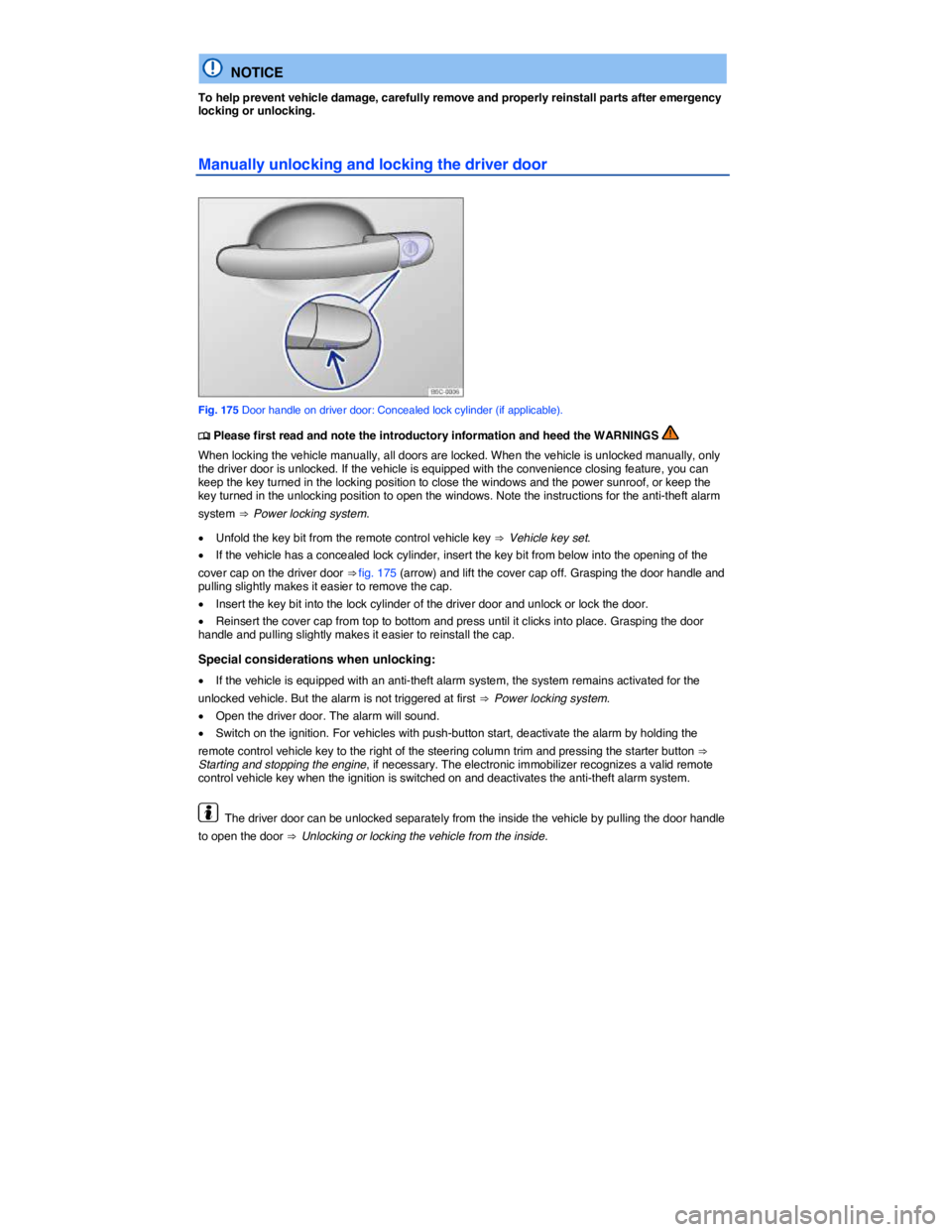
Manually unlocking and locking the driver door
Fig. 175 Door handle on driver door: Concealed lock cylinder (if applicable).
Page 371 of 412
The anti-theft alarm system, when installed, is not activated when the vehicle is locked manually
with the key bit ⇒ Anti-theft alarm system.
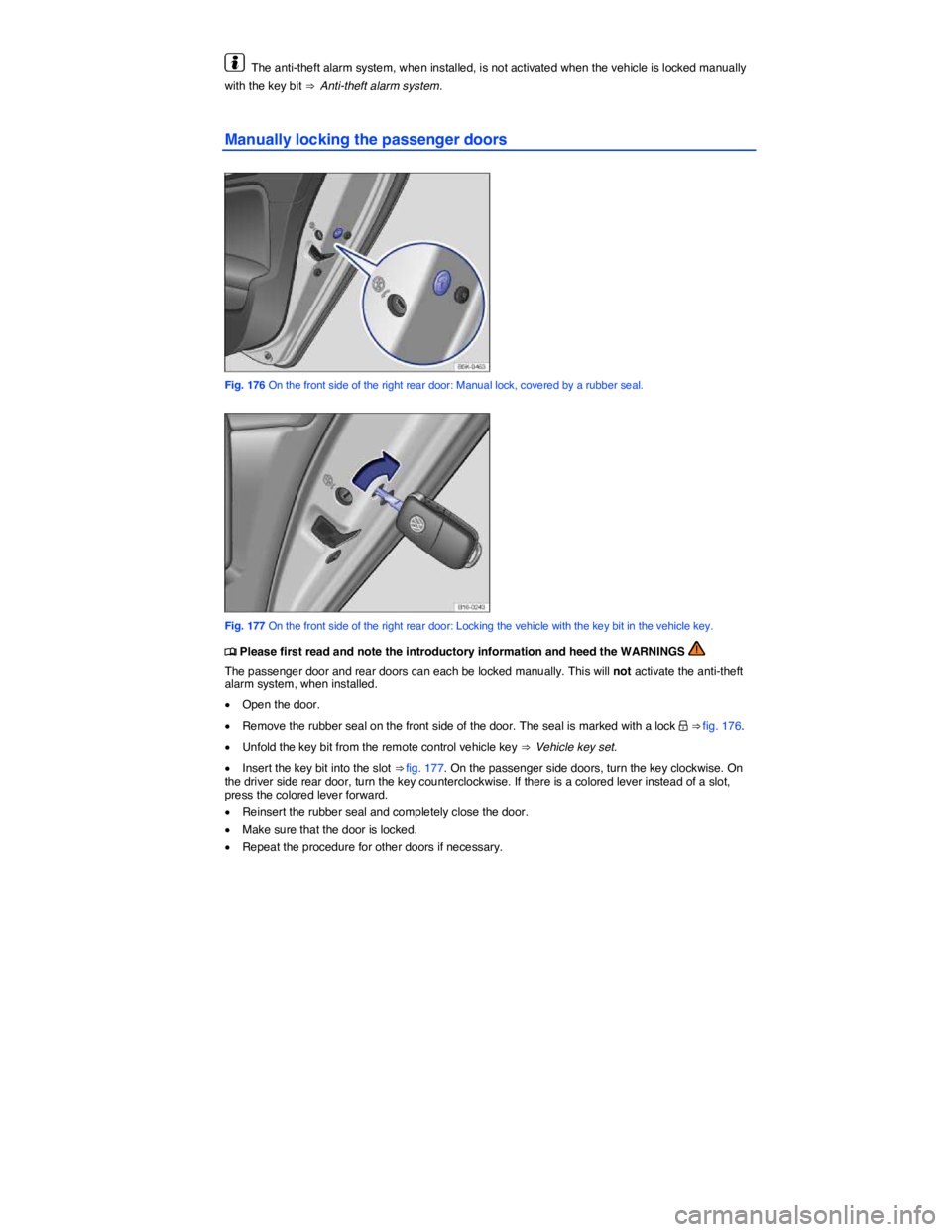
Manually locking the passenger doors
Fig. 176 On the front side of the right rear door: Manual lock, covered by a rubber seal.
Fig. 177 On the front side of the right rear door: Locking the vehicle with the key bit in the vehicle key.
Page 372 of 412
x Have the vehicle checked immediately by an authorized Volkswagen dealer or an authorized Volkswagen Service Facility.
The vehicle doors can be unlocked and opened separately from inside the vehicle by pulling the
door handle to open the door ⇒ Power locking system.
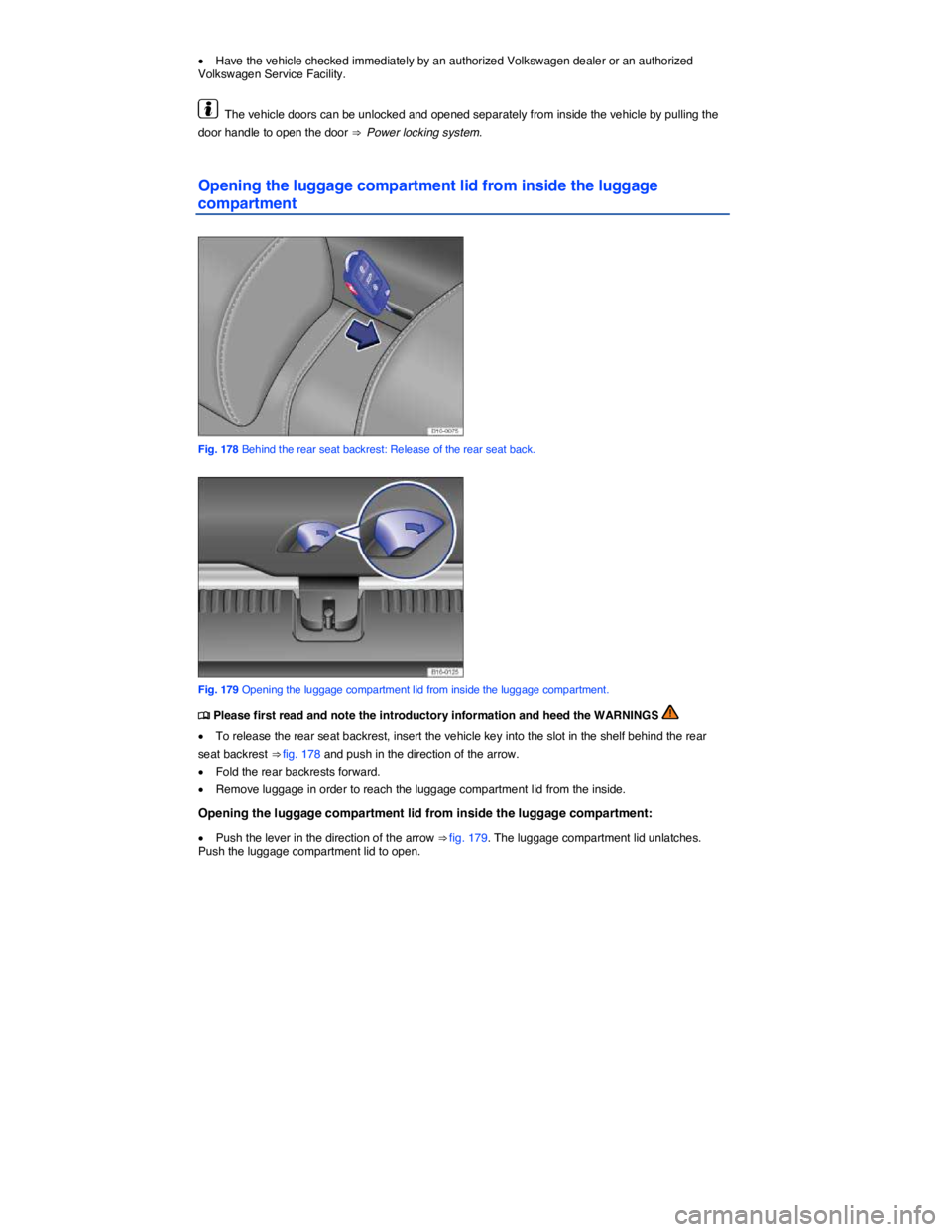
Opening the luggage compartment lid from inside the luggage
compartment
Fig. 178 Behind the rear seat backrest: Release of the rear seat back.
Fig. 179 Opening the luggage compartment lid from inside the luggage compartment.
Page 374 of 412
Before you try to use emergency closing procedures to close the power sunroof, please wait several minutes to make sure that the motor has not been temporarily turned off by the overheating protection feature.
If you must perform an emergency closing, please do so in the following order:
1. Remove the cover in direction of the arrow ⇒ fig. 180.
2. Insert a commercially available 1/6 in. (4 mm) Allen wrench5 into the hexagonal head screw
⇒ fig. 181 (1).
3. Turn the wrench counterclockwise to close the power sunroof.
4. Install the cover again.
5. Have the power sunroof checked by an authorized Volkswagen dealer or an authorized Volkswagen Service Facility. Emergency closing may cause the power sunroof and its pinch pro-tection to malfunction.
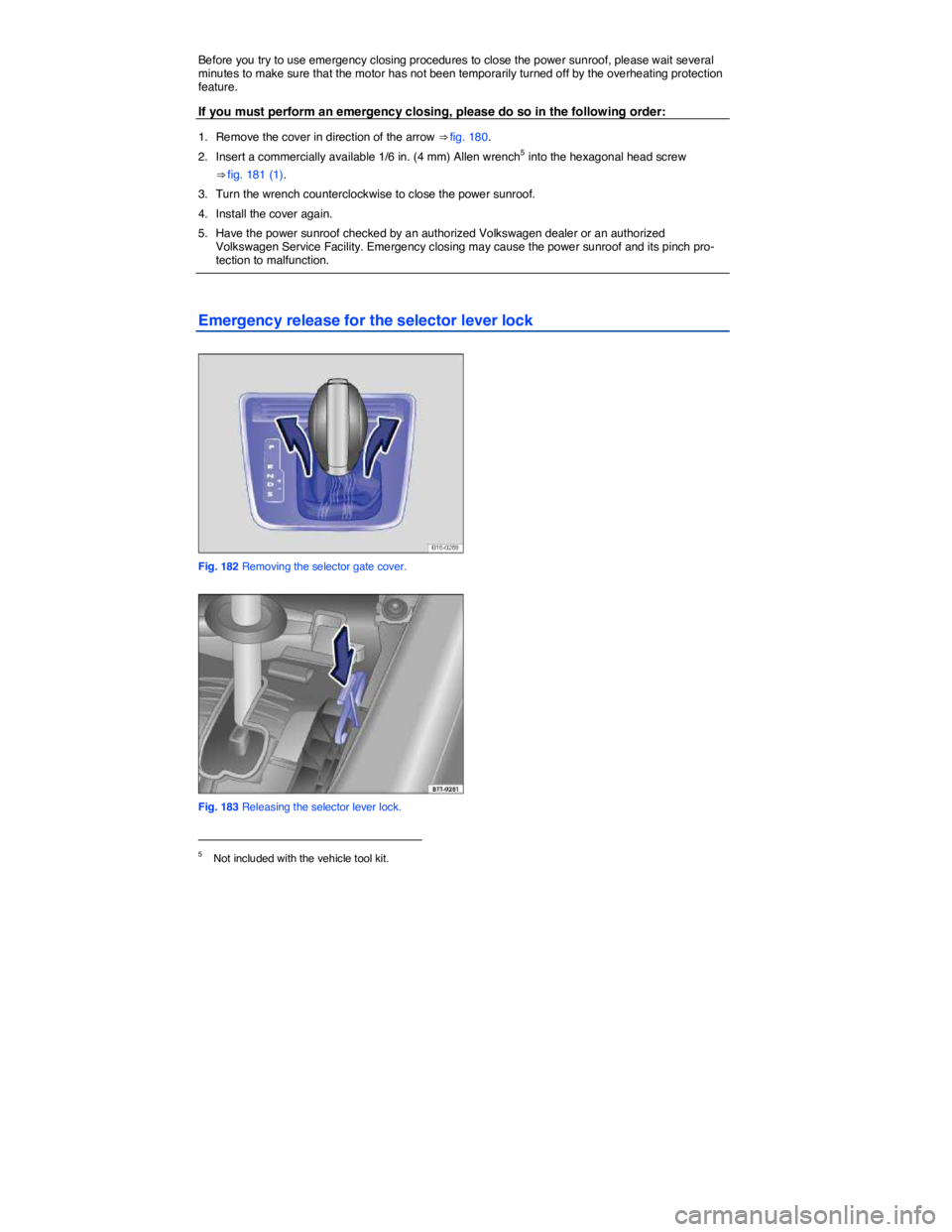
Emergency release for the selector lever lock
Fig. 182 Removing the selector gate cover.
Fig. 183 Releasing the selector lever lock.
5 Not included with the vehicle tool kit.
Page 384 of 412

WARNING
Changing a wheel, especially on the side of the road, can be dangerous. To help reduce the risk of serious personal injury:
x Always stop the vehicle as soon as it is safe to do so. Move the vehicle a safe distance off the road where it is safe to change the wheel.
x Always make sure that all passengers, especially children, are in a safe place outside the vehicle and away from the vehicle and traffic (such as behind a guard rail).
x Turn on the emergency flashers and set up another warning device about 25 yards (25 meters) behind the vehicle to warn approaching traffic.
x Change a wheel by yourself only if you are familiar with the necessary steps. Otherwise, get expert assistance.
x Always switch the engine off, firmly apply the parking brake, and shift the transmission into Park (P) (automatic transmission) or any gear (manual only) to help prevent the vehicle from moving suddenly and slipping off the jack.
x Always make sure that the ground is level and firm. If necessary, place the jack on a large and sturdy board or on a similar ground support.
x Always block the wheel diagonally opposite the wheel being changed with chocks or other similar things.
x If you are towing a trailer, always unhitch it from your vehicle before starting to change the wheel. Always apply the trailer brakes firmly and make sure the trailer cannot move unin-tentionally.
x Always use proper and undamaged tools when changing a wheel.
x Once a wheel is lifted off the ground, having the transmission in Park (P) or in gear will not prevent sudden vehicle movement.
x Always use a jack that has been approved by the manufacturer for your vehicle. Never use other jacks, even if they have been approved for use on other Volkswagen models.
x To reduce the risk of losing control, crashes, and serious personal injuries, never loosen the screws on rims with threaded rim rings.
x After changing a wheel, have the wheel bolt tightening torque checked with an accurate torque wrench.
x After changing a wheel or tire, reset the Tire Pressure Monitoring System ⇒ Tire Pressure Monitoring System (TPMS).
Preparations for changing a wheel
Page 385 of 412
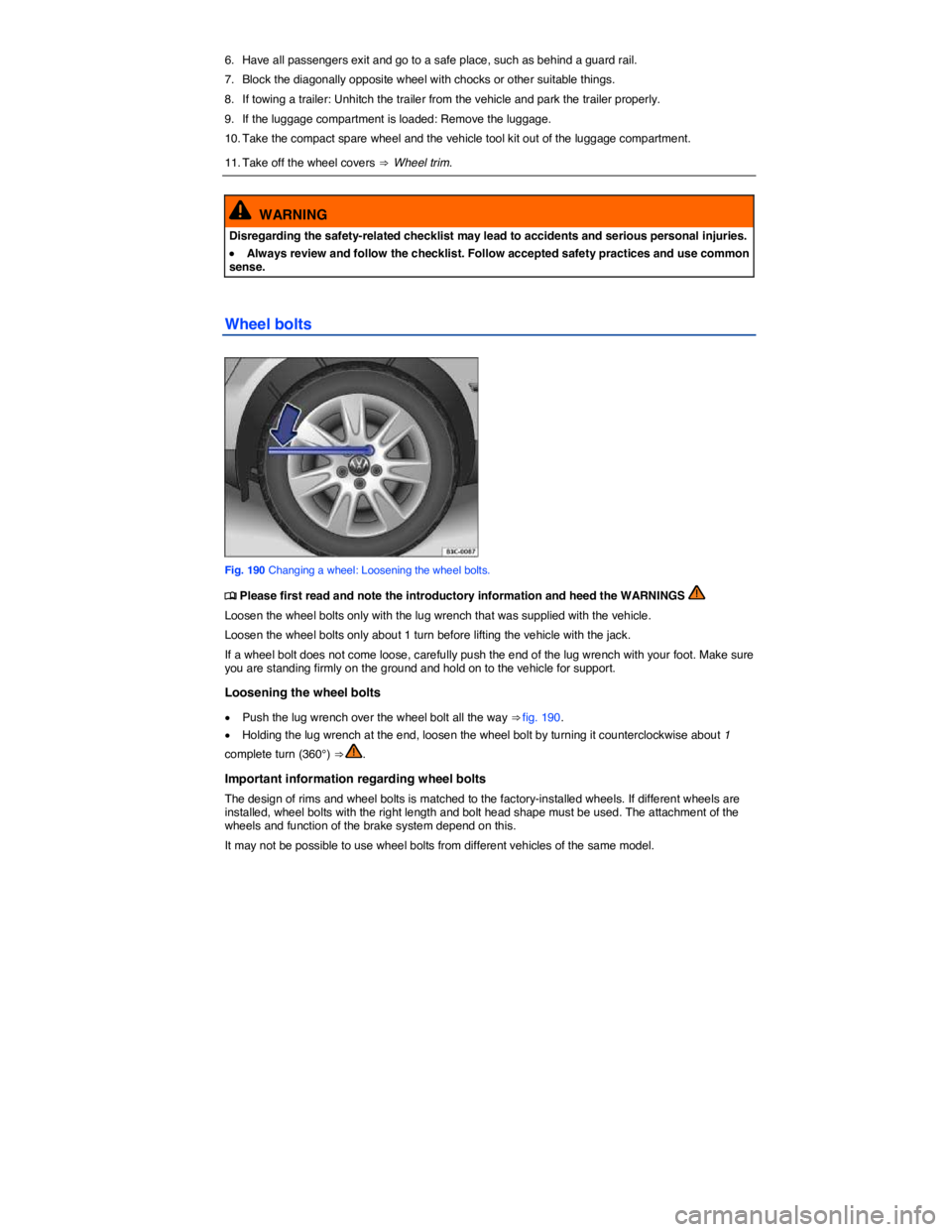
6. Have all passengers exit and go to a safe place, such as behind a guard rail.
7. Block the diagonally opposite wheel with chocks or other suitable things.
8. If towing a trailer: Unhitch the trailer from the vehicle and park the trailer properly.
9. If the luggage compartment is loaded: Remove the luggage.
10. Take the compact spare wheel and the vehicle tool kit out of the luggage compartment.
11. Take off the wheel covers ⇒ Wheel trim.
WARNING
Disregarding the safety-related checklist may lead to accidents and serious personal injuries.
x Always review and follow the checklist. Follow accepted safety practices and use common sense.
Wheel bolts
Fig. 190 Changing a wheel: Loosening the wheel bolts.
Page 389 of 412
Removing the wheel
x Review the checklist ⇒ Preparations for changing a wheel.
x Loosen the wheel bolts ⇒ Wheel bolts.
x Lift the vehicle ⇒ Lifting the vehicle with the vehicle jack.
x Completely unscrew and remove the previously loosened wheel bolts using the hexagonal socket
in the screwdriver handle ⇒ fig. 193. Place the wheel bolts on a clean surface.
x Remove the wheel.
Mounting a compact spare wheel
If the tire is a unidirectional tire, be sure to install it in the proper rolling direction ⇒ Tires and wheels.
x Place the compact spare wheel on the axle.
x Screw in the wheel bolts clockwise and tighten them slightly using the hexagonal socket in the screwdriver handle.
x Lower the vehicle with the jack.
x Use the lug wrench to firmly tighten all wheel bolts (turn clockwise) ⇒ . Do not tighten them in sequence! Tighten any wheel bolt to begin, then tighten the wheel bolt diagonally opposite the first bolt, and so forth.
x Install the wheel bolt caps, center wheel hubcap, or wheel cover, if any ⇒ Wheel trim.
WARNING
Wheel bolts that are tightened or installed improperly can come loose, causing loss of vehi-cle control, a crash, and serious personal injury.
x Always keep wheel bolts and threads in the wheel hub clean and free of oil and grease. The wheel bolts must turn easily and must be tightened with the right torque.
x Use the hexagonal socket in the screwdriver handle only to turn the wheel bolts when they are loose, never to loosen them or tighten them firmly.
WARNING
Improper use of a compact spare wheel can cause loss of vehicle control, a crash or other accident, and serious personal injury.
x Never use a compact spare wheel if it is damaged or worn down to the wear indicators.
x Never drive faster than 50 mph (80 km/h) with a compact spare wheel. Avoid full-throttle acceleration, heavy braking, and fast cornering!
x Never drive more than 125 miles (200 km) with a compact spare wheel that is installed on the front axle (drive axle).
x Replace the compact spare with a normal wheel and tire as soon as possible. Compact spare tires are designed for brief use only.
After changing a wheel