airbag VOLKSWAGEN JETTA GLI 2014 1B / 6.G User Guide
[x] Cancel search | Manufacturer: VOLKSWAGEN, Model Year: 2014, Model line: JETTA GLI, Model: VOLKSWAGEN JETTA GLI 2014 1B / 6.GPages: 357, PDF Size: 5.56 MB
Page 119 of 357

WARNING
Unsecured or incorrectly stowed items can fly through the vehicle, causing serious personal injury during hard braking or sharp steering or in an accident. Loose items can also be struck and thrown through the passenger compartment by the front airbags if they inflate. To help reduce the risk of serious personal injury:
x Always stow all objects securely in the vehicle. Always put luggage and heavy items in the luggage compartment.
x Always secure objects in the passenger compartment properly with suitable straps so that they cannot move into the deployment zone of a side or front airbag during sudden braking, in a sudden maneuver, or in a collision.
x Always keep storage compartments closed while driving.
x Never stow hard, heavy, or sharp objects in the vehicle's open storage compartments, on the shelf behind the rear seat bench, or on the top of the instrument panel.
x Always remove hard, heavy, or sharp objects from clothing and bags in the vehicle interior and stow them securely in the luggage compartment.
WARNING
Transporting heavy objects causes the handling characteristics of the vehicle to change and increases braking distances. Heavy loads which are not properly stowed or secured in the vehicle can lead to a loss of vehicle control and cause serious personal injury.
x Transporting heavy items causes the handling characteristics of the vehicle to change by shifting the vehicle's center of gravity.
x Always distribute luggage evenly and as low as possible within the vehicle. The vehicle capacity weight figures apply when the load is distributed evenly in the vehicle (passengers and luggage).
x Always stow luggage and heavy items in the luggage compartment as far forward of the rear axle as possible and secure them with appropriate straps to the tie-downs provided.
x Never exceed the vehicle's Gross Vehicle Weight Rating or Gross Axle Weight Ratings, which are printed on the Safety Compliance Certification Label located on the door jamb of the driver door. Exceeding the permissible weight can cause the vehicle to skid and behave differently.
x Always adapt your speed and driving style to accommodate your payload and its weight distribution within your vehicle.
x Be especially cautious and gentle when stepping on the accelerator pedal and avoid sudden braking and other maneuvers.
x Brake earlier than you would if you were not driving a loaded vehicle.
NOTICE
The defroster heating wires or antenna in the rear window can be damaged by objects that rub against them.
Page 188 of 357
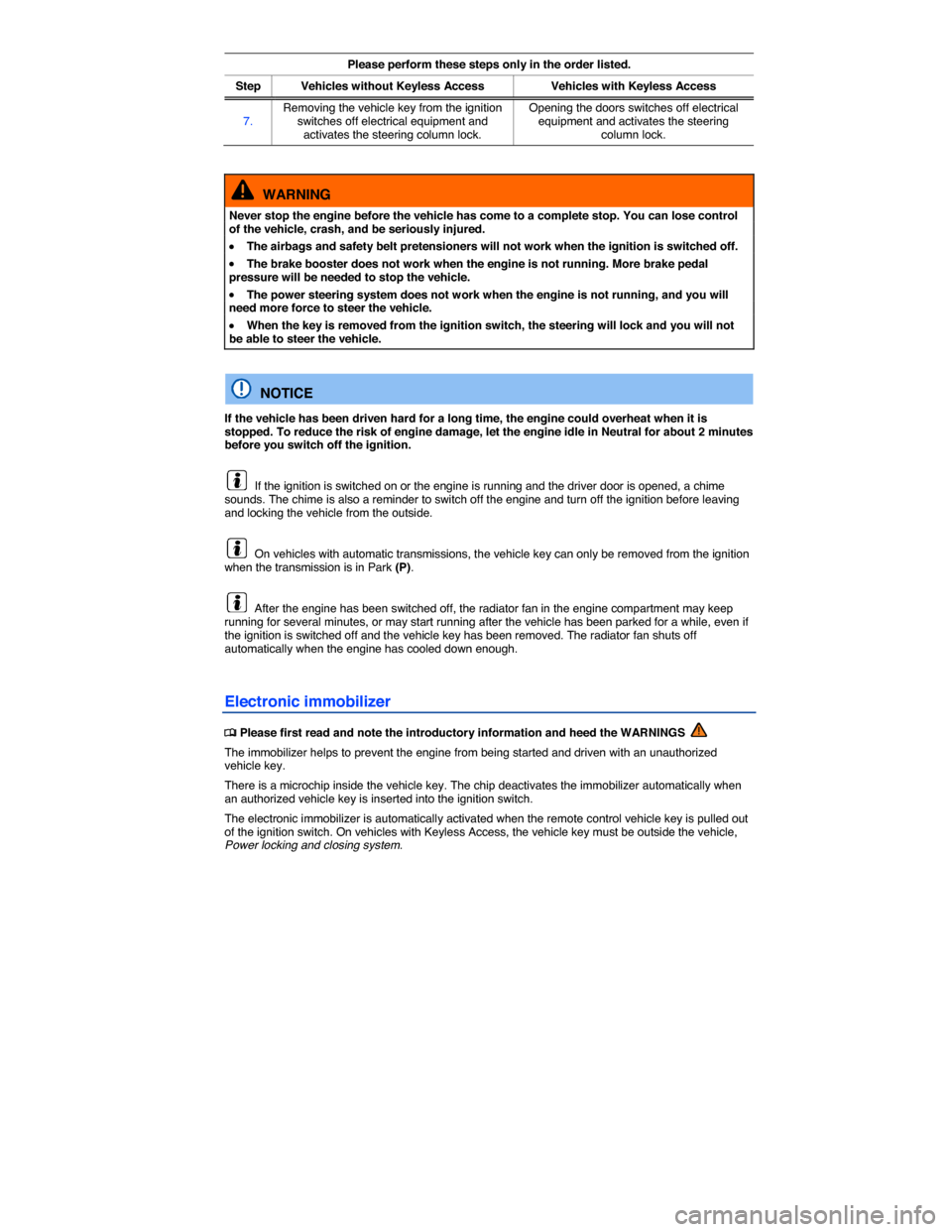
Please perform these steps only in the order listed.
Step Vehicles without Keyless AccessVehicles with Keyless Access
7. Removing the vehicle key from the ignition switches off electrical equipment and activates the steering column lock.
Opening the doors switches off electrical equipment and activates the steering column lock.
WARNING
Never stop the engine before the vehicle has come to a complete stop. You can lose control of the vehicle, crash, and be seriously injured.
x The airbags and safety belt pretensioners will not work when the ignition is switched off.
x The brake booster does not work when the engine is not running. More brake pedal pressure will be needed to stop the vehicle.
x The power steering system does not work when the engine is not running, and you will need more force to steer the vehicle.
x When the key is removed from the ignition switch, the steering will lock and you will not be able to steer the vehicle.
NOTICE
If the vehicle has been driven hard for a long time, the engine could overheat when it is stopped. To reduce the risk of engine damage, let the engine idle in Neutral for about 2 minutes before you switch off the ignition.
If the ignition is switched on or the engine is running and the driver door is opened, a chime sounds. The chime is also a reminder to switch off the engine and turn off the ignition before leaving and locking the vehicle from the outside.
On vehicles with automatic transmissions, the vehicle key can only be removed from the ignition when the transmission is in Park (P).
After the engine has been switched off, the radiator fan in the engine compartment may keep running for several minutes, or may start running after the vehicle has been parked for a while, even if the ignition is switched off and the vehicle key has been removed. The radiator fan shuts off automatically when the engine has cooled down enough.
Electronic immobilizer
Page 287 of 357

these seat surfaces and backrests can damage the vehicle electrical system and prevent the airbag
system from working properly ⇒ .
Electrical components and connectors that could be damaged by incorrect cleaning or handling are
installed in power seats and heated seats ⇒ . This can also result in damage to other parts of the vehicle electrical system.
For this reason, read and follow these cleaning instructions:
x Do not use power washers, steam cleaners, or cooling spray.
x Do not use detergent pastes or mild detergent solutions.
x Do not wet the surface completely.
x Only use cleaning products approved by Volkswagen.
x If you have questions or concerns, consult a professional cleaner.
x Before using any cleaning agent, familiarize yourself with instructions and warnings on the packaging.
x Vacuum upholstery, fabric trim, Alcantara® upholstery, and carpeting regularly with a suitable brush attachment.
x A soft sponge or a commercially available lint-free microfiber cloth may be used for general
cleaning ⇒ .
x Clean Alcantara® surfaces with a damp cotton or wool cloth or a commercially available lint-free
microfiber cloth ⇒ .
Upholstery and fabric trim with light generalized soiling can be cleaned with a commercially available dry-foam cleaner.
If the upholstery and fabric trim pieces are heavily soiled, see your authorized Volkswagen dealer or authorized Volkswagen Service Facility before you begin cleaning to learn about suitable cleaning options. If necessary, have the cleaning done by a professional.
Cleaning upholstery on non-heated seats, manual seats, or seats without airbag components
x Before using any cleaning agent, familiarize yourself with instructions and warnings on the packaging.
x Vacuum upholstery, fabric trim, Alcantara® upholstery, and carpeting regularly with a suitable brush attachment.
x Do not use power washers, steam cleaners, or cooling spray.
x A soft sponge or a commercially available lint-free microfiber cloth may be used for general
cleaning ⇒ .
x Clean Alcantara® surfaces with a damp cotton or wool cloth or a commercially available lint-free
microfiber cloth ⇒ .
Upholstery and fabric trim with light generalized soiling can be cleaned with a commercially available dry-foam cleaner.
If the upholstery and fabric trim pieces are heavily soiled, see your authorized Volkswagen dealer or authorized Volkswagen Service Facility before you begin cleaning to learn about suitable cleaning options. If necessary, have the cleaning done by a professional.
Treating stains
When treating stains, it may be necessary to clean the entire surface and not just the stain itself. This is especially true if the entire surface has become dirty from normal use. Otherwise, the area that is treated may become lighter than the untreated area. If you have questions or concerns, consult a professional cleaner.
Page 288 of 357
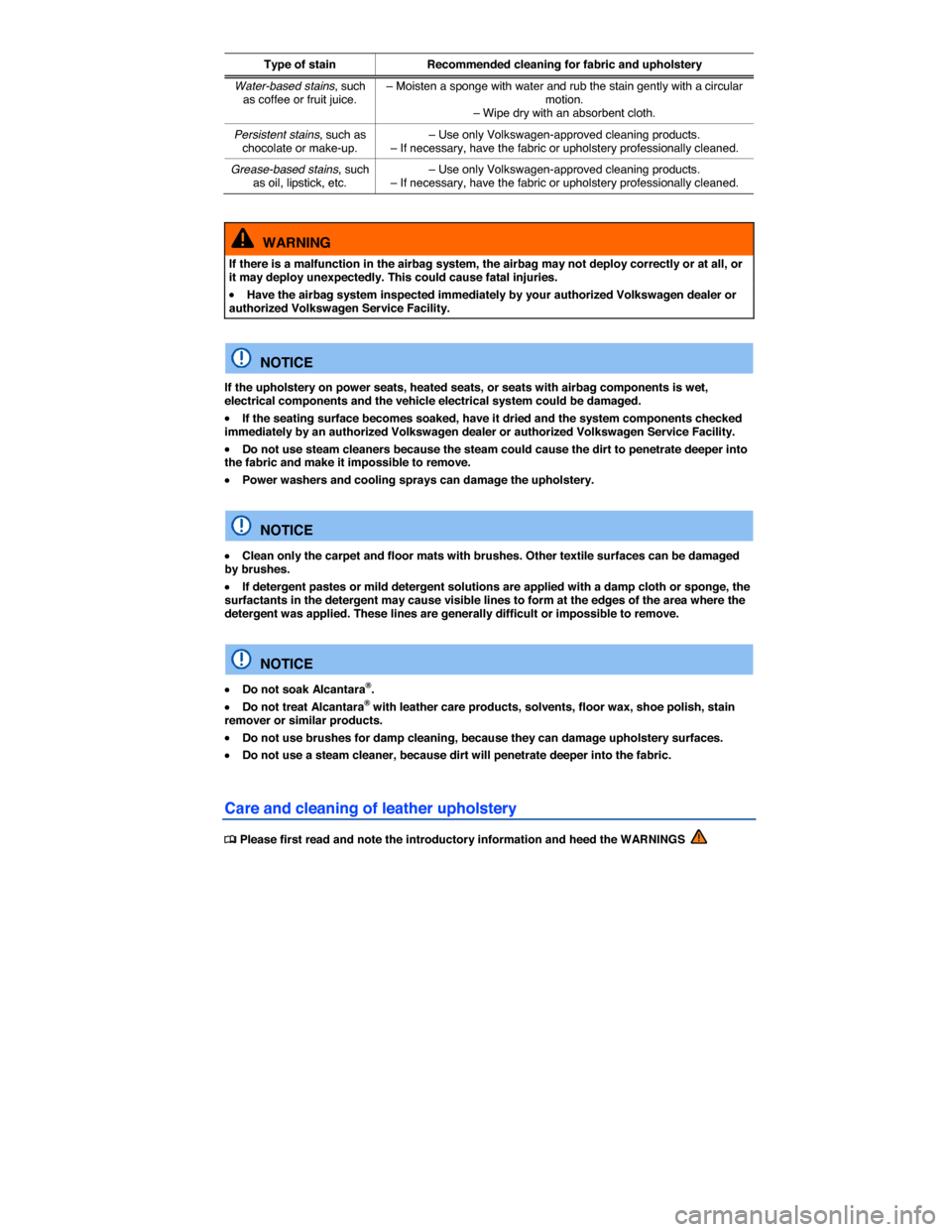
Type of stain Recommended cleaning for fabric and upholstery
Water-based stains, such as coffee or fruit juice. – Moisten a sponge with water and rub the stain gently with a circular motion. – Wipe dry with an absorbent cloth.
Persistent stains, such as chocolate or make-up. – Use only Volkswagen-approved cleaning products. – If necessary, have the fabric or upholstery professionally cleaned.
Grease-based stains, such as oil, lipstick, etc. – Use only Volkswagen-approved cleaning products. – If necessary, have the fabric or upholstery professionally cleaned.
WARNING
If there is a malfunction in the airbag system, the airbag may not deploy correctly or at all, or it may deploy unexpectedly. This could cause fatal injuries.
x Have the airbag system inspected immediately by your authorized Volkswagen dealer or authorized Volkswagen Service Facility.
NOTICE
If the upholstery on power seats, heated seats, or seats with airbag components is wet, electrical components and the vehicle electrical system could be damaged.
x If the seating surface becomes soaked, have it dried and the system components checked immediately by an authorized Volkswagen dealer or authorized Volkswagen Service Facility.
x Do not use steam cleaners because the steam could cause the dirt to penetrate deeper into the fabric and make it impossible to remove.
x Power washers and cooling sprays can damage the upholstery.
NOTICE
x Clean only the carpet and floor mats with brushes. Other textile surfaces can be damaged by brushes.
x If detergent pastes or mild detergent solutions are applied with a damp cloth or sponge, the surfactants in the detergent may cause visible lines to form at the edges of the area where the detergent was applied. These lines are generally difficult or impossible to remove.
NOTICE
x Do not soak Alcantara®.
x Do not treat Alcantara® with leather care products, solvents, floor wax, shoe polish, stain remover or similar products.
x Do not use brushes for damp cleaning, because they can damage upholstery surfaces.
x Do not use a steam cleaner, because dirt will penetrate deeper into the fabric.
Care and cleaning of leather upholstery
Page 289 of 357

If you have questions regarding the care and cleaning of the leather upholstery in the vehicle, please contact an authorized Volkswagen dealer or authorized Volkswagen Service Facility.
Care and treatment
Natural leather requires special attention and care. Napa leather has a smooth surface. The intensity of the color application determines the leather's appearance and texture. If you can see the leather grain and other natural characteristics, this is an untreated napa leather that will provide very comfortable seating. Delicate veins, closed scars, insect bites, folds, and a slightly clouded color remain visible and represent authentic characteristics of the natural material. Untreated napa leather has no protective coating. It is therefore more susceptible to damage. You should keep this in mind if the leather is going to be exposed to severe wear from children, animals, or other factors. By contrast, leather that has a protective coating is more robust. This has a positive effect on the leather's durability in daily use. The typical natural characteristics are hardly visible or no longer visible at all, but that has no impact on the quality of the leather itself. The typical characteristics of untreated leather are much more distinctive than those of a surface-treated leather.
x After each cleaning, apply cream that waterproofs the leather and protects it against the sun. Such creams also nourish the leather, let it breathe, keep it flexible and moisturized. At the same time it protects the surface.
x Clean leather every 2 to 3 months and remove any new stains.
x Treat leather with a suitable leather-care product twice a year ⇒ .
x Apply cleaning and conditioning materials sparingly and always with a dry, lint-free cotton or wool cloth. Do not apply cleaning and conditioning materials directly to the leather.
x Remove fresh stains such as ballpoint pen, lipstick, ink, shoe polish, etc. as soon as possible.
x Preserve the leather's color. If necessary, refresh fading spots with a specially-colored leather cream.
x Wipe the leather with a soft cloth.
Cleaning
Volkswagen recommends using a slightly moistened cotton or wool cloth for general cleaning.
It is important not to let water soak through the leather or penetrate into seams.
Before cleaning leather surfaces, read and heed the information Cleaning upholstery on heated seats and power seats or seats with airbag components.
Type of stain Cleaning
Heavy stains – Apply a mild soapy solution with a cloth that has been wrung nearly dry6. – Dab dry with an absorbent cloth.
Water-based stains, such as coffee, tea, juice, or blood.
– Remove fresh stains with an absorbent cloth.
– If the stains are already dry, use an appropriate cleaning agent ⇒ .
Grease-based stains, such as oil, lipstick, etc. – Remove fresh stains with an absorbent cloth. – Use an appropriate cleaning agent on stains that have not yet
penetrated the surface ⇒ .
Special stains, such as ballpoint pen, marker, nail polish, latex paint, or shoe polish.
– Dab dry with an absorbent cloth. – Clean with a special stain remover designed for leather.
6 Mild soap solution: 2 tablespoons of liquid soap in 1 quart (liter) of water.
Page 292 of 357

WARNING
Inappropriate spare parts and accessories as well as improperly performed work, modifications and repairs can cause vehicle damage, accidents and serious personal injuries.
x Volkswagen strongly recommends to only use accessories approved by Volkswagen and Genuine Volkswagen Parts®. These parts and accessories have been evaluated by Volkswagen for their suitability, reliability and safety.
x Have repairs and vehicle modifications performed by an authorized Volkswagen dealer or authorized Volkswagen Service Facility. Authorized Volkswagen dealers and authorized Volkswagen Service Facilities have the required tools, diagnostic equipment, repair information, and trained personnel to properly replace any airbag in your vehicle and assure system effectiveness in a crash.
x Only install parts on the vehicle that are consistent with factory-installed parts with respect to design and characteristics.
x Never store, mount, or attach objects, such as cup holders or phone cradles, on or next to the airbag module covers or within the airbags deployment zones.
x Only use wheel rim/tire combinations approved by Volkswagen for the respective vehicle type.
Break-in period
Page 295 of 357

Observe all regulations so that the effectiveness of the airbag is not affected and to prevent disassembled parts from causing injuries and pollution. Authorized Volkswagen dealers, authorized Volkswagen Service Facilities, and other qualified workshops are familiar with these regulations.
Changing the vehicle's suspension system can change the way that the airbag system works in a crash. For example, using tire-rim combinations not approved by Volkswagen, lowering the vehicle, changing the stiffness of the suspension, including the springs, suspension struts, shock absorbers etc. can change the forces that are measured by the airbag sensors and sent to the electronic control unit. Some suspension changes can, for example, increase the force levels measured by the airbag sensors and sent to the electronic control unit and make the airbag system deploy in crashes in which it would not deploy if the changes had not been made. Other kinds of changes may reduce the force levels measured by the sensors and prevent the airbag from deploying when it should.
Never install leather upholstery on a vehicle that originally had cloth upholstery. Never install cloth upholstery on a vehicle that originally had leather upholstery. The capacitive passenger detection system for the Advanced Airbag system will not work properly if different upholstery is installed on the passenger seat than the upholstery originally installed on the vehicle when it was originally manufactured.
WARNING
Changing the vehicle's suspension including use of unapproved tire-rim combinations can change airbag performance and increase the risk of serious personal injury in a crash.
x Never install suspension components that do not have the same performance characteristics as the components originally installed on your vehicle.
x Never use tire-rim combinations that have not been approved by Volkswagen.
WARNING
Leaving the optional safety belt extender attached to the safety belt buckle on the front passenger seat when the safety belt is not being used will prevent the Advanced Airbag System from working properly and can increase the risk of serious personal injury in a collision.
x Leaving the extender attached to the safety belt buckle when the front seat is occupied and the safety belt is not being used will signal to the airbag control unit that the front passenger seat is occupied and that the safety belt is being used. The electronic control unit for the airbag system will then receive incorrect information that will
– cause the safety belt pretensioner to deploy unnecessarily in collisions and
– cause the front passenger airbag to deploy later in collisions in which the front airbag would otherwise be triggered earlier to help protect an unrestrained front seat passenger.
x Always remove the safety belt extender when it is not needed and stow it safely.
x Never use the safety belt extender to secure a child restraint.
WARNING
Items stored between the safety belt buckle and the center console can cause safety belt buckle to send the wrong information to the airbag control unit and prevent the Advanced Airbag System from working properly.
x Always make sure that nothing can interfere with the safety belt buckles and that they are not obstructed.
Page 296 of 357

WARNING
Improper care and servicing, and improper modification and repair work, can increase the risk of personal injury and death by preventing an airbag from deploying when needed or deploying an airbag unexpectedly:
x Never repair, adjust, or change any parts of the airbag system.
x All work on the airbag system, steering wheel, instrument panel, front seats or electrical system (including the installation of audio equipment, mobile telephones and CB radios, etc.) should be performed by authorized Volkswagen dealers or authorized Volkswagen Service Facilities. They have the necessary manuals, training, and special equipment.
x The airbag system can be activated only once. After an airbag has inflated, it must be replaced.
x Use only original equipment airbags approved by Volkswagen. Have them installed by a trained technician who has the necessary tools and diagnostic equipment to properly replace any airbag in your vehicle and assure system effectiveness in a crash.
x Never permit salvaged or recycled airbags to be installed in your vehicle.
Undeployed airbag modules and safety belt pretensioners are classified as Perchlorate Material. Special handling may apply – see http://www.dtsc.ca.gov/hazardouswaste/perchlorate. Obey all applicable legal requirements regarding handling and disposal of the vehicle or parts of its restraint system, including airbag modules and safety belts with pretensioners. Authorized Volkswagen dealers and authorized Volkswagen Service Facilities are familiar with the requirements, and we recommend that you have them perform this service for you.
Notice about data recorded by vehicle control modules
Page 297 of 357

human body. Limits and guidelines have been established by governmental authorities and international committees in an effort to keep the electromagnetic radiation from mobile phones at levels that will not cause health problems. However, there is no scientifically based proof that wireless phones are absolutely safe.
Therefore, some experts recommend a precautionary approach regarding the use of mobile phones by taking measures that lower the personal exposure to electromagnetic fields. When using a mobile telephone inside a motor vehicle without a proper connection to an integrated vehicle telephone antenna, the personal exposure to electromagnetic fields will be higher than when using the mobile telephone while properly connected to an integrated or other outside vehicle telephone antenna.
Your vehicle may be equipped with an optional hands-free system that will permit many of the features of compatible Bluetooth® enabled mobile telephones to be used for greater convenience and is consistent with the laws of an increasing number of states and localities that prohibit the use of mobile telephones without some kind of hands-free device.
The hands-free system in your vehicle can be used with certain mobile phones that are connected by wire and hardware connector or via compatible Bluetooth® enabled phones with a cradle that is designed to fit your mobile telephone. The special cradle offers several advantages: The phone cradle must be safely secured to the base plate. Your phone is firmly attached to the instrument panel and is within reach at all times. Placing the phone in its cradle permits it to be charged, but more importantly connects the mobile phone to the vehicle's outside antenna. A mobile telephone that is properly connected to the integrated or other outside vehicle telephone antenna will lower the personal exposure to electromagnetic fields. You should also experience a better quality of service. Although a mobile telephone can be used inside your vehicle without a cradle, the phone will not be securely attached to the vehicle, will not be charged through the cradle wiring, and more importantly will not be connected to the vehicle's integrated telephone antenna. The mobile phone will also not be recharged. You might also experience more dropped calls and an overall impaired quality of the connection.
Therefore we strongly recommend that you use your mobile telephone in your vehicle only when it is properly attached to an appropriate cradle mounted on a base plate on the instrument panel.
Because of the large number and variety of mobile telephones on the market and the frequency with which new models are introduced, Volkswagen does not offer cradles for mobile telephones. Please check with the manufacturer of the mobile telephone that you plan to use.
Bluetooth® is a registered trademark of Bluetooth® SIG, Inc.
WARNING
A mobile phone on the seat, instrument panel or in other places can be thrown around the inside of the vehicle during a sudden braking maneuver, a crash or other accident and injure vehicle occupants.
x Never place or attach accessories or other objects (such as cup holders, telephone brackets, note pads, navigation systems, large, heavy or bulky objects) on the doors, on the windshield, over or near the area marked “AIRBAG” on the steering wheel, instrument panel, backrests or between these areas and the occupant. Such objects could cause serious injury in a collision, especially if an airbag inflates.