engine VOLKSWAGEN PASSAT 2003 Workshop Manual
[x] Cancel search | Manufacturer: VOLKSWAGEN, Model Year: 2003, Model line: PASSAT, Model: VOLKSWAGEN PASSAT 2003Pages: 483, PDF Size: 78.54 MB
Page 364 of 483
Your tank has an on-board
vapors from escaping
from the tank and
you
tecting the environment, procedure
Turn off the ignition.
Unscrew
the
When
As soon as the correctly operated nozzle switches off automatically for the first time, the tank is full. Do not try to add more fuel, be
cause fuel may
After your tank. twist the
cap you hear a defin ite
or evaporating from the
Note
Running your engine may
cause vapors to escape or even
out of the tank. This
a
and can ignite
inside the por
inside the
and can cause fire and serious
burns.
container meets industry standards
TANK------------------3
Page 365 of 483
Fuel supply
rating indicates a
is very
important to
of engine performance .
The recommended
This
rating may be specified as or
used in the Uni
ted
Fuel Recommendation
The fuel recommended for your vehicle is unleaded premium grade ga
soline with a minimum octane rating of 91
is and in most European
countries. We recommend that you do not
take your to areas or countries whe
re may not be
Use of gasoline containing alcohol or MTBE (methyl tertiary butyl ether)
may use with
-must contain more than
2%
Note
Methanol fuels which do not meet these requirements may cause corrosion and damage to plastic and rubber components in the fuel system.
4
------------------FILLING TANK
Page 372 of 483
Anti-Slip
Regulation (ASR}*
prevents the fr ont
The system operates in conjunction with
the a
required, it can by
pressi ng the switch.
When the system is switched off. the
warning comes on.
The
ASR switch ed
on. The system
can offer advantages:
- when driving with snow chains,
in deep
snow or
on surfaces;
- when rocking back and forth to free the
must be fitted with ti
res. Any differences in the
not desired.
See and tire
Power steering
When the engine is running, never
the way turned .
This
when stoppe d,
you
Page 373 of 483
The first
For the first
As a of thumb:
avoid towing a
tres) of
From
Speeds can
Do not drive with unnecessarily
high engine speeds -upshifting early saves fuel, reduces noise and protects the environment -see also page 15.
Do not the engine Downshift
when the engine is no running
Page 376 of 483
Various factors influence fuel consumption:
engine wear. brakes
and tires, environmen
tal impact.
T his chapter addresses some of these
points.
Your
warm up.
When the engine is idling, it takes a very
long time to warm
up. Moreover. during
warm-up, both engine wear and exhaust
gas emissions are very high. Therefore, be
ready to drive
off immediately after starting
the engine and avoid high engine speeds.
Avoid
Upshift as early as possible -do not drive at unnecessarily high engine speeds.
The highest fuel economy and the least di
sturbance to the environment are attained
when you drive at l
ow engine speeds and in
the highest possible gear.
For example , fuel consumption is twice
as high in 2nd gear as it is in the highest gear.
Downshift only when the engine is no longer running smoothly.
Depending on the transmission you have.
you can normally drive in the highest gear at
25 to 37 mph
(40 to km
Avoid driving at high speed.
Fuel consumption, exhaust emissions and
engine noise increase disproportionately at
high speeds.
you drive at approximately
three quarters of top speed, fuel consump
tion
be reduced by one half. Never drive
faster than the posted speed limit and wea
ther condit ions permitting.
Drive as smoothly as possible and keep a lookout ahead.
Unnecessary accelerating and braking in
crease fuel consumption and disturb the en
vironment.
Switch off your engine if you are caught in a traffic jam. This sa
ves fuel and reduces emissions.
The
Heavy traffic, especially in large cities
w ith many traffic lights.
Stop-and-go driving, especially short di
stances so that the engine never warms up as it should.
Driving in heavy, slow moving traffic in low gear so that the engine speed is relati
vely high when compared to the distance
driven.
Plan your trips ahead of time. Organize your trips to include several errands and to avoid heavy traffic.
course. there are some conditions that affect fuel consumption that you can't
control.
For example, fuel consumption increases in
the wint er or under difficult conditions
(bad roads. towing a trailer. etc.).
DRIVING AND
Page 380 of 483
Engine
is im portant the the engine
system be up to the job. Make sure that the
your
brake system must not be direct
use safety chains between your ve
must meet regulations . Do
not connect the
system directly
to the sys tem of your Be sure
to check with your
Mirrors
you are
extended mirrors.
have vision to
the
rear.
AND ADVICE
Operating instructions
Maximum
to a
1 or 2 trailer.
The maximum gross weight and the
tong
ue
Booklet 3.3.
Do not exceed the g ross weight.
w hich is the weight of the veh ic le. inclu ding
dr
iver. passen g ers . luggage. hitch
and tongue weight of the trailer.
in the is secure
to guard against be it for
ward. backward or sideways .
Never
Fo r best hand ling under these chan
ged condit ions. adjust the
is at the maximum or You can get an approxi
mation of the tong ue
the tires of y our to the
unde r on the sticker on the right
doorjamb . tires to and tire manufacturers' specifications.
DRIVING AND ENVIRONMENT ---------19
Page 381 of 483
Lights
The
proper working of
Safety chains
Be sure connected from the Leave enough
A
to the extent
as
transfe r some cargo to th e
requirements
and
The higher the the more
Be
Reduce speed shows the
some areas
speeds for are
The cooling effect of the radiator
fan cannot be increased by downshifting because fan speed is inde
pendent of engine speed. Therefore, when driving
---------DRIVING AND
Page 382 of 483
Trailer towing tips
when to
wing a
weight and weig ht distribution. per
formance and economy depend
on
how your and
operate your rig.
Before you
tow your
you the
unit.
Backing up is
and requires practice.
Steering
wi
thout a
you need
a
than turn ing radius.
When passing, remember that you cannot
be
cause
of the added Make sure you have enough room to pass. After passing. of room for your
changes.
AND
After parking , the and
on a it cannot be avoided. do
so
foot brake .
Have someone chocks under both
With chocks in bra
kes
Turn to curb.
parking brake.
and
transmission in first or reverse gear.
you move the
the
to
move the position.
When restarting after parking on a
the engine.
the parking brake and
and have someone retrieve the
Notes
your may require more frequent maintenance
due to the extra
page 31.
DRIVING AND ENVIRONMENT---------21
Page 390 of 483
Engine compartment
bris from entering the interior
through the heating
and ventil ation ducts
The engine compartment and transmission
have been corrosion protected
at the
mation given on page 22.
Good anti-corrosion treatment is very the
is frequently driven on salted roads. the
entire engine compartment and plenum
or if
you have the engine
the anti
corrosion treatment is almost always
is therefore essential to ask
for a long-last ing corrosion protection of
If you must rinse off gasoline, oil residue or grease while your are cleaning your engine, then the dirty
water should be run through an oil separator filter. We recommend
that you have your engine cleaned at a qualified workshop or service
Page 394 of 483
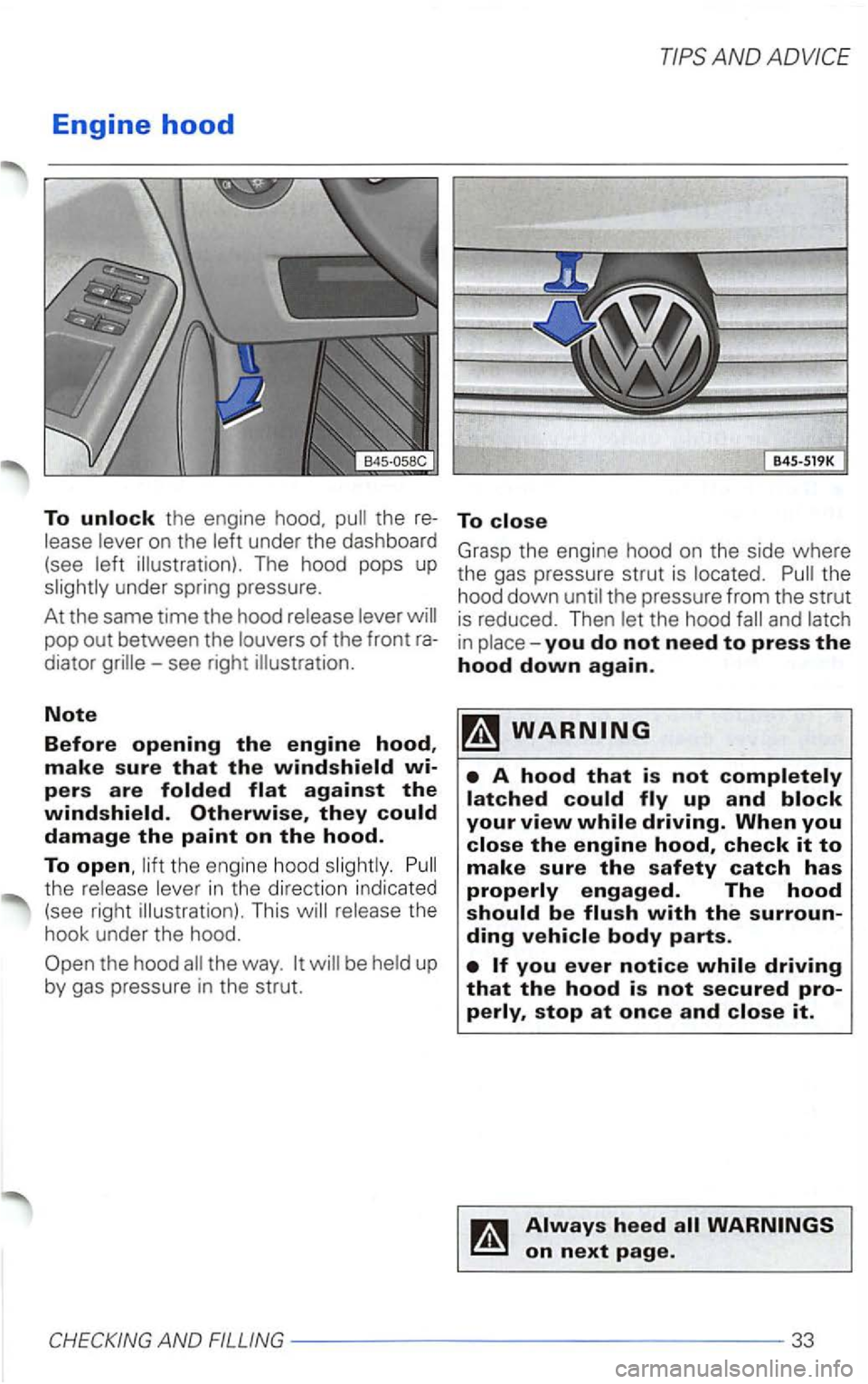
Engine hood
To the engine hood, pull the
on the
make sure that the windshield
the engine hood
the
hook under the hood.
AND
To
Grasp the engine hood on the side where
the gas pressure strut is the
hood down
the hood in you do not need to press the hood down again.