heating VOLKSWAGEN PASSAT 2013 B8 / 6.G User Guide
[x] Cancel search | Manufacturer: VOLKSWAGEN, Model Year: 2013, Model line: PASSAT, Model: VOLKSWAGEN PASSAT 2013 B8 / 6.GPages: 379, PDF Size: 5.56 MB
Page 214 of 379

Anti-Slip Regulation (ASR)
ASR reduces engine power directed to spinning wheels and adjusts power to the road conditions.
Even under poor road conditions, ASR can make it easier to get moving, accelerate, and climb hills.
ESC and ASR can help when driving on loose surfaces (such as gravel) and in deep snow. If you get
stuck in deep snow, you may be able to get going again by “rocking” the vehicle back and forth. ESC
and ASR recognize this special driving situation and automatically increase the speed of the front
wheels. Keep pressing the accelerator and let ESC increase the speed of the front wheels to help you
keep moving or get moving again.
Electronic Differential Lock (EDL)
EDL is applied during regular straight-line acceleration. EDL gently brakes a drive wheel that has lost
traction (spinning) and redirects the drive force to other drive wheels. In extreme cases, EDL
automatically switches off to keep the brake from overheating. As soon as the brake has cooled down,
EDL automatically switches on again.
WARNING
Driving fast on icy, slippery, or wet roads can lead to a loss of control and result in serious
personal injury for you and your passengers.
x Always adjust your speed and driving style to road, traffic, weather, and visibility
conditions. Never let the additional safety that ESC, ABS, BAS, ASR, and EDL can provide
tempt you into taking extra risks.
x Braking assistance systems cannot overcome the laws of physics and always prevent
loss of vehicle control. Slippery and wet roads are still dangerous even with ESC and the
other systems!
x Driving too fast on wet roads can cause the wheels to lose contact with the road and
“hydroplane.” A vehicle that has lost road contact cannot be braked, steered, or controlled.
x These systems cannot reduce the risk of accident, for example if you drive too fast for
conditions or if you do not keep your distance from the vehicle in front of you.
x Although these systems are very effective and can help you control the vehicle in many
difficult situations, always remember that your vehicle handling control is limited by tire
traction.
x When accelerating on a slippery surface, for example on ice and snow, depress the
accelerator carefully. Even with these systems, the wheels may start to spin, leading to a loss
of vehicle control.
WARNING
The effectiveness of ESC can be significantly reduced if other components and systems that
affect vehicle dynamics, including but not limited to brakes, tires, and other systems
mentioned above, are not properly maintained or functioning.
x Always remember that vehicle alterations or modifications can affect the functioning of
the ABS, BAS, ASR, EDL, and ESC systems.
x Changing the vehicle suspension or using an unapproved tire / wheel combination can
change the way the ABS, BAS, ASR, EDL, and ESC systems work and reduce their
effectiveness.
x The effectiveness of ESC is also determined by the tires fitted.
All 4 wheels must be equipped with identical tires in order for ESC and ASR to work properly.
Differences in the tread circumference of the tires can cause the system to reduce the engine power
when it is not expected.
Page 218 of 379
Calm and smooth driving
Consistency is more important than speed. The more smoothly you drive, the less fuel the vehicle
consumes.
When driving on the highway or freeway, a constant, moderate speed is more efficient and economical
than constantly accelerating and braking. Usually you can reach your destination just as quickly by
driving at a moderate, but steady speed.
The cruise control system can assist in maintaining a uniform driving style.
Moderate use of extra electrical loads
Comfort inside the vehicle is nice and important, but it is important to use them in an environmentally
conscious manner.
Some devices can increase fuel consumption when activated (examples):
x Climate control system (air conditioner): If the climate control system has to produce starkly
contrasting temperatures, it requires a large amount of energy, which is generated by the engine. The
temperature in the vehicle should therefore not be extremely different from that of the outside
temperature. It may be helpful to ventilate the vehicle before driving and then to drive a short distance
with the windows open. After that, switch on the air conditioner with the windows closed. Keep the
windows closed when driving at high speeds. Open windows increase fuel consumption.
x Switch off seat heating once it has served its purpose.
x Switch off the rear window defroster as soon as the windows are free of fog and ice.
Additional factors that increase fuel consumption (examples):
x Malfunctioning engine control.
x Driving in the mountains.
x Towing a trailer.
NOTICE
Never let the vehicle coast or roll down a hill in Neutral (N), especially when the engine is not
running. The transmission will not be lubricated and will be damaged.
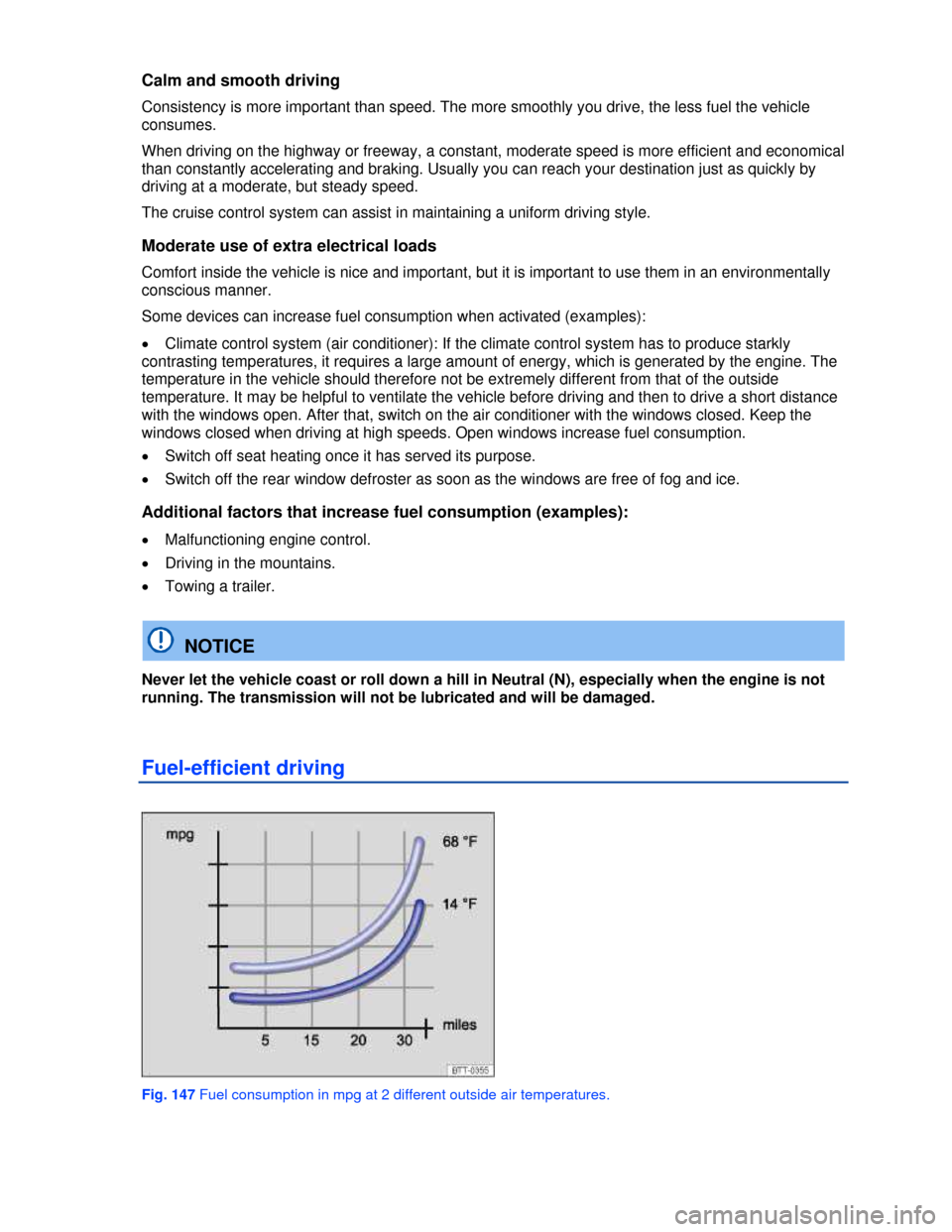
Fuel-efficient driving
Fig. 147 Fuel consumption in mpg at 2 different outside air temperatures.
Page 239 of 379

Heating and air conditioning
Page 240 of 379

WARNING
Poor visibility increases the risk of collisions and other accidents that cause serious
personal injuries.
x Always make sure all windows are clear of ice, snow and condensation for good visibility
to the front, sides, and rear.
x Maximum heating output and defrosting performance are not possible until the engine has
reached operating temperature. Wait until you have good visibility before driving off.
x Always make sure you know how to properly use the heating and ventilation systems as
well as the rear window defroster that you will need for good visibility.
x Never use air recirculation for long periods of time. When the air conditioner is off and
recirculation mode is on, condensation can quickly form on the windows and greatly reduce
visibility.
x Always switch off recirculation mode when it is not needed.
WARNING
Stale air causes driver fatigue and reduces driver alertness, which can cause accidents,
collisions and serious personal injury.
x Never switch off the fan for a long period of time and never use air recirculation a long
period of time because no fresh air will enter the passenger compartment.
NOTICE
x If you think the air conditioner is not working properly or may be damaged, switch it off to
help prevent more damage. Have the air conditioner checked by an authorized Volkswagen
dealer or authorized Volkswagen Service Facility.
x Air conditioner repair requires specialized knowledge and special tools. Volkswagen
recommends that you see an authorized Volkswagen dealer or an authorized Volkswagen
Service Facility.
x Do not smoke when air recirculation is switched on. Smoke drawn into the ventilation
system can leave residue on the evaporator and on the dust and pollen active carbon filter,
resulting in permanent odors whenever the air conditioner is switched on.
If the air conditioner is switched off, the fresh outside air will not be dehumidified. To help keep
the windows from fogging over, Volkswagen recommends leaving the air conditioner (compressor)
switched on. Press the AC button. The indicator light in the button must come on.
When it is very hot and humid outside, water condensation can drip from the air conditioner
evaporator and form a puddle under the vehicle. This is normal and does not indicate a leak.
Keep the air intake slots in front of the windshield free of ice, snow and leaves in order to
maintain proper functioning of the heating and ventilation systems.
Maximum heating output and defrosting performance are not possible until the engine has
reached operating temperature.
Page 245 of 379

Air vents
To help ensure sufficient heating, cooling and ventilation in the passenger compartment, never close
the air vents completely ⇒ fig. 159 (1).
x To open and close the air vents, turn the thumbwheel in the desired direction. When the
thumbwheel is in the ¡ position, the air vent is closed.
x Use the lever on the vent grille to adjust the airflow direction.
Additional air vents are located in the instrument panel (2), in the footwells as well as in the rear area
of the passenger compartment.
NOTICE
Do not place food, medications, or other heat-sensitive things in front of the air vents. Food,
medications, and other things that are sensitive to heat or cold can be damaged or made
unusable by the air flow from the vents.
The air coming out of the vents flows through the passenger compartment and out through vents
below the rear window. Do not cover these slots with clothing or other things.
Air recirculation
Page 248 of 379

WARNING
Even if empty, portable fuel containers can leak and cause a fire and serious personal
injuries, especially in a crash.
x For your safety, we strongly recommend that you do not travel with a portable fuel
container in your vehicle.
x If, under exceptional circumstances, you must transport a portable fuel container, please
observe the following:
– Never fill a portable fuel container while it is anywhere in or on the vehicle (for
example, in the luggage compartment or on top of the luggage compartment lid). Static
electricity can build up while filling and can ignite fuel vapors, causing a fire.
– Always place a portable fuel container on the ground before filling. Never spill fuel
inside the vehicle or luggage compartment. Fuel vapors are highly flammable.
– Always keep the filler nozzle completely inside the portable container before and
during filling.
– If filling a portable container made of metal, the filler nozzle must always be in contact
with the container. This will help prevent static electricity from discharging and causing a
fire.
– Always observe local and state or provincial laws about the use, storage, and
transportation of portable fuel containers.
– Make certain that the portable fuel container meets industry standards, such as ANSI /
ASTM F852-86.
NOTICE
x Remove fuel spills from the vehicle immediately to help prevent damage to the paint, tires,
and wheel housings.
x Refueling with gasoline when your vehicle has a diesel engine or refueling with diesel fuel
when your vehicle has a gasoline engine can cause very serious and expensive engine and
fuel system damage that is not covered by any Volkswagen Limited Warranty.
x If you put any amount of incorrect fuel in the fuel tank, do not start the engine under any
circumstances. Immediately contact the nearest authorized Volkswagen dealer or authorized
Volkswagen Service Facility for assistance. These fuels contain substances that can severely
damage the fuel system and the engine if the engine is started.
x Vehicles with diesel engines must never be refueled or driven with gasoline, kerosene,
heating oil, or other non-specified fuels that have not been expressly approved for use with the
diesel engine. Other kinds of fuel can cause serious damage to the fuel system and the engine
that is not covered by any Volkswagen Limited Warranty.
Fuels can pollute the environment. Spilled fuel must be collected and disposed of properly,
following all applicable environmental regulations.
There is no emergency release for the fuel filler flap. Contact an authorized Volkswagen dealer or
an authorized Volkswagen Service Facility for assistance.