ESP VOLKSWAGEN PASSAT 2013 B8 / 6.G Workshop Manual
[x] Cancel search | Manufacturer: VOLKSWAGEN, Model Year: 2013, Model line: PASSAT, Model: VOLKSWAGEN PASSAT 2013 B8 / 6.GPages: 379, PDF Size: 5.56 MB
Page 295 of 379

Rotating tires
To help ensure even wear on all tires, regular tire rotation according to the diagram ⇒ fig. 177 is
recommended. In this way all tires can have about the same service life.
Volkswagen recommends that you have your tires rotated by an authorized Volkswagen dealer or
authorized Volkswagen Service Facility.
Tires more than 6 years old
Tires age even if they are not being used. Physical and chemical processes reduce tire strength and
performance and cause them to harden and become brittle. Old tires can fail suddenly and without
warning.
Volkswagen recommends replacing tires that are 6 years and older. This also applies to tires that look
new (including the tire on the compact spare wheel) or that seem to still be usable with tread depth
that has not yet reached the legal minimum depth ⇒ .
The age of each tire can be determined with the manufacturing date that is part of the U.S DOT tire
identification number (TIN).
Tire storage
Mark tires before removing them to help make sure that the previous location (left, right, front, rear)
and rolling direction can be maintained when remounting them. Store tires in a cool, dry and preferably
dark place. Do not store tires mounted on wheels standing up.
Tires not mounted on wheels should be covered to help protect them from dirt and stored vertically
(sitting on the tread).
WARNING
Aggressive fluids and materials can cause visible and invisible tire damage that can cause
tire blowouts.
x Always keep chemicals, oils, grease, fuels, braking fluids and other aggressive
substances away from tires.
WARNING
Tires age even if they are not being used and can fail suddenly, especially at high speeds,
causing loss of vehicle control, accidents, and severe personal injuries.
x Tires that are more than 6 years old can be used only in an emergency and even then only
with special care and at low speed.
Always dispose of old tires in accordance with legal requirements.
Applicable only in the United States and Canada
Wheel rims
Page 300 of 379
In most countries the legally permissible minimum tread depth is 1/16 in (1.6 mm), as measured in
tread grooves next to the wear indicators. Please be sure to obey country-specific legal requirements.
Winter tires are no longer suitable for winter operation once the tread pattern is worn down to a depth
of 3/16 in (4.8 mm)
The tread depth of new tires can differ between tire models and manufacturers because of the
different design features and tread patterns.
Tread wear indicator (TWI) in the tire
The 1/16 in (1.6 mm) high wear indicators are molded into the bottom of the tread grooves of the
original tires running across the treads ⇒ fig. 180. Several wear indicators are evenly spaced around
the tire. Markings on the sides of the tires (for example “TWI” or symbols) show the position of the
wear indicators.
Wear indicators show when the tires are worn down. The tires must be replaced no later than when
the tread pattern is worn down to the wear indicators.
WARNING
Worn tires are dangerous and can cause loss of vehicle control including serious personal
injuries.
x Never drive a vehicle when the tread on any tire is worn down to the wear indicators,
replace them sooner.
x Worn tires do not grip the road properly, especially on wet roads, increasing your risk of
“hydroplaning” and loss of control.
x Worn tires reduce the ability of your vehicle to handle well in normal and difficult driving
situations and increase braking distances and the risk of skidding.
Applicable only in Mexico, the AGCC, and South Korea
Tread depth and tread wear indicators
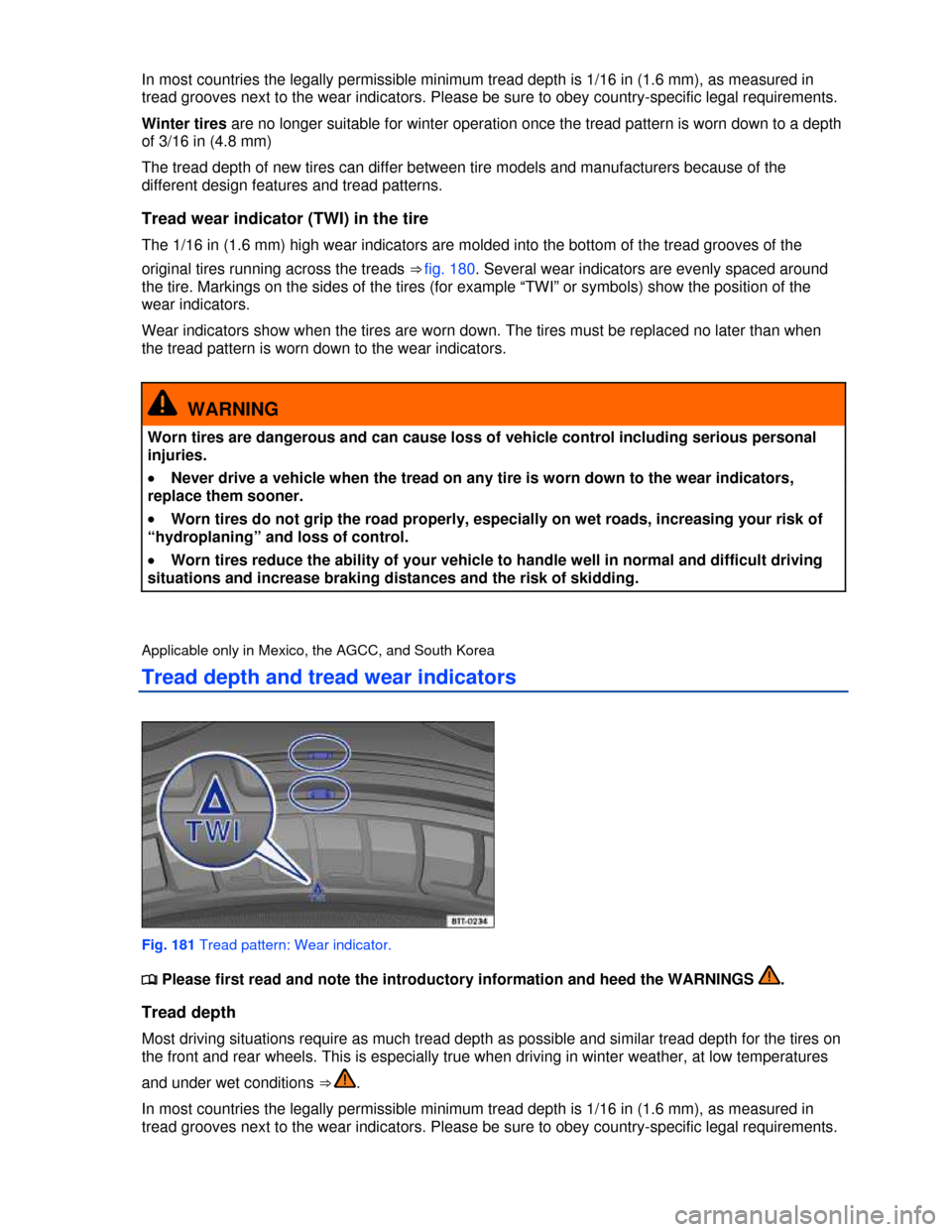
Fig. 181 Tread pattern: Wear indicator.
Page 301 of 379

Winter tires are no longer suitable for winter operation once the tread pattern is worn down to a depth
of 3/16 in (4.8 mm)
The tread depth of new tires can differ between tire models and manufacturers because of the
different design features and tread patterns.
Tread wear indicator (TWI) in the tire
The 1/16 in (1.6 mm) high wear indicators are molded into the bottom of the tread grooves of the
original tires running across the treads ⇒ fig. 181. Several wear indicators are evenly spaced around
the tire. Markings on the sides of the tires (for example “TWI” or symbols) show the position of the
wear indicators.
Wear indicators show when the tires are worn down. The tires must be replaced no later than when
the tread pattern is worn down to the wear indicators.
WARNING
Worn tires are dangerous and can cause loss of vehicle control including serious personal
injuries.
x Never drive a vehicle when the tread on any tire is worn down to the wear indicators,
replace them sooner.
x Worn tires do not grip the road properly, especially on wet roads, increasing your risk of
“hydroplaning” and loss of control.
x Worn tires reduce the ability of your vehicle to handle well in normal and difficult driving
situations and increase braking distances and the risk of skidding.
Applicable only in the United States and Canada
Tire wear and damage
Page 304 of 379

x Do not drive faster than 50 mph (80 km/h)!
x Avoid full-throttle acceleration, hard braking and fast cornering!
x Do not use snow chains on the compact spare wheel.
x After installing the compact spare wheel, check the tire pressure as soon as possible.
Check the tire inflation pressure of the compact spare whenever you check the tire pressure of the
road wheels, at least once a month. Inflate a compact spare wheel to the cold tire pressure specified
for the compact spare on the tire pressure label or on a separate label for the compact spare, if there
is one.
WARNING
Improper use of a compact spare wheel can cause loss of vehicle control, a crash or other
accident, and serious personal injury.
x Never use a compact spare wheel if it is damaged or worn down to the wear indicators.
x In some vehicles, the compact spare wheel is smaller than the original tire. A smaller
compact spare wheel is identified with a sticker and the words “50 mph” or “80 km/h.” This is
the maximum permissible speed when driving with this tire.
x Never drive faster than 50 mph (80 km/h) with a compact spare wheel. Avoid full-throttle
acceleration, heavy braking, and fast cornering!
x Never drive more than 125 miles (200 km) if a compact spare wheel is installed on the front
axle (drive axle).
x Replace the compact spare with a normal wheel and tire as soon as possible. Compact
spare tires are designed for brief use only.
x Regularly check the U.S. DOT Tire Identification Number (TIN) to determine the age of the
compact spare wheel. Tires age even if they are not being used and can fail suddenly,
especially at higher speeds.
x Tires that are more than 6 years old can only be used in an emergency and then with
special care and at lower speeds.
x The compact spare wheel must always be secured with the wheel bolts provided by the
factory.
x Never drive using more than one compact spare wheel.
x After installing the compact spare wheel, the tire pressure must be checked as soon as
possible.
x Snow chains cannot be used on the compact spare wheel. If you must use snow chains
and have a compact spare wheel mounted, move the compact spare wheel to the rear axle if a
front tire has to be replaced. The tire taken off the rear axle can then be used to replace the
flat front tire. Be sure you do not change the tire's direction of rotation. Install the snow
chains on the full-sized road tire.
NOTICE
When the spare wheel or compact spare is being used, the TPMS indicator light can come on
after a couple of minutes.
If possible, attach the compact spare wheel or the tire you took off the vehicle securely in the
luggage compartment.
Page 306 of 379

WARNING
Improper use of a compact spare wheel can cause loss of vehicle control, a crash or other
accident, and serious personal injury.
x Never use a compact spare wheel if it is damaged or worn down to the wear indicators.
x In some vehicles, the compact spare wheel is smaller than the original tire. A smaller
compact spare wheel is identified with a sticker and the words “50 mph” or “80 km/h.” This is
the maximum permissible speed when driving with this tire.
x Never drive faster than 50 mph (80 km/h) with a compact spare wheel. Avoid full-throttle
acceleration, heavy braking, and fast cornering!
x Never drive more than 125 miles (200 km) if a compact spare wheel is installed on the front
axle (drive axle).
x Replace the compact spare with a normal wheel and tire as soon as possible. Compact
spare tires are designed for brief use only.
x Regularly check the U.S. DOT Tire Identification Number (TIN) to determine the age of the
compact spare wheel. Tires age even if they are not being used and can fail suddenly,
especially at higher speeds.
x Tires that are more than 6 years old can only be used in an emergency and then with
special care and at lower speeds.
x The compact spare wheel must always be secured with the wheel bolts provided by the
factory.
x Never drive using more than one compact spare wheel.
x After installing the compact spare wheel, the tire pressure must be checked as soon as
possible.
x Snow chains cannot be used on the compact spare wheel. If you must use snow chains
and have a compact spare wheel mounted, move the compact spare wheel to the rear axle if a
front tire has to be replaced. The tire taken off the rear axle can then be used to replace the
flat front tire. Be sure you do not change the tire's direction of rotation. Install the snow
chains on the full-sized road tire.
NOTICE
When the spare wheel or compact spare is being used, the TPMS indicator light can come on
after a couple of minutes.
If possible, attach the compact spare wheel or the tire you took off the vehicle securely in the
luggage compartment.
Page 308 of 379

Tire labeling (example) Meaning
E4 ... Labeling according to international regulations (E) including
number of the approving country. The multi-digit approval number
is listed next.
DOT BT RA TY5 1709 Tire identification number (TIN8 - In some cases the
manufacturing date is only on one side of the tire:
DOT The tire complies with the requirements of the United
States Department of Transportation, responsible for
issuing safety standards.
BT Identification letter of the manufacturing site.
RA Manufacturer information regarding tire dimensions.
TY5 Tire characteristics provided by the manufacturer.
1709 Manufacturing date: 17th week in 2009.
TWI Marks the position of the treadwear indicator.
Made in Germany Country of manufacture.
MAX LOAD 615 KG (1356 LBS) United States maximum load rating per wheel.
MAX INFLATION 350 KPA
(51 PSI)
United States maximum permissible inflation pressure.
ROTATION Rotation direction (unidirectional tires)
SIDEWALL 1 PLY RAYON Tire ply composition and materials used:
1 layer of rayon.
TREAD 4 PLIES
1 RAYON + 2 STEEL +
1 NYLON
Tire tread composition and materials used:
In this example there are 4 layers under the tread: 1 layer of
rayon, 2 layers of steel belt and 1 layer of nylon.
Consumer information regarding comparison to specified base tires (standardized test
procedure):
TREADWEAR 220 Relative service life expectancy of the tire referenced to a US-
specific standard test.
TRACTION A Traction rating under wet conditions (AA, A, B or C).
TEMPERATURE A Temperature stability of the tire at increased test bench speeds
(A, B or C).
Additional numbers found on the tire could either be tire manufacturer internal labels or
country-specific labels (such as for Brazil and China).
Unidirectional tires
Unidirectional tires are designed to rotate only in one direction. Unidirectional tires have arrows on the
sidewalls that show the direction of rotation. Make sure you mount the tire so that it rotates in the
proper direction. The tire's performance with regard to hydroplaning, traction, noise, and wear is worse
if it is not mounted in the proper direction of rotation.
If you have to mount a tire opposite to its proper direction of rotation, you must drive more carefully,
since the tire is no longer being used as designed. This is particularly important on wet roads. You
must replace or remount the tire as soon as possible in order to restore the correct direction of
rotation.
8 TIN represents the serial number of the tire.
Page 311 of 379

Tire labeling (example) Meaning
Brand, Logo Manufacturer
Tire name Individual tire designation of the manufacturer.
P215 / 55 R 18 Dimensions:
P Tire application: Passenger car
255 Nominal sidewall-to-sidewall width of tire in millimeters.
55 Ratio of height to width (aspect ratio)
R Tire belt design letter code for radial.
18 Rim diameter (in inches)
95 H Load rating code ⇒ page 365 and speed rating code.
XL Indicates “reinforced” tire (heavy-duty)
M+S or M/S Indicates Mud and Snow capability (also M/S).
RADIAL TUBELESS Tubeless radial tire.
E4 ... Labeling according to international regulations (E) including
number of the approving country. The multi-digit approval number
is listed next.
DOT BT RA TY5 1709 Tire identification number (TIN9 - In some cases the
manufacturing date is only on one side of the tire:
DOT The tire complies with the requirements of the United
States Department of Transportation, responsible for
issuing safety standards.
BT Identification letter of the manufacturing site.
RA Manufacturer information regarding tire dimensions.
TY5 Tire characteristics provided by the manufacturer.
1709 Manufacturing date: 17th week in 2009.
TWI Marks the position of the treadwear indicator.
Made in Germany Country of manufacture.
MAX LOAD 615 KG (1356 LBS) United States maximum load rating per wheel.
MAX INFLATION 350 KPA
(51 PSI)
United States maximum permissible inflation pressure.
ROTATION Rotation direction (unidirectional tires)
SIDEWALL 1 PLY RAYON Tire ply composition and materials used:
1 layer of rayon.
TREAD 4 PLIES
1 RAYON + 2 STEEL +
1 NYLON
Tire tread composition and materials used:
In this example there are 4 layers under the tread: 1 layer of
rayon, 2 layers of steel belt and 1 layer of nylon.
Consumer information regarding comparison to specified base tires (standardized test
procedure):
9 TIN represents the serial number of the tire.
Page 319 of 379

Cracking
Any parting within the tread, sidewall, or inner liner of the tire extending to cord material.
Cold tire inflation pressure
The tire pressure recommended by the vehicle manufacturer for a tire of a specified size that has not
been driven for more than a couple of miles (kilometers) at low speeds in the 3 hour period before the
tire pressure is measured or adjusted.
Curb weight
The weight of a motor vehicle with standard equipment including the maximum capacity of fuel, oil,
and coolant, air conditioner, and additional weight of optional equipment.
Extra load tire
A tire designed to operate at higher loads and at higher inflation pressures than the corresponding
standard tire.
Gross Axle Weight Rating (GAWR)
The load-carrying capacity of a single axle system, measured where the tire contacts the ground.
Gross Vehicle Weight Rating (GVWR)
The maximum loaded weight of the vehicle.
Groove
The space between 2 adjacent tread ribs.
Load rating (code)
The maximum load that a tire is rated to carry for a given inflation pressure. You may not find this
information on all tires because it is not required by law.
Maximum load rating
The load rating for a tire at the maximum permissible inflation pressure for that tire.
Maximum loaded vehicle weight
The total of:
x Curb weight
x Accessory weight.
x Vehicle capacity weight.
x Production options weight.
Maximum (permissible) inflation pressure
The maximum cold inflation pressure to which a tire may be inflated. Also called “maximum inflation
pressure.”
Normal occupant weight
Means 150 lbs (68 kilograms) times the number of occupants seated in the vehicle up to the total
seating capacity of your vehicle.
Occupant distribution
The placement of passengers in a vehicle.
Outer diameter
The diameter of a new, properly inflated tire.
Page 320 of 379

Overall width
Total width measured at the exterior sidewalls of an inflated tire, including the additional width of
labeling, decorations, or protective bands or ribs.
Passenger car tire
A tire intended for use on passenger cars, multipurpose passenger vehicles, and trucks, that have a
gross vehicle weight rating (GVWR) of 10,000 pounds or less.
Ply
A layer of rubber-coated parallel cords.
Ply separation
A parting of rubber compound between adjacent plies.
Pneumatic tire
A mechanical device made of rubber, chemicals, fabric, and steel or other materials, that, when
mounted on an automotive wheel, provides the traction and contains the gas or fluid that sustains the
load.
Production options weight
The combined weight of installed regular production options weighing over 5 lbs (2.3 kg) more then the
standard items they replace, and not previously considered as curb weight or accessory weight. These
include, for example, heavy-duty brakes, ride levelers, heavy-duty battery, and special trim.
Radial ply tires
A pneumatic tire in which the ply cords that extend to the beads are laid at substantially 90 degrees to
the centerline of the tread.
Recommended inflation pressure
The tire pressure recommended by the vehicle manufacturer for a tire of a specified size that has not
been driven for more than a couple of miles (kilometers) at low speeds in the 3 hour period before the
tire pressure is measured or adjusted.
Reinforced tire
A tire designed to operate at higher loads and at higher inflation pressures than the corresponding
standard tire.
Rim
The outer edge of a wheel upon which the tire beads are seated.
Rim diameter
The nominal diameter of the wheel's tire bead seating surface. If you change your wheel size, to
wheels of a different diameter, you will have to purchase new tires to match the new wheels.
Rim size
Designation means rim diameter and width.
Rim type designation
The industry or manufacturer's designation for a rim by style or code.
Rim width
The nominal distance between wheel rim flanges.
Page 323 of 379

Cord separation
The parting of cords from adjacent rubber compounds.
Cracking
Any parting within the tread, sidewall, or inner liner of the tire extending to cord material.
Cold tire inflation pressure
The tire pressure recommended by the vehicle manufacturer for a tire of a specified size that has not
been driven for more than a couple of miles (kilometers) at low speeds in the 3 hour period before the
tire pressure is measured or adjusted.
Curb weight
The weight of a motor vehicle with standard equipment including the maximum capacity of fuel, oil,
and coolant, air conditioner, and additional weight of optional equipment.
Extra load tire
A tire designed to operate at higher loads and at higher inflation pressures than the corresponding
standard tire.
Gross Axle Weight Rating (GAWR)
The load-carrying capacity of a single axle system, measured where the tire contacts the ground.
Gross Vehicle Weight Rating (GVWR)
The maximum loaded weight of the vehicle.
Groove
The space between 2 adjacent tread ribs.
Load rating (code)
The maximum load that a tire is rated to carry for a given inflation pressure. You may not find this
information on all tires because it is not required by law.
Maximum load rating
The load rating for a tire at the maximum permissible inflation pressure for that tire.
Maximum loaded vehicle weight
The total of:
x Curb weight
x Accessory weight.
x Vehicle capacity weight.
x Production options weight.
Maximum (permissible) inflation pressure
The maximum cold inflation pressure to which a tire may be inflated. Also called “maximum inflation
pressure.”
Normal occupant weight
Means 150 lbs (68 kilograms) times the number of occupants seated in the vehicle up to the total
seating capacity of your vehicle.
Occupant distribution
The placement of passengers in a vehicle.